The Challenges and Joys of Analysing Ongoing Language Change in
Web-based Corpora: a Case Study
Anne Krause
Leipzig University Beethovenstraße 15
04107 Leipzig
Abstract
Researchers of language variation and change often need to go to great lengths to find sufficient data, particularly when they shall be used for a sound statistical analysis of the phenomenon in question. The recent analogical change in the for-mation of the imperative singular of Ger-man strong verbs with vowel gradation is a case in point, as it could not have been studied without the compilation of a web-based corpus. On the one hand, the inves-tigation was faced with a number of chal-lenges during the compilation of the cor-pus, the search for relevant hits and their annotation for a number of variables. On the other hand, results which would other-wise not have been obtained balance out this increased amount of manual labour. The present paper elaborates on some of these challenges and provides suggestions how they might be avoided in similar in-vestigations in future. It concludes by pre-senting invaluable insights which would not have been gained without the present corpus study.
1 Introduction
It has been noted several times by different au-thors that the use of the web as corpus enriches in-vestigations of linguistic variation and change by providing a higher number of authentic and more recent examples than traditional corpora can fur-nish. In contrast to such “opportunistic” uses of the web, researchers of recent language change may be forced to make “systematic” use of web-based corpora because they are “the only source for examples of very rare usages and construc-tions” (Mair, 2012, 245). In the present project,
a web-based corpus has been compiled as the pri-mary source of evidence, not only because the web yielded more examples than traditional cor-pora but because the only text type which yielded enough evidence is specific to the web.
Instead of consulting a large pre-existing based corpus, material from a very specific web-site was used in the current investigation; never-theless, problems faced during corpus compilation and analysis and suggestions for avoiding them can be generalised to similar phenomena and lan-guages to a great extent.
1.1 Change-in-progress in German verb inflection
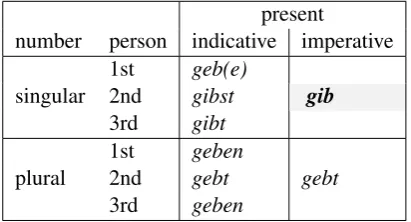
There are a number of German strong verbs which exhibit a stem vowel change from the infinitive -e-to -i- in the imperative singular, for example the verbgeben‘give’ in Table 1:
present
number person indicative imperative 1st geb(e)
singular 2nd gibst gib
3rd gibt
1st geben
plural 2nd gebt gebt
[image:1.595.314.520.514.625.2]3rd geben
Table 1: Conjugation table for the German verb
geben‘give’
The present project investigates the replacement of the established i-stem imperative singular of these strong verbs with vowel gradation by an e-stem variant formed in analogy to weak (regular) verb inflection, e.g. sterben ‘to die’: stirb! →
sterb(e)!;geben‘to give’:gib!→geb(e)!
1.2 The Conserving Effect
Along the lines of former usage-based analyses of analogical language change, it is hypothesised that the established i-stem imperative singular forms of lower frequency verbs are replaced by analogi-cal variants earlier and faster than those of higher frequency verbs. For example, native speakers of German consistently stumble over the expres-sion Milk die Kuh! ’Milk the cow!’, employ-ing the established i-stem imperative form of a low frequency verb, but they seem to accept both variants of verbs from a middle frequency region such asbewirb dich!/bewerb(e) dich! ’apply (for sth.)!’. On the other end of the scale, the analog-ically formed variants of high frequency verbs in sentences like Geb mir das Buch! ’Give me the book!’/Seh es dir an!’Have a look at it!’ are usu-ally frowned at, whereas the i-stem variants of the same verbs are not.
The imperative singular forms of high fre-quency verbs are assumed to resist analogical change because they are highly entrenched in speakers’ minds; this phenomenon is generally re-ferred to as the “Conserving Effect” (Bybee and Thompson, 1997, 380). Although it has been explained from very early on that this frequency effect could be found in “modern leveling” as well (Hooper, 1976, 99), the majority of research in this area has been concerned with cases of com-pleted language change. The present study thus fills two gaps by examining change-in-progress in German, a language in which the effects of type and token frequencies are still underresearched.
1.3 Imperative singular forms in corpora
It became apparent very soon that the change in the imperative singular of strong verbs with vowel gradation could not be examined with the help of “traditional” corpora (Mair, 2012) Although some of them are comparably large (e.g. DeReKo1) and
contain spoken language (e.g. corpora in the DGD database2), where linguistic change usually starts
out before it finds its way into written language, none of these corpora yielded enough tokens of the target imperative singular forms for a systematic (let alone statistical) analysis. Two reasons for the rarity of the imperative singular can be found in the Duden grammar (Dudenredaktion, 2009, 548-550): its use is tied to the condition that speakers
1http://www.ids-mannheim.de/cosmas2/ 2http://dgd.ids-mannheim.de/
are on familiar terms (use of the informal second person singular pronoundu), and there are several other constructions used instead of the imperative to express requests or commands, such as indica-tive, modal and infinitive constructions.
Pre-existing large web-based corpora also have drawbacks. Most of them do not provide meta information about the authors of texts, a circum-stance which has rather obvious reasons, given the wealth of data in the corpora, and which could be accepted. More serious for the study of a recent language change is the fact that no information is available about when the texts in these corpora were produced, as is the case, for example, in the deWaC (Baroni et al., 2008).
2 The Walkthrough Corpus
Instead of consulting traditional or existing web-based corpora, a corpus was specifically compiled for the present investigation. It consists of a web-specific text type, viz. walkthroughs, which con-tains a high number of instances of imperative sin-gular forms. In addition, the website which was crawled contains very recent language material and the majority of texts on it have a timestamp, so that the development of imperative formation can be tracked.
2.1 Texts
Walkthroughs are guides for video games, i.e. computer, console and internet games, which help gamers complete a game successfully. They in-clude step-by-step instructions, lists of achieve-ments and items, cheats and other tips. Like in of-ficial strategy guides (usually in print), which are commissioned by the game publishers, their main focus is on a precise rendering of the game’s con-tent. In contrast to the former, these online guides are written by gamers and the texts are subject to a minimal amount of proofreading or revision. The conditions of their production are therefore very close to natural language.
Perhaps most importantly for the present in-vestigation, the fact that members of the gaming community write walkthroughs for other members provides for an increased use of the imperative sin-gular, e.g. nimm den Gegenstand‘take the item’,
compilation, only one of which provided some of the required meta information (also see section 3 below):
The website spieletipps.de3 exists since 2001
(in the present form). It was crawled in 2013; hence, the corpus covers a time span of 12 years. It is one of the main gaming websites in Ger-many, on which complete walkthroughs, individ-ual cheats and tips and forums are available for the majority of existing platforms (including retro ones like Atari consoles). The final walkthrough corpus compiled from the website comprises ap-proximately 7 m. tokens or word forms.
2.2 Crawler
A webcrawler (Java) was tailored to the website in order to download all walkthrough texts, cheats etc. Each text was stored in one line of a csv file. Available meta information about texts and authors were similarly stored in separate csv files. When queries were entered in the search inter-face (2.4), the data from these files were reunited through an inverted index.
2.3 Annotation
All texts contained in the corpus were then tagged for their part of speech using the Tree-Tagger (Schmid, 1995). This should enable the search for imperative forms of verbs (POS-tag VVIMP in STTS) and thereby reduce the number of word-level queries (however, see 3.1). The an-notated versions of all texts were similarly stored in a csv file.
2.4 Interface
A simple search interface was created, comparable to those of popular web search engines. It allowed word-level, e.g. gib, and POS-level queries, e.g.
vvimp2geben ‘imperative forms of give’. It out-puts csv files with one row for each query hit and columns for the query, sentence context and meta information.
3 Challenges
Challenges arose during the compilation of the corpus, the search for imperative singular forms in it and the annotation of the data for additional variables. One of these can be attributed to the re-searcher (3.1); others are specific to the website
3http://spieletipps.de
(3.2 and 3.3), the corpus (3.4), the walkthrough genre (3.5 and 3.6) or the search interface (3.7).
3.1 Non-computational linguists
Linguists who want to investigate a potential lan-guage change-in-progress might find themselves in a situation when the phenomenon in question is not or only rarely attested in “traditional” cor-pora. Even though they might be able to perform a pilot search using one of the major web search engines, many (if not to say) most linguists do not possess the necessary programming skills for the compilation of a corpus of web data.
Since this was the case in the present paper, the compilation of the corpus itself was left in the hands of a computer scientist. However, the latter needs to be carefully instructed by the researcher in order that the final product yields the required results. Thus, the linguist should have a precise idea not only of which data and meta data are available during crawling (see 3.2 and 3.3) but also of how annotation for additional variables may be partly automatised by the use of an appropriate in-terface (see 3.7).
3.2 Meta information about corpus texts
Although the corpus compiler in the present case was instructed to retrieve each text on the website along with all available meta information, he can only include data in the corpus which is provided by the website (creators). A crucial piece of infor-mation for an investigation of language change in general, and perhaps ongoing change in particular, is the point in time when a linguistic utterance was produced.
mixed; they were therefore reduced to only the posting year.
It turned out later that on the profiles of mem-bers, their last postings were listed with the orig-inal posting date. The comparison of the origorig-inal and extrapolated timestamps for the instances in the final dataset revealed that 53.6% of the extrap-olated posting years were correct and 22.0% could be replaced by the years listed on the member pro-files. For the remaining 24.4% of observations, only the extrapolated dates were available (due to the author’s active membership). Separate statisti-cal analyses performed on the full dataset and a re-duced dataset without these observations showed that extrapolation did not have an effect on the re-sults of the investigation.
3.3 Meta information about authors
In times of heated discussion about data protec-tion, it is easily understood that members of a web-site or forum wish to remain anonymous. On the website used for the present investigation, mem-bers can theoretically provide personal informa-tion such as their full name, age and residence on their profile page, and they can select which of these data to share with the public. The crawler could only include meta information about the au-thors of texts in the corpus which was visible on their public profile page. Therefore, in the final dataset, which was used for the statistical analy-sis, only 21.3% of the instances had an annota-tion for the author’s age, 13.4% for gender (based on members’ first names), and 6.8% for their resi-dence. Analyses of the influence of sociolinguistic factors on the change in imperative singular for-mation of the strong verbs with vowel gradation were thus based on such small samples that they identified trends, but the results are not generalis-able.
3.4 POS tagging
As mentioned before, the corpus search interface allowed word-level and POS-level queries. Unsur-prisingly, the analogical e-stem imperative vari-ants of verbs were incorrectly tagged as finite forms or as proper names; therefore, instead of us-ing the POS-level query, these forms (e.g. geb,
gebe) had to be searched on word-level for ev-ery individual verb. Perhaps more interestingly, even though the i-stem imperative is the estab-lished variant, only lower case instances of, for example, gib were recognised correctly, whereas
capitalisedGibwas often incorrectly tagged as a noun or proper name and therefore not returned by the POS-level query.
The available options in the corpus search inter-face were thus sufficient to extract hits on the word (and POS) level, and the immediate sentence con-text in the output files provided enough informa-tion to distinguish finite forms of a verb from gen-uine imperative hits (1 vs. 2) and imperative forms of simplex verbs from those of particle verbs (2 vs. 3):
(1) “Ich hab das Spiel bereits durchge-spielt und gebe hier mal die Gegner bekannt”
(nds/fluch-karibik-3/2620615)
(2) “Gebeihm das Glas und die Spirale” (pc/clever-smart/2742515)
(3) “Gebedie ersten beiden Buchstaben ein”
(snes/nba-jam/310511)
However, at least the distinction between ex-amples (1) and (2) would have been largely per-formed by the TreeTagger if it had been trained ac-cordingly, which would have reduced the amount of manual POS-tag correction. In similar inves-tigations of variation or recent language change, it may be worth adapting the TreeTagger or sup-plying manually tagged training material with in-stances of the target construction or form before tagging the actual corpus texts.
3.5 Authorship confirmation
Although all imperative singular instances in the dataset were annotated for the member of the web-site who had contributed the text in which they oc-curred, it had to be ascertained that all of these instances were indeed produced by the specified author. For a number of reasons, the authors quote from inside the game whose walkthrough they are writing. Some of these quotes are read-ily recognisable as such from the use of quotation marks or their occurrence in tables of so-called “achievements”, such as “Stiehl 30 Fahrzeuge” ‘Steal 30 vehicles’ (Gangstar Miami Vindication for iPhone). Other quoted imperative singular forms occurred in running text without any indi-cation of being borrowed. The consultation of “Let’s Play” videos4proved an efficient way of
ex-posing the unmarked in-game imperative uses. In
these videos, gamers tape their computer or con-sole screen while playing a particular game and comment on how (missions or chapters in) the game can be completed successfully. Thus, any in-game commands which were quoted in the walk-through appear on the player’s screen in the video and can be discarded from the dataset.
3.6 Skewed frequency data
While walkthroughs have the advantage of being practically the only text type to contain a very high number of instances of the imperative singu-lar, their special topic presented another challenge. One of the aims of the present project was to test whether the Conserving Effect of high token fre-quency in analogical change is also found in the recent change in imperative singular formation of German strong verbs with vowel gradation. To this end, instances in the dataset should be annotated for the verb’s token frequency in German.
Unfortunately, the plots of video games are very different from everyday life in the real world; therefore, token frequencies of words in walk-throughs are necessarily skewed. For example, avatars in first- and third-person shooters and a number of role-playing games do not eat, but es-sen ‘to eat’ is a strong verb with vowel grada-tion in German, hence one of the target verbs. If the token frequencies for this and other target verbs had been taken from the walkthrough cor-pus, the results of the analysis would have been skewed as well. In order to avoid this, verb to-ken frequencies needed to be extracted from refer-ence corpora (DeReWo5; Projekt Wortschatz
Uni-versit¨at Leipzig6), frequency dictionaries (Jones
and Tschirner, 2006; Ruoff, 1990), and frequency counts provided in a dictionary of German (Duden online7).
3.7 Annotation for persistence
A close reading of some of the texts in the cor-pus revealed that the specific form of the imper-ative may in part depend on the preceding con-text. Benedikt Szmrecsanyi explained that lan-guage users are “creatures of habit” and tend to reuse words or patterns whenever possible (2005; 2006). This “persistence” strategy may be at work
5http://www1.ids-mannheim.de/kl/projekte/methoden/ derewo.html
6http://wortschatz.uni-leipzig.de/ 7http://www.duden.de/woerterbuch/
in the formation of the imperative singular of the strong verbs with vowel gradation as well.
Imperative singular forms of German verbs can usually occur as a suffixed or unsuffixed variant:
red!/ rede! ‘talk!’, renn!/ renne! ‘run!’, steh!/
stehe! ‘stand!’. Similarly, the analogical e-stem variants of strong verbs with vowel gradation can occur with or without the suffix -e:nehm!/nehme!
‘take!’; however, the i-stem variant is never suf-fixed: nimm! It seemed that the authors of the walkthroughs developed a “routine”, so that when they had used the suffixed variants of one or sev-eral consecutive verbs, e.g. laufe ... gehe ... ver-lasse, they wished to add a suffix to the following imperative singular form as well. If this next verb was a strong verb with vowel gradation, the author has no choice but to use the suffixed analogical e-stem variant because a suffixed i-e-stem imperative singular variant of these verbs does not exist. Ex-amples (4) and (5) illustrate this persistence effect of suffixed and unsuffixed previous imperatives.
(4) -e→-e
“2. Stelledeine G¨aste einander vor und verkupplesie.
3. Gebe deinen G¨asten gen¨ugend zu trinken, indem...”
(ps2/playboy-mansion/2260012) (5) -ø→-ø
“Nach der Cutszene, geh-øzu Junes und geh-ø in die TV-Welt. Sobald du drin-nen bist sprich-ø mit Rise um den let-zten Boss zu suchen.”
(ps2/persona-4/3379622)
In order to test this hypothesis, all instances of im-perative singular forms of strong verbs with vowel gradation in the dataset need to be annotated for the form of imperative singular occurrences in their preceding context. As the interface which was created for the walkthrough corpus does not incorporate context queries, all imperative singu-lar forms preceding the target forms in the dataset were searched and annotated manually.
4 Joys
reveal frequency and persistence effects on imper-ative singular formation of the strong verbs with vowel gradation, but these results also served as input for a subsequent experimental study.
4.1 Results of the corpus study
After removing all false hits, the final dataset com-prised 1939 observations of imperative singular forms of strong verbs with vowel gradation, i.e. instances of the established i-stem variant and the suffixed and unsuffixed analogical e-stem variants. Mixed-effects regression models were fitted on the dataset in order to determine which of the anno-tated predictor variables had an influence on stem vowel choice and suffixation of the imperative sin-gular forms.
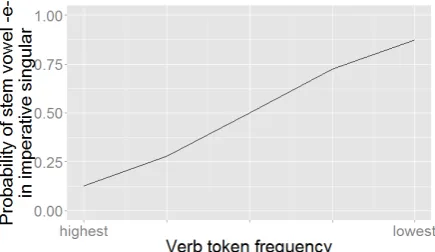
[image:6.595.77.295.420.546.2]As expected, verb token frequency has a sig-nificant effect on stem vowel choice: imperative singular forms of lower frequency verbs show a high probability of occurring with the analogical e-stem, while higher frequency verbs retain the es-tablished i-stem. The Conserving Effect of high token frequency in analogical change is thus con-firmed for morphological change-in-progress in German (see Figure 1).
Figure 1: Conserving Effect of verb token fre-quency
The analysis also affirmed that the suffixation of the imperative forms (and thereby indirectly stem vowel choice) is significantly influenced by the oc-currence of suffixed or unsuffixed imperative sin-gular forms prior to the target imperatives: Imper-ative singular forms of strong verbs with vowel gradation show a high probability of being suf-fixed (e.g. nehme) when they are preceded by other suffixed imperative singular forms. Unsuf-fixed variants of the imperative singular of these verbs (e.g. nimm, nehm) occur more often af-ter other unsuffixed imperative singular forms (see
examples 4 and 5). This effect is reinforced when the previously occurring verb itself is a strong verb with vowel gradation, e.g. nehmefollowing gebe
ornimmfollowinggib.
4.2 Experimental Study
The Conserving Effect of high token frequency is generally explained on the basis of “entrench-ment” (Langacker, 1987, 59): through repeated use, the imperative forms of higher frequency verbs have stronger mental representations than those of lower frequency verbs. Therefore, the forms of higher frequency verbs are more quickly retrieved from memory than the forms of lower frequency verbs. The longer they take to re-trieve, the higher is the probability that the speaker forms the imperative in analogy to the weak verb paradigm. An instance of recent language change, such as the example of imperative singular forma-tion examined in the present paper, is an excellent test case for the validity of this assumption.
In the experiment conducted as part of the cur-rent project, participants’ reactions to the estab-lished i-stem and analogical e-stem imperative sin-gular variants, presented in verbs of different to-ken frequency, were measured. Once it was known from the corpus study that, in addition to the pre-dictor verb token frequency, the presence of suf-fixed or unsufsuf-fixed imperative singular forms prior to the target imperative has a significant influ-ence on the formation of the imperative singular of strong verbs with vowel gradation, this poten-tially disturbing persistence effect could be elimi-nated in the experiment and stimulus design. Fur-thermore, the corpus study showed up trends with regard to the influence of dialect on imperative for-mation (3.3) which inspired the inclusion of par-ticipant groups from different dialect areas in or-der to test this notion more systematically than was possible in the corpus study itself. Finally, sentences adapted from walkthrough texts can ac-commodate a large number of verbs from diverse semantic fields without appearing too absurd to the participants. Thus, the corpus texts served yet an-other purpose.
5 Suggestions for future research
high number of imperative singular forms con-tained in texts of this kind. In other studies, suit-able web-specific genres/ text types may be identi-fied by performing pilot searches on the web or in existing large web corpora and inspecting whether instances of a target construction predominate in a particular text type or web register. The situation might be further improved by attempts at recognis-ing and classifyrecognis-ing as many web registers as pos-sible and identifying linguistic patterns associated with them (cf. Egbert and Biber, 2013; Biber et al., 2015).
As concerns the compilation of a corpus for a linguistic study, this task should preferably be del-egated to a person who has experience with work-ing with a lwork-inguistic corpus or is familiar with the kinds of questions linguists wish to answer with the help of corpora. In the current study, the pres-ence of an ”intermediary” or ”translator”, i.e. a linguist with extended IT knowledge, proved help-ful while the research assistant was instructed on how to compile the walkthrough corpus (cf. 3.1). At the same time, the intermediary could answer the author’s questions about how the corpus and its query interface are created.
However, even the best assistant (and inter-mediary) has to rely on the needs and demands which the employing researcher expresses, who in turn has to know the website(s) and features of the specific text type very well. If the web-site spieletipps.de would have been more thor-oughly inspected before corpus compilation, the time stamps for walkthroughs could have been ex-tracted primarily from the member profile pages; only if they were not available there, the pro-gramme would have to resort to the release date of the video game and the member registration date as a proxy (3.2). Similarly, as explained above, the persistence variables were manually an-notated (3.7), i.e. the verb class and suffixation of imperative singular forms in the preceding con-text and the con-textual distance to the target imper-ative form were searched and counted by hand. Slight changes to the crawler could have reduced the amount of manual labour in both annotation steps. As the analysis of corpus data is at least as time-consuming as the compilation of a corpus, researchers might be tempted to push compila-tion forward before knowing the included sources well enough. The present investigation illustrates clearly that the manual effort which can be avoided
outweighs the costs of a thorough inspection of potential corpus texts, e.g. particular websites.
The analysis of sociolinguistic patterns of varia-tion according to authors’ age, gender and locavaria-tion only revealed trends in the present corpus study. In such cases, conducting additional studies, for example a psycholinguistic experiment (4.2) is an effective way of consolidating or falsifying these trends.
6 Conclusion
Even though the challenges of using web-based corpora for analysing recent language change seem to outweigh the joys in the present con-tribution, this is largely due to the fact that the former have been more elaborately discussed in order to serve as advice for researchers of sim-ilar phenomena in future. Some of the man-ual labour explained above might be increased in web-specific genres of the walkthrough kind and cannot be avoided completely, such as extracting frequency data from reference corpora or other sources. Other drawbacks of the present corpus have been avoided in the compilation of large ex-isting web-based corpora: for example, the DE-COW (German web corpus by DE-COW; Sch¨afer, 2015) is annotated for meta information like the “last modified” date. And yet others may be avoided by tailoring the corpus compilation pro-cess to the specific object of study, e.g. adjusting or training the TreeTagger on a target construction. Nevertheless, it cannot be stressed too often that the walkthrough corpus offered data without which work on the present project would not have been possible. A bit of manual labour (after hours) was rewarded with many invaluable insights from the corpus analysis. Not only do these results ex-plain the present stage of the change-in-progress in imperative formation of strong verbs with vowel gradation, but they also find their repercussions in the design of a subsequent experimental study.
Acknowledgements
Work on the present PhD project (including the compilation of the walkthrough corpus and pay-ment for participants in the experipay-ment) was funded by the Deutsche Forschungsgemeinschaft
through the Research Training Group GRK DFG 1624 ”Frequency Effects in Language”.
References
Marco Baroni, Silvia Bernardini, Adriano Ferraresi, and Eros Zanchetta. 2008. The WaCky Wide Web: A Collection of Very Large Linguistically Processed Web-Crawled Corpora. Language Resources and Evaluation, 43:209–226. [deWaC].
Douglas Biber, Jesse Egbert, and Mark Davies. 2015. Exploring the composition of the searchable web: a corpus-based taxonomy of web registers. Corpora, 10:11–45.
Joan Bybee and Sandra Thompson. 1997. Three fre-quency effects in syntax. In Matthew L. Juge and Jeri L. Moxley, editors,Proceedings of the Twenty-Third Annual Meeting of the Berkeley Linguistics Society: General Session and Parasession on Prag-matics and Grammatical Structure, pages 378–388.
Dudenredaktion, editor. 2009. Duden - Die Gram-matik: unentbehrlich f¨ur richtiges Deutsch. Duden-verlag, Mannheim and Wien and Z¨urich.
Jesse Egbert and Douglas Biber. 2013. Developing a User-based Method of Web Register Classification. InProceedings of the 8th Web as Corpus Workshop, pages 16–23.
Joan B. Hooper. 1976. Word frequency in lexi-cal diffusion and the source of morphophonologi-cal change. In William Christie, editor, Current progress in historical linguistics, pages 95–105. North Holland, Amsterdam.
Randall L. Jones and Erwin Tschirner. 2006. A Fre-quency Dictionary of German: Core Vocabulary for Learners. Routledge, London.
Ronald W. Langacker. 1987. Foundations of cognitive grammar: vol. 1: Theoretical Prerequisites. Stan-ford University Press, StanStan-ford.
Christian Mair. 2012. From opportunistic to system-atic use of the web as corpus. In Terttu Nevalainen and Elisabeth Traugott, editors, The Oxford Hand-book of the History of English, pages 245–255. Ox-ford University Press, New York.
Arno Ruoff. 1990. H¨aufigkeitsw¨orterbuch gesproch-ener Sprache. Niemeyer, T¨ubingen.
Roland Sch¨afer. 2015. Processing and querying large web corpora with the COW14 architecture. In Pro-ceedings of Challenges in the Management of Large Corpora, pages 28–34. [DECOW14].
Helmut Schmid. 1995. Improvements in Part-of-Speech Tagging with an Application to German. In
Proceedings of the ACL SIGDAT-Workshop, pages 1–9. [TreeTagger].
Thomas Schmidt. 2014. Gespr¨achskorpora und Gespr¨achsdatenbanken am Beispiel von FOLK und DGD. Gespr¨achsforschung, 15:196–233. [DGD].
Benedikt Szmrecsanyi. 2005. Language users as crea-tures of habit: A corpus-based analysis of persis-tence in spoken English. Corpus Linguistics and Linguistic Theory, 1(1):113–150.