Munich Personal RePEc Archive
Global Solutions to DSGE Models as a
Perturbation of a Deterministic Path
Ajevskis, Viktors
Bank of Latvia, Riga Technical University
8 April 2014
Online at
https://mpra.ub.uni-muenchen.de/55145/
Global Solutions to DSGE Models as a
Perturbation of a Deterministic Path
Viktors Ajevskis
∗Bank of Latvia and Riga Technical University
[email protected]
April 8, 2014
Abstract
This study presents an approach based on a perturbation technique to construct global solutions to dynamic stochastic general equilibrium models (DSGE). The main idea is to expand a solution in a series of pow-ers of a small parameter scaling the uncertainty in the economy around a solution to the deterministic model, i.e. the model where the volatility of the shocks vanishes. If a deterministic path is global in state variables, then so are the constructed solutions to the stochastic model, whereas these solutions are local in the scaling parameter. Under the assump-tion that a deterministic path is already known the higher order terms in the expansion are obtained recursively by solving linear rational expecta-tions models with time-varying parameters. The present work proposes a method rested on backward recursion for solving this type of models.
Key words: DSGE, perturbation method, rational expectations models with time-varying parameters, asset pricing model
1
INTRODUCTION
Perturbation methods are the most widely-used approach to solve nonlinear DSGE models owing to their ability to deal with medium and large-size models for reasonable computational time. Perturbations applied in macroeconomics are used to expand the exact solution around a deterministic steady state in powers of state variables and a parameter scaling the uncertainty in the economy. The solutions based on the Taylor series expansion are intrinsically local, i.e. they are accurate in some neighborhood (presumably small) of the deterministic steady state. Out of the neighborhood, for example, in the case of sufficiently
∗I thank the WGEM ECB participants, Rudolfs Bems and Anton Nakov for useful
large shocks (or under the initial conditions that are far away from the steady state) the approximated solution can imply explosive dynamics, even if the original system is still stable for the same shocks (or initial conditions) (Kim, Kim, Schaumburg, and Sims(2008);Den Haan, and De Wind(2012)).
This study presents an approach based on a perturbation technique to con-struct global solutions to DSGE models. The proposed solutions are represented as a series in powers of a small parameter σ scaling the covariance matrix of the shocks. The zero order approximation corresponds to the solution to the deterministic model, because all shocks vanish as σ = 0. Global solutions to deterministic models can be obtained reasonably fast by effective numerical methods1even for large size models (Hollinger(2008)). For this reason the next
stages of the method are carried out under the assumption that the solution to the deterministic model under given initial conditions is known.
The higher-order systems depend only on quantities of lower orders, therefore can be solved recursively. The homogeneous part of these systems is the same for all orders and depends on the deterministic solution. Consequently, each system can be represented as a rational expectation model with time-varying parameters. In the case of rational expectations models with constant parame-ters the stable block of equations can be isolated and solved forward. This is not possible for models with time-varying parameters. The present work proposes a method for solving this type of models. The method starts with finding a finite-horizon solution by using backward recursion. Next we prove that under certain conditions as the horizon tends to infinity the finite-horizon solutions approach to a limit solution that is bounded for all positive time.
If the parameterσis small enough, then the solutions obtained are close to the deterministic solution. At the same time, whenever the deterministic solu-tion is global in state variables so is the approximate solusolu-tion to the stochastic problem. For this reason, we shall call this approach semi-global, whereas the perturbation methods based on series expansion around the steady state will be referred to as local. In contrast to the solutions obtained by the local perturba-tion methods, the soluperturba-tions provided by the semi-global method inherit “global” properties, such as monotonicity and convexity, from the exact solution and thus cannot explode by construction.
We apply the method to the asset pricing model ofBurnside (1998). Since the model has a closed-form solution we can check the accuracy of an approx-imate solution against the exact one. We compare the accuracy of the second order solution of the semi-global method with the local Taylor series expansion of order two (Schmitt-Groh´e, and Uribe(2004)). The semi-global approach in-dicates superior performance in accuracy and inherits global properties from the exact solution.
This paper contributes to a growing literature on using the perturbation technique for solving DSGE models. The perturbation methodology in
eco-1The algorithms incorporated in the widely-used software such as Dynare (and less available
nomics has been advanced by Judd and co-authors as inJudd(1998);Gaspar, and Judd (1997);Judd, and Guu(1997). Jin, and Judd (2002) give a theoret-ical basis for using perturbation methods in DSGE modeling; namely, applying the implicit function theorem, they prove that the perturbed rational expecta-tions solution continuously depends on a parameter and therefore tends to the deterministic solution as the parameter tends to zero.
Almost all of the literature is concerned with the approximations around the steady state as inCollard, and Juillard (2001); Schmitt-Groh´e, and Uribe
(2004); Kim, Kim, Schaumburg, and Sims(2008);Gomme, and Klein (2011).
Lombardo (2010) uses series expansion in powers of σ to find approximations to the exact solution recursively. Boroviˇcka, and Hansen (2013) employ Lom-bardo’s approach to construct shock-exposure and shock-price elasticities, which are asset-pricing counterparts to impulse response functions. This approach has some similarity with that employed in the current paper. However, both papers apply the expansion only around the deterministic steady state, therefore the solution obtained remains local. Lombardo’s approach can be treated as a spe-cial case of the method proposed in this study, namely a deterministic solution around which the expansion is used is only the steady state.
Judd (1998, Chapter 13) outlines how to apply perturbations around the known entire solution, which is not necessarily the steady state. He considers the simple continuous and discrete-time stochastic growth models in the dynamic programming framework. This paper develops a rigorous approach to construct solutions to DSGE models in general form by using the perturbation method around a global deterministic path.
The rest of the paper is organized as follows. The next section presents the model. Section3 provides a detailed exposition of series expansions for DSGE models. In Section 4 we transform the model into a convenient form to deal with. Section5presents the method for solving rational expectations models for time-varying parameters. The proposed method is applied to an asset pricing model in Section6, where it also compared with the local perturbation method in terms of accuracy. Conclusions are presented in Section7.
2
The Model
DSGE models usually have the form
Etf(yt+1, yt, xt+1, xt, zt+1, zt) = 0, (2.1)
zt+1= Λzt+σεt+1, εt+1∼N(0,Ω), (2.2)
whereEtdenotes the conditional expectations operator, xt is annx×1 vector containing thet-period endogenous state variables; yt is an ny×1 vector con-taining thet-period endogenous variables that are not state variables; zt is an
assumed to be sufficiently smooth. The scalarσ(σ >0) is a scaling parameter for the disturbance termsεt. We assume that all mixed moments ofεtare finite. All eigenvalues of the matrix Λ have modulus less than one.
The solution to (2.1) and (2.2) is of the form:
yt=h(xt, zt), (2.3) wherehmapsRnx×Rnz intoRny. Another way of stating the problem to solve
is to say: for a given initial condition (x0, z0) find the initial condition y0 for
the vectory such that the solution (xt, yt) to (2.1)–(2.2) will be bounded for all
t >0.
3
Series Expansion
In this section we shall follow the perturbation methodology (see, for example,
Holmes(2013)) to derive an approximate solution to the model (2.1)–(2.2). For smallσ, we assume that the solution has a particular form of expansions
yt=
∞
X
n=0
σny(n)(xt, zt) (3.1)
xt=
∞
X
n=0
σnx(n)
t , (3.2)
where y(i)(xt, zt) andx(i)
t , i = 0,1,2, . . . ,are the i-order of approximation to
the solution (2.3) and the variable xt, respectively. The exogenous processzt
can also easily be represented in the form of expansion inσ
zt=zt(0)+σzt(1). (3.3) Indeed, plugging (3.3) into (2.2) gives
zt+1=zt(0)+1+σz (1)
t+1 = Λ(z (0)
t +σz
(1)
t ) +σεt+1.
Collecting the terms of like powers ofσand equating them to zero, we get
zt(0)+1= Λz (0)
t , (3.4)
zt(1)+1= Λz (1)
t +εt+1. (3.5)
Since the expansion (3.3) must be valid for all σat the initial time t= 0, the initial conditions are
z0(0)=z0 and z0(1)= 0. (3.6)
Note that the arguments of the functions y(i) are expansions in powers of σ.
yt=
∞
X
i=0
σiy(i)
∞
X
j=0
σjx(j)
t , z
(0)
t +σz
(1)
t
. (3.7)
Expandingytfor smallσand collecting the terms of like powers, we have
yt=
∞
X
n=0
σny∗(n)(x(0)t , x
(1)
t , ..., x
(n)
t , z
(0)
t , z
(1)
t ), (3.8)
where
y∗(0)(x(0)t , zt(0)) =y(0)(x(0)t , zt(0)), y∗(1)(x(0)t , x
(1)
t , z
(0)
t , z
(1)
t ) =y(1)(x
(0)
t , z
(0)
t ) +y
(0) 1,0;tx
(1)
t +y
(0) 0,1;tz
(1)
t ,
and
y∗(n)(x(0)
t , x
(1)
t , ..., x
(n)
t , z
(0)
t , z
(1)
t ) =y
(n)(x(0)
t , z
(0)
t ) +y
(0) 1,0;tx
(n)
t +pn,t, (3.9)
where the mapping pn,t = pn(x(0)t , x
(1)
t , . . . , x
(n−1)
t , z
(0)
t , z
(1)
t ) has arguments
with superscript less thannand is defined as
pn,t = n X l=0 1 l!
n−l
X
j=0
n−j−l
X
k=1
1
k!y
(j)
k,l;t
X
i1+i2+···+ik=n−j−l
n−j−l i1;i2;...;ik
x(i1)
t , x
(i2)
t , ..., x
(ik)
t ,
zt(1)
l
Hereyk,l(j);tdenotes the mixed partial derivative ofy(j)of orderkandl with
re-spect toxtandzt, respectively, at the point (x(0)t , z
(0)
t ), and
z(1)t
l
= (zt(1), . . . , z
(1)
t )
(l times). In other words,y(k,lj);tis a (k+l)-multilinear mapping (see, for exam-ple,Abraham, Marsden, and Ratiu(2001, p. 55)) depending on (x(0)t , z
(0)
t ) (and
hence ont). Substituting (3.9) into (3.8), we can rewrite (3.8) as
yt=
∞
X
n=0
σnhy(n)(x(0)t , z
(0)
t ) +y
(0) 1,0;tx
(n)
t +pn,t
i
. (3.10)
Then substituting (3.2), (3.3) and (3.10) into (2.1), collecting the terms of like powers ofσand setting their coefficients to zero, we have
Coefficient of σ0
fy(0)(x(0)t+1, z (0)
t+1), y(0)(x (0)
t , z
(0)
t ), x
(0)
t+1, x (0)
t , z
(0)
t+1, z (0)
t
= 0, (3.11)
The requirement that (3.2) and (3.3) must hold for all arbitrary smallσimplies that the initial conditions for (3.11) are
z(0)0 =z0 and x(0)0 =x0. (3.12)
(2.2), where all shocks vanish. The deterministic model (3.4) and (3.11) with the initial conditions (3.12) can be solved globally by a number of effective algorithms, for example the extended path method (Fair, and Taylor(1983)) or a Newton-like method (for example,Juillard(1996)). As this study is primarily concerned with stochastic models, in what follows we suppose that the solution (x(0)t , y(0)(x
(0)
t , z
(0)
t )) for t >0 to the deterministic model is already known.
Coefficient of σn, n >0
Etnf1,t+1·yt(+1n) +f2,t+1·yt(n)+
h
f1,t+1·y(0)1,0;t+1+f3,t+1
i
x(tn+1)
+hf2,t+1·y1(0),0;t+f4,t+1
i
x(tn)+η
(n)
t+1
o
= 0, (3.13)
where y(tn) = y(n)(x
(0)
t , z
(0)
t ). The requirement that (3.2) must hold for all
arbitrary smallσimplies that the initial condition for (3.13) is
x(0n)= 0. (3.14)
The matrices
fi,t+1 =fi
y(0)(x(0)t+1, z (0)
t+1), y(0)(x (0)
t , z
(0)
t ), x
(0)
t+1, x (0)
t , z
(0)
t+1, z (0)
t
, i= 1, . . . ,6,
are the Jacobian matrices of the mappingf with respect to yt+1,yt, xt+1,xt,
zt+1, andzt, respectively, at the point
y(0)(x(0)
t+1, z (0)
t+1), y(0)(x (0)
t , z
(0)
t ), x
(0)
t+1, x (0)
t , z
(0)
t+1, z (0)
t
.
The mappingEtη(tn)is of the form: Etηt(n+1) =Etη(n)x(0)
t+1, x (0)
t , . . . , x
(n−1)
t+1 , x (n−1)
t , z
(0)
t+1, z (0)
t , z
(1)
t+1, z (1)
t
,
whereη(n)is some mapping for which the set of arguments includes only
quan-tities of order less thann. The vector z(1)t+1 enters the expectations Etηt(+1n) in the form of the mixed moments of ordernor less. The subscriptt+ 1 infi,t+1
andηt(n+1) reflects their dependence ont+ 1 throughx (0)
t+1andz (0)
t+1.
The expectationEtηt(+1n) is bounded if all mixed moments ofz (1)
t+1are bounded
up to ordernand the vectors
yt(0)+1, y (0)
t , x
(0)
t+1, x (0)
t , . . . , y
(n−1)
t+1 , y (n−1)
t , x
(n−1)
t+1 , x (n−1)
t , z
(0)
t+1, z (0)
t , z
(1)
t+1, z (1)
t
are bounded for allt≥0.
4
Transformation of the Model
Define the deterministic steady state as vectors (¯y,x,¯ 0) such that
f(¯y,y,¯ x,¯ x,¯ 0,0) = 0. (4.1)
We can represent fi,t+1 in (3.13) as fi,t+1 = fi+ ˆfi,t+1, i = 1, . . . ,6, where
fi=fi(¯y,y,¯ x,¯ x,¯ 0,0) are the Jacobian matrices of the mapping f with respect toyt+1,yt,xt+1, xt,zt+1, andzt, respectively, at the steady state, and
ˆ
fi,t+1=fi,t+1(y(0)t+1, y (0)
t , x
(0)
t+1, x (0)
t , z
(0)
t+1, z (0)
t )−fi(¯y,y,¯ x,¯ x,¯ 0,0). (4.2)
Note also that ˆfi,t+1→0 ast→ ∞, because a deterministic solution must tend
to the deterministic steady state asttends to infinity. Consequently,fi,t+1 can
be thought of as a perturbation offi.
To shorten notation, further on we omit the superscript (n) when no confu-sion can arise. Therefore Equations (3.13) can be written in the vector form
Φt+1Et
xt+1
yt+1
= Λt+1
xt yt
+Etηt+1, (4.3)
where Φt =
h
f3+ ˆf3,t, f1+ ˆf1,t
i
and Λt =
h
f4+ ˆf4,t, f2+ ˆf2,t
i
. We assume that the matrices Φt are invertible for all t≥0. This assumption holds if, for
example, the Jacobian [f3, f1]−1 at the steady state is invertible2and the terms
ˆ
f1,t and ˆf3,t are small enough for all t≥0. Pre-multiplying (4.3) by Φ−t+11 , we
get
Et
xt+1
yt+1
=L
xt yt
+Mt+1
xt yt
+ Φ−t+11Etηt+1, (4.4)
whereL= [f3, f1]−1[f4, f2] and
Mt+1=
h
f3+ ˆf3,t+1, f1+ ˆf1,t+1
i−1h
f4+ ˆf4,t+1, f2+ ˆf2,t+1
i
−[f3, f1]−1[f4, f2].
Notice that limt→∞Mt = 0. As in the case of rational expectations models
with constant parameters it is convenient to transform (4.4) using the spectral property ofL. Namely, the matrixL is transformed into a block-diagonal one using the block-diagonal Schur factorization3
L=ZP Z−1, (4.5)
where
P =
A 0 0 B
; (4.6)
2This assumption is made for ease of exposition. If [f3, f1] is a singular matrix, then
further on we must use a generalized Schur decomposition for which derivations remain valid, but become more complicated.
whereAandB are quasi upper-triangular matrices with eigenvalues larger and smaller than one (in modulus), respectively; andZis an invertible matrix4. We
also impose the conventional Blanchard-Kan condition (Blanchard, and Kahn
(1980)) on the dimension of the unstable subspace, i.e., dim(B) =ny. After introducing the auxiliary variables
[st, ut]′ =Z−1[xt, yt]′ (4.7) and pre-multiplying (4.4) byZ−1, we have
Etst+1=Ast+Q11,t+1st+Q12,t+1ut+ Ψ1t+1Etηt+1, (4.8)
Etut+1=But+Q21,t+1st+Q22,t+1ut+ Ψ2t+1Etηt+1, (4.9)
where [Ψ1,t+1,Ψ2,t+1] =ZΦ−t+11 and
Q11,t+1 Q12,t+1
Q21,t+1 Q22,t+1
=ZMt+1Z−1. (4.10)
System (4.8)-(4.9) is a linear rational expectations model with time-varying parameters, thus we cannot apply the approaches used in the case of models with constant parameters (Blanchard, and Kahn (1980); Anderson and Moor
(1985);Sims(2001);Uhlig(1999), etc.). In Subsection5.2we devevop a method for solving this type of models.
5
Solving the Rational Expectations Model with
Time-Varying Parameters
5.1
Notation
This subsection introduces some notation that will be necessary further on. By
|·|denote the Euclidean norm in Rn. The induced norm for a real matrixD is
defined by
kDk= sup
|s|=1
|Ds|.
The matrixZ in (4.5) can be chosen in such a way that
kAk< α+γ <1 andkB−1k< β+γ <1, (5.1) whereαand β are the largest eigenvalues (in modulus) of the matrices Aand
B−1, respectively, andγ is arbitrarily small. This follows from the same argu-ments as in Hartmann (1982, §IV 9), where it is done for the Jordan matrix decomposition. Note also thatkBk−1<1 for sufficiently small γ. Let
Bt=B+Q22,t
4A simple generalized Schur factorization is also possible to employ here, but at the cost
andAt=A+Q11,t.(5.2)By definition, put
a= sup
t=0,1,...
kAtk, b= sup
t=0,1,...
B−t1
, (5.3)
c= sup
t=0,1,...
kQ12,tk, d= sup t=0,1,...
kQ21,tk. (5.4)
Here and in what follows we assume that all the matrices Bt, t = 0,1, . . . ,
are invertible. The numbers a, b, c and d depend on the initial conditions (x(0)0 , z(0)0 ). From the definitions of At, A, Bt, B, Q12,t and Q21,t and the
conditionlimt→∞(x(0)t , z
(0)
t ) = (¯x,0), it follows that
lim
t→∞c(x
(0)
t , z
(0)
t ) = 0, tlim→∞d(x
(0)
t , z
(0)
t ) = 0, (5.5)
lim
t→∞a(x
(0)
t , z
(0)
t ) =kAk<1, lim t→∞b(x
(0)
t , z
(0)
t ) =
B−1
<1.
This means thatcanddcan be arbitrary small and
a <1 and b <1 (5.6) by choosing (x(0)0 , z0(0)) close enough to the steady state.
5.2
Solving the transformed system
(
4.8
)
–
(
4.9
)
Taking into account notation (5.1), we can rewrite (4.8)–(4.9) in the form
Etst+1=At+1st+Q12,t+1ut+ Ψ1,t+1Etηt+1, (5.7)
Etut+1=Bt+1ut+Q21,t+1st+ Ψ2,t+1Etηt+1. (5.8)
In this subsection we construct a bounded solution to (5.7)–(5.8) fort≥0 with an arbitrary initial condition s0 ∈ Rnx and find under which conditions this
solution exists. For this purpose, we first start with solving a finite-horizon model with a fixed terminal condition using backward recursion. Then, we prove the convergence of the obtained finite-horizon solutions to a bounded infinite-horizon one as the terminal timeT tends to infinity.
Fix a horizon T > 0. Using the invertibility of BT=1 and solving
Equa-tion (5.8) backward, we can obtainuT as a linear function ofsT, the terminal conditionETuT+1 and the “exogenous” term Ψ2,T+1ETηT+1
uT =−BT−+11 Q21,T+1sT −BT−+11 Ψ2,T+1ETηT+1+BT−+11 ETuT+1.
Proceeding further with backward recursion, we shall obtain finite-horizon so-lutions for eacht= 0,1,2, . . . , T.For doing this we need to define the following recurrent sequence of matrices:
KT ,T−i−1=LT−1+1,T−i(Q21,T−i+KT ,T−iAT−i), i= 0,1, . . . , T, (5.9)
where
with the terminal conditionKT ,T+1= 0. In (5.9) and (5.10) the first subscriptT
defines the time horizon, while the second subscript defines all times between 0 andT+ 1. LetuT ,T−i,i= 0,1, . . . , T,denote the (T−i)-time solution obtained
by backward recursion that starts at the timeT.
Proposition 5.1. Suppose that the sequence of matrices (5.9)and (5.10)exists; then the solution to (5.7)–(5.8) has the following representation:
uT ,T−i=−KT ,T−isT−i+gT ,i+ i+1
Y
k=1
L−T ,T1−i+k
!
ET−i(uT+1), (5.11)
wherei= 0,1, . . . , T;and
gT ,i=−
i+1
X
j=1
j
Y
k=1
L−T ,T1−i+k(Ψ2,T−i+j+KT ,T−i+jΨ1,T−i+j)ET−iηT−i+j. (5.12)
For the proof see Appendix A. The sequence of matrices (5.9) exists if all matricesLT ,T−i, i = 0,1, . . . , T, are invertible. For this we need, in addition,
some boundedness condition on the matricesBT−−1iKT ,T−i+1Q12,T−i.
Proposition 5.2. If fora,b,canddfrom (5.3)–(5.4)the inequality
cd < 1
4
1
b −a
2
=
1−ab
2b
2
(5.13)
holds, then
BT−−1i
· kKT ,T−i+1k · kQ12,T−ik<1, i= 0,1,2, . . . T. (5.14)
For the proof see AppendixA.
Proposition 5.3. If inequality (5.14) holds, then the matrices LT ,T−i, i =
0,1,2. . . . , T, are invertible.
Proof. From (5.10) and the invertibility ofBT−i it follows that LT ,T−i=BT−i I+BT−−1iKT ,T−iQ12,T−i
. (5.15)
The matricesLT ,T−iare invertible if and only if the matrices I+BT−−1iKT ,T−iQ12,T−i
are invertible. From the norm property and (5.14) we have
BT−−1iKT ,T−i+1Q12,T−i
≤
B−T−1i
· kKT ,T−i+1k · kQ12,T−ik<1.
Now the invertibility of I+BT−−1iKT ,T−iQ12,T−i
follows fromGolub, and Van Loan (1996, Lemma 2.3.3)
Fori=T from (5.11) we have
uT ,0=−KT ,0s0+gT ,T +
T+1
Y
k=1
L−T ,k1
!
This is a finite-horizon solution to the rational expectations model with time-varying coefficients (5.7)–(5.8) and with a given initial condition s0. What is
left is to show that the solutionuT ,0 of the form (5.16) converges to some limit
asT → ∞.
Proposition 5.4. If inequality (5.13)holds, then the limit
lim
T→∞KT ,j=K∞,j forj= 0,1,2, . . .
exists in the matrix space defined in Subsection5.1.
For the proof see AppendixA.
Proposition 5.5. If inequality (5.14)holds, then
lim
T→∞
T+1
Y
k=1
L−T ,k1 = 0 (5.17)
and
lim
T→∞gT ,T =g∞, (5.18)
whereg∞ is some vector in Rny.
Proof. From (5.10) and Proposition5.4 it follows that
lim
T→∞LT ,k=Bk+K∞,kQ12,k=L∞,k.
Then the limit in (5.17) can be represented as
lim
T→∞
T+1
Y
k=1
L−T ,k1 = lim
T→∞
T+1
Y
k=1
L−∞1,k. (5.19)
SinceK∞,k is bounded (it follows from formula (A.7) in AppendixA) and
lim
k→∞Q12,k= 0, and klim→∞B −1
k =B
−1,
we havelimk→∞L−∞1,k=B−1. Therefore, ifδ >0 is arbitrary small, there is an
N=Nδ ∈Nsuch that
kL−∞1,kk ≤β+δ=ρ <1, (5.20)
fork > N, where β is the largest eigenvalue (in modulus) of the matrix B−1.
From this, the norm property and (5.19) we obtain
lim
T→∞
T+1
Y
k=1
L−T ,k1
≤ lim
T→∞
T+1
Y
k=1
L
−1
∞,k
≤ lim
T→∞C1ρ
T−K= 0,
By (5.20) the products in (5.12) decay exponentially with the factor ρ as
j → ∞. From this and the boundedness of the terms KT ,k, Ψ2,k, Ψ1,k and E0ηk,T ∈Nandk= 1,2, . . . , T+ 1, it follows that the series
gT ,T =−
T+1
X
j=1
j
Y
k=1
L−T ,k1(Ψ2,j+KT ,jΨ1,j)E0ηj.
converges to someg∞ asT → ∞.
From Proposition 5.4 and Proposition 5.5 it may be concluded that as T
tends to infinity Equation (5.16) takes the form:
u0=−K∞,0s0+g∞. (5.21)
Formula (5.21) gives us the unique bounded solution to the transformed rational expectation model with time-varying parameters (5.7)–(5.8). Note also that the proofs of Propositions5.2–5.5are based on inequality (5.13) that is a spectral gap condition for the unstable and stable parts of the system (5.7)–(5.8), and in a sense substitutes for the Blanchard-Kahn condition for rational expectations models with time-varying parameters. It follows from (5.3)–(5.6) that inequality (5.13) always holds if initial conditions (x(0)t , z(0)t ) is close enough to the steady state. Nonetheless, the condition (5.13) is not local by itself.
5.3
Restoring the original variables
x
(tn)and
y
(tn)Recall that we deal with the n-order problem (3.13)–(3.14), and now we put the superscript (n) back in notation. To find the bounded solution in terms of the original variablesx(tn)andy
(n)
t we need to obtain the initial valuesu
(n) 0 and
s(0n)that correspond to that of the problem (4.4), i.e. x (n)
0 = 0. From (4.7) and
(5.21) we have
"
s(0n)
−K∞(n,)0s (n) 0 +g
(n)
∞
#
=Z−1
0
y0(n)
,
whereZ−1is a matrix that is involved in the block-diagonal Schur factorization
(4.5) and has the following block-decomposition:
Z−1=
Z11 Z12
Z21 Z22
.
Hence
s(0n)=Z12y (n)
0 , (5.22)
−K∞(n,)0s (n)
0 +g(∞n)=Z22y
(n)
0 . (5.23)
Substituting (5.22) into (5.23) and assuming that the matrixZ22+K(n)
∞,0Z12
is invertible, we get
y0(n)= (Z22+K (n)
The left-hand side of (5.24) corresponds toy(n)(x
0, z0) in (3.1). The dependence
ofy(0n) on (x0, z0) follows fromK∞(n,)0 andg (n)
∞ . Therefore, formula (5.24)
deter-mines the solution to the original rational expectations model with time-varying parameters (3.13) and with the initial conditionx(0n)= 0. By assumption, the
solutions of lower order are already computed, thus the policy function approx-imation is of the form5
yt=
n
X
i=0
σiy(i)(xt, zt).
The matrix (Z22+K∞,0Z12) is invertible if (i) the matrix Z22 is square and
invertible, and (ii) the norm of the matrixK∞,0is small enough. The condition
(i) corresponds to Proposition 1 ofBlanchard, and Kahn (1980); at the same time, the condition (ii) can be always attained if initial conditions (x(0)t , z(0)t ) are close enough to the steady state, which follows from (A.6) and (A.7) of AppendixA. Notice again that these conditions are not local by themselves.
If we are interested in finding dynamics, for example, impulse response func-tions; then knowingy(0n)and using (5.22)–(5.24) we can recover initial conditions
(s(0n), u (n)
0 ) in terms of the variables s(n) and u(n), solve equations (5.7)–(5.8)
with these initial conditions , and finally obtain the solution to (4.4), using the transformationZ. This provides the solution to (4.4) in the form
xt(n)=Z11st(n)+Z12u(tn),
yt(n)=Z21st(n)+Z22u(tn),
whereZij,i= 1,2,j = 1,2,are blocks of the block-decomposition of the matrix
Z.
6
An Asset Pricing Model
In this section we apply the presented method to an nonlinear asset pricing model proposed by Burnside (1998) and analyzed by Collard, and Juillard
(2001). The representative agent maximizes the lifetime utility function
max E0
∞
X
t=0
βtC θ t θ
!
subject to
ptet+1+Ct=ptet+dtet,
where β > 0 is a subjective discount factor, θ < 1 and θ 6= 0, Ct denotes consumption,ptis the price at datet of a unit of the asset,etrepresents units
5In fact, it is not hard to prove that in the case of symmetric distribution ofεtfor all odd
nthe unique bounded solution isx(tn)≡0 andy
(n)
t ≡0. We will show this for a simple asset
of a single asset held at the beginning of periodt, anddtis dividends per asset in periodt. The growth of rate of the dividends follows an AR(1) process
xt= (1−ρ) ¯x + ρxt−1+σεt+1, (6.1)
wherext=ln(dt/dt−1), andεt+1∼N IID(0,1). The first order condition and
market clearing yields the equilibrium condition
yt=βEt[exp(θxt+1) (1 +yt+1)], (6.2)
whereyt=pt/dtis the price-dividend ratio. This equation has an exact solution of the form (Burnside(1998))
yt=
∞
X
i=1
βiexp [ai+bi(xt−x¯)], (6.3)
where
ai=θ¯xi+1 2
θσ
1−ρ
2
i−2ρ(1−ρ
i)
1−ρ +
ρ2(1−ρ2i)
1−ρ2
(6.4)
and
bi=θρ(1−ρ
i)
1−ρ .
It follows from (6.2) that the deterministic steady state of the economy is
¯
y= βexp(θx¯) 1−βexp(θx¯).
6.1
Solution
We now obtain a solution to the system (6.1)–(6.2) as an expansion in powers of the parameterσusing the second-order approximation method developed in Sections3–5. Specifically, we are seeking for the solution of the form:
yt=y(0)(xt) +σy(1)(xt) +σ2y(2)(xt) (6.5)
xt=x(0)t +σx
(1)
t . (6.6)
Substituting (6.6) into (6.1) and collecting the terms containingσ0 andσ1, we
obtain the representation (6.6) forxt
x(0)t+1= (1−ρ) ¯x +ρx(0)t (6.7)
x(1)t+1=ρx(1)t +εt+1. (6.8)
Since the expansion (6.6) must be valid for all σat the initial time t= 0, the initial conditions are
Substituting (6.5) and (6.6) into (6.2), then collecting the terms of like pow-ers of σ and setting the coefficients of like powers of σ to zero, we have (for details see AppendixB)
Coefficient of σ0
yt(0)=βexp(θx
(0)
t+1)(1 +y (0)
t+1), (6.10)
x(0)t+1=ρx (0)
t . (6.11)
Coefficient of σ1
y(0)1;tx
(1)
t +y
(1)
t =
+ exp(θx(0)t+1)βEt
h
θx(1)t+1(1 +y (0)
t+1) +y (0) 1;t+1x
(1)
t+1+y (1)
t+1
i
, (6.12)
x(1)t+1=ρx(1)t +εt+1.
Coefficient of σ2
y(2)t =−y1;1tx
(1)
t −12y (0) 2;t
x(1)t
2
+12βhθ21 +y(0)
t+1
+ 2θy(0)1;t+1+y (0) 2,t+1
i
exp(θx(0)t+1)Et
x(1)t+1
2
+βexp(θx(0)t+1)Et
h
y(1)t+1+x (1)
t+1
y(1)1;t+1+θy (1)
t+1
+Etyt(2)+1
i
,
(6.13)
wherey(ji;t), i= 0,1, j= 1,2,are derivatives of y(i)of order j at the pointx
(0)
t .
Here and further on, for the simplicity of notation, we write y(ti) instead of y(i)(x(0)
t ),i= 0,1,2.
The system (6.10)-(6.1) is a deterministic model. Its solution can be obtained by takingσ= 0 in (6.3) and (6.4)
y(0)t =
∞
X
i=1
βiexp
θ
¯
xi+ρ(1−ρ
i)
1−ρ (xt−x¯)
, (6.14)
For the first order approximation we can rewrite (6.12) in the form
y1;(0)tx
(1)
t +y
(1)
t =βexp(θx
(0)
t+1)
h
θ(1 +y(0)t+1) +y (0) 1;t+1
i
Etx(1)t+1
+βexp(θx(0)t+1)Ety (1)
t+1
(6.15)
Under the assumption thatyt(0) andx(0)t are known fort≥0, Equations (6.15) and (6.8) constitute a forward looking model. Since x(1)0 = 0, from (6.8) we
haveE0x(1)t = 0 fort >0. It is easily shown that the only bounded solution of
(6.15) isyt(1)≡0 fort≥0.
considered in Section5. Taking into account that the initial value ofx(1)t is zero,
it can be easily checked that the solution of (6.13) has the form
yt(2)=
1 2
∞
X
n=1
βnexp
θ x(0)t+1+x (0)
t+2+· · ·+x (0)
t+n
·
θ2 1 +yt(0)+n
+ 2θy1;(0)t+n
·Et x(1)t+n
2
(6.16)
Here y1;(0)t+n can be obtained by differentiating (6.3) with respect to xt and is given by
y(0)1;t =
∞
X
i=1
βiρ(1−ρi)
1−ρ exp
θ
¯
xi+ρ(1−ρ
i)
1−ρ (xt−x¯)
.
From (6.8) and (6.9) we have the moving-average representation forx(1)t+1:
x(1)t+n =εt+n+ρεt+n−1+...+ρn−1εt+1.
Since the sequence of innovationsεt,t >0, is independent it follows that
Etx(1)t+n
2
=Et εt+n+ρεt+n−1+· · ·+ρn−1εt+1 2
= 1 +ρ2+· · ·+ρ2(n−1)=1−ρ
2n
1−ρ2 .
(6.17)
From (6.7) we have
x(0)t+1+x (0)
t+2+· · ·+x (0)
t+n = ¯x+ρ(x
(0)
t −x¯) + ¯x+ρ2(x
(0)
t −x¯)
+¯x+ρn(x(0)
t −x¯) =nx¯+ ρ(1−ρn)
1−ρ (x
(0)
t −x¯).
(6.18)
Finally, inserting (6.17) and (6.18) into (6.16) gives
yt(2)= θ2
2
∞
X
n=1
βn1−ρ
2n
1−ρ2 exp
θhnx¯+θρ(1−ρ n)
1−ρ (x
(0)
t −x¯)
ih
θ2(1 +yt(0)+n) + 2θy
(0) 1;t+n
i
.
To summarize, we find the policy function approximation in the form
y(x) =y(0)t (x) +σ2y
(2)
t (x).
The solutions for the higher ordersyt(i)(x),i >2, can be obtained in much the same way as foryt(2)(x). Note also that it is easily shown that for all oddithe
unique bounded solution isyt(i)≡0.
6.2
Accuracy Check
Uribe(2004)). The following three criteria are used to check the accuracy of the approximation methods:
E0,∞= 100·max
i
y(xi)−y˜(xi)
y(xi)
,
E1,∞= 100·max
i
∆y(xi)−∆˜y(xi) ∆y(xi)
,
E2,∞= 100·max
i
∆2y(xi)−∆2y˜(xi)
∆2y(xi)
,
wherey(xi) denotes the closed-form solution, ˜y(xi) is an approximation of the true solution by the method under study, ∆y(xi) = y(xi)−y(xi −∆x) and ∆x = xi−xi−1 are the first difference of y and x, respectively, ∆2y(xi) is
the second difference of y, i.e ∆2y(xi) = ∆y(xi)−∆y(xi
−1). The criterion
E0,∞ is the maximal relative error made using an approximation rather than
the true solution. The criteria E1,∞ and E2,∞ capture the accuracy of the
characteristics of the shape of an approximate policy function, namely the slope and convexity, by comparing the maximal relative first and second differences of an approximate and the closed-form solutions. All criteria are evaluated over the intervalxi∈[¯x−∆·σx,x¯+ ∆·σx], whereσxis the unconditional volatility of the processxtand ∆ = 5.
The parameterization followsCollard, and Juillard(2001), where the bench-mark parameterization is chosen as inMehra, and Prescott(1985). We therefore set the mean of the rate of growth of dividend to ¯x= 0.0179, its persistence to
ρ= -0.139 and the volatility of the innovations toσ = 0.0348. The parameter
θwas set to−1.5 andβ to 0.95. We investigate the implications of larger cur-vature of the utility function, higher volatility and more persistence in the rate of growth of dividends in terms of accuracy.
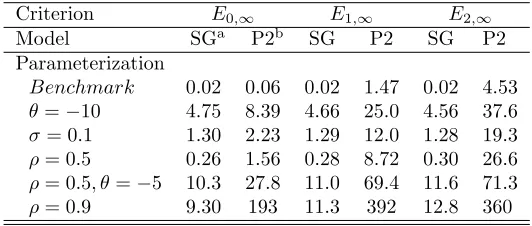
Table1shows that the maximal relative error for the benchmark parameteri-zation is three times larger for the approximation of the Taylor series expansion than for the semi-global method, however the errors for both these methods are very small - 0.06% and 0.02%, respectively. The increase in the condi-tional volatility of the rate of growth of dividends toσ= 0.1 yields the higher approximation errors of 2% and 1% for the local Taylor series expansion and semi-global method, respectively. Increasing the curvature of the utility func-tion to θ = −10 yields the maximal approximation error 8.4% for the Taylor series expansion approximation and about two times smaller for the semi-global method.
Table 1: The relative errors of the approximate solutions Criterion E0,∞ E1,∞ E2,∞
Model SGa P2b SG P2 SG P2
Parameterization
Benchmark 0.02 0.06 0.02 1.47 0.02 4.53
θ=−10 4.75 8.39 4.66 25.0 4.56 37.6
σ= 0.1 1.30 2.23 1.29 12.0 1.28 19.3
ρ= 0.5 0.26 1.56 0.28 8.72 0.30 26.6
ρ= 0.5, θ=−5 10.3 27.8 11.0 69.4 11.6 71.3
ρ= 0.9 9.30 193 11.3 392 12.8 360 a The semi-global method of order two
b The local Taylor series perturbation method of order two (Schmitt-Groh´e, and Uribe(2004))
andE2,∞. Furthermore, for any parameterization the semi-global
approxima-tion gives at least 5 times more accurate soluapproxima-tion in the metrics E1,∞ and 9
times in the metricsE2,∞than the local Taylor series expansion.
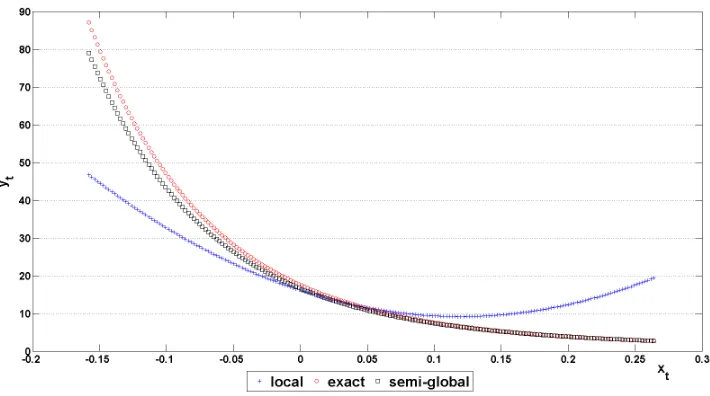
Figure 1 shows the policy functions for the high persistence case, ρ= 0.9, and indicates that the semi-global method traces globally the pattern of the true policy function much better than the local Taylor series expansion. More-over, from Figure 1 we can also see another undesirable property of the the local Taylor series expansion, namely this method can provide impulse response functions with a wrong sign. Indeed, the steady state value ofyt is ¯y = 12.3. After a positive shock the true impulse response function is negative, whereas the impulse response function implied by the local perturbation method is pos-itive, if the shock is large enough. Note also that the solution produced by the semi-global method is indistinguishable from the true solution for positive shocks (the bottom right corner of the Figure1).
7
Conclusion
This study proposes a method based on a perturbation around a deterministic path for constructing approximate solutions to DSGE models. The solutions obtained are global in the state space whenever so is the deterministic solution. As by product, an approach to solve linear rational expectations models with deterministic time-varying parameters is developed. This approach might be valuable in itself, for example, it can be used to solve Markov-Switching DSGE models. All results are obtained for DSGE models in general form and proved rigorously.
Figure 1: Comparison of the policy functions for ρ= 0.9.
modeling, such as projection and stochastic simulations, suffer from the curse of dimensionality, i.e. they can handle only small-dimension models. The pro-posed approach has a potential to solve high-dimensional models as it shares some preferable properties with the local perturbation methods. Namely, the computational gain may come from calculation of conditional expectations. To compute the conditional expectations using the semi-global method all that we need is to know the moments of the distribution up to the order of approxi-mation, while the use of the global methods mentioned above involves either stochastic simulations or quadratures. The former is time consuming, the later can deal with only low-order integrals. The practical implementation of the approach to larger size models the author leaves for future research.
A
Proofs for Section
5
PROOF OF PROPOSITION5.1: The proof is by induction oni. Suppose that
i= 0. For the timeT from (5.8) we have
ETuT+1=BT+1uT +Q21,T+1sT+ Ψ2,T+1ETηT+1.
AsBT+1 is invertible, we have
uT ,T =−KT ,TsT −gT ,0+L−T ,T,T1 ETuT+1,
where KT ,T = B−T+11 Q21,T+1; gT ,0 = −BT−+11 Ψ2,T+1ETηT+1 and L−T ,T1+1 =
[image:20.612.174.529.135.333.2]proved fori= 0. Assuming that (5.11) holds fori >0, we will prove it fori+ 1. To this end, consider Equation (5.8) for the timet=T−i−1. As the matrix
BT−i is invertible, we obtain
uT ,T−i−1=−BT−−1iQ21,T−isT−i−1−BT−−1iΨ2,T−iET−i−1ηT−i+BT−−1iET−i−1uT ,T−i.
Substituting the induction assumption (5.11) foruT ,T−i yields uT ,T−i−1=−BT−−1iQ21,T−isT−i−1−B
−1
T−iΨ2,T−iET−i−1ηT−i
+BT−−1iET−i−1
h
−KT ,T−isT−i+gT ,i+
Qi+1
k=1L
−1
T ,T−i+k
ET−i(uT+1)
i
.
Substituting (5.7) forET−i−1(sT−i) and using the law of iterated expectations
gives
uT ,T−i−1=−BT−−1iQ21,T−isT−i−1−BT−−1iΨ2,T−iET−i−1ηT−i+BT−−1igT ,i
+BT−−1iQi+1
k=1L
−1
T ,T−i+k
ET−i−1(uT+1)
+BT−−1i[−KT ,T−i(AT−isT−i−1+Q12,T−iuT ,T−i−1+ Ψ1,T−iET−i−1ηT−i)].
Collecting the terms withuT ,T−i−1,sT−i−1andηT−i, we get
I+BT−−1iKT ,T−iQ12,T−i
uT ,T−i−1=−BT−−1i
(Q21,T−i+KT ,T−iAT−i)sT−i−1
+(Ψ2,T−i+KT ,T−iΨ1,T−i)ET−i−1ηT−i+gT ,i+
Qi+1
k=1L
−1
T ,T−i+k
ET−i−1(uT+1)
Suppose for the moment that the matrixZT ,T−i =I+BT−−1iKT ,T−iQ12,T−i is
invertible. Pre-multiplying the last equation byZT ,T−1−i, we obtain
uT ,T−i−1=−ZT ,T−1−iB
−1
T−i
(Q21,T−i+KT ,T−iAT−i)sT−i−1
+(Ψ2,T−i+KT ,T−iΨ1,T−i)ET−i−1ηT−i+gT ,i
+Qi+1
k=1L
−1
T ,T−i+k
ET−i−1(uT+1).
Note that LT ,T−i =BT−iZT ,T−i; then using the definition ofKT ,T−i−1 (5.9),
we see that
uT ,T−i−1=−KT ,T−i−1sT−i−1
−L−T ,T1−i(Ψ2,T−i+KT ,T−iΨ1,T−i)ET−i−1ηT−i
+L−T ,T1−igT ,i+L−T ,T1−iQi+1
k=1L
−1
T ,T−i+k
ET−i−1(uT+1).
(A.1)
Using the definition ofgT ,iandLT−i,T−i+j ((5.10) and (5.12)), we deduce that gT ,i+1=−L−T ,T1−i(Ψ2,T−i+KT ,T−iΨ1,T−i)ET−i−1ηT−i+L−T ,T1−igT ,i. (A.2)
From (A.1) and (A.2) it follows that
uT ,T−i−1=−KT ,T−i−1sT−i−1+gT ,i+1+
i+2
Y
k=1
L−T ,T1−i−1+k
!
This proves the proposition.
PROOF OF PROPOSITION5.2: We begin by rewriting (5.9) as
(BT−i+KT ,T−iQ12,T−i)KT ,T−(i+1)= (Q21,T−i+KT ,T−iAT−i).
Rearranging terms, we have
KT ,T−(i+1)=BT−−1i·(Q21,T−i+KT ,T−iAT−i)
−BT−−1iKT ,T−iQ12,T−iKT ,T−(i+1).
(A.3)
Taking the norms and using the norm properties gives
KT ,T−(i+1)
≤
B−T−1i
· kQ21,T−ik+
BT−−1i
· kKT ,T−ik · kAT−ik
+ BT−−1i
· kKT ,T−ik · kQ12,T−ik ·
KT ,T−(i+1)
.
Rearranging terms, we get
KT ,T−(i+1)
≤
B−T−1i
· kQ21,T−ik+
BT−−1i
· kKT ,T−ik · kAT−ik
1− BT−−1i
· kKT ,T−ik · kQ12,T−ik
. (A.4)
Inequality (A.4) is a difference inequality with respect to kKT ,T−ik, i =
0,1, . . . , T, and with time-varying coefficientskAT−ik,
B−T−1i
, kQ12,T−ik and
kQ21,T−ik. In (A.4) we assume that
1− BT−−1i
· kKT ,T−ik · kQ12,T−ik 6= 0.
This is obviously true if kKT ,T−ik = 0. We shall show that if the initial
condition kKT ,T+1k = 0, then 1−
BT−−1i
· kKT ,T−ik · kQ12,T−ik > 0, i =
1,2, . . . , T. Indeed, consider the difference equation:
si+1=
bd+basi
(1−bcsi). (A.5)
Lemma A.1. If inequality (5.13)holds, then the difference equation (A.5)has two fixed points
s∗1=
2bd
1−ba+p
(1−ba)2−4b2cd, (A.6)
s∗
2=
1−ba+p
(1−ba)2−4b2cd
2bc ,
wheres∗
1 is a stable fixed point whereass∗2 is an unstable one. Moreover, under
the initial conditions0= 0the solutionsi, i= 1,2, . . . ,is an increasing sequence
and converges tos∗
1.
The lemma can be proved by direct calculation. From (5.4)–(5.3) the values
a,b,canddmajorizekAT−ik,
BT−−1i
,kQ12,T−ikandkQ21,T−ik, respectively.
If we consider Equation (A.2) and inequality (A.5) as initial value problems with the initial conditions kKT ,T+1k = 0 and s0 = 0, then their solutions
words,kKT ,T−ik is majorized bysi. From the last inequality and LemmaA.1
it may be concluded that
kKT ,T−ik ≤s∗1, i= 0,1,2, . . . , T, T ∈N. (A.7)
From (A.6), (A.7) and (5.4) it follows that
BT−−1i
· kKT ,T−ik · kQ12,T−ik ≤
2b2dc
1−ba+p
(1−ba)2−4b2cd. (A.8)
From (5.13) we see that 2b2dc <(1−ab)2/2. Substituting this inequality into
(A.8) gives
BT−−1i
· kKT ,T−ik · kQ12,T−ik ≤
(1−ba)2 2(1−ba+p
(1−ba)2−4b2cd)
< (1−ba)
2
2(1−ba)= 1−ba
2 <1,
(A.9)
where the last inequality follows from (5.6). This proves Proposition 2. PROOF OF PROPOSITION5.4: The assertion of the proposition is true if there exist constantsM andrsuch that 0< r <1 and for T ∈N
kKT ,j−KT+1,jk ≤M rT+1, j= 0,1,2, . . . . (A.10)
Note now that KT ,j (KT+1,j) is a solution to the matrix difference equation
(5.9) at i = T −j (i = T + 1−j) with the initial condition KT ,T+1 = 0
(KT+1,T+2= 0). Subtracting (A.3) forKT ,T−(i+1) from that forKT+1,T−(i+1),
we have
KT ,T−(i+1)−KT+1,T−(i+1)=BT−−1i(KT ,T−i)−KT+1,T−i)AT−i
−BT−−1iKT ,T−i)Q12,T−iKT ,T−(i+1)+B−T−1iKT+1,T−iQ12,T−iKT+1,T−(i+1).
Adding and subtractingB−T−1i·KT ,T−i·Q12,T−i·KT+1,T−(i+1)in the right hand
side gives
KT ,T−(i+1)−KT+1,T−(i+1)=BT−−1i(KT ,T−i)−KT+1,T−i)AT−i
−B−T−1i·KT ,T−i·Q12,T−i(KT ,T−(i+1)−KT+1,T−(i+1))
−B−T−1i(KT ,T−i−KT+1,T−i)Q12,T−i·KT+1,T−(i+1).
Rearranging terms yields
(I+BT−−1iKT ,T−iQ12,T−i)(KT ,T−(i+1)−KT+1,T−(i+1))
=BT−−1i(KT ,T−i−KT+1,T−i)AT−i
−BT−−1i(KT ,T−i−KT+1,T−i)Q12,T−iKT+1,T−(i+1).
From Proposition5.3it follows that the matrix
is invertible, then pre-multiplying the last equation by this matrix yields
KT ,T−(i+1)−KT+1,T−(i+1)=ZT ,T−1−i(B
−1
T−i(KT ,T−i−KT+1,T−i)AT−i
−B−T−1i(KT ,T−i)−KT+1,T−i)Q12,T−iKT+1,T−(i+1)).
Taking the norms, using the norm property and the triangle inequality, we get
kKT ,T−(i+1)−KT+1,T−(i+1)k
≤ kZT ,T−1−ik ·(kB
−1
T−ik · kKT ,T−i−KT+1,T−ik · kAT−ik
+kB−T−1ik · kKT ,T−i)−KT+1,T−ik · kQ12,T−ik · kKT+1,T−(i+1)k).
(A.11)
From (5.3) and (A.9) we have
kKT ,T−(i+1)−KT+1,T−(i+1)k
≤
ab+1−ba 2
kZT ,T−1−ik · kKT ,T−i−KT+1,T−ik
= 1 +ba 2 kZ
−1
T ,T−ik · kKT ,T−i−KT+1,T−ik.
(A.12)
From the norm property and Golub, and Van Loan (1996, Lemma 2.3.3) we get the estimate
kZT ,T−1−ik=k(I+B−T−1iKT ,T−iQ12,T−i)−1k ≤
1
1− kB−T−1iKT ,T−iQ12,T−ik
≤ 1
1− kBT−−1ik · kKT ,T−ik · kQ12,T−ik
By (A.9), we have
kZT ,T−1−ik=< 1
1−1−ba
2
= 2
1 +ba
Substituting the last inequality into (A.12) gives
kKT ,T−(i+1)−KT+1,T−(i+1)k<kKT ,T−i−KT+1,T−ik. (A.13)
Using (A.16) successively for i = −1,0,1, . . . , T −1, and taking into account
KT ,T+1= 0 andKT+1,T+1=BT−+21 Q21,T+2 results in
kKT ,j−KT+1,jk<kKT ,T+1−KT+1,T+1k=kBT−+21 Q21,T+2k
≤ kB−T+21 k · kQ21,T+2k ≤bkQ21,T+2k, j= 0,1,2, . . . .
(A.14)
Recall thatQ21,T depends on the solution to the deterministic problem (3.11),
i.e. Q21,T =Q21
x(0)T+1, x(0)T , z(0)T+1, z(0)T . FromHartmann(1982, Corollary 5.1) and differentiability ofQ21 with respect to the state variables it follows that
whereαis the largest eigenvalue modulus of the matrixAfrom (4.6),Cis some constant andθis arbitrary small positive number. In fact,α+θdetermines the speed of convergence for the deterministic solution to the steady state. Inserting (A.15) into (A.16), we can conclude
kKT ,j−KT+1,jk< bC(α+θ)T+2, j= 0,1,2, . . . (A.16)
DenotingM =bC(α+θ) and r=α+θ we finally obtain (A.10). This proves the proposition.
B
Series expansion for Burnside’s model
Substituting (6.5) and (6.6) into (6.2) yields
y(0)x(0)
t +σx
(1)
t
+σy(1)x(0)
t +σx
(1)
t
+σ2y(2)x(0)
t +σx
(1)
t
+· · ·
=βEt
exphθx(0)t+1+σx(1)t+1i
1 +y(0)x(0)t+1+σx(1)t+1+σy(1)x(0)t +σx(1)t
+σ2y(2)x(0)t+1+σx(1)t+1+· · ·
Expandingyt for smallσup to order two gives
y(0)t +σy1(0),tx(1)t +1 2σ
2y(0) 2,t
x(1)t 2+σy(1)x(0)t +σ2y1(1),tx(1)t +σ2y(2)t +· · ·
=βEtexp(θx(0)t+1)
1 +σθx(1)t+1+1 2
σθx(1)t+12+· · ·
1 +yt(0)+1+σy(0)1,t+1x(1)t+1
+σ21
2y
(0) 2,t+1
x(1)t+1
2
+σyt(1)+1+σ2y (1) 1,t+1x
(1)
t+1+σ2y (2)
t+1+· · ·
Collecting the terms of like powers ofσof the last equation, we have
yt(0)+σ
h
(y(0)1,tx
(1)
t +y(1)x
(0)
t
i
+σ2
y(2)+y(1)2,tx
(1) t + 1 2y (0) 2,t
x(1)t
2
+· · ·
=βexpθx(0)t+1
Et
(1 +y(0)t+1) +σ
h
θx(1)t+1(1 +y (0)
t+1) +y (0) 1,t+1x
(1)
t+1+y (1)
t+1
i
+σ21
2(θx
(1)
t+1)2(1 +y (0)
t+1) +y (2)
t+1+y (1)
t+1x (1)
t+1+y (1) 1,t+1x
(1)
t+1+
1 2y
(0) 2,t+1
x(1)t+1
2
+θy1(0),t+1x(1)t+12+θx(1)t+1y(1)t+1
+· · ·
References
Adjemian, S., H. Bastani, M. Juillard, F. Karam´e, F. Mihoubi, G. Perendia, J. Pfeifer, M. Ratto, and S. Villemot (2011): “Dynare: Reference Manual, Version 4.” Dynare Working Papers, 1, CEPREMA
Anderson, G., andG. Moor(1985): “A Linear Algebraic Procedure for Solv-ing Linear Perfect Foresight Models,”Economics Letters 17247–252
Andreasen, M., J. Fern´andez-Villaverde, and J. F. Rubio-Ramrez(2013): “The Pruned State-Space System for Non-Linear DSGE Models: Theory and Empirical Applications,” NBER Working Paper No. 18983.
Blanchard, O.J., andC.M. Kahn(1980): “The Solution of Linear Difference Models Under Rational Expectations,” Econometrica 481305–1311.
Boroviˇcka, J., andL. P. Hansen (2013): “Examining Macroeconomic Mod-els through the Lens of Asset Pricing.” Working Paper
Burnside, C. (1998): ”Solving asset pricing models with Gaussian shocks,”
Journal of Economic Dynamics and Control 22 329–340
Collard, F., andM. Juillard(2001): “Accuracy of stochastic perturbation methods: the case of asset pricing models,”Journal of Economic Dynamics and Control 25979–999.
Den Haan, W. J., and J. De Wind (2012): “Nonlinear and stable perturbation-based approximations,” Journal of Economic Dynamics and Control 361477–1497.
Fair, R., andJ.Taylor(1983): “Solution and maximum likelihood estimation of dynamic rational expectation models,”Econometrica 511169–1185.
Gaspar, J. ,and K. L. Judd (1997): “Solving Large-Scale Rational-Expectations Models,”Macroeconomic Dynamics 145–75.
Golub, G.H., and C.F.Van Loan (1996): Matrix Computations, 3rd ed. Johns Hopkins University Press, Baltimore.
Gomme, P., andP. Klein(2011): “Second-Order Approximation of Dynamic Models without the Use of Tensors,” Journal of Economic Dynamics and Control 35604–615.
Hartmann, P. (1982): Ordinary Differential Equations, 2nd ed. Wiley, New York.
Holmes, M. H.(2013): Introduction to Perturbation Methods, 3rd ed Springer-Verlag, Berlin-Heidelberg-New-York-Tokyo.
Jin, H., and K. L. Judd(2002): “Perturbation methods for general dynamic stochastic models.” Discussion Paper, Hoover Institution, Stanford.
Judd, K. L.(1998): Numerical Methods in Economics, The MIT Press, Cam-bridge.
Judd K. L., and S.-M. Guu (1997): ”Asymptotic Methods for Aggregate Growth Models,”Journal of Economic Dynamics and Control211025–1042.
Juillard, M.(1996): “DYNARE: a program for the resolution and simulation of dynamic models with forward variables through the use of a relaxation algorithm.” CEPREMAP working paper No. 9602, Paris
Kim, J., S.Kim, E.Schaumburg, and C. A.Sims(2008): “Calculating and using second order accurate solutions of discrete time dynamic equilibrium models,”Journal of Economic Dynamics and Control 323397–3414.
Lombardo, G.(2010): “On Approximating DSGE Models by Series Expan-sions,” European Central Bank Working Paper Series, No. 1264.
Mehra, R., and E.C. Prescott(1985): “The equity premium: a puzzle,”
Journal of Monetary Economics 15145–161.
Schmitt-Groh´e, S., and M.Uribe (2004): “Solving dynamic general equi-librium models using as second-order approximation to the policy function,”
Journal of Economic Dynamics and Control 28755–775.
Sims, C.A.(2001): “Solving Linear Rational Expectations Models,” Computa-tional Economics 201–20.