Study on the effect of blade profile, number of blade, Reynolds number, aspect ratio on the performance of
vertical axis wind turbine.
Arti Tirkey1, Yamini Sarthi2, Khemraj Patel3, Ritesh Sharma4, Prakash Kumar Sen5
1,2,3Student Bachelor of Engg. (Mechanical Engg.)
Kirodimal Institute of Technology Raigarh (C.G.) INDIA
4,5Faculty, Department of Mechanical Engg.
Kirodimal Institute of Technology Raigarh (C.G.) INDIA
Abstract— This paper present the effect of blade profile, number of blade, surface roughness of blade, aspect ratio and Reynolds number on the performance of vertical axis wind turbine. A numerical analysis, adopting the multiple stream tube (MST) method, is carried out to evaluate the performance depending on the parameters. The numerical result shows that the variation of blade profile directly affected the influence power production.
An enhancement of the power production is observed with increasing the Reynolds number on the whole tested blade speed ratio range. Aspect ratio of wind turbine is the ratio between blade length and rotor radius. Since the aspect ratio variations of a vertical-axis wind turbine cause Reynolds number variations, any changes in the power coefficient can also be studied to derive how aspect ratio variations affect turbine performance. It is shown experimentally that the surface roughness on the turbine blade has a significant effect on the performance of turbine.
Keywords— Vertical axis wind turbine, Reynolds number, aspect ratio, blades.
I. INTRODUCTION
Wind turbine is generally used for converting wind energy into electrical energy and other applications. Wind turbine in mainly two types: (1) Vertical axis wind turbine and (2) Horizontal axis wind turbine. Vertical axis wind turbine is classified in three types: Savonius type, Darrieus eggbeater type, and Darrieus straight type. Deglaire et al. [1], who did a numerical study to evaluate the forces on a rotating blade of the straight type VAWT, mentioned that a blade profile is one of the key factors to affect the performance of a wind turbine [2]. A study illustrate that the performance of a turbine is enhanced with increasing the Reynolds number, and decreasing the number of blade. So Reynolds number directly affects the performance of wind turbine. As observed by Raciti Castelli [2], the vertical axis wind turbine has an inherently non-stationary aerodynamic behaviour, mainly due to the continuous variation of the blade angle of attack during the rotation of the machine: this peculiarity involves the continuous variation both of the relative velocity with respect to the blade profile and - although to a lesser extent - of the
corresponding Reynolds number. This phenomenon, typical of slow rotating machines, has a significant effect both on the dynamic loads acting on the rotor and on the generated power and, therefore, on performance. The wind turbine airfoils operate frequently under fully separated flow, whenever stall is used for power regulation at high wind speeds. Even in the case where traditional aviation airfoils are used on wind turbines, their performance needs to be verified in the entire operational range and at suitable Reynolds numbers [3].
One of the most promising resources is wind power associated with local production of clean electric power inside the built Environment, such as industrial and residential areas, which has lead to the development of the so called computational wind engineering. The new discipline has also renewed the interest in vertical axis wind turbines (VAWTs) [4]. As pointed out by Howell et al.[8], solidity is one of the main parameters dictating the rotational velocity ay which the turbine reaches its maximum performance coefficient. With experimental studies he compared the behaviour of a two and three bladed VAWT, and demonstrated that the two bladed generates a higher power than the three bladed and the peak power is obtained for higher values of tip speed ratio.
.
II. FACTOR AFFECTED VERTICAL AXIS WIND TURBINE
The performance of vertical axis wind turbine is affected by various factors. The most common factors are present in this paper.
A. Effect of blade profile
The VAWT rotor, comprised of a number of constant cross- section blades, is designed to achieve good aerodynamic qualities at various angles of attack. Unlike the HAWT where the blades exert a constant torque about the shaft as they rotate, a VAWT rotates perpendicular to the flow, causing the blades
to produce an oscillation in the torque about the axis of rotation. VAWT blades are designed such that they exhibit good aerodynamic performance throughout an entire rotation at the various angles of attack they experience leading to high time averaged torque. To find the effects of the blade profile on the performance of a straight-type Darrieus VAWT, the four-digit symmetrical NACA airfoil profiles were selected, and the performance of the turbine was evaluated for changing the digit of the symmetrical NACA profile at a given condition of Re = 360,000 and σ = 0.08333. The numerical analysis proposed in the present work is based upon the 2D vertical axis Darrieus wind turbine geometry analysed by Raciti Castelli et al. [5], [6]. Rotor's main geometrical features are summarized in Table 1. The solidity parameter σ is defined as Nc/Rrotor, as suggested by Strickland [7].
The parametric studies of McIntosh [8] revealed that thinner aerofoil’s can attain higher maximum power coefficients than those of thicker sections. Also, that the thicker aerofoil power curves are greatly slopped with a flatter top while the power curves of the thin aerofoil’s are sharply slopped with higher gradients. The maximum power coefficient is attained at a higher tip speed ratio by the thinner aerofoil ’s than the thicker aerofoil’s that attained maximum power coefficient at a lower tip speed ratio, so, asserted that thicker aerofoil’s performed better in gusty (where rapid changes in TSR) air conditions over the thinner aerofoil’s.[9]
B. Effect of number of blade
The Number of blade is a very important term in any kind of turbine. Number of blades are affected the speed and efficiency of turbine. The most commonly used wind turbines use three blades. It is trade off between two major factors:
1) Power drawn from each blade. Assuming each blade draws a certain amount of power from the wind, a higher number of blades would draw more energy from the wind.
2) The interference effect of each blade on another. Lesser the interference of each blade on another blade (of the same wind turbine) higher the efficiency of each blade.
TABLE I
MAIN GEOMETRICAL FEATURES OF THE TESTED MODEL
Drotor[mm] 1030
H
rotor1 (2D simulation)
Blade profile NACA0025
C(MM) 85.8
The Rotor sub-grid is the fluid area simulating the revolution of the wind turbine and is therefore characterized by a moving mesh, rotating at the same angular velocity of the turbine. Its location coincides exactly with the circular opening inside the Wind Tunnel sub-grid area and is cantered on the turbine rotational axis. Fig.1 shows the main dimensions and the boundary conditions of the Rotor sub-grid area.
All blade profiles inside the Rotor sub-grid area were enclosed in a control circle of 400 mm diameter. Unlike the interface, it had no physical significance: its aim was to allow a precise dimensional control of the grid elements in the area close to rotor blades, by adopting a first size function operating from the blade profile to the control circle itself and a second size function operating from the control circle to the whole Rotor sub-grid area, ending with grid elements of the same size of the corresponding Wind tunnel sub grid elements [10].
C. Effect of aspect ratio
The aspect ratio of a geometrical shape is the ratio between its sizes in different dimensions. For example, the aspect ratio of a rectangle is the ratio of its longer side to its shortest side.
In aerodynamics the aspect ratio of wing is the ratio between the lengths to its breadth. A high aspect ratio indicates long, narrow wings, whether a low aspect ratio indicates short, stubby wing. For most wings the length of the chord is not a constant but varies along the wing, so the aspect ratio AR is defined as the square of the wingspan b divided by the area S of the wing platform, which is equal to the length to breadth ratio for a constant chord wing.
AR = b2/S
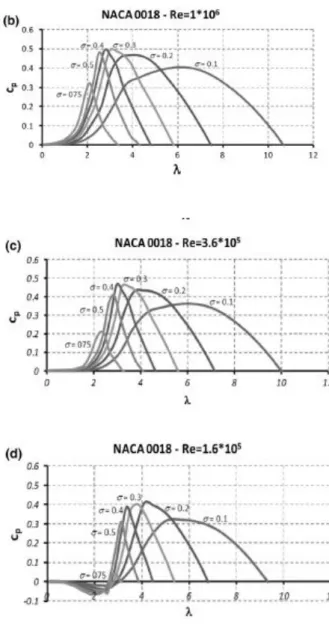
Fig.3 shows how the power coefficient increases as the Reynolds number rises. Moreover, the rotational velocity ω can be derived from Eq.
ω = λ
cpmaxv
0/R
Equation shows how x is inversely proportional to R. From the Fig.3 graph, note how
λ
cpmax decreases as Reynolds number rises. So, to maximize the power coefficient, the rotor’s aspect ratio should be as small as possible. As aspect ratio diminishes there are two advantages: the local Reynolds number rises and simultaneously the rotational velocity diminish. The effect of the rotor’s aspect ratio on Reynolds number and rotational velocity are shown in Fig. 2 for a twin- bladed 1 kW turbine in a wind velocity of 10 m/s. Fig: 4 shows two vertical-axis turbines with identical Design power,Fig.1.Schema of rotor sub-grid area for the three bladed VAWT (Dimensions in mm)
Fig.2. Effect of aspect ratio (h/R) on VAWT performance
Fig.3. Characteristic curves for high Reynolds numbers
Fig. 4 Wind turbines with different aspect ratios
two different aspect ratios (AR1 = 2; AR2 = 0.4). As stated above, the turbine with the lowest AR will have the highest power coefficient and the lowest rotational velocity. Fig: 6 shows the same graphs as Fig.2 but parameterized for design power variation. Note how the turbines with the highest power have higher Reynolds numbers and lower rotational velocity [11].
Fig:5 wind rotor rotational plane
The height of the turbine is affected the performance of turbine as well as the roughness of surface of the turbine also effect the performance.
Turbulence has an important influence on the average output power of a wind turbine. The wind dynamics coupled to the turbine dynamic characteristics results in a fairly complicated behaviour. The blade geometry was based on the modified NACA 63 and AE02 series profiles. The cylindrical profile was adopted near the blade root for easy connection with rotor hub and to assure the structural strength on the inner part of the blade. The effect of surface roughness of rotor blades due to accumulated dust on the blade surface of stall-regulated, horizontal axis 300 kW wind turbine was investigated. The Effect of operation period of wind turbines on the blade surface roughness intensity was investigated by Khalfullaha and Koliubb (2007) experimentally [3].
E. Effect of Reynolds number
Reynolds number always affected the performance of vertical axis wind turbine. Variation of blades number affects the speed of blades and tip speed ratio
.
1. The maximum power coefficient CP.max is increased. This is caused by a lower drag in the low drag bucket, which leads to less profile losses and thus a power coefficient which is closer to the theoretical maximum of CP = 0.59.
2. The power coefficient at low tip speed ratios is increased.
The reason therefore is that more lift can be generated due to the higher maximum lift caused by the Reynolds number effect. Also less blade sections operate in stalled conditions which results in less drag. Hence profile losses are decreased at low tip speed ratios as well.
3. The shape of the power coefficient curve changes, its saddle becomes wider. This is a consequence of 1. And 2: less drag at the Best lift to drag ratio and higher stall angle of attack. This is Advantageous for operating conditions at non optimum tip speed Ratios, i.e. for operation at maximum tip speed below rated power.
4. The optimum blade set angle is increased. The reason therefore is that the best lift to drag ratio is shifted to smaller angles of attack and thus smaller lift coefficients. Hence the optimum performance is reached at smaller section in flow angles which is achieved by increasing the pitch.
5. The optimum tip speed ratio is increased. The reason therefore is that the optimum lift to drag ratio occurs at
The decrease in lift coefficient is compensated by increasing the section velocity, which shifts the optimum tip speed ratio to higher values.
6. The thrust coefficient is increased at low tip speed ratios, but can be partly decreased by increasing the blade set angle [12].
REFERENCES
[1] P. Deglaire, S. Engblom, O. Ågren and H. Bernhoff, Analytical solutions for a single blade in vertical axis turbine motion in two- dimensions, European Journal of Mechanics B/Fluids, 28 (2009) 506- 520.
[2] Roh Sung-Cheoul, Kang Seung-Hee Effects of a blade profile, the Reynolds number, and the solidity on the performance of a straight bladed vertical axis wind turbine. Journal of mechanical and technology, 27(11) (2013) (3299- 3307).
[3] Effect of surface roughness on performance of wind turbine. Division of safety and fire engg, SOE, CUSAT.
[4] M. Raciti Castelli, E. Benini, Effect of blade inclination angle on a Darreius wind turbine, Journal of turbomachinery,2012.
[5] Raciti Castelli, M., Pavesi, G., Benini, E., Battisti, L., Ardizzon, G., Modeling Strategy and Numerical Validation for a Darrieus Vertical Axis Micro-Wind Turbine, Proceedings of the ASME 2010 International Mechanical Engineering Congress & Exposition, November 12- 18, 2010, Vancouver, British Columbia, IMECE2010- 39548.
[6] Raciti Castelli, M., Englaro, A., Benini, E., The Darrieus Wind Turbine:
Proposal for a New Performance Prediction Model Based on CFD, accepted for publication by: Energy
[7] Strickland, J. H.: The Darrieus Turbine: A Performance Prediction Model Using Multiple Streamtube, SAND75-0431.
[8] McIntosh, S.C., Wind Energy for the Built Environment, in Department of Engineering 2009, Cambridge University: Cambridge. p.
164.
[9] Eboibi Okeoghene “The Influence of Blade Chord on the Aerodynamics and Performance of Vertical Axis Wind Turbines” the university of Sheffield mechanical engineering department, October 2003.
[10] Castelli Marco Raciti, Stefano De Betta and Ernesto Benini. “Effect of Blade Number on a Straight-Blade Vertical Axis Darreius Wind Turbine” world academy of science, engineering and technology vil: 6 2012-01-20 .
[11] S. Brusca • R. Lanzafame • M. Messina “Design of a vertical-axis wind turbine: how the aspect ratio affects the turbine’s performance”
Int J Energy Environ Eng (2014) 5:333–340.
[12] Abbott, Ira H., Doenhoff, Albert E. von and Stivers, Lois S. Jr., Summary of Airfoil Data, NACA Report No. 824, Memorial Aeronautical, 1945.