IN
ELEMENTARY PARTICLE PHYSICS
A thesis
submitted for the Degree of
Doctor of Philosophy in Physics in the
University of Canterbury
by
G.R.E. Black
LIBR.ARY
PREFACE
This thesis is divided into two, largely unrelated, sections. The first concerns the production of group
theoretic methods which are useful to physicists, whereas the second is an application of group theoretic methods to a specific problem.
In part I (Chapters 1 to 4) I have considered the problem of the evaluation of the Kronecker products of
irreducible representations of the compact semisimple groups. The ultimate goal of this study has been the
production of simple and icient methods that can be used to create a single computer package to perform all these operations. The usefulness of this package may be seen from the fact that earlier versions were, to a large extent, instrumental in the derivation and checking of solutions to some of the more difficult problems, such as the so
2k+Uk branching rule. My contribution in this has been primarily in the development of the so2k' so2k+l and sp
2k branching rule method product formulae, the so
2k+Uk branching rule, and also in the development of the computer package.
In part II (Chapter 5) I have considered an application of tensor operator techniques in the study of multiquark
hadrons. This study is an extension of the earlier work of Dr Paul Bickerstaff (1980) whose thesis concerned the derivation of the methodology and also applications to the q2
q
2, q4q
to this work has been in the calculation of various parameters of the q3q 3 configuration. While this configuration is
interesting because of its apparent link with baryon-antibaryon production experiments, the magnitude of the problem has in the past been such that a serious study has been seriously attempted. The Bickerstaff methodology
alleviates this problem to a large extent.
Much of this thesis has been published or submitted for publication. A paper, written with Dr R.C. King and Professor B.G. Wybourne, containing many of the results of Part I has been submitted to the Journal of Physics
(Black et al. 1982). The results in part II have already been published (Black and Wybourne 1981).
I would like to express my thanks to my supervisor, Professor B.G. Wybourne, for his guidance, support and motivation. Also I would like to thank Dr R.C. King for his suggestions and results, which provided much impetus
for the work in part I. Thanks are also due to Dr P.H. Butler and my fellow research students Paul Bickerstaff, Ric Haase and Mike Reid for computing assistance and for many useful and stimulating conversations. Ric and his accomplice David also deserve mention for some amusing interludes. I also thank the University Grants Committee for financial support, and Janet Warburton for her typing of this thesis.
CONTENTS
PREFACE
CONTENTS
LIST OF TABLES
ABSTRACT
1. INTRODUCTION
2. SCHUR FUNCTIONS AND PRESENTATIONS OF LIE GROUPS: LABELLING AND BASIC CONCEPTS 2.1 Schur functions
2.2 Labe ing of representations 2.3 Modification rules
3. KRONECKER PRODUCTS FOR COMPACT SEMISIMPLE LIE GROUPS
3.1 Kronecker products using Schur function techniques
3.2 The branching rule method 3.3 The branching rule
so
2k+uk 3.4 . Kronecker products forso
2k
3.5 Branching rule Kronecker products for
so
2k+l andsp
2k3.6 Kronecker products of the exceptional groups
Page
i i
iv
vi
1
3
7
8
12
20
35
36
46
49
57
67
Page
4 . COMPUTING CONSIDERATIONS 79
4.1 Data representation 80
4.2 Program structure and scope 82
4.3 The interactive mode 85
4.4 Current developments and future prospects 90
5. MULTIQUARK HADRONS 93
5.1 Introduction 93
5.2 Classification of multiquark states 98
5.3 The mass calculation 105
5. 4' Dissociation of states 110
5.5 Comments and conclusions 119
APPENDICES
I Schur function identities 125
II Branching rules for S010 ~ SU5 x U1 129 III Branching rules for SUs ~ SU2 x SUa x U1 135
2.1 2.2 2.3 2.4 2.5 2.6 2.7 2.8 3.1 3.2 5.1 5.2 5.3 5.4 5.5 5.6 5.7
LI TABLES
Standard labels of the classical groups Standard labels of the exceptional groups Second order Casimir invariants for the classical groups
Dimensions and second order Casimir invariants for the exceptional groups
Modification rules (1) Modification rules (2)
Weight space modification rules
Composite partition modification rules Half the sum of positive roots
§G-§H for the exceptional groups Branching rules
Parentage of states listed in table (5.4) Nucleon-antinucleon related states
Bag model eigenstates and energies
su6
+
SU2 xsu 3
reduced matrix elementsBB dissociations
3 meson dissociations
ABSTRACT
The use of Schur function methods in the evaluation of Kronecker products of irreducible representations of the compact semisimple Lie groups is reviewed. For irreducible representations of the classical groups,
explicit, unambiguous and rank-independent general formulae are derived. In particular, for the group so2k, a technique necessitating the derivation of new branching rules is used to obtain the appropriate formulae. The same technique is used to obtain efficient methods for the evaluation of Kronecker products of the irreducible representations of the exceptional groups. An account is given on computer algorithms developed to implement these methods and
formulae.
Tensor operator methods are used to evaluate
colour-spin matrix elements of the multiquark hadrons q 3q3, The static spherical cavity approximation to the MIT bag model is used to calculate the masses of the s-wave q3q3 states. Many of these states are found to have masses below the baryon-antibaryon threshold, but none are found below the triple meson threshold. Dissociation calculations are performed on the states which have nucleon-antinucleon content. Some comments concerning the relationship of the
CHAPTER 1
INTRODUCTION
The theory of Lie groups has become, in recent years, an indispensable tool in theoretical physics. This is
especially true in fundamental research fields such as elementary particle and quantum field theory. Vital to this application is the calculation of several group
theoretic properties such as dimensions, branching rules, indices and products of irreducible representations (irreps) of groups, since knowledge of these properties is a pre-requisite to quantitative calculations. It is therefore important to the physicist that there exist either tables of these properties or efficient and fast methods for calculating them. Part I of this thesis is primarily
concerned with the Kronecker products of irreps of compact semisimple Lie groups. In particular the object is the production of simple, efficient and unambiguous methods for evaluating these products, with a view to computer implementation.
Schur (1901), was greatly developed by Littlewood (1940). It is concerned with the characters of groups of matricies, and as such has an affinity to standard tensor and spinor methods. In general the two approaches provide complementary
insights into the uses and problems of groups. Both approaches lead to methods for evaluation of Kronecker products, but not equally successful ones. The character methods have the virtue of producing rank independent general formulae for the c ssical semisimple Lie groups. The weight space techniques, in contrast, do not produce general formulae or rank independent algorithms, and are somewhat tedious, even for low rank groups. Nevertheless these methods may be usefully employed, especially in computer algorithms, to calculate Kronecker products for both classical and exceptional Lie groups (Englefield 1981, Slansky 1981). However the object of this thesis is best served by concentrating on the character approach, using weight space results as required.
The superiority of the character methods depends almost entirely on the powerful algeb~a of Schur functions. This leads directly to the Kronecker product rule for the covariant irreps of the unitary group, which was first produced by Littlewood and Richardson (1934). Schur function manipulation leads to analogous formulae for the tensor irreps of the orthogonal and .symplectic groups
(Newell 1951, Littlewood 1958). Methods to evaluate
Kronecker products involving spinor irreps of the orthogonal
(,
to King (1975a). Generalisations in notation using
composite Young diagrams (Abramsky and King 1970, King 1970, cf Littlewood 1944 p398) have led to a simple formula
for the product of mixed tensor irreps of the unitary group (King 1971).
How.ever Schur function methods have, in the past, failed to produce simple Kronecker product formulae for
the even dimensional notation group, so 2k' (King et al. 1981). This has been a major gap in the results for the classical Lie groups. In the exceptional groups the situation is
somewhat worse as no formulae at all may be obtained, although Schur function methods are useful in the algorithms that
exist (Wybourne and Bowick 1977). To help leviate this problem, King (198la) derived a new method of performing products from the weight space method of Racah (1964) and
iser (1964). This method 11 does not produce general formulae for the exceptional group products, but is a considerab improvement on previous methods. The method may also be applied to the classical Lie groups, including so2k' to produce general product formulae (section 3.4 and 3.5). This application was motivated by recent work of Girardi, Sciarrino and Sorba (1981, 1982)
~~re
generalised Young diagram methods for evaluating Kronecker products of classic Lie groups are produced from weight space arguments.relationship between representations and Schur functions. The elementary properties of Schur functions and Schur function ser s are also reviewed. Always necessary when Schur functions are applied in a group context are
modification rules to ensure only standard labels are produced. These are listed in full.
In chapter three the Kronecker product problem is considered in depth. Using King's branching rule method new rules are derived for the classical Lie groups
so
2k+l'
so
2k and Sp 2k. A key step in this is the derivation of the difficult branching rule forso
2k
+
Uk. Several examples are given of the use of the formulae.Chapter four considers the computer implementation of the products and other group properties. The formulae given in chapter three are both un~mbiguous and extremely eff ient and are therefore ideally suited to such imple-mentation. A program, called SCHUR, has been written to
CHAPTER 2
SCHUR FUNCTIONS AND REPRESENTATIONS OF LIE GROUPS: LABELLING AND BASIC CONCEPTS
In the labelling of both Schur functions and representations of compact semisimple Lie groups,
partitions of integers have an important role to play. A partition of the positive integer ~ and p parts
A1 A2 I I ••• A p with A1 ~ A2 ~ ••• ~A p > 0 and
A 1
+
A 2+ • · ·
+ A=
~ is denoted by (A 1 1 A 2 1 A 3 • • • A )p p
or often just as (A). The integer ~ is often termed the weight of the partition. Any such partition (A) may be used to specify a regular Young diagram which is made up of ~ boxes arranged in p rows. In this the i-th row has \. boxes as in figure (2.la). The partition (X) 1
l
conjugate to (\) may be obtained from the Young diagram by reflecting the diagram about the main diagonal
(figure 2.lb). Thus
X.
is given by the length of j-th Jcolumn of the (A) diagram. An alternate notation for partitions is given by Frobenius (Littlewood 1940 section 5.1). The numbers ai are defined as the number of boxes
( 3:1.)
(b)Conjugata diagram
I ... I ...
I I
I
I
...
in the i-th row of a diagram, (A), to the. right of the main diagonal, that is Ai-i. The numbers bj are defined as the number boxes beneath the main diagonal in the j-th column of the diagram, that is b.
=X. -
j. The partitionJ J
is then specified by
(A.)
=
[a1 az ••. ar] b1 bz ... brwhere r is the Frobenius rank of the partition. Clearly the conjugate partition is obtained by interchanging the a.
~
and b.
~
{2.1) SCHUR FUNCTIONS
A Schur function (S-function) is a particular type of symmetric function defined on a set of indeterminates. Each S-function is defined so as to correspond to an
irreducible representation (irrep) of the symmetric group, S . Whilst the actual combinatoric structure is
n
not relevant to this thesis, detailed accounts exist in the literature (Littlewood 1940, Wybourne 1970, Macdonald, 1979). Schur functions, like all symmetric functions, may be labelled by partitions. Partitions labelling S-functions are denoted by {A}, following Littlewood.
of indeterminates is called the outer product. The product S-function obtained may be decomposed into a sum of
S-functions. This can be written as
{A}·{~}
-
{A·~}
=I
rn~~
{v}v
v
where rnA~ is the multiplicity of {v} in the product. Actual evaluation of outer products is performed using the well known Littlewood-Richardson rule (Littlewood and Richardson 1934, Littlewood 1940, p94). Extensive
( 2 .1)
tabulations of S-function outer products are available in the literature, notably Butler's (Wybourne 1970).
Closely related to the operation of outer product is the S-function division (Littlewood 1940 pllO). This can be written as
v
=
I
rnA~{A}
A
'where the coefficients rn~~ are the same as in (2.1). This operation defines the skewS-function {v/~}. Thus
{v/~} is the sum of rn~~ times the S-functions
{A}
whoseouter product with {~} gives the S-function {v}.
Given these operations an algebra of S-functions may be defined such that
{(A·~)/v}
=I
{A/cd·{~/(v/a)}a
{A/(J.PV)}
=
{(A/lJ)/v}=
{(!t/v)/lJ} (2. 3){(A+lJ)/v} = {A/V} + {lJ/V}
{;\/(lJ+V)}
=
{A/lJ} + {;\/v}The use of infinite series of S-functions is an important technique in practical calculations. The following series (King 1975b, King et al. 1981) are particularly useful
A
I
(-l)~/
2{a}
B=
I
{ s}a B
c
I
(-l)a/2{y} D=
I
{a}a 0
E
=
I
(-l) (e+r) /2{£} F=
I
{r,:}£
s
G
=
I
(-l) (e-r)/2{£} H=
I
(-)z{l,;}£
s
(2.4) L
=
I
(-l)m{lm} MI
{m}m m
I
mI
{lm}p
=
(-1) {m} Q=
m m
v
=
I
<-l)q{w}w =
I
(-l)q{w}w w
X
=
I
{w} yI
{w}w w
(a) (E) • • • er] ••• e
r
( 2. 5)
(y) is the partition conjugate to (a) .
The partition ( ) , giving the S-function {0}
=
l, is assumed to be included in the series A,C,E and G.{a)
is a partition into even parts only and (S) is conjugate to ( o) • (s) is any partition whi (w) is a pa~tition of an even number into at most two parts, the second of
which q.
Noting equations (2.3) the use of capitals for the infinite series leads to the notation given by the examples
{:\/A} =
I
(-l)a/2{:\/a}a
{:\/y·A}
=
I
(-l)a/2{:\/s·a}a
AB
=
I
(-l)a/2{a•S}a,S
( 2. 6)
Most of the series of (2.4) occur as mutually inverse pairs so that
AB
=
CD=
EF=
GH=
LM PQ=
VW=
{0}=
l { 2. 7)The following identities may also be shown
AL CP = E BM = DQ = F
CM
=
AQ G DL=
BP = M ( 2 • 8)Occasionally i t will be convenien.t to use the
notation {lr;:\} to represent an S-function whose corresponding Young diagram is formed by adjoining a single column of
length r to the left side of the Young diagram of
{A}.
For example, {110 ;21} is equivalent to {3218 } .
Further identities of S-functions and series of S-functions
. .
may be found in appendix I.
(2.2) LABELLING OF REPRESENTATIONS
The connection between Schur functions and Lie groups comes through the theory of invariant matrices (Littlewood 1940, Ch 10). Using this theory Schur (1901) and later Littlewood were able to develop a formalism in which the S-functions on n variables are seen to be the characters of representations of the n x n matrix groups. The groups considered in this thesis are the unitary group, Un' the special unitary group, sun' the orthogonal groups, o2k and 02k+l' the special orthogonal groups, so2k and so2k+l' the symplectic group, sp
2k' and the five exceptional groups
In the case of the unitary group, Un' and hence
sun
the representations corresponding to the S-functions are also irreducible. These irreps are thus labelled by the S-functions themselves. In the other classicalantisymmetric metric tensors for the orthogonal and symplectic groups respectively. However the irreps of On and Sp
2k may still be labelled by partitions and are written as [A] and <A> respectively. The S-function representations may be reduced to a sum of irreps of
the appropriate group. The reductions with their inverses are given by
{A}
+
[A/D] [A] t {A/C} Sp2k {A}+
<A/B> <A>+
{A/A}(2.9a) (2.9b) (2.10a) (2.10b)
Not all the irreps of U may be labelled by S-functions.
n
Along with these representations, whose bases are covariant
tensors, there are representations associated with contravariant tensors, labelled {~}, and also representations whose
bases are mixed tensors, labelled by {~;A}. In this
notation the
A
partition is associated with the ~ covariant indices of the basis tensor while the barred ~ partition is associated with the m contravariant indices. It is con-venient to write {O;A} ={A}, {~;0} = {~}. The mixedi
tensor totation can be associated with a composite Young diagram formed by placing the Young diagrams for (~) and (A) back to back (figure 2.2a). Another sort of composite
Young diagram can be formed using the natural labels discussed at the end of this section. In Un' each mixed tensor label can be written as a single n-part generalised partition (the condition
A.
~ 0 is dropped) such that{~;X}
-
{Al,A2, ( 2 .11)The corresponding n-dependent generalised Young diagram is shown in figure (2.2b).
Fi~ure 2.2 Generalised Young diagram
a)Composite Yeung diagram (b) n-dependent ~natural' form
... 1 .. ..
.... .... 1 ... ..
I .... I ...
I .... I ....
I
C211;32J in U(6)
In the orthogonal groups, as well as the tensor irreps given by [A], there exist double-valued or spinor representations (Brauer and Weyl 1935) which are denoted by [6;A]. In this notation 6 is the fundamental spinor
k
representation of dimension 2 for
o
2k ando
2k+l. [6;A] is the principal representation that appears in the Kronecker product of 6 with [A]. (Littlewood 1940, p256).these groups are {0}, [0] and <0> respectively. However for Un and on this is not the case. For U , s is the
n
irrep {ln} with an inverse s-1
=
s
=
{ln}. For On allgroup elements have determinant +1 or -1 hence s
=
s-1and s x s
=
[0].The product of the irrep s with another irrep is also an irrep, and inequivalent irreps related by some power of s are said to be associated. For Un there are an infinite number of irreps associated with any given irrep, one of which will be labelled by a partition with less than n parts. For instance (see figure 2.3)
Figure 2.3 Associated irreps of U(5).
I I ... I .... .... . .. I .•. I
....•... 1 .... I •...•... 1 ... 1 ... 1 ...• 1
I
1 ••..••.•••.. 1 ••••...• 1 .•••
.... 1 ... I
... I .... I .... I ... I I I I
, \ I;
i
[image:21.597.83.558.52.734.2]-.... -.... .•.. 1 •.•• ... 1
{:1.:1.;:4~5}
.... I .... . .. I .... . .. .... 1.... I
I
{~"54 :1.)
• •• 1 .•• 1 .. _ - ,_1 __ ·- I ... I... I .... I ..• I
I
I
{624i} {5231}
/ , I ,
{541}, {65212 }
{4~/;1}, {322;21}, {221;32}, {12 ;43}, are all associated irreps of U5 • They
irrep of less than n parts is related to the general mixed tensor irrep by
The fact that, under the restriction of Un to sun, all associated irreps become equivalent (since E=l) allows
(2.12)
all irreps of sun to be denoted by single partitions of less than n parts. In general the Kronecker product of any real power of E with an irrep of U n is an irrep of U . n If the power of E is non-integer the irrep is not a true irrep of Un since the representation is multivalued. Particularly of interest is the case of half integer powers of c, as these correspond to double-valued
representations analogous to the spinor representations
For 0 there can only be one inequivalent associate n
of any irrep and often there is none. Irreps for which the character is zero for all group elements having
determinant -1 will not possess an inequivalent associate. Such an irrep is termed self-associate. Following
Murnaghan (1938, p276) the irreps associated with [\] and [6;\J are denoted [\]*
=
c[\] and [6;\]*=
c[6;\] respectively. While for o2k+l no irrep is self-associate, for o 2k all the spinor irreps and the tensor irreps
lost. This means that the asterisk labels are not required for son. However under this restriction only those irreps which are not self-associate remain
irreducible. The sel sociate irreps of o
2k on res-triction to so2k reduce into two inequivalent irreps of equal dimension. This process may be described by (King
et al. 1981)
[A]
+
[.\]+ + [,\] (2.13a)(2.13b)
where in the first case (,\) is understood to be of k parts. In so2k these irreps are related by an involutory outer automorphism,
t,
such that[.\]t [A] p < k
[A] t
=
[A]- p k±
+
t
[6;:\]+ p ~ k [6;:\]±
=
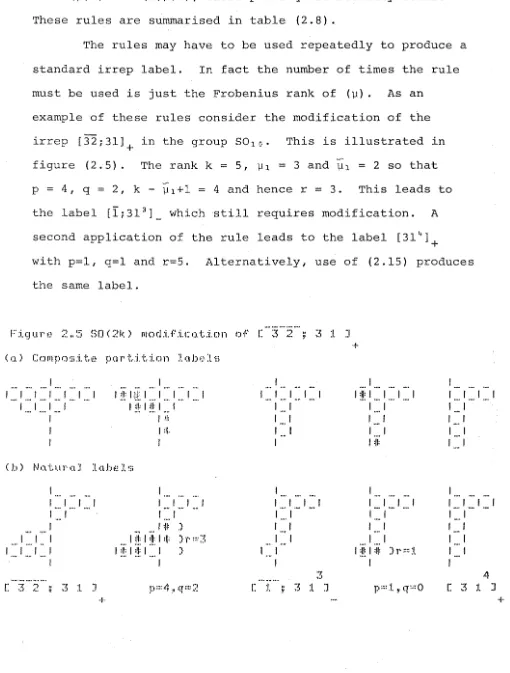
The fact that there exist equivalences within the notation means that a subset of all the possible labels can be defined as standard. These are specified in table (2.1) for the classical Lie groups U , SU ,
n n
on, son and sp 2k.
(2.14a)
(2.14c)
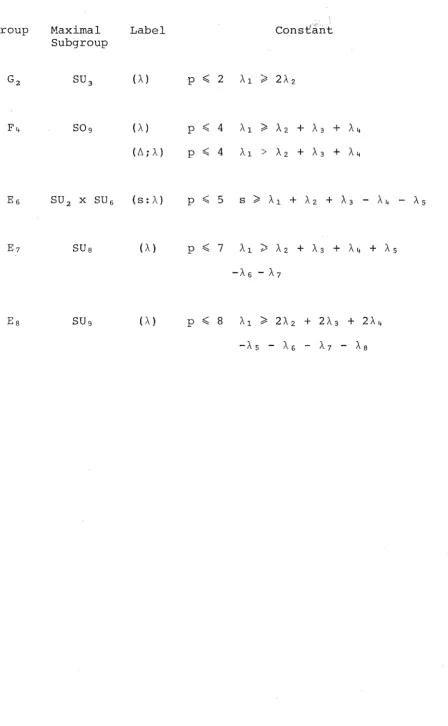
The irreps of the exceptional groups G2 , F4 , E6 , E7 and E8 may be usefully labelled by employing the labelling
1977, King and Al-Qubanchi 198la). There are many choices of maximal subgroup available. In this thesis the
criterion of most importance is the amount to which Kronecker products are facilitated. The choices are SU3, SOg, the product group SU2 x SUs, SUs and SUg for
·G2, F4, E6 , E7 and E8 respectively. Additional constraints are put on these labels so that the exceptional group
standard labels are a subset of those of the classical subgroup. Table (2.2) gives a complete specification of the standard labels of the exceptional groups.
The labels described may be used to specify any irrep of the compact semi-simple Lie groups. Several alternative labelling schemes exist and may be useful in many situations. Very closely related to the standard labels are the natural labels of King and Al-Quabanchi
(198la) which are trivially ived from the highest weight vector of the irrep. The natural labels, denoted ~' are k dimensional vectors where k is the rank of the Lie algebra corresponding to the Lie group. They are generalised partition labels in the sense that A= (~11~2, ... , ~k) is ordered such that ~1 ~ ~2 ~ ·••
~ ~k' though the ~i may be negative and half-integer. The relations between the standard labels and the natural labels are given by:
{A) ==
(~;A)
(Al,A2, ... , A , 01 0, . . . 0)
p
(A 1 ' A 2 , . . . I Ap , 0 I • • • , 0 , -11 q, . . . , -)..12, -)..11)
( 2 .15a)
A+~,~,~, ... ~) p
A , 0, 0, ... 0) . p
The label (s:A) is used to label the exceptional group E6 through the group SU2 X 806 . In addition to these symbols i t is useful to introduce the following /otation
A +1, 1, 1, ... 1)
p
(2.15c)
(2.15d)
(2.15e)
(2.15f)
The '±' notation, useful for
so
2k is described in natural labels by
(2.16)
The irreps of the Lie groups are commonly labelled using Dynkin's (1957) scheme. The relation between the
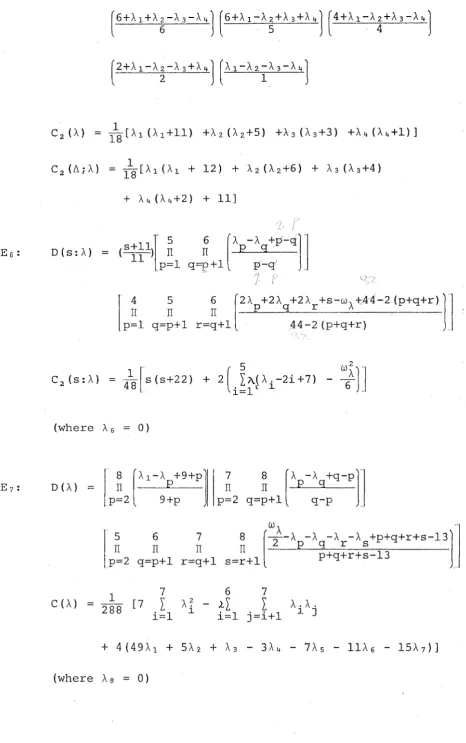
Wybourne (1974). The formulae for the second order Casimir invariants of the classical groups are given in table (2.3) and the formulae for the dimensions and second order
Casimir invariants of the exceptional groups in table (2.4).
(2.3) MODIFICATION RULES
While the standard labels of tables (2.1) and (2.2) suffice to completely label the irreps of both the classical and exceptional Lie groups, in many calculations non-standard labels will arise. In a particular group, G, the character corresponding to a nan-G-standard label is found to either vanish or be equal to the character of a G-standard irrep or the negative of such a character. The equivalence relations between non-standard and standard labels are known as modification rules. Some trivial modification rules are given in tabel (2.5).
There are two main types of modification rules to be considered. The first type,only necessary for the classical groups, are used when the number of parts in a partition exceeds the allowed number, k. The second type are often necessary after the employment of weight space techniques or related methods (such as in section 3.2) where the condition on the labels
(A)
thatA.
~ 0 or thel
removal (King 1971, King 1975b, King et al. 1981). Boundary hook removal is the process where a continuous run of
boxes is removed from the right boundary of a Young diagram starting at the foot of the first column. The notation
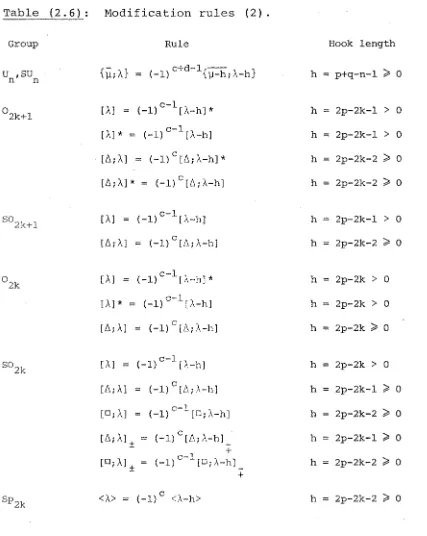
(,\-h) is used for a diagram (,\) modified by the removal of a boundary hook of length h. If the diagram (,\-h) is not regular 1 that is, if the columns of (A-h) are not weakly decreasing from le to right the character of the irrep corresponding to the label will vanish. Figure (2.4) gives several examples of hook length removal. Table (2.6) gives a complete list of the modification rules of this type.
r" . 1 '') 4 I I r) ,.,. I( ·.1. •'.HH,:J t h r 1\~ fli () v 0:1 1
, .. :t IJ !. '(' \\~ "" " .. \, ··' .
....
.... ....-
-
-
........
·-
........ .... ....
·-·
.... ....I I I I I I I I I
....
I I .... I _.., I-
I-
I I _1 .... 1 ~t I~: II .... I .... I .... I .... I .... .... .... -···
·-
-·
....
I~~ I:!!: I:!!: I I I
....
.... I .... I I jJ: I~: 1 .... Iqt
I:!!: I~; II :lt: I I
:!t
II;!).' I 11!: I
1 .... 1 .... 1 .... 1
1 .... 1
I·\:::: :1. f·\:::::3 h::::4 h::::6
( 43 :1.)
(4::-::t· ..
·h) ( 4:?):1. .... h) <4:3:1.· .. ·1'\) ( 4:::) :1. ·-h):::: ( 4:3) vr:1 n:l. !:;h.;~m ::'~ ( 4) :::: ( 2)
The modification rules of the second type may be derived f~om the Weyl reflection symmetry of the weights of an irrep of a group (King and Al-Qubanchi 198lb) . The key rule of this type (Murnaghan 1937) is
( 6c
1 ,6c
2 I • • • , A . ' A . +1 , • • • I Ak)~l ~l ~
[image:27.595.113.555.334.756.2]This rule is valid if i
=
1,2, ... , k-1 for the classical groups of rank k and f o r i = 2,3, •.• , k-1 for theexceptional groups of rank k. Repeated use of this rule allows any sequence of \.s to be ordered such that . -J
~l ~ ~2 ~ ••• ~ ~k· In addition to this rule there are several rules special to particular groups. King and Al-Qubarichi (198la) have evaluated these and the comple.te set of their rules using natural labels is given in table
(2.7).
The need will se, later in the thesis, to modify generalised partitions to standard ones for the groups
so
2k' so 2k+l and sp 2k. To achieve this,the rules of table (2.7) must be applied in a purposeful sequence to eliminate all negative parts of~ (i.e. (~;A) or (6;~;\)).For so
2k the method is to first apply equation (2.16) to change ~k (that is either -~1 or -~1+~) to -~k
and change the sign of the '±' index on ~±· This process is the same as adding 2j~kj to ~k or equivalently adding 2~1 for the case of (~;A) and 2~1-1 for the case (6;~;\). This process can be summarised as the adding of a continuous boundary hook of length 2j~kj to the generalised partition
~~ and the multiplication by a sign factor determined by the number of uses of (2.17). Similar rules can be
derived for so2k+l and sp
2k using the special modification rules of table (2.7) instead of (2.17). For so2k+l and Sp2k the lengths of boundary hook to be added on are
2j~kl - 1 and 2j~kl - 2 respectively.
involves the production of labels (~-p;A+q) and (~;~-p;A+q)
from (~;A} and (~;~;A), where p and q are boundary hooks. These rules are summarised in table (2.8).
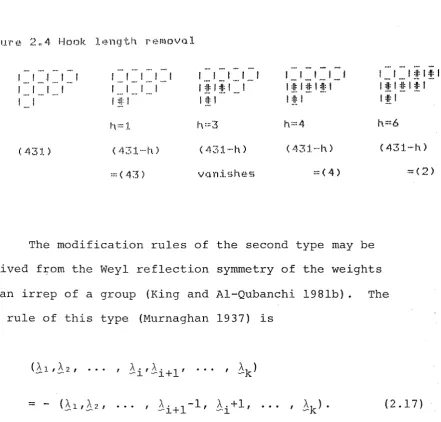
The rules may have to be used repeatedly to produce a standard irrep label. In fact the number of times the rule must be used is just the Frobenius rank of (~). As an
example of these rules consider the modification of the irrep [32;31]+ in the group 8010 • This is illustrated in figure (2.5). The rank k
=
5, ~1 = 3 and ~1 2 so thatp 4, q 2, k - ~1+l = 4 and hence r = 3. This leads to the label
n::;
313] which s t i l l requires modification. A
second application of the rule leads to the label [314]+
with p=l, q=l and Alternatively, use of (2.15) produces the same label.
Figure 2.5 S0(2k) modification of C 3 2 ; 3 1 J
(a) Composite partition labels
'
·~··
....
.... ·~·· .....
.. .I ... I .... I .... I ... I ... I .... I 1._1 .... 1 .... 1
I
I I
1 ... .
1 .... 1 .... 1 .... 1
I I
... 1 .... 1 .... 1 .. I 1 .... 1 .... 1 .... 1
I
[ 3 2 y : 3 l J
+
.... ... . ... I ... . I~!; I .... I .... I .... I ....
I :!!; I ;!!: I ... I
I .if:
I :~.
I
I ...
1, .. 1_.1 .... 1 .... 1
.... .. .. I ~1: }
.... I:!!:
I:~ f:IJ: ) r•I~!:
I:!!: I .... I
}
'
p:::4 !I q::::2
.... I ... .
I .... I ... I .... I .... I
1 .... 1
I-· I I .... I I
'
.. ..1 .... I .... I __ I
'
....'
I ..
.1
.... 1 .... 1
I I
I
3
r:: :1. ; ~~ :1. J
+
.... 1 .. ..
I~: 1 .... 1 .... 1 .... 1
1 .... 1
I .... I
'····'
I :If:
I ...
I __ I·-'····'
1.~ I 1 .... 1
.... 1 .... 1
I~~ I :fl: } T' :::::1.
I
1 .... 1 __ 1 .... 1 .... I ... I I __ I
'-'
1 .... I
I ....
1_.1 _I·- I
1 .... 1
1 .... 1
1 .... 1
I I I
[image:29.597.57.567.93.766.2]The symbol {lr;A}, introduced in section (2.1), may also require modification under some circumstances. If r is less than p, the number of parts of A, the corresponding Young diagram is irregular. The modification rule is given by (King 1971)
(2.18)
Table (2.1): Standard labels of the classical groups.
Group Label Constraint
un {~;A} p+q
sun {A} p
0
2k+l [A],[A]* p
[6;A],[6;A]* p
so2k+l [A] p
[ 6; A] p
0
2k [A] p
[A]* p
[ 6; A] p
so2k [A] p
[A]+' [A]_ p [6;A]+' [6;A]_ p
Sp2k <A> p
(A) a partition into p parts
(~) a partition into q parts
~
~
~
~
~
~
~ ~
~
=
~
~
~ n
n-1
k k
k k
k k-1 k
k-1 k k
[image:31.595.87.507.73.796.2]Table
Group
Ea
Standard labels of the exceptional groups
Maximal Subgroup
Label
(A)
(A)
(L'!;A)
su
2 Xsu
6 ( s : A)su
8 (A) [image:32.597.97.546.80.807.2]Table
su :
n802k+l:
Second order Casimir invariants for the classical groups
1
Cz{A.}
=
2n
n
I
1
C2[\J =
---=--2(2k+1)
w2
A..
(A.. -
2i + n +1) -
~]
~ ~
k
I
n
A..
(A..
+ 2k - 2i + 1)~ ~
k
1
[I
x.
<A. + zk- zi + 2) + k4<zk+1)J 2(2k+1) i=1 1 ~
k
I
1
4(k+l) i=l
k
I
1
A..
(A..
+ 2k - 2 i + 2)~ ~
C2[A](±) =
4k-1 i=l
A. • (A. + 2k - 2 i)
~ ~
1
4k-1
k
I
A. (A. + 2k- 2i + 1) + k4(2k-l)J.1 ~ ~
[image:33.597.82.551.63.804.2]Table (2.4): Dimensions and second order Casimir invariants for the exceptional groups.
G2: D (A)
=
1 (Al+Az+4) (Al-2Az+l) (2AI-Az+5) (A1+3)120
(Az+1) (AI-Az+2)
C 2 (A)
=
-[(Al-Az)1 2 + AIA2 + SA1 - Az] 12 [image:34.595.82.552.63.751.2]Table (2.4) Continued
E s:
C2 (A) = l [A.1 (>..1+11) +A2 (A2 ) +A3 (As+3) +A4(A4+1)]
C2 (t.\iA) = I8[Al 1 (;\1 + 12) + l-2(!-2+6) + 1-s (A s+4) + A4 (A4+2) + 11]
(s+ll~r ~
6[ ' -A
+P-oi]
D{s:A) = 11
E
g.11 p=1 p-q!
4 5 6 (2:\ +2:\ +. 2.A +s-w;\ -t:k4-2 (p+q+r)
1··1
II II 11 p q r . '
p=1 q=p+l r=q+1 44-2(p+q+r) .
[
.. ( 5
w2J_l
4 1
8 s(s+22) + 2
i~~~;\i-2i+7)
- - } "(where ;\6
=
0)D (A.) = 11 8
[>-1-A.
E +9+plp=2 9+p
~
~
("E
-1-q+q-p~-p=2 q=p+ 1 q-p ..
5 6
II II
p=2 q=p+1
C.( A)
=
1 [77
I
(where A.e
=
0)WA.
7 8 r--->.. -;\ -A -A +p+q+r+s-13]
II II 2 p
g
r sr=q+l s=r+1 p+q+r+s- 13 .
7
I
j=i+1;\.:\.
[image:35.595.83.550.88.832.2]Es: D()d
~ [p~2
[A'::::20+p]]
w;._
8 9
[A -A +q-p][A
1+A +A--+28-p-q]]
TI TI p q . p g 3p::::2 q=p+l q-p 28-p-q ~
7 8 9
[wA -A -A -A +p+q+r-10]
TI IT IT 3 p q r ·
p=2 r=q+l p+q+r-10
1 8 7 8
C 2 (A) = [4
I
A~-
I
I
A.A.7 l
i=l j=i+l l J
+ 3(68/..l + 2/..2
-
A3 - 4A~t - 7As - 10A6A7 - 16Aa)]
(where A 9 0)
[image:36.595.83.557.34.793.2]Table
Group
so2k
Modification rules (1)
Rule
{A} = {3::} = 0
A
{,\} = {A./n n}
[A]*=(,\]
[A; A] [A; A
J
[A] = (o;,\/lkJ
[A]± = (D;,\/lk]±
[A; A.] :::: [LI.;A.]+ + [A; A.]
[D i A J == (D;A_J+ + ( D i ,\]
Condition
p > n
p
=
np+g ~ n
p=k
p ~ k
p = k
p = k
p ~ k
Table
Group
U ,SU
n n
Modification rules (2).
Rule
c-1
[A] = (-1) [A-h] *
[A]*= (-1)c-l[A-h]
[image:38.597.83.510.54.590.2][6;A]
=
(-1)c[6;A-h]*[6;A]* (-1) (6;A-h] c
[A] = (-1)c-l[A-h]
[6;A} = (-1)c[6;A-h]
[A] = (-1)c-1[A-h]*
[A)* (-1)c-1[A-h]
[6;A] = (-1) 0 [6;A-h]
c-1
[AJ = (-1) [A-h]
=
(-1)c[6;A-h](D; A] (-1) c-1 [D;A-h] [6;A]±
[D;A]±
c
(-1) [6;A-h]
-+
c-1
(-1) [D;A-h]
c
<)..>
=
(-1) <A-h>-+
Hook length
h = p+q-n-1 ;;?: 0
h 2p-2k-l > 0
h
=
2p-2k-1 > 0h
=
2p-2k-2 ;;?: 0h = 2p-2k-2 ;;?: 0
h
=
2p-2k-l > 0h
=
2p-2k-2 ;;?: 0h = 2p-2k > 0
h = 2p-2k > 0
h = 2p-2k ;;?: 0
h = 2p-2k > 0
h = 2p-2k-1 ;;?: 0
h
=
2p-2k-2 ;;?: 0h
=
2p-2k-1 ;;?: 0h = 2p-2k-2 ;;?: 0
h = 2p-2k-2 ;;?: 0
(A) and (~) are partitions of p and q respective!~ c and d are columns
Table (2.7): Weight space modification rules
A - 1!
(a) Classical groups of rank k
Group - 1!
All groups - (.6_1, • • • , ~i+l A -1 ' .0-i ' +1 ' • • • ' ~k A l
- [.6_1 '.6_2'
-<.6_1 '.6_2'
- [.6_1 '.6_2'
(b) Exceptional groups
Group
All groups
Ea
Maximal subgroup
SOg
SUa
SUg
...
'
.6.k-l' -A -11 ~k...
'
.6.k-l' -A -2> ~k...
'
-A -1 ~k ' -A ~k-1 -11-(A1, ... ,A.
1-l,A.+l, ... ,Ak)
~ ~l+ ~l ~
i
=
1,2, ... , k-1E ~ 0
(i = 2,3, ... , k-1)
In addition G2 , F4 , E7 and E8 may be modified using the rules appropriate
[image:39.595.82.560.135.708.2]Table (2.8): Composite partition modification rules
Group Rule hook length
[lJ;A]± r-1 - -
>
0so2k (-) [1-1-p;A+q]+ q 1-11-1-11+1
[6;~;A]± r-1 - - ~
>
0(-1) [6;1-1-p;A+q]+ q 1-11-1-11
[~; ;\J r - -
-
>
080
2k+l = (-1) [1-1-p;A+q] q 1-11-1-11
[L',;~;A] (-1) [6;11-p;A+qJ r - - q 111-111-1
>
0<~;A> r - - 1-11-111-1
>
0Sp2k (-1) <1-1-p;A+q> q
q begins in the (k-0 1+l)th row of the Young diagram corresponding
[image:40.597.83.495.58.369.2]CHAPTER 3
KRONECKER PRODUCTS FOR COMPACT SEMISIMPLE LIE GROUPS
This chapter is devoted to the derivation of
efficient methods of evaluating the Kronecker products of the compact semisimple Lie groups. In the context of this thesis, efficient evaluation means methods which are fast, simple and which also produce rank independent formulae.
In the next section the application of Schur functions to Kronecker product calculation is considered. Little of this material is new, but demonstrates both the power 'and the limitations of the S-function algebra. The power
is evident in the production of general formulae which are no harder to evaluate for very high rank groups than for trivially ranked groups. The limitations arise in the inability to produce formulae for the exceptional groups or simple ones for the group
so
2k. King (198la) has developed a new method of Kronecker product evaluation using products of a subgroup. This is discussed and examined in section (3.2). The classical group products causing difficulty, those of
so
2k' may be evaluated using this method. First though, the branching rule to a subgroup where products are easily calculated must be found. The new branching rules for so
2
k~Uk are derived in section(3.3), allowing the product formulae to be presented in section (3.4). Formulae for the products of
so
with those of section (3.1) are considered in section (3.5). Finally in this chapter the application of the branching rule method to products of the exceptional groups is considered in section (3.6).
(3.1) KRONECKER PRODUCTS USING SCHUR FUNCTION TECHNIQUES The Kronecker product of two representations of a linear group is isomorphic to the multiplication of the corresponding characters. For representations whose
characters are S-functions on the eigenvalues of the group elements, this multiplication corresponds to the outer product of those S-functions (Littlewood 1940). This fact has great application in evaluating the Kronecker products of irreps of the classical groups.
Since the characters of the purely covariant and purely contravariant irreps of U are just S-functions,
n
Kronecker products of these irreps are just given by the Littlewood-Richardson rule, so that
{\} X {~}
=
For the mixed tensor irreps of U the product formula is n
(3.1)
{jl;>.} x (p;v}
I {
{f.J/a) • (p/S); (f./B)· {v/a)} ,a,s
(3.2)
where {a} and {S} are any S-functions that fit. Equation (3.1) is a special case of this, being produced when either (1.1) ( p)
= (
0) or when (A)= (
v)= (
0) . Like ( 3 . 1) this formula is an n-independent result, however some non-standard labels may appear in the final result for particular values of n. These terms require the use of the Un modification rules found in table (2.6).An alternate method for computing products, and one which avoids the modification process needed for (3.2), uses the special irrep s. This may be used to convert a mixed tensor irrep into a product of a power of
E
and a purely covariant tensor (using the identity (2.12). These may be multiplied together to form a sum of such products which may be converted back to a sum of mixed tensor irreps.As an example consider the product {l;l} x {l;l} in U3.Formula (3.2) gives the Un result
un {l;l} x {l;l}
=
{2;2} + {2;12} +{l
2 ;2} + {l2;12} +2{l;l} +{0;0} .
However, in U3 the label {lL;l2} is non-standard as the sum of the number of parts is four. On modification by the appropriate rule in table (2.6) i t is found to vanish, and hence the term does not contribute to the product in Un' n=3. The U3 result is then just
u
3 {l;l} x {l;l}
=
{2;2} + {2;1 2In the alternate method, the first step is to note that for U3 , equation (2.12) gives {l;l}
=
s{21}. Then,using (3.1) followed by the simpler Un modification rule in table (2.5), and then (2.12)
U3 {l;l} X {l;l}
=
s
2 X {21} X {21}=
s
2X ({2212} + {23} + {313} + 2{321}
+ {32} + {412
} + {42})
=
£
2 X ({23} + 2{321} + {32} + {412}{42})
The use of (3.2) , in general, superior to this alternate method as the alternate method only produces results for a particular n. In addition, in high rank
groups the identity (2.12) may produce high weight covariant labels from low weight mixed tensor labels. For instance in U18 , (2.12) gives that {l;l} =
s
2{2116}. However the use E, and especially half-integral powers of E in this way, has many advantages which will be exploited in the use of the branching rule method in the Kronecker products of irreps of so2k and so2k+l"For the groups On' SOn and Sp
2k the S-function representations are reducib However use of reductions
For Sp
2k the rule is just (King 1975a)
<A.> X <lJ> == < ((A./A). (ll/A) /B> ( 3 . 3)
This is not a very simple product formula as i t contains two infinite series, one of which (the A series) possessing
negative contributions. Negative terms in any result always means that overcounting is occurring, which is inefficient. A far simpler result for sp
2k' derived by Newell (1951) and later Littlewood 58) , is
<A.> x <lJ> ==
I
<(A./~;)·<llls>
>1;
This result is far more efficient than (3.3),
( 3 • 4)
containing only positive terms. Like (3.1), (3.2) and (3.3) the formula is rank-independent given that any non-standard labels that occur must be modified by the appropriate rule in table (2.6) for a particular k.
As an example of the use of (3.4) consider the product
+
2<21>+
<13>+
<1> •( 3. 5)
For instance in case k
=
2 (Sp4 ) the product becomesSp4 <21> X <12>
=
<32>+
<3>+
<21>+
<1> ,as in Sp4 <312>,<221>, <213> and <13> are all found to vanish, while <213> is the negative of <21>.
Since the orthogonal groups contain two diff~rent
types of irrep (tensor and spinor) , consideration of 0
n
products is complicated by the fact that there are three different types of product: tensor-tensor, tensor-spinor, 'and spinor-spinor.
Derivation the tensor-tensor product rule for On runs along similar lines to the sp2k rules, (3.3) and
(3.4). Using (2.9) this rule is just (King 1975a)
[A] X (1_1] [ ((A/C). (p/C)) /D] ( 3. 6)
which, like (3.3) is inefficient. Once again the rule is ea ly bettered by rule of Newell (1951) and Littlewood
(1958), that
[A] X [p]
=
I [
(A/t;). (f.!/1;)]l;
The rules (3.4) and (3.7) are almost identical,
(3.7)
the only difference being in the modification rules for a particular rank of group. The relationship between (3.3) and (3.4) and also (3.6) and (3.7) results in a set of identities for ser s which are considered in appendix I.
and Wybourne (1969) and much simplified by King (1975a). Crucial to these results was the evaluation of the
Kronecker square of the basic spinor irrep, 6 = [6;0]. This was first obtained by Brauer and Weyl (1935) and may be expressed as
[lk] k-1
0
2k 62 = +
I
[1m] + [lm] * = [Q]=
[Q*] m=O(3.8a)
k
[1m] ( *) m
0
2k+l 62
2:
~[Q*]m=O
( 3 . 8b)
The series Q* and its inverse P* are convenient generalisations of the series Q and P and are defined by
Q* =
I
{1m} (*)m P*=
2<-l)m{m}(*)m ( 3 • 9)m m
where i t is understood that
[A (*)m] = [A] (*)m
=
{[A]*
m even[A] m odd (3.10)
In equations (3.8), the final statement of the expressions contain apparently unbounded infinite series of S-functions. In reality bounds are supplied by the
o
2k and
o
2k+l modification rules (table 2.6) which place a limit on the number of parts in the irreps of the series.
(3.lla)
[6;A.]
=
6 X [A./PJ (3.llb)6 X (i\]
=
(6;A./Q*] (3.12a)[6;A.]
=
6 X [A/P*] (3.12b)Simple manipulations of (3.8), (3.11) and (3.12) along with the S-function series identity
(A.]J) /Z = (A./Z). (11/Z) (3.13)
true for series
z
=
P,Q,L,M,V an.d W, and discussed inappendix I, lead to the desired Kronecker product formulae. These are given by King (1975a) and King et al. (1981) as
02k ( 6; A.] X []J]
I
[6 i (A/r,;). (]J/(;Q)] (3.14a)1:;
(6;A.) X [l'I;]J]
I
[ (A/1;;). (]J/l,;) .Q] (3.14b) 1:;02k+l [l'I;A.] X []J]
=
I
[6; (i\/1:;). (]J/I:;Q*)] (3.15a) 1;;[l'l;,\] X [6;]J]
=
I
~ [(A./I:;). (]J/1;;) .Q*] (3.15b)r;
Like equation (3.8), formulae (3.14b) and (3.15b) contain series of S-functions bounded only by modification rules. In practice this creates a not insignificant overcounting problem in these formulae as the On modification rules
of the modification rules (table 2.6) shows that the
highest possible value of m which will give non-vanishing terms in a product of the type
I
[lm.A] is given bym
(3.16)
Various manipulations may be performed on (3.14b) and {3.15b) (King et al. 1981) so that fewer intermediate terms are produced. This is largely achieved by noticing that the modification rule can be applied earlier in the calculation. However the cost of this approach is in the s licity of the equations. Nevertheless equations (3.14) and (3.15), along with (3.7), represent the easiest and most efficient methods evaluating the products of the orthogonal groups.
For the subgroup SO the situation regarding products
n
is more difficult. The problem lies in the reducibility of the sel sociated irreps of On under restriction to SO . There is no
n fficulty for so2k+l since all irrep~
of o 2k+l remain_irreducib on restriction to so2k+l' The equations ·(3.7) and (3.15) remain valid for so
2k+l except that now the
*
is irrelevant and may be deleted from (3.15) and from the modification rule in table (2.6).In the case of so
[D;/..]
+
[D;/..]+ + [D;;\] (3.17)Most progress towards a solution for products involving [D;A.]± or [6;A.]± has been made through the use of difference characters (Murnaghan 1938, Littlewood 1940). These are defined for tensor and spinor representations as
[A.]"= [A]+- [A.]_
(D;/..] 11 = (D;/..]+- [D;/..]
[6;/..]" = [6;A.]+- [6;A.]
Equations (2.13) and (3.17) can then be used to give
[A.] =~([A] ± [A]")
±
[D;;\)±
=
~([D;;\] ± (D;/..] 11 )[6;A.]± = ~([6;A.] ± [f1;A.]")
Using (3.19) I the Kronecker products of the so2k
irreps may be obtained if the rules are known for the difference character. Butler and Wybourne (1969) and later King et al. (1981) have used this method to obtain
(3.18a)
(3.18b)
(3.18c)
(3.19a)
(3.19b)
(3.19c)
many results for so
2k. Vital to the success of this method was the finding of relations analog to (3.12). These
s,t
ox [A]
=
[D;A/Xl + 2I
[lk-1-t;A/ll+t+s/ls] s,t[ 0 ; A] II
=
0 II X [A /~'V]o'' x [A)
=
[o;A/V]"[ 6 ; A J " == 6 II X [A /M]
!::."X [A]= [6;A/L] 11
(3.20a) (3.20b)
(3.2la)
(3.2lb)
(3.22a)
(3.22b)
Also necessary are the ten Kronecker products for the four basic irreps, o, o", !::. and 6''. These are listed in full by King et al. (1981). Extensive manipulations produce the required product formulae between difference characters and also between difference characters and the ordinary characters. These formulae along with (3.14) and (3.7) make up a set of fifteen which may be used together
according to (3.19) to give the Kronecker products of the
s of
so
2k.In practice, this is an extreme tedious procedure, ·and produces much overcounting. The method is also
unsatisfying from a purely aesthetic point of view as i t is complicated and are no compact general formulae produced for the products of the irreps. Some general formulae have been produced (King et al. 1981) by
algebraically combining the appropriate formulae together. However attempts to do this for the complete set of
so
products are frustrated by the complicated nature of (3.20) and of some of the basic Kronecker products~
This is as far as this approach of using S-function manipulation currently can be taken. In spite of the obvious power of the method, there are still problems which have
not been fully resolved. Firstly there are the products in the exceptional groups which have yet to be discussed. Secondly there is the question of whether more compact formulae exist for the products of the irreps of so2k.
These problems may be resolved by the use of a new technique, discussed in the next section.
(3.2) THE BRANCHING RULE METHOD
When the group elements of a group G are restricted to those of a subgroup H of G, each irrep ~G of G yields a representation of H, which is, in general, reducible.
The problem o£ resolving this representation into the irreps of H is called the branching rule problem. The solution to this problem is a branching rule, which may be written as
G+H (.3. 2 3)
QH .
where B\ LS a non-negative integer called the branching
~G
multiplicity. Similarly an inverse rule can be defined
~G
where A may be a positive or negative integer. This g:H
process should not be confused with induction, which also uses the 't' symbol.
Solutions to the branching rule problem may be used to advantage in evaluating Kronecker products. In
working with a group i t is often useful to consider subgroups, or to consider the group as a subgroup of some larger group. The relationship between the products is such that if
G ~G X gG
=
I
K ~G ~G~G ~GgG
and
(3.24a)
M 0 X
I
QHlH
=
K QH~H
g_H QHlH
(3.24b)
then
~G
I
QH lH QH ~GK.\
=
B.\ B K AgG 0 T QH
-Gldg g:H,}_H,fl_H ~G ~H~H
(3.25a)
=
(3.25b)This relationship was in fact what was being
exploited in section (3.1) to obtain products for On and sp
2k. Equations (2.9) are just equations (3.23) and
(3.24) for the special case U ~0 , while (2.10) gives the
n n
rule for
u
2k+
Spthe 807
+
G2 branching rule with {3.25b) to obtain theand E8
+
SU9 branching rules with (3.25a} to obtain theF4 , E6 , E7 and E8 products respectively. The exceptional
group products are harder to evaluate than the classical group products because the branching rules are very much harder to produce and cannot be stated as a general formulae such as in {2.9) and (2.10).
Another method of evaluating Kronecker products of groups is the use of weight space techniques. An early technique was to decompose the two irreps into two sums
weights, multiply the weights together in a trivial operation and then convert the sum weights into a sum of irreps. This procedure is a special case of the use of
(3.25a), where the subgroup is the product group
U~k
consisting of k U1 groups. Racah (1964) and Speiser(1964) have much simplified this method so that only one irrep need be decomposed into weights. Special modification rules are needed to standardise labels in this method, and these are just those rules given in table (2.7).
King (l98la) generalised Racah and Speiser•s result so that any subgroup of rank k, naturally embedded
in G, may be used, instead of just
u~k.
The method
may be expressed as a formula
G (3.26)
G and H respectively (King and Al-Qubanchi 198la) . The notation (QH - oG + oH) is just short for
(QH- §G +§H)
=
(QlH-§lG+§lH,R2H-§2g+§2H' ... 'QkH-§kG+§kH).. (3.27)
The G and H subscripts in (3.26) specify to which groups the labels are to be standardised.
To use the method four things must be known about the group G and the chosen subgroup H: firstly the branching rule for G+H must be known for the irreps ~G; secondly
the term §G-§H; thirdly simple and efficient means of evaluating the Kronecker products of the irreps of H; and
finally the modification rules in the group G, to make the terms (QH-§G+oH) G-standard.
The method may be used to evaluate Kronecker products in both classical and exceptional groups, and is of
particular interest for the cases where the methods of section (3.1) have not been successful.
(3.3) THE BRANCHING RULE S0
2k_±_Qk
Before considering the question of the
so
2k products the subgroup to be used must be chosen and the branching rule from
so
2k must be evaluated. As is seen in the next section, considerable simplification to (3.26) may be achieved by using a unitary group as the subgroup, and so the branching rule to be determined in the case of
This branching has proved difficult to determine because of the reducibility of the self-associate irreps of
o
2k on reduction to
so
2k, the same reason that made the Kronecker products difficult to evaluate in section (3.1). However in this case a general formula can be derived.Important in the derivations are the series identities
z
X {~;A}=
{~/Z;A•Z} (3.27a)z
X {~;A}=
{~·Z;A/Z} (3.27b)for the series
z
=
L,M,P,Q,V and W, andI
{r;/z; (A/~;;> ·r;}=
I
{n; P/n·z> ·p} (3.28)r; n
for any series
z.
Proofs for these identities are found in appendix I.King (1975b) has given the branching rules for
o
2k+uk, and while they are not generally applicable to theso
2k branching, they may be used in conjunction ~ithdifference character techniques to derive the
so
2k+Uk rules. The tensor branching is given by0 2k+Uk
[A]
-1-I
1;;{~;A/t;•B} I (3.29)
which is valid for
so
Since an almost identical derivation gives the branching rule for [6;:\] 11
and [o;A.]", the derivation is given here in full. The decomposition of the basic spinor is given by
(3.30)
The half-integral powers of E correspond to double-valued representations of U , as mentioned in chapter 2. . n The alternate form of the branching arises because the series Q is made up of only one column partitions and
hence
Q
=
E- 1 x Q. The general rule can then be evaluated using (3.llb) followed by (3.29) and (3.30) along with the identities (3.27a) and (3.28)[l:I;A.]
=
6 X [A/P]+
E -~ X Q XI
{~;A./L,•B•P}'C,
-:k
I
{r,/Q; (A./r,•B•P) •Q}=
E 2 X'C,
-:k
I
{n; (A/L,-B·P•Q) •Q}=
E 2 Xn
-:k
I
{n; (A./<;;·B) ·Q}=
E 2 X (3.3la)n
Use of the alternate form of the branching of the basic spinor produces the alternate general branching rule
:!,.:
[l:I;A.]
+
s 2 x i {n·Q;A./r,-B} ( 3. 3lb)The rules (3.29) and (3.31) may be used to derive the so 2k + uk rules [~;A]± and [A]± only if the
decompositions for [~;A]" and [A]" are known. Considering the spinor case first, the decomposition of the~~~, basic spinor irrep is given by
Using (3.22a), (3.29) and (3.32) a result analagous to (3.31) may be produced
S02k+Uk [~;A.] "+s -k 2 X
I
{~; (A/I;;•B) • ( )kL}1;;
k
I
{I;;·L;\/?;B} [b.;A.]"+s 2x
.
s
Using (3.19c) the two rules (3.31) and (3.33) may be combined to produce the rules for [6;\]±
-:k<
I
{~; (A/t;;•B) •Q± ( )k} so2k+uk [~;\]±+s 2 X1;;
k
I
[6;\]±+E2
X {i;;•Q±;\/i;•B}
,
s
where the series Q±' defined by
Q± == ~(Q±L),
are given by
Q+ ==
I
{l2m} mQ ==
I
{l2m+l}.
m(3.32)
(3.33a)
{3.33b)
(3.34a)
(3.34b)
(3.35)
(3.36a)



![Table (2.4) Continued [A'::::20+p]]](https://thumb-us.123doks.com/thumbv2/123dok_us/9958238.497068/36.595.83.557.34.793/table-continued-a-p.webp)