Preparation of Thin Films by a Bipolar Pulsed-DC
Magnetron Sputtering System Using Ca
3
Co
4
O
9
and
CaMnO
3
Targets
Weerasak Somkhunthot1, Nuwat Pimpabute1, Tosawat Seetawan2
1Program of Physics and Science Center, Faculty of Science and Technology, Loei Rajabhat University, Loei, Thailand; 2Thermoelectrics
Research Center, Faculty of Science and Technology, Sakon Nakhon Rajabhat University, Sakon Nakhon, Thailand. Email: [email protected]
Received June 7th, 2012; revised July 2nd, 2012; accepted August 5th, 2012
ABSTRACT
The thin films were deposited on the glass substrates by an asymmetric bipolar pulsed-dc magnetron sputtering system using the Ca3Co4O9 (p-type) and CaMnO3 (n-type) targets of 60 mm diameter and 2.5 mm thickness. The targets were
prepared from powder precursors, which obtained by a solid state reaction. Optical emissions from plasmas during sputter depositions of films were detected using a high resolution spectrometer. Thickness of thin film was estimated by Tolansky’s Fizeau fringe method and ellipsometic measurement. Crystal structures were studied from X-ray diffraction. The thermoelectric properties were assessed from Seebeck coefficient and electrical resistivity measurements at room temperature. The power factors were calculated. It was found that the optical emission spectrums showed that the Ca, Mn, Co and O atoms were sputtered from the targets onto glass substrates. As-deposited Ca-Co-O and Ca-Mn-O films thickness values were 0.435 m and 0.449 m, respectively. The X-ray diffraction patterns clearly showed amorphous nature of the as-deposited films. Determining thermoelectric properties of Ca-Co-O film gave Seebeck coefficient of 0.146 mV/K, electrical resistivity of 0.473 cm, and power factor of 4.531 µW/mK at room temperature. Ca-Mn-O film baring a high resistance was not the experimental determination of thermoelectric properties.
Keywords: Thermoelectric Thin Film; Ca3Co4O9; CaMnO3; Bipolar Pulsed-DC Magnetron Sputtering System
1. Introduction
In the past, the metal coating in form of thin films to im-prove the quality of material was done by electroplating process which is often also called electro-deposition. The disadvantage of electroplating was harmful to the environ-ment. Subsequently, the vacuum depositions were devel-oped in chemical vapor deposition (CVD) and physical va-por deposition (PVD). CVD is a technique whereby gase-ous reactants can be deposited onto a substrate. However, often dangerous by-products are removed by gas flow. PVD is a clean coating technology that involves evaporation and deposition of a material. Material vaporizes are removed from a source by physical processes such as evaporation sputtering and it is transported in the form of a vapor atomic beam through a vacuum to the substrate. Magnetron sput-tering is one of PVD methods, which are widely used in thin film technology. The various types of magnetron sput-tering technique are direct current (DC), alternating current (AC), radio frequency (RF), and pulsed-dc [1]. Pulsed-dc magnetron sputtering is one of the latest developments of sputtering technology for thin films deposition, which has
many advantages over others. Namely, it is versatile and provides the ability to deposit thin films of oxide com-pounds at high deposition rate and to eliminate arcing problems of poisoned targets [2]. This is interested to apply the deposition technology. It may be possible to customize the deposition conditions so that the thin films of highly preferred orientation can be grown.
In this work, the depositions of thin films have been car-ried out by a bipolar pulsed-dc magnetron sputtering sys-tem using the Ca3Co4O9 and CaMnO3 targets, which were
made from powder precursors obtained from the solid state reaction (SSR) route. Optical emissions from plasmas dur-ing sputter deposition of thin films were measured usdur-ing a high resolution spectrometer. Crystal structures of the as- deposited films were studied from X-ray diffraction (XRD). The thickness of thin films and thermoelectric properties were investigated.
2. Experimentation
on t
off
t Time
Cathode
Anode
100 High Voltage Probe Oscilloscope
Bipolar Pulsed-DC
Power Supply
+V
V +
off t ton
Vacuum Chamber
Magnetron Sputtering Gun, Target Argon (Ar)
[image:2.595.58.286.87.182.2]Substrate
Figure 1. Experimental setup of a bipolar pulsed-dc magnetron sputtering system.
deposition conditions, plasma and characterizations, and thermoelectric properties measurements are given below.
2.1. Deposition Conditions
The sputtering targets were the p-Ca3Co4O9 and n-CaMnO3
pellets of 60 mm diameter, 2.5 mm thickness, 3.218 and 2.862 g/cm3 densities, respectively. The glass slide substr-
ates of 1.0 mm thick in dimension 25.0 50.0 mm2 were
used. The substrates were placed at a distance of 5.0 cm above the targets and no additional heating was applied. To generate the pulsed-dc plasma and initiate the thin film deposition, the vacuum chamber was pumped down to a base pressure of 2.00 N/m2 and flushed with high purity
argon (Ar 99.999%) gas flow rate of 15.0 ± 0.1 sccm the total working pressures was 5.33 N/m2 for sputtering from
the Ca3Co4O9 and CaMnO3 targets. The pulse off time was
kept constant at 14 s ( off and toff). The reverse posi-tive and cathode negaposi-tive pulse widths of the power supply were fixed at 10 s ( on) and 20 s (ton), respectively. These values of timings give the corresponding pulse frequency of 17.24 kHz. The anode positive power was set to be the same current-voltage of 20 mA and 100 V. The cathode negative current fixed at 120 mA, the output voltage were about 260 - 280 V with deposition time of 60 minutes. Here are the optimal conditions for the depo-sition, which are summarized in Table 1.
t
t
2.2. Plasma and Characterizations
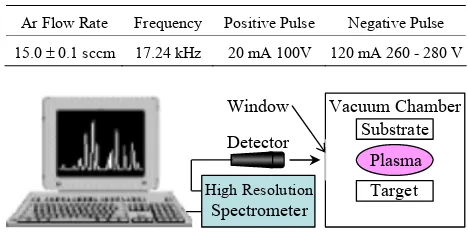
Optical emissions from plasma during sputter deposition of films were observed in the wavelength range of 360 - 800 nm using a high resolution spectrometer (the getSpec- 2048 spectrometer, Sentronic GmbH) as shown in Figure 2. The spectral lines were indexed to the ASD data
infor-mation of National Institute of Standards and Technology [4]. Crystal structures of as-deposited films were investi-gated by X-ray diffractometer (PW3043 Philips X-ray dif-fractometer of the Netherlands) at room temperature using CuKα radiation, = 0.15406 nm. Each film was meas-ured in the 2-theta angle range of 10˚ 2θ 70˚ with scan-ning rate of 0.02˚/s. Thin film thickness can be estimated from the optical interference using Tolansky’s Fizeau fringe method which is now accepted [5]. The thickness (t) of the
Table 1. Deposition conditions of thin films.
Ar Flow Rate Frequency Positive Pulse Negative Pulse
sccm kHz mA V mA - V
Plasma High Resolution
Spectrometer Window
Detector Substrate
Target Vacuum Chamber
Figure 2. Observation of optical emission from plasma during sputter deposition.
film is given by Equation (1) [6],
2
x t
x
(1)
where x is the displacement of fringes at step, x is the distance between consecutive fringes, and is the wave-length of monochromatic light. The experimental arrange-ment and fringe pattern is shown in Figure 3. The film thic-
kness was measured by the Ellipsometer (Model L 115 S 300, Gaertner Scientific Corporation, USA) for com-parison of the calculated values of thickness.
2.3. Thermoelectric Properties Measurements
The measurement of thermoelectric properties at room tem- perature in air by the Keithley instruments included the charge carrier, Seebeck coefficient, and electrical resistiv-ity. The experimental setups can be elucidated as follows.
Firstly, the charge carrier and Seebeck coefficient were determined by hot probe method [7,8] as shown in Fig-ure 4. The hot and cold junctions between across two ends
of a film were connected to the digital voltmeter (Keithley 617 Programmable electrometer). The temperatures TH
and TC were sensed using the type K thermocouples, which
were connected to the digital thermometers (7563 Digital thermometer, Yokogawa). The silicone thermal insulator pads were placed between junctions and thermocouples. The resistor of 10 W 5 was used to heat at hot junction by applying currents to a resistor placed on hot side. See-beck coefficient (S) was measured by the relation between thermoelectric voltage (V) and temperature difference (T). The S is defined as [8]:
V S
T
(2) Secondly, the electrical resistivity was measured by four- point probe method, which can be conveniently determined by the Van der Pauw resistivity measurement technique [9] as shown in Figure 5. All contacts were made by silver
[image:2.595.305.539.99.215.2]Glass Slide Substrate x x Monochromatic Light Eye Piece Fringe Pattern Partial Reflector
Film Thickness t xx 2 =
[image:3.595.97.248.88.254.2]Sample Film
Figure 3. Experimental arrangement for Tolansky’s Fizeau fringe method.
Film Silver Paste Silicone Pad Thermocouple
Wires
Glass Slide Substrate Silver Paste
Silicone Pad V
Digital Thermometers
[image:3.595.95.251.295.406.2]TC TH
Figure 4. Side view (vertical cross section) of charge carrier and Seebeck coefficient measurement.
Glass Slide Substrate Film a b c d V A
Figure 5. Three-dimensional top view of electrical resistivity measurement.
measurement of resistivity () are measured. The can be estimated from [9]
ab,dc bc,ad ab,dc
bc,ad π
ln2 2
R R R
t
F R
(3) where t is the film thickness, Rab,dc = Vdc Iab , Rbc,ad =
ad bc
V I
, and F is correction function which can be calculated from
Rab,dcRbc,ad
Rab,dcRbc,ad
F ln2
arccosh exp ln2
F
2.Finally, the thermoelectric efficiency can be examined from power factor (P), which was calculated from the S
and in Equation (4) [7,10].
3. Results and Discussion
The results and discussion of plasma, characterizations, and thermoelectric properties are given below.
3.1. Plasma and Characterizations
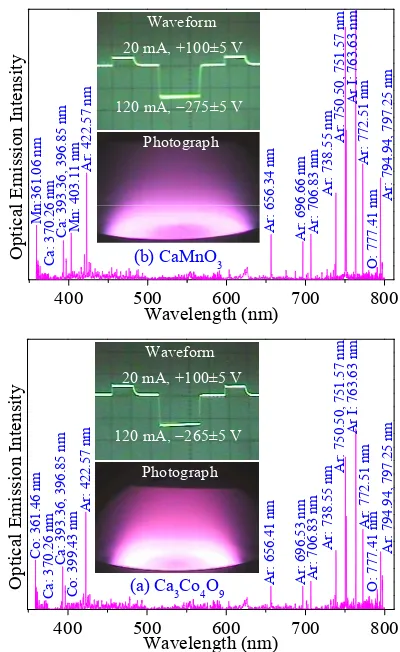
[image:3.595.322.522.382.708.2]The cathode voltage waveforms, photographs of stable glow discharges, and optical emission spectrums of the bi-polar pulsed-dc magnetron argon discharge during the sput- tering of the Ca3Co4O9 and CaMnO3 targets are shown in
Figure 6. These results indicated the good pulsed-dc plas-
ma characteristics. The spectral lines were indexed to the ASD data information of NIST [4]. It was found that the emission lines of Ar (422.57, 656.34, 696.66, 706.83, 738.55, 750.50, 751.57, 763.63, 772.51, 794.94 and 797.25 nm), Ca (370.26, 393.36 and 396.85 nm), Co (361.46 and 399.43 nm), and Mn (361.06 and 403.11 nm) were promi-nent features. The emission line of O (777.41 nm) was de-tected, but it is not intense due to the strong line of this species is not in measured range. The optical emission spectrums showed that Ca, Co, Mn, and O atoms were sputtered from the targets. Hence, it can be expected that
400 500 600 700 800
(b) CaMnO3
Ar : 696.6 6 nm Mn : 403. 11 nm O: 77 7.41 nm Ar: 794 .94, 79 7.25 nm Ar: 77 2.51 nm
Ar I: 76
3.63 nm Ar: 75 0.50, 7 51.57 nm Ar : 738.5 5 nm Ar: 706.83 nm Ar: 656.34 nm Ar: 422.57 nm C a: 393.36, 396.85 nm Ca : 37 0.26 nm Mn: 361.06 nm O pti ca l E m is si on In te ns ity Wavelength (nm)
20 mA, +100±5 V
120 mA, 275±5 V Waveform
Photograph
400 500 600 700 800
(a) Ca3Co4O9 Ar: 696.53 nm
Co: 39
9.43 nm
O: 777.4
1 nm
Ar: 794.9
4, 797.25 nm
Ar: 772.
51 nm
Ar I: 763.6
3 nm Ar: 750.50, 751. 57 nm Ar: 7 38.55 nm Ar: 706.83 nm Ar: 656. 41 nm Ar: 42 2.57 nm Ca : 393 .36, 396.85 nm C a: 370.26 nm C o: 361.46 nm O pti ca l E m is sio n In te ns ity Wavelength (nm) Waveform 20 mA, +100±5 V
120 mA, 265±5 V
Photograph
[image:3.595.109.234.444.561.2]the deposited films will contain these atomic species. From this point onward, the deposited films will be re-ferred to as Ca-Co-O and Ca-Mn-O containing. The as-deposited films of 1.60 1.60 cm2 and XRD patterns
are shown in Figure 7. From this figure clearly indicated
amorphous nature of the as-deposited films. This was expected since the substrates were not heated during the deposition process. Therefore, the kinetic energy of atomic species at the substrate surface was not enough to promote the growth of a crystal. Each film thickness was initially estimated using optical interference method (yel-low sodium light, = 589.3 nm) and was obtained from ellipsometic measurement (red laser light, = 632.8 nm). The results are given in Table 2. The results of
meas-urement gave the thickness of 435.31 nm and 449.35 nm for as-deposited Ca-Co-O and Ca-Mn-O films, respec-tively.
3.2. Thermoelectric Properties
The results of investigations on thermoelectric properties of Ca-Co-O and Ca-Mn-O films such as the types of charge carrier, Seebeck coefficient, electrical resistivity, and power factor are presented and discussed.
Firstly, the types of charge carriers were determined by hot probe method (see Figure 4). The result of
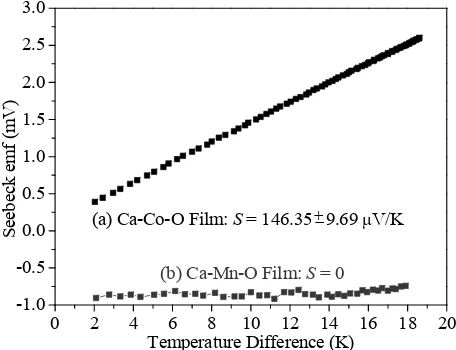
measure-ment on Ca-Co-O film, the cold junction showed higher voltage than the hot junction, indicating that the holes con-duction dominated transport property (p-type). The meas-urement results of relation between Seebeck emf (V) and temperature difference (T) are shown in Figure 8. Ca-
Co-O film indicated linear dependence between V and
10 20 30 40 50 60 70
Intensit
y (coun
ts)
2 (degree)
(a) As-deposted Ca-Co-O Film (a) As-deposted Ca-Mn-O Film
(b) As-deposited Ca-Mn-O Film
(a) As-deposited Ca-Co-O Film
(b)As-deposited Ca-Mn-O Film [image:4.595.309.537.86.261.2](a)As-deposited Ca-Co-O Film
[image:4.595.72.274.475.623.2]Figure 7. As-deposited Ca-Co-O and Ca-Mn-O films of 1.60 1.60 cm2 and XRD patterns.
Table 2. Thickness of the as-deposited Ca-Co-O and Ca-Mn-O films.
Samples Calculation (nm) Measurement (nm) Refractive Index
Ca3Co4O9 CaMnO3
~441.98 ~452.50
435.31 3.37
449.35 1.27
2.22 0.01
2.06 0.01
0 2 4 6 8 10 12 14 16 18 20
-1.0 -0.5 0.0 0.5 1.0 1.5 2.0 2.5 3.0
(b) Ca-Mn-O Film: S = 0
(a) Ca-Co-O Film: S = 146.35 9.69 V/K
Seebeck em
f (m
V)
Temperature Difference (K)
Figure 8. Seebeck emf of thin films as a function of tempera-ture difference (a) Ca-Co-O film and (b) Ca-Mn-O film.
T, the S of 146.35 V/K is obtained. Ca-Mn-O film bar-ing a high resistance was not the experimental determi-nation of charge carrier and Seebeck coefficient.
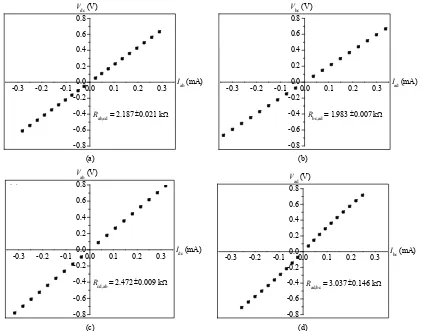
Secondly, the current-voltage characteristics were ob-tained by the Van der Pauw four-probe measurement (see
Figure 5). The experimental result of Ca-Co-O film is
shown in Figure 9. The plot exhibited good ohmic I-V
characteristics. The value obtained from this I-V plot, it is 0.473 cm. For the experimental measurement of Ca- Mn-O film could not be determined.
Finally, the power factor was calculated from S and in Equation: P S 2 . The result of Ca-Co-O film gave value of 4.53 µW/mK.
4. Conclusion
The preparation of Ca-Co-O and Ca-Mn-O thin films using a bipolar pulsed-dc magnetron sputtering system were successfully deposited on glass substrates from the Ca3Co4O9 and CaMnO3 targets, respectively. The XRD
patterns clearly indicated amorphous nature of the as-depo- sited films. Determining thermoelectric properties of Ca- Co-O film showed the low Seebeck coefficient and high electrical resistivity, which leaded to a low power factor. Ca-Mn-O film baring a high resistance was not an experi-ment. The post deposition annealing and doped metals have been expected candidates for good thermoelectric prop-erties. This will be further investigated.
5. Acknowledgements
[image:4.595.55.288.690.737.2]-0.3 -0.2 -0.1 0.0 0.1 0.2 0.3
-0.8 -0.6 -0.4 -0.2 0.0 0.2 0.4 0.6 0.8
Rab,cd = 2.187 0.021 k
Vdc (V)
Iab (mA) (a)
-0.3 -0.2 -0.1 0.0 0.1 0.2 0.3
-0.8 -0.6 -0.4 -0.2 0.0 0.2 0.4 0.6 0.8
Rbc,ad = 1.983 0.007 k
Vbc(V)
Iad (mA) (b)
(a) (b)
-0.3 -0.2 -0.1 0.0 0.1 0.2 0.3
-0.8 -0.6 -0.4 -0.2 0.0 0.2 0.4 0.6 0.8
Rcd,ab = 2.472 0.009 k
Vab (V)
Idc (mA)
(c)
-0.3 -0.2 -0.1 0.0 0.1 0.2 0.3
-0.8 -0.6 -0.4 -0.2 0.0 0.2 0.4 0.6 0.8
Rad,bc = 3.037 0.146 k
Vad(V)
Ibc (mA)
(d)
[image:5.595.87.509.83.414.2](c) (d)
Figure 9. Plot of the current-voltage characteristics for the electrical resistivity measurement of Ca-Co-O film (a) Iab-Vdc; (b) Iad-Vbc; (c) Idc-Vab and (d) Ibc-Vad.
[4] J. Curry, “NIST Atomic Spectra Database,” 2012. http://www.nist.gov/pml/data/asd.cfm
Science, Khon Kaen University (KKU) is gratefully ac-knowledged for kind help with preparation of thin films by an asymmetric bipolar pulsed-dc magnetron sputtering sys-tem and thermoelectric characterizations.
[5] S. Tolansky, “An Introduction to Interferometry,” Kong-mans, Green & Co. Ltd., London, 1955.
[6] K. Jayachandran, “Electrical, Optical and Structural Studies in Bismuth, Antimony, Bismuth Oxide and Antimony Oxide Thin Films,” Ph.D. Thesis, Mahatma Gandhi Uni-versity, Kerala, 1997.
REFERENCES
[1] D. A. Glocker, S. I. Shah and W. D. Westwood, “Hand-book of Thin Film Process Technology,” Institute of
Physics Publication, Philadelphia, 1995. [7] B. V. Zeghbroeck, “Principles of Semiconductor Devices,” 2011. http://ecee.colorado.edu/~bart/book/ [2] J. Sellers, “Asymmetric Bipolar Pulsed DC: The Enabling
Technology for Reactive PVD,” Surface and Coatings Technology, Vol. 98, No. 1-3, 1998, pp. 1245-1250.
doi:10.1016/S0257-8972(97)00403-9
[8] G. S. Nolas, J. Sharp and H. J. Goldsmid, “Thermoelec-trics: Basic Principles and New Materials Developments,” Springer-Verlag, Berling, 2001.
[9] L. J. van der Pauw, “A Method of Measuring the Resistivity and Hall Coefficient on Lamellae of Arbitrary Shape,” Philips Technical Review, Vol. 20, No. 8, 1958, pp. 220-224. [3] W. Somkhunthot, T. Burinprakhon, I. Thomas, V. Amorn-
kitbamrung and T. Seetawan, “Bipolar Pulsed-DC Power Supply for Magnetron Sputtering and Thin Films Synthe- sis,” Elektrika: Journal of Electrical Engineering, Vol. 9, No. 2, 2007, pp. 20-26.