ISSN Online: 2327-4379 ISSN Print: 2327-4352
DOI: 10.4236/jamp.2018.61017 Jan. 19, 2018 174 Journal of Applied Mathematics and Physics
Explicit Large Time Stepping with Third-Order
Exponential Time Differencing Scheme for
Hypersonic Chemical Non-Equilibrium Flow
Shiran Dai, Songping Wu
School of Aeronautic Science and Engineering, Beijing University of Aeronautics and Astronautics, Beijing, China
Abstract
In this paper, a third-order exponential time differencing scheme, named ETDRK3, was investigated for large time stepping in the computation of hypersonic non-equilibrium flow. The second-order Harten-TVD scheme was used for the spatial discretization. The efficient implementation of the scheme with diagonalization of Jacobin matrix was established and carried out for the semi-cylindrical around flow. Current observations showed that the numeri-cal results were in good agreement with those obtained by the classinumeri-cal explicit three-stage Runge-Kutta scheme (RK3) and implicit LU scheme. Efficiency assessments promised the effectiveness of the ETDRK3 scheme. The rational-ity of the application of this scheme was proved by its preferable accuracy and efficiency.
Keywords
Exponential Time Integrator, Hypersonic Chemical Non-Equilibrium Flow, Numerical Efficiency
1. Introduction
With the development of hypersonic vehicle, the numerical simulation of hypersonic flow field has been the frontier of aerodynamics research, of which hypersonic non equilibrium flow is one of the typical representatives. In recent years, significant development of high accuracy spatial discretization schemes has been made for computational fluid dynamics (CFD). Although these spatial schemes perform well in the simulation of hypersonic flow field and can be im-plemented efficiently by parallel techniques, their computational expense on time marching direction is still high. For time marching computation, the
expli-How to cite this paper: Dai, S.R. and Wu, S.P. (2018) Explicit Large Time Stepping with Third-Order Exponential Time Diffe-rencing Scheme for Hypersonic Chemical Non-Equilibrium Flow. Journal of Applied Mathematics and Physics, 6, 174-182. https://doi.org/10.4236/jamp.2018.61017
DOI: 10.4236/jamp.2018.61017 175 Journal of Applied Mathematics and Physics cit schemes are widely used because of their ease of application. However, in the presence of highly stretched grids, the Courant-Friedrichs-Lewy (CFL) condition leads to the usage of a tiny time-step, consuming a large CPU time. The implicit scheme is theoretically proved insensitive to the CFL condition. Nevertheless, the usage of implicit scheme needs to solve a large linear system at each iteration step, making the computation expensive. Recently, mathematicians have been developing an explicit method with large time step known as exponential time differencing [1] [2] [3]. Methods of this type offer very high accuracy and stabil-ity free from the severe time step restriction other explicit schemes present. For a recent review, see [4] and the references therein. Despite this alternative strategy has attracted increased attention in a number of diverse fields and obvious ad-vantages have been found, there are few applications in computational fluid dy-namics (CFD). That probably because the efficiency of the traditional algorithm for evaluating the exponential of Jacobin matrix in this class of methods is in-adequate [5]. In order to avoid this limitation, we modified the existing schemes [6] by using a diagonalization method for the Jacobin of non-viscous flux in the governing equation. The performance, accuracy and efficiency, of exponential time differencing scheme in the simulation of hypersonic chemical non-equilibrium flow was then assessed in this paper.
2. Governing Equations and Numerical Method
2.1. Governing Equations
The governing equation is the two-dimensional N-S equation with chemical reaction source term in general coordinates
,
v v
F G
Q F G
J S
t ξ η ξ η
∂ ∂
∂ +∂ +∂ = + + ⋅
∂ ∂ ∂ ∂ ∂ (1) where,
(
)
(
)
(
)
1 2 1 2 1 1 1 1 1 1 , , , , , , , , , , , , ( ) , , , , , , ( ), , , 0, , ,
, , , 0, , ,
, , T ns T ns T ns T s
v s xx xy xx xy x
T s
v s yx yy yx yy y
Q u v e
F u u u u p uv e p u
G v v v vu v p e p v
Y Y
F D D u v q
x x
Y Y
G D D u v q
y y
S
ρ ρ ρ ρ ρ
ρ ρ ρ ρ ρ
ρ ρ ρ ρ ρ
ρ ρ τ τ τ τ
ρ ρ τ τ τ τ
ω = = + + = + + ∂ ∂ = + + ∂ ∂ ∂ ∂ = + + ∂ ∂ =
(
ωns, 0, 0, 0, 0, 0)
T(2)
in the proceeding expressions, ρk k,=1,2,...,ns is the density of the species.
1 ns k k ρ ρ =
=
∑
is the total density, u v, are the speed in the general direction, e isDOI: 10.4236/jamp.2018.61017 176 Journal of Applied Mathematics and Physics The quantity J is the coordinate transformation matrix.
The chemical source terms ws represent the production of species from fi-nite rate chemical reactions [7]. In the study, a five-species air chemistry model is used, that are N O N O NO2, 2, , , .
2.2. Exponential Time Differencing Scheme
The start point of our derivation is the spatial discretization. In the study, we used the second-order Harten-Yee TVD scheme [8] to discrete the non-viscous flux F G, , the viscous flux F Gv, v were approximated by the central difference. Then the original Equation (1) can be converted to ordinary differential equa-tions (ODE)
d
( ) dt =
Q Q
R , (3)
with Q=Q
( )
x,t is the exact solution, R is the right hand term obtained bythe spatial discretization above.
Splitting the right hand term of Equation (3) into
(
α n β n)
Q( )
Q t,= + +
R A B N , (4)
where,
α β
= =1 are adjustable parameters andn n
ij ij
n n
ij ij
n Q Q
n Q Q
x y x y ξ ξ η η ∂ ∂ = + ∂ ∂ ∂ ∂ = + ∂ ∂
A A B
B A B
. (5)
In Equation (5), the terms A F,B G
Q Q
∂ ∂
= =
∂ ∂ denote the Jacobin matrix of the non-viscous flux F and G , the term N Q t
( )
, = −R(
αAn+βB Qn)
is anon-linear remainder. For notation simplification, we note K=αAn+βBn and
(
,)
n n
Q =Q xt . Then the Equation (3) can be written as
( ( ) ) ( ( ))
n n
dQ
R K Q t Q N Q t
dt = + − + (6)
Multiplying the both sides with Kt
e− and then integrating over a single time
step [ ,t tn n+h], we can obtain the basic expression of exponential time
diffe-rencing method [3]
(
)
1 0 ( , ) .
h
Kh Kh K
n n n n
Q+ =e Q +e
∫
e− τN Q t +τ t +τ τd (7)Define a function 1 (1 ) 0
1 ( )
z
z s e
z e ds
z
ϕ = − = −
∫
, and then the Equation (7) can be expressed as1
(1 )
1
0
( ) hK s ( )
n n n
Q+ =Q +hKϕ hK Q +h e
∫
− N Q ds. (8)DOI: 10.4236/jamp.2018.61017 177 Journal of Applied Mathematics and Physics compute the hypersonic chemical non-equilibrium flow, which is expressed as
1
2 1
1 1 2
1 ( ) ( ) 2 1 4 ( ) ( ) 2 3
(13 3 )
16
n
n
n n
k hK N U
k hK N U hk
h
U U k k
φ φ + = = + = + +
. (9)
2.3. Evaluation of the Exponential Function of Jacobi
In the practical implementation, diagonalize K in1
R R−
= Λ
K , (10) In the expression (10), R and R−1 are the right and left eigenvector matrix,
Λ is the characteristic matrix with the diagonal elements
1 kc, 2 3 , 4 kc
λ θ= − λ =λ θ λ= = +θ , (11)
where
1 2
2 2 1 2
1 2 1 2
1 2 1 2
, ,
, , ,
,
k k
x x y y
k k
k k k k k
k k
k u k v k u k v k
ξ η ξ η
α β α β
θ θ θ ∂ ∂ ∂ ∂ = + = + ∂ ∂ ∂ ∂ = + = = = + = = +
. (12)
Founding that for a related exponential function
ϕ
we have(
1)
( )
1( ) ( ) ( ) ( )
11 , 2 , 3 , 4
R R R R Rdiag R
ϕ Λ − = ϕ Λ − = ϕ λ ϕ λ ϕ λ ϕ λ −
. (13)
The evaluation of the exponential related function of Jacobin
ϕ
can be con-verted to the evaluation of the related exponential function of the diagonal ele-ments of Λ, the efficiency of implementation will be much improved.3. Comparison Parameter
The first comparison parameter used in this paper is the CFL number defined as
max t
CFL x
λ ∆ =
∆ , (14) In expression (13) λmax is the maximum of the eigenvalues. Greater CFL number indicates larger time step and better efficiency. Classical explicit schemes such as the various Runge-Kutta schemes are usually inefficient to solve complex flow problems because of the restriction of CFL number. However, the exponen-tial time differencing scheme do not suffer from this limitation and can run a larger CFL number. To assess the efficiency of the ETDRK3 scheme developed, the baseline solutions computed by the third-order TVD Runge-Kutta scheme noted as RK3 scheme and implicit LU scheme [10] were given for the perfor-mance comparison.
DOI: 10.4236/jamp.2018.61017 178 Journal of Applied Mathematics and Physics the maximum of the pressure difference between current time step and previous time step on the mesh was used and expressed as
1 max 1 ,
L n n
R = P+ −P (15)
A residual of quantity 10−3 can be regarded as the convergence condition.
4. Numerical Results and Analysis
The test case is a hypersonic two-dimensional cylindrical round flow problem at Mach number 20 which represents a typical external flow application. The free stream conditions are given as follow:
3 3
1.0269 10 kg/m ,
ρ −
∞ = ×
270.65 K,
T∞=
Mass fraction N2 =0.7655 Mass fraction O2=0.2345
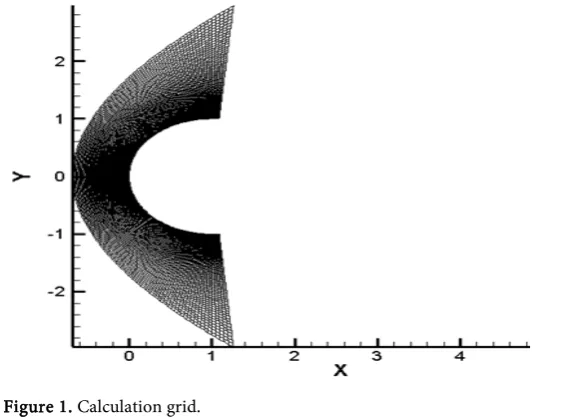
The boundary conditions used in the calculations were as follows: Along the inflow plane, free stream values are maintained. Along the outflow plane, values are obtained by extrapolation. A constant temperature of 1000 K was maintained on the body surface that was assumed to be non-catalytic. Nonslip and zero pressure gradient conditions were enforced. The 180 × 200 grid given by the al-gebraic generation method is shown in Figure 1.
[image:5.595.240.527.515.724.2]Figure 2 gives the residuals evaluation during 45,000 evaluations of ETDRK3 scheme at CFL = 0.7, which is the best CFL number for ETDRK3. The conver-gence performance was further compared with the errors obtained by the RK3 scheme at a maximum allowable CEL number 0.3 and fully implicit LU scheme at the same CFL 0.7. All of the three schemes can convergence at a low residual at about 10−3. The ETDRK3 scheme has a similar convergence performance to the LU scheme, which indicates the ETDRK3 scheme has the same accuracy as the LU scheme.
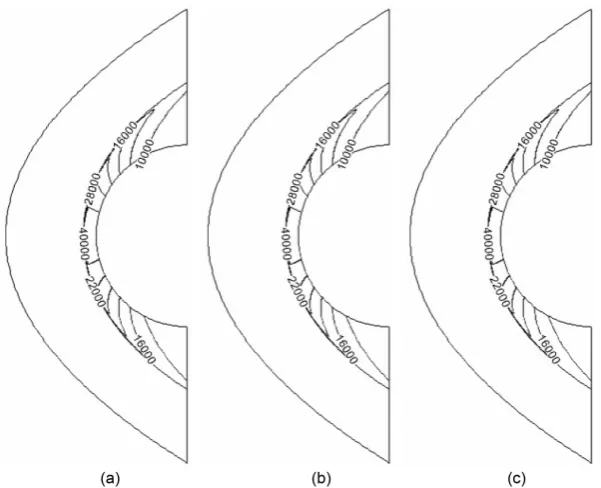
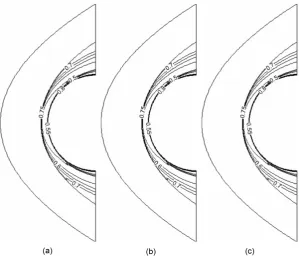
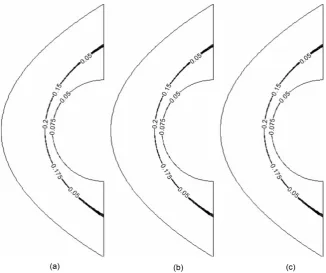
DOI: 10.4236/jamp.2018.61017 179 Journal of Applied Mathematics and Physics Figures 3-6 represent separately the pressure distribution, the temperature distribution, the mass fraction of N2 and the mass fraction of O2 computed by ETDRK3 (CFL0.7), RK3 (CFL0.3) and LU (CFL0.7) at 45,000 steps. We can see a clear shock wave in the three figures. After the shock wave the pressure and temperature augmented, chemical reaction happened significantly which leads
Figure 2. Residuals evaluation during 45000 iterations for RK3 at CFL 0.3, ETDRKS at CFL 0.7 and LU at CFL 0.7, the three schemes can all convergence and have a similar convergence performance.
DOI: 10.4236/jamp.2018.61017 180 Journal of Applied Mathematics and Physics
Figure 4. Temperature distribution/K obtained by (a) ETDRK3 at CFL = 0.7; (b) LU at CFL = 0.7 and (c) RK3 at CFL = 0.3.
Figure 5. Mass fraction distribution of N2 obtained by (a) ETDRK3 at CFL = 0.7; (b) LU at CFL = 0.7 and (c) RK3 at CFL = 0.3.
[image:7.595.224.524.362.618.2]DOI: 10.4236/jamp.2018.61017 181 Journal of Applied Mathematics and Physics After the accuracy assessment above, the efficiency of the three schemes were compared by counting the Wall time at 45,000 iterations and the CPU time for a i7-2600 CPU 3.40 GHz. Table 1 gives the CPU time and wall time of each scheme. The result shows obviously that the CPU time of ETDRK3 is much more less than RK3 and LU. Moreover, it was also observed that ETDRK3 scheme is the fastest one in term of wall time. With the equitable convergence steps, the efficiency comparison of the three schemes proved a preferable effi-ciency of the ETDRK3 scheme.
5. Concluding Remarks
[image:8.595.211.538.295.568.2]In this paper, we used the ETDRK3 scheme in the computation of hypersonic non-equilibrium flow. This scheme was compared with explicit RK3 scheme and implicit LU scheme. The numerical results were parallel with that of theory. The convergence comparison revealed that the ETDRK3 scheme could achieve the
Figure 6. Mass fraction distribution of O2 obtained by (a) ETDRK3 at CFL = 0.7; (b) LU at CFL = 0.7 and (c) RK3 at CFL = 0.3.
Table 1. Efficiency comparison of the three schemes.
Scheme name CFL number, wall time and CPU time for 45,000 steps
CFL Wall time/s CPU time/min
RK3 0.3 5.08 922.5
LU 0.7 11.3 577.8
ETDRK3 0.7 12.3 319.9
[image:8.595.207.540.633.711.2]DOI: 10.4236/jamp.2018.61017 182 Journal of Applied Mathematics and Physics same accuracy as LU scheme. Efficiency assessment showed that ETDRK3 scheme cost much less CPU time than the two other schemes while outperforms in term of wall time. We can conclude from the assessments that the ETDRK3 scheme is reasonable an alternative time marching scheme in hypersonic chem-ical non-equilibrium flow. Further study will focus on larger CFL number for ETD schemes. The application of ETD schemes on three-dimensional problems will also be investigated in the future work.
Acknowledgements
This work was supported in part by National Nature Science Foundation of China (NSFC 91530325).
References
[1] Calvo, M.P. and Palencia, C. (2005) A Class of Multistep Exponential Integrators for Semilinear Problems. Submitted.
[2] Certaine, J. (1960) The Solution of Ordinary Differential Equations with Large Time Constants. Mathematical Methods for Digital Computers, Wiley, New York, 128-132.
[3] Hochbruck, M., Lubich, C. and Selhofer, H. (1998) Exponential Integrators for Large Systems of Differential Equations. SIAM J. Sci. Comput., 19, 1552-1574.
https://doi.org/10.1137/S1064827595295337
[4] Hochbruck, M. and Ostermann, A. (2010) Exponential Integrators. Acta Numer., 209, 209-286. https://doi.org/10.1017/S0962492910000048
[5] Li, S.-J., Wang, Z.J., Ju, L.L. and Luo, L.-S. (2017) Explicit Large Time Stepping with a Second-Order Exponential Time Integrator Scheme for Unsteady and Steady flows. AIAA SciTech Forum, 2017. https://doi.org/10.2514/6.2017-0753
[6] Ostermann, H.M. and Schwitzer, J.A. (2009) Exponential Rosenbrock-Type Me-thods. SIAM J. Numer. Anal., 47, 786-803. https://doi.org/10.1137/080717717
[7] Palmer, G. and Venkatapathy, E. (1995) Comparison of Non-Equilibrium Solution Algorithms Applied to Chemically Stiff Hypersonic Flows. AIAA.J., 33, 1211-1219.
https://doi.org/10.2514/3.12673
[8] Yee, H.C. and Harten, A. (1985) Implicit TVD Schemes for Hyperbolic Conserva-tion Laws in Curvelinear Coordinate. Aiaa Journal, 25, 266-274.
https://doi.org/10.2514/3.9617
[9] Cox, S.M. and Matthews, P.C. (2002) Exponential Time Differencing for Stiff Sys-tems. J. Comp. Phys., 176, 430-455. https://doi.org/10.1006/jcph.2002.6995
[10]Shuen, J.-S. (1992) Upwind Differencing and LU Factorization for Chemical Non-Equilibrium Navier-Stokes Equations. J.Comp.Phys., 99, 233-250.
https://doi.org/10.1016/0021-9991(92)90205-D