An Efficient Cancer Disease Prediction System through
Quantum Computing Technique
Milan Jain Setu Kumar Chaturvedi, Ph.D
M. Tech. Research scholar Professor & HeadDept. of Computer Science and Engineering Dept. of Computer Science and Engineering Technocrats Institute of Technology, Bhopal Technocrats Institute of Technology,
Bhopal
ABSTRACT
Diagnosis and exact recommendation for a cancer patient is very much sensitive and of greater influencing in cure of this diseases. Traditionally the diagnosis procedure was very time consuming and not so accurate, so here in this respect there is a need of more accurate, fast and easily to understand method / diagnosis tool which gives reliable results. Here we use the shor algorithm, Hce tool and we get accurate and frequent result, when we adopt the approach of quantum computing with the traditional tools of diagnosis.
Index Terms
Cancer, Cancer classification, Quantum Computing, Quan-tum Algorithm, Hierarchical Clustering Explorer.
1 INTRODUCTION
A Quantum computing is one of the fastest growing areas of research and technical field, which revolves two area of cen-tury computer science and quantum mechanics and both of the field having its own importance. It is used for the calculation for searching anything on internet, modelling the national economy, forecasting the weather etc. A simple computer operate any operation at a time due to this it takes too time for solve the problem and this is overcome by quantum computer [26]. Quantum computing is an emerging technology. The key to improving computer performance has been the reduction of size in the transistors used in modern processors [24]. The quantum computer is one proposal that may have merit in dealing with the problems presented.
The performance of a computer is improved, according to Moore’s law, if the performance keeps improving by means of technological innovations, which have occurred over the last few decades, the number of transistors per chip may be dou-bled every 18 months. Furthermore, processor clock fre-quency could reach as much as 40 GHz within 10 years [6]. In this way, quantum computers can be used to solve certain computationally intense problems where classical computers require large amounts of processing time. Notwithstanding, further improvements will be necessary to ensure quantum computers’ proper performance in future, but such improve-ments seem obtainable. Currently, there exist some algorithms utilizing the advantage of quantum computers. For instance, the polynomial-time algorithm for factoring a large integer with O (n3) time was proposed by Peter Shor [21]. This algo-rithm performs factoring exponentially faster than classical computers. This algorithm could factor a 512-bit product in about 3.5 hours with 1 GHz clock rate [20], whereas the num-ber field sieve could factor the same product in 8400 MIPS years [4]. (One MIPS year is the number of instructions that a processor can execute in a year, at the rate of millions of
in-Feynman thought up the idea of a 'quantum computers', a device which uses the effects of quantum mechanics to its advantage [9]
In the classical model of computing, the most common build-ing block is bit, it can only lie in two distinct states, 0 or 1. In quantum computers the rules are changed [8],[9],[25]. Not only can a 'quantum bit', usually referred to as a 'qubit', exist in the classical 0 and 1 states, this also be in a coherent super-position of both states. In 1982, Feynman states that quantum computers would be able to simulate quantum mechanics systems with a highly greater degree of accuracy than is pos-sible with classical computers [22].
1.1 Cancer
It stands for malignant neoplasm, which is class of diseases involving out of control cell growth. This can harm the body due to spread of damage cells in different part of body by blood stream. All the tumours are not a cancer tumours, the starting tumour is not entering into neighbouring tissue and not transfer over body. Humans are affected by 200 different known cancers [5].
The cancer is undefined as a result the cells grow uncontrolla-ble. The cancer causes are diverse, tough, and only half under-stood. There are many reasons which are responsible for can-cer like use of tobacco, user diet, alcohol, some infections, radiation, poor in physical activity, and environmental pollut-ants [3]. These source can injured or combine genes with pre-sent genes due to which cells to cause cancerous mutations [18]. Near about 5–10% cancers find directly for inherited genetic defects [2]. The detection of Cancer can be done by number of ways like presence of some signs and symptoms, screen testing, microscopic examination of a tissue sample. There are many possibilities of surviving this disease by its type and where the cancer is situated. Cancer can harm all age’s person, and some types of cancer are famous in children and possibility of increasing cancer with age. The survey in 2007 the 13% of all human deaths worldwide (7.9 million) by causing cancer. In the developing world the Rates are increase due to people live to an old age and the change in lifestyle [17].
1.2 History of Cancer
ney sweeps [14]. In the 18th century, it discovered ‘cancer poison' pass from the primary stage by lymph nodes to other stage ("metastasis") and first formulated by the English sur-geon Campbell De Morgan between 1871 – 1874[11].
2 LITERATURE SURVEY
This section reviews the current literature and related work in the areas of cancer with different methods and technology through examination of various research papers, journals and online resources.
A. E. Kaplan, P. Meystre. In this paper, a method for makes possible the analysis of the most fundamental aspects of light-matter interaction, and promises uprecedented accuracy in the determinant. [1]
Craig S. Lent and P. Douglas Tougaw.This paper provides a paradigm for computing with interacting quantum dots, quan-tum-dot cellular automata (QCA). Arrays of quanquan-tum-dot cells could be used to perform useful computations. [7]
Fortunato Bianconi, Valerio Brunori, Paolo Valigi, Francesco La Rosa, and Fabrizio Stracci. In this paper, it present a mod-ern web-based management system that allows to integrate different sourcing, validation and data elaboration thus provid-ing a new evaluation system for the oncology network based on cancer registries.[10]
Hualong Yu1, Jun Ni2, Yuanyuan Dan3, Sen Xu4. This paper presents a skewed gene selection algorithm that introduces a weighted metric into the gene procedure. [15]
Huseyin Seker, Student Member, Michael O. Odetayo, Do-brila Petrovic, and Raouf N. G. Naguib. The aim of this paper is to investigate the fuzzy –nearest neighbor (FK-NN) classi-fier as a fuzzy logic method that provides a certainty degree for prognostic decision and its markering. [16]
Lipo Wang, Feng Chu, and Wei Xie. This paper is an attempt to finding the smallest set of genes that can ensure highly accurate classification of cancers from microarray data by using SVM algorithms.[19]
Shi Kuifan , Chen Yuehui , Dong Jiwen . This paper briefly reviews some neural networks and discusses aboutdisadvan-tages. [23]
3 PROPOSED METHODOLOGY
[image:2.595.326.568.92.316.2]Here user try to collaborate these two the science of quantum computing and the techniques of cancer detection under the same hut, for accuracy of medicine technique of cancer detec-tion and for faster the process which in the mean time benefit the different folks who fight the cancer for welfare of man-kind.
Figure 3.1 Proposed model for cancer by Shor Technique
3.1 Proposed Algorithm
Basically seven steps are used which are given below Step1 Apply Cancer tumour size a.
Step2 Apply the number N is the number we wish to factor-ize.
Step3 Apply random number X, where 1<X<N-1. Step4 Result by Shor technique.
Step5 Comparing cancer value and proposed values. Step6 Result.
4 EXPERIMENTAL SETUP
4.1 Data Filtering
4.1.1 Present call filtering
There are two outputs from the noise calculations; one is the continuous p value assignment, and the other is a simple pre-sent/absent threshold. When the probe set detection p value reaches a certain level of significance, then the probe set is assigned a current call and other whose probe sets having less noise ratios are assigned as absent call.
4.1.2 Standard deviation filtering
Users can filter out rows based on the standard deviation. The default threshold is 1.
4.2 Data Transformation
4.2.1 Log transformation (Natural log)
Users sometimes want to transform the variable to get a good output.
4.2.2 Normalization
Users can normalize the input data either row-to-row or col-umn-to-column.
Values will be standardized, means calculate mean from deviation and then divide the devia-tion by the standard deviadevia-tion. After standardiza-tion, each row (, or column) will have the same mean (0) and the same standard deviation (1).
Simply divide values by the value which is from first column or row.
Simply divide values by the median.
rescale to a new range
Linearly transform each row or each column to get the values of new range.
Table 4.1 Normalization of input data
4.3 Linkage method
When hierarchical clustering algorithm merges two clusters to generate a new bigger cluster, it should calculate the distances of the previous and next clusters. We have 5 different linkage methods. Let Cn be a new cluster, a merge of Ciand Cj. Let Ck
be a left. Average Linkage (UPGMA : Unweighted Pair Group Method with Arithmetic Mean)
(1)
Average Group Linkage (Centroid Linkage) :
Complete Linkage :
(3)
Single Linkage :
(4)
Shneiderman's 1by1 Linkage :
Let Cn-1 be the newly merged cluster in the previous iteration.
Let Cm be the closest cluster to Cn-1, and Cp be the closest
cluster to Cm.
If |DIST(Cn-1,Cm) - DIST(Cm,Cp)|<THRESHOLD, merge Cn-1
and Cm instead of searching two new closest clusters globally.
4.4 Choose a distance/similarity measure
The formula for Pearson’s correlation is as follows.
It can be used if the numbers are converted into z scores:
where zx is the variable X converted into z scores and zy is the
4.5 Experiment Results and Analysis
4.5.1 Experiments Performed on Original Dataset of Can-cer
ID TR
T
AG E
WEI GHI N
STA GE
TO- TAL-CIN
TO-TAL CW2
TO-TAL CW4
TO-TALC W6
1 0 52 124 2 6 6 6 7
11 0 59 175.8 2 6 7 16 13
15 0 69 167.6 1 6 6 6 11
26 0 56 158 3 6 11 15 15
39 0 46 149 4 7 8 11 11
14 1 42 162.6 1 4 6 8 7
16 1 44 261.4 2 6 11 11 14
24 1 68 226 4 12 11 12 9
42 1 73 181.5 0 8 11 16 .
44 1 67 187 1 5 7 7 7
50 1 60 164 2 6 8 16 .
58 1 54 172.8 4 7 8 10 8
Table 4.2 Dataset of Traditional Cancer Technique
4.5.2 Experiments Performed on Proposed Dataset of can-cer
NAME ID AG
E
a X N SHO
R
Ankya 22 20 2 2 3 1
Sujit 10
2
81 2 4 7 2
Dinesh 46 41 3 5 8 5
Ruchi 68 55 7 6 7 6
Kiran 88 33 1 7 9 0
Simple 70 58 3 8 1
0 2
Rohan 11
4
75 4 9 1
1 5
Pradeep 52 41 4 1
0 1 3
3
Servesh 12 5
34 1 4 9 0
Vinay 75 43 6 6 1
1 5
Asish 19
0
46 4 5 9 4
Shati 76 56 1 7 1
0 0
Upen-dra
10 8
62 3 7 1
0 3
Kapil 77 45 3 7 1
1 2
Sanjeev 16 47 4 8 1
1 4
San-chita
11 0
62 2 9 1
3 3
Shobhit 79 50 3 2 5 3
Nirupm a
40 50 2 1
1 1 5
1
Sheetal 41 87 4 1
2 1 7
3
Rakesh 21 52 2 4 2 0
Table 4.3 Dataset by Shor Technique
5 RESULTS
The comparative results analysis of Traditional Cancer Tech-nique and shor techTech-nique.
5.1 Dendrogram Display by Traditional Cancer Tech-nique
Graph 5.1 Results for Traditional Cancer Technique
5.2 Dendrogram Display by Shor Technique
5.3 Table View by Traditional Cancer Technique
5.4 Table view by Shor
NAME X SHOR A N ID AGE
Sheetal Rakesh Nirupma Shobhit Sanchita Sanjeev Kapil Upendra Shati Asish Vinay Servesh Pradeep Rohan Simple Kiran Ruchi Dinesh -0.66 -0.49 -0.83 -0.50 -0.62 -0.62 -0.60 -0.57 -0.65 -0.43 -0.52 -0.48 -0.72 -0.59 -0.64 -0.57 -0.49 -0.64 -0.69 -0.59 -0.88 -0.50 -0.60 -0.62 -0.64 -0.57 -0.68 -0.43 -0.55 -0.50 -0.78 -0.57 -0.67 -0.61 -0.53 -0.53 -0.39 -0.38 -0.35 -0.53 -0.45 -0.35 -0.46 -0.47 -0.45 -0.42 -0.52 -0.41 -0.41 -0.47 -0.46 -0.38 -0.53 -0.53 -0.22 -0.49 -0.14 -0.43 -0.35 -0.15 -0.32 -0.39 -0.35 -0.36 -0.33 -0.30 -0.25 -0.43 -0.39 -0.32 -0.49 -0.37 0.59 0.53 1.19 1.99 2.05 0.18 2.03 2.04 1.84 2.30 2.07 2.28 1.78 1.95 1.75 2.20 1.80 1.70 2.13 2.18 1.72 1.04 0.86 2.25 0.89 0.90 1.18 0.18 0.87 0.25 1.21 1.05 1.32 0.45 1.31 1.42
ID NAME TOTALCIN TOTALCW2 TOTALCW6 TOTALCW4 TRT STAGE AGE WEIGHT
Sujit
Ankya
-0.56
-0.52
-0.56
-0.63
-0.51
-0.52
-0.44
-0.41
1.80
1.67
1.30
1.45
Table 5.3 shows the result of Traditional Cancer Technique which shows Minimum and maximum value of dataset, dis-played using bar graph in following graph 5.1. Table 5.4 shows the result of Shor Technique which shows Minimum and maximum value of dataset, displayed using bar graph in following graph 5.2.
5.5 Profile Search by Traditional Cancer Diagnosis
Graph 5.3 Result for parallel patient by Traditional Can-cer Diagnosis
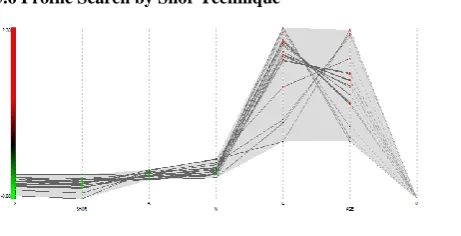
5.6 Profile Search by Shor Technique
Graph 5.4 Result for parallel patient by Shor Cancer Di-agnosis
Figure 5.3 shows the result of Profile search by Traditional Cancer Technique and this graph shows the report of all the Cancer Patient Diagnosis by Cancer Technique and Figure 5.4 shows the result of Profile search by Shor Technique and this graph shows the report of all the Cancer Patient Diagnosis by Shor Technique.
6 CONCLUSIONS
With classical computers gradually approaching their limit, the quantum computing promises to deliver a new level of computational power. A quantum computer have power to perform calculations across the multitude of parallel universes gives it the ability to quickly perform tasks that classical com-puter will never be able to practically achieve.
A quantum computing user start work after diagnoses of can-cer, and by quantum analysis we get exact dataset and with the help of this we can increase the accessing speed .It provide an interrelation and make a more appropriate approach for accu-rate disease detection.
7 REFERENCES
[1] A. E. Kaplan, P. Meystre “Quantum Electronics on the Quantum and Nonlinear Optics of Single Atoms, Ions, and Electrons”. In IEEE Journal of quantum electronics, vol. qe-23, no. 1, January1987.
[2] American Cancer Society. Retrieved July 22, 2013. [3] Anand P, Kunnumakkara AB, Kunnumakara AB,
Sunda-ram C, Harikumar KB, Tharakan ST, Lai OS, Sung B, Aggarwal BB ,"Cancer is a preventable disease that re-quires major lifestyle changes". Pharm. Res. 25 (9): 2097–116. doi:10.1007/s11095-008-9661-9. PMC 2515569. PMID 18626751, September 2008. [4] B. Preneel (Ed.), Factorization of a 512-bit RSA modules,
Lecture Notes in Computer Science, Vol. 1807 (Berlin: Springer- Verlag, 2000).
[5] Cancer Research UK "How many different types of cancer are there, CancerHelp UK", Retrieved 11 May 2012. [6] C.P. Williams & S.H. Clearwater, Exploration in quantum
computing (New York: Springer-Verlag, 1997). [7] Craig S. Lent and P. Douglas Tougaw “A Device
Archi-tecture for Computing with Quantum Dots” .In Proceed-ing of the IEEE, Vol. 85, No. 4, April 1997.
[8]Cue the qubits: Quantum computing - How to make a quantum computer. The Economist Volume 342 Issue 8005
[9] David Deutsch ,Quantum computation., Physics World, 1/6/92
[10] Fortunato Bianconi, Valerio Brunori, Paolo Valigi ,Francesco La Rosa, and Fabrizio Stracci, Information Technology as Tools for Cancer Registry and Regional Cancer Network Integration, IEEE Transaction on sys-tem, man and cybernetics-part A:systems and humans, VOL. 42, NO. 6, November 2012.
[11] Grange JM, Stanford JL, Stanford CA ,"Campbell De Morgan's 'Observations on cancer', and their relevance today". Journal of the Royal Society of Medicine 95 (6): 296–9. doi:10.1258/jrsm.95.6.296. PMC 1279913. PMID 12042378, (2002).
[12] Hajdu SI, Thun, MJ, Hannan, LM, Jemal, "A note from history: landmarks in history of cancer, part 1, Cancer 117 (5): 1097–102. doi:10.1002/cncr.25553. PMID 20960499, (March 2011).
[13] Hajdu SI, Thun, MJ, Hannan, LM, Jemal, "A note from history: landmarks in history of cancer, part 2.". Cancer 117 (12): 2811–20. doi:10.1002/cncr.25825. PMID 21656759 ,(June 2011).
[14] Hajdu SI, Thun, MJ, Hannan, LM, Jemal, "A note from history: Landmarks in history of cancer, part 3.". Cancer 118 (4): 1155–68. doi:10.1002/cncr.26320. PMID 21751192 , (July 2011).
[image:6.595.46.549.74.123.2] [image:6.595.57.288.358.476.2]Sci-ence and technology ISSNll1007-0214ll07/10llpp666-673 Volume 17, Number 6, December 2012
[16] Huseyin Seker, Michael O. Odetayo, Dobrila Petrovic, and Raouf N. G. Naguib, A Fuzzy Logic Based-Method for Prognostic Decision Making in Breast and Prostate Cancers, IEEE transaction on information technology in biomedicine , VOL. 7, NO. 2, JUNE 2003.
[17] Jemal A, Bray, F, Center, MM, Ferlay, J, Ward, E, For-man, D "Global cancer statistics", CA: a cancer journal for clinicians 61 (2): 69–90. doi:10.3322/caac.20107. PMID 21296855, (February 2011).
[18] Kinzler, Kenneth W.; Vogelstein, Bert, The genetic basis of human cancer , New York:McGraw-Hill, Medical Pub. Division. p. 5. ISBN 978-0-07-137050-9,(2002). [19] Lipo Wang, Feng Chu, and Wei Xie “Accurate Cancer
Classification Using Expressions of Very Few Genes”. In IEEE/ACM Transaction On Computational biology and bioinformatics, Vol. 4, No. 1, January-March 2007.
[20]M. Oskin, F.T. Chong, & I. Chuang, A practical architec-ture for reliable quantum computers, IEEE Computer, 79–87, January2002.
[21] P.W. Shor, Algorithm for quantum computation: Discrete logarithm and factoring, Proc. 35th IEEE Annual Symp. On Foundations of Computer Science, Santa Fe, NM, 24–134, November 1994.
[22] Seth Lloyd ,Universal Quantum Simulators, Science 23/8/96
[23] Shi Kuifan , Chen Yuehui , Dong Jiwen, Classification of Cancer Cells Using Neural Networks in Combination with Expert Experience, Tsinghua Science and technol-ogy,ISSN 1007-0214 22/ 23 pp853-855 Volume2, Num-beri December 1997
[24] Tom Thompson ,When silicon hits its limits, Byte 1/4/96 [25]Two-bit heroes - Computing with quanta. The Economist
Volume 338 Issue 7948