Properties of Stabilized Peat by
Soil-Cement Column Method
Roslan Hashim
Department of Civil Engineering, University of Malaya, Malaysia E-mail: [email protected]
Md. Shahidul Islam
Department of Civil Engineering, University of Malaya, Malaysia E-mail: [email protected]
ABSTRACT
A field model study has been carried out to stabilise peat soil using various types of binder by deep mixing method and to investigate its effect on engineering properties. Some soil-cement model columns have been constructed at site and different mechanical properties of stabilised peat, like undrained shear strength, unconfined compressive strength and shear strength was determined after 14 days of curing time. Scanning Electron Micrograph (SEM) and Energy Dispersive X-Ray (EDX) test were also conducted to observe the microstructure of stabilised peat soil. From the test result it was observed that the engineering properties of peat soil can be improved by stabilisation using additives.
KEYWORDS:
Binder, bearing capacity, microstructure, deep mixing method, strength.INTRODUCTION
Peat exhibits very high compressibility, low strength and bearing capacity (Hashim and Islam, 2008) and poses serious problems in construction industry due to its long-term consolidation settlements even when subjected to a moderate load (Jarret, 1995). Hence, peat is considered unsuitable for supporting foundations in its natural state.
Deep soil stabilisation technique is often an economically attractive alternative to removal of deep peat or use as deep foundation. The essential feature of deep soil stabilisation is that columns of stabilised material are formed by mixing the soil in place with a ‘binder’ and the interaction of the binder with the soft soil leads to a material which has better engineering properties than the original soil (Hebib and Farrell, 2003). This method is often applied on many geotechnical and foundation applications such as the stabilisation of deep excavations or high embankments, the reduction of settlement or the increase of soil strength for building foundation, the slope stability, the tunnel support, the water retention etc. The strength of soil-cement mixture (the most common binder that is used in DMM) is influenced from many parameters like physicochemical properties of the soil, geological and hydro-geological conditions of the area, the properties and the quality of the used binder or the additive, the mixing method and consequently the mechanical equipment, the curing conditions (Porbaha, 2000). Because of the aforementioned parameters, a significant deviation between the laboratory measurements of strength of soil-cement specimens and the corresponding one taken from in situ is usually observed. The design philosophy for deep stabilisation is to produce a stabilised soil that mechanically interacts with the surrounding unstabilised soil. The applied load is partly carried by the columns and partly by the unstabilised soil between the columns. Therefore, a too stiffly stabilised material is not necessarily the best solution since such a material will behave like a pile (EuroSoilStab, 2002)
A study was carried by Wong et al. (2008) found that, the unconfined compressive strength gain of the stabilised peat specimen was only significant after a minimal dosage of 250 kg m-3 binder with 75% cement and 25% slag in composition was added. At the dosage and composition of the binder, its unconfined compressive strength reached 142.5 kPa and with the dosage of binder increased to 300 kg m-3, the stabilised soil specimen yield the higher unconfined compressive strength of 178.6 kPa as compared to those of other compositions and dosages of the stabilised soil specimens. The high dosage of the binders and siliceous sand required to stabilise the peat can be explained by the fact that the soil has a very low amount of solid particles to be stabilised and hence, more cement, slag and siliceous sand need to be added to the soil to form a sustainable load bearing stabilised soil. Huat et al. (2005) to examine the effect of cement on the unconfined compressive strength of the peat soil sample, namely to examine the effect of cement content and curing period, as well as the influence of organic content on the unconfined compressive strength of the peat soil samples and revealed that increasing the cement content increases the unconfined compressive of the soils samples. Similarly higher strength is obtained from samples that have been cured for 28 days compared with the 3, 7, 14-days cured samples. Bergado et al. (1996) found that pozzolanic reaction can continue for months or even years after mixing, resulting in the increase in strength of cement stabilised clay with the increase in curing time.
Objectives of this study were to stabilise peat soil in field by column technique with various types of binder and to observe effect on mechanical strength and microstructure of peat after stabilisation.
METHODS AND MATERIALS
Soil Characterization
observed that the soil was somewhat pasty with muddy water squeezed out, and the plant structure was not easily identified. Table 1 show physical properties of the soils are as follows:
Table 1: Physical properties of Klang peat (Hashim and Islam, 2008)
Cement
A Portland cement particle is a heterogeneous substance, containing minute tri- calcium silicate (C3S) dicalicum (C2S), tricalcium (C3A), and solid solution described as tetra calcium alumino-ferrite (C4A). When the pore water of the soil encounters with cement, hydration of the cement occurs rapidly and the major hydration (primary cementitous) produces hydrated calcium silicates (C2SH x , C4AH x ), and hydrated lime Ca(OH)2 (Bergado et. al, 1996). In this study we used two types Malaysian local made cement such as YTL cement and Lafarge brand Mascrete cement.
Bentonite
Bentonite is an absorbent aluminum phyllosilicate which in general terms are impure clay consisting mostly of montmorillonite. Two types exist: swelling bentonite which is also called sodium bentonite and non-swelling bentonite or calcium. It is formed from weathering of volcanic ash, most often in the presence of water. Bentonite expands when wet – sodium bentonite can absorb several hundred percent of its dry weight in water. It is commonly used in drilling fluids, to make slurry walls, and to form impermeable barriers (i.e., plug old wells, as a liner at the base of landfills to prevent migration of leeches eating into the soil).
Sand
Sand plays a vital role in enhancing the bond in cementation reactions of soil mixing. It is found that grain size distribution provides a satisfactory skeleton, and the voids are filled with fine-sand, giving a compact and high load-bearing capacity. The type of sand used in the laboratory was from Kuala Selangor, Selangor in Malaysia.
Calcium chloride (CaCl
2)
Field experiment
Soil-cement column (height 1000 mm and diameter 200 mm.) were constructed by using ordinary Portland cement, bentonite, calcium chloride as binder. Dosage rate of binder was 300 kg/m3. Mixing proportion of binder was 1) YTL Cement and bentonite in 85:15 ratio and 25% 0f well graded sand by volume of soil 2) 100 % of Mascrete (Lafarge brand) cement, CaCl2 (4 % of binder) and 25% of sand by volume of soil. Column was conducted by premixed and premixed method in which a 200 mm diameter and 1000 mm height whole was made by drilling a hand operated auger. Soil and binder were mixed in a tray and the mixer was inserted into the whole.
Hand operated cone penetrometer
A proving ring hand operated cone penetrometer has been used in this experiment which consists of a T handle, penetration rod, proving ring of 1 kN capacity with dial indicator, and a removable cone point. The penetrometer is pressed into the soil manually and relates the force required to drive the probe a certain distance through a soil in order to determine the relative density, stiffness, strength or bearing capacity (Cernica, 1995).
Unconfined compression test
Sample was collected from stabilised column to conduct unconfined compressive strength test (UCT) in laboratory. The test was performed in a 50 mm diameter and 100-mm height mould according to BS 1377:1990.
Direct shear box test
60 mm x 60 mm x 300 mm column have been formed in field using cement, CaCl2 and silica sand as binder. After 14 days of curing the column have been collected and brought to laboratory and performed direct shear box test to know shear strength for different normal stress condition . The test was conducted by following BS 1377:1990.
RESULT AND DISCUSSION
Observation of visual inspection
Plate 1: a) Formation of column after 14 days b) vertically exposed column
Effect on undrained shear strength
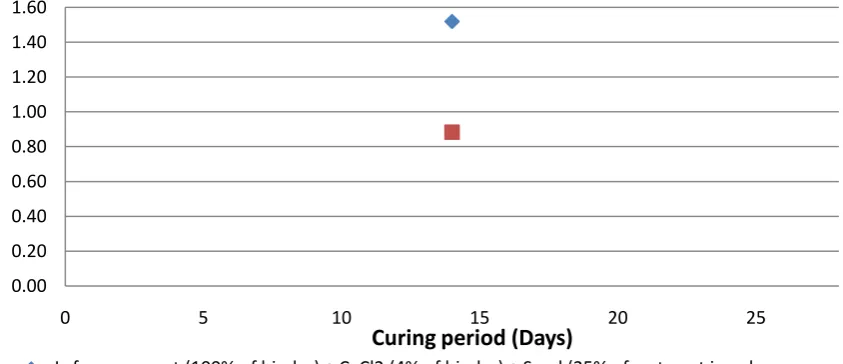
[image:5.595.101.523.490.672.2]From the cone penetrometer test it was observed that undrained shear strength has reached at 1.60 Mpa (Fig. 1) for the column stabilised by the mix design with cement, CaCl2 and sand. Binding agent of cement, bentonite and sand had a considerable effect on undrained shear strength which was 0.86 Mpa. This result seems to be higher because the result of cone penetrometer sometime misleads but nevertheless this result indicated that the bearing capacity of stabilised column increased dramatically after stabilisation.
Figure 1: Undrained shear strength of stabilised column after 14 days curing time 0.00
0.20 0.40 0.60 0.80 1.00 1.20 1.40 1.60
0 5 10 15 20 25
Und
ra
in
e
d
sh
e
ar
s
tre
n
gth
(M
P
a)
Curing period (Days)
Effect on unconfined compressive strength
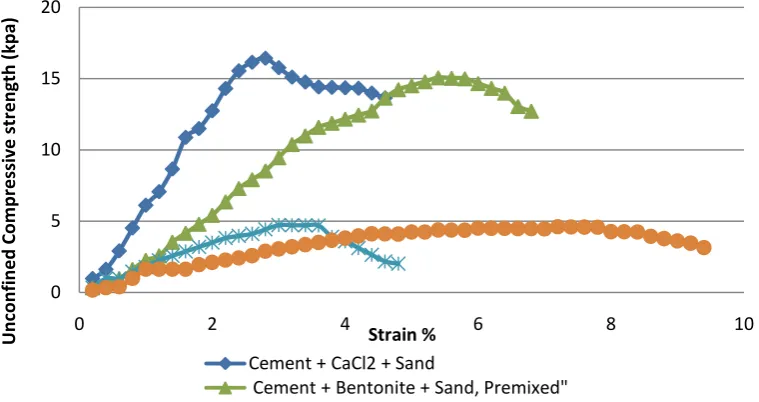
[image:6.595.108.488.226.427.2]Form UCT test in laboratory with the sample collected from stabilised column after 14 days of stabilisation, it was observed that unconfined compressive strength increased than original soil . Although this result does not reflect the actual field condition, as it is difficult to collect undisturbed sample, this is a clear indication of improvement. Wong et al. (2008), Huat et al. (2005) and Deboucha et al. (2008) have found higher value of unconfined strength in their respective study because they have implemented every step of experiment in laboratory. Fig. 2 shows UCT result.
Figure 2: Unconfined compressive strength of collected sample from stabilised column.
Effect on shear strength
From direct shear box test it was observed that the shear strength has reached upto 100 Kpa for 20 kg normal stress and for the sample tested after 14 days of stabilisation. This indicates that shear strength of peat soil significantly improve after stabilisation. Fig. 3 shows the direct shear box test result.
Figure 3: Shear stress of stabilised peat for different normal load condition from direct shear box test 0.00 20.00 40.00 60.00 80.00 100.00 120.00
0.00 1.00 2.00 3.00 4.00 5.00 6.00
Shea
r
str
es
s
(Kpa
)
Shear displacement (mm)
10 Kg 20 kg 5 kg 0
5 10 15 20
0 2 4 6 8 10
Unc o n fi n e d Co m p re ssi ve st re n gth (k p a) Strain % Cement + CaCl2 + Sand
[image:6.595.106.468.580.735.2]SEM and EDX test
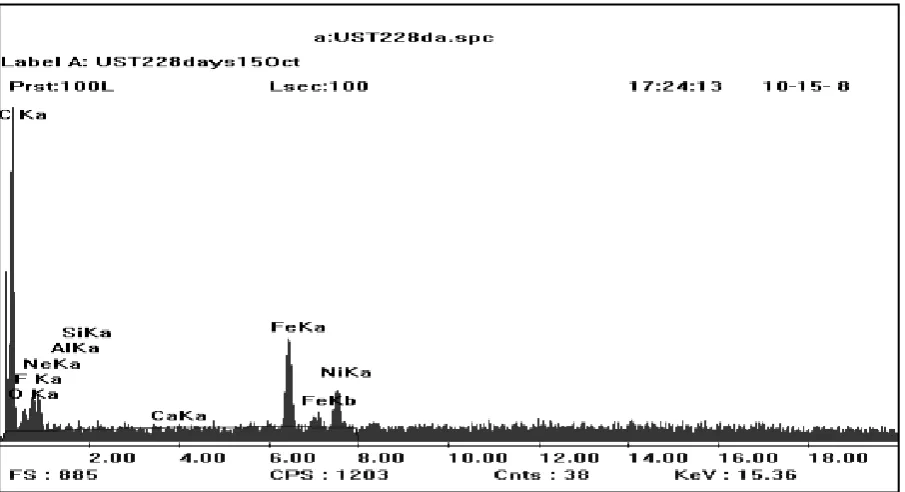
The effect of stabilization on peat soil column’s structure has been observed by Scanning Electron Micrograph (SEM) and Energy Dispersive X-Ray (EDX) test as Figs. 4 and 5. These figures explain that the new structure’s soil has been appeared in stabilised soil column. SEM shows that peat soil become very compact condition after stabilisation. The presence of carbon at peak implies that pozzolanic reaction is taking reaction is taking to form a cementitious material.
[image:7.595.77.525.234.445.2](a) (b)
Figure 4: Scanning electron micrograph of a) original peat soilb) stabilized peat
[image:7.595.77.530.498.744.2]CONCLUSION
The following conclusion can be drawn on the basis of test result obtained from peat soil stabilisation by deep mixing method using various types of binder:
Deep soil stabilisation process not only form a soil-column, but also stabilise the surrounding soil which increase bearing capacity by increasing friction between soil column and surrounding stabilised soil.
Undrained shear strength increases considerably after stabilisation. This result indicates that bearing capacity of peat soil can be improved by stabilisation with deep mixing method using cement, sand, bentonite and CaCl2 as binder.
Results shows that shear strength of peat soil can also be increased by stabilisation.
Unconfined compressive strength of stabilised peat is higher than the untreated peat although the result of UCT test in laboratory does not reflect the actual condition.
Microstructure of peat totally changed after stabilization.
ACKNOWLEDGMENT
The authors are wish to gratefully acknowledge for financial support provided by the Postgraduate Research Fund (PPP) under University of Malaya Research University Grant PS012-2007C & Science Fund under the Ministry of Science and Technology, Malaysia, Project no. 13-02-03-3003.
REFERENCES
1. Bergado, D.T. (1996) Soil compaction and soil stabilisation by admixtures. Proc. of the seminar on ground improvement application to Indonesian soft soils. Indonesia: Jakarta, 23-26.
2. Cernica J. N. (1995) Geotechnical Engineering: Soil Mechanics. Wiley, New York.
3. T.B. (2003) Recent advances in geotechnical characterization and construction over peat and organic soils. Proc. 2nd Int. Conference on Advances in Soft Soil Engineering and Technology. Huat et al. (eds). Malaysia, Putrajaya. 3 – 25.
4. EuroSoilStab (2002) Development of Design and Construction Methods to Stabilise Soft Organic Soils: Design Guide Soft Soil Stabilisation. CT97-0351. Project No. BE 96-3177, Industrial & Materials Technologies Programme (Brite- EuRam III), European Commission.
5. Hashim, R. and S. Islam (2008) Engineering Properties of Peat Soils in Peninsular, Malaysia, J. Applied Sci., 8 (17): 1-5, ISSN 1812-5654.
7. Huat, B. B. K., S. Maail and T. A. Mohamed (2005) Effect of Chemical Admixtures on the Engineering Properties of Tropical Peat Soils, Am. J. Applied Sci., 2 (7), 1113-1120, ISSN 1546-9239
8. Jarret, P.M. (1995) Geoguide 6. Site Investigation for Organics Soils and Peat. JKR Document 20709-0341-95. Institut Kerja Raya Malaysia.
9. Porbaha, A. (2000) State-of-the-art in deep mixing technology: design considerations, Ground Improvement, 4, 111-125.
10. Wong, L. S., R. Hashim and F. H. Ali (2008) Strength and Permeability of Stabilised Peat Soil, J Applied Sci., 8 (17): 1-5, ISSN 1812-5654