International Journal of Emerging Technology and Advanced Engineering
Website: www.ijetae.com (ISSN 2250-2459,ISO 9001:2008 Certified Journal, Volume 4, Issue 8, August 2014)
580
An Experimental Study on Quantum-Entangled Cooperative
Behavior in Swarm Intelligence
Ichiro Iimura
1, Kazuhiro Takeda
2, Shigeru Nakayama
31
Prefectural University of Kumamoto, 3-1-100 Tsukide, Higashi-ku, Kumamoto 862-8502, Japan
2Kagoshima National College of Technology, 1460-1 Shinkou, Hayato-cho, Kirishima 899-5193, Japan
3Kagoshima University, 1-21-40 Korimoto, Kagoshima 890-0065, Japan
Abstract—The physical concept of quantum entanglement
state was applied to cooperative behavior of two ants (agents) pushing a pebble, which is too heavy for one ant, developed by Summhammer. His conventional study showed that the two quantum-inspired ants imitating quantum entanglement state can push the pebble up to twice relative to the two classical ants in independent relation. In order to set up an experimental condition close to a real society, we increased the number of ants and performed the simulation. From the experimental results, we have proven that the swarm of ants inspired by quantum entanglement state can efficiently gather all pebbles to the goal in comparison with the swarm of independent classical ants. This research achievement is promising for the application to the behavior of robots.
Keywords—agent, cooperative behavior, quantum cooperation, quantum entanglement state, swarm intelligence
I. INTRODUCTION
Recently, the physical concept of quantum computation models such as quantum superposition state, quantum interference and quantum entanglement state has inspired the information and computer science domain as well as the biology. For instance, the physical concept of quantum interference was brought to Genetic Algorithm (GA) by Narayanan et al. [1]. Quantum superposition state was also brought to Evolutionary Algorithm (EA) by Han et al. [2]. Layeb has presented a new inspired algorithm based on hybridization between cuckoo search algorithm and quantum computing called Quantum-Inspired Cuckoo Search Algorithm (QICSA) [3]. Moreover, a new application of quantum information to game theory has been discovered [4-6]. Game theory is a branch of mathematics broadly applied in a great number of fields, from biology to social sciences and economics. The Prisoner’s Dilemma is a famous game in classical game theory and has been extended into quantum domain by Eisert et al. [4].
Summhammer applied quantum entanglement state to cooperative behavior of two ants (agents) pushing a pebble, which is too heavy for one ant [7].
That is, each ant measures quantum states to decide whether to execute certain actions. In his model, the ants make odour-guided random choices of possible directions, followed by a quantum decision whether to push or to rest. According to his results, we have confirmed that the two quantum-inspired ants imitating quantum entanglement state, i.e., two entangled ants, can push the pebble up to twice relative to the two classical ants in independent relation, i.e., two independent ants. Furthermore, Nakayama et al. have simulated the cooperation of two ants while changing the condition of parameters relating to “the minimum force necessary to push a pebble” and “the force magnitude of two ants”, and have clarified its feature [8, 9]. From the experimental analysis, in competitive society where ants with strong force are advantageous, Nakayama
et al. have proven that two homogeneous ant brains are good and two heterogeneous ant forces are good. The result of the experimental analysis was similar to the idea in collective decision making [9]. However, only two ants were simulated in these conventional studies.
In this paper, we increased the number of ants to set up an experimental condition close to a real society, performed the simulation, and described the experimental results. We aim at the optimum modeling of cooperative relation of a swarm in which two individuals cooperate in competitive society. The contents in this paper deserve the initial experiment.
II. SUMMHAMMER’S MODEL OF ONLY TWO ANTS PUSHING A PEBBLE
International Journal of Emerging Technology and Advanced Engineering
Website: www.ijetae.com (ISSN 2250-2459,ISO 9001:2008 Certified Journal, Volume 4, Issue 8, August 2014)
581 Before a push attempt, two ants must make two decisions as follows. These decisions are made independently by each ant and they are not communicated to the other ant.
1. Choose each direction that each ant pushes. The direction is chosen in accordance with a probability distribution ( ) as shown in
( ) ( | |) (1)
where is an appropriate normalization factor and is a positive constant of [ ].
2. Decide either to really push at this attempt or to have a little rest. These decision processes of two entangled ants and two independent ants are described in Section 3 and 4, respectively.
If the ant decides to push, the force applied to a pebble is given as follows:
*
+ (2)
where is the strength of the ant. The direction is
, where is the direction straight to the
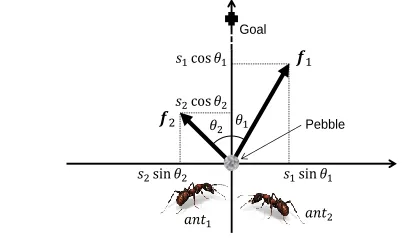
[image:2.612.52.254.450.569.2]goal. For example, and , which are the forces of the ant and the ant , are depicted in Fig. 1.
Figure 1: Relation between the forces and in two ants and
.
III. COOPERATIVE BEHAVIOR OF TWO ENTANGLED ANTS
A. Real Space of a Force and Brain Space of a Qubit in a
Quantum-Inspired Ant
In general, a qubit is described by two-dimensional column vector in the complex vector space where the inner product is defined. It uses the following computational basis states | 〉 and | 〉 as orthonormal base vectors.
| 〉 * +| 〉
| 〉 | 〉 * +
| 〉
| 〉 (3)
The qubit can have a stochastic superposition state (vector sum) of the two vectors | 〉 and | 〉 with each complex probability amplitude. The superposition state | 〉 of the qubit can be shown as follows:
| 〉 | 〉 | 〉 * +| 〉
| 〉 (4)
Where and are the complex probability amplitudes to observe the state of | 〉 or | 〉, respectively. They are normalized as | | | | . | | is the probability that the state of | 〉 is observed, and | | is the probability that the state of | 〉 is observed. In this paper, the observation result corresponds to pushing a pebble, and the observation result corresponds to resting without pushing a pebble.
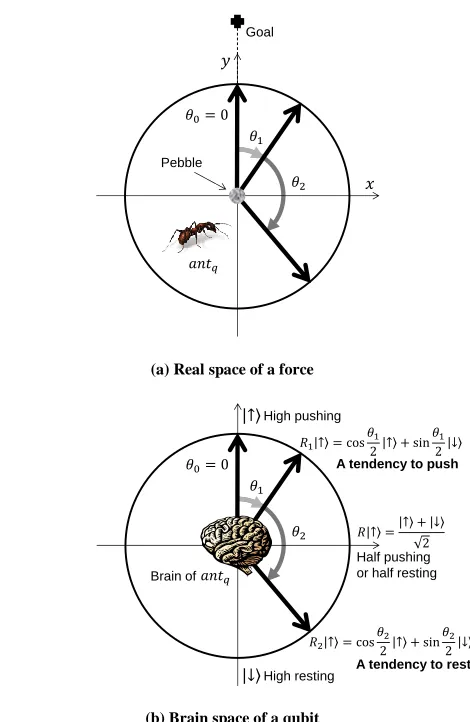
Next, let us think the relation between “the force direction to push a pebble in real space of a force” and “the behavior (pushing a pebble or resting) of a quantum-inspired ant in brain space of a qubit” by using a single qubit. As shown in Fig. 2(a), let (
) be the angle between the goal direction and the force direction to push a pebble. The is the parameter relating to behavioral decision of a quantum-entangled ant which either pushes a pebble or rests. The ratio of the probability amplitudes in the superposition state | 〉 changes depending on the , and its change is performed by unitary transformation. To perform the unitary transformation, the following rotation matrix can be used. That is, the ratio of the probability amplitudes is changed by rotating a qubit depending on the force direction.
| 〉 | 〉 * ( ⁄ ) ( ⁄ )
( ⁄ ) ( ⁄ )+ | 〉 (5)
For instance, the rotation of the initial state | 〉 is given as follows:
| 〉 * ( ⁄ ) ( ⁄ )
( ⁄ ) ( ⁄ )+ * +
| 〉 | 〉
( ⁄ ) | 〉 ( ⁄ ) | 〉 (6)
International Journal of Emerging Technology and Advanced Engineering
Website: www.ijetae.com (ISSN 2250-2459,ISO 9001:2008 Certified Journal, Volume 4, Issue 8, August 2014)
582 And Fig. 2(b) shows the rotation result. That is to say, the probability to push a pebble becomes higher if | | becomes smaller, and the probability to push a pebble becomes lower if | | becomes larger. Thus, the real space of a force is associated with the brain space of a qubit.
(a) Real space of a force
[image:3.612.52.287.202.563.2](b) Brain space of a qubit
Figure 2: Relation between force direction to push a pebble in real space of a force and behavior of a quantum-inspired ant in
brain space of a qubit.
B. Occurrence of Cooperative Behavior
Cooperative behavior occurs to two quantum-inspired ants, which have the above-mentioned behavioral decision process, by imitating quantum entanglement state. Here, the decision process of the cooperative behavior is explained. First, we think two qubits state
| 〉
√ (| 〉 | 〉) (7)
Which is called triplet state in which two ants and are entangled.
The force directions to push a pebble of two quantum-inspired ants and are and , respectively.
The rotation matrices corresponding to and are and , respectively, where
. Then, the state | 〉 is translated by the linear operator as follows:
| 〉→ ( )| 〉 | 〉
√
√ ( | 〉 | 〉 | 〉 | 〉)
√ , (
) | 〉
(
) | 〉 (
) | 〉
(
) | 〉- (8)
Where
| 〉 | 〉
[
( ⁄ ) ( ⁄ )
( ⁄ ) ( ⁄ )
( ⁄ ) ( ⁄ )
( ⁄ ) ( ⁄ ) ]
| 〉
| 〉
| 〉
| 〉
(9)
| 〉 | 〉
[
( ⁄ ) ( ⁄ )
( ⁄ ) ( ⁄ )
( ⁄ ) ( ⁄ )
( ⁄ ) ( ⁄ )]
| 〉
| 〉
| 〉
| 〉
(10)
Therefore, the probability to observe | 〉 in which and cooperatively push a pebble is
given as follows:
|
√ (
)| (11)
Where ( ). Similarly, the probabilities and to observe | 〉 and | 〉 in which either or push a pebble are given as
follows:
(12)
The probability to observe | 〉 in which and cooperatively rest is given as follows:
High resting
Goal
Pebble
High pushing
Half pushing or half resting
High resting
A tendency to push
International Journal of Emerging Technology and Advanced Engineering
Website: www.ijetae.com (ISSN 2250-2459,ISO 9001:2008 Certified Journal, Volume 4, Issue 8, August 2014)
583
(13)
Here, . That is to say, the probabilities and become high when two ants are going to push a pebble in the almost same direction. As a result, two ants show cooperative behavior. On the other hand, the probabilities and become high when two ants are going to push a pebble in the almost opposite direction. In this case, two ants show noncooperative behavior not to cancel a force of each ant. It leads to better result.
C. Displacement of a Pebble after One Push Attempt
According to the above-mentioned observation probabilities, ants to really push a pebble are determined. If the sum of the forces of ants to really push a pebble is equal to or larger than the minimum force necessary to push
a pebble, a pebble is pushed and moved. The expected displacement of the pebble after one push attempt is
∑ ∫
( ) ( ) ( )
(| | ) ∫
∫
( ) (14)
Where the abbreviation ( ) stands for
( ) ( ) ( ) ( )
[ ( ) ( )] (| | ) (15)
Here, is the proportionality constant translating applied force to pushed distance in one push attempt,
refers to the angle not integrated over, and ( ) is the step function the value of which is 1 if and 0 otherwise. Since successive push attempts are independent of each other, the expected endpoint after push attempts is simply .
IV. BEHAVIOR OF TWO INDEPENDENT ANTS
The decision process of the behavior in two independent ants is very simple. In two classical ants in independent relation, and , each ant independently decides either to push a pebble or to rest in accordance with the probability 1/2. As a result, the probabilities , , and in two independent ants are given as follows:
(16)
In addition, the expected displacement of a pebble after one push attempt in two independent ants is same as that of two entangled ants.
V. BASIC EXPERIMENT IN SWARM OF ANTS
A. Swarm Model of Ants Pushing Pebbles Based on
Summhammer’s Model
We assume that a swarm of ants must push all pebbles towards a given goal, and that one pebble must be pushed by a pair of two ants determined randomly. Each
(
) can push with a force . In order to move a pebble, a minimum force must be applied. A [image:4.612.327.563.409.647.2]
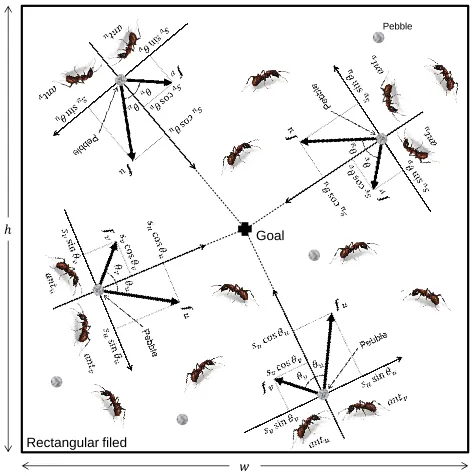
pair of two ants determined randomly, and , achieves their task by making a series of simultaneous push attempts. Figure 3 shows the depicted image of the swarm model of ants pushing pebbles based on Summhammer’s model in the condition of 8 pebbles, 16 ants, and 4 pairs determined randomly.
Figure 3: Depicted image of the swarm model of ants pushing pebbles (Example of 8 pebbles, 16 ants, and 4 pairs determined randomly).
In a pair of independent ants, each ant independently decides either to push a pebble or to rest in accordance with the probability 1/2.
Goal
Pebble
International Journal of Emerging Technology and Advanced Engineering
Website: www.ijetae.com (ISSN 2250-2459,ISO 9001:2008 Certified Journal, Volume 4, Issue 8, August 2014)
584 As a result, the probabilities , , and
in a pair of independent ants are given as follows:
(17)
Where is the probability in which two ants in a pair cooperatively push a pebble, and are the probabilities in which only one ant in a pair pushes a pebble, and is the probability in which two ants in a pair cooperatively rest.
On the other hand, a pair of entangled ants decides with a measurement of quantum states. That is, the probabilities , , and in a pair of entangled ants are given as follows:
(18)
(19)
Where ( ).
A push attempt is successful if the force | | applied to a pebble is equal to or larger than the required minimum force . Then the pebble will move a little path length proportional to the force in the direction of the force.
Note that the computational complexity of the swarm of entangled ants and that of the swarm of independent ants are the same, because the probabilities to determine whether to push a pebble or to rest are only different.
B. Experimental Analysis
In order to confirm the effects of cooperative behavior in a swarm of ants inspired by quantum entanglement state, we have performed the numerical simulation while changing the important parameter . We change
from 0.01 to 1.99 in every +0.01 steps. The other parameter values used are shown in Table 1. The number of trials is 100 and we analyze the performance by the average values of 100 trials. In addition, the initial values for the position of all ants and all pebbles and the moving direction of all ants are determined randomly. Pairs of ants are determined randomly. After one action attempt, a pair of ants cancels the pairing with the probability of 10%, and then another pair of ants is made.
The probability distribution ( ) used in the experiment is the standard normal distribution in which the mean is 0.0 and the variance is 1.0. Therefore the probability density function (PDF), ( ) , and the cumulative distribution function (CDF), ( ), of the probability distribution ( ) used in the experiment are shown in Fig. 4 as a function of the pushing direction .
TABLEI PARAMETER VALUES USED
Parameter Name Value Used
Rectangular field size, [dots] Position of the goal Center of the field
Pebble size [dots]
Ant size [dots]
Number of pebbles, [pebbles] 50 Number of ants, [ants] 1,000 Force magnitude of , | | 1.00 Walking speed of an ant [dots/iteration] 3 Moving distance of a pebble [dots/force] 3
Figure 4: The probability density function (PDF), ( ), and the cumulative distribution function (CDF), ( ), of the probability distribution ( ) used in the experiment as a function of the pushing
direction .
The experimental results are shown in Figs. 5 and 6. Figure 5 shows the average number of iterations at which all pebbles are gathered to the goal as a function of the minimum force necessary to push a pebble, . Figure 6
shows the ratio of the swarm of ants inspired by quantum entanglement state to the swarm of classical ants being independent as a function of minimum force necessary to push a pebble, , with respect to average number of
iterations.
0.0 0.1 0.2 0.3 0.4 0.5 0.6 0.7 0.8 0.9 1.0
-4.00 -3.00 -2.00 -1.00 0.00 1.00 2.00 3.00 4.00
確率密度関数 累積確率密度関数
[rad]
International Journal of Emerging Technology and Advanced Engineering
Website: www.ijetae.com (ISSN 2250-2459,ISO 9001:2008 Certified Journal, Volume 4, Issue 8, August 2014)
[image:6.612.48.257.124.313.2]585 Figure 5: Average number of iterations at which all pebbles are
gathered to the goal as a function of minimum force necessary to push a pebble ( ).
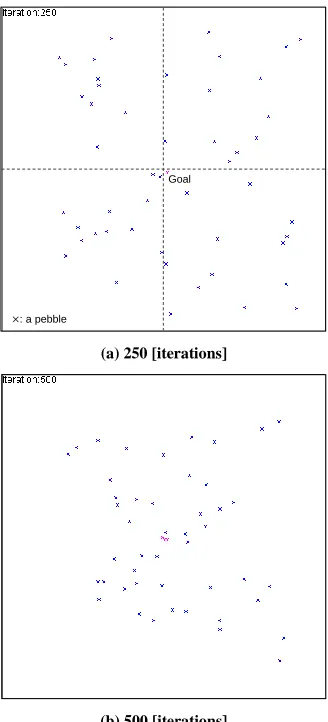
Moreover, Figs. 7 and 8 show the examples of gathering the pebbles to the goal in the condition of . Figures 7 and 8 are the case of the swarm of classical ants being independent and the swarm of ants inspired by quantum entanglement state, respectively. Small “ ” marks in a rectangular field are pebbles. Blue small “ ” marks in the rectangular field are pebbles that have not reached the goal yet. Pink small “ ” marks are pebbles that have reached the goal.
Figure 6: Ratio of the swarm of ants inspired by quantum entanglement state (swarm of entangled ants) to the swarm of classical ants being independent (swarm of independent ants) as a function of minimum force necessary to push a pebble ( ), with
respect to the average number of iterations.
From the experimental results, we have confirmed that the swarm of ants inspired by quantum entanglement state can push all pebbles efficiently up to half regarding the number of iterations relative to the swarm of classical ants being independent.
VI. CONCLUSIONS
In this paper, we have proven that the swarm of ants inspired by quantum entanglement state can efficiently gather all pebbles to the goal in comparison with the swarm of classical ants being independent. This research achievement is promising for the application to the behavior of robots.
(a) 250 [iterations]
(b) 500 [iterations]
0 1,000 2,000 3,000 4,000 5,000 6,000 7,000
0.00 0.20 0.40 0.60 0.80 1.00 1.20 1.40 1.60 1.80 2.00
Av
erage
numbe
r
of i
teration
s
Minimum force necessary to push a pebble ( )
Average number of iterations (Swarm of independent ants) Average number of iterations (Swarm of entangled ants)
0.00 0.20 0.40 0.60 0.80 1.00 1.20
0.00 0.20 0.40 0.60 0.80 1.00 1.20 1.40 1.60 1.80 2.00
Rati
o of
av
erage
numbe
r
of i
teration
s
Minimum force necessary to push a pebble ( )
Ratio of average number of iterations (Entangled / Independent)
Goal
[image:6.612.362.526.292.653.2]International Journal of Emerging Technology and Advanced Engineering
Website: www.ijetae.com (ISSN 2250-2459,ISO 9001:2008 Certified Journal, Volume 4, Issue 8, August 2014)
586 (c) 1,000 [iterations]
Figure 7: Examples of gathering the pebbles to the goal in the condition of in the case of the swarm of classical ants being independent. (Blue small “ ” marks in the rectangular field are
pebbles that have not reached the goal yet. Pink small “ ” marks are pebbles that have reached the goal.)
(a) 250 [iterations]
(b) 500 [iterations]
(c) 1,000 [iterations]
Figure 8: Examples of gathering the pebbles to the goal in the condition of in the case of the swarm of ants inspired by
quantum entanglement state. (Blue small “ ” marks in the rectangular field are pebbles that have not reached the goal yet. Pink
small “ ” marks are pebbles that have reached the goal.)
REFERENCES
[1] Narayanan, A. and Moore, M. 1996. Quantum-inspired genetic algorithms. Proc. IEEE Int. Conf. Evolutionary Computation, 61-66. [2] Han, K.-H. and Kim, J.-H. 2002. Quantum-inspired evolutionary
algorithm for a class of combinatorial optimization. IEEE Trans. Evolutionary Computation, 6(6), 580-593.
[3] Yang, X.S., Cui, Z.H., Xiao, R.B., Gandomi, A.H., and Karamanoglu, M. 2013. Swarm Intelligence and Bio-Inspired Computation: Theory and Applications. Elsevier.
[4] Eisert, J., Wilkens, M., and Lewenstein, M. 1999. Quantum games and quantum strategies. Phys. Rev. Lett., 83, 3077.
[5] Du, J., Li, H., Xu, X., Shi, M., Wu, J., Zhou, X., and Han, R. 2002. Experimental realization of quantum games on a quantum computer. Phys. Rev. Lett., 88, 137902.
[6] Pawela, Ł., and Sładkowski, J. 2013. Quantum prisoner’s dilemma game on hypergraph networks. Physica A: Statistical Mechanics and its Applications, 392, 910-917.
[7] Summhammer, J. 2006. Quantum cooperation of two insects. arXiv:quant-ph/0503136v2.
[8] Nakayama, S. and Iimura, I. 2010. Experimental study on quantum-entangled cooperative behavior of two ants. Proc. 2nd World Cong. Nature and Biologically Inspired Computing, 573-578.
[9] Nakayama, S. and Iimura, I. 2011. Cooperative action in two ants inspired by quantum entanglement state and an interpretation in collective decision making. IPSJ Journal, 52(8), 2467-2473.
Goal