i
A Systems Analysis of Preventative Measures and Attributes
of a Resilient Enterprise
Hisham TARIQ
ii
A Systems Analysis of Preventative Measures and Attributes
of a Resilient Enterprise
Hisham TARIQ
Centre of Disaster Resilience
School of the Built Environment
The University of Salford
Salford, UK
Submitted in Partial Fulfilment of the Requirements of the
Degree of Master of Philosophy
1
TABLE OF CONTENTS
TABLE OF CONTENTS ... 1
LIST OF FIGURES ... 4
LIST OF TABLES ... 6
ACKNOWLEDGEMENTS ... 7
ABBREVIATIONS ... 8
DECLARATION ... 9
ABSTRACT ... 10
CHAPTER 1 Introduction ... 11
1.1 Background to the research ... 13
1.2 Justification of the research ... 14
1.3 Research problem ... 15
1.4 Research methodology ... 16
1.5 Contribution to knowledge ... 17
1.6 Synopsis of the thesis: ... 17
1.6.1 Chapter 1 – Introduction ... 17
1.6.2 Chapter 2 –Theoretical Background and Literature Review ... 18
1.6.3 Chapter 3 – Methods and Methodology ... 18
1.6.4 Chapter 4 – Results and Analysis ... 18
1.6.5 Chapter 5 – Discussion and Conclusions ... 18
1.7 Summary ... 18
CHAPTER 2 Theoretical Background and Literature Review ... 19
2.1 Understanding Disaster Impacts ... 19
2.1 .1 Paradigms in Disaster Research ... 19
2.1.2 Complexity Paradigm and Disaster Management ... 24
2.1.3 Complexity and Disaster Causation ... 25
2.2 Resilience Theory in Disaster Management ... 26
2.2.1 Review of Resilience Narratives and Definitions ... 28
2.2.2 The Systems Approach to Organizations ... 32
2.2.3 Conceptualizing Vulnerability at the Enterprise level ... 34
2
2.2.5 Conceptualizing Disruption at the Enterprise level ... 42
2.2.6 Modelling Resilience ... 45
2.3 Nature of Epidemics as Disasters ... 46
2.3.1 Overview of the origin and spread of EVD outbreak 2014 ... 51
2.3.2 Overview of extractive industry in West Africa ... 52
2.3.3 Epidemics as disruptions ... 55
2.4 Research in context ... 56
2.5 Summary ... 57
CHAPTER 3 Methods and Methodology ... 58
3.1 Complexity Science as a research paradigm ... 58
3.2 Methods of Complexity Science... 60
3.3 A Systems Approach ... 62
3.4 Systems thinking and case study research ... 66
3.6 Systems dynamics and Participatory Modelling ... 67
3.7 Research Process ... 71
3.7.1 Study setting ... 71
3.7.2 Design ... 72
3.7.3 Data collection ... 72
3.7.4 Analysis of data ... 74
3.7.5 Systems thinking ... 76
3.8 Summary ... 79
CHAPTER 4 Results and Analysis ... 80
4.1 Introduction ... 80
4.2 Sample Size and Composition ... 80
4.3 Main themes of qualitative analysis ... 83
4.3.1 C1 - Conditions before the disruption... 83
4.3.2 C2 - Characteristics of the disruption... 86
4.3.3 C3 – Consequences of the disruption ... 90
4.3.4 C4 – Chronology of major events during the disruption ... 108
4.4 Estimated costs of the preventative measures ... 110
4.5 Vulnerability and Risk perception of AM employees in FGDs ... 116
4.6 The system dynamic model of resilience ... 136
4.7 Summary ... 163
3
5.1. Introduction ... 165
5.2. Achievement of Objectives ... 165
5.2.1. Objective 1: To identify the common attributes of a Resilient Enterprise and recognize if those attributes were present or not in the case study firm ... 166
5.2.2. Objective 2: To document the chronology of events and preventative measures/actions taken by the firm during the disruption event ... 166
5.2.3. Objective 3: To estimate the cost of preventative measures taken by the firm during the disruption event ... 168
5.2.4. Objective 4: To develop and validate a conceptual model with stakeholders that can be used to assess how various preventative measures (and attributes) could be used to enhance resilience ... 169
5.3. Implications for theory and practice ... 169
5.4. Strengths and limitations ... 171
5.5. Key lessons and recommendations ... 173
5.6. Scope for further research ... 175
References: ... 177
Appendix A: Combined Information sheet, Invitation letter and Consent Form ... 184
Appendix B: Interview Guide for IDIs ... 186
Appendix C: Focus Group Discussion Guide ... 191
4
LIST OF FIGURES
FIGURE 1. THE COMPLEXITY PARADIGM.SOURCE:SIMONOVIC (2011) ... 24
FIGURE 2. DNA STRAND MODEL OF COMPLEXITY AND DISASTER CAUSATION (PETLEY,2009) ... 26
FIGURE 3.RESILIENCE AS A FUNCTION OF VULNERABILITY AND ADAPTIVE CAPACITY (GALLOPIN,2006). ... 35
FIGURE 4. THE VULNERABILITY MAP (SOURCE:SHEFFI,2015B) ... 37
FIGURE 5.CONCEPTUAL RESILIENCE TRIANGLE PROPOSED BY BRUNEA ET AL (2003). ... 43
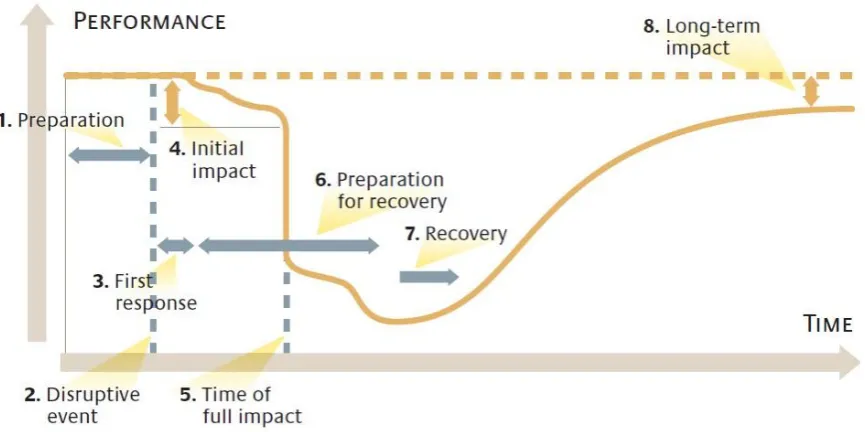
FIGURE 6.PROFILE OF A SHOCK TO THE PERFORMANCE OF A FIRM.SOURCE:SHEFFI AND RICE JR.(2005) ... 44
FIGURE 7.IMPACT OF PREVENTATIVE MEASURES ON SYSTEM PERFORMANCE (SOURCE:PECK AND SIMONOVIC,2013) ... 46
FIGURE 8.COMPLEXITY OF RESILIENCE ISSUES AND THE UNCERTAINTY PRESENT IN DISASTER SETTINGS (ADAPTED FROM URBAN ET AL.,2011). ... 50
FIGURE 9.MINERAL SECTOR SHARE OF GDP ... 54
FIGURE 10.METHODS OF COMPLEXITY ... 61
FIGURE 11.ICE BERG MODEL OF SYSTEMIC THINKING (MAANI AND CAVANA,2007) ... 63
FIGURE 12.STAGES IN SYSTEMS ANALYSIS MODELLING (SOURCE:LACEY (2014)) ... 65
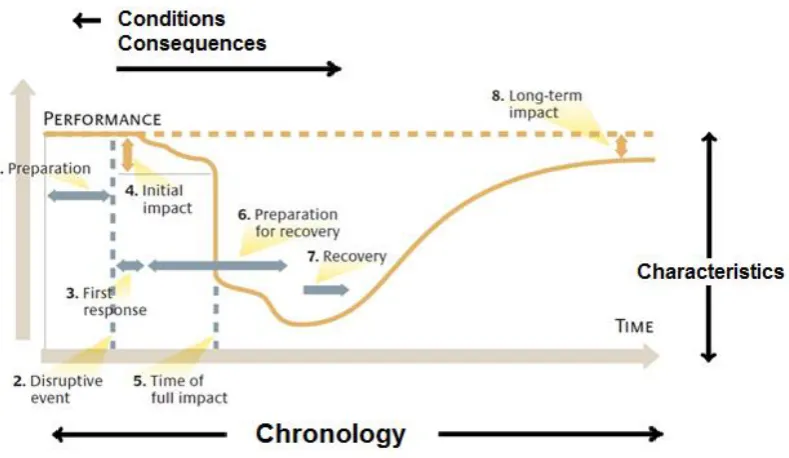
FIGURE 13.THE 4CS AND THE DISRUPTION PROFILE.ADAPTED FROM SHEFFI AND RICE JR.(2005) AND PHILLIPS (2014B). ... 75
FIGURE 14. RESPONDENTS’ LEVEL OF EXPERIENCE ... 83
FIGURE 15.VULNERABLE FUNCTIONS OF THE FIRM ... 91
FIGURE 16.MAJOR COST IMPACTS AS PERCEIVED BY RESPONDENTS ... 92
FIGURE 17.EBOLA CASES PER WEEK AND THE CHRONOLOGY OF PREVENTATIVE MEASURES AND EXTERNAL SUPPORT ... 109
FIGURE 18.PERCENTAGE DISTRIBUTION OF COSTS RELATED TO PREVENTIVE ACTIONS ADOPTED ON SITE AND ADJACENT COMMUNITY ... 110
FIGURE 19.COSTS OF EXTERNAL SUPPORT BY ACTIVITIES ... 111
FIGURE 20.GEOGRAPHICAL DISTRIBUTION OF EXTERNAL SUPPORT ... 112
FIGURE 21.VULNERABILITY MAP (SOURCE:FGDS AND VALIDATION WORKSHOP) ... 116
FIGURE 22.MENTAL MODEL OF MEDIUM TO LONG-TERM IMPACTS OF EBOLA IN LIBERIA (SOURCE:VALIDATION WORKSHOP WITH SENIOR MANAGEMENT) ... 118
FIGURE 23.MENTAL MODEL OF AML OPERATIONS AND IMPACT ON COMMUNITY RESILIENCE (SOURCE: SENIOR MANAGEMENT FGD) ... 120
FIGURE 24.TERMS USED IN THE CLDS TO DENOTE RELATIONSHIPS ... 121
FIGURE 25.THE IMPACT OF EBOLA ON THE WHOLE SYSTEM – CAUSAL RELATIONSHIPS RELATING TO ACTUAL RISK AND RISKS PERCEIVED BY KEY STAKEHOLDERS ... 125
FIGURE 26.THE IMPACT OF EBOLA ON THE WHOLE SYSTEM – CAUSAL RELATIONSHIPS RELATING TO COMMUNICATIONS ... 128
FIGURE 27.THE IMPACT OF EBOLA ON THE WHOLE SYSTEM – CAUSAL RELATIONSHIPS RELATING TO HEALTH PREVENTION ACTIVITY ... 130
FIGURE 28.THE IMPACT OF EBOLA ON THE WHOLE SYSTEM – CAUSAL RELATIONSHIPS RELATING TO EXPATRIATE WORKFORCE AND MANAGEMENT ... 133
FIGURE 29. THE IMPACT OF EBOLA ON THE WHOLE SYSTEM – CAUSAL RELATIONSHIPS RELATING TO CONTRACTOR BEHAVIOUR.. 134
FIGURE 30.HIGH LEVEL SYSTEMS MAP ADAPTED FROM O'REGAN AND MOLES (2006) AND VALIDATED BY INTERVIEW DATA. ... 135
FIGURE 31.ELEMENTS IN THE ARCELORMITTAL LIBERIA SYSTEM ... 137
FIGURE 32.CONCEPTUALIZING RESILIENCE WITH STAKEHOLDERS IN FIRST GMB SESSION. ... 139
FIGURE 33.THE CONCEPTUAL MODEL IN STELLA. ... 141
FIGURE 34.RESILIENCE OF PRODUCTION IN ARCELORMITTAL LIBERIA CASE STUDY ... 145
FIGURE 35.PROJECTED ORGANISATIONAL PERFORMANCE RESPONSE TO DISRUPTION WITH VARIATION IN RESILIENCE: WEEKLY PERFORMANCE LEVELS ... 153
FIGURE 36.PROJECTED ORGANISATIONAL PERFORMANCE RESPONSE TO DISRUPTION WITH VARIATION IN RESILIENCE: CUMULATIVE PERFORMANCE ... 154
5
FIGURE 38.PROJECTED ORGANISATIONAL PERFORMANCE RESPONSE TO DISRUPTION WITH APPLICATION OF A RESILIENCE
IMPROVEMENT PLAN: CUMULATIVE PERFORMANCE ... 156
FIGURE 39.THE GENERAL USER INTERFACE DEVELOPED BY THE RESEARCHER FOR USE BY PARTICIPANTS AT THE VALIDATION WORKSHOP. ... 157
FIGURE 40.BASELINE RESILIENCE SCORE AS DETERMINED BY THE PARTICIPANTS ... 159
FIGURE 41–INTRODUCTION OF PREVENTATIVE MEASURES IMPROVING ON RESILIENCE SCORE (PRODUCTION FUNCTION SELECTED) ... 160
FIGURE 42.A CLOSE UP OF THE TWO RESILIENCE TABLES USED TO INPUT A)BASELINE AND B) A NEW RESILIENCE PLAN TO BE IMPLEMENTED ... 160
FIGURE 43.PROJECTED ORGANISATIONAL PERFORMANCE RESPONSE TO DISRUPTION WITH APPLICATION OF A RESILIENCE
6
LIST OF TABLES
TABLE 1.THE CHANGING DISASTER PARADIGMS (SMITH,2015) ... 20
TABLE 2. SELECTED DEFINITIONS OF ORGANIZATIONAL RESILIENCE.ADAPTED FROM BHAMRA (2015) ... 29
TABLE 3.FEATURES OF COMPLEXITY (SOURCE:ADAPTED FROM JOHNSON 2009) ... 59
TABLE 4.PRIMARY STRENGTHS OF SELECTED COMPLEXITY METHODS (LUKE AND STAMATAKIS 2012) ... 62
TABLE 5.STAGES OF SYSTEMS ANALYSIS WITH METHODS THAT CAN BE USED AT EACH STAGE.ADAPTED FROM LUNA-REYES ET AL. (2012). ... 64
TABLE 6.PROCEDURE FOR CASE STUDY APPROACH JUSTIFICATION.ADAPTED FROM (THOMAS,2015A). ... 66
TABLE 7.IDIS SAMPLE SIZE AND COMPOSITION ... 81
TABLE 8.DURATION (IN HOURS) PER DAY SPENT ON EBOLA ACTIVITIES DURING OUTBREAK PERIOD ... 114
TABLE 9.DISTRIBUTION OF WORKFORCE AND HOURLY WAGE RATE ... 114
TABLE 10.TOTAL COSTS OF PREVENTIVE MEASURES ... 115
7
ACKNOWLEDGEMENTS
First, I would like to first thank my supervisor Professor Terence Fernando for providing me the guidance, help and the opportunity to learn first-hand from him – it has been a valuable and memorable experience for me. I would also like to thank Professor Bingunath Ingirige for his help and support during the early part of my research. Additionally, I would like to express gratitude for all the helpful advice and guidance given to me by Dr. Chaminda and Dr. Udayangi throughout my journey.
I sincerely appreciate and wish to thank ArcelorMittal London for providing me the opportunity to do research with them. They have been extraordinary in providing access and facilitating the research process for me to collect data for the study. A special thanks to all the participants in the research from ArcelorMittal (in both London and Liberia) for giving me their valuable time. I would especially like to acknowledge the participants of the group model building sessions who were especially patient with me and gave me a lot of time – thank you Joseph Mathews, Claire Esbenshade from the London ArcelorMittal London office for your continued support throughout the study as well as Marcus Wehl, Mohanty Tapas and Ravi Chandreshekar of ArcelorMittal Liberia.
In addition, a special thanks to all my friends and family without whom I would not have been able to this work.
8
ABBREVIATIONS
ABM
Agent Based Modeling
ACE US Army Corps of EngineersAM ArcelorMittal London
AML ArcelorMIttal Liberia (subsidiary) CHES Coupled Human-Environment System
CLD
Causal Loop Diagram
CR&S
Corporate Responsibility and Sustainability
DES
Discrete Event Simulation
DRR&M
Disaster Risk Reduction and Management
EID
Emerging Infectious Disease
EMT
Emergency Management Team
EVD
Ebola virus disease
FGD
Focus Groups Discussion
FTE
Full Time Employee
GAR
Global Assessment Report (UNISDR)
GDP
Gross domestic product
GEMT
Global Emergency Management Team
GMB
Group Model Building session
IDIs
In-Depth Interviews
IDRAM
Infectious Disease Risk Assessment and Management
LAMCO
Liberian-Swedish-American Mining Company
LICs Lower Income Countries
MCEER
Multidisciplinary Centre for Earthquake Engineering Research
MDA Mineral Development AgreementNES
Non-Essential Staff
PATM
Professional, Administrative and Technical Management
PHEIC
Public Health Emergency of International Concern
SA
Systems Analysis
SD
System Dynamics
SNA
Social Network Analysis
ST
Systems Thinking
9
DECLARATION
This thesis is submitted under the University of Salford rules and regulations for
the award of a MPhil degree by research.
The researcher declares that no portion of the work referred to in this thesis has
been submitted in support of an application for another degree of qualification
of this, or any other university or institution of learning.
__________________
Hisham Tariq
10
ABSTRACT
The Ebola Virus Disease (EVD) outbreak of 2014 had a considerable socioeconomic impact on the affected West African countries. The extractive sector plays a key role in these economies in providing employment opportunities, tax revenue and contributions to gross domestic product (GDP) with some mining firms having to suspend operations and even shutdown during the epidemic. The study looks at a case study of a mining firm that continued operating during the period despite other firms stopping production. Recent literature has suggested a larger role for the private sector in addressing disaster risk reduction and economic resilience has a strong contribution to the resilience of the overall community.
The study has followed a systems thinking approach to understand the impact of the EVD outbreak on the firm. The study used qualitative methods to understand the sequence of events and channels of impact of the outbreak on the firm, as perceived by its employees and contractors. A total of 16 in-depth interviews, 2 focus group discussions, 2 group model building sessions and a final validation workshop were conducted to identify what key employees understood as impacts on the firm and if the attributes of a resilient enterprise were present in the case firm. Informed by the qualitative analysis and the quantitative data provided by the firm, the study estimated the actual cost of the preventative measures (both internal and external) that the firm had adopted during the outbreak period. Additionally, the study has also developed a conceptual simulation model of senior management’s perceptions (mental model) of operational resilience of a mining firm in the face of shocks such as the 2014 EVD outbreak.
11
CHAPTER 1
Introduction
Since the beginning of the millennium, more than 2.3 billion people have been directly affected by natural disasters with research showing that total damages may have been vastly underreported – by almost 50 percent – for an estimated total economic impact of $ 2.5 trillion over the period 2000-2013. The United Nation’s Global Assessment Report (GAR) (2013) indicates that a large portion of those losses has been accrued by the private sector (UNISDR, 2013). The United Nation’s Office for Disaster Risk Reduction (UNISDR) has strongly recommended that the private sector should play a larger role in Disaster Risk Reduction and Management (DRR&M). The GAR cites a number of studies that make a business case for investment in preventative and mitigation measures (UNISDR, 2013, Ingirige et al., 2015). The effective allocation of limited resources for disaster mitigation, particularly in the post-2008 recession economic environment, is to a large extent dependent on decision makers having a better understanding of the impacts of hazard events. Due to complex processes like changing demographics, urbanization and climate change, natural disasters are increasingly affecting human societies making understanding impacts difficult (Guha-sapir et al., 2011). Over the years, disaster researchers have adopted various paradigms in trying to understand how hazards and disasters impact society, organizations and individuals with the recent consensus in the field on adopting a complexity science approach to understanding disasters (Simonovic, 2011, Smith, 2015). The complexity paradigm incorporates hazards and disasters within local processes and the larger global phenomenon (Smith, 2015). This requires scientists to understand impacts from a “systems of systems” view and not only of individual components – allowing us to study the feedback between individual components of a system and how the system behaves as a whole (Simonovic, 2011, Ramalingam, 2013). This approach is particularly useful at looking at decision making within an organization to understand how it was affected and what measures were taken for disaster risk reduction and mitigation (Mabry et al., 2008, Ramalingam et al., 2008, Hovmand, 2014, Inam et al., 2015).
12 damages but also the impact of disruptions to supply chains, distribution networks, and finance streams (UNISDR, 2013, Ingirige et al., 2015). The ability of a community to respond to and recover from a disaster is strongly correlated to its economic capacity before the disaster event (Rose and Krausmann, 2013). Economic resilience plays an important role at all four stages of the disaster cycle – Preparedness, Response, Recovery and Mitigation (Rose, 2009). Therefore, the Resilient Enterprise is an important component of community resilience. Business organizations need to play a greater, more proactive role in mitigation, preparedness, response and recovery in the face of a diverse set of disaster events that could potentially disrupt their operations (Sheffi, 2007, Rose and Krausmann, 2013, Sheffi, 2015b).
For them to play a greater role, there is a need to understand these disaster impacts and how they affect private sector firms. Hence, more case studies are required looking at disaster impacts at the firm level to understand how individual firms faced crises so that lessons can be drawn from their experiences of those types of disruptions. Natural disasters, pandemics, economic recession, civil unrest, equipment failure and human error can all pose considerable threats to the continuity of an organization’s operations. Thus, it is crucial to understand how each disaster event’s disruption profiles might be similar to or different from each other to plan accordingly (Sheffi and Rice Jr., 2005). One of the main threats to organizational resilience that have not been covered enough in the literature is High Impact, Low Probability disruptions which are very difficult to prepare and plan for making it hard to justify large investments in advance for mitigation (Sheffi, 2015b). For large multinational firms spread over many locations and countries, being resilient is not just a theoretical concept but a strategic reality which needs to be understood if the firm is expected to succeed (Dalziell and McManus, 2004, Fiksel, 2015).
13 to understand how the case study firm maintained operations and production while other firms were unable to do so during the tense period.
1.1
Background to the research
In 2014 West Africa saw the largest EVD outbreak ever recorded with over 28,000 confirmed cases and almost 11,300 lives lost in the three most affected countries; Guinea, Liberia and Sierra Leone (WHO, 2016a). The morbidity and mortality impact of the 2014 EVD outbreak is far larger than all previous Ebola outbreaks combined (WHO and Team, 2014). In addition to the human loss, the outbreak had significant social and economic impact on the region. A World Bank study (Thomas et al., 2015) estimated that the Ebola-attributable gross domestic product (GDP) loss for the three countries in 2015 was approximatly US$2.2 billion. The individual country estimates for losses were reported at US$240 million for Liberia, $535 million for Guinea and $1.4 billion for Sierra Leone (Thomas et al., 2015). The extractive industry plays a major role in the West African countries and the mineral sector is one of the major sources of tax revenues for governments in the region (World Bank, 2014). Extractive1 projects are also at high risk of exposure to pathogens such as the Ebola virus, as their activities are frequently associated with increased contact between wildlife, humans and domestic animals - a major risk factor for the emergence of infectious diseases (Bausch and Schwarz, 2014). According to reports mining companies in the region have been considerably affected by the outbreak, particularly in Liberia, where firms like China Union, Ltd and Aureus Mining Inc. have either shutdown operations or have been hit with short and medium term stoppages in their operations, affecting long-term investment decisions (Thomas et al., 2015).
The unprecedented scale of the epidemic also triggered responses from the private sector, including extractive companies, to protect their employees, operations and business interests against these threats (Llamas et al., 2015). Many companies were compelled to act out of a sense of corporate social responsibility and participated in the Ebola response. Responses of mining firms to the outbreak are likely to be influenced by its perceived cost to them. Information on the economic costs of the outbreak on a business firm are not readily available, and businesses may use data on societal costs inappropriately (Farnham, 1994). Estimating economic impacts of a complex
14 phenomenon like natural disasters and epidemics is methodologically difficult and requires a careful assessment (Guha-sapir et al., 2011).
This study applies a retrospective firm-level single case study design to understand the impacts of the 2014 EVD outbreak on a mining firm and seeks to employ a systems approach to documenting the impacts. This study will explore the application of systems thinking, which uses qualitative methods like interviews and focus group discussions on helping contextualize the quantitative data taken from the finance department of the firm as an approach to understanding the hazard impacts for large firms in the private sector. Understanding the nature of hazard impacts across social, economic and built components of systems and the relationships between them and an organization embedded in that system is one of the motivations for using the systems approach. A systems approach can study resilience holistically, as more than just a sum of its parts. This is contrary to the current methodological practice in the sciences of dividing problems or systems into ever smaller parts and to study them individually for simple linear cause and effect relationships (Sterman, 2000, Sterman, 2006).
1.2
Justification of the research
Several estimates of economic consequences of the 2014 EVD outbreak have projected a slowdown of macroeconomic growth as well as the decline in important sectors of the concerned economies (World Bank, 2014). While macroeconomic and sector-level estimates are important, it is also vital to estimate the economic impact of the EVD outbreak on large extractive firms at the firm level. This can be done by exploring the mechanisms of how an outbreak affects the operational business environment of mining firms in detail thus helping increase our understanding of their ability to continue business activities, i.e. be a resilient enterprise, even in the face of threats like emerging infectious diseases (EIDs). The extractive sector is an important industry to consider the larger economic impacts of the EVD outbreak as it contributes to a significant proportion of GDP in the affected countries in the 2014 Outbreak. Additionally, how they respond to the outbreak will be directly influenced by the perceived cost of the event to them, both in regarding the direct costs and indirect costs as well as the costs of the preventative measures that are adopted and the perceived effectiveness of those measures to them.
15 approximately 50 percent. These losses were in large part attributable to damages incurred by the private sector from direct and indirect impacts. The size of these impacts through damages to infrastructure, supply chain disruptions and loss in business continuity make a strong case for the need for the private sector to consider investment in risk management and mitigation strategies. These investments will in the long run be a benefit to both their business and the communities that they are a part of (UNISDR, 2013). Firms need to evaluate the relative costs and benefits of alternative mitigation and preparedness strategies to choose the one that is most efficient and cost-effective. Inaccurate or low reporting of costs, due to lack of reporting systems or other methodological issues, may lead to incorrect assessments of the economic consequences. This can result in an impact on the decision-making process of taking or not taking certain preventive actions, hence leading business firms to underestimate the true impact of a hazard or disruption (Ingirige et al., 2015) like the EVD outbreak to their business. There is a gap in the literature that looks at impacts of epidemics at the firm level. This study seeks to address that gap by focusing on one particular firm during the 2014 EVD outbreak and trying to understand in detail the chronology of the impacts as they occurred. This is documented largely through the eyes of the employees working during the epidemic as well as though the gathering ofinformation and data on the types of the preventative measures undertaken during the period and their costs.
1.3
Research problem
The large size and scope of the extractive sector in the Ebola-affected countries warrants a more detailed analysis of the impact and costs of the EVD outbreak incurred by the extractive firms that are traditionally not measured in the macroeconomic or sector level analyses. The impact and costs of the EVD outbreak estimated at the firm level could help in developing and designing interventions that may limit significant health (morbidity and mortality) and economic impacts of the EVD outbreak to extractive firms and the communities in which they operate.
16 face of this particular disaster by assessing its disruption profile through the experiences of employees at different levels of management and operations.
Aim: To investigate the impact of a disruption from a natural disaster on the operations of a firm by using systems analysis methods and to determine if the firm was a Resilient Enterprise or not
In this regard the specific objectives are:
1) To identify the common attributes of a Resilient Enterprise and recognize if those attributes were present or not in the case study firm
2) To document the chronology of events and preventative measures/actions taken by the firm during the disruption event
3) To estimate the cost of preventative measures taken by the firm during the disruption event 4) To develop and validate a conceptual model with stakeholders that can be used to assess how
various preventative measures (and attributes) could be used to enhance resilience
1.4 Research methodology
The research methodology section comprises of two sections that discuss; a) the underlying paradigm related to the chosen research design and strategy and b) the research process as indicated throughout the different stages of the applications of the research design during the study. The discussion in the section first looks at the methodological paradigm chosen for the research starting with the complexity paradigm and then going to the data collection and analysis process. According to the complexity paradigm, and keeping in mind the research questions, the researcher had adopted systems analysis as the approach to the case study. Additionally, the single holistic case study is used in the research as it illustrates the key nature of the case under consideration as a resilient enterprise during a natural disaster event.
17
1.5 Contribution to knowledge
The study seeks to address a gap in disaster impact literature, particularly the impacts of epidemics, which focuses on the experience of the single firm, as a case study of a resilient enterprise. As mentioned above, a number of macro-level studies previously have been published, but very few case studies are focusing on the impacts of a single firm have been considered by researchers. To fully capture and understand the impacts of complex phenomena like natural disasters – a more detailed micro-level approach is needed where individual firm-level impacts are recorded. This can help in developing a more detailed understanding of the economic and social cost of disasters on firms and can be used to understand the decision-making process in these firms better.
Additionally, a large number of resilience frameworks have been published, some them focusing on organizations but fewer studies have been published looking to validate those frameworks. This study seeks to validate an existing framework from the literature on the characteristics of a resilient enterprise by searching for the presence or absence of those characteristics within the case study. It is thought by using a holistic systems approach to understanding disaster impacts would further highlight the importance of using such methods towards the better understanding of the complex phenomenon.
The findings of the research identified the presence of systems for early detection, redundancy in human resource use and to some extent supply chains, flexibility in management and a corporate culture that took new emerging threats to its operations seriously. This resulted in the firm taking well thought out preventative measures that contirubted to its resileince and resulted in continued operations.
1.6 Synopsis of the thesis:
This section discusses the structure of the dissertation with a brief summary of each chapter as indicated in the list of chapters as follows.
1.6.1 Chapter 1 – Introduction
18
1.6.2 Chapter 2 –Theoretical Background and Literature Review
Chapter 2 covers the theoretical background and the literature review of the research particularly covering the literature on systems approaches to disaster management and the literature on resilience.
1.6.3 Chapter 3 – Methods and Methodology
Chapter 3 discusses the research design and the steps of the research process. Within this chapter, a discussion on the complexity paradigm behind the use of systems analysis is discussed and why the systems approach is best suited for the research is explored.
1.6.4 Chapter 4 – Results and Analysis
Chapter 4 will discuss the results of the study.
1.6.5 Chapter 5 – Discussion and Conclusions
Chapter 5 will discuss the main findings and limitations of the study. It will also conclude with a discussion on recommendations as well as future work.
1.7 Summary
19
CHAPTER 2
Theoretical Background and Literature Review
This chapter looks at some of the theoretical background to the study by looking at the evolution of disaster perspectives or paradigms and their effect on disaster research in general and the emergence of complexity as the new disaster paradigm. The chapter also provides a theoretical for the complexity paradigm and the systems approach (which is covered in more detail in Chapter 3) and what that entails for disaster research into impacts as well as looking at organizational resilience and the attributes of a resilient enterprise. The chapter also looks into the specific nature of epidemics as disasters and their potential impacts at the firm level.
2.1 Understanding Disaster Impacts
The study of hazards and how disasters have impacted human society over the ages has undergone an evolutionary process, one that has affected how researchers define and conceptualize natural hazard events and disasters. The following section first looks at those changing perspectives on disaster impacts and how these different “paradigms” affect the nature of investigation and approach to understanding disaster impacts and how this has broadly evolved over the history of human settlement till today.
2.1 .1 Paradigms in Disaster Research
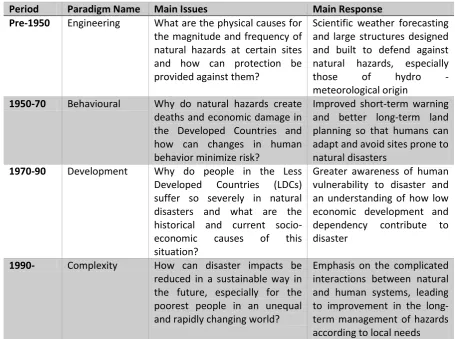
20
Period Paradigm Name Main Issues Main Response
Pre-1950 Engineering What are the physical causes for the magnitude and frequency of natural hazards at certain sites and how can protection be provided against them?
Scientific weather forecasting and large structures designed and built to defend against natural hazards, especially
those of hydro
-meteorological origin 1950-70 Behavioural Why do natural hazards create
deaths and economic damage in the Developed Countries and how can changes in human behavior minimize risk?
Improved short-term warning and better long-term land planning so that humans can adapt and avoid sites prone to natural disasters
1970-90 Development Why do people in the Less Developed Countries (LDCs) suffer so severely in natural disasters and what are the historical and current socio-economic causes of this situation?
Greater awareness of human vulnerability to disaster and an understanding of how low economic development and dependency contribute to disaster
1990- Complexity How can disaster impacts be reduced in a sustainable way in the future, especially for the poorest people in an unequal and rapidly changing world?
[image:22.595.63.519.130.469.2]Emphasis on the complicated interactions between natural and human systems, leading to improvement in the long-term management of hazards according to local needs
Table 1. The changing disaster paradigms (Smith, 2015)
Several scholars like Wisner et al. (2004) and Smith (2015) have indicated that for a large majority of human existence natural hazards were attributed as largely external, inevitable events based on the belief that catastrophic disasters were a result of “Acts of God.” Disasters were considered as a form of divine punishment for the populace. In many societies, this resulted in a fatalistic approach to understanding disaster impacts where the general populace had an attitude of acceptance. Often large-scale catastrophes would be assigned to the will of the divine and to act against this will was considered futile (Wisner et al., 2004). Unfortunately, this attitude can still be seen in many societies today (Schipper, 2010).
21 infrastructures. Public works, like dams and flood defenses on rivers (first used almost 5,000 years ago) and adaptation in building techniques of structures for earthquakes (first used almost 2,000 years ago). These mitigation and adaptation measures were undertaken with the intention to limit the damaging impacts of natural disasters indicating the beginning of a very broadly defined perspective called the engineering paradigm (Smith, 2015).
According to Wisner et al. (2004), despite the continued importance of divine punishment in explaining disaster events for the general public, the engineering paradigm grew to become the predominant perspective used throughout most of human history even up to now in the modern times (the 1950s). This approach primarily looked at “hardening” of built structures or the building of large-scale public works like flood defenses and civil defense actions like mass evacuations during emergencies (Perry, 2007). As scientific knowledge accumulated and technology developed new tools were made available. For example, tools to understand better weather leading to advances that improved metrological analysis and forecasting of storms. The availability of these tools further improved the ability of societies to protect themselves reinforcing the need for science-based government agencies to provide essential services for the populace (Smith, 2015). The engineering paradigm is still a very important part of disaster sciences and continues to provide the basis of most preparedness and emergency response strategies which are essential components of any disaster risk reduction and management initiative (Wisner et al., 2004, Smith, 2015).
22 to limit hazard impacts (Burton et al., 1978). This combination of approaches was a more effective approach to understanding both the impacts of disasters and the ways that those impacts could be limited across the population, at least this was the view in the industrialized and developed world where it was mostly applied.
In stark contrast to this there was little progress in reducing disaster impacts in the least developed countries where most the world population lived and in the 1970s a new radical approach called the developmental paradigm was theorized to explain the experience of these underdeveloped countries (Wisner et al., 2004, Perry, 2007). The developmental paradigm arose from the work of social scientists that argued that catastrophic disasters continue to occur in these regions primarily due to the marginalization of disadvantaged people as an outcome of the global economic structure (Perry, 2007). This paradigm advocates that economic dependency increases the frequency and impact of natural hazards in the developing countries context and that poverty increases the magnitude of those impacts. Accordingly, under this paradigm the concept of vulnerability, where poverty plays a key role, became a central factor in determining the impact of disasters (Wisner et al., 2004). Contrary to the behavioral paradigm, it argued that there were long-term root causes of disasters (not just from the hazard) and that there were limits to the actions individuals could take that were forced by powerful actors with financial and political interests (Smith, 2015). This paradigm was, perhaps, best embodied in the writings of Wisner et al. (2004) where they argued that “…disasters are the outcome of a direct clash between the socio-economic processes that create human vulnerability and the natural processes that create geophysical hazards (Wisner et al., 2004).
23 look at an all hazard, disaster based view that looked at failings within the political and social systems as key components to understanding disaster impact (Perry, 2007, Smith, 2015).
While both paradigms contributed to the development of tools and methods that greatly increased the overall understanding of disasters and their impacts, several scholars such as Dyness (2004) and McEntire (2004), drew attention to the potential weaknesses in both paradigms when applied singularly. McEntire (2004) argued for the use of a more holistic integrated approach that viewed disasters as the result of complicated interactions between many systems – physical, socio-economic, technological and organizational (McEntire, 2004).
Criticisms as those cited above and an accumulation of experience where governments and people still underestimated or misunderstood disaster impacts led to disaster management researchers and practitioners to adopt a more interdisciplinary approach to understanding disaster impacts. This combination of the natural and social science approaches in a more holistic framework resulted in the current paradigm used for understanding disasters and their impacts called the Complexity paradigm (Simonovic, 2011, Smith, 2015). This paradigm uses a “system of systems” approach that shifted the emphasis away from preparedness and response to incorporate mitigation and long-term recovery with issues such as vulnerability and resilience (Simonovic, 2011). The new Complexity based approach emphasized the importance of sustainability as a key factor in developing disaster strategies (Mileti and Myers, 1997, Smith, 2015).
24
2.1.2 Complexity Paradigm and Disaster Management
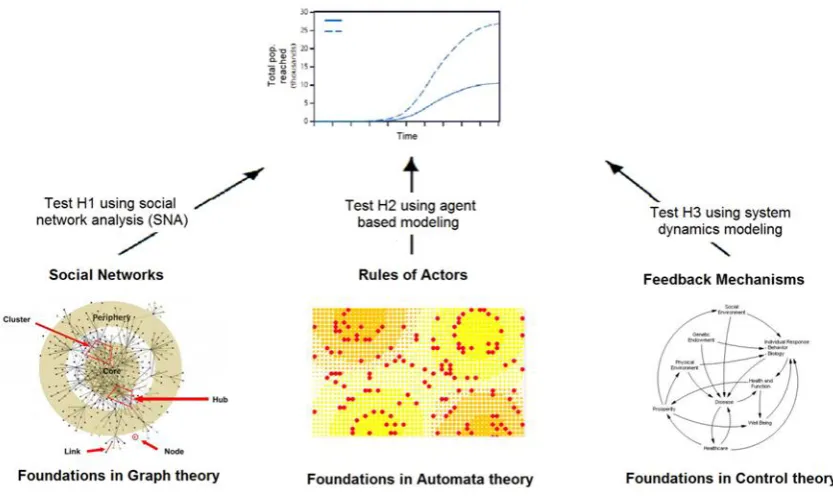
Simonovic (2011) has indicated that the complexity paradigm is going to be most influential in the formation of research methods and tools for the future in Disaster management - as shown in Figure 1 below. He attributes three components to this change in perspectives that explain why this paradigm is playing such a crucial role in the development of tools and methods that are more suited to the analysis of the dynamics surrounding disaster resilience before and during hazard shocks. Tools and methods such as Social Network Analysis (SNA), Systems Thinking & System Dynamics (ST & SD), Discrete Event Simulation (DES) and Agent Based Modelling (ABM) (Simonovic, 2011).
Figure 1. The Complexity Paradigm. Source: Simonovic (2011)
The first component of the complexity paradigm is that disasters are increasingly becoming more and more complex which Simonovic (2011) calls Domain Complexity. The other two components of the complexity paradigm are related to the technical advances made over the last half-century both in the processing power of personal computers and in the ability of scientists to use that computing power to develop methods and tools. These changes have reduced the difficulty in using methods developed relatively recently such as SNA and ABM, hence making these tools more accessible to more researchers. The spread of these tools has resulted in their application to complex phenomena like epidemics, stock markets, traffic congestion and variability in weather patterns due to climate change (Johnson, 2009, Ramalingam, 2013).
25 effects are presented through linear relationships and controls can be theoretically applied cannot cope with the complexity of the huge numbers of variables, the large number of interactions and feedbacks involved. The way researchers think about complex phenomenon determines the solutions they advocate and if their mental models are incorrect about how they generate evidence then how confident can they be about the validity of the policy based on that evidence. Therefore, climate change is a complex phenomenon that is contributing to an increase in both complexity and uncertainty in disaster management. Hence researchers need to develop and use tools more suitable to understanding complexity for instance social network analysis, agent-based modeling, discrete event simulation, or as used in this research, systems analysis (SA) (Simonovic, 2011, Ramalingam, 2013).
It is pertinent to note that unlike paradigms in other fields, like economics or psychology, new hazard disaster paradigms do not mean a total rejection of previous approaches but rather an evolution of the approach. In this case, the paradigm shifts are more related to the shift in emphasis or focus of analysis and how that affects how researchers interpret hazards as disasters and their impacts (Perry, 2007). Another point worth repeating is that the complexity paradigm emphasizes the interdisciplinary nature of disaster research by encouraging natural and social scientists to work together to understand the interconnections between social and physical systems and the impacts on them both (Simonovic, 2011). Finally, the paradigm also encourages investigators to look at disaster impacts as a chain of events that affect resilience and intervening in or breaking this chain of events could either reduce or even prevent impacts from the hazard – effectively stopping it from becoming disasters and catastrophes (Smith, 2015).
2.1.3 Complexity and Disaster Causation
26
Figure 2. DNA strand model of complexity and disaster causation (Petley, 2009)
For example, the other paradigms mentioned previously focused on one strand or the other, but the complexity paradigm gives both strands an equal importance and stresses the interconnections between them. He has stated that during disasters the impacts are a result of the pattern of interconnections between the physical and social strands (Petley, 2009). For example, during complex disasters such as an epidemic, interactions can take place in the affected population (inside the social system), within the disease outbreak (complexity of the virus itself), and between the organizations embedded in the population (within the complexity of the coupled physical and social systems). The complexity of epidemics will be touched on in a later section below.
Accordingly, impacts could vary because the interactions between individuals, private sector firms, emergency agencies and government organizations are socially complex and can have different outcomes due to the level of communications or interconnections between them (Comfort, 1999). Pelling (2003) notes that those communities with higher levels of social interaction or cohesion often have more effective disaster response and that technology can play a major role in developing these interactions (Pelling, 2003). Private sector firms can play a vital role in risk communication and developing social cohesion before, during and after a disaster event to help limit disaster impacts (MARSH, 2007). Communication plays an important role in forming the linkages between the different nodes of the system and it is vital that communications remain functional during a disaster for effective coordination and response (Simonovic, 2012).
2.2 Resilience Theory in Disaster Management
27 discourse on sustainability science and vulnerability that took place during the 1970s-90s when disaster researchers were considering the shift from behavioral and developmental paradigms to the more holistic complexity paradigm (Smith, 2015). Resilience became an important aspect of community-based disaster risk reduction where it was linked to the capacity of a community to overcome its vulnerabilities to hazards. International agreements, such as the Hyogo Framework for Action 2005-2015, required that communities work towards building their capacities to respond to and recover from hazard events hence improving their overall resilience (Manyena, 2006, Manyena, 2009, IFRCRCS, 2011).
Arguably the most used definition in the context of strategic objectives such as those of the Hyogo Protocols and community resilience in general is the United Nations International Strategy for Disaster Reduction definition (UN/ISDR, 2009). UN/ISDR has defined resilience as: “…the ability of a system, community or society exposed to hazards to resist, absorb, accommodate to and recover from the effects of a hazard in a timely and efficient manner, including through the preservation and restoration of its essential basic structures and functions.” (UN/ISDR, 2009). The elements contained in this and other definitions from the literature are covered in more detail below in the next section. Despite widespread use of the term resilience, there has been some criticism leveled at its use in the literature. For example, some critics of the term indicate that it is a derogatory “colonial” term implying the difference between haves and have-nots regarding the availability of material resources only. Proponents of this debate argue that it only serves to highlight the resilience differences between the developed and developing world as a case for western style modernization of “primitive” non-resilient societies (Hornborg, 2009) while others have argued that its meaning is vague and can cause more misunderstandings (MacKinnin and Derickson, 2013). Manyena (2006) has also noted that there is a linguistic ambiguity attached to the term which hampers its application in the developing world (Manyena, 2006).
28 evidence-based policy (Simonovic, 2011, Ramalingam, 2013). Complexity methods, such as systems analysis, can help in providing a framework for documenting and analyzing these interactions between components and help disaster researchers better understand the capacity of a community, or an organization within that community, to cope with and recover from impacts of natural disasters.
2.2.1 Review of Resilience Narratives and Definitions
This section looks briefly at some of the narratives and definitions of resilience in the literature, particularly those that are used for organizational resilience and considers some of the elements common to the general resilience definition and how that helps in conceptualizing organizational resilience.
The UN/ISDR definition stated above is fairly recent and has found widespread use among disaster management professionals and aid agencies, yet there is still a wide range of perspectives in the literature leading to a large number of definitions. In an early review of the term resilience in natural hazards, Klein et al. (2003) note that there was little consensus on its exact wording nor its application. Since then the literature has grown considerably across different contexts of the disciplines of the researchers, as well as the scope and scale of the studies. Norris et al. (2008) mention 21 different definitions and again although they note the same lack of consensus in the literature they also note several common perspectives among the definitions. They note that some common elements have begun emerging such as the links between adaptation, bouncing back better, resilience and vulnerability (Gallopin, 2006, Norris et al., 2008).
29 Table 2. selected definitions of organizational resilience. Adapted from Bhamra (2015)
Author Context Definition/Characteristics
Horne and Orr (1998)
Organizational Resilience is the fundamental quality to respond productively to significant change that disrupts the expected pattern of events without introducing and extended period of regressive behavior Patton et al. (2000) Disaster
Management
Resilience describes an active process of self-righting, learned resourcefulness and growth. The concept relates to the ability to function at a higher level psychologically given an individual’s capabilities and previous experience.
Bruneau et al. (2003)
Disaster Management
The ability of social units to mitigate hazards contain the effects of disasters when they occur and carry out recovery activities that minimize social disruption and mitigate the effects of future events.
Hamel and
Valikangas (2003)
Organizational Resilience refers to the capacity to continuous reconstruction.
Dalziell and
McManus (2004)
Organizational Resilience is a function of an organization’s situation awareness, identification, and management of Keystone vulnerabilities and adaptive capacity in a complex, dynamic and interconnected environment.
McDonald (2006) Organizational Resilience conveys the properties of being able to adapt to the requirements of the environment and being able to manage the environment’s variability
Linnenluecke and Griffiths (2010)
Organizational The capacity to absorb impact and recover. Braes and Brooks
(2011)
Organizational Resiliency relates to organizational characteristics and resilience refers to a dynamic development process.
Of the selected definitions above, the definition put forward by Dalziell and McManus (2004) has been one of the more comprehensive ones as it contains most of the elements that need to be explored to understand and assess an organization’s ability to cope with disruption events. This definition seems to resonate closely with the attributes of a resilient enterprise as detailed by Sheffi and Rice Jr. (2005) which is covered in slightly more detail below.
Additionally, Srivastav and Simonovic (2014) review a number of definitions across these multiple perspectives and note that they contain the eight key elements. These are 1) the ability to recover quickly, 2) buoyancy, 3) the property of assuming back its original shape, 4) elasticity, 5) ability to withstand stresses, 6) capacity for collective action in response to an event, 7) the capacity to absorb shocks, and 8) the capacity to adapt existing resources and skills to new situations and operating conditions (Srivastav and Simonovic, 2014).
30 system and 3) the ability to use local experience and skills to adapt and improve in the future (Smith, 2015).
Bhamra (2015) and (Smith, 2015) both have indicated that resilience and its definitions have naturally been influenced by factors such as disciplinary perspectives as is expected but also by the overall shift in disaster paradigms. These paradigms have contributed to the narratives of disasters and disaster impacts that have emerged over the years in the literature (Bhamra, 2015, Smith, 2015).
Raco and Street (2012) also indicate that these varying perspectives have created selective narratives around the concept of resilience – each based on the context and disciplinary background of the researcher or research group. For example, the “ecological” perspective was represented in the writings of (Adger, 2000, Folke et al., 2002) and the “engineering” perspective in the writings of (Bruneau et al., 2003, Bruneau and Reinhorn, 2007). Both perspectives have contributed to the development of resilience as a concept, and subsequent researchers have benefited from the works of these pioneering academics (Peck and Simonovic, 2013).
It is interesting to note that building on Holling’s (1973) original work, Gallopin (2006) has emphasized stability as a key feature of community/organizational resilience (Gallopin, 2006). He writes that stability is a function of vulnerability and a system’s capacity to respond, or in other words, its adaptive capacity thus enabling us to conceptualize resilience as a subset of these two features. More recently, Simonovic (2016) has warned that disaster managers and professionals that focus solely on vulnerability analysis may lead organizations to focus only on risk management and not adaptive capacity hence underestimating the value of resilience research (Simonovic, 2016). The distinction between vulnerability, resilience and adaptive capacity is further covered below in another section.
31 and this has been the focus of much literature on disaster management especially true of research designs focussing on the phases of response and recovery (Nigg et al., 2006, Phillips, 2014).
The transformation discourse, on the other hand, explicitly recognizes that the impact of a disruption event may be larger than the current capacity of a system and hence the impact is not absorbed and requires the system to adapt in response to the event (Shaw and Theobald, 2011). This narrative borrows elements from the ecological narrative to suggest a “living” and learning system (Bhamra, 2015).
Finally, another perspective that has pushed resilience research toward a specific narrative is the security perspective of public response agencies and their concern for building preparedness into communities in response to terrorist events or disruptions (Coaffee, 2013). This narrative seeks to build resilience as a long term goal for communities and enhances the system’s capacity to respond to disruptions indicating a pro-active approach rather than a reactive approach to disaster management (Bhamra, 2015). By pro-actively seeking to improve system resilience, this perspective places the responsibility of adaptation and response on the impacted systems or communities. This highlights the importance of research on preventative measures and the allocation of scarce resources for mitigation and preparedness (MacKinnin and Derickson, 2013). This narrative also fits with the direction of the GAR (2013) and its emphasis on the private sector adopting a more pro-active role in disaster risk reduction through mitigation and preparedness (UNISDR, 2013).
This distinction between proactive and reactive approaches is particularly true of the preventative measures taken by private sector firms with regards to pandemic preparation and response (Llamas et al., 2015). International health response agencies, for example as the WHO and USAID, have been trying to make the investment case for long-term investments into local health systems rather than the quick and short term (often more expensive) reactive responses that typically take place in response to an outbreak (MARSH, 2007).
Additionally, concerning notable research into organizational resilience, the research stream
developed at the Multidisciplinary Centre for Earthquake Engineering Research (MCEER),
based at the University of Buffalo in the US, shows great potential for application in this
field. MCEER has used the framework to assess the impact of seismic and hydrological
events on organizational entities such as hospitals, power plants, and other key
infrastructures and has an all-hazard approach (Bruneau and Reinhorn, 2007, Vugrin et al.,
32
This approach is suitable for adaptation to the organizational level. Accordingly, as an
extension to this research stream, Simonovic (2016) has derived the following definition of
organizational resilience having five components as follows: 1) the minimization of losses, damages and business disruption;
2) maximization of the ability and capacity to adjust when there are shocks to systems (finding adaptation strategy);
3) returning systems to a functioning state as quickly as possible; 4) recognition that resilient systems are changing in time and space; and
5) acknowledgment that the post-shock system performance levels may not be the same as pre-shock levels (Simonovic, 2016).
After considering these elements, he proposes the following definition of organizational resilience; “...the ability of a system and its component parts to anticipate, absorb, accommodate or recover from the effects of a system disruption in a timely and efficient manner, including through ensuring the preservation, restoration or improvement of its system performance or its essential basic structures and functions (Simonovic, 2016).”
From the different definitions and reviews discussed briefly above it can be seen that there is a considerable focus in the literature on theoretical frameworks and conceptualizations and very little empirical work that apply or test these frameworks in the organizational context (Srivastav and Simonovic, 2014). Bhamra (2015) has concluded that there is a need within the literature to apply methods such as case studies or survey methodologies to validate these frameworks and definitions to form a wider base in the literature on organizational resilience.
2.2.2 The Systems Approach to Organizations
33 McManus (2008) the systems approach to organizational resilience was first highlighted in the seminal work of Jeff Horne (1997) in his article “A New Direction: The Coming Age of Organisational Resilience.” and was further elaborated upon in a follow-up publication “Assessing behaviors that create resilient organizations.” (Horne and Orr, 1998) which formed the basis of some of the research on attributes of resilient organizations and enterprises published later (McManus, 2008). As mentioned in more detail in the next chapter on Methods, systems thinking uses a holistic point of view where the relationships between elements in a system are more important than the elements themselves. Johnson (2009) describes that as the number of elements in the system rises and the resulting behavior of the system becomes non-linear, then the system becomes complex, or in other words, there is an increase in the domain complexity (Johnson, 2009, Simonovic, 2011). The systems approach requires researchers to carefully list the elements in the organizational system, first those elements that are external and then those elements within the firm, to understand how behavior might be influenced (McManus, 2008, Gharajedaghi, 2012, Srivastav and Simonovic, 2014). This approach is consistent with the complexity paradigm detailed above and requires researchers to explore both the external environment (i.e. suppliers, competitors, markets) and the internal environment (i.e. organizational processes, supportive technologies and employee relationships) (Gharajedaghi, 2012). This is especially true when looking at disruptions in the organizational system and the vulnerability of the system to disruptions and shocks.
McManus (2008) discusses how disruptions could be studied in organizational systems through an understanding of disruption types and the vulnerability of the organization to those disruptions and uses a classification initially proposed by Charles Perrow (1984) for technological systems (McManus, 2008). Perrow (1984) has defined two interrelated terms for technical systems in organizations, that can also help disaster researchers understand disruptions and vulnerability, by looking at 1) the Interactive complexity in the systems and 2) the loose or tight coupling of systems (McManus, 2008).
Interactive complexity refers to the unknown sequence of events that occur in interconnected systems that cannot be observed directly and hence are not planned for by the organization. This could be due to the problem or disruption arising in other systems and that the processes within the organization were not able to detect the problem and act in time (McManus, 2008).
34 another part. On the other hand, loosely coupled systems are linked but the performance of one element in the system is not too dependent on the other. Meaning that the system has the capacity to absorb disruptions and still function overall (McManus, 2008).
Perrow’s approach (1984) allows researchers to understand disruptions as “system failures” that can be unpredictable and potentially cascading in nature. McManus (2008) indicates that these terminologies can help researchers to understand critical failures or system disruptions by assessing their key vulnerabilities across both internal and external environments. This is especially true for business enterprises that can usually be classified as tightly coupled and with high interactive complexity (Dalziell and McManus, 2004, McManus, 2008).
There are several examples in the literature of such disruptions occurring in business enterprises such as the 1984 Bhopal chemical plant disaster in India (Shrivastava, 1992) , the Exxon Valdez oil spill in 1989 (Grabowski and Roberts, 1996), Toyota suppliers after Great East Japan Earthquake (Sheffi, 2015a), and others. For researchers to assess how these disruptions affect the organization at the enterprise level, they need a framework to conceptualize vulnerabilities and disruptions, and the next sections will look at how some scholars in the literature have done this conceptualization.
2.2.3 Conceptualizing Vulnerability at the Enterprise level
As mentioned in the discussion above on the narratives and elements of resilience definitions in the literature - two elements that require greater understanding while conceptualizing the resilient enterprise are vulnerability and the system’s capacity to respond, i.e. adaptive capacity. This section takes a closer look at these two concepts at the organizational level while also describing how these concepts will be used in this research.
35 the sensitivity and the exposure of the system to the hazard or disruption and forms the basis of conceptualizing the interconnections between these complex concepts.
Gallopin (2006) has described these linkages between vulnerability, adaptive capacity and resilience in detail helping researchers conceptualize how they are related to each other as a part of a system. He has described vulnerability to have three components; sensitivity, the capacity of response and exposure – as shown below in Figure 3. Furthermore, Gallopin has conceptually linked resilience and adaptive capacity as subsets of the capacity of response within the overarching concept of vulnerability, hence describing how this determines the dynamic (over time) role resilience plays in vulnerability.
Figure 3. Resilience as a function of Vulnerability and Adaptive Capacity (Gallopin, 2006).
In this model, vulnerability is described as a capacity to maintain the structure of a system, i.e. in organizational terms, this relates to the function and purpose of that system. Regarding this research, the function or purpose of a system is described as the system performance. Additionally, resilience is shown as the capacity to recover or bounce back from a disruption while Adaptive capacity is the ability to evolve and to cope with the changing environment and the ability to expand the range of response or mitigation options (Gallopin, 2006). In this research, these options are identified as preventative measures that the system can use over time. Preventative measures enhance the adaptive capacity of an enterprise and hence contribute to greater overall resilience (MacKinnin and Derickson, 2013).
36 learning behavior to the ability of an organization to deal with unforeseen circumstances – effectively an organization’s ability to deal with the unknown (Folke et al., 2002). This indicates that organizations that are resilient will not be passive in relation to the external environment and will pro-actively develop and apply knowledge about the challenges they face in the social, economic and ecological environments (Folke et al., 2002, Bhamra, 2015).
This understanding of adaptive capacity links resilience of the enterprise with its general competitiveness and long-term sustainability as well. As mentioned previously, Gallopin (2006) has shown several influences on this view of vulnerability and resilience from both the ecological and the sustainability perspectives (Gallopin, 2006).
The other two sub-components of vulnerability, exposure, and sensitivity, also require further description as they are crucial to understanding the different threats facing an organization as well as the consequences of those anticipated threats. Sheffi and Rice Jr. (2005) have specified that understanding system vulnerability involve two processes - finding out what the level of exposure is and how sensitive the system is to that exposure. Sheffi (Sheffi, 2007) goes on to state that these concepts can be explored by answering the following three questions: 1) What can go wrong? 2) What is the likelihood of that event happening? and, 3) What are the consequences of that happening? (Sheffi, 2007).
37 Figure 4. The vulnerability map (source: Sheffi, 2015b)
These maps need to be frequently updated as new threats emerge and old ones become redundant as the likelihood of these threats would change according to the firm’s actions such as preventative measures before a disruption (Sheffi and Rice Jr., 2005). These preventative measures that may or may not be taken can lead to changes in either the likelihood or the impact of a disruption changing and this can be directly lead to an increase in the resilience of the firm (Sheffi, 2007). For instance, human resources policy might affect the number of people being exposed (at the workplace) to a virus, and this may result in increased resilience to worker infection during a flu epidemic.