Best Compromise Solution of Economic
Emission Load Dispatch Using Ant Lion
Optimization
Arjun Rathore1, Nitish Chopra2
1,2Assistant Professor, SSIET Galgotia college of Engineering & Technology
Abstract: This paper presents ant lion optimization method for solving multi-objective economic emission load dispatch (EELD) problem in diverse test power systems. NOX emission, power balance and generation limit constraints are considered here. Ant Lion Optimization (ALO) is a novel meta-heuristic motivated by hunting mechanism of ant lions in nature. The proposed technique is applied on different test systems having 3,6,10 and 40 generators have been considered for solving the EELD. Comparison of the obtained results is carried out with other techniques stated in literature which shows that ALO is effective to solveEELD.
Keywords: Economic Emission Load Dispatch(EELD); ALO; best compromise solution(BCS)
I. INTRODUCTION
The main goal of economic emission load dispatch problem is to get optimum output of thermal generators in power system subjected to several constraints to minimize the operating cost. The thermal power plant operation is dependent upon combustion of fossil fuel which produces SOx, NOx and COx emissions. The increasing pollution is a matter of environmental concern worldwide which has led to formation of international standards for emissions from industries and power plants. Different acts have been made which forces the industries to modify their principles to follow the environment-emission standards strictly. Thus it becomes significant to do emission dispatch or consider emission constraints in economic emission load dispatch. The economic & emission scheduling are contradictory in character and both must be considered together to find optimal scheduling. The problem is put together as a multi objective economic emission load dispatch problem (EELD) problem in which both objectives (emission and economy) have to be minimized.
Earlier traditional methods like Newton’s method, gradient approach and linear programming [1] were used for solving economic load scheduling problem. In the last years different techniques have been used for solving EELD. Nanda et al [2] applied goal programming techniques to solve economic emission load dispatch. Song et.al [3] solved environmental/economic dispatch with genetic algorithm controlled by fuzzy logic. Abido [4] used genetic algorithm for the economic emission load dispatch (EELD) to find out pareto-optimal solutions. Ah King [5, 6] applied improved non-dominated sorting genetic algorithm (NSGA-II) for creating pareto-optimal front for EELD. Then mozhi [7] solved EELD using hybrid genetic algorithm. Perez [8] solved environmental/economic dispatch using differential evolution. Hong [9] applied immune genetic algorithm for EELD. Hazra [10] proposed bacteria foraging algorithm for emission constrained economic dispatch. Hemamalini [11] solved non convex EELD by applying particle swarm optimization. Sudhakaran applied refined genetic algorithm[12] and hybrid genetic algorithm[13] for solving EELD problem. Bhattacharya.et.al [14] presented a BBO technique to solve EELD of thermal generators with different emission substances (SOx, NOx, &COx).Niknam [15]proposed teaching learning based algorithm for dynamic EED. Abedinia [16] applied firefly algorithm (FFA) for EELD.
Differential evolution hybridized with biogeography-based optimization [17]is applied to solve EELD problem. Rajasomashekaret al.[18]proposed a new method applying BBO algorithm for getting best compromised solution for EELD problem[18].Opposition based Harmony Search Algorithm [21] is used to solve EELD problems. Güvenç et al.[22]solved EELD using gravitational search algorithm (GSA). Shaw et al. [23]solved EELD by including the opposition based learning scheme of [21] within gravitational search algorithm. Basu [24] applied multi objective differential evolution for solving EELD. Bhattacharjee.et.al.[25] solved EELD using Real Coded Chemical Reaction algorithm.
like artificial neural networks [28], constraint handling PSO [29], artificial bee colony(ABC) algorithm[30],firefly optimization[31], NSGA [32] and SPEA [33]which have been successfully used to solve EELD problem.
Recently, a new optimization technique based on the concept of hunting mechanism of ant lions called antlion optimization (ALO)has been proposed by Seyedali Mirjalili[34].The proposed algorithm has been applied successfully to solve benchmark test functions , classical engineering problems(truss design, gear train design and cantilever beam design) and for optimizing shape of ship propellers. In this paper ALO is applied to find out best compromise solution for EELD problem using the normalized objective function proposed by Rajasomashekar[18].
II. PROBLEMFORMULATION
A. Economic load dispatch (ELD)
Objective for economic dispatch is to reduce the operating (fuel) cost of thermal generators satisfying some limits. The objective function is given by:
= ∑ (a P + b P + c )(1)
Where ai, bi, & ci are the fuel-cost coefficient sand is power output for the ith generating unit among NG total committed generating units.
The overall fuel cost has to be reduced with the following constraints:
1) Power balance constraint: The overall generation by the entire generators should be equal to the sum of whole power demand (PD)& system’s real power loss (PL).
∑ P −P −P (2) The power loss is calculated by using B coefficients and unit power output:
P =∑ ∑ P B P +∑ B P + B (3)
2) Generator limit constraint
Each generator’s real power generation is to be controlled within its respective lower operating limits and upper operating limits .
P ≤P ≤P , i=1, 2… NG (4)
B. Economic Emission dispatch(EED)
The objective is to reduce the entire pollution discharge from combustion of coal or gas for producing electricity. The problem of optimum emission dispatch for NOx emission can be defined by as:
E =∑ (d P + e P + f )(5)
Where ENare the total amount of NOx emission from the power plant in kg/hr. diN,eiN, fiNare the NOx emission coefficients of ithgenerating unit. The power balance & generator limit restrictions are given by Eq. (2 & 4) respectively.
C. Multiobjective Economic emission load dispatch (EELD) problem
The emission and economic dispatch are contradictory in character and they both have to be considered together to find optimal dispatch. The problem is expressed as a multi objective economic emission load dispatch (EELD) problem in which both the objectives (emission and economy) have to be minimized. The objective function is given by:
FC (C, EN) (6) Where ‘C’denotes fuel cost objective and ‘EN’ denote emission objective.
The multi-objective optimization could be solved using Fuzzy set theory along with any conventional optimization techniques [19], weighted sum method and many other techniques. Again, the multi-objective problem mentioned above could be solved after converting EELD problem to a solo objective optimization problem using cost penalty factors (CPF) [20].The whole objective function may be put together by using PPF and given as:
Minimize FC =∑ wC P + (1−w)jE (P ) (7)
(2) and (4). When the value of w is 1 the objective function represents fuel cost of generation function and when w is equal to 0, the objective function represents emission function only. It is very difficult to make a solution that will give the best compromising solution (BCS) which lie nearer to both of the best solution. The fuel cost rises and emission price reduces when w is decreased in steps from 1 to 0. When w is equal to 0,objective function becomes purely EED that curtail only the emissions.
Pareto front based on the non-dominated solution could be founded by resolving the problem a number of times with dissimilar w values. However it might not give the best compromising result, which can be described as the one with equal percent difference from the best solutions resultant to ELD and EED.
Rajasomashekar et al. [18] proposed a method to find the best compromising solution. The drawbacks of the existing approaches is overcome, after expressing bi-objective function of Eq.(7) in a modified way after normalizing the fuel cost and emission components with a view to provide relatively equal significance to both the objectives. The modified overall objective function may be represented as:
= w ∑ + (1−w) ∑ (8)
The required values for Cmin, Cmax, Emin and Emax, canbe obtained through solving Eq.(7)for both economic dispatch and emission dispatch.
The customized normalized depiction of objective function for EELD problem offers best compromising solution (BCS) when w is set to 0.5 [18] and the overall solution process involves only three runs for solution of ELD, EED and EELD problems. But, fuzzy based strategies require several solution runs with different w values. The current methods provide a result in which fuel cost is extremely near to the best fuel cost while restraining the emission far-off from the best emission point and contrariwise. This indicates that the relative importance given to both objectives are unequal. But according to [18], the new problem formulation (8) based optimization process gives approximately the same significance to the fuel cost and emission and get their values to lie in the similar range.
The amount by which best compromising solutions deviate from the global best fuel cost and emissions are calculated using the following indices:
1) Fuel Cost Performance Index( FCPI)
= ∑ × 100 (9)
2) Emission Cost Performance Index( ECPI)
= ∑ × 100 (10)
However, the relative significance between fuel cost and emissions can be varied by altering w in between 0 and 1 in the objective function of (8). It permits the operator of system to choose on diverse desires for the objectives according to operating conditions of system.
III. ANTLIONOPTIMIZATION
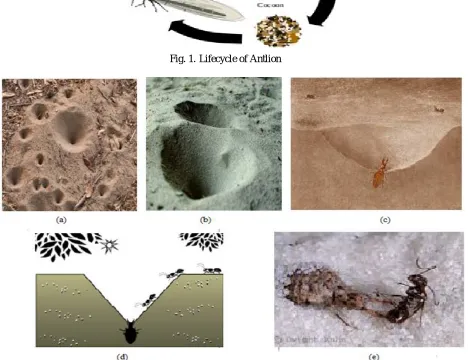
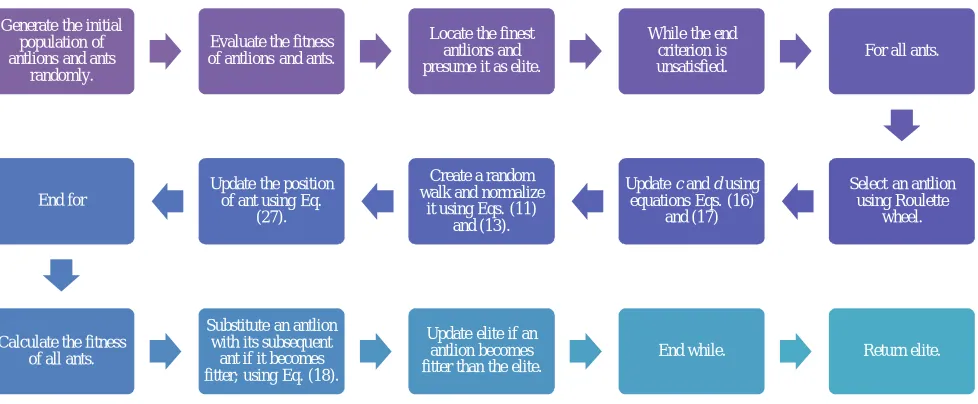
Ant Lion Optimizer (ALO) [34] is a novel nature-inspired algorithm proposed in 2015 by Seyedali Mirjalili. The ALO algorithm imitates hunting behavior of ant lions in nature. Five major steps of prey hunting such as the arbitrary walk of ants, trap constructing, entrapping of ants in traps, prey grabbing, and trap rebuilding are implemented.
Fig. 1. Lifecycle of Antlion
Fig. 2.a–c Trap building of antlions ; d–e prey catching and trap rebuilding [34]
A. Random Walks of Ants
Random walks are all based on the equation below:
( ) = [0, (2 ( )−1), (2 ( )−1), … … . . , (2 ( )−1)] (11)
Where cumsum computes the cumulative sum, ndenotes maximum iterations, t shows the arbitrary walk step and r(t) is an assumed function stated as :
( ) = 1 > 0.5
0 ≤0.5(12)
To keep the arbitrary walks within the search space, they are normalized using the succeeding equation:
=( )×( )
( ) + (13)
Where aiis the minimum of arbitrary walk of ith variable, bi is the maximum of arbitrary walk in ith variable, is the minima of ith
B. Trapping in Antlion’s Pits
Antlions’ traps influence the arbitrary walks of ants. To model this assumption mathematically, the equations proposed are:
= + (14)
= + (15)
where is minima of entire variables attth iteration, denotes the vector having the maxima of entire variables at tth iteration, is the minima of entire variables for ith ant, is the maxima of entire variables for ithant, and Antliontj indicates the location of the chosenjthantlion at tthiteration
C. Constructing Trap
To model the hunting ability of antlion, a roulette wheel is used. ALO algorithm needs to use a roulette wheel operator for picking ant lions according to their fitness during optimization [34]. This method gives better probabilities to the fitter ant lions to catch ants.
D. Sliding ants towards ant lion
With the method proposed so far, ant lions are capable of constructing traps relative to their fitness and ants are required to move arbitrarily. However, ant lions shoot soil outward the mid of the pit once they understand that an ant is in trap. This conduct slides down the trapped ant that is attempting to escape [34]. To model this mathematically following equations are proposed in this regard:
= & = (16)
Where ct is the minima of entire variables at tth iteration, and dt indicates the vector having the maxima of entire variables at tth
iteration and ‘I’ is a fraction given by:
= 10 (17)
Where t is the iteration in progress, T is the maximum number of iterations, and w is a constant defined based on the current iteration [23].
E. Catching prey and re-building the pit
Thelast phase of hunting is when an ant reaches the bottommost of pit and is trapped in the antlion’s jaw. After this phase, the antlion jerks the ant inside the soil and eats its body. For imitating this procedure, it is supposed that prey catching occur when ants turn out to be fitter (go inside soil) than its analogous antlion [34]. Then it is essential for antlion to update its position to the newest position of frightened ant
to improve its gamble of catching novel prey. The following equation is offered in this regard:
= ( ) > (18)
Where t shows the current iteration, shows the location of selected jth antlion at tth iteration, and indicates the location of ithant at tthiteration.
F. Elitism
It is supposed that each ant arbitrarily walks around a particular antlion by roulette wheel and the elite concurrently as follows:
= (19)
Fig.3. Steps of ALO algorithm [34]
IV. SIMULATIONTESTS&RESULTS
In this paper multi-objective economic emission load dispatch has been solved for three different test systems. In all cases, the constraints of operating limit and power balance are considered. The program was written in MATLAB (R2009b).The population taken in each case was 30 and maximum numbers of iterations performed were 500.
A. Test system I
In this case system having 3 generating units considering NOx emissions is tested with power demand of 700 MW. The inputdata, such as cost & emission coefficients, loss data, generation restrictions, is taken from [30]. The best compromise results achieved from ALO are shown in table 1 and their comparison with conventional method [12], simple genetic algorithm (SGA) [12], refined genetic algorithm (RGA)[12] and FFA[31] is shown in table 2.FCPI and ECPI indices were calculated with respect to ELD and EED results for ALO and small difference of 2.86 between the two indices promises the validity of ALO for finding best compromising solution.
B. Test system II
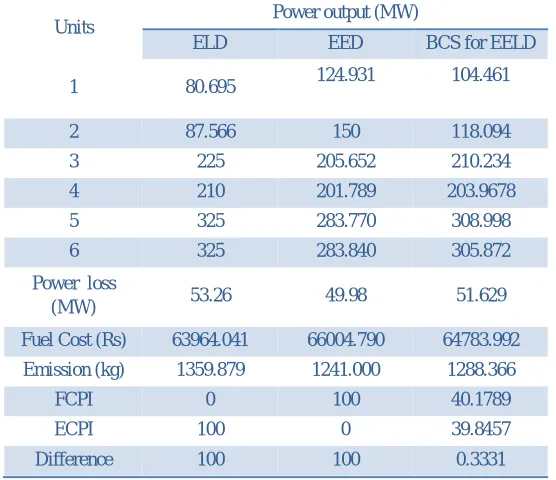
In this case system having 6 generating units considering NOx emissions is tested with power demand of 1200MW. The input data, such as cost & emission coefficients, loss data, generation restrictions, is taken from [24]. The best compromise results achieved from ALO are shown in table 3 and their comparison with MODE [24], PDE [24], NSGA-II [24], SPEA-2 [24] and PSO [26] is shown in table 4. FCPI and ECPI indices were calculated with respect to ELD and EED results for ALO and small difference of 0.331 between the two indices promises the validity of ALO for finding best compromising solution.
TABLE I. OBTAINED BY ALO FOR TEST SYSTEM I ( PD=700 MW)
Units
Power output (MW)
ELD EED BCS for
EELD
1 154.725 185.818 169.764
2 284.518 268.748 276.879
3 284.516 268.725 276.872
Power loss
(MW) 23.760 23.292 23.516
Generate the initial population of antlions and ants
randomly.
Evaluate the fitness of antlions and ants.
Locate the finest antlions and presume it as elite.
While the end criterion is unsatisfied.
For all ants.
Select an antlion using Roulette
wheel.
Update cand dusing
equations Eqs. (16) and (17) Create a random
walk and normalize it using Eqs. (11)
and (13). Update the position
of ant using Eq. (27). End for
Calculate the fitness of all ants.
Substitute an antlion with its subsequent
ant if it becomes fitter; using Eq. (18).
Update elite if an antlion becomes fitter than the elite.
[image:7.612.180.429.615.724.2]Fuel Cost
(Rs) 35424.174 35472.112 35435.510
Emission
(kg) 660.408 651.416 653.800
FCPI 0 100 23.6456
ECPI 100 0 26.5079
[image:8.612.188.425.199.362.2]Difference 100 100 2.86
TABLE II. COMPARISO OF BEST COMPROMISING SOLUTION FOR TEST SYSTEM I ( PD=700 MW)
Method Cost ($/h) Emission (lb)
CONVENTIONAL
METHOD [12] 35485.05 652.55
SGA[12] 35478.44 652.04
RGA[12] 35471.4 651.60
FFA[31] 35464 651.5
ALO 35435.510 653.800
C. Test system III
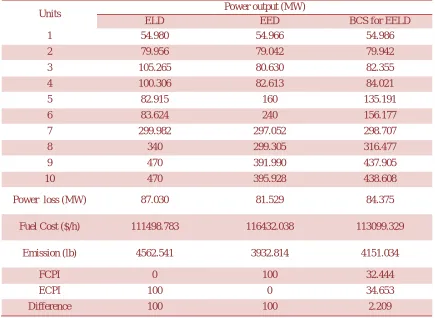
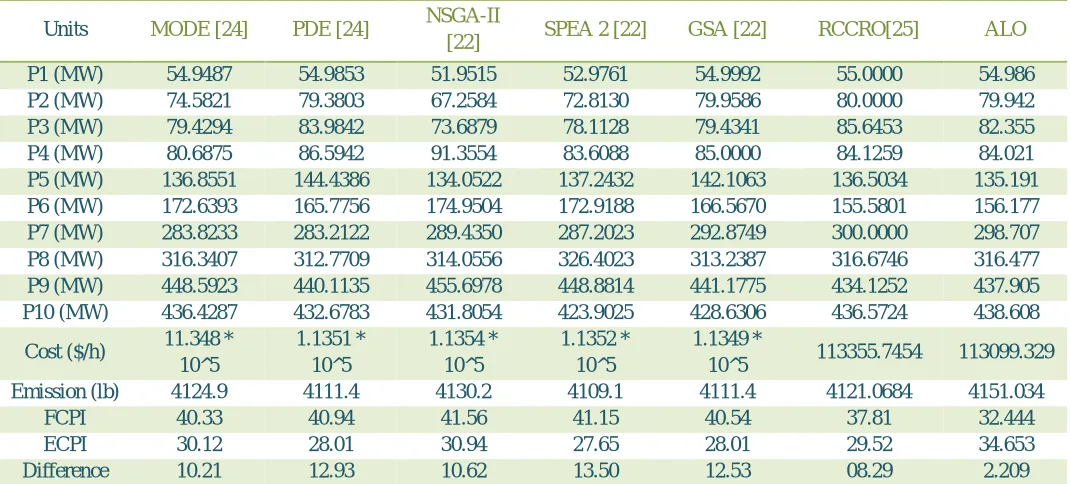
In this case system having 10 generating units considering valve point effects and NOx emissions is tested with power demand of 2000 MW. The input data, such as cost & emission coefficients, loss data, generation restrictions, is taken from [22]. The best compromise results achieved from ALO are shown in table 5 and their comparison with MODE [24], PDE [24], NSGA-II [22],SPEA 2,[22],GSA [22],RCCRO[25] is shown in table 6. FCPI and ECPI indices were calculated with respect to ELD and EED results for ALO and small difference of 2.209 between the two indices promises the validity of ALO for finding best compromising solution. The pictorial comparison of difference between FCPI and ECPI indices obtained by various methods is shown in fig.4.
TABLE III. RESULTS OBTAINED BY ALO FOR TEST SYSTEM II ( PD=1200 MW)
Units Power output (MW)
ELD EED BCS for EELD
1 80.695 124.931 104.461
2 87.566 150 118.094
3 225 205.652 210.234
4 210 201.789 203.9678
5 325 283.770 308.998
6 325 283.840 305.872
Power loss
(MW) 53.26 49.98 51.629
Fuel Cost (Rs) 63964.041 66004.790 64783.992
Emission (kg) 1359.879 1241.000 1288.366
FCPI 0 100 40.1789
ECPI 100 0 39.8457
[image:8.612.168.446.486.726.2]TABLE IV. COMPARISO OF BEST COMPROMISING SOLUTION FOR TEST SYSTEM II ( PD=1200 MW)
Method Cost ($/h) Emission (lb)
MODE[24] 64843.00 1286.00
PDE[24] 64920.00 1281.00
NSGA-II[24] 64962.00 1281.00
SPEA-II[24] 64884.00 1285.00
PSO [26] 64887.88 1283.40
ALO 64783.99 1288.366
D. Test system IV
In this case system having 40 generating units considering valve point effects and NOx emissions is tested with power demand of 10500 MW. The input data, such as cost & emission coefficients is taken from [22]. The best compromise results achieved from ALO are shown in table 7 and their comparison with MBFA [27] is shown in table 8. FCPI and ECPI indices were calculated with respect to ELD and EED results for ALO and small difference of 4.30078 between the two indices promises the validity of ALO for finding best compromising solution. The pictorial comparison of difference between FCPI and ECPI indices obtained by ALO and MFBA [27] is shown in fig.5.
TABLE V. RESULTS OBTAINED BY ALO FOR TEST SYSTEM III ( PD=2000 MW)
Units Power output (MW)
ELD EED BCS for EELD
1 54.980 54.966 54.986
2 79.956 79.042 79.942
3 105.265 80.630 82.355
4 100.306 82.613 84.021
5 82.915 160 135.191
6 83.624 240 156.177
7 299.982 297.052 298.707
8 340 299.305 316.477
9 470 391.990 437.905
10 470 395.928 438.608
Power loss (MW) 87.030 81.529 84.375
Fuel Cost ($/h) 111498.783 116432.038 113099.329
Emission (lb) 4562.541 3932.814 4151.034
FCPI 0 100 32.444
ECPI 100 0 34.653
[image:9.612.89.524.399.717.2]TABLE VI. COMPARISO OF BEST COMPROMISING SOLUTION FOR TEST SYSTEM III ( PD=2000 MW)
Units MODE [24] PDE [24] NSGA-II
[22] SPEA 2 [22] GSA [22] RCCRO[25] ALO
P1 (MW) 54.9487 54.9853 51.9515 52.9761 54.9992 55.0000 54.986
P2 (MW) 74.5821 79.3803 67.2584 72.8130 79.9586 80.0000 79.942
P3 (MW) 79.4294 83.9842 73.6879 78.1128 79.4341 85.6453 82.355
P4 (MW) 80.6875 86.5942 91.3554 83.6088 85.0000 84.1259 84.021
P5 (MW) 136.8551 144.4386 134.0522 137.2432 142.1063 136.5034 135.191 P6 (MW) 172.6393 165.7756 174.9504 172.9188 166.5670 155.5801 156.177 P7 (MW) 283.8233 283.2122 289.4350 287.2023 292.8749 300.0000 298.707 P8 (MW) 316.3407 312.7709 314.0556 326.4023 313.2387 316.6746 316.477 P9 (MW) 448.5923 440.1135 455.6978 448.8814 441.1775 434.1252 437.905 P10 (MW) 436.4287 432.6783 431.8054 423.9025 428.6306 436.5724 438.608
Cost ($/h) 11.348 * 10^5 1.1351 * 10^5 1.1354 * 10^5 1.1352 * 10^5 1.1349 *
10^5 113355.7454 113099.329 Emission (lb) 4124.9 4111.4 4130.2 4109.1 4111.4 4121.0684 4151.034
FCPI 40.33 40.94 41.56 41.15 40.54 37.81 32.444
ECPI 30.12 28.01 30.94 27.65 28.01 29.52 34.653
Difference 10.21 12.93 10.62 13.50 12.53 08.29 2.209
TABLE VII. RESULTS OBTAINED BY ALO FOR TEST SYSTEM IV (PD = 10500 MW).
Units ELD EED BCS for EELD
MBFA [27] ALO MBFA [27] ALO MBFA [27] ALO
1 114.0000 112.3215159 114.0000 113.7901571 − 113.6650901
2 110.8035 113.4247916 114.0000 113.8942034 − 111.3219521
3 97.4002 100.5697446 120.0000 119.7159511 − 99.41236768
4 179.7333 131.5182381 169.3671 175.7333282 − 180.7215271
5 87.8072 89.35228422 97.0000 96.93064366 − 87.36721866
6 140.0000 114.7613699 124.2630 122.6306849 − 106.94894
7 259.6004 297.2870638 299.6931 294.2575497 − 275.1213922
8 284.6002 299.9440429 297.9093 293.6042562 − 293.1532851
9 284.6006 287.0497722 297.2578 287.639498 − 288.9386537
10 130.0000 139.0494733 130.0007 153.7915638 − 132.4513295
11 168.7999 98.24985186 298.4210 296.0180853 − 244.6069906
12 168.7998 168.8810585 298.0264 299.6681256 − 243.9528083
13 214.7598 304.629644 433.5590 433.5063754 − 394.355992
14 304.5195 394.3024487 421.7360 421.5400279 − 394.7416178
15 394.2794 304.534581 422.7884 423.6487236 − 394.1624837
16 394.2794 305.2867349 422.7841 423.3030886 − 394.3357374
17 489.2794 490.3691148 439.4078 438.3566651 − 487.9795599
18 489.2794 489.5036818 439.4132 439.7283053 − 489.2258923
19 511.2795 511.7451751 439.4111 441.3131258 − 509.5198803
20 511.2795 511.3866797 439.4155 440.9302873 − 424.3372814
21 523.2794 523.7526806 439.4421 432.7498843 − 444.6752248
22 523.2794 546.4490405 439.4587 437.9981222 − 498.1749219
23 523.2796 524.5335111 439.7822 436.3860074 − 518.8884704
[image:10.612.47.567.373.732.2]25 523.2795 526.0300827 440.1191 440.5317634 − 433.7498497
26 523.2796 523.6386784 440.1219 440.2191136 − 503.3093562
27 10.0001 10.53824559 28.9738 24.16349618 − 11.00102962
28 10.0002 10.3420627 29.0007 48.41126024 − 16.56165106
29 10.0002 10.92134498 28.9828 30.7785289 − 13.95256909
30 89.5070 94.02741173 97.0000 95.82240167 − 96.3499386
31 190.0000 189.4857853 172.3348 172.5764043 − 188.984363
32 190.0000 190 172.3327 170.1042776 − 189.0600581
33 190.0000 188.8414191 172.3262 173.2868247 − 172.3326822
34 164.8026 168.7137325 200.0000 199.8494977 − 199.2972466
35 164.8035 190.3635298 200.0000 200 − 169.5882049
36 164.8292 199.1141077 200.0000 200 − 199.9560462
37 110.0000 89.15280064 100.8441 96.57168146 − 96.01766374
38 110.0000 103.4431437 100.8346 105.9796775 − 108.4345129
39 110.0000 109.9597579 100.8362 82.96801795 − 89.737272
40 511.2795 512.1733591 439.3868 442.8381317 − 422.1824737
Total generation 10500.00 10500.00 10500.00 10500.00 10500.00 10500.00
Fuel cost ($/h) 121415.653 122310.1012 129995.000 130503.4665 123638.00 125084.5385
Emission (Ton/h) 356424.497 368903.5705 176682.269 179062.812 188963.00 235182.0535
FCPI 0 0 100 100 25.9034 33.862
ECPI 100 100 0 0 6.8324 29.5612
Difference 100 100 100 100 19.0710 4.30078
Fig.4. Comparison of the performances for Test case III
Fig.5. Comparison of the performances for Test case IV 0
10 20 30 40 50
FCPI
ECPI
Difference
0 10 20 30 40
MFBA ALO
FCPI
ECPI
IV. CONCLUSION
The ALO algorithm is efficiently applied for solving multi-objective EELD problem. The obtained results shows that the proposed ALO algorithm can evade the deficiency of early convergence of the genetic algorithm and particle swarm optimization methods to get superior solutions. The results confirmed that ALO was able to give competitive results in comparison to GA, hybrid GA, PSO, FFA, MFBA, MODE, NSGA-II, GSA and RCCRO. The novel probabilistic model of trap constructing, entrapping of ants in traps, prey grabbing, and trap rebuilding handle the trouble of early convergence. Because of simplicity and effectiveness of the ALO method, it can be useful for searching better results in difficult power system problems in future.
REFERENCES
[1] Wood, A. J. and Wollenberg, B. F., Power Generation, Operation, and Control, 1996, Wiley, New York, 2nd Ed.
[2] Nanda, J., Khotari, D. P., and Lingamurthy, K. S., “Economic-emission load dispatch through goal programming techniques,” IEEE Trans. Energy Conversion, Vol. 3, No. 1, pp. 26–32, March 1988.
[3] Song, Y. H., Wang, G. S., Wang, P. Y., and Johns, A. T., “Environmental/economic dispatch using fuzzy logic controlled genetic algorithms,” IEE Proc. Generat. Transm. Distrib., Vol. 144, No. 4, pp. 377–382, July 1997.
[4] Abido, M. A., “A niched Pareto genetic algorithm for multi-objective environmental/economic dispatch,” Elect. Power Energy Syst., Vol. 25, No. 2, pp. 79– 105, February 2003
[5] Rughooputh, H.C.S.; Ah King, R.T.F., "Environmental/economic dispatch of thermal units using an elitist multiobjective evolutionary algorithm," Industrial Technology, 2003 IEEE International Conference on , vol.1, no., pp.48,53 Vol.1, 10-12 Dec. 2003
[6] R. T. F. Ah King and H. C. S. Rughooputh, “Elitist Multi-objective Evolutionary Algorithm for Environmental/Economic Dispatch,”Congress on Evolutionary computation, vol. 2, pp. 1108-14, 8-12 Dec.2003.
[7] N.; Mary, D., "Economic emission load dispatch using hybrid genetic algorithm," TENCON 2004. 2004 IEEE Region 10 Conference, vol.C, no., pp.476,479
Vol. 3, 21-24 Nov. 2004
doi: 10.1109/TENCON.2004.1414811
[8] Perez-Guerrero, R.E.; Cedeno-Maldonado, J.R., "Differential evolution based economic environmental power dispatch," Power Symposium, 2005. Proceedings of the 37th Annual North American , vol., no., pp.191,197, 23-25 Oct. 2005
[9] Hong-da Liu; Zhong-li Ma; Sheng Liu; HaiLan, "A New Solution to Economic Emission Load Dispatch Using Immune Genetic Algorithm," Cybernetics and Intelligent Systems, 2006 IEEE Conference on , vol., no., pp.1,6, 7-9 June 2006
[10] Hazra, J.; Sinha, A.K., "Environmental Constrained Economic Dispatch using Bacteria Foraging Optimization," Power System Technology and IEEE Power India Conference, 2008. POWERCON 2008. Joint International Conference on , vol., no., pp.1,6, 12-15 Oct. 2008
[11] Hemamalini, S.; Simon, S.P., "Emission constrained economic dispatch with valve-point effect using particle swarm optimization," TENCON 2008 - 2008 IEEE Region 10 Conference , vol., no., pp.1,6, 19-21 Nov. 2008
[12] M. Sudhakaran, S.M.R Slochanal, R. Sreeram and N Chandrasekhar, “Application of Refined genetic Algorithm to Combined Economic and Emission Dispatch” J. Institute Of Engg. (India) volume-85, Sep. 2004pp. 115-119.
[13] M. Sudhakaran and S.M.R Slochanal, “Integrating Genetic Algorithm and Tabu Search for Emission and Economic Dispatch Problem” J. Institute of Engg. (India) volume-86, June.2005, pp-22-27.
[14] Bhattacharya, Aniruddha, and P. K. Chattopadhyay. "Application of biogeography-based optimization for solving multi-objective economic emission load dispatch problems." Electric Power Components and Systems 38, no. 3 (2010): 340-365.
[15] Niknam, T.; Golestaneh, F.; Sadeghi, M.S., " -Multiobjective Teaching–Learning-Based Optimization for Dynamic Economic Emission Dispatch," Systems Journal, IEEE , vol.6, no.2, pp.341,352, June 2012
[16] Abedinia, O.; Amjady, N.; Naderi, M.S., "Multi-objective Environmental/Economic Dispatch using firefly technique," Environment and Electrical Engineering (EEEIC), 2012 11th International Conference on , vol., no., pp.461,466, 18-25 May 201
[17] A, Chattopadhyay PK. Solving economic emission load dispatchproblems using hybrid differential evolution. Appl Soft Comput (Elsevier)2011;11(2):2526– 37.
[18] Rajasomashekar S, Aravindhababu P. Biogeography based optimizationtechnique for best compromise solution of economic emission dispatch.Swarm Evol Comput 2012;7:47–57.
[19] Hota PK, Barisal AK, Chakrabarti R. Economic emission load dispatch throughfuzzy based bacterial foraging algorithm. Int J Electr Power Energy Syst2010;32(7):794–803.
[20] Kumarappan N, Mohan MR, Murugappan S. ANN approach applied tocombined economic and emission dispatch for large scale system. In:Proceedings of the 2002 international joint conference on neural networks,IJCNN, vol. 02, no. 1; 2002. p. 323–7.
[21] Chatterjee A, Ghoshal SP, Mukherjee V. Solution of combined economic and emission dispatch problems of power systems by an opposition-basedharmony search algorithm. Electr Power Energy Syst 2012;39(1):9–20.
[22] Güvenç U, Sönmez Y, Duman S, Yörükeren N. Combined economic andemission dispatch solution using gravitational search algorithm. Orig ResArticle Sci Iran 2012;19(6):1754–62.
[23] B, Mukherjee V, Ghoshal SP. A novel opposition-based gravitational search algorithm for combined economic and emission dispatch problems of power systems. Electr Power Energy Syst 2012;35(1):21–33
[24] Basu, M. ‘‘Economic environmental dispatch using multi-objective differential evolution’’, Applied Soft Computing, 11, pp. 2845–2853 (2011). [25] systems by Real Coded Chemical Reaction algorithm”, Electrical Power and Energy Systems 59 (2014) 176–187
[27] Hota PK, Barisal AK, Chakrabarti R. Economic emission load dispatch through fuzzy based bacterial foraging algorithm. Int J Electr Power Energy Syst 2010;32(7):794–803.
[28] Kumarappan, N.; Mohan, M.R.; Murugappan, S., "ANN approach applied to combined economic and emission dispatch for large-scale system," Neural Networks, 2002. IJCNN '02. Proceedings of the 2002 International Joint Conference on , vol.1, no., pp.323,327, 200
[29] AlRashidi, M. R., and El-Hawary, M. E., “Emission-economic dispatch using a novel constraint handling particle warm optimization strategy,” Canadian Conference on Electrical and Computer Engineering 2006, pp. 664–669, Ottawa, Canada, 7–10 May 2006.
[30] Gaurav Prasad Dixit, Hari Mohan Dubey, ManjareePandit, B. K. Panigrahi, “Artificial Bee Colony Optimization for Combined Economic Load and Emission Dispatch”, International Conference on Sustainable Energy and Intelligent System (SEISCON 2011) ,Dr.M.G.R. University, Maduravoyal, Chennai, Tamil Nadu, India. July.20-22, 2011.
[31] Dinakara Prasad Reddy P, J N Chandra Sekhar ,“Application of Firefly Algorithm for Combined Economic Load and Emission Dispatch” International Journal on Recent and Innovation Trends in Computing and Communication, Vol.2 , No.8(2014):2448-2452