Technology (IJRASET)
Facial Expression Recognition: A Study
Arpita Waze1, Asst Prof. Deepak Sharma2
Digital Communication, SDBCT Indore
Abstract— Facial Expressions are the outcome of the moments done through face muscles with respect in the changes on face. These expressions may represent the person’s internal emotional stage as well as thought in a body language manner. Body language is the hidden sign of expression which not only represent the thinking of the person but also help to judge the person. It helps for better communication and thought exchange. There is a considerable history associated with the study on facial expressions.
In this work, we present our recent work on recognizing facial expressions using discriminative local statistical features. Especially variants of principal component analysis are investigated for facial representation. Finally, the current status, open problems, and research directions are discussed. This study investigated whether facial expressions can be accurately identified using face region only, how much recognition is impaired relative to the facial parts, and what mechanisms account for the recognition advantage of some expressions. In most of the prior studies, the facial parts were used but there significance in recognition respective of facial expression was not shown.
Keywords—Facial Expression Recognition, LBP, PCA, M2DPCA, Action Unit
I. INTRODUCTION
Facial Expressions are kind of body language represent mindset of human being in the muscle manners. Darwin (1872) was the first to describe in details the specific facial expressions associated with emotions in animals and humans, who argued that all mammals show emotions reliably in their faces. Since that, facial expression analysis has been an area of great research interest for behavioral scientists.
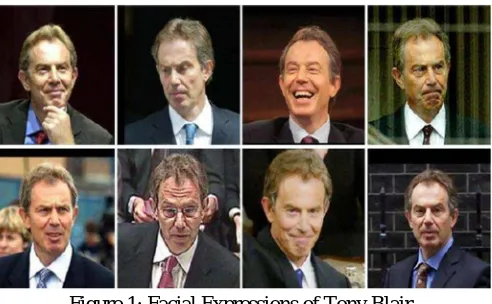
[image:2.612.186.432.468.620.2]Facial expressions can be described at different levels [2]. Two mainstream description methods are facial affect (emotion) and facial muscle action (action unit) [3]. Psychologists suggest that some basic emotions are universally displayed and recognized from facial expressions , and the most commonly used descriptors are the six basic emotions, which includes anger, disgust, fear, joy, surprise, and sadness. This is also reflected by the research on automatic facial expression analysis; most facial expression analysis systems developed so far target facial affect analysis, and attempt to recognize a set of prototypic emotions. Figure 1 explains the various face expression of Tony Blair.
Figure 1: Facial Expressions of Tony Blair
However there is various kind of expression which are supposed to be considering for understanding. Some of may be very complicated expressions like happily disgusted and angrily surprised and some of are very easy and understanding like Confusion or angry. A list of various facial expressions is listed below;
Technology (IJRASET)
E. Exhaustion F. Anger G. Seduction H. Fear I. Sadness J. Happiness K. Disgust L. Contempt M. Frustration N. Boredom O. EmbarrassedFacial expression recognition itself is an efficient way of communication: it's natural, non-intrusive, and has shown that, surprisingly, expression conveys more information than spoken words and voice tone. To build a friendlier Human Computer Interface, expression recognition is essential. This section talks about the method which has been considered in our experiments.
II. RELATED WORK
The present study aimed to clarify the role played by the eyes, nose and mouth areas in the recognition of the six basic emotions. The mouth and eye areas were not equally important for the recognition of all emotions. More precisely, while the mouth was revealed to be important in the recognition of one expression and the eye area of another, results are not as consistent for the other emotions. In consistent with previous studies, the eyes were fixated for longer periods than the mouth for all emotions. Again, variations occurred as a function of the emotions, the mouth having an important role in happiness and the eyes in sadness. The general pattern of results for the other four emotions was inconsistent between the experiments as well as across different measures. The complexity of the results suggests that the recognition process of emotional facial expressions cannot be reduced to a simple feature processing or holistic processing for all emotions.
Zheng Zhang has developed an architecture based on two-layer perceptions for recognizing facial expressions. He has compared the use of two types of features extracted from face images. The first type is the geometric positions of a set of fiducially points on a face. The second type is a set of multi-scale and multi-orientation Gabor wavelet coefficients extracted from the face image at the fiducial points. They can be used either independently or jointly. Comparison of the recognition performance with different types of features shows that Gabor wavelet coefficients are much more powerful than geometric positions and that the agreement between computer and the person who is expressing’ labelling is higher than that between human subjects and the subject labelling.
Furthermore, since the first layer of the perceptron actually performs a nonlinear reduction of the dimensionality of the feature space, he have also studied the desired number of hidden units, i.e., the appropriate dimension to represent a facial expression in order to achieve a good recognition rate. It turns out that at least two hidden units are necessary to code reasonably facial expressions and that five to seven hidden units are probably enough to give a precise representation.
Then, Zhang has investigated the importance of each individual fiducial point to facial expression recognition. Sensitivity analysis reveals that points on cheeks and on forehead carry little useful information. After discarding them, not only the computational efficiency increases, but also the generalization performance slightly improves. This has an important consequence: we only need to extract features in the eyes and mouth regions from images. Note that we have only studied the sensitivity of each individual fiducial point on a face. There may be strong correlations between the features of some points such as those on both eyes. This is one subject of our future research. Finally, he has studied the significance of image scales. Experiments show that facial expression recognition is mainly a low frequency process, and a spatial resolution of 64 pixels x 64 pixels or lower is probably enough [20]. M. Pantic, presented an automated system that was developed to recognize facial gestures in static, frontal- and/or profile-view colour face images. A multi detector approach to facial feature localization is utilized to spatially sample the profile contour and the contours of the facial components such as the eyes and the mouth. From the extracted contours of the facial features, we extract ten profile-contour fiducial points and 19 fiducial points of the contours of the facial components. Based on these, 32 individual facial muscle actions (AUs) occurring alone or in combination are recognized using rule-based reasoning. With each scored AU, the utilized algorithm associates a factor denoting the certainty with which the pertinent AU has been scored. A recognition rate of 86% was achieved [21].
Technology (IJRASET)
improves the efficiency of recognition; it performs well under varying illumination and expression conditions and its performance is better as compared to the traditional PCA methods. In this method the face image is divided into three horizontal strips thus the face image is divided into three sub-images. On these three horizontal modules the Modular PCA is applied for feature extraction. Due to the extraction of features using three horizontal stripes, the effect of variations in expressions is minimized and because of the use of depth-map images the proposed algorithm gives better recognition rate even in varying illumination conditions. The performance of the proposed technique is evaluated under varying illumination and expression. The experiments were carried out on the face images with varying light effects and expressions from two standard face databases; CASIA 3D and GAVA DB databases.
III. LOCALBINARYPATTERNS
This section talks about the method which has been considered in our experiments.
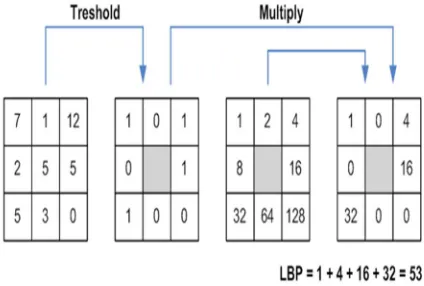
The original LBP operator, introduced by Ojala, is a powerful method of texture description. Figure 2.1 is showing how LBP code is calculated in a 3×3 neighbourhood which contains total 9 gray values. For all pixels in an image, a binary code is produced by comparing its neighbourhood with the value of the pixel. As shown in Figure 2.1, pixels encircling the central pixel are labelled 1 if their values are greater than or equal to the value of the central pixel; 0, otherwise. The LBP binary code of the centre pixel is composed of those labels anticlockwise. Finally, the local binary pattern for centre pixel is obtained by converting the binary code into a decimal one.
The local binary pattern (LBP) operator is defined as a gray-scale invariant texture measure, derived from a general definition of texture in a local neighbourhood. Through its recent extensions, the LBP operator has been made into a really powerful measure of image texture, showing excellent results in many empirical studies. The LBP operator can be seen as a unifying approach to the traditionally divergent statistical and structural models of texture analysis. Perhaps the most important property of the LBP operator in real-world applications is its invariance against monotonic gray level changes. Another equally important is its computational simplicity, which makes it possible to analyse images in challenging real-time settings [12]. The LBP method and its variants have already been used in a large number of applications all over the world.
The recent emergence of Local Binary Patterns (LBP) has led to significant progress in applying texture methods to various computer vision problems and applications. The focus of this research has broadened from 2D textures to 3D textures and spatiotemporal (dynamic) textures. Also, where texture was once utilized for applications such as remote sensing, industrial inspection and biomedical image analysis, the introduction of LBP-based approaches have provided outstanding results in problems relating to face and activity analysis, with future scope for face and facial expression recognition, biometrics, visual surveillance and video analysis [13]. Computer Vision Using Local Binary Patterns provides a detailed description of the LBP methods and their variants both in spatial and spatiotemporal domains.
This comprehensive reference also provides an excellent overview as to how texture methods can be utilized for solving different kinds of computer vision and image analysis problems. Source codes of the basic LBP algorithms, demonstrations, some databases and a comprehensive LBP bibliography can be found from an accompanying web site. Topics include: local binary patterns and their variants in spatial and spatiotemporal domains, texture classification and segmentation, description of interest regions, applications in image retrieval and 3D recognition - Recognition and segmentation of dynamic textures, background subtraction, recognition of actions, face analysis using still images and image sequences, visual speech recognition and LBP in various applications. Professional engineers and graduate students in computer vision, image analysis and pattern recognition.
The local binary pattern operator is an image operator which transforms an image into an array or image of integer labels describing small-scale appearance of the image. These labels or their statistics, most commonly the histogram, are then used for further image analysis. The most widely used versions of the operator are designed for monochrome still images but it has been extended also for color (multi channel) images as well as videos and volumetric data [14].
Technology (IJRASET)
A. Derivation Of The Generic LBP Operator
[image:5.612.204.416.127.270.2]Several years after its original publication, the local binary pattern operator was presented in a more generic revised form by Ojala et al. [17]. In contrast to the basic LBP using 8 pixels in a 3 × 3 pixel block.
Figure 2: Calculations of Local Binary Patterns
Figure 3: Representation of Uniform LBP with 8, 16, 24 pixels
The success of LBP methods in various computer vision problems and applications has inspired much new research on different variants. Due to its flexibility the LBP method can be easily modified to make it suitable for the needs of different types of problems. The basic LBP has also some problems that need to be addressed. Therefore, several extensions and modifications of LBP have been proposed with an aim to increase its robustness and discriminative power. In this section different variants are divided into such categories that describe their roles in feature extraction. Some of the variants could belong to more than one category, but in such cases only the most obvious category was chosen The choice of a proper method for a given application depends on many factors, such as the discriminative power, computational efficiency, robustness to illumination and other variations, and the imaging system used.
IV. PROBLEMDOMAIN
The face expression research community is shifting its focus to the recognition of spontaneous expressions. As discussed earlier, the major challenge that the researchers face is the non-availability of spontaneous expression data. Capturing spontaneous expressions on images and video is one of the biggest challenges. If the subjects become aware of the recording and data capture process, their expressions immediately loses its authenticity [6]. To overcome this they used a hidden camera to record the subject’s expressions and later asked for their consents. Although building a truly authentic expression database (one where the subjects are not aware of the fact that their expressions are being recorded) is extremely challenging, a semi-authentic expression database (one where the subjects watch emotion eliciting videos but are aware that they are being recorded) can be built fairly easily.
Technology (IJRASET)
located on the first frame. The challenge is to make the system fully automatic. In recent years, there have been advances in building fully automatic face expression recognizers.
A. Efficiency Of Feature Extraction Algorithm
Firstly, because the difference between the facial expressions that characterize emotion is small, it requires an algorithm to extract features that are very sensitive to any change in the facial images. In contrast, it is a problem at training stage that will affect negatively on the system and if it has extracted useless features. Therefore, the pre-processing applied on dataset is a very important stage since it serves to unify the characteristics of images and removes noise.
Secondly, the extracted feature algorithm that is focused to improve and utilized in this project is a principal component analysis (PCA). This algorithm is required to analyze the data set together, which means that the image will not be analyzed and it will not extract its features individually because of the strength of (PCA) that lays the ground for how to extract a feature based on comparing all data sets together to identify the important data. Thus, it is necessary to choose the experimental data set carefully not just for the training stage but also for extracting the feature required for testing the data set. Furthermore, it also means that it cannot extract the feature for one testing image individually; one has to compare the testing results and apply the PCA algorithm to the data set and the testing image to extract its features.
The complete study observe that there is big gap between desire and available. Work requires reducing detection time and looking out to develop a solution to improve facial expression detection during automatic reorganization.
V. METHODOLOGY
[image:6.612.195.416.402.479.2]The facial expression recognition system is designed for two purposes: one for recognition of facial expression using variants of PCA. We applied Modular Two Dimensional Principal Component Analysis for information extraction .The information extraction is performed on face and facial parts images. While classifications performed using various classifiers and the final classifier chosen are presented in the flow diagram of the proposed system is shown in Figure 4.
Figure 4: Facial Expression Recognition System
VI. CONCLUSION
The complete study concludes that; To maintain the equilibrium in selecting useful information and reducing unwanted information or less important face regions, we have further applied Adaboost method to get the most important information from a face image i.e. the central region of the face composed of Eyes, Nose and Mouth. To derive the significance of facial parts we have used the most important parts of face as module of M2PCA. It is not only four parts of face image but these are four identification pillars which are Left and Right Eye, Nose and Mouth.
Moreover, few expressions seem to be a difficult to correctly classify. This mainly results from the fact that the performance of expressions varies among subjects. The experiments demonstrate that which facial part plays important role in classification of particular expression. For example, angry expression can be recognized correctly with help of two facial parts i.e. Eyes and Mouth .In same manner we identified the facial parts which have significance in recognition of expressions. The complete work will be simulated and evaluated by MATLAB.
REFERENCES
Technology (IJRASET)
International Journal of Pattern Recognition and Artificial Intelligence, Volume 13, no. 6, 1999 , pp 893-911.[3] Maja Pantic and Leon J. M. Rothkrantz, “Facial Action Recognition for Facial Expression Analysis from Static Face Images”, IEEE Transactions on Systems, Man, and Cybernetics - Part B: Cybernetics, Volume 34, no. 3, June 2004
[4] Nita M. Thakare and V. M. Thakare, “Modular PCA Based Fuzzy Neural Network Approach for Illumination and Expression invariant 3D Face recognition”, published in International Journal of Scientific & Engineering Research Volume 3, Issue 5, 2012
[5] José Francisco Pereira, ”Modular Image Principal Component Analysis for Handwritten Digits Recognition”, in proceedings of the Seventeenth International Conference on Systems, Signals and Image Processing , 2010, pp 356-359.
[6] Ambika. D, Arathy. B and Srinivasa Perumal. R, “Comparison of PCA and MPCA with Different Databases for Face Recognition”, published in International Journal of Computer Applications, Volume 43, no. 17, 2012
[7] Hamimah Ujir and Michael Spann, “Facial Expression Recognition Using FAPs-Based 3DMMM”, published in Topics in Imaging and Computer Vision, Springer, Volume 243, 2013, pp 33-41.