Technology (IJRASET)
Improved Digital Image Watermarking Using
Arnold Transform Based SVD
Kamalpreet Kaur1, Khushdeep Kaur2
1,2
Department of Computer Engineering, BMSCE, Muktsar(Pb), India
Abstract:-The main aim of this research is to provide modification in SVD to improve the robustness, which is neglected by many researchers. This research work proposes a new integrated watermarking technique which will integrate DCT, DWT and modified SVD. The SVD will be modified by Arnold transform. Proposed algorithm will combine the advantages of the well-known watermarking techniques DCT, DWT and modified SVD. DCT will be applied to the input cover image. Then principal one level DWT will be applied to form sub-bands. To accomplish inaudibility HH wave band will be selected for additional wave level decomposition. Modified-SVD will be then applied to HH and values will be adapted with the values of the image going to be watermarked. Thus the proposed technique has better results because the insertion is more secure as followed by several well-known techniques. Thus the results are more efficient even in case of some well-well-known techniques.
Keywords:- Watermarking; DCT; DWT; SVD; ARNOLD TRANSFORM.
I. INTRODUCTION
The security and authenticity issues of digital image are becoming popular than ever, due to the rapid growth of multimedia and Internet technology. On Internet, digital images are easily and widely shared among the different users at different geographical places. Every day large amount of digital images are transmitted over the internet in various applications. As digital technology allows unauthorized reproduction of digital images, the protection of the copyrights of digital image is a very important issue. Image watermarking schemes are used to protect the digital images. Watermarking is the process to hide some data which is called watermark or label into the original data(image, audio or video) such that watermark can be extracted or detected later to make an assertion about the object. Watermarks of varying degree of visibility are added to presentation media as a guarantee of authenticity, quality, ownership and source. The image watermarking schemes have been widely used to solve the copyright protection problems of digital image related to illegal usage or distribution. Watermarking scheme quality is determined using robustness, transparency and capacity. Transparency means after insertion of watermark the original image should not be distorted. Robustness is related to attacks. If watermark removal is difficult to various attacks like rotation, scaling, compression, noise then watermarking scheme is robust. Capacity means amount which are inserted to cover image. More capacity means one can hide large amount of information [Divecha and Jani, 2013].
Fig 1: Typical Watermarking block diagram [Keta and Zafar, 2013]
II. RELATED WORK
Technology (IJRASET)
perceptual weighting (JPW) model. In this, JPW model three human visual system characteristics has been defined, namely: spatial frequency sensitivity, local brightness masking and texture masking, to compute a weight for each wavelet coefficient, which is then used to control the amplitude of the inserted watermark[Saini et al., 2014] has introduced a hybrid watermark embedding and extracting technique. SVD and DWT methods are used for watermark embedding because DWT method is more flexible and provides a wide range of functionalities for still image processing.[Varghese et al., 2014] has analyzed an image adaptive Singular Value Decomposition based Watermarking scheme. The algorithm reproposed by author incorporates standard deviation method to identify high / low frequency blocks of the carrier image to decide where the blocks of the watermark image are to be embedded so that perception quality is not affected. [Zhao and Xu, 2013] has presented a new semi-blind watermarking scheme based on discrete wavelet transform (DWT) and subsamping. For watermark embeddng, the host image is decomposed into subimages by sub samping and after transforming these subimages via DWT, the embedding subgraph is obtained. Then its detail coefficients are transformed by singular value decomposition (SVD). [Zhu et al., 2013] has described the digital watermarking is an important means of copyright protection, that decomposes RGB for the color image and embeds the algorithm of multiple watermarks in the grayscale image of R, G. The algorithm has increases the amount of watermark embedded and solves the interference problem of embedding multiple watermarks. [Keta and Zafar, 2013] has explained the problems related to security and authenticity of digital data in digital communication. In multimedia communication, digital images and videos have many applications. Although, watermarking algorithms are used for copyright protection and security. But, most of the watermarking algorithms transform the host image and embedding of the watermark information is done in robust way.[Divecha and Jani, 2013] has described digital image watermarking is a technology that has been developed to secure digital content from illegal use. Author proposed the implementation and performance analysis of two different watermarking schemes based on DCT-DWT-SVD.
III. IMAGE WATERMARKING ARCHITECTURE
Digital watermarking hides the copyright information into the digital data through certain algorithm. To trace illegal copies, a unique watermark is required based on the location or identity of the recipient in the multimedia network. The sort of information hidden in the item when using watermarking is usually a signature to signify origin or ownership for the purpose of copyright protection. The major application of watermarking is copyright control, in which an image owner seeks to avoid illegal copying of the image. Robust watermarks are well matched for copyright protection, because they reside intact with the image under various manipulations. A digital watermark can be visible or invisible. A visible watermark typically consists of a conspicuously visible message or a company logo indicating the ownership of the image. On the other hand, an invisibly watermarked image appears very similar to the original. The existence of an invisible watermark can only be determined using an appropriate watermark extraction or detection algorithm. In this report we restrict our attention to invisible watermarks. A watermarking system is divided into three distinct steps, embedding, attack and detection [Zhu et al., 2013]. In embedding an algorithm accepts the host and the data to be
embedded, and produces a watermarked signal.The watermark insertion step is represented as:X0 = EK(X; W)
where X is the original image, W is the watermark information being embedded, K is the user’s insertion key, and E represents the watermark insertion function and the watermarked variant is represented as X0.
Depending on the way the watermark is inserted, and depending on the nature of the watermarking algorithm, the detection or extraction method can take on very distinct approaches. Watermark extraction works as follows:
ˆW= DK0(ˆX 0)
where ˆX 0 is a possibly corrupted watermarked image, K0 is the extraction key, D represents the watermark extraction/detection function, and ˆW is the extracted watermark information.
IV. WATERMARKING TECHNIQUES
Many watermarking techniques are available. But, the following techniques are mostly used in image watermarking.
A. Discrete Cosine Transform
Technology (IJRASET)
B. Discrete Wavelet Transform
The DWT is nothing but a system of filters. There are two filters involved, one is the “wavelet filter”, and the other is the “scaling filter”. The wavelet filter is a high pass filter, while the scaling filter is a low pass filter. After applying a 1-level DWT on an image, we get the approximation subband LL, the horizontal subband HL, the vertical subband LH, and the diagonal subband HH. Moreover we can apply 2-level DWT on any subband. DWT is preferred, because it provides both a simultaneous spatial localization and a frequency spread of the watermark within the host image [Saini et al., 2014]. The hierarchical property of the DWT offers the possibility of analyzing a signal at different resolutions and orientations.
C. Singular Value Decomposition
SVD is an effective numerical analysis tool used to analyze matrices. The Singular Value Decomposition of image I of size m x n is obtained by the operation
I= USV
where U is column-orthogonal matrix of size m x m , S is the diagonal matrix with positive elements of size m x n and transpose of n x n orthogonal matrix V. The important property of SVD based watermarking is that the large of the modified singular values of image will change by very small values for different types of attacks.
D. Arnold Transformation
Image scrambling refers to transformation of the image, which rearranges the spatial position of the pixels according to some rules, and makes image distortion for the purpose of security. Arnold transform is used to scramble watermarking image. Assume image pixel coordinates are x and y; x, y ε{0,1,… N-1} ( N is the order of image array), Arnold transform is
V. STEPS OF PROPOSED APPROACH
This section will explain the working of the proposed algorithm. Watermark Embedding Process
The detailed insertion process for the proposed approach is given below:
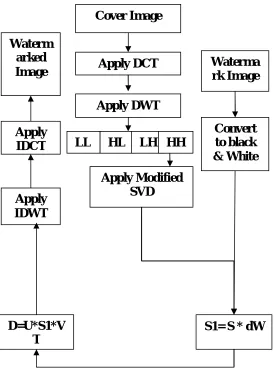
Step1: Consider the Cover Image of size N*N and let it be C1. If it is a color image select the color channel. Step2: Apply DCT to cover image C1 and name it C2.
Step3: Apply DWT to C2 to decompose it into four N/2 x N/2 sub-bands LL1, LH1, HL1 and HH1.
Step4: Evaluate HH1 band and then DWT will come in action to decompose DWT coefficients into four N/4 * N/4 sub bands LL, LH, HL and HH.
Step5: Apply SVD to HH, block by block and for each block calculate HH=U1*S1*V1, and acquire U1, S1 and V1. Step6: Modify Singular values of SVD ie S1 by standard values of Arnold Transformation to get S2.
In Arnold Transformation, the transformation of point (x, y) to another point (X ', Y ') is:
Where, are standard values.
Step 6: Let W of size N/16 x N/16 to represent watermark. Step 7: Now, modify S2 with watermark such that S=S2 + a* W. Step 8: Obtain HH* using HH*= U*S*VT.
Step 9: Apply inverse DWT to LL, HL, LH and HH* to get matrix HH1*.
X’
Y’
=
1 1
1 2
X
Y
mod(N)
X’
Y’
=
1 1
1 2
X
Y
mod(N)
Technology (IJRASET)
Step 10: Apply inverse DWT to LL1, HL1, LH1 and HH1* to get cover image C2. [image:5.612.150.424.124.495.2]Step 11: Apply inverse DCT to C2 to produce C1 and set it to selected color channel to get watermarked image WI.
Fig 2: Flow Chart of embedding process
Watermark Detection Process
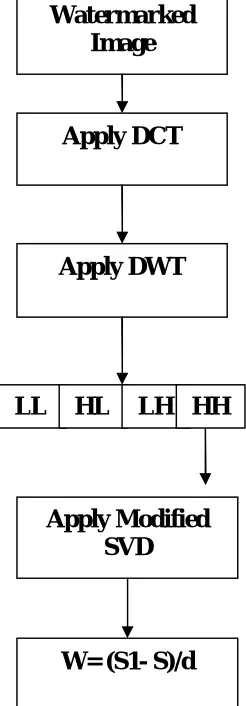
The Mining process has been alienated into subsequent steps and is momentarily designated as given below: Step 1: Select color channel and apply DCT to WI to get C2.
Step 2: Apply DWT to C2 to get LL1, HL1, LH1 and HH*
Step 3: Select HH1* band and apply DWT to it to get LL, HL, LH and HH*.
Step 4: Apply SVD to HH*, block by block and for each block calculate HH*=WU1*WS1*WV1, and acquire WU1, WS1 and WV1.
Step 5: Obtain W=(S-WS1)/a.
Waterm
arked
Image
Cover Image
Apply
IDCT
Apply
IDWT
S1= S * dW
D=U*S1*V
T
Apply Modified
SVD
Apply DWT
Apply DCT
Waterma
rk Image
Convert
to black
& White
Technology (IJRASET)
Fig 3: Flow Chart of detection process
VI. RESULTS AND DISCUSSIONS
The proposed algorithm is tested on various images. The algorithm is applied using various performance indices Mean Squared Error (MSE), Peak Signal to Noise Ratio (PSNR), Normalized Cross-Correlation (NCC), Bit Error Rate (BER), and Root Mean Square Error (RMSE).
In order to implement the proposed algorithm, design and implementation has been done in MATLAB using image processing toolbox. The developed approach is compared against some well-known image watermarking techniques available in literature. In order to do cross validation we have also implemented a new semi-blind watermarking scheme based on discrete wavelet transform (DWT) and subsampling. After these comparisons, we are comparing proposed approach against Gaussian Noise, Median Filtering and Histogram Attack using some performance metrics. Result shows that our proposed approach gives better results than the existing techniques.
VII. EXPERIMENTAL RESULTS
Figure 4 has shown the input images for experimental analysis. Fig.4 (a) is showing the cover image and fig.4 (b) is showing the watermark image. The overall objective is to combine relevant information from multiple images into a single image that is more informative and suitable for both visual perception and further computer processing.
Watermarked
Image
W= (S1- S)/d
Apply Modified
SVD
Apply DWT
Apply DCT
Technology (IJRASET)
Fig 4(a):Cover Image Fig 4(b): Watermark image
Figure 5 has shown the watermarked image of proposed technique. Comparing the watermarked image with the original cover image does not feel the presence of the watermark. So the algorithm achieves visual invisibility.
Fig 5: Watermarked Image of Proposed Technique
Fig 6: Extracted watermark of proposed technique without any attack
Figure 6 has shown the extracted watermark of proposed technique. The extracted watermark as compared to the original watermark does not show any difference. The proposed method also removes the standard SVD line in watermark, hence improves the quality.
Fig 7:Extracted watermark of proposed technique after Gaussian Noise attack Figure 7 has shown the extracted watermark of proposed
technique after Gaussian noise attack. Gaussian noise is statistical noise having a probability density function (PDF) equal to that of the normal distribution, which is also known as the Gaussian distribution. The extracted watermark does not show any noise.
Fig 8: Extracted watermark of proposed technique after Median Filter attack
[image:7.612.194.421.236.364.2]Technology (IJRASET)
Fig 9: Extracted watermark of proposed technique after Histogram attack
Figure 9 has shown the extracted watermark of proposed technique after histogram attack. The histogram attack produces undesirable effects when applied to images with low color depth. It estimates a watermark by using only histogram of an image. It may increase the contrast of background noise, while decreasing the usable signal.The extracted watermark removes the standard SVD line in watermark.
VIII. PERFORMANCE ANALYSIS
This section contains the cross validation between existing and proposed techniques. Some well-known image performance parameters for digital images have been selected to prove that the performance of the proposed algorithm is quite better than the existing methods.
A. Mean Square Error Evaluation
Mean square error is a measure of image quality index. Mean square error between the reference image and the fused image is :
Where Ai, j and Bi, j are the image pixel value of reference image
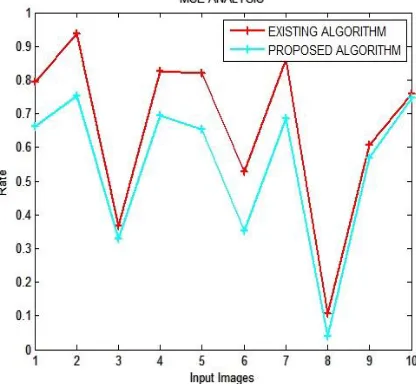
[image:8.612.199.407.382.574.2]As mean square error need to be reduced therefore the proposed algorithm is showing the better results than the available methods as mean square error is less in all the cases.
Fig 10: MSE of Existing Technique & Proposed Approach for different images
Figure 10 has shown the quantized analysis of the mean square error of different images using watermarking by Existing Technique (Red colour) and watermarking by Proposed Approach (Sky Blue Colour). It is very clear from the plot that there is decrease in MSE value of images with the use of proposed method over other methods in all images. This decrease represents improvement in the objective quality of the image.
B. Peak Signal to Noise Ratio Evaluation
Technology (IJRASET)
[image:9.612.195.415.120.268.2]As PSNR need to be maximized; so the main goal is to increase the PSNR as much as possible.
Fig 11: PSNR of Existing Technique & Proposed Approach for different images
Figure 11 has shown the quantized analysis of the peak signal to noise ratio of different images using watermarking by Existing Technique (Red Color) and watermarking by Proposed Approach (Sky Blue Color). PSNR is maximum in the case of the proposed algorithm therefore proposed algorithm is providing better results than the available methods
[image:9.612.59.558.375.720.2]It is very clear from the plot that there is increase in PSNR value of images with the use of proposed method over other methods. This increase represents improvement in the objective quality of the image.
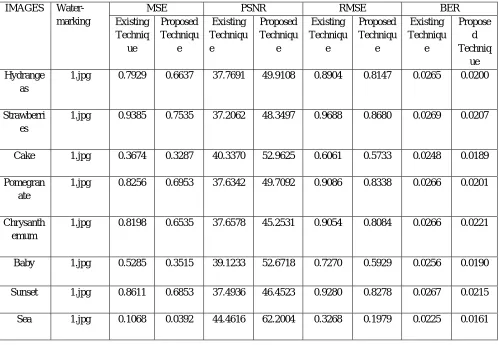
Table 1: Evaluation of MSE, PSNR, RMSE and BER
IMAGES
Water-marking
MSE PSNR RMSE BER
Existing Techniq ue Proposed Techniqu e Existing Techniqu e Proposed Techniqu e Existing Techniqu e Proposed Techniqu e Existing Techniqu e Propose d Techniq ue Hydrange as
1.jpg 0.7929 0.6637 37.7691 49.9108 0.8904 0.8147 0.0265 0.0200
Strawberri es
1.jpg 0.9385 0.7535 37.2062 48.3497 0.9688 0.8680 0.0269 0.0207
Cake 1.jpg 0.3674 0.3287 40.3370 52.9625 0.6061 0.5733 0.0248 0.0189
Pomegran ate
1.jpg 0.8256 0.6953 37.6342 49.7092 0.9086 0.8338 0.0266 0.0201
Chrysanth emum
1.jpg 0.8198 0.6535 37.6578 45.2531 0.9054 0.8084 0.0266 0.0221
Baby 1.jpg 0.5285 0.3515 39.1233 52.6718 0.7270 0.5929 0.0256 0.0190
Sunset 1.jpg 0.8611 0.6853 37.4936 46.4523 0.9280 0.8278 0.0267 0.0215
Technology (IJRASET)
Warning 1.jpg 0.6056 0.5697 38.6684 50.2976 0.7782 0.7548 0.0259 0.0199
Sparrow 1.jpg 0.7590 0.7465 37.9151 49.4005 0.8712 0.8640 0.0264 0.0202
C. Normalized Cross-Correlation Evaluation
Normalized cross correlation is used to find out similarities between fused image and registered image is given by the following equation:
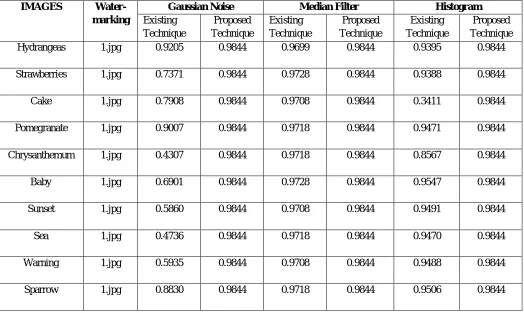
[image:10.612.196.405.259.398.2]As NCC needs to be close to 1, therefore proposed algorithm is showing better results than the available methods as NCC is close to 1 after gaussian noise attack, median filter attack and histogram attack.
[image:10.612.181.419.498.681.2]Fig 12: NCC of Existing Technique & Proposed Approach for Gaussian Noise attack
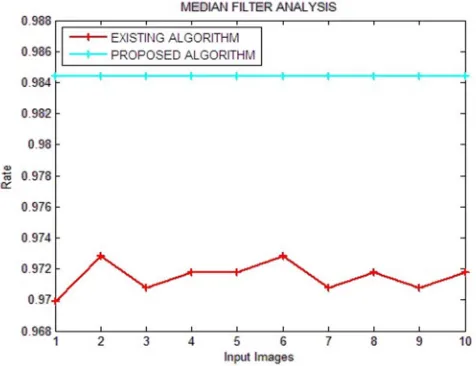
Figure 12 has shown that the value of NCC is close to1 in every case with the use of proposed method over other methods. This represents improvement in the objective quality of the image. Figure 13 has shown that the value of NCC is close to1 in every case with the use of proposed method over other methods. Figure 14 has shown that the value of NCC is close to1 in every case with the use of proposed method over other methods. This represents improvement in the objective quality of the image.
Technology (IJRASET)
[image:11.612.46.570.355.668.2]Fig 14: NCC of Existing Technique & Proposed Approach for Histogram attack
Table 2: Evaluation of NCC for Gaussian Noise, Median Filter and Histogram
IMAGES Water-marking
Gaussian Noise Median Filter Histogram Existing
Technique
Proposed Technique
Existing Technique
Proposed Technique
Existing Technique
Proposed Technique
Hydrangeas 1.jpg 0.9205 0.9844 0.9699 0.9844 0.9395 0.9844
Strawberries 1.jpg 0.7371 0.9844 0.9728 0.9844 0.9388 0.9844
Cake 1.jpg 0.7908 0.9844 0.9708 0.9844 0.3411 0.9844
Pomegranate 1.jpg 0.9007 0.9844 0.9718 0.9844 0.9471 0.9844
Chrysanthemum 1.jpg 0.4307 0.9844 0.9718 0.9844 0.8567 0.9844
Baby 1.jpg 0.6901 0.9844 0.9728 0.9844 0.9547 0.9844
Sunset 1.jpg 0.5860 0.9844 0.9708 0.9844 0.9491 0.9844
Sea 1.jpg 0.4736 0.9844 0.9718 0.9844 0.9470 0.9844
Warning 1.jpg 0.5935 0.9844 0.9708 0.9844 0.9488 0.9844
Sparrow 1.jpg 0.8830 0.9844 0.9718 0.9844 0.9506 0.9844
IX. CONCLUSION AND FUTURE SCOPE
Technology (IJRASET)
the use of standard SVD is easily crack-able by the hacker or cracker. The integrated technique has successfully reduced the limitations of the existing watermarking technique. Comparative analysis has shown the significant improvement of the proposed algorithm over the available algorithms.
This research work has not considered any evolutionary technique to modify SVD in more secure manner. So in future we will propose a new Ant Colony Optimization based improved SVD to enhance the results further.
X. ACKNOWLEDGEMENT
Apart from the efforts of me, the success of this research depends largely on the encouragement and guidelines of many others. I take this opportunity to express my gratitude to the people who have been instrumental in the successful completion of this dissertation. The guidance and support received from Khushdeep Kaur was vital for the success of this article. Without the wise counsel and able guidance, it would have been impossible to complete the research in this manner. I am grateful for their constant support and help.
REFERENCES
[1] Zebbiche, Khalil, and Fouad Khelifi. "Efficient wavelet-based perceptual watermark masking for robust fingerprint image watermarking." IET Image Processing 8, no. 1 (2014): 23-32.
[2] Saini, Hemraj. "Efficient hybrid watermarking approach by using SVD, DWT, and Back Propagation Neural Network." In Advance Computing Conference (IACC), 2014 IEEE International, pp. 985-990. IEEE, 2014.
[3] Varghese, Justin, Omer Bin Hussain, Bijoy Babu, Jamshid M. Basheer, Saudia Subash, Mohamed Ramadan Saadi, and Mohamed Samiulla Khan. "An efficient DCT-SVD based algorithm for digital image watermarking." In Security Technology (ICCST), 2014 International Carnahan Conference on, pp. 1-6. IEEE, 2014. [4] Zhao, Ke, and Jiang-feng Xu. "A new semi-blind watermarking scheme based on DWT-subsampling." In Software Engineering and Service Science (ICSESS), 2013 4th IEEE International Conference on, pp. 623-626. IEEE, 2013.
[5] Zhu, Yong, Xiaohong Yu, and Xiaohuan Liu. "An image authentication technology based on digital watermarking." In Sensor Network Security Technology and Privacy Communication System (SNS & PCS), 2013 International Conference on, pp. 179-183. IEEE, 2013.
[6] Raval, Keta, and S. Zafar. "Digital Watermarking with copyright authentication for image communication." In Intelligent Systems and Signal Processing (ISSP), 2013 International Conference on, pp. 111-116. IEEE, 2013.
[7] Divecha, Nidhi, and N. N. Jani. "Implementation and performance analysis of DCT-DWT-SVD based watermarking algorithms for color images." In Intelligent Systems and Signal Processing (ISSP), 2013 International Conference on, pp. 204-208. IEEE, 2013.
[8] Hamid Shojanazeri, Wan Azizun Wan Adnan, Sharifah Mumtadzah Syed Ahmad “Video Watermarking Technique for Copyright Protection and Content Authentication,”IEEE International Journal of Computer Information Systems and Industrial Management Applications, vol.5, pp. 652–660, 2013.
[9] Kakkirala, Krishna Rao, Srinivasa Rao Chalamala, and Jyoti Dhillon. "A robust image watermarking using DWT, SVD and Torus automorphism." In Computational Intelligence and Cybernetics (CYBERNETICSCOM), 2013 IEEE International Conference on, pp. 160-163. IEEE, 2013.