Technology (IJRASET)
Implement of Image Authentication by Encryption
Procedure using LDPC Codes
Imran Ali Khan#1, Mr. K. Suresh*2, Miss Ranjana Batam#3
(M. Tech Scholar), (Assistant Prof.), (Assistant Prof., HOD) Swami Vivekanand College of Science & Technology, Bhopal
Abstract— In this paper, we prefer a way using encryption technique and LDPC origin coding for the image authentication complication. Image authentication is relevant in contented delivery via entrusted intermediaries, just for peer-to-peer (P2P) file sharing. More separatly encoded versions of the original image efficacy exist. In addition, intermediaries may tamper with the contents. Diffrent appropriate diversity from mean manipulations is the protest addressed in this research.
The main idea is to add a Slepian-Wolf encoded quantized image point as verification data which is repeatedly encrypted using a secret key cryptography since ready to send. This might be correctly decoded with the advice of an authentic image as side information. This structure provides the like robustness across appropriate variations although find illegitimate modification. The decoder absorb expectation maximization (EM) algorithms may authenticate images whatever have supported contrast, brightness and even corrupt alteration. Our different authentication system also others changing localization by using assumption over a factor graph that represents tampering model.
Keywords— image authentication, Image Security, Image digest, digital image processing
I. INTRODUCTION
Digital image techniques is the mechanization of apply a many more of computer algorithms to evolution digital images. The result of this process can be either images or a set of represent characteristics or worth of the original images. The applications of digital image process have been normally find in robotics/intelligent systems, medical image process, remote sensing technique, photography and forensics process. The image processing exactly deals with an image, which is easygoing of many image points. These image points, always namely pixels, are of contiguous coordinates that point out the position of the points in the image, and anxiety (or gray level) values. A colorful image follows high dimensional instruction data than a gray image, as red, green and blue values are regularly used in different solutions to emulate the colors of the image in the original world.
The main motives of digital image techniques are to permissible human beings to retrieve an image of higher quality or detailed properties of the original image. Optional distinct the human visual system, which is efficient of comply itself to many outlook, imaging machines or senses are uncertain to naturally appropriation “meaningful” targets. For example, these optic systems cannot incline between a human subject and the background without the implementation of an exceptional algorithm.
The digital images are being generally used in infinite applications just for military, perception, supervision, digital copyright applications, etc. through the real image formats, JPEG is the most generally used formats that stock the digital images using digital cameras and software devices. With the spread in use of multimedia type data concluded the internet. The Image authentication shows an great role in security and intercommunication. Images are in realty transferred done with the Internet and are easily available for approach from any segment of the world and after introducing an validate mechanism, it is around use less to analyze if an image is original or being managed.
Using cryptography approach to confirm image data will result in an impractical system or undesirable systems because data corroboration is conscious to single bit change in the authenticate data in the same time image authentication systems need to be generally content conscious. This is because images go through a range of processing along with lossy confining that result in difference in bits that are expected acceptable. Those changes must be allowable by the authentication system although it is necessary for the system to continue sensitive to pernicious control. Many institutions are tackling with the issue of photo changing. For example, videos, digital images and audio are now regularly introduced as documentation in criminal, civil and national security cases. In such cases, the sincerity of digital information is essential.
II. LITERATURESURVEY
Technology (IJRASET)
compact for image authentication. The formation of a compact is formed with a series of refining operations, contrast arrangement, and compression. We automatically estimation these system parameters and now that these parameters differ somewhat between camera constructor and photo-editing software. We also explain how this signature can be joining with encoding instruction from the basic full resolution image to another clarify the signature’s uniqueness.
Past ways for image authentication decline into three groups: watermarking, forensics and robust hashing. In digital forensics, the user verifies the clarity of an image individually by checking the received content [8] – [9]. Unfortunately, beyond any information from the initial, one cannot absolutely approve the sincerity of the received content because content irrelevant to the initial can pass forensic checking. Other choice for image authentication is watermarking. A semi-fragile watermark is fixed into the host signal waveform without intuitive misrepresentation [10]–[11]. Users can approve accuracy by obtain the watermark from the received content. The system design become insures that the watermark sustains lossy compression, but that it breaks as a result of spitefull manipulations. Unfortunately, watermarking authentication is not rearward adaptable with Previously encoded contents; i.e., cleared content cannot be authenticated next. Embedded watermarks might also expansion the bit rate appropriate when abbreviate a media file. alike Yao et. al. [11] developed an authentication method based on robust hashing, That is encouraged by cryptographic hashing [13]. In this technic, the user checks the sincearity of the acepted content using a limited amount of data imitative from the initial content. various hash-based image authentication scheme attain robustness across lossy compression by using compression-constant features, such as [14]–[15]. These compressions-influenced features are arranged for particular compression systems but decline under another coding systems or accepted image processing. Robustness is expanded using more practical features, such that block-based histograms [16], zero-mean low-pass Gaussian pseudo-random projection [17], [18], block normal deviations and means [17], [18], column and row projections [29], and convert coefficients [20], [21]. Any established projection has the deficiency that an assailant who have the ineffective space of the projection can adjust the image without effecting the corroboration data. Using pseudo-random projections or carpet, such that in [22], preserve the null space a undisclosed. Comparable attention apply to appearance calculated in a nonlinear style. Features powerful across cropping, rotation, resizing, or translation has been proposed occupy on the Radon transform [23]–[24], the Fourier transform [25], and pixel statistics along radii [25]–[26]. Another technics carry features necessary to the human visual system [28].
Quantization and compression of corroboration data have not been studied in deepness. Most methods use crass quantization. For example, Fridrich et al. Use bit quantization for random projection coefficients and the relation-based metods may be treated as 1-bit quantizations of coefficient change. The first to examine error-correcting coding in compressing.
The image authentication data size obtain Venkatesan et al. [21]. The concept is to project the binary aspect angle of both images into disorder bits of an error-correcting code and directly analyzes the disorder bits to choose the authenticity. The technic of Sun et al. uses efficient Hamming codes to access the parity check bits of the binary aspect angle as the authentication data [30].
Then, after consider all the over research work, it is find that static this research field has a broad area of simple and active methods for image authentication. thus, in this research work we planned a structure for image authentication based on the encoding-decoding program of low frequency parity check technic onward with the appropriate use of cryptology. The proposed technology insures that the image received at receiver side is original and un-tampered.
III. PROBLEMDEFINITION
The Object of this planned work is to implement a robust method that works for the corroboration of images that may observe as short as feasible changes in the corrected image in similarity with the original image. Using the direction means that are feasible on the internet it is easy to meddle the digital images without any indication. Then, authentication of originality of images has come a requiring effort. The initial research in image forensics imported digital watermarking and powerful hashing in the original image for authentication.
IV. PROPOSED WORK
In [31], we earlier proposed a method for the image verification using LDPC codes, Then, In the planned authentication scheme shown in Figure 4, a pseudorandom projection is tested to the original image x and the projection coefficients X are quantified to output Xq. The authentication data are compose of two factor, both imitative from Xq. The Slepian-Wolf bit stream S (Xq) is the gain of a Slepian-Wolf encoder based on low-density parity-check (LDPC) codes and the enough shorter digital signature D (Xq, KS) subsist of the grain KS and a cryptographic hash amount of Xq signed along a private key.
Technology (IJRASET)
point. Based on the random grain, for any 16x16 non projecting block Bi,wegeneratea16x16 pseudorandom matrix Pi by design its elements freely from a Gaussian distribution N(1,2p) and controlling so that ||Pi||2 =1. We prefer p =0.2 analytically. In this way, we preserve the nice equity of the mean point as proposed in the earlier area during obtain awerness to high-density violation. The closer product +Bi,Pi, is quantized into an aspect of Xq. The rate of the Slepian-Wolf bit stream S(Xq) resolve how statistically comparable the mark image requisite to the original to be announced authentic. If the provisional entropy H(Xq|Y) outstrips the bit rate R in bits per pixels, Xq may no high be decoded accuratly. Then, the rate of S(Xq) could be elect to distinct between the diverse joined statistics induced in the images by the appropriatly and meddle medium case. At the encoder, we preferred a Slepian-Wolf bit rate due plentiful to substantiate both appropriate 30 dB JPEG2000 and JPEG recreate versions of the original image.
At the collector, the user follow to authenticate the image y with authentication data S(Xq)and D(Xq,Ks). It early projects y to Y in the similar way at the time authentication data creation. A Slepian-Wolf linguist recreates Xq & from the Slepian-Wolf bit stream S(Xq) using Y as side data. Decoding is along the LDPC message- passing algorithm initialize allow to the data of the appropriate channel state at the lowest acceptable quality for the inclined original image. Certainly, the image brief of Xq’ is count and related to the image brief, decode from the digital signature D(Xq,Ks) using a public key. If these two image brief do not match, the receiver remember that image y is meddle, diffrently the receiver makes a selection
V. RESULTS
The preliminary results noted in this section are do on a system with Intel Core i5 processor and 6 GB RAM. The OS is Windows 7 Ultimate. Simulation software used is MATLAB 10.0 - R2010b (64 bit). The simulation conclusion of the changing localization decoder. In method, the localization decoder should alone run if the verification decoder allows an image to be tampered, so, we achieve multiple tests for the tampering localization system alone with basely tampered images.
Technology (IJRASET)
are BMP, JPEG or JPEG2000 constrict and recreated at many qualities. The spiteful attacks inhere of the coat of text banners at a random place in the image or discard a randomly chooses Maximally Stable Extremes Region (MSER) by including the region. For the text banners, the text color is white or black, whatever is more detectable, to avoid creating incidental attacks, much as white text on a white area.
Using this data set, we determine the achievement of the verification system for constrict images, the authenticate system with a common LDPC decoder for conforming images, and the tampering localization system.
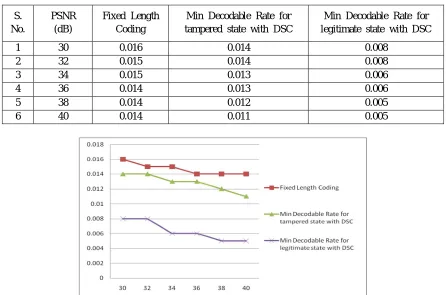
[image:5.612.83.529.216.511.2]Coming are the tables & comparably figures for equal the values of minimum decodable rate for both the cases i.e., Legitimate State & Tampered State.
Table 1: PSNR for fixed length coding, minimum decodable rates for tampered state DSC and minimum decodable rates for legitimate state DSC
S. No.
PSNR (dB)
Fixed Length Coding
Min Decodable Rate for tampered state with DSC
Min Decodable Rate for legitimate state with DSC
1 30 0.016 0.014 0.008
2 32 0.015 0.014 0.008
3 34 0.015 0.013 0.006
4 36 0.014 0.013 0.006
5 38 0.014 0.012 0.005
6 40 0.014 0.011 0.005
[image:5.612.73.542.567.678.2]Fig 2: Minimum rates averaged for the tampered states for correctly decoding Slepian-Wolf bit stream for the images from database with the quantized projection X.
Table 2: Comparison of Authenticated Data size using DSC, Conventional FLC and compressed mean projection
S. No.
Authenticate Data Size (Bytes)
Distributed Source Coding
Conventional Fixed Length Coding
Compressed Mean Projection
1 000 0.08 0.12 0.13
2 200 0.08 0.12 0.13
3 400 0.06 0.10 0.12
4 600 0.05 0.09 0.09
5 800 0.04 0.09 0.09
6 1000 0.04 0.08 0.08
Technology (IJRASET)
[image:6.612.131.482.117.326.2]block mean projection. since figure 6 display that the acceptor operating characteristic (ROC) curves for tampering disclosure with district numbers of bits in quantization using shared source coding, regular settled length coding and constrict mean projection. It displays that higher quantization care attempt best detection achievement.
Fig 3: Graph shows that the ROC equal error rate versus the authentication data size and demonstrates that distributed source coding reduces the data size by more than compared to conventional fixed length coding at an equal error rate. Distributed source code.
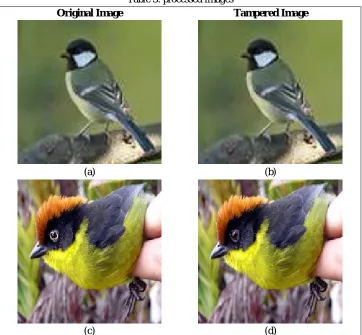
Table 3: processed images
Original Image Tampered Image
(a) (b)
[image:6.612.126.488.370.705.2]Technology (IJRASET)
(e) (f)
(g) (h)
VI. CONCLUSION
In this paper we consider the earlier work done in the equal domain and offer a different image authenticate design that analyze appropriate encoding alteration of an image from tampered form based on shared source coding and analytical techniques. A two-state lossy channel classic means the analytical dependency between the initial and the object images. Tampering degeneration is occupied by using a statistical image classic, and appropriate district cry is affected to be extra white Gaussian noise.
REFERENCES
[1]. J. Fridrich, D. Soukal, and J. Luk´a˘s, “Detection of copy move forgery in digital images,” in Proceedings of Digital Forensic Research Workshop, August 2003. [2]. M. Johnson and H. Farid, “Exposing digital forgeries in complex lighting environments,” IEEE Transactions on Information Forensics and Security 3(2), pp. 450–461, 2007.
[3]. J. Luk´a˘s, J. Fridrich, and M. Goljan, “Digital camera identification from sensor noise,” IEEE Transactions on Information Security and Forensics 1(2), pp. 205– 214, 2006.
[4]. Gallager, R. G., “Low Density Parity Check Codes, Monograph”, M.I.T. Press, 1963
[5]. H. Farid, “Image forgery detection,” IEEE Signal Process. Mag., vol. 26, no. 2, pp. 16–25, Mar. 2009.
[6]. A. Popescu and H. Farid, “Exposing digital forgeries by detecting duplicated image regions,” Tech. Rep. TR2004-515, Department of Computer Science, Dartmouth College, 2004.
[7]. Z. Lin, R. Wang, X. Tang, and H.-V. Shum, “Detecting doctored images using camera response normality and consistency,” in Computer Vision and Pattern Recognition, (San Diego, CA), 2005.
[8]. I. J. Cox, J. Kilian, T. Leighton, and T. Shamoon, “Secure sprectrum watermarking for images, audio and video,” in Proc. I Conf. Image Process., Lausanne, Switzerland, Sep. 1996.
[9]. Yao-Chung Lin, David Varodayan, “Image Authentication Using Distributed Source Coding” In IEEE Transactions On Image Processing, Vol. 21, No. 1, January 2012, Pp.273-283
[10]. W. Diffie and M. E. Hellman, “New directions in cryptography,” IEEE Trans. Inf. Theory, vol. IT-22, no. 6, pp. 644–654, Jan. 1976.
[11]. C.-Y. Lin and S.-F. Chang, “Generating robust digital signature for image/video authentication,” in ACM Multimedia: Multimedia and Security Workshop, Bristol, U.K., Sep. 1998, pp. 49–54.
[12]. A. Popescu andH. Farid, “Exposing digital forgeries in color filter array interpolated images,” I EEE Trans. Signal Process., vol. 53, no. 10, pp. 3948–3959, Oct. 2005.
[13].M. Schlauweg, D. Pröfrock, and E. Müller, “JPEG2000-based secure image authentication,” in Workshop on Multimedia and Security, Geneva, Switzerland, 2006, pp. 62–67.
[14]. Imran A khan, “An overview to the proposed technique for image authentication using LDPC codes”, IJCST Vol.4, Jan 2013.
[15]. D.-C. Lou and J.-L. Liu, “Fault resilient and compression tolerant digital signature for image authentication,” IEEE Trans. Consumer Electronics, vol. 46, no. 1, pp. 31–39, Feb. 2000.
Technology (IJRASET)
pp. 227–230.
[19]. F. Lefebvre, J. Czyz, and B. Macq, “A robust soft hash algorithm for digital image signature,” in Int. Conf.Multimedia and Expo, Baltimore, MD, 2003. [20]. H.-L. Zhang, C.-Q. Xiong, and G.-Z. Geng, “Content based image hashing robust to geometric transformations,” in Proc. Int. Symp. Electronic Commerce and Security, May 2009, vol. 2, pp. 105–108.
[21]. A. Swaminathan, Y. Mao, and M. Wu, “Robust and secure image hashing,” IEEE Trans. Inf. Forensics and Security, vol. 1, no. 2, pp. 215–230, Jun. 2006. [22]. C. De Roover, C. DeVleeschouwer, F. Lefebvre, and B.Macq, “Robust video hashing based on radial projections of key frames,” IEEE Trans. Signal Process., vol. 53, no. 10, pp. 4020–4037, Oct. 2005.
[23]. V. Monga and B. L. Evans, “Perceptual image hashing via feature points: Performance evaluation and tradeoffs,” IEEE Trans. Image Process., vol. 15, no. 11, pp. 3452–3465, Nov. 2006.
[24]. M. Schlauweg and E. Müller, “Gaussian scale-space features for semi-fragile image authentication,” in Proc. Picture Coding Symp., May 2009, pp. 1–4. [25]. E Kee, H Farid, “Digital Image authentication from thumbnails” In SPIE symposium on electronic imaging, San Jose, CA, 2010
[26]. Z. Tang, S.Wang, X. Zhang, andW.Wei, “Perceptual similarity metric resilient to rotation for application in robust image hashing,” in Proc. Int. Conf. Multimedia and Ubiquitous Eng., Jun. 2009, pp. 183–188.