DOES EFFICIENT FUZZY KOHONEN CLUSTERING
NETWORK ALGORITHM REALLY IMPROVES
CLUSTERING DATA RESULT?
1EDY IRWANSYAH, 1MUHAMMAD FAISAL, 2ANNISAA PRIMADINI
1Dept. of Computer Science, Bina Nusantara University, Jalan KH. Syahdan No. 9 Palmerah
Jakarta 11480, Indonesia
2Department of Electrical Engineering, University of Indonesia, Depok 16424, Indonesia
E-mail: [email protected], [email protected], [email protected]
ABSTRACT
In this research, Fuzzy Kohonen Clustering Network (FKCN) algorithm is compared to Efficient Fuzzy Kohonen Clustering Network (EFKCN) algorithm. This research is conducted to see if EFKCN is really efficient and could do a better clustering analysis than original FKCN. We do empirical testing and simulations to compare both algorithms, by using an expanded Fisher’s Iris Data. The result showed the accuracy of EFKCN is not yet better algorithm rather than FKCN.
Keywords: Artificial Neural Network, Clustering Analysis, Fuzzy Kohonen Clustering Network, Kohonen Network, Self-orginizing Map,
1.
INTRODUCTIONFuzzy Kohonen Clustering Network (FKCN) introduced by [1] is an unsupervised learning clustering analysis method. This algorithm integrates FCM model [2] and Kohonen network [3]. FKCN improved the error convergence as well as reduced labeling errors problem on FCM.
FKCN enhances the FCM algorithm and showed great superiority in processing ambiguity and uncertainty of a certain dataset or image. Yang et al, 2009 [4] attempted to make an efficient FKCN (EFKCN) to reduce computation process on the original FKCN. The accuracy of EFKCN achieved 92.7 percent by the fourth iteration. In which, the previous research conducted by [1] didn't show a remarkable result with the same iteration number. The improvement of learning rate computation yields a different result compared to FKCN [1]. Empirical testing with the same data set and algorithm in this research is conducted to find out whether EFKCN is really efficient and could do a better data clustering than the original FKCN.
2.
RELATED WORKSYang et al, 2008 [4] introduced threshold values and dynamic adjustment of the weighting exponent on each fuzzy membership to adjust learning rates
dynamically on FKCN by Bezdek et al, 1992 [1]. The error data of EFKCN is just 11 error data by fourth iteration. Meanwhile, FKCN has more than 40 error data with the same iteration. On the top of that, Bezdek at al, 1992 [1] had big number of mistakes in FKCN under the eighth iteration.
FKCN has been implemented well for image segmentation [5], [6], [7], [8] and [9]. Atmaca at al, 1996 [5] used FKCN to determine cluster membership values by doing some improvements, Lei at al, 1999 [6] introduced Adaptive FKCN that reduce computation process in image segmentation, by using HSV as color representation, Jabbar at al, 2009 [8] proved FKCN have ability to segment the color image and noisy color image can be segmented more effectively and provide more robust segmentation results by using FKCN with some improvements by Lu et al, 2009 [9].
ISSN: 1992-8645 www.jatit.org E-ISSN: 1817-3195
3.
FKCN AND EFKCN ALGORITHMThe algorithm of FKCN is summarized as follow:
Step 1: Fix c, sample space and threshold error ɛ > 0 some small positive constant.
Step 2: Initialize 0
(
10, 20,..., 0)
c v v vv = choose
0
m >
1 and iteration limit ( tmax)
Step 3: For t = 1,2…,tmax a. Compute all learning rates:
m t m m
t = 0− *∆ ,
max
1
t m=
∆ (1)
Where mtis the fuzzy membership for the t iteration and∆m: fuzzy membership differences for
each iteration
For each member, update its membership function:
1 1 2 1 , 1 , , − − − − − − =
∑
m t j k t i k t ik V X V Xu (2)
Whereuikt
, is the membership function of the k-th data of i-th cluster for each t-iteration; Xk is the k-th data; Vi,t−1 is the i-th cluster center for t-1
iteration; Vj,t−1is the j-th cluster center for t-1
iteration and mis weighting exponent on each fuzzy membership.
Compute learning rate
(
)
μτικ,τ
ικ,τ υ
α = (3)
Where ikt ,
α is the learning rate of the k-th data of
i-th cluster for t iteration.
b. Update all weight vectors:
(
)
∑
∑
= − − − − + = n j t ij n k t i k t ik t i t i v x v v 1 , 1 1 , , 1 , , α α (4)Whereviis i-th cluster center and
t i
v
, is i-th cluster
center for t iteration
c. Compute the function
1 − − = t t
t V V
E
(5)
WhereEtis error for each t iteration; Vt is cluster center for t iteration and Vt−1 and cluster center for t-1 iteration.
d. If Et<ε stop. Else t = t + 1 goto step 3
The difference between EFKCN and FKCN lies in the learning rate computation, while FKCN uses equation (3), EFKCN follows the equation (6) below:
(
)
(
)
(
)
ikt du t ik d d t ik m t ik m t ik m t ik ικ,τ t u t u t t u u u u α d t u < ≤ ≤ > = , , , , , , (6)
Where tu and d
t are threshold value,
u
t is upper
cut set (0.5,1), td is lower cut set (0,0.5),
u m and
d
m are fuzzy convergence operators, u
m (0,1) and
d
m > t m
4.
EXPERIMENTS AND RESULTTable 1. Result comparison to Yang et al, 2009
FKCN Yang et al
(2009)
FKCN Irwansyah et al
(2014)
EFKCN Yang et al
(2009)
EFKCN Irwansyah et al
(2014)
Parameter m=3; ε=0.001; tmax=50; c=3
m=3; ε=0.001; tmax=50; c=3
m=3;ε=0.001; tmax=50; c=3; tu=0.7; td=0.3;
mu=0.4;
m=3; ε=0.001; tmax=50; c=3; tu=0.7; td=0.3;
mu=0.4;
Correct Number 5480 5427 5560 4513
Correct Rate 91.33% 90.45% 92.67% 75.22%
Iteration Number 12 12 4 4
Hathway Cluster Center
5.00 5.93 6.58 3.42 2.77 2.97 1.46 4.26 5.55 0.24 1.32 2.02
Cluster Center
5.01 5.75 6.60 3.14 2.73 3.01 1.48 4.14 5.36 0.25 1.29 1.91
5.04 5.91 6.58 3.38 2.78 2.99 1.60 4.37 5.36 0.30 1.40 1.91
5.00 5.91 6.58 3.41 2.79 3.00 1.48 4.22 5.44 0.25 1.32 1.98
5.32 5.88 6.14 3.24 3.00 2.97 2.38 3.92 4.51 0.63 1.26 1.51 The square sum of
the relative cluster center's error
0.1073 0.1208 0.0256 0.0787
Table 2. The clustering result comparison with same iteration number
FKCN EFKCN
Parameter m=3; ε=0.001; tmax=50; c=3
m=3;ε=0.001; tmax=50; c=3; tu=0.7; td=0.3;
mu=0.4;
Correct Number 5456 5202
Correct Rate 90.93% 86.70%
Iteration Number 10 10
Hathway Cluster Center
5.00 5.93 6.58 3.42 2.77 2.97 1.46 4.26 5.55 0.24 1.32 2.02
Cluster Center
5.04 5.97 6.61 3.37 2.79 3.00 1.60 4.45 5.41 0.30 1.44 1.94
5.01 6.02 6.57 3.37 2.79 2.97 1.58 4.55 5.37 0.28 1.49 1.92
The square sum of the relative cluster center’s error
[image:3.595.151.445.446.702.2]ISSN: 1992-8645 www.jatit.org E-ISSN: 1817-3195
Figure 1: Number of mistakes FKCN with t = 12 and EFKCN with t = 4
[image:4.595.97.283.333.500.2]Figure 2: Number of mistakes FKCN and EFKCN with t = 10
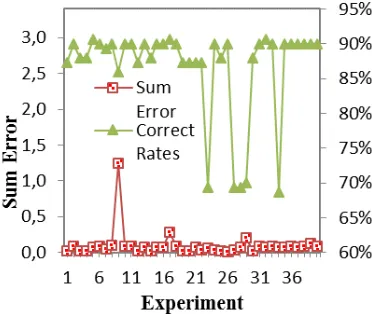
Figure 3: Comparison between square sum error and correct rates using FKCN
Figure 4: Comparison between square sum error and correct rates using EFKCN
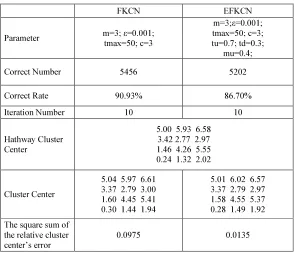
The experimental results show the accuracy of EFKCN [4] not yet close to 92.7 percent by fourth iteration (Table 1). Moreover, with t = 4, the accuracy of EFKCN is 75.22 percent. Meanwhile, the accuracy of FKCN [1] with t = 12 achieved 90.45 percent; just slightly different from result by Yang et al, 2009 [4]. Figure 1 showed that number of mistakes in FKCN is always smaller than EFKCN and the square sum error of the relative cluster centers are the smallest number from the experimental result (See Table 1 and Table 2).
Table 2 described the result of simulation and testing with same iteration (t = 10). Once again, the result showed the accuracy of FKCN is better than EFKCN, 90.93 percent compared with 86.70 percent. Interestingly, eventhough EFKCN has a lower correct rate than FKCN, computation results
showed EFKCN square sum of the relative cluster center is very low.
5.
CONCLUSION [image:4.595.318.504.340.497.2]REFRENCES:
[1] Bezdek, J.C., Tsao, E.C-K., Pal, N.R.: Fuzzy Kohonen Clustering Networks. IEEE (1992) 1035-1043
[2] Bezdek, J. C.: A Convergence Theorem for the Fuzzy C-Means Clustering Algorithm. IEEE (1980)
[3] Kohonen, T.: Self-Organization and Associative Memory. 3rd Edition. Springer, Berlin (1989)
[4] Yang, Y., Jia, Z., Chang, C., Qin, X., Li, T., Wang, H., Zhao, J.: An Efficient Fuzzy Kohonen Clustering Network Algorithm. IEEE (2008) 510 - 513
[5] Atmaca, H., Bulut, M., Demir, D.: Histogram Based Fuzzy Kohonen Clustering Network For Image Segmentation. IEEE (1996) 951-954 [6] Lei, W., Feihu, Q.: Adaptive Fuzzy Kohonen
Clustering network for Image Segmentation. IEEE (1999) 2664-2667
[7] Xiaodan, W., Hua, J., Rongchun, Z.: Texture Segmentation method Based on Incomplete Tree Structured WaveleTransform and Fuzzy Kohonen Clustering Network. IEEE (2000) 2684-2687
[8] Jabbar, N., Ahson, S.I., Mehrota, M.: Fuzzy Kohonen Clustering Network for Color Segmentation. IPCSIT vol. 3. LACSIT Pres (2011) 254-257
[9] Lu, B., Wei, Y., Li, J.: A Noise-Resistant Fuzzy Kohonen Clustering Network Algorithm for Color Image Segmentation. IEEE (2009) 44-48
[10] de Almeida, C.W.D., Souza, R.M.C.R., Candeias, A.L.B.: IFKCN: Applying Fuzzy Kohonen Clustering Network to Interval Data. IEEE (2012)
[11] Fan, J., Jia, S., Li, X.: The Application of Fuzzy Kohonen Clustering Network for Intelligent Wheelchair Motion Control. IEEE (2013) 1995-2000
[12] Irwanyah, E., Hartati, S.: Data Clustering and Zonation of Earthquake Building Damage Hazard Area Using FKCN and Kriging Algorithm. In: M.K. Kundu et al. (eds.) Advanced Computing, Networking and Informatics - Volume 1, Smart Innovation, Systems and Technologies 27. Springer International, Switzerland (2014) 171-178. [13] Fisher, R.A.: The Use of Multiple
Measurements in Taxonomic Problems. Annual Eugenics, 7, Part II, (1936) 179-188