Open Access
Study protocol
REFINE (Reducing Falls in In-patient Elderly) - a randomised
controlled trial
Catherine D Vass*
1, Opinder Sahota
2, Avril Drummond
1, Denise Kendrick
3,
John Gladman
1, Tracey Sach
4, Mark Avis
5and Matthew Grainge
6Address: 1Department of Ageing and Rehabilitation, University of Nottingham, Nottingham, NG7 2UH, UK, 2Department of Health Care of the
Older Person, Nottingham University Hospitals NHS Trust, Nottingham, NG7 2UH, UK, 3Primary Care Research, University of Nottingham,
Nottingham, NG7 2RD, UK, 4School of Chemical Sciences and Pharmacy, University of East Anglia, Norwich, NR4 7TJ, UK, 5School of Nursing,
Midwifery and Physiotherapy, University of Nottingham, Nottingham, NG7 2UH, UK and 6School of Community Health Sciences, University of
Nottingham, Nottingham, NG7 2UH, UK
Email: Catherine D Vass* - [email protected]; Opinder Sahota - [email protected]; Avril Drummond - [email protected]; Denise Kendrick - [email protected];
John Gladman - [email protected]; Tracey Sach - [email protected]; Mark Avis - [email protected]; Matthew Grainge - [email protected]
* Corresponding author
Abstract
Background: Falls in hospitals are common, resulting in injury and anxiety to patients, and large costs to NHS organisations. More than half of all in-patient falls in elderly people in acute care settings occur at the bedside, during transfers or whilst getting up to go to the toilet. In the majority of cases these falls are unwitnessed. There is insufficient evidence underpinning the effectiveness of interventions to guide clinical staff regarding the reduction of falls in the elderly inpatient. New patient monitoring technologies have the potential to offer advances in falls prevention. Bedside sensor equipment can alert staff, not in the immediate vicinity, to a potential problem and avert a fall. However no studies utilizing this assistive technology have demonstrated a significant reduction in falls rates in a randomised controlled trial setting.
Methods/Design: The research design is an individual patient randomised controlled trial of bedside chair and bed pressure sensors, incorporating a radio-paging alerting mode to alert staff to patients rising from their bed or chair, across five acute elderly care wards in Nottingham University Hospitals NHS Trust. Participants will be randomised to bedside chair and bed sensors or to usual care (without the use of sensors). The primary outcome is the number of bedside in-patient falls.
Discussion: The REFINE study is the first randomised controlled trial of bedside pressure sensors in elderly inpatients in an acute NHS Trust. We will assess whether falls can be successfully and cost effectively reduced using this technology, and report on its acceptability to both patients and staff.
Trial Registration: ISRCTN trial number: ISRCTN44972300.
Published: 10 September 2009
Trials 2009, 10:83 doi:10.1186/1745-6215-10-83
Received: 17 June 2009 Accepted: 10 September 2009
This article is available from: http://www.trialsjournal.com/content/10/1/83
© 2009 Vass et al; licensee BioMed Central Ltd.
Background
Falls in hospitals are common, ranging from 3 to 14 for every 1,000 bed days [1]. Over 200,000 falls were reported to the National Patient Safety Agency's (NPSA) National Reporting and Learning System (NRLS) in the 12 months from September 2005 to August 2006, with falls data being reported from 98% of organisations providing in-patient services [2]. In-in-patient falls result in injury and anxiety to patients and large costs to NHS organisations, including the costs of treating injuries, increased hospital stay, complaints and litigation [3-5].
Elderly in-patients are at particular risk of falling with the incidence of falls being almost triple that for community-dwelling older people [6]. Several factors contribute to this including; age, a history of falling, impaired mobility and special toileting needs. People with dementia are more likely than those without it to require hospital admission, and are at least twice as likely to fall [7-9]. Up to 30% of in-patient falls occur during the first 48 hours of the patients' admission and 75% of in-patient falls occur in the first two weeks of hospital stay [7,10,11].
Our hospital audit data are consistent with published data [2] and has shown that more than half (53%) of all in-patient falls in elderly people in acute care settings occurred at the bedside, during transfers or whilst getting up to go to the toilet. In the majority of cases these falls were unwitnessed. Where patients had been advised to call for assistance they were often reluctant to ask for help as they "did "not want to bother the nurses" or were una-ble to do so because of cognitive impairment.
Prevention of falls is a priority for NHS policy makers and practitioners. The Healthcare Commission has used falls prevention as a focus for inspecting compliance under patient safety [12]. Despite our increasing knowledge of the aetiology and epidemiology of falls, there is a dearth of evidence for effective falls prevention in hospitals [13-15]. There is good evidence for falls prevention in the community dwelling elderly [16-18], but these findings are unlikely to generalise to the acute hospital setting.
Advances in telecare afford innovative approaches to the reduction of falls. Assistive technology such as bed and bedside chair alarms, which alert nearby staff that a per-son is attempting to leave the bed or chair, are increasingly being used in the NHS [19]. However there is a lack of evi-dence underpinning the use of such systems. Of the few studies that have been published, none have demon-strated a significant reduction in falls rates in a ran-domised controlled trial setting [20,21].
The current study will address shortcomings in the evi-dence base. We will assess whether falls can be
success-fully and cost effectively reduced using pressure sensor-pager technology in a randomised controlled trial.
Objectives
Main research hypothesis
The hypothesis to be tested is that the use of a pressure sensor alert system, incorporating a radio-paging alerting mode to alert staff to patients rising from their bed or chair, can decrease the number of bedside falls, in older people hospitalized in an acute care setting.
Secondary research hypotheses
1. There is a beneficial effect of pressure sensors upon health outcomes (transfer and mobility, fear of falling, quality of life, length of hospital stay and residential status on discharge) in hospitalised older people.
2. That the intervention above is cost-effective compared to usual care from a secondary care NHS perspective.
3. That there are groups of patients in whom the health or economic benefits from the intervention are greatest.
4. That the sensor system is acceptable to staff and patients and practical for use in an acute hospital setting.
Methods/Design
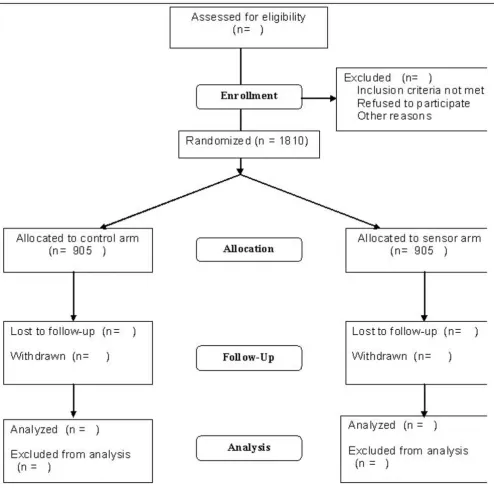
The study is a pragmatic parallel-arm randomised control-led trial. Subjects are randomised either to receive bed and chair sensor equipment, or standard care (control arm), see Figure 1 (Flow of participants through the study).
Setting
Five acute older persons' care wards at Nottingham Uni-versity Hospitals NHS Trust (NUH).
Participants
All patients admitted to five older persons' care wards are eligible for inclusion into the trial. Patients will be excluded from the study if they were permanently bed bound prior to admission, moribund/unconscious, or receiving end of life care on admission, or if they have pre-viously been included in the study in an earlier admission.
Ethics and consent
The study is executed in accordance with the principles laid down in the Helsinki Declaration [22]. This study was approved by Nottingham Research Ethics Committee 1 on the 23rd May 2008 (Reference: 07HC006; MREC: 08/ H0403/40).
sub-ject cannot understand the nature of consenting to a research study and the study process), consent is obtained by carers or other proxies including staff, following the established framework of Berghmans, used in previous ethically approved studies in older persons with dementia [24].
Intervention
Those participants randomised to the intervention arm of the trial will receive bedside chair and bed pressure sen-sors for the duration of their ward admission.
[image:3.612.59.553.85.573.2]Each sensor device consists of a flexible pressure pad enveloped in thin foam encased in a durable plastic coat-Flow of participants through the study
Figure 1
ing such that it confirms to hospital infection control pol-icies. The bed sensor (760 mm × 250 mm × 3 mm) is placed between the bed mattress and the base of the bed in a horizontal position directly under the hip region. The chair sensor (360 mm × 175 mm × 3 mm) is positioned on top of the chair base and/or under a cushion.
The sensors detect pressure changes as the patient rises from the bed or chair, whereafter an alert is sent via radio page to a handheld pager carried by nursing staff. The pager provides the location of the call so staff can respond rapidly and ensure the patient is safe. In this way the sen-sor system provides an early warning to staff that the patient has left the bed or chair, and may therefore avert a potential fall.
Sensor units are leased from Tunstall Ltd. and are CE marked, complying with the regulatory authorities. Nurs-ing staff on participatNurs-ing will be trained to use the sensors prior to trial recruitment. Members of the research team fit the sensors to the beds and chairs with the sensors left in place until the participant is discharged.
Sample size
Based on data obtained from our wards during 2005, we anticipate a rate of bedside falls of 8.0 per 1,000 bed days in the control group, assuming that 53% of all falls occur at the bedside and that the average length of stay is 19 days (mean number of falls per patient = 0.15). To detect a 35% reduction in the rate of bedside falls among the intervention group, assuming 80% power, alpha = 0.05 and an over dispersion parameter of 1.5 (to allow for non-independence of falls within individuals), 905 partici-pants are required in each arm of the trial.
Randomisation
Subjects are allocated to the sensor or control arm using the web based randomisation service provided by the Clinical Trials Support Unit, University of Nottingham. Randomisation is determined by a computer-generated pseudo-random code using random permuted blocks of randomly varying size, created by the Nottingham Clini-cal Trials Unit (CTU) in accordance with their standard operating procedure (SOP) and held on a secure server, employing the Stata add-in ralloc [25]. Participants are allocated with equal probability to the sensor or control arm of the study. The randomisations are requested through a PC with internet explorer and internet access. The system is located on a dedicated secure server within the University of Nottingham. All communications between the user's PC and the server are fully encrypted (secured SSL 128 bit encrypted) and via a unique user-name and password.
Blinding
In order to mitigate against nurses preferentially giving attention to patients with sensor equipment (i.e. the inter-vention arm) as compared to those without equipment (i.e. the control arm), we wished to find out if the nurses could be blinded to treatment allocation by the use of "dummy" (inactive) sensor equipment. To test the feasi-bility of this, we carried out a pilot study conducted over two days, with three 2 hour observation periods each day. Six sensors (4 active and 2 "dummy" sensors) were used with six patients, with one nurse (blinded to the status of the sensors) responding over each 2 hour period. Five nurses were assessed (the fifth nurse on the second day underwent two periods of observations). Four of the five nurses successfully identified the "dummy" versus the active sensors over the observation period. On the basis of this we concluded that it was not feasible to blind nurses to dummy verses active sensor, and therefore we decided not to use dummy sensor equipment with the control arm patients, who will be randomised to standard care alone. Any impact upon the standard care of the control group will be assessed in a qualitative sub study comprising of a non-participant observational study, and in-depth inter-views with ward staff.
In order to reduce observer bias, the primary outcome measure is assessed from hospital incident reporting forms by a researcher blinded to treatment group alloca-tion. Secondary outcome participant interviews are con-ducted away from the bedside so researchers remain unaware of group allocation. In instances where the researcher becomes aware of the intervention the partici-pant has received ("unblinding"), this will be recorded.
A member of the research team, blinded to sensor alloca-tion, enters trial outcome data. To assess the success of blinding, those measuring or entering outcome data are asked to estimate intervention or standard care for each participant, and this will be compared to actual allocation at the end of the study.
Outcome measures
Definition of primary and secondary outcome measures
The primary outcome measure is the number of bedside in-patient falls per 1,000 bed days from time of randomi-sation until the participant is discharged from the ward.
The secondary outcome measures are:
a. Number of injurious in-patient falls per 1,000 bed days, defined as falls resulting in abrasion, bruise, swelling, cut, laceration, dislocation, fracture or muscle sprain or strain.
b. Length of hospital stay.
c. Residential status on discharge.
d. Transfer/mobility score and activities of daily living, measured using the Barthel Index [26].
e. Fear of falling, measured using the Modified Falls Effi-cacy Scale (mFES) [27] to ascertain any differential fear of falling in the two participant groups due to an increased awareness of a potential for a fall, or a greater sense of safety arising from sensor use.
f. Health related quality of life, measured using the EURO-QOL EQ-5D [28].
g. Participant and staff experience of using bed and chair sensors. This sub-study will be reported separately.
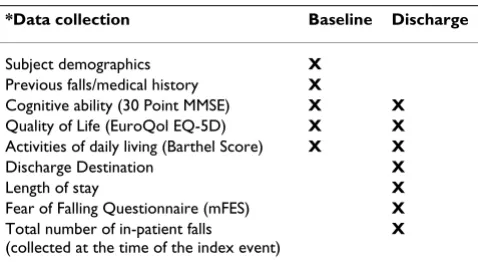
Ascertainment of outcomes (see Table 1 Data Collection Points) (a) baseline data
The baseline data collected at recruitment originates from face to face interview between researcher and patient, the patient's medical and nursing notes, and/or carer.
Baseline data includes:
a. Demographic and residential details, reason for admis-sion, time since admission.
b. Any previous history of falls, and any resulting frac-tures.
c. Mobility and transfer before the illness that precipitated admission, and at the time of recruitment (measured by the Barthel ADL index).
d. 30 point Mini Mental Stare examination (MMSE).
e. Health related quality of life measured using the Euro-Qol EQ-5D.
(b) follow up data
Follow up data are collected one day prior or on the day of discharge.
Follow up data includes:
a. Falls, ascertained from hospital incident reporting forms. The use of these incident forms in NUH to record falls is mandatory and enforced by clinical governance processes. Members of the research team collect copies of hospital incident reporting forms from participating wards. Data such as fall event, time, and place, injuries sustained and subsequent actions taken are recorded. Where a medical opinion has been requested, the out-come is recorded, together with any investigations requested. In addition, aggregated, anonymzed data on falls will be collected from hospital incident reporting forms for the trial wards for the 12 month period prior to the trial commencing. The rate of falls in the period prior to the trial commencing will be compared with the con-trol arm rate of falls during the trial to explore whether the use of sensors increases the rate of falls in the control arm.
b. Transfer/mobility and activities of daily living (Barthel ADL). This information is ascertained from the partici-pant or carer, and/or their medical and nursing notes.
c. Quality of life (EuroQol EQ-5D) ascertained by pant interview. Where a participant is unable to partici-pate in an interview, health related quality of life is ascertained from the carer and named nurse.
d. Fear of falling (mFES), ascertained by participant view. Where a participant is unable to take part in an inter-view due to poor cognitive ability, this assessment is coded appropriately and excluded from analysis.
e. Mini Mental State Examination (MMSE), through par-ticipant interview. The baseline assessment does not account for any acute delirium secondary to the patient's condition on hospitalization, which may improve with treatment. The change in delirium may have an effect on the risk of falling.
f. Length of stay and residential status on discharge, ascer-tained from medical records.
[image:5.612.56.295.600.731.2]Data on resource use will be collected for the economic analysis and will include the costs of investigations and interventions arising from any fall whilst in hospital and Table 1: Data Collection Points
*Data collection Baseline Discharge
Subject demographics X
Previous falls/medical history X
Cognitive ability (30 Point MMSE) X X
Quality of Life (EuroQol EQ-5D) X X
Activities of daily living (Barthel Score) X X
Discharge Destination X
Length of stay X
Fear of Falling Questionnaire (mFES) X
Total number of in-patient falls
(collected at the time of the index event)
the length of stay. These data will be obtained from the medical records. Unit costs will be derived from pub-lished sources. The cost of the intervention will include rental costs, plus costs of any sensor failures and cost of installing, cleaning, and responding to sensor alarms. Nursing staff on each ward will be asked to record sensor problems and reasons for sensor removal.
Nurse time taken to respond to sensor alarms will be ascertained from an observational study to measure the content and process fidelity of the intervention. The researchers fitting the bed sensors record the length of time taken to fit sensors.
Measuring content and process fidelity of the intervention
It is important to be able to demonstrate the extent to which the bed sensors are used in the study (content ity) and the way in which they were used (process fidel-ity). We record the number of participants who do not receive the allocated intervention and reasons for this. Nursing and research staff are asked to record sensor prob-lems and reasons for sensor removal. In order to assess process fidelity, an observational study will be conducted to monitor nurse response rates and time taken to respond, false alarms and improper use of the sensor (e.g. not re-setting the transmitter after an alert). Staffing levels will also be recorded for observation periods to explore whether ability to respond varies with staffing levels. An observer will be provided with a pager identical to those provided to the nurses and will record each alert, the response to each alert, the time taken to respond, the time taken to attend to the patient, whether it was a false alarm or not and improper use of the sensor. Observations will be undertaken over a random sample of days and time periods (two days every 6 months), covering each of the five wards, over the study period.
Withdrawals
Participants are free to withdraw from the trial at any stage. Participants, who decide to withdraw once recruited to the study, if allocated to a sensor, will have the sensor removed and further data collection from that point stopped. Participants, if allocated to a sensor, in whom it is deemed are at risk of harm resulting from the sensor equipment (for example in cases of confusion where the participant mis-handles the sensor equipment), will have the sensor removed and further data collection from that point stopped.
Analysis
Quantitative analysis
Analyses will be undertaken on an intention to treat. Intention to treat analysis is defined in this study as an a priori plan to analyse the data according to the groups to
which the subjects were randomised regardless of the treatment they received.
Fall rates for each group will be expressed as number of bedside falls per 1,000 bed days. The number of bedside falls per patient will be compared between groups using Poisson regression allowing for over dispersion, with length of stay in days as an offset. Crude models contain-ing intervention group only will be fitted initially, whilst additional models will adjust for the effects of age, MMSE and mobility/transfer scores. Interactions between each of these three variables and treatment group with respect to our primary and secondary outcome measures will also be examined, with covariates dichotomised where necessary. For other secondary outcome measures, groups will be compared using the independent samples t-test for con-tinuous outcomes (or Mann-Whitney U test if assump-tions for using the t-test are not satisfied following appropriate transformations of the data) and the chi-square test for binary/categorical outcomes. The rate of falls in the trial wards in the 12 months prior to the trial commencing will be compared with the rate of falls in the control arm during the trial using Poisson regression, allowing for overdispersion as appropriate. A significance level of p < 0.05 will be used for all analyses.
Health economic analysis
A cost-effectiveness and cost-utility analysis will be per-formed using established methods [29]. The comparative analysis will be undertaken from a secondary care NHS perspective capturing direct secondary care health service costs and benefits over the study period. In addition to measuring the cost of the intervention, the resources con-sumed in the two arms of the study are likely to differ as there is the potential for differential rates of investigations and treatments, and differential lengths of stay in hospi-tal. Resources will be valued using published unit cost data or where needed using locally derived unit costs. In this study we will use falls prevented as the effectiveness measure and change in utility as measured using the Euro-Qol EQ-5D as baseline and discharge [30].
An incremental economic evaluation comparing the sen-sor group to the standard care will be undertaken to esti-mate mean incremental cost-effectiveness. If one group is clearly dominant (less costly and more effective) a recom-mendation will be made. If non-dominance occurs (that is if costs are greater and the intervention is more effective or if the intervention is cheaper and less effective), an incremental cost-effectiveness ratio will be produced.
estimated using appropriate statistical techniques such as the non-parametric bootstrap method. This stochastic analysis will enable cost effectiveness acceptability curves and a cost effectiveness acceptability froniter to be pro-duced [31] illustrating the uncertainty surrounding the optimal decision. Estimates of the incremental cost, incre-mental cost effectiveness and the uncertainty around these estimates will enable us to examine the implications of rolling out sensors nationally.
Project management, governance and administration
The trial is undertaken in accordance with the Standard Operating Procedures of the Clinical Trials Support Unit of the University of Nottingham and the International Conference on Harmonisation Guidelines for Good Clin-ical Practice in ClinClin-ical Trials [23].
The day-to-day management of the trial is the responsibil-ity of the research lead, including research staff training and management. The study finance, documentation (such as assessment forms and operating procedures), data recording and storage is managed by the research lead, who also monitors progress in respect of project milestones (see Table 2, Project milestones for the study) and provides appropriate reports to the Trial Management Group and Trial Steering Committee. The principal inves-tigator will instigate audits of procedures as required and takes overall responsibility for any protocol changes throughout the study.
A Trial Management Group chaired by the principle inves-tigator, comprising investigators, research staff and patient representatives, monitors all aspects of the con-duct and progress of the trial, ensures that the protocol is adhered to, and will take appropriate action to safeguard participants and the quality of the trial.
A Trial Steering Committee, comprising the trial manage-ment group and three external experts (one of whom acts
as chair) has been established to ensure the study govern-ance and conduct complies with good clinical practice guidance.
A sub-group of the trial steering committee, the Data Monitoring and Ethics Committee comprising two of the external members of the steering group (including the steering group chair) and a statistician independent to the study, will receive adverse event forms electronically and will meet as required in the event of an excessive serious adverse event rate or if other information is reported to it which raises concern over the safe conduct of the trial.
Confidentiality and data storage
All participant questionnaires and case note abstraction forms are stored in locked cabinets, identified by a unique participant identifier. Consent forms and other docu-ments including the participant's name are stored sepa-rately from questionnaires and other trial documents in locked cabinets.
All computer databases include the unique participant identifier and not the name and address of the participant. The database is stored on a secure dedicated clinical trials server at the University of Nottingham. The server itself is located within in a locked server room, with restricted key access to authorised individuals. Users log into the data-base system by entering their username and password via a secure encrypted connection (https protocol/128 bit SSL encryption). The database automatically maintains an audit trail, which records all activity. Data will be stored for 10 years.
Discussion
The REFINE study proposed is the largest single interven-tion in inpatient falls, in the UK, as far as the researchers are aware. This innovative study is among the first ran-domised controlled trials to examine the effectiveness and cost-utility of a bedside sensor-paging system. It will
Table 2: Project milestones for the study.
Project milestones REFINE
2005. "Bed Sensors Reduce In-patient Falls and Hospital Length of Stay" [32] 2005. Health and Social Care Technology Award for the Midlands and East 2006. Planning for a large RCT of inpatient sensors initiated
Dec 2007. Grant awarded by the Research for Patient Benefit Programme of the National Institute for Health Research, UK (PB-PG-0107-11112)
May 2008. Ethics approval has been obtained from the Nottingham Research Ethics Committee (reference 07HC006). Aug 2008. Study commencement.
Sept 2008. Ward staff trained, Pilot of equipment and procedures Oct 2008. Recruitment commenced
respond to the dearth of randomised trials to investigate the impact of telecare upon falls in the elderly. Moreover it will be conducted with a large number of elderly in-patients in the challenging environment of a busy acute NHS Trust. The results will establish whether this moni-toring system is a cost effective intervention that patients, acute trusts and other in-patient institutes can utilize and benefit from.
Publications
All investigators will contribute towards drafting the paper reporting the main trial findings and all investiga-tors will be named authors on that paper, providing they fulfil the Vancouver criteria for authorship. Investigators wishing to analyze and report other findings from the study can do so on the agreement of the other investiga-tors, and the study team will agree authorship for these papers, subject to the Vancouver criteria for authorship.
Competing interests
The authors declare that they have no competing interests.
Authors' contributions
CDV: research lead, wrote the draft of this manuscript and obtained additional trial funding.
OS: principle investigator, conceived the project, co-led the design and co-ordination of the trial and obtained the main trial funding.
AD, DK: co-led the design of the trial and are grant hold-ers.
TS: provided health economic advice and wrote the rele-vant sections of the protocol.
JG, MA: improved on the study design and are grant hold-ers.
MG: provided statistical advice and wrote the relevant sec-tions of the protocol.
All authors participated in the trial design, and com-mented, read and approved the study protocol.
Acknowledgements
This paper presents independent research commissioned by the National Institute for Health Research (NIHR). The views expressed are those of the author(s) and not necessarily those of the NHS, the NIHR or the Depart-ment of Health.
Trial sponsor, Nottingham University Hospitals NHS Trust.
References
1. National Ageing and Research Institute: An analysis of research on preventing falls and falls injury in older people: community, residential and hospital settings. Canberra: Australian Govern-ment DepartGovern-ment of Health and Ageing; 2004.
2. The third report from the Patient Safety Observatory. Slips, trips and falls in hospital. The National Patient Safety Agency, National Patient Safety Agency, NHS 2007.
3. Vetter N, Ford D: Anxiety and depression scores in elderly fall-ers. Int J Geriatr Pscyh 1989, 4:168-73.
4. Bates D, Pruess K, Souney P, Platt R: Serious falls in hospitalised patients; correlates and resource utilisation. Am J Med 1995,
99(2):137-43.
5. Liddle J, Gilleard C: The emotional consequences of falls for patients and their families. Age Ageing 1994, 23(supp 4):17. 6. American Geriatrics Society and British Geriatrics Society:
Guide-line for the prevention of falls in older persons. J Am Geriatr Soc 2001, 49(5):664-672.
7. Oliver D, et al.: Risk factors and risk assessment tools for falls in hospital inpatients: a systematic review. Age and Ageing 2004,
33:122-130.
8. George J, et al.: Causes and prognosis of delirium in elderly patients admitted to hospital. Age and Ageing 1997, 26:423-427. 9. Blair E, Gruman C: Falls in an inpatient geriatric psychiatric population. Journal of the American Psychiatric Nurses Association 2005, 11:351-354.
10. Mahoney JE: Immobility and falls. Clin Geriatr Med 1998,
14(4):699-727.
11. Healey F, et al.: Using targeted risk factor reduction to prevent falls in older hospital inpatients. A randomised controlled trial. Age and Ageing 2004, 33:390-395.
12. Healthcare Commission: Annual Health Check 2008/2009: Assessing and Rating the NHS. 2008.
13. National Ageing and Research Institute: An analysis of research on preventing falls and falls injury in older people: community, residential and hospital settings. Canberra: Australian Govern-ment DepartGovern-ment of Health and Ageing; 2004.
14. Oliver D: Prevention of falls in hospital inpatients. Agendas for research and practice. Age and Ageing 2004, 33:328-330. 15. Oliver D, Connelly JB, Victor CR, et al.: Strategies to prevent falls
and fractures in hospitals and care homes and effect of cog-nitive impairment: systematic review and meta-analyses.
BMJ 2007, 334(7584):82.
16. Gillespie LD, Gillespie WJ, Robertson MC, Lamb SE, Cumming RG, Rowe BH: Interventions for preventing falls in elderly people.
Cochrane Database Syst Rev 2006:CD0003402.
17. Chang J, et al.: Interventions for the prevention of falls in older adults: systematic review and meta-analysis of randomised clinical trials. British Medical Journal 2004, 328:680.
18. National Institute for Health and Clinical Excellence: Falls. The assessment and prevention of falls in older people. London: NICE; 2004.
19. Telecare - mainstreaming and outcomes - Falls - 23 Decem-ber 2008.doc Telecare LIN X). .
20. Kelly KE, Phillips CL, Cain KC, et al.: Evaluation of a non intrusive monitor to reduce falls in nursing home patients. J Am Med Dir Assoc 2002, 3(6):377-82.
21. Tideiksaar R, Feiner C, Maby J: Falls prevention: The efficacy of a bed alarm system in an acute care setting. Mount Sinai J Med 1993, 60:522-7.
22. World Medical Association Ethics Unit: General Assembly, Dec-laration of Helsinki, 59th WMA General Assembly, Seoul, October 2008. .
23. International Conference on Harmonisation on Good Clini-cal Practice Guidelines (ICH-GCP). 1996.
24. Berghmans RLP, Ter Meulen RHJ: Ethical issues in research with dementia patients. Int J Geriatr Psychiatry 1995, 10:64751. 25. Ryan P: "RALLOC: Stata module to design randomised
con-trolled trials". Boston College Department of Economics, Statisti-cal Software Components. S319901
Publish with BioMed Central and every scientist can read your work free of charge
"BioMed Central will be the most significant development for disseminating the results of biomedical researc h in our lifetime."
Sir Paul Nurse, Cancer Research UK
Your research papers will be:
available free of charge to the entire biomedical community
peer reviewed and published immediately upon acceptance
cited in PubMed and archived on PubMed Central
yours — you keep the copyright
Submit your manuscript here:
http://www.biomedcentral.com/info/publishing_adv.asp
BioMedcentral 27. Hill KD, Schwarz JA, Kalogeropoulos AJ, et al.: Fear of falling
revis-ited. Arch Phys Med Rehabil 1996, 7710:1025-9.
28. EuroQol Group: EuroQol - A new facility for the measurement of health-related quality of life. Health Policy 1990, 16:199-208. 29. Drummond M, Schulpher M, Torrance GW, O'Brien BJ, Stoddart G:
Methods for the Economic Evaluation of Health Care Pro-grammes. 3rd edition. Oxford University Press; 2005.
30. Brooks R: EuroQol: the current state of play. Health Policy 1996,
37(1):53-72.
31. Fenwick E, Claxton K, Sculpher MJ: Representing uncertainty: the role of cost-effectiveness acceptability curves. Health Econ 2001, 10:779-787.
32. Till A, Sahota O, Piper J, Grainge MJ: Bed Sensors Reduce In-patient Falls and Hospital Length of Stay. Age Ageing 2005,