© 2017, IRJET | Impact Factor value: 5.181 | ISO 9001:2008 Certified Journal
| Page 233
INCREASING ENERGY PRODUCTIVITY IN MULTIPLE ACCESS CHANNEL
BY UTILIZING PACKET DROPPING
Varshitha K
1,Mohammad Sharukh
2, Niyad Rahman
31.Assistant Professor, Department of Computer science & Engineering, Srinivas School of Engineering Mukka,
Mangalore, India
2. UG Student, Department of Computer science & Engineering, Srinivas School of Engineering Mukka, Mangalore,
India
---Abstract -
Quality of service for a network is specified regarding parameters such as packet delay and latency. To meet the changing demands of wireless channel certain mechanisms should satisfy the Quality of service requirement. However, the mechanism used do not consider channel condition. In a multi-hop network when all nodes try to send a data simultaneously packet drop may occur. A scheduler scheme (RORB) is used to optimize the energy consumption which improves the Quality of service constraints and helps the controller to schedule the packets in timely manner which results in no packet loss, specifically an iterative approach is used to transmit the packets in sequential order to the destinationKey Words
: Quality of service, Round Robin
Algorithm(RORB), scheduling, Packet loss
1.INTRODUCTION
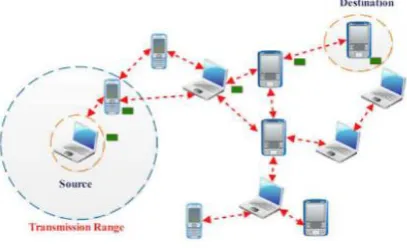
Quality of service (QoS) refers to the ability of a network to provide service to the network traffic and deal with network performance elements. Mobile ad-hoc network is a network which has several free nodes and is composed of mobile devices that arrange themselves in various ways and operate without any strict network administration. The important goals of the protocols are Localized packet routing decision and differentiated QoS options. In fig 1.1 during the transmission if the nodes want to send the information from source to destination and the destination node doesn’t lie within the communication range then the communication takes place with the help of intermediate node.
In a multi hop network, when all the nodes try to transmit data to the server simultaneously, leads to Collision, Cross Talk, Packet Drop, No Reliability. In order to overcome these problems, the following schemes are introduced:
A novel scheduling scheme which takes into account packet loss characteristics, QoS characteristics and maximum
delay
[image:1.595.328.532.275.399.2]Fig 1.1 Mobile ad-hoc network
limitations for a packet. This framework provides better results in terms of energy efficiency. Buffering at sender side which is used for packet scheduling. A controller which controls the transfer of packets to the server using round robin scheduling algorithm.The main purpose of this network is to improve quality of service. The growing real-time application provides quality of service support in wireless and mobile ad hoc network environment. The scope of this paper: Used in multimedia networks which expects high throughput, low delay, and low packet loss rate. Used in wireless sensor network which incorporates a gateway that provides wireless connectivity back to the wired world and distributed nodes.
2.RELATED WORK
© 2017, IRJET | Impact Factor value: 5.181 | ISO 9001:2008 Certified Journal
| Page 234
authors also present a method to develop the powerefficiency of cellular networksand suggest some techniques to enable an energy efficient cellular network [3]. Addressing the fundamental delay for minimizing energy expenditure in a multiuser wireless network with randomly varying channels, demonstrating that any algorithm that yields average power within the minimum power required for network stability must also have an average queueing delay [4]. The presentation regarding brief description about mobile ad-hoc network, mobile ad-hoc network is collection of independent nodes where a node can communicate directly with another node within radio wave. If the node is in the outer range, then using intermediate node communication is possible [5].The method which manages the communication of multimedia packets in a way that the users have a fair share of packet loss according to their Quality of
service requirements, and maximizes the number of the served users under the Quality of service constraints [6]. The advantages of intelligently dropping small fraction of packets that arrive for transmission, the packet dropping and the optimum energy delay can be delayed [7]. A user communicating over a feeding channel with perfect channel state information. Data are assumed to arrive from higher layer and stored in buffer until transmitted. The main objective is to regulate both long term and average transmission power [8]. An efficient medium access control protocol with fair packet loss sharing packet scheduling is proposed for wireless code division multiple access communication [9]. The packet loss bustiness over wireless channels is commonly acknowledged as a key impacting factor on the performance of networking protocols [10].
3.SYSTEM DESIGN
[image:2.595.377.525.293.520.2]Consider a network in fig 1.2 it mainly consists ofthree users ,user created user buffer, central controller , and server as the main integral part. The user buffer is dynamic in size.
Fig 1.2 : Simple Architecture
In order for the client to communicate with the server, the nodes have to be registered with the server. According to fig 1.2
The registration is the important part because without the registration the transferring of packets cannot take place. After the registration is
successful the packets are available for transferring. The Bandwidth of the server is analyzed and is used
to calculate the no. of packets to be sent at a time. No. of packets to be sent at a time = Sever
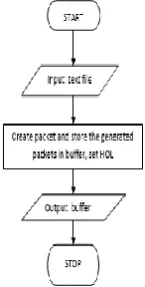
bandwidth / no. of nodes. The data to be sent by the nodes is placed in the user buffer. The packets are created based on the no. of lines in the file. According to fig 1.3
[image:2.595.384.457.574.718.2]Fig 1.3 Node registration flowchart
[image:2.595.76.219.594.718.2]
© 2017, IRJET | Impact Factor value: 5.181 | ISO 9001:2008 Certified Journal
| Page 235
The controller runs the scheduling algorithmwhich then schedules the packets to be sent to the server.
The packets to be sent to the server are sent in a particular order in which order they have entered the buffer.
The packets are sent from each node to the server according to which the packets have been divided by the central controller.
4.IMPLEMENTATION
It is a main page of a controller the controller is used schedule the packets from the user buffer to the server. The scheduling is based on round robin algorithm.In order for the user to send a file to the server, initially the server has to be up.
Main Page of the Server
The controller is used schedule the packets from the user buffer to the server. The scheduling is based on round robin algorithm.
Main Page of the Controller
For node registration, the username and the password has to be entered. Only once the registration is required. Once registered, any no .of files can be transferred to the server.
Main Page of the Node
Shows the registration of node 1 along with the username and password
Node Registration
If the user has entered the unique username and password, the registration will be successful. The registered user will be stored in the database.
Node Registration Successful
© 2017, IRJET | Impact Factor value: 5.181 | ISO 9001:2008 Certified Journal
| Page 236
to packets based on the no. of lines in the file. An fileidentifier is used inorder to recognise the file once received by the server.
Packet Creation Successful
Before sending the file to the server it has to be placed in the buffer and must be converted to packets. Inorder to identify the file when received by the server, an file identifier is used. Packet creation will be a failure if we don’t enter the file identifier.
Packet Creation Failure
When the user places the packet in the buffer, a notification message is received by the controller. This notification message will contain the packet status, username of the user who has placed the packet in the buffer and no.of packet available
Packet Available message is received by the Controller
Inorder to view the file sent by the user, we need to load the file name. once it has been loaded we will receive the file identifier of the files which has been received by the server.
Files Received by the Server
Once the file identifier is selected, the list of packets available in that file can be viewed in encrypted format. To view that packet in decrypted format the packets has to be selected
Packets Decrypted by the Server
5. CONCLUSION
© 2017, IRJET | Impact Factor value: 5.181 | ISO 9001:2008 Certified Journal
| Page 237
of the applications characterizing the network traffic. Incontrast to common approach of dropping a packet as a consequence of failing to provide a required rate to the users, we propose maximizing the use of packet drop tolerance by dropping as many packets as permissible without compromising the QoE for the users.A scheduling scheme (Round Robin Algorithm) is used to optimize the energy consumption, which improves the QoS constraints and helps the Controller to schedule the packets in timely manner, which results in no packet loss.
ACKNOWLEDGMENT
We, express sincere gratitude to Management and staff of Srinivas School of Engineering Mukka,Surathkal for providing platform to conduct research and experimentation
REFERENCES
[1] Maximizing Energy Efficiency in Multiple AccessChannels by Exploiting Packet Dropping and Transmitter Buffering M. Majid Butt, Member, IEEE,Eduard A. Jorswieck, Senior Member, IEEE, Bjorn Ottersten, Fellow, IEEE ,March 2015
[2] A. Fehske, G. Fettweis, J. Malmodin, and G. Biczo´k, “The global footprint of mobile communications: The ecological and economic perspective,” IEEE Communications Magazine, vol. 49, no. 8, pp. 55–62, August 2011.
[3] Z. Hasan, H. Boostanimehr, and V. Bhargava, “Green cellular networks: A survey, some research issues and challenges,” IEEE Communications Surveys Tutorials, vol. 13, no. 4, pp. 524–540, 2011.
[4] M. J. Neely, “Optimal energy and delay tradeoffs for multiuser wireless downlinks,” IEEE Trans. Inform. Theory, vol. 53, no. 9, pp. 3095–3113, September 2007.
[5]Dr. S. S. Tyagi,”Study of MANET: Characteristics, Challenges, Application and Security Attacks”,journal paper. [6]M. M. Butt, “Energy-performance trade-offs in multiuser scheduling,Large system analysis,” IEEE Wireless Communications Letters, vol. 1,no. 3, pp. 217–220, June 2012.
[7] M. J. Neely, “Optimal energy and delay tradeoffs for multiuser wireless downlinks,” IEEE Trans. Inform. Theory, vol. 53, no. 9, pp. 3095–3113, September 2007.
[8] R. A. Berry and R. G. Gallager, “Communication over fading channels with delay constraints,” IEEE Trans. Inform. Theory, vol. 48, no. 5, pp. 1135–1149, May 2002.
[9] V. Huang and W. Zhuang, “QoS-oriented packet scheduling for wireless multimedia CDMA communications,” IEEE Transactions on Mobile Computing, vol. 3, no. 1, pp. 73– 85, 2004.
[10] I. Bettesh and S. Shamai, “Optimal power and rate control for minimal average delay: The single-user case,”
Information Theory, IEEE Transactions on, vol. 52, no. 9, pp. 4115–4141, Sept 2006.
APPENDIX
Node Registration Algorithm:
Input:- username, password
Output:- success or failure message
Step 1:- enter username and password
Step 2:- check for username and password field is empty or not
If(username or password is empty)
Show message to enter values Else
Send data for registration.
Step 3:- check status of database query
If(registration success)
Display success message Else
Display failure message.
Packet Creation Algorithm:
Input: - text file
Output: - packets[i], buf[i];
Step1: - Read a Text input file
Step2: -Generate a Packet using number of lines available in file.
Step3:- Store generated packets in a buffer.
Step4:- Set HOL [Head of Line to identify packet index] to a generated Buffer.