© 2017, IRJET | Impact Factor value: 5.181 | ISO 9001:2008 Certified Journal
| Page 1845
FABRICATION OF MICRO ELECTRODES FOR EDM AND OPTIMIZATION
OF THE PROCESS PARAMETERS FOR MAXIMUM MACHINING RATE (MR)
Arun Kumar
1, Jagmeet Singh
21
PG Student, PEC University of Technology, Sector-12, Chandigarh-160012, India
2PG Student, PEC University of Technology, Sector-12, Chandigarh-160012, India
3
PEC University of Technology, Sector-12, Chandigarh-160012, India
---***---Abstract -
Electrodes are the most essential component inMicro Electrical Discharge Machining (Micro-EDM). Electrode wear affects the geometry and precision of the components. In present work, a new technique has been adopted to fabricate micro electrodes in rectangular metallic materials using tubular electrodes in EDM process. Micro electrodes with high aspect ratio were generated in rectangular copper block using tubular electrodes of copper in electrical discharge drilling (EDD) process. Machining rate (MR) has been investigated on EDD process using Taguchi’s L9 orthogonal array. The process parameters namely Discharge current (Ip), Pulse-on time
(T-on) and Pulse-off time (T-off) are used for investigation. In order to optimize process parameters for maximum machining rate, Taguchi’s approach has been used in the present research work.
Key Words: Micro electrodes, Micro EDM, Machining Rate,
EDD, electrode material.
1. INTRODUCTION
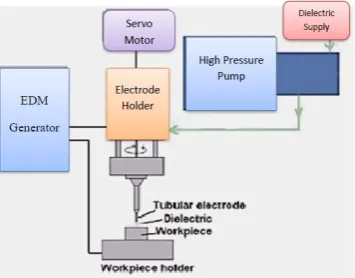
Electrical Discharge Machining (EDM) Drilling is quickly becoming the standard method for producing small, tight tolerance holes. It is an extremely cost-effective method for producing fast and accurate holes into all sorts of whether hard or soft conductive materials. Electrical Discharge Machining (EDM) is the process of machining electrically conductive materials by using precisely controlled sparks that occur between an electrode and a workpiece in the presence of a dielectric fluid. EDM is based on the erosion of electrically conductive materials through the series of spatially discrete high-frequency electrical discharges (sparks) between the tool and the workpiece illustrates that each spark occurs between the closest points of the electrode and the workpiece. The spark removes material from both the electrode and workpiece, which increases the sparking gap (distance between the electrode and the workpiece) at that point. This causes the next spark to occur at the next-closest points between the electrode and workpiece. As EDM is a thermal process, material is removed by heat. Every discharge (or spark) melts a small amount of
material from both of the electrodes. Part of this material is removed by the dielectric fluid and the remaining solidifies on the surface of the electrodes.
Fig. 1 Electrical Discharge Drill machine
1.1
WORKING PRINCIPLE
[image:1.595.345.523.288.427.2]© 2017, IRJET | Impact Factor value: 5.181 | ISO 9001:2008 Certified Journal
| Page 1846
sparking takes place at the bottom of the electrode andelectrode wear takes place primarily at the bottom edge of the electrode as shown in fig.1.5. In addition to that the secondary discharges material removal takes place between the electrode and top edge of the work material.
1.2 IMPORTANT PARAMETERS IN EDD
(1) Spark On –time (Ton): The duration of the time the current is allowed to flow per cycle. The amount of energy applied during the cycle is directly proportional to pulse on time. This energy is really controlled by the peak current and the length of the on-time.
(2) Spark Off-time (Toff): It is time duration between the successive sparks. The time which allows the molten metal solidify and to be wash out of the gap. This parameter affects the speed and stability of the cut. Thus, if the off-time is too short, it will cause the sparks to be unstable.
(3) Arc gap (or gap): It is the gap between the electrode and workpiece during the process of EDM. It may be called as the spark gap. Spark gap here is maintained by the servo system. (4) Discharge current (Ip): Discharge current is very important parameter here which controls the material removal rate.
(5) Electrode polarity: Polarity refers to an electrical condition determining the direction of the current flow relative to the electrode.
Straight polarity: Electrode (-) & work-piece (+) Reverse polarity: Electrode (+) & work-piece (-)
1.3
TOOL (ELECTRODE) MATERIAL
Tool material should be such that it would not undergo much tool wear when it is impinged by positive ions. Thus the localized temperature rise has to be less by tailoring or properly choosing its properties or even when temperature increases, there would be less melting. Further, the tool should be easily workable as intricate shaped geometric features are machined in EDM.
The basic characteristics of electrode materials are: • High electrical conductivity – electrons are cold emitted more easily and there is less bulk electrical heating. • High thermal conductivity – for the same heat load, the local temperature rise would be less due to faster heat conducted to the bulk of the tool and thus less tool wear.
• Higher density – for the same heat load and same tool wear by weight there would be less volume removal or tool wear and thus less dimensional loss or inaccuracy.
• High melting point – high melting point leads to less tool wear due to less tool material melting for the same heat load. • Easy machinability.
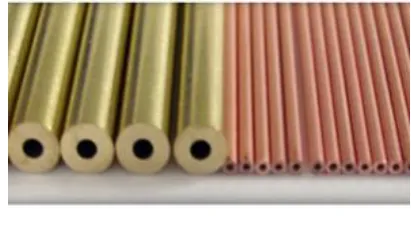
Fig. 2 Tubular electrodes
2. EXPERIMENTAL RESULTS FOR MACHINING
RATE (MR)
Here the experiments carried on the copper workpiece using the copper tubular electrode having outer diameter 2 mm and inner diameter 0.9 mm. This study has been done on three experimental input parameters Current(Ip), Pulse on time (T-on), Pulse off time (T-off). So According to this approach Experiments have been done using three level and three factors. For this L9 array has been used to process the parameters. The depth has been taken 20 mm.
Table -1: Process parameters selected for present work Process
parameters
Level
1
Level
2
Level
3
A Discharge current(Ip) (Amp.)
3 4 5
B Pulse-on time(µs) 5 6 7
C Pulse –off time(µs) 4 5 6
[image:2.595.329.535.213.326.2]© 2017, IRJET | Impact Factor value: 5.181 | ISO 9001:2008 Certified Journal
| Page 1847
having rotation of 145 rpm for fabricating the microelectrodes for EDM of high aspect ratio.
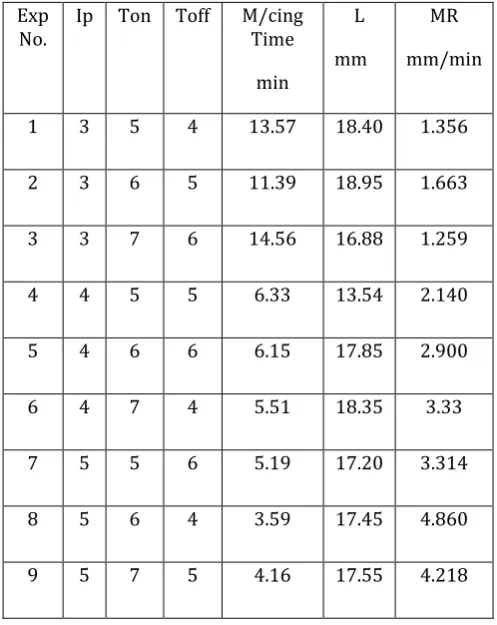
Table -2 Results for Machining Rate of micro electrodes Exp
No. Ip Ton Toff M/cing Time min
L mm
MR mm/min
1 3 5 4 13.57 18.40 1.356
2 3 6 5 11.39 18.95 1.663
3 3 7 6 14.56 16.88 1.259
4 4 5 5 6.33 13.54 2.140
5 4 6 6 6.15 17.85 2.900
6 4 7 4 5.51 18.35 3.33
7 5 5 6 5.19 17.20 3.314
8 5 6 4 3.59 17.45 4.860
[image:3.595.39.288.157.470.2]9 5 7 5 4.16 17.55 4.218
Table-3 Analysis of variance (ANOVA) Table for MR Source DF Adj SS Adj MS F value P
Ip 2 10.9731 5.48655 1292.34 0.001
Ton 2 1.2439 0.62196 146.50 0.007
Toff 2 0.7693 0.38463 90.60 0.011
Error 2 0.0085 0.00425
Total 8 12.9948
Results for MR were analyzed using ANOVA to find significant factors which are affecting response factor i.e. MR. ANOVA table for machining rate is generated for 95% confidence interval. F-test is also performed on the data to
find contribution of each factor. The principal of F-test is that the larger the value of F more is the effect on response variables or in other words more is the contribution. For 95% confidence interval a factor is said to be significant if F-value is greater than the table F-value and P F-value is less than 0.05. Hence, significant results are found for Machining rate of micro electrodes.
Fig.3: main effects plot for means of MR.
Fig.4 Main effects of plot fot SN ratio of MR From SN ratio graph for MR as shown in Figure 6.2, the optimized values for maximum MR are:
I
p= A3 = 5 Amp.
T
on= B2 = 6 s
T
off= C1 = 4 s
[image:3.595.315.550.206.360.2] [image:3.595.321.547.394.547.2]© 2017, IRJET | Impact Factor value: 5.181 | ISO 9001:2008 Certified Journal
| Page 1848
=
+
………(i)
[image:4.595.35.283.243.454.2]where ηm is the total mean of the machining characteristic under consideration; ηi is the mean values at the optimum level (from response Tables) and q is the number of process parameters that significantly affects the machining characteristics. By using equation (i) the predicted value has been calculated for MR, EWR and Taper ( ).
Table-4 Optimized results for MR using Taguchi’s approach
Machining characteristic
Optimal parameters
combination Significant parametes Predicted value Experimental value
MR A3B2C1 A, B, C
4.86 mm/min
4.95 mm/min
Fig -5: 3-D view under stereo zoom microscope of fabricated micro electrodes for EDM
Fig.6 SEM images of micro electrodes
Recast layer has been found on the micro electrodes. Craters also have been investigated on the surface of micro
electrodes. The recast layer or the carbon layer help to reduce the electrode wear rate in micro EDM machining.
3. CONCLUSIONS
In the present work the micro electrodes were fabricated using tubular electrodes of copper having outer diameter 2mm and inner diameter 0.9 mm on electrical discharge drilling (EDD) process. The following conclusions are obtained:
1. Machining rate (MR has been investigated on the electrical discharge drilling (EDD) using Taguchi’s L9 orthogonal array.
2. The micro electrodes of Aspect ratio (length/diameter) ranging between (22.08-30.91) have been investigated. The minimum mean diameter of micro electrodes obtained is 0.581 mm and maximum length of micro electrode is obtained as 18.95 mm.
3. MR of the electrodes fabricated increases with the increase in discharge current and pulse on time, while decreases on increasing the pulse off time.
4. Recast layer has been found during the SEM on the micro electrodes which has a surface roughness on the higher side. 5.Using the Taguchi’s approach the optimal combination of the process parameters for MR is observed as A3(Ip=5Amp.), B2(Ton=6 s), C1(Toff=4 s).
REFERENCES
1. Abbas, N Mohd, D. G. Solomon, and Md Fuad Bahari),
"A review on current research trends in electrical discharge machining (EDM)." International Journal of machine tools and Manufacture 47.7,(2007) 1214-1228.
2. Abinesh, P., Varatharajan, K. and Kumar, Satheesh , “Optimization of process parameters influencing MRR, surface roughness and electrode wear during machining of titanium alloy by WEDM”,
[image:4.595.36.279.494.737.2]© 2017, IRJET | Impact Factor value: 5.181 | ISO 9001:2008 Certified Journal
| Page 1849
4. Ali, M. A. Md., Laily, S., Manshoor, B., Syahrian, N. I.,Izamshah, R., Hadzley, M and Muhamad, M. R. “Performance of copper, copper tungsten, graphite and brass electrode on MRR, EWR and SR of aluminium LM6 in EDM die-sinking”, Journal of Advanced Research in Applied Mechanics, Vol. 6, No. 1, (2015), Pp. 30-36, Issn: 2289-7895.
5. Ali, M. A., Samual, M., Hussein, N.I.S., Rizal, M., Izamshah, R., Hadzley, M., Kasim, M.S., Sulaiman, M.A. and Sivarao, S.), “The Effect of EDM Die-sinking parameters on metal removal rate of beryllium copper using full factorial method”, Middle-East Journal of Scientific Research, 16(1), (2013), Pp.44-50, Issn:1990-9233
6. Ali, Mohammad Yeakub., Khan, Ahsan Ali., Hamzah, Munirah and Khalid, N or Azura “Study of material removal rate and electrode wear ratio for Micro electrical discharge milling of AISI 420 and Stavax ESR”, International Journal of Mechanical and Material, Vol. 4,No. 3, . (2009), Pp. 300-308.
7. Aligiri, E., S. H. Yeo, and P. C. Tan., "A new tool wear compensation method based on real-time estimation of material removal volume in
micro-EDM." Journal of Materials Processing
Technology 210.15, (2010), 2292-2303.
8. Amorim, Fred L and Weingaertner, Walter, “The Behavior of graphite and copper electrodes on the finish die-sinking electrical discharge machining (EDM) of Aisi P20 Tool Steel” J, Braz. Soc. Mech. Sci. & Eng, Vol. 29, No. 4, (2007), Issn:1678-5878. 9. Backer, Shahul., Mathew, Cijo and George, Sunny k.
“Optimization of MRR and TWR on EDM by using Taguchi’s method and ANOVA” International journal
of Innovative Research in Advanced
Engineering(IJIRAE), Vol. 1, (2014), Issue 8, Pp-106-112, Issn;2349-2163.
10. Badekar, S. G. and Dabade, Dr. B. M. (2015), “Modeling and optimization of EDM process parameters: A Review”, International Journal of Mechanical Engineering and Technology, Vol. 6, Issue 2, Pp. 30-36, Issn: 6340(Print), 0976-6359(Online).
11. Banker, K. S., Oza, A. D and Dave, R. B. “Performance capabilities of EDM machining using aluminium, brass and copper for AISI 304l material”
International Journal of Application or Innovation In Engineering & Management, Vol. 2, Issue 8, (2013), Pp186-191, Issn:2319-4847.
12. Bergaley, Ajeet., Sharma, Narendra. “Optimization of electrical and Non electrical factor In EDM for
machining die steel using copper electrode by adopting Taghuchi technique”, International Journal of Innovative Technology and Exploraing Engineering , Vol. 3, Issue 3, (2013), Pp44-48, Issn:2278-3075.
13. Bhaumik, Munmun and Maity, Kali Pada. “Study the effect of tungsten carbide electrode on stainless steel (AISI 304) material in die- sinking EDM”, Journal of Material Science and Mechanical Engineering,2014, Vol. 1, No. 1, (2014), Pp. 1-6, Issn: 2393-9095.
14. Dewangan, Shailesh Kumar"experimental
investigation of machining parameters for EDM using U-shaped electrode of AISI P20 tool steel." Department of Mechanical Engineering, National Institute of Technology Rourkela (India), .,(2010).
15. Jahan, M. P., M. Rahman, and Y. S. Wong., "A review on the conventional and micro-electrodischarge machining of tungsten carbide." International Journal of Machine Tools and Manufacture 51.12, (2010) 837-858.
16. Jangra, Kamal, Sandeep Grover, and Aman
Aggarwal,"Optimization of multi machining characteristics in WEDM of WC-5.3% Co composite using integrated approach of Taguchi, GRA and
entropy method." Frontiers of Mechanical
Engineering , (2012),
17. Kulkarni, Anjali V. "Electrochemical discharge machining process.," Defence Science Journal 57.5 ,765, (2007)
18. Kumar, Nikhil, et al.,) "Comparative study for MRR on die-sinking EDM using electrode of copper and graphite." International journal of advanced technology & engineering research 2.2, (2012) 170-174.
19. Maradia, U., et al,"A strategy for low electrode wear in meso–micro-EDM." Precision Engineering 42, (2015) 302-310.
20. Rahman, M., et al,"Integrated hybrid micro/nano-machining." ASME Conf Proc. Vol. 4, (2007).
21. Raj, Sumit, and Kaushik Kumar,"Optimization and