© 2018, IRJET | Impact Factor value: 6.171 | ISO 9001:2008 Certified Journal | Page 1852
COMPARATIVE ANALYSIS OF POTATO SLICE DRYING AND REHYDRATION
IN DIRECT AND HYDRID SOLAR DRYING
R.Pandiyan
1, R. Ragul Kannan
2, M.Thirulogachandar
3,
C. Mohan Das
4, S. Nirmal Kumar
51,3,4,5
Asst. Professor, Dept. of Mechanical Engineering, M.A.M. College of Engineering, Trichy,
2Asst. Professor, Dept. of Electronics and Instr. Engg., M.A.M. College of Engineering, Trichy.
---***---
Abstract - Solar drying is the process of removing themoisture present in the foodstuff in order to preserve it from the environmental factors like fungi, Bacteria and algae. In this study the selected product was investigated by Direct and Hybrid solar drying. The experimental set up was developed for both drying and the measurements like Ambient air temperature, solar radiation, Drying air temperature, Relative humidity of ambient and dryer and the different product properties were measured by the various measuring devices. The rehydration test also conducted and the readings were noted. From the readings, graphs had been developed for analyzing the experiment. Potato was dried in the direct solar drying by the ambient conditions and in the hybrid solar drying with the conditions of the constant inlet air temperature of 55°C and the varied inlet air velocities of 1, 1.5 and 2 m/s. The time taken for reducing the moisture content below 10% in the hybrid solar drying was reduced by about 21.43%, 28.57% and 35.71% for the inlet air velocities of 1, 1.5 and 2m/s compared to direct solar drying respectively. When the inlet air velocities increased from 1 to 2 m/s, the product gets dried 30 minutes earlier in the hybrid solar drying. The drying rate also increased in hybrid solar drying when compared to direct solar drying in which drying rate get increased while the radiation increased. The drying rate was increased till the moisture ratio get reduced below 50% and then it was decreased. The shrinkage of product was higher in the direct solar drying due to higher radiation and uncontrolled air velocity over the product. In the hybrid solar drying, the shrinkage was increased at the time of velocity increases. The rehydration test was conducted in distilled water for the temperatures of 30, 40, 50 and 60 °C. The rehydration ratio increased from the temperatures of 30 to 50 °C and then it decreased in 60°C compared to 50°C due to the loss of solid occurred at the time of temperature beyond the limit.
Key Words: Solar drying, moisture, rehydration test, temperature, Hybrid solar drying, etc.,
1. INTRODUCTION
Drying by exposure to the Sun is one of the best methods using solar energy, for food preservation, as vegetables, fruits, fish, meat, etc. Drying or dewatering is a very simple
process of excess water and moisture removal from a natural product or industrial product in order to reach the standard specification water and moisture content. It is nothing but an energy intensive operation.
1.1 Importance of Solar Drying
Reducing moisture content of foodstuff down to a certain level slows down the action of enzymes, bacteria, yeasts and moulds. So the food can be stored and also preserved for long time without any spoilage. Another case of drying or dewatering is the total removal of moisture up to food has zero moisture at all way. Dehydrated food is in ready to use when re-watered and also almost retain its initial (original) conditions.
Solar radiation, in the form of solar (thermal) energy, is an alternative source of energy for drying especially to vegetables, dry fruits, agricultural grains nuts and also other kind of materials like wood, etc. Drying by solar radiation can be divided into two main categories:
(a) Direct, or open-air sun drying, the direct exposure to the sun.
(b) Indirect solar drying or convective solar drying.
1.2 Problem in Direct Solar Drying
Food materials and crops are very sensitive to the drying conditions. Drying must be performed in a way that does not affect seriously their colour, flavour, texture or nutritional value. In direct solar drying called ―sun drying‖ the product is heated directly by the sun’s rays and moisture is removed by natural circulation of air due to density differences. Following are the difficulties in direct solar drying:
In direct solar drying, the drying products like vegetables, fruits and grains tend to lose its colour, flavour, taste and quality.
It is not possible for drying during night hours.
© 2018, IRJET | Impact Factor value: 6.171 | ISO 9001:2008 Certified Journal | Page 1853
It is not possible any scientific control of final quality and moisture content which depends only on observations by experience.
It is a very slow rate operation. Drying rate depends on solar intensity fluctuations but also on environmental air humidity of the site.
The product is exposed directly to all kinds of weather changes, as rain, hail, and strong winds, etc., that can rot or destroy totally the material Bad weather conditions on the other hand facilitate growing of bacteria, moulds etc.
They have very large qualitative and quantitative losses due to all weather and natural attack conditions closely related to the open-air procedure, as dusting, rotting when weather conditions are not favourable, attacks by insects, etc.,
1.3 Indirect Solar Drying
Indirect solar drying is (a) the process of convective heat transfer of air at normal conditions (or) heat transfer between the thermal energy storage system and the flowing air which absorbs the heat from heat storage material and supplies the heat to the product when it to be needed. Hot air is going to increase heat of the product, it will helps to released moisture to the atmosphere. Indirect solar drying has the merits over direct solar drying as follows:
Indirect solar Drying is not affects the colour, flavour and quality of the product.
The main advantage is possibility of night time drying.
Drying rate is high. Agricultural products are dried within 15–30 h instead of few days.
Drying can be controlled scientifically, ensuring the proper moisture content of the final product, according to the specifications. Thus the dried product can be stored for long times.
No loss at all as the product is not subject to any natural phenomena.
Due to the above constructive properties the indirect solar drying is prescribed for drying applications.
1.4 Hybrid Solar Drying
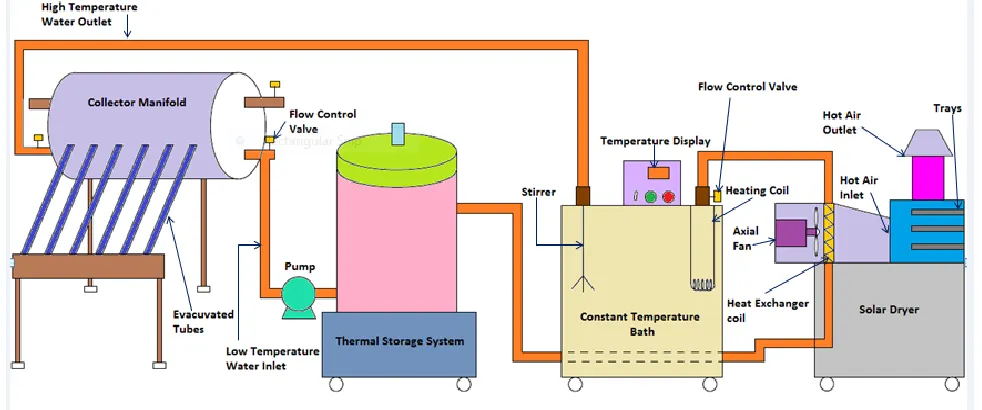
Hybrid solar drying is the process of combining the process of direct and indirect solar drying to produce hybrid solar drying. There are many types of hybrid solar drying available. In this study, from the value of maximum temperature attained in evacuated tube collector, the
constant temperature bath was attached to maintain the constant temperature and to develop the hybrid solar dryer.
2. OBJECTIVE OF THE PROJECT
The main objectives of this project is
The selection of the product and the preparation of the product for Direct and Hybrid solar drying.
To Measure the ambient and working conditions of Both Drying in different situations.
To analyze the Properties of product like Moisture content, Moisture ratio, Drying rate, Shrinkage and Rehydration and select the suitable condition for quality drying.
3. SELECTION AND PREPARATION OF PRODUCT
3.1 Solar Drying of Products
Fruits and vegetables are the nutritional foods whose has the large amount of Vitamins, Minerals, sugar and fibers. So it is very essential to preserve the fruits and vegetables and takes as a food for growing of the cells of human body. Solar drying is used to remove the moisture content from vegetables. If the product is maintained with their harvesting characters, the products tent to deteriorate, affected by microorganisms like bacteria, moulds etc. And it is very difficult to export the fruits to other countries. For avoiding all these above factors solar drying is to be done. Solar dried products has less weight and sizes also.(e.g) The appearance of dried products as given below as shown in figure.
Fig – 1. The appearance of Solar dried Products
3.2 Selection of Product
© 2018, IRJET | Impact Factor value: 6.171 | ISO 9001:2008 Certified Journal | Page 1854 process which has the good drying properties in the
temperature range of 50 to 60°C.
3.3 Products and their Drying Temperatures
[image:3.612.330.562.140.294.2]The standard drying temperatures are differing for different fruits. The name of the fruits and their drying temperatures are listed below.
Table - 1 The drying temperatures of various products
S.NO PRODUCTS LIST DRYING TEMPERATURE (˚C)
1 Apples 55-75
2 Potatoes 50-70
3 Carrots 55-70
4 Onions 45-50
5 Bananas 70
6 Pumpkins 60
7 Ladies fingers 60-90
8 Tomatoes 55-60
9 Mushrooms 50-60
10 Corn 55-75
3.4 Preparation of the Product
The fresh potato was selected where the potatoes whose have green points, black spots and shrinkage were eliminated. Selected potatoes were washed and sliced as 1.5 mm thickness by kitchen kit. The excess water surrounding the potato was removed by the tissue paper. In the direct solar drying, the slices were spreaded over the wooden board. In the hybrid solar drying, the sliced product was distributed over the trays. Three trays were selected for the process and 150 g of sliced potatoes was carried in each tray.
4. EXPERIMENTATION
4.1 Measuring Devices Used For Experimentation
The important of the drying process is to predict the operating conditions and the drying product conditions. For finding these values, measuring devices were used.
Temperature and Humidity meter was used to measure the temperature and humidity of atmospheric and drying chamber air.
Solar meter was used to capture the solar radiation in the direct solar drying.
Vane anemometer was used examine the variation of air flow rate.
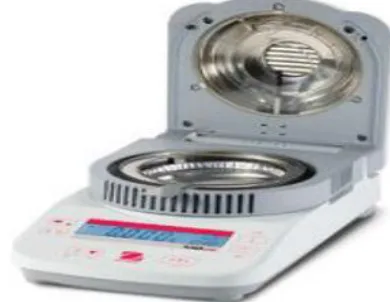
Moisture content of the product predicted by Moisture analyzer.
[image:3.612.48.284.202.357.2] Digital micrometer and digital vernier caliper were used to measure the dimensions of the drying product before and after drying.
[image:3.612.334.559.344.462.2]Fig – 2: Instruments used for measuring air properties (a) Anemometer (b) Temperature and Humidity meter.
Fig - 3: Instruments used for measuring the product properties (a) Digital vernier caliper (b) Digital micrometer.
[image:3.612.349.544.526.677.2]© 2018, IRJET | Impact Factor value: 6.171 | ISO 9001:2008 Certified Journal | Page 1855
5. EXPERIMENTAL PROCEDURE
5.1 Drying Kinetics of Direct Solar Drying
About 150 g of potatoes were placed over the cotton cloth on the wooden board which was exposed to the sun directly without affecting any shadows of surroundings. The atmospheric conditions were examined by the devices
[image:4.612.78.569.190.395.2]periodically. The Temperature and humidity values were measured by Temperature and humidity meter and the air velocity was measured by vane anemometer. The solar radiation was recorded by solar meter. The drying samples were taken for every 30 minutes of drying and analysed by Moisture analyzer. This procedure was repeated until the moisture content to reach below 10%.
[image:4.612.70.543.426.607.2]Fig - 5: Schematic view of Hybrid solar dryer
Fig - 6: Photographic view of Hybrid solar dryer
5.2 Operating Conditions of Hybrid Solar Drying
For 1 m/s air inlet velocity:
Mass flow rate of water: 0.25 l /s
Mass flow rate of air : 0.184 kg/s
Mass of potatoes used : 450 g
Potato thickness : 1.5 mm
Air inlet Temperature : 60 °C
For 1.5 m/s air inlet velocity:
© 2018, IRJET | Impact Factor value: 6.171 | ISO 9001:2008 Certified Journal | Page 1856 For 2 m/s air inlet velocity:
Mass flow rate of air : 0.368 kg/s
5.3 Drying Kinetics of Hybrid Solar Drying
Heated water from the constant temperature bath was passing through the heat exchanger coil. The constant temperature of water was maintained in constant temperature bath after the water heating from the solar evacuated tube collector. The damper was used to control the flow rate and the velocity of fan. The constant air temperature of 55°C was selected as appropriate temperature for drying and the velocities of inlet air were changed as 1, 1.5 and 2 m/s for different conditions.
The potato was characterized by analyzing the moisture content and drying rate curves on wet basis. Initially the moisture content of potato was predicted by moisture analyzer. Then the sliced potatoes were distributed over the 3 trays. Each tray carried 150 g of potatoes and each potato was measured as 3 g by weighing balance. After 30 minutes, a sample of potato was taken out from the dryer and the moisture content measured with the help of moisture analyser. This procedure was repeated every 30 minutes interval till the moisture content reduces to below 10%.
In the moisture analyser the samples of 3g of potatoes heated at 130°C. The potatoes were dried in the analyser until all the water content in potatoes was evaporated.
Finally the moisture analyser displayed the moisture content present in the sample on wet basis.
The moisture ratio of potato samples during the drying was determined by using the equation of
MR = (Mt-Me) / (M0-Me) Where,
M0 is the initial moisture content on wet basis.
Me is the equilibrium moisture content.
Mt is the moisture content of sample at time interval t on wet basis.
The values of the equilibrium moisture content are very small as compared to Mt and Mo values. So it can be neglected and the equation can be simplified as
MR= Mt / M0
The Drying rate of the sample can be written as
DR = (Mt1-Mt2) / (t2-t1)
Where,
Mt1 is the moisture content of the sample at time t1 on wet basis.
Mt2 is the moisture content of the sample at time t2 on wet basis.
t2-t1 is the time interval between the sample drying.
5.4Shrinkage Test
Shrinkage test is the important test to find the effect of temperature and the air velocity on the drying sample. Shrinkage occurred due to the moisture transfer from the potato. The degree of shrinkage may affect the drying rate and diffusion coefficient. In this study shrinkage was quantified as volume reduction measured by digital vernier caliper and digital micrometer. The highest shrinkage occurred at the time of velocity increases. The shrinkage was computed by the formula of
Shrinkage = (V0-Ve) / V0
Where,
Vo is the initial volume of the sample Ve is the dehydrated volume of the sample
5.5 Rehydration Test
Dehydrated products should be rehydrating for their use. Rehydration is a complex process aimed at restoration of the properties of the dried product. Therefore, the study of the rehydration kinetics of products is useful for to know how the kinetics will be affected by processing variables will be predicted. Rehydration done by a sample of potato immersed in 150 ml of distilled water at various temperature conditions while the temperature maintained as constant at heating mantle during rehydration. At initially the dried sample was measured by weighing balance and then the test to be started. The rehydrated sample was weighted in the weighing balance at the time interval of 30 minutes. The test to be continued until the sample reached the saturation state.
The rehydration ratio was computed by the formula of
RR = M rh / M dh
Where,
M rh is the mass of rehydrated sample at every 30 minutes.
© 2018, IRJET | Impact Factor value: 6.171 | ISO 9001:2008 Certified Journal | Page 1857
6. RESULTS AND DISCUSSION
6.1 Experimental Drying Curves
[image:6.612.333.561.187.290.2]By measuring the working conditions and the product properties, the drying curves were plotted by using Origin Pro8 software. From the drying curves, the drying properties like moisture content, moisture ratio, drying rate, shrinkage and rehydration ratio can be compared between direct and hybrid solar drying . The comparison of the variation in velocity of air affects the properties in hybrid solar drying also done by the graphs.
Fig - 5: The variation in solar radiation for 3 days of direct solar drying.
6.2 Moisture Content
[image:6.612.56.278.232.381.2]In solar drying, the experimentation done for 3 days and graphs had been plotted. The time taken for reducing the moisture content below 10% in the direct solar drying was 7 hours. The initial moisture contents before drying were 83.14%, 8.94% and 82.17% for day 1, day 2 and day 3 respectively. After the 7 hours of direct solar drying, the moisture content of potato reduced to 9.73%, 9.92% and 10.77% for day 1, day2 and day 3 respectively. The reduction in the moisture content of the potato on first day was more than other two days. Because the solar radiation and the ambient temperature higher than next two days.
Fig - 6: The moisture content variation with respect time (a) direct solar drying (b) hybrid solar drying.
[image:6.612.330.559.426.693.2]In the hybrid solar drying the temperature of inlet air was maintained at constant of 55°C and the velocity of inlet air was changed as 1, 1.5 and 2m/s. In this drying, the moisture content of potato at the top tray (TR1) was reduced to 9.97%, 9.85% and 9.43% for 1, 1.5 and 2 m/s inlet air velocity respectively. And moisture content of potato at bottom tray (TR 2) was reduced to 10.23%, 10.21% and 10.32% for 1, 1.5 and 2 m/s respectively.
Fig - 7: The drying rate with respect to time for (a) direct solar drying and (b) Hybrid solar drying.
This result indicates when the velocity of inlet air increases, the reduction in moisture content also increases. This is due to the enhancement of mass transfer rate at the time of velocity and the mass flow rate increases. The amount of moisture removal is more in the TR1 than TR2. This happens due to accumulation of air nearer to TR1 more than TR2 and removing more moisture from TR1.
[image:6.612.53.285.584.689.2]© 2018, IRJET | Impact Factor value: 6.171 | ISO 9001:2008 Certified Journal | Page 1858
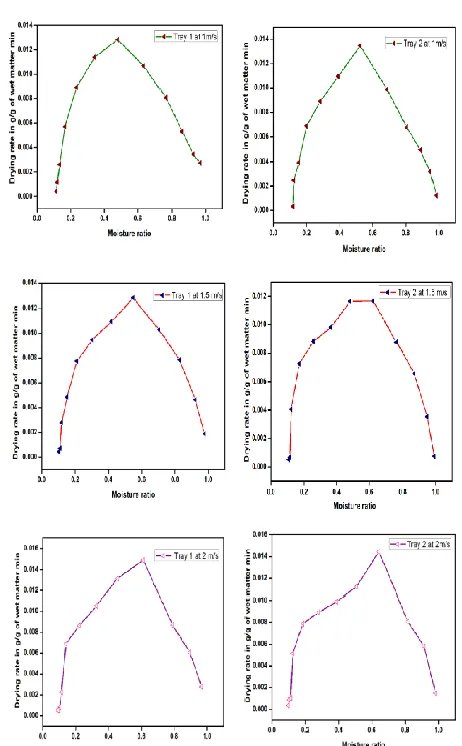
Fig - 9: Drying rate with respect to moisture ratio for TR 1 and TR 2 for 1, 1.5 and 2m/s inlet air velocities and 55°C for
hybrid solar drying.
6.3 Drying Rate
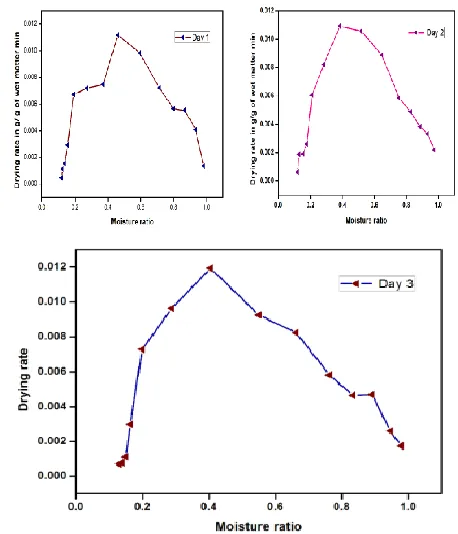
In the direct solar drying, the drying rate at Day 1 was increases rapidly than other two days. This is also the reason of intensity of solar irradiation and the temperature of ambient conditions. The graph resulted that the maximum drying rate obtained was 0.0119 at 12.30 pm for Day 1, 0.01092 at 1:00 pm for Day 2, 0.01194 at 1:00 pm for day 3. The maximum trying rate occurred only at the maximum radiation recorded at those days. The drying rate increases while the moisture ratio increases and then DR decreases after the Moisture ratio value reaches below 0.4. This is indirectly indicates the drying rate reduction occurred after the moisture content of the product decreases
In the hybrid solar drying, the maximum trying rate obtained was 0.01283 at TR1 and 0.01348 at TR2 for 1 m/s inlet air velocity to drying chamber. Then 0.01281 at TR1
and 0.01168 at TR2 for 1.5 m/s inlet air velocity and also 0.01489 at TR1 and 0.01444 for TR2 for 2 m/s inlet air velocity . The drying rate increases while the mass flow and the velocity of inlet air increased. This also happens because of the reason of the moisture transfer rate increases at the time of air velocity increases. The maximum drying rate achieved at 150 minutes, 120 minutes and 90 minutes for 1m/s, 1.5 m/s and 2 m/s respectively. It means the higher velocity with large amount of mass flow rate removed the moisture present in the air quickly. Then the drying rate decreased suddenly at the higher velocities. Because when the moisture content of potato decreases, the drying rate also decreases. This is indicated by the graphs as shown in the figure 5.5. The DR deceased below the MR value as 0.4 like in the direct solar drying.
6.4 Rehydration
Rehydration test was conducted at 150 ml distilled water in the beaker for four different temperatures of 30, 40, 50 and 60°C. The readings were noted for every 30 minutes of rehydration. The graph shows that the Rehydration ratio (RR) increases from 1 to 3.977, 4.588, 5.383 and 5.175 for 30, 40, 50 and 60°C respectively for the dried product of direct solar drying. And the RR increases from 1 to 4.485, 5.187, 5.473 and 5.376 for 30, 40, 50 and 60°C for the product dried in the Hybrid solar drying. Both the results clearly exposed that when the temperature of the water increases, the Rehydration Ratio increases. At the same time the temperature increases more than the limit that means at the 60°C, the Rehydration rate increased initially and then decreased as compared to 50°C. If the temperature of the water increases, the loss of solid may occurred. So that the RR decreased at the time of temperature increased from 50°C.
7. CONCLUSION
© 2018, IRJET | Impact Factor value: 6.171 | ISO 9001:2008 Certified Journal | Page 1859 Shrinkage test conducted for hybrid solar dried
product was given better result compared to direct solar drying. The shrinkage percentage of direct solar drying was 81.15% while 67.93%, 51.25% and 42.7% for 2, 1.5 and 1m/s inlet air velocity in the hybrid solar drying. The percentage of shrinkage reduction in the hybrid solar drying was 13.22%, 29.9% and 38.45% for 1, 1.5 and 1 m/s inlet air velocities respectively. This is the reason of constant air velocity and the low velocity creates the moisture removal rate as smooth which is not affect the structure of potato dynamically. Rehydration test for both direct and hybrid solar dried product sample was conducted for four different temperatures of 30, 40 50 and 60°C. The rehydration ratio increases while the temperature increases up to 50°C due to the enhancement of thermal diffusivity. Then the Rehydration ratio was decreased for 60°C because of the loss or detoriation of solid matter from the sample at the time of temperature increases. From all the result, the air velocity of 1.5 m/s at 55°C in the hybrid solar dryer is more appropriate condition for drying and 50°C water temperature is most suitable for rehydration of potato.
REFERENCES
1. A. El-Beltagy, G.R. Gamea, A.H. Amer Essa, (2007), ‘Solar drying characteristics of strawberry’, Journal of Food Engineering, Vol-78, pp.456-464.
2. A.A. El-Sebaii, S.M. Shalaby (2013), ‘Experimental investigation of an indirect-mode forced convection solar dryer for drying thymus and mint’, journal of Energy Conversion and Management, Vol- 74, pp.109– 116.
3. A.O. Dissa, D.J. Bathiebo, H. Desmorieux, O. Coulibaly , J. Koulidiati (2011), ‘Experimental characterisation and modelling of thin layer direct solar drying of Amelie and Brooks mangoes’, journal of energy, Vol-36, pp.2517-2527.
4. A.O. Dissa, J. Bathiebo, S. Kam, P.W. Savadogo, H. Desmorieux, J. Koulidiati, (2009) , ‘Modelling and experimental validation of thin layer indirect solar drying of mango slices’, journal of Renewable Energy, Vol-34, pp.1000-1008.
5. Ahmad Kouchakzadeh (2013) , ‘The effect of acoustic and solar energy on Drying process of pistachios’, journal of Energy Conversion and Management, Vol- 67, pp.351–356.
6. B.M.A. Amer, M.A. Hossain, K. Gottschalk (2010), ‘Design and performance evaluation of a new hybrid solar dryer for banana’, journal of Energy Conversion and Management,Vol-51,pp.813–820.
7. David Gudiño-Ayala, Ángel Calderón-Topete (2014 ),‘Pineapple drying using a new solar hybrid dryer’, journal of Energy Procedia, Vol-57, pp.1642-1650.
8. M.A. Hossain, B.K. Bala (2007), ‘Drying of hot chilli using solar tunnel drier’,journal of Solar Energy,Vol-81, pp.85-92.
9. Namtip Leeratanarak, Sakamon Devahastin, Naphaporn Chiewchan (2006), ‘Drying kinetics and quality of potato chips undergoing different drying techniques’, Journal of Food Engineering, Vol-77, pp.635-643.
10. Raymundo Lopez, Mabel Vaca, Hilario Terres, Arturo Lizardi, Juan Morales, Julio Flores, Araceli Lara and Sandra Chávez ( 2014 ) , ‘ Kinetics modeling of the drying of chickpea (Cicerarietinum) with solar energy’, journal of Energy Procedia , Vol-57, pp.1447 – 1454.
11. S.E. Cunningham, W.A.M. Mcminn, T.R.A. Magee, P.S. Richardson (2008) , ‘Experimental study of rehydration kinetics of potato Cylinders’, journal of food and bioproducts processing, Vol-86, pp.15 – 24.
12. Yahya M. Gallalia, Yahya S. Abujnah, Faiz K. Bannani, (2000), ‘Preservation of fruits and vegetables using solar drier: a comparative study of natural and solar drying, III; chemical analysis and sensory evaluation data of the dried samples (grapes, figs, tomatoes and onions)’, journal of Renewable Energy, Vol-19, pp.203-212.
13. B.K. Bala , M.R.A. Mondol , B.K. Biswas , B.L. Das Chowdury, S. Janjai (2003), ‘Solar drying of pineapple using solar tunnel Drier’, journal of Renewable Energy, Vol-28, pp.183-190.
14. B.M.A. Amer, M.A. Hossain, K. Gottschalk (2010), ‘Design and performance evaluation of a new hybrid solar dryer for banana’, journal of Energy Conversion and Management,Vol-51,pp.813–820.