International Journal of Emerging Technology and Advanced Engineering
Website: www.ijetae.com (ISSN 2250-2459,ISO 9001:2008 Certified Journal, Volume 3, Issue 8, August 2013)
463
Thermal Conductivity and Microstructure of Concrete Using
Recycle Glass as a Fine Aggregate Replacement
Renga Rao Krishnamoorthy
1, Juvinia Augustine Zujip
2Falculty of Civil Engineering, University Of Technology Mara Shah Alam, Malaysia
Abstract — The prime aim of this study was to investigate
the thermal conductivity of concrete using crushed recycled glass as a fine aggregate. Influencing factors on thermal conductivity of concrete are investigated using The UnithermTM Model 6000 Guarded Hot Plate Thermal Conductivity Instrument. A total of 36 concrete mixes were produced with different water cement ratios (0.4 and 0.5). Recycled glass was used to replace fine aggregate in proportions of 0%, 10%, 20%, 30%, 40%, and 50%. The outcome of the experimental results suggest that water cement ratio, moisture condition and percentage of crushed recycled glass of specimen revealed as affecting factors on the conductivity of concrete.
Keywords-- Recycled glass; Thermal Properties; Concrete; ASR
I. INTRODUCTION
The need for energy efficient design and construction for building structure which take thermal conductivity into
consideration has become increasingly imperative,
especially with the rising energy costs and increasing awareness on the effects of global warming [1]. In Malaysia, air conditioners are used in almost all commercial buildings to cool the space or room due to hot air outside the building and to absorb the heat produced by the people and electrical appliances from inside building [2]. This equipment is operated continuously all the time in tropical countries to provide comfortable working and residence environment. This give a significant impact in increasing the demand on electrical energy for cooling purposes which is involved the burning of fossil fuel for power generation causes releases green house gases and lead to global warming.
The generated waste is enormously increased due to rapid growth of population and industry. The construction industry has realized that recycling waste materials became one of way to reduces green houses effect, saves landfill space and reduce the demand for extraction of natural raw material for construction activity. Recycling of waste materials has become a critical issue not only in Malaysia but also worldwide.
Currently glass is one of the least recycled materials in a majority of countries and requires relatively large amounts of energy to be consumed in order to process the raw constituents [3].
It could be deduced that glass recycling is not widely practiced in Malaysia. Recycled glass as fine aggregate replacement has many added benefits to the concrete industry; however, it has not found its niche. Recycled glass in concrete can be applied as a non load bearing structures, such as wall partition for building as a good thermal resistance. There are primarily three glass bottle manufacturers in Malaysia and they produce 600 tonnes of new bottles daily. But only 10% of these bottles will eventually go back to the factories and be reused to make new ones. Glass, surprisingly, may well be the least recycled discard.
Using glass as an aggregate is not a new idea and a number of studies were carried out in the 1960s but interest however diminished. Recently fears of climate change and renewed environmental concerns have reignited interests in the past few decades for more sustainable materials. Using waste recycled glass as concrete component is relatively new technology that requires further studying and investigation in order to promote this application and confidently introduce the waste recycled glass to the construction market as an alternative for primary material [4].
It has been known for a while that glass and cement are chemically incompatible. As a siliceous material, the use of recycle glass sand as sand replacement in concrete possesses high risk of alkali-silica reaction (ASR) expansion. Therefore, cracks were observed when recycle glass sand was used as sand replacement in concrete without any precautions to minimize this risk. The potential risk of alkali-silica reaction ASR in concrete with the presence of recycled glass as an aggregate replacement was first investigated by Schmidt and Asia (1963) [5]. ASR is considered as a major obstacle that restrains the use of recycled glass in concrete [6]. Different materials were used as ASR suppressors to mitigate the potential risk of ASR, such as ground granulated blast furnace slag,
International Journal of Emerging Technology and Advanced Engineering
Website: www.ijetae.com (ISSN 2250-2459,ISO 9001:2008 Certified Journal, Volume 3, Issue 8, August 2013)
464
The test results confirmed that LiNO3 and PGP have
significantly reduced the ASR expansion.
Concrete, being one of the most commonly and importantly used construction materials. The knowledge of thermal conductivity for concrete and other construction materials draws importance, which is involved to understand the process of heat transfer is essential in predicting the temperature profile and heat flow through the material. An analysis of conduction heat transfer through structure is of great importance in civil engineering problems such as heat flow into a building in energy efficient building design, planning and design of building for thermal comfort, design of radiation shield in nuclear power stations, analysis of bridge deck and other exposed structures for solar thermal loading and etc [8, 9]. The use of structures with high thermal resistance has become of great importance in hot weather countries where temperature can reach high levels especially in summer [10]. The low value of the thermal conductivity is desirable due to the associated ability to provide thermal insulation [11].
This study investigates the effect of recycled glass as a sand replacement in concrete on thermal conductivity performance and microstructure of concrete contain crushed recycled glass. Recycled glass was chosen because recycling of glass makes an important contribution to overall sustainability and significantly will reduces the demand on the natural resources for construction materials. Other advantages of using recycled glass as sand replacement material as it is available abundantly.
II. EXPERIMENTAL PREPARATION
2.1. Measurement device
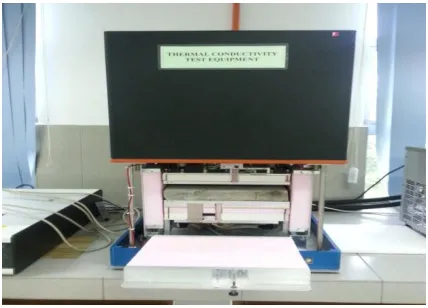
The UnithermTM Model 6000 Guarded Hot Plate
Thermal Conductivity Instrument is used for thermal performance testing of thermal insulations, according to ASTM C177 and ISO 8302, were as follows: The range of thermal conductivity serviced by this instrument is 0.02 to 2 W/mK. The guarded hot plate method is a steady state absolute method suit. It is designed to measure the thermal conductivity of 12” square (300 to 305 mm square) specimens up to 3” (76 mm) thick. Optimum specimen thickness is 1” – 2” (25-50mm). The large specimen size lends itself to testing non-homogeneous specimens and materials such as cellular plastics, fiberglass, and other low temperature thermal insulations.
The UnithermTM Model 6000 Guarded Hot Plate
Thermal Conductivity Instrument, shown in Figure 3.1 is a production of Anter Corporation, Pittsburgh, PA, USA. The instrument temperature range is dependent upon the configuration ordered.
[image:2.612.337.551.241.395.2]There are several different plate temperature ranges available covering the 170°C to 550°C plate temperature range. However, this instrument which ordered by Civil Engineering Faculty UiTM basically can only be used to measure one (1) segment for a sample with fixed temperature of 25°C. The measurement temperature is 25ºC, the duration of samples taken to complete the test is depends on the types of sample. For these specimens of size 300 mm x 300 mm x 50mm, the testing needs exactly 16 hours to get the thermal conductivity result.
Figure 1:Experimental Set-up of UnithermTM Model 6000
Guarded Hot Plate Thermal Conductivity Instrument
2.2 Materials
2.2.1. Cement
Ordinary Portland cement (OPC) obtained from widely used cement manufacturer was used as the main binder in this study.
2.2.1 Coarse Aggregate
Crushed coarse aggregate with a passing size of 20mm was used in all mixtures.
2.2.2. Fine Aggregate
Natural fine aggregate which is mining sand which obtained sieve analysis result all particles less than 1.18 mm in diameter. These qualified the sand to be classified as well graded fine aggregates.
2.1.3 Fine Aggregate
International Journal of Emerging Technology and Advanced Engineering
Website: www.ijetae.com (ISSN 2250-2459,ISO 9001:2008 Certified Journal, Volume 3, Issue 8, August 2013)
465 3.1.4 Water
Clean tap water was used throughout this study.
2.1.5 Lithium Nitrate
Lithium Nitrate (LiNO3) was used to avoid segregation
and to reduce the expansion due to alkali silica reaction. The percentage used in all mixtures was 5% by weight of
cement. LiNO3 is more efficient than other lithium
compounds.
2.3 Specimen preparation
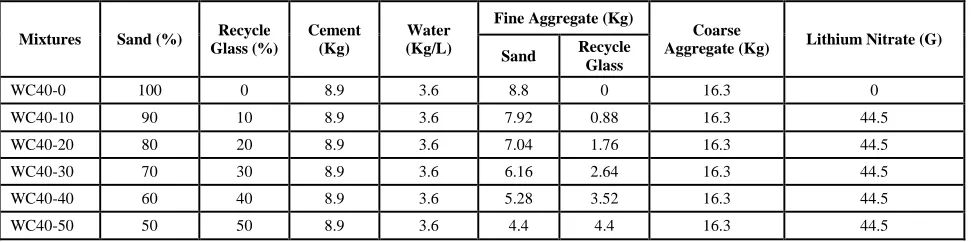
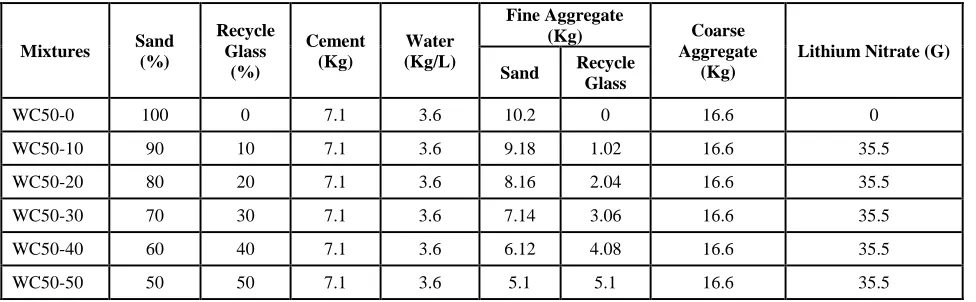
To study the effects of water cement ratio and percentage of glass on thermal properties, eighteen (18) different mixtures were designed as shown in Table 1 and Table 2. The control mix was designed to achieve a design strength of 30MPa. The cement, coarse aggregate, water/ binder ratio and the dosage of the lithium nitrate were kept constant for each water cement ratio of mixed which is 0.4, and 0.5 to show the effect of percentage of the recycled glass on the thermal conductivity of concrete.
In this study, the sand (fine aggregate) will be replaced by certain percentage of recycle crushed glass (fine aggregate). The percentage will be 10%, 20%, 30%, 40% to 50% of recycled glass aggregate and one sample is normal mixed concrete (100% of sand) which will be used as a control sample. The replacement is depending on the mix proportion of cement and sand. After adding all the
materials into the mixer, lithium nitrate (LiNo3) which have
been dissolved in the water were gradually added into the mix as admixture to reduce the ASR effect in the concrete. The concrete mixture will be casting into the mould and then compact it by using vibrating machine. Then, the specimen will keep dry for 24 hours before curing. The mould was removed from test specimens at the age of 1 day. All the specimens were placed in a water tank until the time of the test which is 28 days after casting.
The mixtures were named with both percentage of recycle glass and the water cement ratio.
For example, WC40-10 means that the concrete mixtures with 10% of recycle glass and 0.4 of the water/cement ratio.
The Guarded Hot Plate Thermal Conductivity analysis needs a total contact area of the probe for better results and accuracy. The surface of a concrete slab on both sides must be smoothed. The rough and uneven portion of the specimen can be adjusted by using a concrete grinder to even the surface of the concrete specimen. In this experimental the specimen which were test are in the wet condition.
Thermal conductivity of the concrete was also affected by the moisture change. So in ordered to have a consistency in testing a precaution method need to be taken. When the specimen ages 28 days, the specimen will be taken out from curing tank. This specimen will be dry by towel before left it one (1) hour in temperature room and after that loaded it in the furnace to be tested.
2.4 Test method
The amount of heat flow depends on the thermal conductivity and thickness of specimen, and on the magnitude of the temperature difference. Under thermal equilibrium conditions, i.e when all the temperatures are steady, the thermal conductivity of specimen can be determined from the Fourier linear heat flow equation.
λ = (W/A)*(d1/dT1) (Equation 1)
Where
λ = Thermal conductivity of the test specimen
W = Electric power input to the center heater A = Main heater surface area
d1 = Specimen 1 thickness
dT1 = Temperature gradient from hot
[image:3.612.65.553.587.708.2]plate to cold plate 1
Table 1
Concrete Mixture Designs with Water Cement Ratio 0.4
Mixtures Sand (%) Glass (%) Recycle Cement (Kg) (Kg/L) Water
Fine Aggregate (Kg)
Coarse
Aggregate (Kg) Lithium Nitrate (G) Sand Recycle
Glass
WC40-0 100 0 8.9 3.6 8.8 0 16.3 0
WC40-10 90 10 8.9 3.6 7.92 0.88 16.3 44.5
WC40-20 80 20 8.9 3.6 7.04 1.76 16.3 44.5
WC40-30 70 30 8.9 3.6 6.16 2.64 16.3 44.5
WC40-40 60 40 8.9 3.6 5.28 3.52 16.3 44.5
International Journal of Emerging Technology and Advanced Engineering
Website: www.ijetae.com (ISSN 2250-2459,ISO 9001:2008 Certified Journal, Volume 3, Issue 8, August 2013)
466
Table 2
Concrete Mixture Designs with Water Cement Ratio 0.5
Mixtures Sand (%)
Recycle Glass
(%)
Cement (Kg)
Water (Kg/L)
Fine Aggregate
(Kg) Coarse
Aggregate (Kg)
Lithium Nitrate (G) Sand Recycle
Glass
WC50-0 100 0 7.1 3.6 10.2 0 16.6 0
WC50-10 90 10 7.1 3.6 9.18 1.02 16.6 35.5
WC50-20 80 20 7.1 3.6 8.16 2.04 16.6 35.5
WC50-30 70 30 7.1 3.6 7.14 3.06 16.6 35.5
WC50-40 60 40 7.1 3.6 6.12 4.08 16.6 35.5
WC50-50 50 50 7.1 3.6 5.1 5.1 16.6 35.5
The power applied to the center heater (W) is measured from the DC power supply used to actuate the heater. Equation 2.1 assumes that the heat flow through the specimen is continuous and that all heat passes through the specimen from hot plate to cold plate in a straight line perpendicular to the specimen surface. Auxiliary guard heaters limit the heat exchange from sides of the specimen to the surrounding area, which would cause distortions in the linear flow pattern near in center only. This so-called metering area (A) is nominally 4” by 4” (100 mm by 100mm) section I the center of the 12” (300 mm) square specimen. Actual effective area varies somewhat due to the thermal behavior of the boundary channels. The effective area is usually determined using NIST certified standard reference material.
The actual ambient thickness is input through the software program. It is imperative that the thickness selected permit contact between the specimen and the plates. In models equipped with thickness transducers, the
thickness (d1) of the specimen under test is determined by
correcting with the displacement of the cold plate. The location of the cold plate, which can move up and down to accommodate different thickness specimens, is sensed with a linear motion potentiometer. The thickness transducer only compensates for the thickness change during a test.
The hot and cold plate temperatures are measured with platinum RTD’s located in the plate surfaces facing the specimen. When testing thermal insulations, the error introduced by not accounting for small temperature drop across the interface between specimen and adjacent surface plates is negligible. These temperatures are used to
determine dT1 for the specimen.
2.4. Test variables and mix proportions
[image:4.612.65.553.145.296.2]Thermal conductivity measurements were performed with particular reference to their dependence on some other interacted factors such as water–cement (W/C) ratio and percentage of recycle glass as a replacement of fine aggregate. To determine the thermal conductivity coefficient in concrete specimens a test for each parameter was selected as shown in Table 3.
Table 3 Test Parameters
Parameter Variables For
Test
Mixture Type
W/C ratio (%) 40, 30, 50 Concrete Moisture Condition Wet, Dry Concrete Percentage Of Recycle
Glass
0, 20, 30, 40, 50 Concrete
III. RESULT &DISCUSSION
International Journal of Emerging Technology and Advanced Engineering
Website: www.ijetae.com (ISSN 2250-2459,ISO 9001:2008 Certified Journal, Volume 3, Issue 8, August 2013)
467
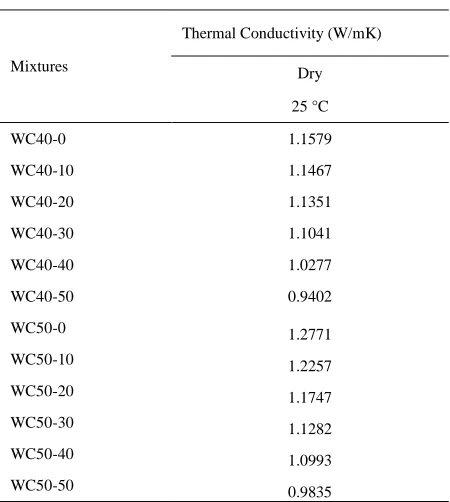
Test results in Table 4 and Figure 2 show that the
[image:5.612.328.560.290.438.2]coefficient of thermal conductivity of the cement is increased when the w/c increased. This showed that the thermal conductivity coefficient is easily influenced by the components of concrete. This result gave a different result compared with the result done before by other researchers [13,14] which using plain concrete. The research done before claimed that with the addition of the amount of cement for a lower W/C ratio the thermal conductivity of paste specimens increases since cement has a higher thermal conductivity value than water. But in reality other constituents of concrete specimen need to be considered too.
Table 4 Effects Of W/C
Mixtures
Thermal Conductivity (W/mK) Dry 25 °C
WC40-0 1.1579
WC40-10 1.1467
WC40-20 1.1351
WC40-30 1.1041
WC40-40 1.0277
WC40-50 0.9402
WC50-0 1.2771
WC50-10 1.2257
WC50-20 1.1747
WC50-30 1.1282
WC50-40 1.0993
WC50-50 0.9835
3.2. Dependence of thermal conductivity on moisture Condition
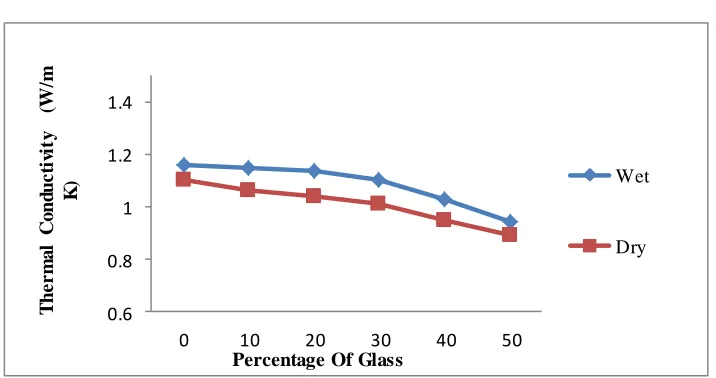
Among all the material parameters involved, moisture condition is known to be a key influencing factor. As shown in Table 5 and Figure 3, thermal conductivity increasing with the sample stated from wet to dry.
The status of concrete specimen changes from dried to saturated thermal conductivity is dramatically increasing [13]. Other research done before the thermal conductivity of the screeds is increased significantly by the presence of moisture [14]. This is attributed to changes in air voids filled with water, whose thermal conductivity is superior compare to air.
[image:5.612.56.281.294.545.2]The thermal conductivity of concrete increases with increasing moisture content and since water has a conductivity about 25 times that of air, when the air in the pores has been partially displaced by water or moisture, the concrete must have greater conductivity [15].
Table 5
Effects Of Moisture Condition
Mixtures
Thermal Conductivity (W/mK)
Wet Dry
25 °C
WC40-0 1.1579 1.1018
WC40-10 1.1467 1.0638
WC40-20 1.1351 1.0421
WC40-30 1.1041 1.0130
WC40-40 1.0277 0.9501
WC40-50 0.9402 0.8924
3.3 Dependence of thermal conductivity on percentage of
glass as a fine replacement
International Journal of Emerging Technology and Advanced Engineering
Website: www.ijetae.com (ISSN 2250-2459,ISO 9001:2008 Certified Journal, Volume 3, Issue 8, August 2013)
468
0.6 0.8 1 1.2 1.4
0 10 20 30 40 50
T
h
e
r
m
a
l
C
o
n
d
u
c
ti
vi
ty
(
W
/m
K
)
Percentage Of Glass
W/C 40
[image:6.612.138.493.123.311.2]W/C 50
Figure 2: Thermal conductivity of different water cement ratio
0.6 0.8 1 1.2 1.4
0 10 20 30 40 50
T
h
e
r
m
a
l
C
o
n
d
u
c
ti
vi
ty
(
W/
m
K)
Percentage Of Glass
Wet
Dry
Figure 3: Thermal conductivity of different moisture condition
IV. MICROSTRUCTURAL EXMINATION OF CONCRETE
CORES
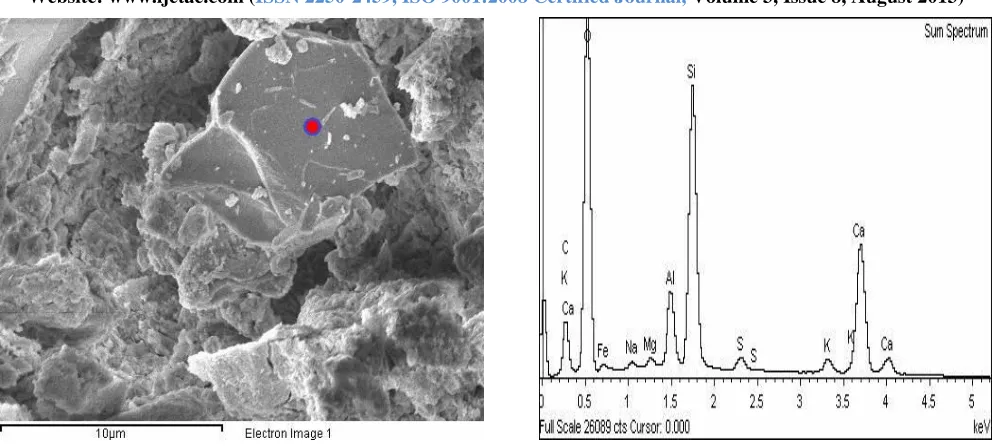
Scanning electron microscopy (SEM) and energy-dispersive X-ray (EDX) analysis were used to examine the nature of the hydrated binder and the binder-aggregate interfacial zones. The locations of the EDX analyses are marked on each SEM image. Note that the peak height in the EDX spectra is proportional to the amount of element present. A brief summary of SEM/EDX analysis is given below.
Figure 3 shows the typical composition of the hydrated
[image:6.612.128.486.333.522.2]International Journal of Emerging Technology and Advanced Engineering
Website: www.ijetae.com (ISSN 2250-2459,ISO 9001:2008 Certified Journal, Volume 3, Issue 8, August 2013)
[image:7.612.54.561.120.327.2]469
Figure 3 : SEM view of cement paste near a glass particle in Mix WC40-0 ( (reference), and its EDX spectrum.
[image:7.612.52.562.347.532.2]
International Journal of Emerging Technology and Advanced Engineering
Website: www.ijetae.com (ISSN 2250-2459,ISO 9001:2008 Certified Journal, Volume 3, Issue 8, August 2013)
[image:8.612.58.556.113.336.2]470
Figure 5. SEM view and EDX composition of paste near a reacted glass particle in Mix Mix WC40-30
The composition of the paste in Mix WC40-10, which contained 10% crushed recycle glass was found to have
been enriched with silica, as expected (Figure 4). While
composition showed in Figure 5 above showed that of unreacted or partially reacted glass [17]. The composition of the paste in Mix WC40-30 (30% crushed recycle glass) also showed enrichment in silica. This maybe one of the reason why the thermal conductivity coefficient reduce when the crushed recycle glass added. When the particle of glass embedded in the concrete paste it can be seen that there are spaces between the glass and concrete paste which will be obstacle for the heat to transfer smoothly.
V. SUMMARY AND CONCLUSION
An experimental study was conducted to determine the influencing factors on the thermal conductivity of concrete when the crush recycle replace the fine aggregate using
UnithermTM Model 6000 Guarded Hot Plate Thermal
Conductivity Instrument which the principle of steady stated is adopted. The following conclusions may be made based upon the systematic investigation of the thermal properties of the different concrete samples tested:
1) Thermal conductivity are revealed affecting by water cement ratio of concrete. According to test result with the increasing of water cement ratio the thermal conductivity will increased because of there are increasing in aggregate content which is influencing the thermal conductivity as whole specimen.
2) The thermal conductivity of the screeds is increased significantly by the presence of moisture.
3) The thermal conductivity increased with the increasing in percentage of crushed recycle glass.
4) Crushed recycle glass has a good and excellent potential in construction industry not only in reducing energy costs and effects of global warming by recycle the glass but to provide good insulation in concrete especially for use in tropical country.
REFERENCES
[1 ] Ng SC, Low KS (2010),Thermal Conductivity of Newspaper Sandwiched Aerated Lightweight Concrete Panel, Energy and Buildings 42 (2010) 2452–2456.
[2 ] Mahlia TMI, Taufiq BN, Ismail HH, Masjuki (2008), Correlation Between Thermal Conductivity and The Thickness of Selected Insulation Materials For Building Wall, Energy and Buildings 39 (2) (2008) 182–187.
[3 ] Poutos KH, Alani AM, Walden PJ, Sangha CM (2008), Relative Temperature Changes Within Concrete Made With Recycled Glass Aggregate, Construction Building Material 2008:22:557–65. [4 ] Taha B, And Nounu G (2007), Properties of concrete contains mixed
colour waste recycled glass as sand and cement replacement, Construction and Building Materials 22 (2008) 713–720
[5 ] Taha B, And Nounu G (2009), Utilizing Waste Recycled Glass as Sand/Cement Replacement in Concrete,Journal Of Material In Civil Engineering 2009.21:709-721
[6 ] Dhir RK, Dyer TD and Tang MC (2003), Expansion Due ToAlkali-Silica Reaction ASR Of Glass Cullet Used In Concrete, ProcIntSymp On Recycling And Reuse Of Waste Materials, Dundee University,U.K., 751–761.
[7 ] Taha B, And Nounu G (2007), Using Lithium Nitrate and Pozzolanic Glass Powder in Concrete as ASR Suppressors, Cement & Concrete Composites 30 (2008) 497–505
International Journal of Emerging Technology and Advanced Engineering
Website: www.ijetae.com (ISSN 2250-2459,ISO 9001:2008 Certified Journal, Volume 3, Issue 8, August 2013)
471
[9 ] Xu Y, Chung DDL. (1999), Effect of Sand Addition on The Specific Heat And Thermal Conductivity of Cement, Cement and Concrete Research 30 (2000) 59–61
[10 ]Al-Jabri K.S , Hago A.W , Al-Nuaimi A.S, Al-SaidyA.H (2004), Concrete Blocks For Thermal Insulation In Hot Climate, Cement and Concrete Research 35 (2005) 1472– 1479.
[11 ]Xu Y, Chung DDL. (1999), Effect of Sand Addition on The Specific Heat And Thermal Conductivity of Cement, Cement and Concrete Research 30 (2000) 59–61
[12 ]Khan M.I(2001), Factors Affecting The Thermal Properties Of Concrete And Applicability Of Its Prediction Models, Building and Environment 37 (2002) 607 – 614.
[13 ]Kim KH, Jeon SE, Kim JK, Yang S (2002), An Experimental Study On Thermal Conductivity Of Concrete, Cement and Concrete Research 33 (2003) 363–371.
[14 ]Alani A, MacMullen J, Telik O, Zhang Z. (2011), Investigation into the thermal performance of recycled glass screed for construction purposes, Construction and Building Materials 29 (2012) 527–532 [15 ]Demirboga R (2002), Influence Of Mineral Admixtures On Thermal
Conductivity And Compressive Strength Of Mortar, Energy and Buildings 35 (2003) 189–192.
[16 ]Shin AHC, Kodide U (2011), Thermal Conductivity of Ternary Mixtures ForConcrete Pavements, Cement & Concrete Composites 34 (2012) 575–582.