BIROn - Birkbeck Institutional Research Online
Hudson, M. and Konzelmann, Suzanne J. and Wilkinson, F. (2002) Partnership in practice. Working Paper. ESRC Centre for Business Research, Cambridge, UK.
Downloaded from:
Usage Guidelines:
Please refer to usage guidelines at or alternatively
PARTNERSHIP IN PRACTICE
ESRC Centre for Business Research, University of Cambridge Working Paper No. 239
By
Maria Hudson, Suzanne Konzelmann and Frank Wilkinson* ESRC Centre for Business Research
Judge Institute of Management Building University of Cambridge
Trumpington Street Cambridge, CB2 1AG, UK
Tel: +44 (0) 1223 765325 Fax: +44 (0) 1223 765338 Email: [email protected]
June 2002
* Maria Hudson is a Research Fellow at the Policy Studies Institute, London and a PhD researcher in the Faculty of Economics and Political Science at the University of Cambridge. Sue Konzelmann is a Senior Research Fellow in the ESRC Centre for Business Research at the University of Cambridge and Associate Professor of Economics at Indiana University South Bend. Frank Wilkinson is a Reader in Applied Economics at the University of Cambridge.
Abstract
This paper examines human resource management practices adopted in a group of eight case study firms and their tendencies towards versus away from partnership. The analysis is based on data collected during interviews with 124 employees (75 in organisations tending towards partnership and 49 in organisations tending away from partnership) and senior managers, conducted in 1997-1998 for the Job Insecurity and Work Intensification Survey (JIWIS). Drawing on the perspectives of senior managers and employees, we examine the tendency of firms towards and away from partnership in employment relations; and in keeping with the JIWIS methodology (Burchell et.al., 2001) we combine quantitative and qualitative evidence in our analysis. Specifically, we are interested in what partnership looks like in these different contexts, the reasons it is pursued (or not), the degree to which companies have been successful in achieving their partnership objectives (from the perspective of both management and employees), and the conditions that have either facilitated or impeded partnership in relationships with employees.
JEL Codes: G34, J53, L23, M12
Keywords: industrial partnership, corporate governance, cooperation
Acknowledgements
The work for the present paper was supported by the ESRC core grant to the Centre for Business Research and forms part of a wider study assessing job insecurity and work intensification funded by the Joseph Rowntree Foundation (Burchell, Ladipo and Wilkinson 2001; Deakin, Hobbs, Konzelmann and Wilkinson 2002). An early draft of this paper was presented at the Cambridge University/MIT Workshop on Corporate Governance and Human Resources, 12 November 2001.
Partnership in Practice
1. Introduction
Throughout the 1990s, in the face of privatisation, concentration and globalisation, British organisations in both the private and public sectors have experienced rapid technological change and intensifying competition. Customers have learned to exercise their ‘choice’ more aggressively and shareholders (both private and public) have become increasingly impatient for a quick and profitable return on their investments. In response to these pressures, firms have been forced to re-examine their organisational systems and structures in an effort to improve performance as well as their ability to respond effectively to these mounting pressures from competitors, customers and shareholders. In this context, systems of work organisation have been an important focus and the notion of ‘partnership’ has figured prominently in the debate.
Cooperation and conflict in production relations
There is no question about the advantage of co-operation or ‘partnership’ in production. It allows for the full exploitation of the technical complementarities inherent to production and facilitates the sharing of knowledge necessary for the effectiveness of productive systems and their improvement.1 It also fuels the organisational learning processes by which new information and knowledge are created, incorporated and diffused, and by which new products, processes and organisational forms are developed (O’Sullivan 1998; Lazonick 1991). The resulting operational and dynamic efficiencies are crucial determinants of the ability of organisations to compete effectively, and to respond flexibly to changing circumstances and new opportunities. These efficiencies are also important because they generate the value added by the productive system, which forms the basis for the income and employment security of its various stakeholder groups.
them may be in production, there is an inevitable competition over the distribution of proceeds from that co-operation among the various stakeholder groups because what one group receives, the others cannot have. This competition extends beyond the workplace to include pressures from other claimants: for example, the pressure exerted on companies to regularly report increases in earnings to the stock market; the pressure of customers on suppliers to keep prices down and of suppliers on customers to keep them up, the pressure from consumer groups on public services regulators to cut prices; or, for that matter, the political pressure exerted on behalf of taxpayers, determining the money available to pay for the public sector services taxpayers demand. These hagglings, with their potentially negative-sum consequences for employees, shape the environment within which decisions are made regarding whether or not to co-operate or to form partnerships in employment relations.
These pressures from other claimants are justified by liberal economics on the grounds of the superiority of individual choice in free markets for maximising economic welfare. The pivotal role assigned to market forces for the effective co-ordination of production and consumption has been handed down from Adam Smith to modern neo-classical economists. Markets based on the freedom of contract provide information and price incentives, ensure contractual compliance (by providing opportunities for buyers and sellers to readily switch trading partners from among a large number of equally well-qualified alternatives) and determine distribution.
To ensure markets work effectively, regulation is needed to prevent collective and individual monopolies from operating in
restraint of trade. In particular, such collectives as trade unions,
are ruled as being fundamentally against the public interest and therefore in need of close regulation.
Liberal economics is, however, more ambiguous about the effect of dominant firms and their power to monopolise and reduce economic welfare. Nevertheless, the market offers opportunities for more efficient forms of organisation to succeed; and this may result in, or even require, a degree of market control. Large businesses evolve, it has been argued, because of their superior managerial and production organisation which gives them market advantage (Chandler 1978) or because of their ability to discover new profit opportunities in a world of uncertainty (Kirzner 1997). To a certain degree, monopoly is also seen as encouraging technical change by allowing the innovator to secure sufficient profits to encourage investment in new products and processes (Schumpeter 1943). Managerial command provides another alternative to the market when contracts are difficult and costly to enforce (Williamson, 1987). The right of corporations to expand through acquisition of others by means of hostile takeovers is justified on the grounds that the stock market operates as an efficient market for managerial control; it is assumed to provide share holders the opportunity to discipline inefficient or malfeasant managers by selling their shares to others promising a higher rate of return. In each of these cases, market competition is seen as a creative process by which efficient forms of organisation are promoted and inefficient forms are superseded. From this perspective, large size may be the reward of success; however large firms can only survive if they generate the operational and dynamic efficiencies necessary for keeping on their feet in the face of the market driven “gale of creative destruction” (Schumpeter 1943).
therefore accepted as necessary to counter such negative
externalities2 and to contain the destructive capabilities of
competition. But, caution economists, the urge to regulate must be tempered by the recognition that in the final analysis the market provides the best opportunities and outcomes for both individuals and society. Whilst the market concentrates economic power, it also yields important benefits in the form of technical progress and economic growth. What is good for big business is assumed to also be good for society, and although their excesses require checking, it would check progress to unduly restrict their market opportunities.
The central message of liberal economics is that of the superiority of the market for stimulating, co-ordinating and regulating production in the general interest. In his book, The Fatal Conceit:
The Errors of Socialism, Hayek argued that individualisation and
the ordering principle of the market, the hallmark of capitalism, evolved to supersede direct co-operation within groups, which he identified as an instinctual primitive trait (1988, Chapter 1). But what Hayek failed to evolve (a weakness shares with other liberal economists) was a theory of production and especially one of work organisation. This was left to management theorists.
Theories of work organisation
much the same way that the laws of the market do outside the firm.
The failure of scientific management to fully deliver improved performance and to resolve management worker conflict led to a greater interest in management practice that would enhance the physical and psychological well-being of the workforce. In the development of the human relations approach, psychological and sociological theories were used to challenge the idea of economic man and to replace it with that of social man. Initially, the aim of human relations was to identify the physiological and social needs of workers. This knowledge would then be used to modify existing selection, training and work design processes as well as to make hierarchical management more compatible with the socio-psychological needs of workers. This essentially remedial role for human relations was later overtaken by research which showed that it had a more proactive role to play. What was discovered was that there are increasing returns to greater worker involvement in the planning and execution of work, as well as to work group activities, worker self regulation, closer involvement with management and a more democratic style of management.
It is important to note the opposing tendencies of liberal economic and labour management theory. Whereas the former lent theoretical justification to the concentration of control over production, the latter provided theoretical support for the decentralisation of responsibility for production. However, the two schools agree that trade unions and collective bargaining are unnecessary. Liberal economics retains its faith in the market as the arbiter for distributional shares whilst in labour management theory, the threat of conflict inherent in distributional bargaining poses a threat to the co-operation needed for production.
Although they recognise the sociological and psychological needs of workers, and the importance of worker self-regulation and involvement in management as mechanisms for securing full-co-operation, the proponents of human resource management and its pre-cursors have been no more sympathetic to workers’ independent representation than liberal economists or the scientific management school. The early case for human relations was that the diagnosis and effective treatment of socio-psychological problems would improve the well-being of group members, the cohesiveness of the group and therefore its productive performance. From this standpoint, conflict was considered dysfunctional. Elton Mayo, of Hawthorne fame, believed that:
Social scientists have also argued that wage demands mask ‘more real and human needs for appreciation, understanding and friendliness;’ and they have gone further by identifying the need to join trade unions as a symptom of low intellect and psychological disorders (Baritz 1975, p332).
Co-operation and competitiveness: From hierarchical management to industrial partnership
The major challenge to traditional forms of work organisation in Britain came not from internal reforms, but rather, from the demonstrated competitive superiority of more co-operative forms of industrial organisation, largely by foreign producers. This new
competition is broadly based on higher quality, improved design,
greater variety more rapid product and process innovation and lower costs (Best 1990). It was launched by Japanese, German, Italian, Swedish and other producers who had evolved co-operative employment relations and relational contracting arrangements with their suppliers and customers.3 The effect was the generation of high levels of operational and dynamic efficiency, largely as a consequence of mobilising and improving worker and supplier commitment, skills and knowledge. High levels of competitive performance rest on the recognition of the mutuality of interests and the ability to maximise these by building high-trust, partnership relationships.4 Such co-operative arrangements are supported by the state, trade associations, trade unions, and other organisations and institutions which intervene by setting norms, rules and standards for regulating market and other relations between the social partners.
companies have been re-assessing their HRM strategies and turning to more co-operative forms of work organisation.
Following this trend, the ‘New’ Labour Government, elected in 1997, endorsed labour-management co-operation and ‘partnership’ as an effective approach for improving economic performance. In interpreting the Government’s position, Wood (2000) identified the requirements of the new system as:
‘one of partnership at work … associated with the kind of model of HRM … focused on the achievement of a particular role orientation on the part of employees so that they are flexible, expansive in their perceptions and willing contributors to innovation.’ (Wood 2000, p. 130).
He went on to suggest that
‘Partnership is a matter of employers having the right to ask employees to develop themselves in order to accept fresh responsibilities whilst they themselves must take responsibility for providing the context in which this can happen’
In this formulation of partnership, the strong emphasis is on the need for workers to make largely unconditional commitments to their employer’s business interests and objectives, and to mould themselves to its needs. In this way, workers provide additional and improved resources for the firm’s managers to manage more effectively.
strategy for instance for doubling business. Or bringing employee relations in line with market re-positioning. Or ending the often-meaningless ritual of annual wage squabbling.’ It should be carefully noted that Blair made no reference to the ritual of the continuous squabble over the distribution of dividends between managers or shareholders or to the constant insistence on better terms for consumers which the Government orchestrates. Rather, what Blair clearly had in mind was the need for workers to bow to the needs of business by meeting both its production and distributional requirements.
As might be expected, the Trade Union Congress (TUC), although committed to New Labour and to industrial partnership, took a less bipartisan view of workers’ position with respect to co-operative work systems. In its May 1999 Partners for Progress – New
Unionism at the Workplace, 6 the TUC advocated enterprise-level
industrial partnership and identified six underlying principles. Four of these emphasised the importance of the commitment by both sides of industry to co-operation as a means of improving business performance:
1. a shared commitment to the success of the organisation;
2. a renewed focus on the quality of working life, giving
workers access to opportunities to improve their skills, focusing attention on improving job content and enriching the quality of work;
3. openness and a willingness to share information;
4. adding value – unions, workers and employers must see that
partnership is delivering measurable improvements;
Two of the principles implied that such a commitment by workers was not to be thought of as unconditional:
5. a recognition by both the union and employer that they each
have different and legitimate interests.’
6. a commitment by the employer to employment security in
2. On the Road to Partnership?
In this section and the next, we examine more closely the human resource management practices adopted by our case study firms and their tendencies towards versus away from partnership. This analysis is based on data collected during interviews with 124 employees (75 in organisations tending towards partnership and 49 in organisations tending away7 from partnership) and senior managers, conducted in 1997-1998 for the Job Insecurity and Work Intensification Survey (JIWIS). Drawing on the perspectives of senior managers and employees, we examine the tendency of firms towards and away from partnership in employment relations; and in keeping with the JIWIS methodology (Burchell et.al., 2001) we combine quantitative and qualitative evidence in our analysis. Specifically, we are interested in what partnership looks like in these different contexts, the reasons it is pursued (or not), the degree to which companies have been successful in achieving their partnership objectives (from the perspective of both management and employees), and the conditions that have either facilitated or impeded partnership in relationships with employees.
Table 1a: Organisations Participating in the Study
Company Description Companies Tending Towards Partnership
RegColl
A medium sized, independent corporation providing educational services to the further education sector. RegColl receives a substantial proportion of its finances from a government funding agency.
CementCo A large independent manufacturing company in the building materials sector. CementCo’s shares are quoted on the stock market.
DrinksCo A large manufacturing company in the food and drinks sector which is owned by a British corporation. DrinksCo is quoted on the stock market.
InsureCo A large financial services company owned by a British corporation. InsureCo’s shares are quoted on the stock market.
Companies Tending Away From Partnership
FEColl
A medium sized, independent corporation providing educational services to the further education sector. FEColl receives a substantial proportion of its funding from a government funding agency
CableCo
A large manufacturer of components for the telecommunications and IT markets which is owned by a British corporation. CableCo’s shares are quoted on the stock market.
DairyCo A large, independent food manufacturer. DairyCo’s shares are traded on the stock market.
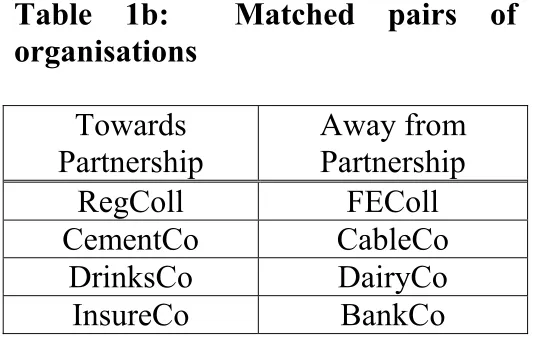
Table 1b: Matched pairs of organisations
Towards
Partnership Away from Partnership
RegColl FEColl CementCo CableCo
DrinksCo DairyCo InsureCo BankCo
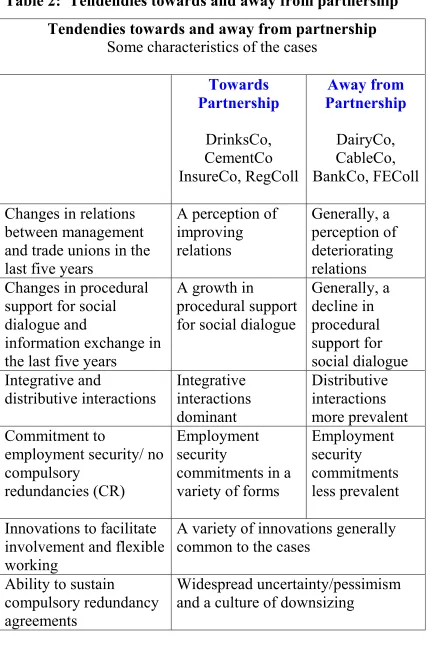
Table 2: Tendendies towards and away from partnership Tendendies towards and away from partnership
Some characteristics of the cases
Towards Partnership DrinksCo, CementCo InsureCo, RegColl Away from Partnership DairyCo, CableCo, BankCo, FEColl
Changes in relations between management and trade unions in the last five years
A perception of improving relations Generally, a perception of deteriorating relations Changes in procedural
support for social dialogue and
information exchange in the last five years
A growth in
procedural support for social dialogue
Generally, a decline in procedural support for social dialogue Integrative and distributive interactions Integrative interactions dominant Distributive interactions more prevalent Commitment to
employment security/ no compulsory
redundancies (CR)
Employment security
commitments in a variety of forms
Employment security
commitments less prevalent
Innovations to facilitate involvement and flexible working
A variety of innovations generally common to the cases
Ability to sustain
compulsory redundancy agreements
We start by examining the pressures to which firms have been subject and their responses to those pressures. We then examine the nature of partnership and non-partnership tendencies in our eight case study firms. Finally, we compare partnership with non-partnership organisations in terms of their human resource practices and employee outcomes.
Pressures from competitors, customers and shareholders
Irrespective of whether they were tending towards or away from partnership, all of the organisations in our survey reported intensifying competition in their product markets, translating into considerable price pressure. In virtually every case, senior managers told us that the market and/or what customers were prepared to pay were important in determining their prices. Organisations least likely to emphasise the importance of the market in determining prices generally had their prices regulated by external agents. But as demonstrated by the experience of RegColl and FEColl, the two organisations providing educational services, external price regulation was no protection from the competitive forces operating in the non-regulated industries. Both colleges stressed that failure to meet targets set by government funding agencies (based on 'units of activity' i.e. students on courses) would inevitably result in funding cuts.
In every case, price pressure meant that maintaining profit margins depended on containing costs, particularly those costs over which firms had most direct control (i.e., labour costs). Thus, instead of practicing ‘cost plus pricing’, organisations practiced ‘price minus
costing’; and in the six cases where shares were quoted on the
stock market, pressure to deliver share holder value placed additional constraints on costs.
In addition to pressures stemming from shareholders and
this context, the need for organisational responsiveness was particularly apparent as customers increasingly demanded 'just-in-time' delivery of goods and services. Further, when it came to scheduling production, senior managers told us that pressure to meet the immediate requirements of customers meant that putting the customer 'on hold' (via waiting lists or variations in delivery times) was not an option.
In addition to customer impatience, organisations were forced to contend with considerable variation in customer demands. Our evidence suggested the pervasiveness of economic uncertainty, the uncertainty due to product demand changes and technical change. Only two organisations, both manufacturers (CementCo and DairyCo), reported slight (and predictable) variations in the demand for their products or services. Three organisations, RegColl, InsureCo and BankCo reported that variations in demand were moderate and unpredictable. DrinksCo deviated slightly from its matched pair DairyCo in telling us that variations in the demand for their products or services were substantial but predictable; the remaining two (FEColl and CableCo) deviated slightly from their sectoral counterparts indicating that they faced demand variations that were both substantial and unpredictable.
Changing relations with customers and suppliers in response to increased pressures
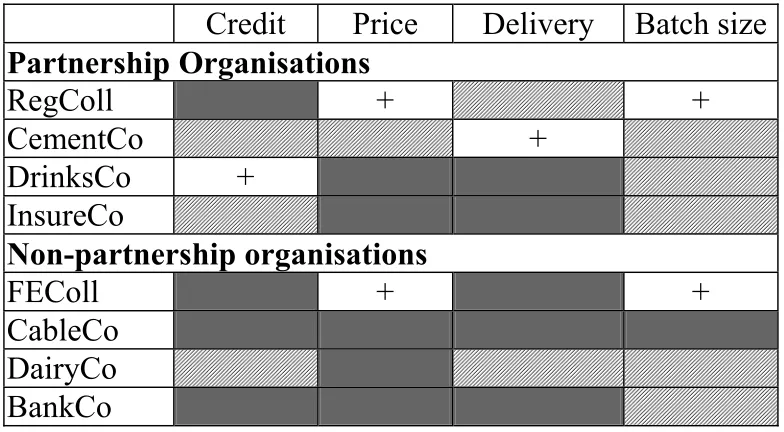
[image:19.595.113.505.475.691.2]As noted earlier, all the senior managers in every organisation in our study told us that competition for their products and/or services had intensified over the past five years. The substantial increased pressure coming from customers that they reported in describing these changes is shown in Table 3. Dark cells indicate that customers were exercising greater control: by securing additional credit (e.g. taking longer to pay), exercising more control over prices, or insisting on more frequent delivery and smaller batch sizes. Diagonal shading indicates no change in the relationship while plus signs indicate that changes have been favourable to the organisation. It is clear from Table 3 that overall, the partnership firms were coming under less increased pressure from customers than the non-partnership firms. Taking a closer look at the matched pairs, the most pronounced differences occurs between CementCo and CableCo, the latter experiencing increased pressure on all sides.
Table 3. Change in Customers Relations and budget constraints
Credit Price Delivery Batch size
Partnership Organisations
RegColl + +
CementCo +
DrinksCo + InsureCo
Non-partnership organisations
FEColl + +
CableCo DairyCo BankCo
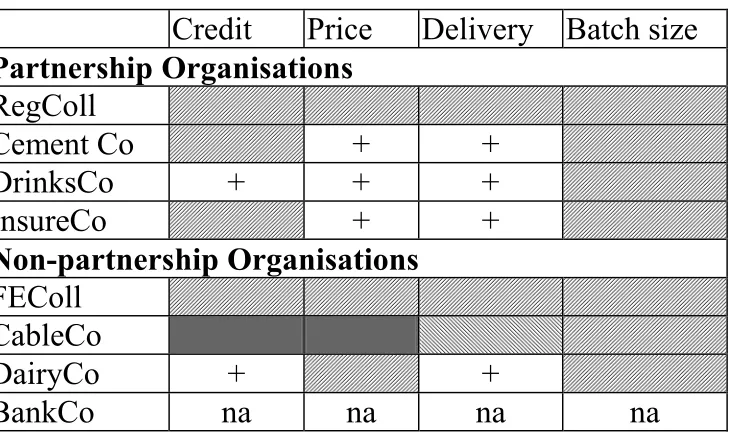
evident in Table 4, where plus signs indicate a greater degree of control over suppliers, dark cells indicate less control and diagonal shading suggests that there has been no change. The evidence in Table 4 suggests that overall, the partnership firms were more successful at passing on pressure to their suppliers than were the non-partnership organisations. Again the most pronounced matched pairs difference occurs between CementCo and CableCo, the latter experiencing an erosion of control over its suppliers. DrinksCo also found itself more able to pass on pressure to suppliers than DairyCo via its enhanced control over prices.
Table 4. Change in Relations with Suppliers
Credit Price Delivery Batch size
Partnership Organisations
RegColl
Cement Co + +
DrinksCo + + +
InsureCo + +
Non-partnership Organisations
FEColl CableCo
DairyCo + +
BankCo na na na na
techniques that relied on adjusting the number of workers to match fluctuations in demand, were also eschewed by the organisations in our survey. For the majority of firms (87.5 percent and 75 percent respectively) neither labour hoarding nor dishoarding played an important part in their production schedules. Instead, the burden of adjusting production to demand tended to be borne by their core employees, an imposition that fell on both partnership and non-partnership organisations alike.
Partnership versus non-partnership tendencies
In the four cases in our study identified as tending towards partnership, we found that partnership could be characterised as ‘pro-active’ (where the objective of partnership was to facilitate delivery of a high quality/value product or service to consumers, or to jointly find a way forward in the face of market or regulatory opportunities or challenges) or ‘reactive’ (where the objective of partnership was more likely to be the management of redundancies or plant closures). Close up, partnership in practice was somewhat more complex than this and we found that the spectrum of partnership orientation involved a considerable area of grey (figure 1).
pro-active partial pseudo reactive
InsureCo RegColl CementCo
DrinksCo BankCo
FEColl
[image:21.595.88.535.485.652.2]CableCo DairyCo Figure 1: a spectrum of partnership orientations
pervasive feature of the vignettes of partnership orientation in our cases, to which we now turn.
Table 5: Summary of redundancy exercises in the JIWIS Survey Partnership and Non partnership organisations
Organisation (% fall in workforce in last 5 years)
“Redundancy” exercises in the last five years
Job categories affected
Proportion of “redundancies”
by form
VR CR VER CementCo
(21percent)
Partnership
1994 All 25 % 75 % x
CableCo (45 %)
Non partnership
1996, 1998 All 15 % 85 % x
DrinksCo (30 %)
Partnership
1993/4, 1994-7 All 86 % 14 % x
DairyCo
Non partnership 1995
Manual workers on shop floor in
bottling plant 100 %* x x InsureCo
(10 %)
Partnership YES
Managerial grades and clerical staff in
branch network 100 %* x x BankCo (17 %) Non partnership 1993,1994,1995 1996,1997 Managerial, Clerical staff in branch network
70 % 30 % x
RegColl
Partnership
1996/97 Part/full-time lecturers, senior/middle managers, Technicians and
caretakers
15 % 85 % Most
FEColl
Non partnership 1996/97 Part-time lecturers x 100 % x
VR - voluntary redundancy; CR - compulsory redundancy; VER - voluntary early retirement;
*staff offered relocation to job in another part of the organisation/country.
Proactive partnership tendancies: CementCo and DrinksCo
CementCo and DrinksCo came closest to approximating what might be described as ‘proactive’ partnership. And as we will see shortly, this was very much in contrast to their matched pairs. Both companies described themselves as ‘partnership’ organisations; and these descriptions were imbued with the language of aspiring to develop ‘positive’ and ‘constructive’ employment relationships, requiring ‘goodwill’ and ‘high trust’ to effect organisational change, a healthy psychological contract. Both companies had experienced movement in the direction of ‘greater’ social partnership during the last five years and both had made substantial efforts to formalise the parameters of that partnership. Their approaches resonate with the TUC’s six underlying principles of enterprise level partnership, including worker commitments that were, ostensibly, conditional.
At both CementCo and DrinksCo, a great deal of emphasis was placed on delivering a high quality service to customers and benchmarking their performance against world-class manufacturers. Their competitive strategy involved working co-operatively with recognised trade unions and employees, and cultivating integrative interactions, rather than distributive bargaining. Innovation was not considered to be a management prerogative in the sense that both CementCo and DrinksCo actively endeavored to develop a culture of continuous improvement through involvement and collectivisation of effort. Employment security was seen as fundamental to achieving this change in culture and to enhance performance standards. Employment security agreements in both companies might more appropriately be described as partnership agreements. The focus on a healthy psychological contract is fundamental to partnership because of its importance in helping to secure co-operation at work and reducing the (social) uncertainty that can arise because of the separation of labour power and labour.
DrinksCo’s partnership agreement. In 1994 DrinksCo signed a
and TGWU covering manual workers and the agreement was subsequently extended to 1999. The key features of the agreement were employment security, training and flexibility. Under the 1994 pay and benefits agreement there was a demand for flexibility in skills and attitudes. And there was related investment in multi-skilling on the shop floor with staff undertaking quality checks/problem-solving and moves towards self-managing work teams. In exchange for co-operation in a ‘long-term’ pay deal, moderating increases, it was emphasised that flexibility might mean jobs being cut, and if they were, voluntary redundancies would be sought and others would be re-deployed. The agreement stressed that
‘Employment commitment will provide the security in which to suggest and initiate changes and improvements without being concerned about ending up on the dole queue’.
In other words employment security assurances were seen as a key to facilitating a high-trust work environment and ‘integrative interactions’, providing a context in which workers would willingly accept additional responsibilities. Indeed, management emphasised that trust and employee fulfillment were the single most important motivational factors and that while fear of redundancy might enhance performance in the short term, in the longer term performance would decline. The commitment was to core workers. The practice of temporary workers becoming permanent workers after twelve months’ service was ended to increase redeployment opportunities for established employees.
traditional exclusive focus upon pay was reported. And an employee development programme for shop stewards and line managers was introduced. Joint training was also developed for these groups, who were seen as key lubricants in organisational change. In addition there was investment in employee representative training. A wider employee development programme included a focus on core communications skills and assertiveness training.
It has been noted that employers grant trade unions recognition as a means of establishing a procedural structure within which a power relationship can be mediated. Consultation promoting dialogue and information exchange can positively influence that relationship enhancing the conditions for goodwill (Brown et.al. 2001). DrinksCo provides an example of an experiment in using targeted training, encouraging ‘in this togetherness’, to influence the interaction of union and management leadership in consultation and negotiation. Clearly some careful thought was given to the internal conditions for partnership. By early 1997, the union side was vigorously promoting the benefits of positive partnership (See Box 1).
Box 1: GMB statement of the Benefits of positive partnership
· Increased efficiency across the business · Reduced overtime
· Shorter lead times · New product capability
· Increased employee motivation
· Greater accountability and responsibility · Beaten budgets in four consecutive years · A new culture based on mutual trust & respect
· A consensus based approach to the management of change
CementCo’s partnership agreement. In 1997 CementCo signed
(TGWU) and (b) all other staff (GMB, TGWU, AEEU). This step was seen as building on previous initiatives that had a focus on eroding job demarcations and developing total quality. The agreements were largely modelled on those of DrinksCo, both management and unions having visited DrinksCo the year before. Again there was a preoccupation with the internal conditions for partnership. Terms of the agreement were summarised in a note from the union side (See Box 2).
Box 2: The basis of the Way Ahead Agreement at CementCo
Company Benefits
· Employee involvement to minimise cost · Flexible working
· New technology to be brought in
· Distribution fleet to be reviewed annually · Modest pay increases
Employee Benefits
· All staff to be salaried – end to clocking on · NVQ based training programme
· 3.5percent pay increase plus £200 for drivers and pay freeze following year
· Pay review body for drivers in 1999 · Drivers working week cut by one hour
· No contracting out of drivers work for next five years
· Process production staff to revive RPI plus 0.25percent for three years · No compulsory redundancies for production staff
agreement signalled that employment security assurances could potentially become open ended if there was subsequent willingness ‘to settle pay in the interests of job security’.
Like at DrinksCo, there were concerted efforts to depart from traditional patterns of hierarchy. Training was considered to be an investment with the promise of a large-scale properly funded training programme supporting the multi-skilling of all staff; business improvement teams; and self directed team working. All this was in support of a process of developing a culture of continuous improvement. ‘You’ve got to coach not dictate and recognise why a host of ideas have gone untapped’.
Senior management stressed that a union was needed in a competitive environment in order to have ‘a coherent team’.
‘The workforce need a voice from somewhere. If there’s no union organisation there is no point of reference that you can refer to’.
Underpinning this was a commitment to social dialogue. Changes in procedural structure included the introduction of Local Action Teams that ‘could talk about everything except cement prices, acquisitions and general stock market related issues’. As in DrinksCo, targeted training to influence the interaction of union and management leadership had been introduced but was at an earlier stage. Joint training for shop stewards and front-line managers was planned. A ‘hotline’ was also set up, staffed by the senior shop steward and a senior personnel manager to provide individuals with an opportunity to raise grievances and personal concerns. Management felt that the single most important motivational factor is communications and, evidently, involvement in decision-making:
Employment security agreements that legitimate and
institutionalise organizational uncertainty. = The distinction
between economic insecurity and organisational insecurity was made in earlier analyses of the JIWIS data which found that employer promises to their workforce were conditional on economic uncertainty (due to product demand changes and technical change) and organisational uncertainty (corporate restructuring and merger and take-over activity in pursuit of shareholder value) (Burchell et.al. 1994; Wilkinson 2002). This was reflected in the dialectic of organisational pursuit of flexibility by default and design. (Hudson 2001, in Burchell et. al. 2001).
Table 6: Job security agreements and compulsory redundancies across JIWIS partnership and non partnership companies Stated policy of deliberately avoiding CR (year introduced) SMQ.32a Perception of policy as sustainable in the next 5
years SMQ.32b
Redundancy Exercises involving CR in last 5 years
(year) SMQ24
Nature of “redundancies” in the last 5 years
VR CR VER CementCo Partnership Employment Security Agreement (1997)
Unsure 1994 25% 75% x
CableCo Non partnership Yes No (site closing 1999
– linked to merger)
1996 Few Most x
DrinksCo Partnership No Compulsory Redundancy Agreement (1994) Not sure (uncertainty due to recent
merger)
1993/4 86% 14% x
DairyCo
Non
partnership
Not sure
Informally would aim to
avoid CR none 100%* x x InsureCo
Partnership
A philosophy
rather than a stated policy
No (due to recent merger)
none 100 %* x x
BankCo Non Partnership Security of Employment Agreement (revised 1991) Would like to think so
(branch manager at local level)
1997 x Yes x
RegColl
Partnership Yes
Unsure (because of
funding pressures)
1996/98 Few Most Most
FEColl Non partnership No (long-standing policy recently changed)
x 1998 x 100% x
VR - voluntary redundancy; CR - compulsory redundancy VER - voluntary early retirement
CementCo had an investment programme for new state of the art plants. After having cut its workforce size by 40 percent in 1985 and 21 percent in 1994, by 1998 it envisaged a further 15 to 18 percent of the workforce to be lost through the closure of three of its ten plants over the next five years. Senior management acknowledged a down side to this, an optimal limit to job cutting being described as perilously close. In spite of assurances that the jobs would go through voluntary severance, at the time of fieldwork, workers most likely to be affected were concerned that when their plant was shut, they might not be absorbed into the new plant. In other words they were questioning the credibility of employment security assurances in the face of corporate restructuring plans. And in spite of the centrality of re-training to the employment security agreement, the company identified a problem in getting people to re-train because the workforce perceived a pattern of redundancies to follow the training. Taken in organisational historical perspective this is perhaps unsurprising.
DrinksCo had voluntary redundancies throughout the life of its employment security agreement. Following a merger in 1997, it had promised that it would follow a £200m per year cost savings target (The Guardian, June 20 1998). This arguably fuelled uncertainty about the sustainability of employment security assurances. Indeed further plant closures were soon scheduled. After our work with DrinksCo in the field it was announced that the company would close three of its distilleries. A strong pound and the Asian economic crisis may well have fuelled economic uncertainty and the closure decision (The Guardian, June 20 1998), but what of the organisational uncertainty generated by further rationalisation plans to meet promises made to shareholders?
tendencies seemed to be present, which is what emerged in the case of DrinksCo and what workers feared at CementCo.
From proactive to reactive partnership tendencies: InsureCo
During the period of our study, InsureCo, appeared to experience a shift away from pro-active partnership tendencies towards more reactive partnership tendencies. It recognised a staff association for collective bargaining, covering all but senior managers, and reported an enormous improvement in relations with the association during the last five years. Earlier relations were described as ‘quite beer and sandwiches’, in other words, adversarial. However, the new relationship was imbued with a culture of ‘sharing’ that was more ‘productive’ and rational.
InsureCo felt that reliable delivery of services and maintenance of low claims costs were important determinants of performance effectiveness and competitive success. However, reducing labour costs could be a double-edged sword, because a happy, well-paid, secure staff were more likely to help the company achieve its aim of reducing claims costs. While InsureCo did not have a formal employment security agreement it stressed that ‘no compulsory redundancies’ was very much the organisational philosophy. In terms of the necessary conditions for job security, there seemed to be greater emphasis on the imperative of maintaining customers than on pay moderation.
During the previous five years, InsureCo had reduced the size of its workforce by 10 percent in a programme of substantial de-layering of managerial grades and elimination of lower value jobs. Again we see changes in traditional hierarchies. Operations were becoming more team based with greater delegation, empowerment and self-controlling teams.
association at all stages of restructuring, voluntary severance and other matters arising from the change in working practices. He admitted that the company had failed in the past in its communications with staff, but that there was now a great awareness of this issue. Many steps had been taken to improve matters including the biennial conference attended by members of the staff, at which improving communications was a major topic. There were also circle groups, focus groups and a structure of local consultative committees. The managing director maintained that the only way it was possible for an organisation to be truly competitive over the long-haul was in persuading the staff that they belonged to a first class company that would look after them. Implicit was the importance of cultivating goodwill and there was a sense that the company had moved away from Tayloristic, low trust employment relations, in trying to avoid social uncertainty. The company would help develop their career path by expanding their skills and allowing them the freedom to make decisions and to apply them in the framework of control by their peers, i.e. using the team-working principle.
However, eight months after bringing the importance of genuine job security to the fore, organisational uncertainty emerged in the form of a merger. Compulsory redundancies were felt to be inevitable.
Pseudo Partnership: RegColl
Part of this new direction had been greater opportunities for social dialogue. A workplace joint consultation committee was used to develop targets and performance measures; and to give people an opportunity to be involved in decision-making. As well as conducting an attitude survey followed up with an action plan, an open surgery was started to give people an opportunity to approach the principal on a one-to-one basis. However, the principal was skeptical of the value of these opportunities for social dialogue:
‘Employees often complain that they want opportunities to communicate but, when such opportunities are provided, they don’t make the effort to use them’.
RegColl had a no compulsory redundancy agreement but felt unsure that it would be able to honour it due to funding pressures. Subsequently there were compulsory redundancies, seemingly as the brunt of funding pressures were brought to bear on labour. The Principal also noted that a significant number of employers had been contracted out, including catering and security and part-time teaching staff. There was a sense that events were out of her control as the college responded to cuts in college funding. It was the Principal at RegColl who emphasised that flexibility required a higher degree of flexibility and mutual trust. And she further noted that ‘employees have got a worse deal….. flexibility for employees means infringement of basic rights’.
The content of dialogue strains human relations: FEColl
FEColl emphasised that the motivation, commitment and development of staff was crucial to performance, though it was reported that other senior managers placed more emphasis on price considerations. It was a difficult time for the organisation, a time
of uncertainty and change. Catering had been contracted out and
bearing the brunt of the organizational response to increased pressures.
Social dialogue was in action. Open forums had been introduced to address blocks in communication. And there was regular contact between management and recognised trade unions through a joint consultation committee. However, the content of dialogue with the trade unions had become more difficult. A senior manager described how she had to negotiate in circumstances that she could not control. An expression of the deterioration in relations was a partial one day strike held over a distributive issue, a 33 percent pay cut for part-time teachers, their hourly rate having been cut from £22 to £15 per hour. Social dialogue may have been in action, but it was also under strain.
The senior manager dwelt on the importance of both written and unwritten contracts in securing flexible working practices and motivating employees, noting that the goodwill of employees was essential. However, she reported that the psychological contract was being undermined. Discussing declining morale, she noted that there had been ‘a loss of goodwill’.
Non partnership tendencies and derecognition: BankCo
In maintaining performance BankCo emphasised the importance of customer service and a well-trained staff, using the latest technology and controlling labour costs as important. BankCo also had an employment security agreement, which though very detailed was more narrowly concerned with procedures for redundancy, retraining and redeployment than the partnership agreements of CementCo and DrinksCo. The agreement stated that it was BankCo’s policy
..’to seek to provide security of employment for every member of its staff, having due regard to the need for increased efficiency. Such security of employment is best provided by careful planning in the adoption and development of new or revised business practices and /or procedures including those associated with new technology. In accordance with this principal …. The parties agree that they share a common aim of maintaining the efficiency and profitability of the Bank and in continuing to further the best possible relationships in order to safeguard the current or future employment of the staff of the Bank’.
Work reorganisation and redundancies featured prominantly in this case. A broadening of job content had occurred with a focus on customer care; there had been a shift to team working and a delayering of the managerial workforce accompanied by the devolution of responsibilities to the branch offices. Redundancies had occurred in each of the last five years, workforce size falling by 17 percent, 30 percent compulsory. In practice then, BankCo’s employment security agreement also appeared to legitimise and institutionalize organizational uncertainty.
For managerial staff, BankCo had made substantial efforts to change its relationship with BIFU. And it was with regard to this that senior management felt that its relationship with BIFU had deteriorated on a national level. The union had been derecognised for management staff. This was indicative of such moves by a range of organizations in the 1990s. The union was seen as ‘picking up on any case’, as ‘mischievous’, and the bank ‘had enough’.
There were continued opportunities for social dialogue with an emphasis on consultation through workplace joint consultation committees and a staff forum. The staffing review committee was established under the 1991 employment security agreement and was the procedural structure within which the union was given information and consulted over the implications of work restructuring plans, revised business practices, and changed trading and economic circumstances. It was noted that ‘when no agreement is found the bank goes ahead with its plans anyway’, a stance reminiscent of CableCo.
Strong non partnership tendencies: DairyCo and CableCo
The strongest tendencies to non partnership in our eight cases were to be found in DairyCo and CableCo. A concern with cutting costs, distributive conflict and recourse to industrial action, poor relations between union and management and disillusionment with social dialogue were dominant features of these cases. There was no evidence of any attempts to move down the road of a partnership agreement; so what emerges is a very limited adherence to the underlying principles of partnership as espoused by the TUC.
by ‘digging trenches’. Joint consultation structures had been longstanding, but were disbanded and then made ad hoc in 1995.
Quality and delivery of performance were important to DairyCo. Efforts were being made to deliver a multi-skilled workforce, though measures stopped short of self-managing work teams. With some prompting it emerged that cutting labour costs was a major concern. Management were not clear on whether there was a deliberate policy of avoiding compulsory redundancies, though expressing an informal desire to secure jobs. There had been one redundancy exercise in the last five years in the form of a plant closure and the redundancies were labeled as voluntary since workers were given the opportunity to relocate to another part of the country.
While DairyCo had not experienced a great deal of industrial action in recent years, there had been a recent unofficial overtime ban. Ironically, there was subsequently a threat of further industrial action over loss of overtime, which meant that the JIWIS research team was unable to interview employees. At the heart of this tension was a distributive conflict. While CementCo and DrinksCo had tried to rule out the deployment of temporary workers as a contentious issue by signaling their commitment to ‘core’ worker security in their partnership agreements, DairyCo planned to recruit temporary workers into permanent post with a view to cutting overtime costs, which would erode earnings on the job floor. In this context a deterioration of morale was reported.
experienced a strike and overtime bans over pay. And neither form of action had led to management offering anymore money.
It looked as though CableCo had given up on the procedural structures for social dialogue. The senior management was quite candid in describing how consultation structures were only nominally in place because of European requirements. In practice there were no structures for consulting the workforce. They had fallen into disrepute since 1990. Nevertheless, it was also reported that the unions were consulted on rationalisation plans, including redundancy.
Cost reduction was seen as fundamental to performance. Delayering of management and a move to team working and multi-skilling had taken place. While teams were not self-managing, delayering had been accompanied by the delegation of some decisions to working team leaders. Material costs were reported to be more important than labour costs and the extent of job cutting reflected CableCo’s greater control over these costs, taking us back to price minus costing. There had been substantial compulsory redundancies in the last five years. Soon after fieldwork was completed in this case, a period of organizational uncertainty culminated in the announcement that this work site would be closed; an action linked to a merger.
3. Patterns of Change in Relations with Employees in Partnership versus Non-partnership organisations
reduce the terms and conditions of employment. As a result, the emphasis has been on improvement in the terms and conditions of employment, a key feature of which is the promise of greater employment security. In exchange, workers have accepted a widening in the range of tasks they perform, an augmentation in their skill levels, and an increase in their involvement by agreeing to greater responsibility for quality control, co-ordination and management.
In the analysis of the JIWIS these developments have been most closely associated with our partnership organisations, though not exclusively so. However, the ability of employers to achieve these objectives depends on whether they keep their side of the ‘psychological contract’ and minimise social uncertainty. For example, improvement in job content is likely to have a positive effect on the psychological contract, thereby increasing the individual’s morale and motivation levels. However, if workers perceive changes in job content to be a device by which the firm reduces employment and intensifies the work of those remaining, it would be likely to have a negative impact on the psychological contract.
In this section, we draw on employee perceptions to compare partnership with non-partnership organisations with respect to changes in work organisation and employment relations. These include the following: the determinants of work effort and levels of motivation; employer commitment to employees, employment relations and good HRM practice, increased demands on workers and employment security, job satisfaction and employer attachment and relative power/union representation. The analysis below summarises important differences in the conditions for partnership, partnership orientations and employee responses.
cases, employees were expected to shoulder an increasing part of the burden of adjusting production to demand. Extra work pressure came in the form of increased skills, augmented responsibility, broader task composition and increased effort; and unreasonable demands were made on hours of work and task requirements. An important cause of this pressure came from the inadequacy in staffing which was reported by a majority of workers interviewed. Although enhancement in job content would seem to require that top priority be given to training, fewer than 50 percent of respondents reported an increase in training; and a similar proportion thought that the training they received was adequate. This is despite recognition by workers of the importance of training for both their present job and their future career and their keenness to acquire it. Only a minority of workers told us that their employers were willing to help them get the training they thought they needed. In general, communication with immediate supervisors was regarded as good, although communication within the wider organisation was not as good. Although seen to be improving, 25 percent of employees reported that they did not hear from managers about changes affecting their work and a half said that very often it was by rumour that they first learned of such changes.
prospects experienced by workers in our study was not commensurate with the extra effort they were expected to put forth. Very few felt that their jobs had improved in these respects; and although the proportions were higher in partnership than in non-partnership organisations, they were nevertheless small.
It is perhaps not surprising that most workers were attached to their employers. For the vast majority, job security was important, especially as most indicated that it would be difficult to find another job as good as their present one. Nevertheless, fewer than half in both types of organisation felt secure with their present employer and for a similar proportion, the level of security had declined over the previous year. Within the organisation, prospects for promotion were remote. Reflecting this sense of insecurity, only around a third of the workers we interviewed indicated certainty about their career, job security, not being laid off, or opportunities for promotion.
A higher proportion of workers in partnership organisations reported increases in training, although the figure was little more than 50 percent. However, more workers in partnership firms said that staffing was inadequate and that unreasonable demands were made on the tasks they were expected to perform. In the area of pay, partnership organisations scored better than non-partnership firms. Workers in partnership organisations were much more likely to indicate that their pay compared favourably with similar workers in the vicinity, and that it had kept up with the cost of living, their needs and the pay of friends and acquaintances. Employees in partnership organisations were more also likely to believe that their employers made every effort to encourage employee commitment and to look after their well-being, but even so this only amounted to a third of the employees concerned.
In general, satisfaction with jobs and relationships with managers was high; but satisfaction with pay, job security and prospects for promotion was low. Levels of employee morale were generally low and falling. Scepticism about employers’ concern for employee welfare at work and lack of trust in management was wide spread. Few workers felt that they that they were very fairly treated and only 30 percent agreed that workers and bosses were on the same side. Employees were not generally trusting of managers to look after their best interests or to keep them informed about matters affecting their future. Few felt that they understood their employers well enough to exercise any influence. It is therefore not surprising that the vast majority of employees were members of trade unions and that they believed the importance of trade union membership had increased.
4. Conclusions
suppliers, sub-contracting, cutting jobs and increasing the use of temporary and casual workers. But the main burden of securing higher performance at lower costs has fallen on the core work force. This has been driven by the changing market demands and the additional burdens imposed on the survivors by downsizing and the delayering of management. Workers are required to be more responsive, responsible and co-operative, to acquire greater skills, intensify effort and accept greater responsibilities, and generally become more flexible. But, while employees have generally welcomed opportunities to take more control over the planning and execution of their work, distrust of management is widespread and the perception is that pay levels have failed to adequately compensate for the extra responsibility, accountability, work-load, working hours and effort that workers are expected to bear. As we have just seen in our exploration of human resource practices in organisations tending to and away from partnership, there is much commonality in the experience of employees.
What has been happening is that largely unconditional demands are being made of workers whilst employers’ commitment to job security, and to honouring other promises made to their employees, are increasingly conditional on the ambitions of top management and the pressure imposed on them by product market pressure and the stock market. The unconditional demands made by management require workers to be totally committed to organisational objectives and to collectivise their effort, while the conditional promises made by managers mean that workers are readily disposable and that risk is individualised. In Wood’s words (2000), there is no evidence that workers have failed ‘to develop themselves in order to accept fresh responsibilities.’ Rather, there is evidence that employers, or more precisely the employing system, ‘has not taken the responsibility for providing the context in which this can happen’.
in the process. But as with more traditional forms of exploitation, the new forms are counter-productive. Increased work intensification and employment uncertainty have served to lower trust, reduce morale and motivation and turn stress into a major industrial disease. Not surprisingly, the greater involvement of workers has not diminished their sense of need for trade union protection, or the importance of representation, independent of management, in their working lives (Burchell, et al. 2001).
The essence of work systems is that employers and workers have shared and separate interests. Both have a stake in total value added,9 which is generated by their cooperation in production; but each claims a share which limits what the others can have. The claim to a share that either side makes is likely to be tempered by the necessity of ensuring that the other side continues to effectively cooperate. The important point here is that in production, each party must to take into account two different types of incentives: 1) their own and 2) that needed to get their partner(s) into full co-operation with them.
But the sequence of events is that the decision to co-operate is taken prior to the realisation of the benefits from co-operation. In effect, in deciding the extent of their co-operation, individuals give a hostage to fortune, the outcome of which depends on how their partners respond. The choice being made is therefore between short and long term interest, whether to take a larger slice now and risk a smaller pie later. And that choice is necessarily based on the predictions about what others will do which depend on the promises they make and whether they can be trusted to keep them.
demands, failed to provide adequate training and support for training, failed to fully communicate and provide effective support. Management was also not to be trusted far. From the worker’s perspective, therefore, what partnership there might have been was one sided. Interestingly, as we saw in section 2, organisations tending towards partnership were not only coming under less pressure from their customers, but were also most able to pass pressure onto their suppliers. In these organisations, management has gone further to meet the worker’s side of the psychological contract than in those tending away from partnership. However, there is more shadow than substance to their commitment to partnership.
Notes
1. For a discussion of the concept of productive systems see
Wilkinson (1983), Tarling and Wilkinson (1987), Konzelmann Smith (1996), Birecree and Konzelmann (1997) and Birecree, Konzelmann and Wilkinson (1997), Konzelmann and Forrant (2001).
2. Externatilities are costs not fully accounted for in the price or
market system.
3. Appelbaum and Batt (1994) in their extremely valuable study
identified four main systems of cooperation production: Italian flexible specialisation; German diversified quality production; and Swedish sociotechnical systems. The Japanese and Swedish systems are more firmly rooted in Taylorist mass production than the German or, particularly, the Italian. But what the four systems have in common is the importance given to high levels of worker training and the success they have achieved in closely involving workers at all levels of the organisation in the management of production, in product and process innovation and in the development of organisations and institutions designed to facilitate cooperative working relationships.
4. See Fox (1974) for a further discussion.
5. Foreword to the White Paper, Fairness at Work Cm 3968
(1998), at p. 3.
6. www.tuc.org.uk/partnership/six_principles.cfm
7. Taylor differentiated between the conceptualisation of work
simplifying the required tasks. The responsibility for co-ordinating the individualised tasks then fell to management. Taylor also believed that the incentives regulating the task performance were essentially pecuniary, the determinants of which also fell to management.
8. Which can be taken to include material and socio-physic
References
Appelbaum, E. and Batt, R. (1994) The new Amerian Workplace: Transforming Work Systems in the United States, New York, ILR Press.
Baritz , L. (1975) ‘ The Servants of Power’, in Esland, G., Salaman, and Speakman, M-A. (eds) People and Work, Edinburgh, Holmes Macdonald .
Best, M. (1990) The New Competition: Institutions of Industrial Restructuring, Cambridge, Mass, Harvard University Press.
Birecree, A., and Konzelmann, S. (1997) ‘Comparative Analysis of Adversarial Labor Relations Strategies in the Corn Processing, Steel, Paper and Coal Industries’, Journal of Economic Issues, vol. 31, No. 1, March.
Birecree, A., Konzelmann, S. and Wilkinson, F. (1997) ‘Productive systems, competitive pressures, strategic choices and work organisation: an introduction’, International Contributions to Labour Studies, vol, 7. Special Issue on Co-operative and Antagonistic Work Organisation Brown, W., Deakin, S., Hudson, M., Pratten, C. (2001) ‘The Limits of
Statutory Trade Union Recognition’, Industrial Relations Journal, vol. 32, No. 3, August.
Burchell, B., Ladipo, D. and Wilkinson, F. (eds) (2001) Job Insecurity and Work Intensification, London, Routledge.
Burchell, B., Elliot, J., Rubery, J. and Wilkinson, F. (1994) ‘Job content from managers’ and employees’ perspective’, in Penn, R., Rose, M. and Rubery, J. (eds.) Patterns of Skill Change, Oxford University Press.
Chandler, A.D., (1978) The Visible Hand: The Managerial Revolution in American Business, Cambridge, Harvard University Press.
Deakin, S., Hobbs, R., Konzelmann, S and Wilkinson, F. (2001) ‘Partnership, Ownership and Control: The Impact of Corporate governance on Employment Relations.’ ESRC Centre for Business Research Working Paper No. 200, University of Cambridge
Fox, A. (1974), Beyond Contract, London, Routledge. Hayek, F. (1988) The Fatal Conceit, London, Routledge.
Hudson, M. (2001) ‘Flexibility and the Reorganisation of Work’, in Burchell, B., Ladipo, D. and Wilkinson, F. (eds) (2001) Job Insecurity and Work Intensification, London, Routledge.
Kirzer, I.. (1997) How Markets Work, Disequilibrium, Entrepreneurship and Discovery, IEA Paper, No. 133, London. Institute of Economic Affairs.
Konzelmann, S. and R. Forrant (2000). ‘Creative Work Systems in Destructive Markets.’ ESRC Centre for Business Research. Working Paper No. 187.
Lazonick, W. (1991) Business Organization and the Myth of the Market, Cambridge, Cambridge University Press.
O’Sullivan, M. (1998) ‘Sustainable Prosperity, Corporate Governance and Innovation in Europe’. In Michie, J. and Grieve Smith, J. (eds) Globalization, Growth and Governance, Oxford, Oxford University Press.
Shumpeter, J. (1943) Capitalism, Socialism and Democracy, London, George Allen and Unwin Ltd.
Smith, A. ([1776] 1974), The Wealth of Nations, Harmondsworth, Penguin. Tarling, R. and Wilkinson, F. (1987) ‘The Level, Structure and Flexibility
of Costs’, in Tarling, R. (ed) Flexibility in Labour Markets, London, Academic Press.
White Paper. (1998) Fairness at Work, Cm3976
Wilkinson, F. (2002) ‘Productive Systems and the Structuring Role of Economic and Social Theories’, in J. Michie (ed), Systems of Production: Markets, Organisations and Performance, London, Routledge, Forthcoming.
Wilkinson, F. (1983) ‘Productive systems’, Cambridge Journal of Economics, vol. 7, pp.413-429.
Williamson (1986) The Economic Institutions of Capitalism. New York, Free Press.
Wood, S. (2000) ‘From Voluntarism to Partnership: A Third Way Overview of the Public Policy Debate in British Industrial Relations,’ In Collins, H. P. Davies and R. Rideout (eds) Legal Regulation of the Employment Relation, London,10 Kluwer Law International.