Munich Personal RePEc Archive
The Evolution of Analytical Hierarchy
Process (AHP) as a Decision Making
Tool in Property Sectors
Mohd Safian, Edie Ezwan and Nawawi, Abdul Hadi
Universiti Tun Hussein Onn Malaysia, Universiti Teknologi MARA
30 March 2011
Online at
https://mpra.ub.uni-muenchen.de/39442/
The evolution of Analytical Hierarchy Process (AHP) as a decision making tool in
property sectors
Edie Ezwan Mohd Safian
Faculty of Technology Management, Business and Entrepreneurship (FPTPK),
Universiti Tun Hussein Onn Malaysia (UTHM) Batu Pahat, Malaysia
Abdul Hadi Nawawi
Faculty of Architecture Planning & Surverying (FSPU), Universiti Teknologo MARA (UiTM)
Shah Alam, Malaysia [email protected]
Abstract—In the 1970s, Analytical Hierarchy Process (AHP) has been introduced accidentally by Saaty [4] as a tool to allocate resources and planning needs for the military. However, due to its ability to identify the weightage of variables efficiently in research, it has become popular in many sectors. Basically, AHP is a tool in decision making that arranges the variables into a hierarchical form in order to rank the importance of each variable. Leading to the weightage calculation of the variables indirectly researchers in all over the world also have discovered that AHP can be modified and used not only for military but in any sectors as well. From the military sector, the modification of AHP has been widely used in other sectors such as automotive, medical, education, business and also administration. It has also been discovered that AHP has given an impact in the property market field. The application of AHP in the property market has taken place in many ways such as assessment of building quality and performance, tenants perception and expectation, identification of the tenants or occupiers needs, investment portfolio as well as grading and classification. In a global context, the advanced AHP modification has been used in property research. However, in Malaysia, only a few property research had used AHP nevertheless, it has shown positive development. Therefore, this paper aims to identify the evolution of the AHP usages in a global and local context, especially in property sectors. The findings from this paper will highlight some critical issues in using AHP in property sectors and provides some suggestions for improving the use of it.
Keywords—Analytical hierarchy process, decision making tool, property sector
I. INTRODUCTION
The key objective of this paper is to identify the evolution of Analytical Hierarchy Process (AHP) as an instrument or tool applied in property sectors from a local and global context. One of the most efficient instruments and had been chosen to develop the decision making tool in property sectors is the AHP. This instrument has been applied by many countries, for instance, in Australia, Hong Kong and New Zealand for property investment, building quality assessment. In addition, it can also be used to classify office building as well as shopping complexes, for example, like the one been used in Surabaya, Indonesia [1]. As stated by [2], AHP became very popular in research due to its weightage calculation and also the different approach of problem solving compared to others that use commonly
applied tools. This AHP development can be detected in the early 1970’s from response sources in the allocation for military planning [3]. Recently, AHP has been widely used as a tool for decision making in many sectors including property sectors.
As an instrument, AHP is easy to be applied in stages. This objective formula program is to process the problem solving [4], and has been used by various fields and sectors. Therefore, this paper seeks to identify the application of AHP in property sectors and how it can be an important instrument in property sectors for a decision making tool.
II. THE AHPMETHOD
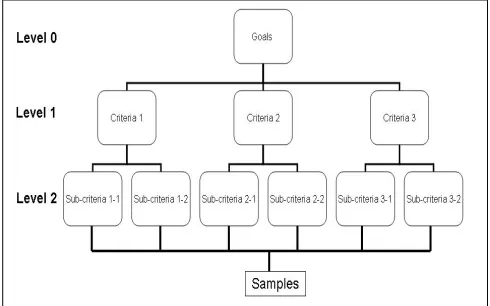
[image:2.612.314.559.546.699.2]Basically, AHP uses mathematical approach based on metrics algebra. It has been used as a tool to identify the importance of criteria in decision making or problem solving to achieve a goal. AHP bringing the qualitative and quantitative approach in research and combines it into the context as a sole empirical question. AHP applies the qualitative approach to restructure problems into hierarchy which is more systematic. On the other hand, based on a quantitative approach, it uses more of the comparison method of pair-wise to obtain responses and reliability that are more consistent through questionnaire forms [1]. Figure 1 below reveals the hierarchy towards the application of the AHP method.
Figure 1 shows that AHP is based on three principles, which are hierarchical form, comparison weighting, and importance integrating. This is a measurement theory to discuss each criterion that can be quantified and make known the differences. This method has been applied in various situations involving the result theory and problem solving [2].
Practically, AHP functions to test the weightage among the related elements. The weightage of each element or criteria has two main functions, which are firstly, to give priority (ranking) to every element so that the importance of each element can be determined. With this method, performance of each element or criteria can be evaluated. Secondly, apart from determining the weightage, this process can make a more precise decision regarding each criterion. This process is more to strategic planning to solve problems.
This paper has discovered and summarised the application of AHP that includes four main steps [5], [6], [7] which are;
1. Diagnose the problem, and determine the objective. 2. Develop a hierarchy from above (goal, objective), via intermediate level (criteria/sub criteria) and lower level (samples).
3. Comparing among the criteria via pairwise comparison method.
4. Identify the relative weightage of each level, criterion and sub-criteria to get the importance of each element.
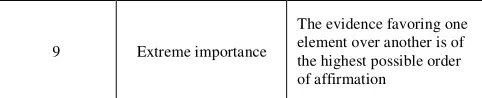
In addition, the most crucial part in the AHP method is to determine the relative weightage for each criterion. Every criterion has a priority and each comparison among the criteria has its own importance or priority among one another. The indicator that states the relative importance of each criterion is in the scale 1-9 as shown in Table 1.
Table 1. The comparison scale of pairwise Saaty [5]
The Fundamental Scale For Pairwise Comparisons Intensity of
Importance Definition Explanation
1 Equal importance Two elements contribute
equally to the objective
3 Moderate importance
Experience and judgment slightly favor one element over another
5 Strong importance
Experience and judgment strongly favor one element over another
7 Very strong
importance
One element is favored very strongly over another, its dominance is
demonstrated in practice
9 Extreme importance
The evidence favoring one element over another is of the highest possible order of affirmation
Intensities of 2, 4, 6 and 8 can be used to express intermediate values. Intensities 1.1, 1.2, 1.3, etc. can be used for elements that are very close in importance
The criteria for each stage of the hierarchy outcome are evaluated using the pairwise comparison method. Once all the elements are compared, with the importance’s scale among the criteria, the pair for each comparison will be considered via the metrics method [7]. Then, the total relative score for each criterion will be gathered and combined along with the regarded weightage value to produce one absolute sum. This process must be presented by applying the metrics method in pairwise comparison via normalized eigenvector to evaluate the metrics comparison [8].
III. THE APPLICATION OF AHP IN PROPERTY SECTORS
Since AHP was created, it has become a tool to assist in decision making and is normally used by researchers. It has already been widely applied as a tool to solve a problem. The application of AHP has also been shown to give an impact in property sectors. However, due to the growth of AHP applications, there have been modified by researchers based on its purpose and suitability in the property sectors.
In the property sectors, AHP has been used as a tool for decision making including investment, building quality, planning and deciding the best alternative such as contractors, property managers, and tenants. In addition, the modifications of AHP that are applied by researchers in property sectors have been classified into three groups, which are [7]:
Application based on one theme – (choosing, evaluation, benefit giving–cost analysis, allocation, planning and development, priority and status, and decision making).
Specific applications – (forecasting, investment, risk and related field).
Application merged with other methods– (AHP is applied with Building Quality Index (BQI)).
In the previous phase, AHP application is a sole and profound tool. After researchers were exposed to the application of AHP, they have started to combine the AHP with other techniques. Realising the need in problem solving and decision making in property sectors, researchers then changed the AHP versions via merging with other instruments [7].
[image:3.612.317.558.72.121.2]Meanwhile, [10], have suggested a model to assist in decision making for maintenance by applying AHP as an approach to provide reference for maintenance. That survey elaborated the maintenance problems that have occurred due to the absence of a clear concept, and also not having a firm design standard to build equipments and a detailed maintenance plan.
Furthermore, [11], has identified the importance of property specific attributes in assessing CBD office building quality by using AHP. [4], also has used AHP to develop a decision model for facility location selection. There are many researchers that have applied AHP in property sectors even though they have to modify and upgrade it to make them suitable in the property sectors.
In Malaysia, the applications of modified AHP in property sectors have shown a positive growth. Researchers in the country realised that the classification model of purpose built office can be developed by using AHP because of the flexibility of AHP to adapt to local culture [12] and [7]. Recently, AHP has become popular due to its effectiveness in facilitating problem solving and decision making. Many researchers both global and local have believed that AHP is a reliable instrument or tools to date.
As a conclusion, it can be summarised that the AHP method is not only applicable in one sector, but it can also be widely used in various sectors and can be merged with other applications according to its suitability. This AHP method has a flexible way that enables it to combine with other various methods effectively. For that matter, it can be concluded that AHP is a flexible method that can be applied by numerous sectors and criterions as a tool for decision making, especially in property sectors.
IV. FINDINGS
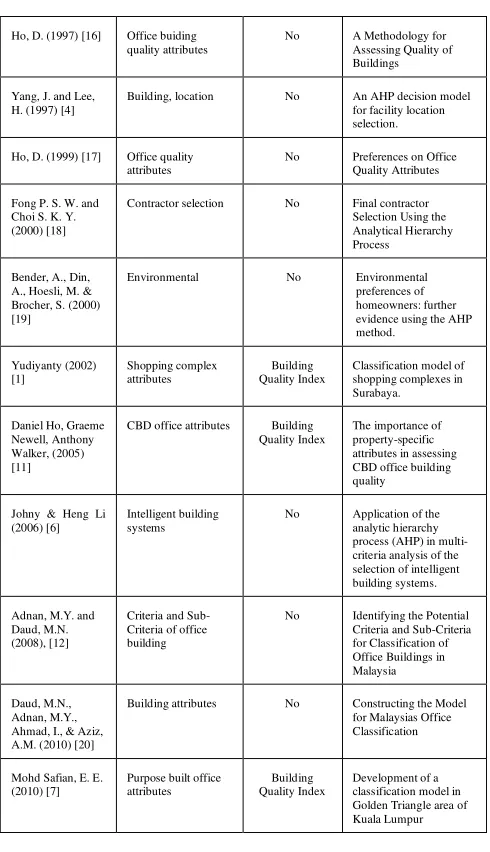
[image:4.612.315.560.64.490.2]This paper has identified AHP applied by researchers in property sectors in a global and local context. Table 2, shows the evolution of AHP through a whole range of research that have been used AHP as their instrument in property sectors.
Table 2. The evolution of AHP in property sectors
Extant research Criteria examined Modification Major views
Ball, J. and Srinivasan, V. (1994) [13]
Housing attributes No Using the analytic hierarchy process in house selection
Schniederjans, M., Hoffman, J. and Sirmans, G. (1995) [14]
Housing attributes Goal Programming
Using goal programming and the analytical hierarchy process in house selection
Ong, S.E. and Chew, T.I. (1996) [15]
Residential market No Singapore residential market: an expert judgemental forecast incorporating the analytical hierarchy process
Ho, D. (1997) [16] Office buiding quality attributes
No A Methodology for Assessing Quality of Buildings
Yang, J. and Lee, H. (1997) [4]
Building, location No An AHP decision model for facility location selection.
Ho, D. (1999) [17] Office quality attributes
No Preferences on Office Quality Attributes
Fong P. S. W. and Choi S. K. Y. (2000) [18]
Contractor selection No Final contractor Selection Using the Analytical Hierarchy Process
Bender, A., Din, A., Hoesli, M. & Brocher, S. (2000) [19]
Environmental No Environmental preferences of homeowners: further evidence using the AHP method. Yudiyanty (2002) [1] Shopping complex attributes Building Quality Index
Classification model of shopping complexes in Surabaya.
Daniel Ho, Graeme Newell, Anthony Walker, (2005) [11]
CBD office attributes Building Quality Index
The importance of property-specific attributes in assessing CBD office building quality
Johny & Heng Li (2006) [6]
Intelligent building systems
No Application of the analytic hierarchy process (AHP) in multi-criteria analysis of the selection of intelligent building systems.
Adnan, M.Y. and Daud, M.N. (2008), [12]
Criteria and Sub-Criteria of office building
No Identifying the Potential Criteria and Sub-Criteria for Classification of Office Buildings in Malaysia
Daud, M.N., Adnan, M.Y., Ahmad, I., & Aziz, A.M. (2010) [20]
Building attributes No Constructing the Model for Malaysias Office Classification
Mohd Safian, E. E. (2010) [7]
Purpose built office attributes
Building Quality Index
Development of a classification model in Golden Triangle area of Kuala Lumpur
V. CONCLUSION AND SUGGESTION
REFERENCES
[1] Yudiyanty, Y. (2002). Pengukuran Kualitas Bangunan Pusat
Perbelanjaan dengan Metode Analytical Hierarchy Process (AHP). Studi Kasus: Plasa Tunjungan dan Plasa Surabaya. Petra Christian University, Surabaya: Tesis Ph.D.
[2] Arash Shahin & Ali Mahbod, M. (2006). Prioritization of key
performance Indicators: An integration of analytical hierarchy process and goal setting. International Journal of Productivity and Performance Management, Vol. 56 No. 3, 226-240.
[3] Saaty, T. (2001). Decision Making with Dependence and Feed Back
the Analytical Network Process. 2nd ed., University of Pittsburg, Pittsburg: RWS Publications.
[4] Yang, J. and Lee, H. (1997). An AHP decision model for facility
location selection. Facilities,Vol. 15 No. 9, 241-54.
[5] Saaty, T. (1994). Fundamentals of Decision Making and Priority
Theory, with the Analytical Hierarchy Process. Pittsburgh, PA.: RWS Publications.
[6] Johny & Heng Li (2006). Application of the analytic hierarchy
process (AHP) in multi- criteria analysis of the selection of
intelligent building systems. Building and Environment, 43 (2006), 108–125.
[7] Mohd Safian, E. E. (2009), Model klasifikasi bagi pejabat binaan
khas di kawasan segi tiga emas Kuala Lumpur, UTHM, Master thesis.
[8] Manoharan, R. (2005). Subcontractor Selection Method Using
Analytical Hierarchy Process - Research, Faculty of Civil Engineering. Universiti Teknologi Malaysia: Master thesis.
[9] Al Harbi (2001), Application of the AHP in project management,
International Journal of Project Management Volume 19, Issue 1, January 2001, Pages 19-27.
[10] Anish Sachdeva, Dinesh Kumar, Pradeep Kumar (2008), A
methodology to determine maintenance criticality using AHP, International Journal of Productivity and Quality Management 2008 - Vol. 3, No.4 pp. 396 – 412.
[11] Daniel Ho, Graeme Newell, Anthony Walker, (2005), The importance
of property-specific attributes in assessing CBD office building quality. Journal of Property Investment &Finance, Vol. 23 No. 5, 424-444.
[12] Adnan, M.Y. and Daud, M.N. (2008), Identifying the Potential
Criteria and Sub-Criteria for Classification of Office Buildings in Malaysia, International Real Estate Research Symposium 2008, Kuala Lumpur.
[13] Ball, J. and Srinivasan, V. (1994), “Using the analytic hierarchy process in house selection”,Journal of Real Estate Finance and Economics, Vol. 9, pp. 69-85.
[14] Schniederjans, M., Hoffman, J. and Sirmans, G. (1995), “Using goal
programming and the analytical hierarchy process in house selection”, Journal of Real Estate Finance and Economics, Vol. 11, pp. 167-76.
[15] Ong, S.E. and Chew, T.I. (1996), “Singapore residential market: an expert judgemental forecast incorporating the analytical hierarchy process”, Journal of Property Valuation and Investment, Vol. 14 No. 1, pp. 50-66.
[16] Ho, D. (1997). A Methodology for Assessing Quality of Buildings, in
Asean Real Estate Society Conference, Hong Kong.
[17] Ho, D. (1999). Preferences on Office Quality Attributes, in
International Real Estate Society Conference, Kuala Lumpur.
[18] Fong, P.S.W., Choi, S.K.Y. (2000), "Final contractors selection using
the analytical hierarchy process", Construction Management and Economics, Vol. 18 pp.547-57.
[19] Bender, A., Din, A., Hoesli, M. & Brocher, S. (2000). Environmental
preferences of homeowners: further evidence using the AHP method. Journal of Property Investment and Finance, Vol. 18 No. 4, 445-55.
[20] Daud, M.N., Adnan, M.Y., Ahmad, I., & Aziz, A.M. (2010).