Stable Boundary Layer Height Parameterization:
Learning from Artificial Neural Networks
Wei Li
Department of Marine, Earth, and Atmospheric Sciences, North Carolina State University,Raleigh, USA Email: [email protected]
Received May 17, 2013; revised June 18, 2013; accepted June 26,2013
Copyright © 2013 Wei Li. This is an open access article distributed under the Creative Commons Attribution License, which permits unrestricted use, distribution, and reproduction in any medium, provided the original work is properly cited.
ABSTRACT
Artificial neural networks (ANN) are employed using different combinations among the surface friction velocity u*,
surface buoyancy flux Bs, free-flow stability N, Coriolis parameter f, and surface roughness length z0from large-eddy
simulation data as inputs to investigate which variables are essential in determining the stable boundary layer (SBL) height h. In addition, the performances of several conventional linear SBL height parameterizations are evaluated. ANN results indicate that the surface friction velocity u* is the most predominant variable in the estimation of SBL height h.
When u* is absent, the secondly important variable is the surface buoyancy flux Bs. The relevance of N, f, and z0 to h is
also discussed; f affects more than N does, and z0 shows to be the most insensitive variable to h.
Keywords: Artificial Neural Network; Large-Eddy Simulation; Stable Boundary Layer Height
1. Introduction
Parameterizations of the stable boundary layer (SBL) height are often critical in many practical problems, such as air pollutant dispersion modeling [1-3], weather mod- eling, and climate modeling. Due to the complex rela- tionship between the mean profiles and the turbulence in the stable boundary layer [4,5], it is less straightforward to determine the SBL height from wind speed and tem- perature profiles compared to observing the convective boundary layer height from mean profiles. During recent several decades, a number of model formulations of SBL depth have been developed based on various datasets [6-11]; these formulations are mainly in forms of linear equations or complex non-linear multi-limit equations. Most of these schemes are surface flux-dominated mod- els; they are summarized by Zilitinkevich et al. [11].
Various linear relationships [6-8] were formulated by considering the SBL height relying on one or two vari- ables among the earth’s rotation (f), surface friction ve- locity (u*), surface buoyancy flux (Bs), and free-flow
stability (N) which have been identified as the key physi- cal processes that govern the SBL height. However, no consensus was achieved from these linear models.
By employing the turbulent kinetic energy (TKE) budget equation, Zilitinkevich and Mironov [10] derived two diagnostic multi-limit equations for the equilibrium depth of SBL that contains all the four aforementioned
variables and several unknown coefficients, and that can hold in both the general case and the limiting cases. Fur- thermore, Zilitinkevich et al. [11] proposed two refined Ek- man-layer height equations from the momentum balance equations and validated their model against observations.
The above parameterizations of SBL height have been evaluated by many researchers based on various observa- tional datasets [11-14] and controlled numerical simula- tions [15-17]. Using datasets over grassland, cooler ocean surface and snow cover, Vickers and Mahrt [13] evaluated a variety of surface flux-based SBL height formulations; they summarized that the existing formula- tions generally perform poorly and often overestimate the depth of SBL.
The aforementioned multi-limit equations were further discussed and evaluated by Zilitinkevich and Baklanov [12]; they found that the Ekman-layer height equations by Zilitinkevich et al. [11] produced more accurate esti- mation of SBL height than that by the equations in Zilit- inkevich and Mironov [10]. Kosovic and Lundquist [17] compared several parameterizations to calculate SBL height using large-eddy simulations of moderately stable boundary layers and they demonstrated that the gravity waves in the free atmosphere do affect the height of SBL.
the SBL height, especially for shallow boundary layers, and no unique parameter that sets for these equations can be determined. Alternatively, Steeneveld et al. [14] devel- oped a formulation based on formal dimensional analysis using the same quantities as in the multi-limit equations; this new formulation showed to be more robust and it sig- nificantly reduced the model bias for shallow boundary layer heights compared with the multi-limit equations, and a unique parameter set was found for this new equa- tion. Furthermore, Steeneveld et al. [18] proposed an- other alternative equation by an inverse interpolation of the eddy diffusivities for each boundary layer prototype [16] instead of interpolating the height scales for each prototype in the equations by Zilitinkevich and cowork- ers when applying the definition of Ekman layer depth. This equation reduced the bias of the predicted SBL height compared to their equations. However, the formu- lation derived from formal dimensional analysis [14] still shows better performance than this equation [18].
Therefore, the above studies have enlightened us that some formulations which involve less variables can per- form better than the complex multi-limit formulations for the SBL height estimation. In this paper, we will take an unconventional approach to figure out which variables are indeed essential for an optimum representation of the SBL height. Artificial neural networks will be employed to model this non-linear phenomenon based on a large- eddy simulation output dataset.
2. Data Description
The data used in this study are the output from 68 runs of large eddy simulation (LES). They are idealized simula- tions, by setting different values for the parameters of geostrophic wind G, cooling rate C of air temperature, surface roughness length z0, initial boundary layer height
H, Brunt-Vaisala frequency N in the free atmosphere above the SBL, and Coriolis parameter f, to represent typical low-level jet scenarios in the stable boundary layer.
The LES computational domain employed for this study extends 800 meters in the lateral direction and 795 meters in the vertical direction. The grid size in both y and z directions is 10 meters; at each grid point, the three dimensional wind velocity and air temperature are gen- erated as a time series; the time step for the LES flow fields is 0.1 sec [19]. The 5-min mean values of the simu- lated data are output for the boundary layer height studies. From each LES run, a total of 144 time steps are ob- tained representing 12 hours of simulation between 1800 to 0600 LST.
Each simulation starts from a neutral profile. As shown by the wind profiles, the damping layer of wind speed starts from 550-m level around, we only use the
data from the surface to 550-m height to analyze the sta- ble boundary height.
There have been many definitions of SBL height with different emphasis on properties of turbulence [20], heat flux [21], mean wind speed [22], mean temperature [23], and other effects [16,24,25]. In this study, we will em- ploy the definition of the height of the lowest maximum of the wind speed [22,26], often referred to as the low- level jet height, as the targeted SBL height h in the para- meterization. The LES wind profiles show that low-level jets usually start developing after 0000 LST. Therefore, only the data between 0000 - 0600 LST in each simula- tion are selected to represent typical low-level jets.
3. Resampling Strategy
In this study, at each time step in each LES run, from the wind speed profile, a SBL height h can be estimated as the height of the maximum wind speed, i.e., the low-level jet height. Thus from each simulation there are totally 72 output values of 6 hours for surface friction velocity u*,
surface buoyancy flux Bs, and boundary layer height h.
The geostrophic wind G, the Coriolis parameter f, the Brunt-Vaisala frequency N in the free atmosphere, and the surface roughness length z0 are set as various values
for each LES run.
We will firstly combine the data from all the 68 LES sruns together to form a total dataset, and then apply re- peated random sub-sampling cross-validation algorithm, to evaluate five conventional linear formulations of sta- ble boundary layer height. This method randomly parti- tions the dataset into training and validation data by a certain percentage (60% training and 40% validation in this study). For each such split, the model is fit to the training data, and assesses the predictive accuracy using the validation data. This procedure is repeated for 100 times in this study.
The variables from the training data are used in the conventional linear formulations to calculate their in- cluded constants first. Then substituting the variables in the validation data, together with the derived constants into the linear equations, the SBL height h can be pre- dicted. Consequently based on the difference between the predicted and the targeted values of h, the statistical quantities such as root mean squared error (RMSE), me- dian absolute error (MAE), median bias error (MBE), and index of agreement (IOA) are calculated. Therefore the performance of these linear formulations can be evalu- ated from the distribution of the statistical errors.
4. Performance of Conventional SBL
Height Parameterizations Based on
LES Data
depth of the stably stratified boundary layer are surface- flux-dominated formulations. In these parameterizations, the turbulent heat flux and momentum flux at the surface are required to be estimated. Rossby and Montgomery [27] proposed that the surface friction velocity u* and
Coriolis parameter f mainly affect the stable boundary layer depth:
*1 2ir
u h C
fN
(3)
Kitaigorodskii [6] proposed that only the surface heat flux and momentum flux are dominated on the depth of the boundary layer without the effect of earth rotation
3 *
s s
u
h C
B
(4)
*
n
u h C
f
(1)
When only considering surface momentum flux and the overlying free-flow stratification, Kitaigorodskii and Joffre [9] obtained
Then Zilitinkevich [7] considered the surface heat flux together with the influences of surface friction and the earth’s rotation such that
*
i
u h C
N
(5)
2 *
1 2
sr s
u h C
fB
(2)
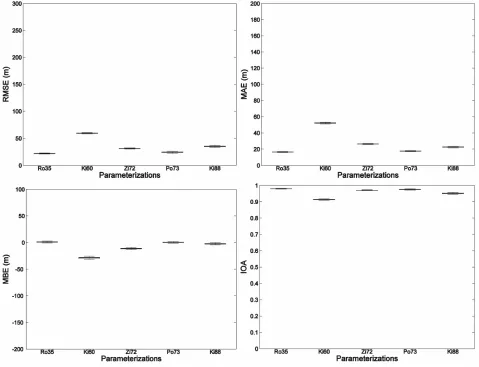
In this study, we evaluate the performance of the above five parameterizations against controlled large eddy simulation output. Figure 1 shows the statistical
errors of RMSE, MAE, MBE, and IOA between the pre- dicted and the target values of stable boundary layer where Bs is the surface buoyancy flux. Pollard et al. [8]
[image:3.595.61.540.352.719.2]were the first to suggest that N, the free-flow stratifica- tion above the stable boundary layer, would affect the boundary layer height:
Figure 1. Performance of conventional linear parameterizations.
height h based on these five formulations.
The formulation by Rossby and Montgomery [27] when only considering influences of u*and f shows the
best performance with minimum values of RMSE (25 m) and MAE (18 m) among others. The Pollard et al. [8] scheme performs secondly best with a RMSE of 30 m and a MAE of 20 m when N is taken into account. Then Zilitinkevich [7] formulation has slightly larger RMSE than that by Pollard et al. [8] when N is replaced by Bs.
When f is not involved in the formulations [Equations (4) and (5)], the models biases are largely increased with Equation (4) being the worst case.
Therefore, the performance of these conventional lin- ear parameterizations of SBL height against LES data indicates that the surface friction velocity u* and Coriolis
parameter f are proved to be the two most predominant variables to determine h and the free-flow stability N
shows more important than the surface buoyancy flux Bs.
5. Artificial Neural Networks
Artificial neural networks (ANN) are composed of sim- ple interconnected neurons. Unlike other statistical tech- niques, ANN usually makes no prior assumptions re- garding the data distribution, and can model extremely non-linear relationships and be trained to be accurately representative for new and unseen data [28]. Typically, a neural network can be trained based on a comparison between the output and the target until the network out- put matches the target, so that a particular input leads to a specific target output.
Artificial neural networks have been applied to per- form complex functions in various fields. In recent years, a significant number of ANN applications have been developed in different fields of geosciences such as satel- lite remote sensing, meteorology, oceanography, numeri- cal weather prediction, and climate studies [29].
The work flow for the general neural network design process has the following three primary steps:
5.1. Collect and Prepare the Data
After the sample data have been collected, they need to be preprocessed and to be divided into three subsets be- fore they are used to train the network. The first subset is the training set, which is used for computing the gradient and updating the network weights and biases. The second subset is the validation data which will determine the stopping criteria. The error on the validation set is moni- tored during the training process. The validation error normally decreases during the initial phase of training, as does the training set error. However, when the network begins to over fit the data, the validation error typically begins to rise after some iterations. The network weights and biases are saved when the validation error reaches
the minimum at the certain iteration, which gives the optimum iteration number for the network training. The third subset in the data is the testing data, the error on which is not used during the training process, but used to compare different models. Typically, a poor division of the dataset happens when the testing error reaches a minimum at a significantly different iteration number from that at which the validation error reaches its mini- mum.
5.2. Create, Configure and Initialize the Network
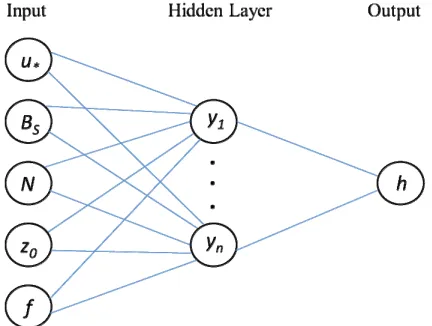
After the data have been prepared, the next step is to se- lect the network architecture and create the network. In this paper, the most predominant network architecture of multilayer perceptron is utilized to map the relationships between the stable boundary layer height h and the asso- ciated variables u*, Bs, N, f, and z0. We create a two-layer
feedforward network (see Figure 2). The sum of the
weighted inputs and the bias forms the input to the trans- fer function in the network; then the transfer function generates the output vector [28,30]. Multilayer networks often use the log-sigmoid transfer function.
After configuring the network object and also initial- izing the weights and biases of the network, the network is ready for training.
5.3. Train and Validate the Network
The process of training a neural network involves ad- justing the values of the weights and biases of the net- work to optimize the network performance, that is, to find the combination of weights which can result in the smallest error [28]. The default performance function for feedforward networks is the mean square error (MSE) between the network outputs and the targets.
[image:4.595.319.535.543.706.2]Gradient descent is the simplest optimization algo- rithm; the gradient is calculated using the technique of
back propagation algorithm, which involves performing computations backward through the network and is the most computationally straightforward algorithm for train- ing the multilayer perceptron [28,31]. The gradient de- scent algorithm updates the network weights and biases in the direction in which the performance function de- creases most rapidly.
Once the training procedure is complete, the network validation can be done by checking the training record and creating a regression plot between the outputs of the network and the targets.
6. ANN Modeling Strategy of Stable
Boundary Layer Height
In this study, we will apply ANN to predict the stable boundary layer height. ANN development for simulating the SBL height requires identification of the input and output variables. From the knowledge of conventional parameterizations, the SBL height h can be expressed as a function of surface friction velocity u*, surface buoy-
ancy flux Bs, Brunt-Vaisala frequency N in the free at-
mosphere above the SBL, Coriolis parameter f, and sur- face roughness length z0.
Figure 2 shows the illustration of the two-layer per-
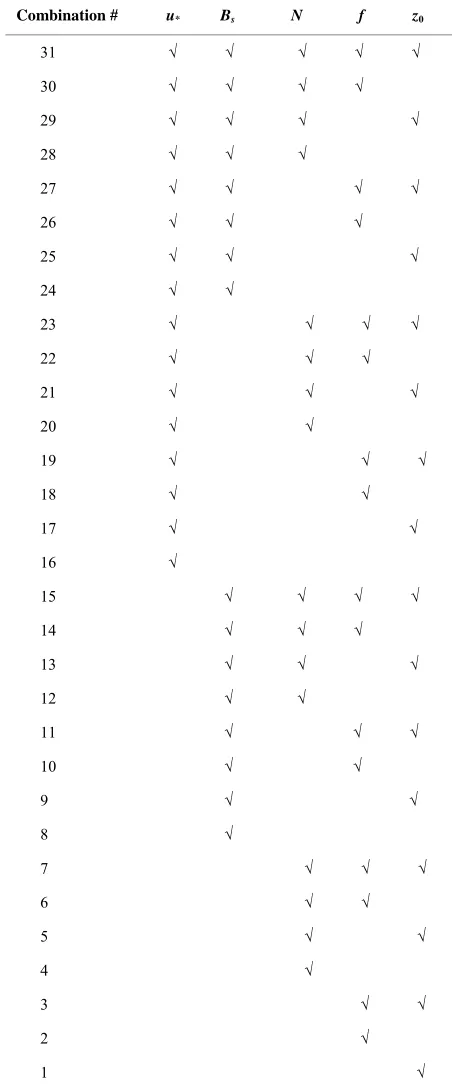
ceptron ANN architecture in modeling the SBL height h. The architecture of the network depends on the number of input and output variables. For the present problem, the number of input nodes in the two-layer perceptron network varies from the minimum of 1 to the maximum of 5; the input variables are randomly combined among the five associated variables u*, Bs, N, f, and z0. Table 1
shows the 31 variable combinations of inputs used in the network. Only one output node exists in this problem.
However, the number of nodes in the hidden layer is not fixed. For each combination of input variables, we test the network by changing the neuron number in the hidden layer from 1 to 20 in turn to find a best number of hidden nodes. At each specific hidden nodes number, the network is repeated to run 100 times to calculate a statis- tical median value of the errors. For each run, the dataset are randomly partitioned into three subsets of training, validation, and testing data with the proportion of 30%, 30%, and 40%, respectively.
ANNs are developed using MATLAB Neural Network Toolbox (version 2010). The back propagation algorithm is applied for training. The training is performed using the default values for the parameters of the network.
7. Performance of ANN-Based
Parameterizations Based on LES Data
From previous studies, the basic variables that govern the SBL height h are the surface friction velocity u*, the sur-
[image:5.595.307.533.105.649.2]face buoyancy flux Bs, the free-flow stability N, the
Table 1. Input variable combinations in ANN modeling.
Combination # u* Bs N f z0
31 √ √ √ √ √
30 √ √ √ √
29 √ √ √ √
28 √ √ √
27 √ √ √ √
26 √ √ √
25 √ √ √
24 √ √
23 √ √ √ √
22 √ √ √
21 √ √ √
20 √ √
19 √ √ √
18 √ √
17 √ √
16 √
15 √ √ √ √
14 √ √ √
13 √ √ √
12 √ √
11 √ √ √
10 √ √
9 √ √
8 √
7 √ √ √
6 √ √
5 √ √
4 √
3 √ √
2 √
1 √
Coriolis parameter f, and the surface roughness length z0.
In this study, these five variables u*, Bs, N, f, and z0 were
randomly combined into 31 different combinations of inputs for the neural network in the order of binary num- bers (see Table 1) to investigate which combination of
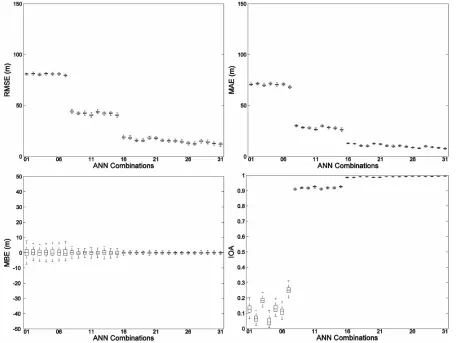
boundary layer height h. Figure 3 shows the statistical
errors of RMSE, MAE, MBE, and IOA calculated be- tween the output value and the target value of SBL height h in the network based on the 31 input combina- tions utilizing the LES output data.
We divided the 31 combinations into 4 groups. From the first group of combinations (combination number 1 to 7 in Table 1) where the variables u* and Bs are not in-
volved in the input, the model performance is very poor. The values of RMSE are as high as 75 m; all the IOA values are lower than 0.3.
In the second group of combinations (combination number 8 to 15 in Table 1), when the surface buoyancy flux Bs are included in the model input, the RMSE de-
crease to be around 50 m, the IOA are largely increased up to 0.9. This indicates that buoyancy flux is a very im- portant variable in predicting h when friction velocity is absent in the input.
When the third (combination number 16 to 23 in Ta- ble 1) and the fourth (number 24 to 31) groups of com-
binations are input into the network, where the surface friction velocity u* is involved in each input, the model
performance is largely improved again to be the best
among all the variable combinations of input. The RMSE are very close to each other based on these 16 set of in- puts, with a mean value of 20 m, and their IOA reach to be as high as 0.98. This strongly proves that the surface friction velocity u* is the most dominant variable in de-
termining the SBL height.
From the second group to the fourth group of variable combinations, keeping the way of combining other three variables (N, f, z0) as that in the first group, when adding
u* with Bs in the input variables, the model performance
is largely improved. From the second group to the third group, when Bs is replaced by u* in the input, the model
performance is largely improved similarly. This indicates that the variable Bs has less relevance compared to u*in
predicting h, even if Bs has been proved to be an impor-
tant one. This can also be verified from that when chang- ing the input combinations from the fourth group to the third group, where Bsis removed from the variable com-
binations, the model performance is not changed obvi- ously.
The median RMSE based on the variable combination of (u*, Bs, N, f, z0) is the minimum of the RMSE values
[image:6.595.72.528.374.717.2]based on all combinations. This means that when all the
Figure 3. Performance of ANN-based parameterizations using 31 different variable combinations as inputs.
five relevant variables u*, Bs, N, f, and z0 are taken into
account in the model input, the model performs best. In addition, within the third and fourth groups, when the coriolis parameter f is added into the combinations, the RMSE values are decreased; when replacing f by N in the combinations, RMSE are increased; when f and N are both involved, the RMSE values are decreased again. Therefore, the coriolis parameter f shows to be more im- portant for h prediction compared to the inversion strength N.
In further details, within both the third group and the fourth group, the values of RMSE are changing in pairs. The two median RMSE values of each pair are almost equal; the difference between the two input variable combinations within each pair is that the surface rough- ness length z0 is included or not. This demonstrates that
the surface roughness length z0 is not obviously affective
to h determination.
Overall, our results based on ANN shows that the strongest relation of h exists with u*, and then with Bs
secondly. Koracin and Berkowicz [32] ever proposed a simple empirical estimate of h = 700u*. This formula
was evaluated by Steeneveld et al. [14] by observational data and it performs well over their datasets. In the alter- native formulation using dimensional analysis by Steen- eveld et al. [14], they also concluded that h relies on u*
most strongly, and then on Bs in the very stable limit,
then on N while f and z0 are less relevant for their data;
when the Coriolis parameter f is omitted, the SBL height
h for moderately stable conditions is proportional to u*/N,
and for high stability conditions h is proportional to the length scale 3
S
B N .
Kosovic and Lundquist [17] also used LES study to explore various parameterizations of SBL height. They found that from a small-domain simulation, the SBL height formulation proposed by Kosovic and Curry [15] in which the strength of the inversion N was not involved (except for u*, Bs and f) appeared to match the SBL
height defined by turbulent shear stress better than the scheme by Zilitinkevich et al. [11] did in which N was involved, due to the simulation domain was too small to include the effects of gravity waves that developed above the SBL. They also conducted medium-resolution LES with the domain size sufficiently large to resolve the overlying gravity waves; the results showed that the formulation [11] with N involved consequently gave a better prediction of SBL height.
In the conventional formulations, the friction velocity
u* and Coriolis parameter f are proved to be the two most
predominant variables in determining h, whereas the surface buoyancy flux Bs is not an important factor and
[image:7.595.309.537.124.209.2]even has less influence than the free-flow stability N.
Table 2 compares the model performance given by the
statistical errors of RMSE, MBE, MAE and IOA based
Table 2. Performance of two linear parameterizations and two ANN-based parameterizations using corresponding variable combinations as inputs.
Parameterization RMSE MBE MAE IOA
(u*, f) 15.59 −0.07 10.54 0.991
(u*, Bs) 15.26 −0.07 10.48 0.991
Ro35 22.15 0.95 16.51 0.980
Ki60 59.53 −28.56 52.16 0.913
on the conventional formula of h = Cnu*/f by Rossby and
Montgomery [27] (Ro35 in Figure 1) and based on the
input variable combination of (u*, f) in ANN. Their per-
formance is quite good and they have close RMSE values of 22 m and 16 m; both have very high IOA values near- ing to 1. The cases for the conventional formula h = −Csu*3/Bs by Kitaigorodskii [6] (Ki60 in Figure 1) and
the variable combination of (u*, Bs) in ANN are also
listed in Table 2. Although Ki60 results in a very high
IOA value of 0.91, its RMSE is as large as 60 m, which is much larger than the RMSE of 15 m for the combina- tion (u*, Bs) in ANN. As discussed in section 4, this Ki60
formulation performs worst among the five conventional formulations (Figure 1); this might be due to the cube of u* in the formulation and needs to be further explored.
8. Conclusions
In this paper, we tried to find out which variables are essential and can achieve the best performance in deter- mining the stable boundary layer height h based on large- eddy simulation data. Artificial neural networks were ap- plied to investigate which combination of variables is the optimum input. We also evaluated the performance of conventional linear formulations for the SBL height pre- diction, in which the surface friction velocity u* and the
Coriolis parameter f were proved to be the two most pre- dominant variables to determine h and the free-flow sta- bility N showed to be more important than the surface buoyancy flux Bs for h prediction.
The results based on ANN showed that the strongest relation of h exists with the surface friction velocity u*.
The secondly dominant variable relevant to h is the sur- face buoyancy flux Bs. The Coriolis parameter f shows to
be more important compared to the inversion strength N. The surface roughness length z0 is not an affective vari-
able to h.
9. Acknowledgements
REFERENCES
[1] P. Seibert, F. Beyrich, S. E. Gryning, S. Joffre, A. Ras- mussen and P. H. Tercier, “Review and Intercomparison of Operational Methods for the Determination of the Mix- ing Height,” Atmospheric Environment, Vol. 34, No. 7, 2000, pp. 1001-1027.
http://dx.doi.org/10.1016/S1352-2310(99)00349-0 [2] J. A. Salmond and I. G.McKendry, “A Review of Turbu-
lence in the Very Stable Boundary Layer and Its Implica- tions for Air Quality,” Progress in Physical Geography, Vol. 29, No. 2, 2005, pp. 171-188.
http://dx.doi.org/10.1191/0309133305pp442ra
[3] G. J. Steeneveld and A. A. M. Holtslag, “Meteorological Aspects of Air Quality,” Air Quality in the 21st Century, Nova Science Publishers, New York, 2009, pp. 67-114. [4] W. Brutsaert, “Radiation, Evaporation and the Mainte-
nance of the Turbulence under Stable Conditions in the Lower Atmosphere,” Boundary-Layer Meteorology, Vol. 2, No. 3, 1972, pp. 309-325.
http://dx.doi.org/10.1007/BF02184772
[5] L. Mahrt, “Modeling the Height of the Stable Boundary Layer,” Boundary-Layer Meteorology, Vol. 21, No. 1, 1981, pp. 3-19. http://dx.doi.org/10.1007/BF00119363 [6] S. A. Kitaigorodskii, “On the Computation of the Thick-
ness of the Wind-Mixing Layer in the Ocean,” Izvestiya AN SSSR, Geophysical Series, Vol. 3, 1960, pp. 425-431. [7] S. S. Zilitinkevich, “On the Determination of the Height
of the Ekman Boundary Layer,” Boundary-Layer Mete- orology, Vol. 3, No. 2, 1972, pp. 141-145.
http://dx.doi.org/10.1007/BF02033914
[8] R. T. Pollard, P. B. Rhines and R. Thompson, “The Dee- pening of the Wind-Mixed Layer,” Geophysical Fluid Dynamics, Vol. 3, 1973, pp. 381-404.
[9] S. A. Kitaigorodskii and S. M. Joffre, “In Search of Sim- ple Scaling for the Heights of the Stratified Atmospheric Boundary Layer,” Tellus, Vol. 40A, No. 5, 1988, pp. 419- 443.
http://dx.doi.org/10.1111/j.1600-0870.1988.tb00359.x [10] S. S. Zilitinkevich and D. V. Mironov, “A Multi-Limit
Formulation for the Equilibrium Depth of a Stably Strati- fied Boundary Layer,” Boundary-Layer Meteorology, Vol. 81, No. 3-4, 1996, pp. 325-351.
http://dx.doi.org/10.1007/BF02430334
[11] S. S. Zilitinkevich, A. Baklanov, J. Rost, A. S. Smedman, V. Lykosov and P. Calanca, “Diagnostic and Prognostic Equations for the Depth of the Stably Stratified Ekman Boundary Layer,” Quarterly Journal of the Royal Mete- orological Society, Vol. 128, No. 1, 2002, pp. 25-46. http://dx.doi.org/10.1256/00359000260498770
[12] S. S. Zilitinkevich and A. Baklanov, “Calculation of the Height of Stable Boundary Layers in Practical Applica- tions,” Boundary-Layer Meteorology, Vol. 105, No. 3, 2002, pp. 389-409.
http://dx.doi.org/10.1023/A:1020376832738
[13] D. Vickers and L. Mahrt, “Evaluating Formulations of the Stable Boundary Layer Height,” Journal of Applied Mete- orology, Vol. 43, No. 11, 2004, pp. 1736-1749.
http://dx.doi.org/10.1175/JAM2160.1
[14] G. J. Steeneveld, B. J. H. Van de Wiel and A. A. M. Holtslag, “Diagnostic Equations for the Stable Boundary Layer Height: Evaluation and Dimensional Analysis,” Journal of Applied Meteorology and Climatology, Vol. 46, No. 2, 2007, pp. 212-225.
http://dx.doi.org/10.1175/JAM2454.1
[15] B. Kosovic and J. A. Curry, “A Large Eddy Simulation Study of a Quasi-Steady, Stably Stratified Atmospheric Boundary Layer,” Journal of the Atmospheric Sciences, Vol. 57, No. 8, 2000, pp. 1052-1068.
http://dx.doi.org/10.1175/1520-0469(2000)057<1052:AL ESSO>2.0.CO;2
[16] S. S. Zilitinkevich and I. Esau, “The Effect of Baroclinic- ity on the Equilibrium Depth of Neutral and Stable Plane- tary Boundary Layers,” Quarterly Journal of the Royal Meteorological Society, Vol. 129, No. 595, 2003, pp. 3339-3356. http://dx.doi.org/10.1256/qj.02.94
[17] B. Kosovic and J. K. Lundquist, “Influences on the Height of the Stable Boundary Layer,” 16thSymposium on Boun- dary Layers and Turbulence, American Meteor Society, Portland, 23 June 2004, Preprints.
[18] G. J. Steeneveld, B. J. H. Van de Wiel and A. A. M. Holtslag, “Notes and Correspondence: Comments on De- riving the Equilibrium Height of the Stable Boundary Layer,” Quarterly Journal of the Royal Meteorological Society, Vol. 133, No. 622, 2007, pp. 261-264.
http://dx.doi.org/10.1002/qj.26
[19] C. Sim, S. Basu and L. Manuel, “On Space-Time Reso- lution of Inflow Representations for Wind Turbine Loads Analysis,” Energies, Vol. 5, No. 7, 2012, pp. 2071-2092. http://dx.doi.org/10.3390/en5072071
[20] D. H. Lenschow, X. S. Li, C. J. Zhu and B. B. Stankov, “The Stably Stratified Boundary Layer over the Great Plains. I. Mean and Turbulent Structure,” Boundary-Lay- er Meteorology, Vol. 42, No. 1-2, 1988, pp. 95-121. http://dx.doi.org/10.1007/BF00119877
[21] S. J. Caughey, J. C. Wyngaard and J. C. Kaimal, “Turbu- lence in the Evolving Stable Layer,” Journal of the Atmo- spheric Sciences, Vol. 36, No. 6, 1979, pp. 1041-1052. [22] J. W. Melgarejo and J. W. Deardorff, “Stability Functions
for the Boundary Layer Resistance Laws Based upon Ob- served Boundary Layer Heights,” Journal of the Atmos- pheric Sciences, Vol. 31, No. 5, 1974, pp. 1324-1333. http://dx.doi.org/10.1175/1520-0469(1974)031<1324:SFF TBL>2.0.CO;2
[23] T. Yamada, “Prediction of the Nocturnal Surface Inver- sion Height,” Journal of Applied Meteorology, Vol. 18, No. 4, 1979, pp. 526-531.
http://dx.doi.org/10.1175/1520-0450(1979)018<0526:PO TNSI>2.0.CO;2
[24] J. R. Garratt and R. A. Brost, “Radiative Cooling Effects within and above the Nocturnal Boundary Layer,” Jour- nal of the Atmospheric Sciences, Vol. 38, No. 12, 1981, pp. 2730-2746.
http://dx.doi.org/10.1175/1520-0469(1981)038<2730:RC EWAA>2.0.CO;2
pheric Sciences, Vol. 60, No. 1, 2003, pp. 16-33. http://dx.doi.org/10.1175/1520-0469(2003)060<0016:SFI ITS>2.0.CO;2
[26] F. Beyrich, “Sodar Observations of the Stable Boundary- Layer Height in Relation to the Nocturnal Low-Level Jet,” Meteorologische Zeitschrift, Vol. 3, No. 1, 1994, pp. 29-34.
[27] C. G. Rossby and R. B. Montgomery, “The Layer of Fric- tional Influence in Wind and Ocean Currents,” Papers in Physical Oceanography and Meteorology, Vol. 3, No. 3, 1935, pp. 1-101.
[28] M. W. Gardner and S. R. Dorling, “Artificial Neural Net- works (the Multilayer Perceptron): A Review of Applica- tions in the Atmospheric Sciences,” Atmospheric Envi- ronment, Vol. 32, No. 14-15, 1998, pp. 2627-2636. http://dx.doi.org/10.1016/S1352-2310(97)00447-0 [29] V. M. Krasnopolsky, “Neural Network Emulations for
Complex Multidimensional Geophysical Mappings: Ap- plications of Neural Network Techniques to Atmospheric
and Oceanic Satellite Retrievals and Numerical Model- ing,” Reviews of Geophysics, Vol. 45, No. 3, 2007, Arti- cle ID: RG3009.
http://dx.doi.org/10.1029/2006RG000200
[30] M. Gevrey, I. Dimopoulos and S. Lek, “Review and Comparison of Methods to Study the Contribution of Variables in Artificial Neural Network Models,” Eco- logical Modelling, Vol. 160, No. 3, 2003, pp. 249-264. http://dx.doi.org/10.1016/S0304-3800(02)00257-0 [31] D. E. Rumelhart, G. E. Hinton and R. J. Williams, “Par-
allel Distributed Processing: Explorations in the Micro- structure of Cognition, Vol. 1,” MIT Press, Cambridge, 1986.