2016 International Conference on Mathematical, Computational and Statistical Sciences and Engineering (MCSSE 2016) ISBN: 978-1-60595-396-0
Modeling the Interaction Dynamics between
Honeybees and Food Availability
Carlos A. AGRINSONI-SANTIAGO
1, Matthew BACA
2, Carlos CRUZ
3,
Armando SALINAS
3, Juan RENOVA
3, Mary L. ROSS
3and Baojun SONG
4,*1Department of Mathematics-Physics, University of Puerto Rico at Cayey, Puerto Rico
2
Department of Mathematics, New Mexico Institute of Mining and Technology, USA
3Simon A. Levin Mathematical, Computational and Modeling Sciences Center, Arizona State
University, USA 4
Department of Mathematical Sciences, Montclair State University, USA *
Corresponding Author
Keywords: Dynamical models, Social inhibition, Threshold, Sensitivity analysis.
Abstract. The success of honeybee (Apis mellifera) colonies is critical to the United States agriculture with 35% of American diets dependent on honeybee pollination. There are various complex factors that can contribute to a colony’s failure, such as nutritional stress. Nutritional stressors primarily pertain to food scarcity, lack in diversity of food, and the availability of food with low nutritional value. In this work, we use a mathematical model to investigate the impact of food scarcity and limited storage space on honeybee viability, early recruitment rates of workers into foragers, and the influence of these rates on the growth of a colony. Social inhibition of honeybee pollination is described through the role change between foragers and workers. A threshold was found for conditions when a colony persists or collapses. We obtained conditions for the coexistence of a honeybee population and food supply as well as coexistence conditions in fluctuation fashion. Our sensitivity analysis showed that a honeybee colony is most sensitive to changes in the rate at which a worker bee encounters food and the rate food is entering the food supply.
Introduction
Honeybee colonies are highly complex societies with each individual's survival dependent on one another and the honeybee's longevity influenced by their role in the colony [9]. In addition to their role in the colony, honeybees play a vital role in global food production in which honeybees are responsible for pollinating 80% of all pollinated plants. Pollination is crucial to food production and the economy; food coming from pollinated plants accounts for 35% of an American's diet, with $15 billion annually in the United States, and exceeds $200 billion globally [10,11]. Honeybee health is therefore a topic that has over the past decade received considerable attention, especially given reports of an unexpected and undetermined cause of colony losses since October 2006. During the winter of 2006-2007 and subsequently 2007-2008, apiaries lost up to 90% of their colonies due to a condition referred to as Colony Collapse Disorder (CCD) [5]. Many studies are being conducted to explore what stressors may be causing honeybee colonies to collapse not only due to CCD, but also in general [5]. It is suggested that a combination of one of the following anthropogenic stressors such as parasites, pathogens, certain agricultural pesticides, beekeeper applied chemicals, genetically modified crops, and changed cultural practices may be leading to the failure of honeybee colonies [12,13].
foraging for food and protecting the nest for the remainder of their life [15]. The division of labor among the workers and foragers is associated with differences in age, genotype, and morphology, all of which are based on the worker's behavioral development. This method of dividing labor is thought to contribute immensely to the overall growth and development of a honeybee colony.
There is great flexibility in this pattern of dividing labor amongst the adult bee population [15,18]. For example, bees exhibit social inhibition in which the transition to foraging is socially regulated such that the existence of an established foraging population in the colony delays the recruitment of worker bees to the role of a forager. In response to multiple stressors, such as a loss in the forager population, low food storage, or diseases, worker bees expedite their behavioral development in order to fulfill the needs of the colony [8]. Precocious foragers may not be optimally adapted for the foraging tasks outside the colony. There is evidence that precocious foragers are heavier and less efficient fliers than adequate foragers and the efficiency of the foraging force is reduced, which may have serious consequences such as a food shortage [13].
Additionally, brood rearing is also sensitive to a shortage in food supply. For example, in a honeybee colony, most of the protein income comes from pollen, which is utilized to feed the uncapped brood. Thus the colony's capability of raising brood successfully depends on keeping a sufficient supply of pollen. The brood's mean capping age highly correlates with the mean pollen income; the less pollen stored in the colony during the brood's development, the earlier the brood are capped. This leads to an accelerated reduction in the quantity of uncapped older brood in response to a shortage of available pollen. Older uncapped brood have the highest pollen demand, so worker bees will cannibalize younger uncapped brood to compensate for a shortage of pollen supply by reducing pollen demand. The protein gained from cannibalism enriches the royal jelly, and the early capping of older brood saves the oldest part of the brood, which represents the maximum brood care investment [17].
Several mathematical models have been developed to describe the dynamics of honeybee populations and the impact of anthropogenic stressors, particularly pathogens, parasites, and nutritional stressors, on the long-term viability of a colony [1-4,7-10,13,16]. Of these previous studies, the most relevant are those of Khoury et al. in which a model was established to study different death rates of foragers and the impact these had on colony growth and development [8,9]. Russell et al. examined the sensitivity of a colony by looking into seasonal variations, rates of forager mortality, food availability and factors that influence the transition age of worker to forager [16]. Perry et al. studied a model and collected data to examine food shortage and the impact of rapid maturation on the success of a honeybee colony [13]. However, to our knowledge, our approach is the first to recognize a finite food storage, and the impact of the food storage on early and delayed recruitment within a honeybee colony.
In this study, we employ a mathematical model to simulate the potential influence of food shortage and storage space on honeybee population dynamics. We explore how a finite food supply or shortage in food supplies influence rapid maturation of worker bees, and overall growth or collapse of the colony. In the following sections we describe the stage-structured model employed, the sources of data used in this analysis, which is then followed by a presentation of results and a discussion.
Model
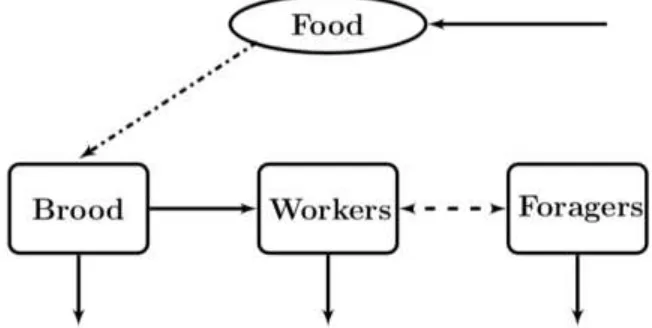
Brood enter the worker class through the process of eclosion and then are naturally recruited to foraging typically within three weeks. When the forager population is too low, more workers are recruited to become foragers. In the case of too many foragers, either there is a delay in recruitment, referred to as social inhibition, or a portion of foragers transition back to the role of a worker [6]. Aside from recruitment, workers may also leave the worker class through natural death or death induced by lack of food supply. Workers are entering the forager class via natural recruitment, or hastened recruitment, depending on the forager population. Foragers leave the forager class either through recruitment back to the worker class due to overpopulation of foragers, or through natural death or death induced by lack of food supply.
With the food supply, we assume the foragers are consuming their portion of food (in grams) and storing the remainder that is collected in the hive. The food supply is assumed to grow logistically. Note that with a lower forager population, the overall growth rate of the incoming food supply is lower. Workers then remove food from the supply in order to feed and nurture themselves along with the existing brood; also this relationship between workers, supply, and workers encountering food per unit time is dictating how many brood are being born.
[image:3.595.134.460.370.534.2]A compartmental diagram of the model can be seen in Figure 1. Empirical data supports that sex-allocation ratios of pupae or adults are typically female biased; therefore this model only considers the female population of the hive [14]. We do not distinguish between uncapped brood and capped brood, and assume them all to be a part of the brood class similarly. Although the food supply in a bee colony consists of mostly nectar (carbohydrates) and a small quantity of pollen (protein), we do not distinguish between the two.
Figure 1. Schematic representation of the compartmental model. Brood eclose into workers, then mature to foragers. Food is collected by the foragers, while the workers and available food develop brood (dashed-dotted line). In the case of not enough foragers, workers precociously transition to the forager class; and if there is an abundance of foragers, the
recruitment of workers to foragers is delayed or foragers revert back to workers (dashed line).
We assume that in the absence of a bee population, the food supply (S) grows logistically at the rate, r, with a carrying capacity, K. We implement a Holling Type II functional response to examine the relationship between the food supply, workers (W), and brood (B) being born. Here a is the encounter rate of the workers with the food supply per unit time, c is the conversion of the food to brood, and b is the amount food required to reach half the maximum birth rate of brood. Brood eclose at a rate, γ, and the workers are naturally recruited to foraging at the rate, αmin. The ratio of foragers (F) to workers is represented by α, and when the populations are out of proportion the adult bees will transition either to or from each class at a rate of σ. We assume the death rates for each class (μB , 𝜇𝑊, and μF) and growth rate of food supply to be constant.
These assumptions lead to the following system of nonlinear ordinary differential equations:
𝑑𝐵 𝑑𝑡 =
𝑐𝑎𝑆𝑊
𝑏+𝑆 − 𝛾𝐵 − 𝜇𝐵𝐵, (1)
𝑑𝑊
𝑑𝐹
𝑑𝑡 = 𝛼𝑚𝑖𝑛𝑊 + 𝜎(𝛼𝑊 − 𝐹) − 𝜇𝐹𝐹, (3)
𝑑𝑆
𝑑𝑡 = 𝑟𝑆 (1 − 𝑆 𝐾) −
𝑎𝑆𝑊
𝑏+𝑆 . (4)
Analytic Results
We analyze the mathematical model (Eqn. 1 - Eqn. 4). The trivial equilibrium point (0,0,0,0) always exists and it is always unstable. The equilibrium (0,0,0,K) is of importance since it indicates whether a colony can persist or not. The basic demographic reproductive number for the bee population is:
𝑅𝑑 = (𝛼𝜎+𝛼𝑚𝑖𝑛)𝜎
(𝛼𝜎+𝛼𝑚𝑖𝑛+𝜇𝑊)(𝜎+𝜇𝐹)+
𝛾𝑐𝐾
(𝛾+𝜇𝐵)(𝛼𝜎+𝛼𝑚𝑖𝑛+𝜇𝑊)(𝑏+𝐾) . (5)
Theorem. If Rd < 1, then the equilibrium (0,0,0,K) is locally asymptotically stable. If Rd > 1,
(0,0,0,K) is unstable and there exists an interior equilibrium (coexistence of bees with food supply). Here we give a biological interpretation of the demographic reproduction number. The term, 𝛼𝜎+𝛼𝑚𝑖𝑛
𝛼𝜎+𝛼𝑚𝑖𝑛+𝜇𝑊, is the proportion of workers promoted to the role of foraging,
𝜎
𝜎+𝜇𝐹, is the proportion of foragers demoted to the role of a worker, 𝛾
𝛾+𝜇𝐵, is the proportion of brood that survive and become workers, 𝑐𝐾
𝑏+𝐾, is the number of brood produced by a worker per unit time,
𝛼𝜎
𝛼𝜎+𝛼𝑚𝑖𝑛+𝜇𝑊, is the proportion of precocious workers becoming foragers, and 1
𝛼𝑚𝑖𝑛+𝜇𝑊, is the average time spent as a worker when the colony is in homeostasis. The meaning of Rd becomes clear for the simple case σ= 0 (without social inhibition):
𝑅𝑑 = ( 𝛾 𝛾+𝜇𝐵) (
𝑐𝐾 𝑏+𝐾) (
1
𝛼𝑚𝑖𝑛+𝜇𝑊) (6) The first term in Rd is
𝛾
𝛾+𝜇𝐵, which is the proportion of brood eclosing into workers. Next the term, 𝑐𝐾
𝑏+𝐾, is the number of brood produced by a worker per unit time. Finally the last term, 1
𝛼𝑚𝑖𝑛+𝜇𝑊, is the average time spent in the worker class during homeostasis. Therefore the basic demographic reproduction number during homeostasis represents the average number of worker bees produced per worker bee during the average lifespan of a typical worker bee.
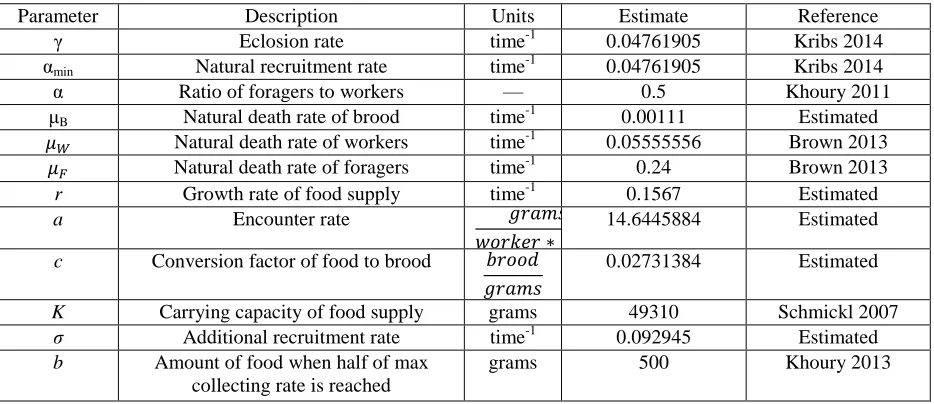
[image:4.595.66.533.598.800.2]For the case of Rd > 1, a Hopf bifurcation is found. We choose b as our bifurcation parameter and fix the other parameters from Table 1. We found that a Hopf bifurcation occurs around b = bc = 3.194001536. This can be also seen in Figure 2.
Table 1. Parameter definitions, units, and estimated values.
Parameter Description Units Estimate Reference
γ Eclosion rate time-1 0.04761905 Kribs 2014
αmin Natural recruitment rate time-1 0.04761905 Kribs 2014
α Ratio of foragers to workers — 0.5 Khoury 2011
μB Natural death rate of brood time-1 0.00111 Estimated
𝜇𝑊 Natural death rate of workers time-1 0.05555556 Brown 2013
𝜇𝐹 Natural death rate of foragers time-1 0.24 Brown 2013
r Growth rate of food supply time-1 0.1567 Estimated
a Encounter rate 𝑔𝑟𝑎𝑚𝑠
𝑤𝑜𝑟𝑘𝑒𝑟 ∗ 𝑡𝑖𝑚𝑒
14.6445884 Estimated
c Conversion factor of food to brood 𝑏𝑟𝑜𝑜𝑑
𝑔𝑟𝑎𝑚𝑠
0.02731384 Estimated
K Carrying capacity of food supply grams 49310 Schmickl 2007
σ Additional recruitment rate time-1 0.092945 Estimated
b Amount of food when half of max collecting rate is reached
Parameter Estimation and Simulations
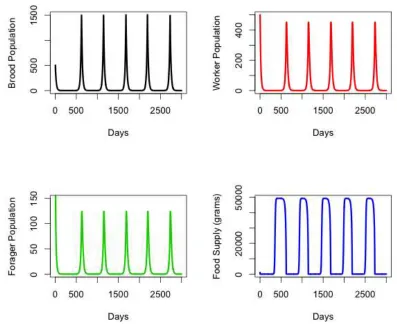
The parameter estimations are summarized into Table 1. Our simulations show the population growth and decline of the brood, workers, foragers, and food supply over time. If we look at Figure 2, one can see that if there is an initial amount of food in the hive, then the brood, workers, foragers, and food supply will all grow and decline periodically.
In our simulations we have the period of each oscillation to be 500 days. Looking at these simulations one can see that the honeybees have a strong resilience, since when the population is near zero the bees are able to survive and prevent total collapse. If we consider a stochastic effect on the population near zero, then there is a probability that the bees can die out.
[image:5.595.89.486.304.628.2]Figure 2 shows that when there is a low amount of food, there is a low population of the brood, workers, and foragers. We can infer that since the quantity of food is low, the mechanism of early recruitment is at play in helping the colony to persist and increase its numbers. However, as the population grows, the demand for food also increases, therefore the overall food supply decreases. This behavior becomes cyclic, creating periodic behavior as shown in the numerical simulations.
Figure 2. Oscillating behavior for all three honeybee classes, as well as in the food supply within the colony.
Elasticity of Parameters on Rd
We are interested in what conditions affect honeybee colony viability. Thus we analyze the reproductive number Rd. If Rd > 1 then the colony will thrive. However if Rd < 1 the colony will surely collapse. All of our parameters influence the basic reproductive number and stability of equilibria. We, however, are most interested in σ, the social inhibition rate, and r, the gathering rate of food, since both play a key role in survivability.
the maximum birth rate is reached b can induce colony collapse because foragers need to gather more food to feed the growing brood population, thus the foragers will die out faster.
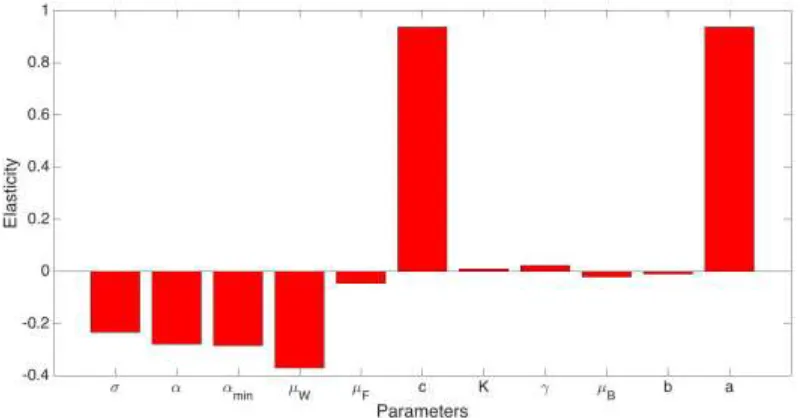
The brood population increases at an exponential rate significantly higher than the death rate, and as a result the death rate of brood 𝜇𝐵 is rendered insignificant to the vitality of the hive. Nevertheless, increasing the brood mortality can lead to colony collapse. Increasing the amount of food that bees can store K can increase Rd since the more food the colony can store, the more capable it is of surviving.
[image:6.595.96.498.235.444.2]An interesting relationship to note is that the elasticity of the death of brood is of the opposite sign of the elasticity of eclosion rate γ. Increasing the eclosion rate can lead to colony survival, as the rate of brood becoming worker bees increases with no negative consequences (as the eclosion rate would be natural).
Figure 3. Elasticity of the parameters and their effect on scaled Rd.
Surprisingly, the death of foragers 𝜇𝐹 has very little influence relative to other parameters, but realistically it could lead to colony collapse since the colony depends on foragers to collect food. This is not the case with our model since the growth rate of food supply is not a function of the amount of foragers.
An increase in social inhibition σ can lead to colony collapse, since social inhibition is caused by the pheromones from foragers signaling for the delay of worker to forager promotion (higher social inhibition rate means the delay of recruitment). Thus increasing σ can potentially halt the flow from workers to foragers.
The parameter with the second most considerable influence on Rd is the conversion factor, c. An increase in the conversion factor can lead to survival. This is reasonable since the conversion factor is in terms of the amount of food given to the brood, as well the birth rate of the brood. Thus c is necessary to expand the brood class. Note that an increase of c does not imply a food shortage caused by the amount of brood, for the conversion factor considers an increase in nutrition that would maintain the population.
Conclusion
In this paper, we model the interaction dynamics between honeybees and the food available in a honeybee colony. Depending on parameter values, our model shows that the brood, workers, and foragers all die if there is no food. However if there is food inside the hive, our model shows that the brood, workers, foragers, and food supply can coexist. We then found a threshold value Rd, where if Rd < 1 the bees die out and if Rd > 1 the bees will live on.
Sensitivity analysis was done on our threshold Rd. Through finding the elasticity of each parameter on Rd, we found that the rate at which a worker bee encounters food, a, has the strongest positive effect on the threshold Rd. While the death rate of the worker bees, 𝜇𝑊, has the strongest negative effect on our threshold Rd.
Under our parameters, simulations show the extinction of the population if no food is introduced in the system, even with an arbitrary amount of foragers. Extinction under these circumstances occurs because the hive cannot sustain itself; it sends workers to their early deaths, and the foragers die at a faster rate. Eventually the workers and foragers die out, and the brood closely follow their demise. As long as we have food in the system, the population will find a way to thrive, since the initial condition of food is data sensitive. If there is a lack of workers, the foragers will revert to workers at a fast rate. It also follows that if there is a lack of foragers, the influx of workers will be tremendous at first but then slow down.
Acknowledgements
This research was conducted in Mathematical and Theoretical Biology Institute (MTBI) at the Simon A. Levin Mathematical, Computational and Modeling Sciences Center (SAL MCMSC) at Arizona State University (ASU). We would like to thank Dr. C. Castillo-Chavez, Executive Director of MTBI. This research was partially supported by grants from the National Science Foundation (DMS 1263374), the National Security Agency (H98230-15-1-0021), the Office of the President of ASU, and the Office of the Provost at ASU.
References
[1] Katherine A. Aronstein, Eduardo Saldivar, Rodrigo Vega, Stephanie Westmiller, and Angela E. Douglas, How varroa parasitism affects the immunological and nutritional status of the honey bee, apis mellifera. Insects, 3(3)(2012)601-615.
[2] Matt I. Betti, Lindi M. Wahl, and Mair Zamir, Effects of infection on honey bee population dynamics: A model. PLoS ONE 9(10): e110237. doi:10.1371/journal.pone.0110237 2014.
[3] Scott Camazine, James Sneyd, Michael J. Jenkins, and J.D. Murray, A mathematical model of self-organized pattern formation on the combs of honeybee colonies, Journal of Theoretical
Biology, 147(4)(1990)553-571.
[4] Hermann J. Eberl, Mallory R. Frederick, and Peter G.Kevan, Importance of brood maintenance terms in simple models of the honeybee-varroa destructor-acute bee paralysis virus complex. In Electron. J. Di. Eqns., Conf, volume 19, pages 85-98, 2010.
[5] van Engelsdorp D, Evans J.D., Saegerman C., Mullin C., Haubruge E., Nguyen B.K., et al., Colony Collapse Disorder: A Descriptive Study. PLoS ONE 4(8)(2009) e6481. doi:10.1371/journal.pone.0006481
[7] Yun Kang, Marisabel Rodriguez-Rodriguez, and Stephen Evilsizor, Ecological and evolutionary dynamics of two-stage models of social insects with egg cannibalism, Journal of Mathematical Analysis and Applications, 430(1)(2015)324-353.
[8] David S. Khoury, Andrew B. Barron, and Mary R. Myerscough, Modelling food and population dynamics in honey bee colonies. PLoS ONE 8(5)(2013) e59084. doi:10.1371/journal.pone.005908
[9] David S. Khoury, Mary R. Myerscough, and Andrew Barron. A quantitative model of honey bee colony population dynamics. PloS ONE, 6(4)(2011):e18491.
[10] Christopher M. Kribs-Zaleta and Christopher Mitchell, Modeling colony collapse disorder in honeybees as a contagion. Mathematical biosciences and engineering: MBE, 11(6)(2014)1275-1294.
[11] Myrsini E. Natsopoulou, Vincent Doublet, and Robert J. Paxton, European isolates of the microsporidia nosema apis and nosema ceranae have similar virulence in laboratory tests on european worker honey bees. Apidologie,(2015)1-9.
[12] Benjamin P. Oldroyd, What's killing American honey bees. PLoS Biol, 5(6)(2007)e168.
[13] Clint J. Perry, Erik Svik, Mary R. Myerscough, and Andrew B. Barron, Rapid behavioral maturation accelerates failure of stressed honey bee colonies. Proceedings of the National Academy of Sciences, 112(11)(2015)3427-3432.
[14] Francis L.W. Ratnieks and Laurent Keller, Queen control of egg fertilization in the honey bee, Behavioral Ecology and Sociobiology, 44(1)(1998)57-61.
[15] Gene E. Robinson. Regulation of division of labor in insect societies. Annual review of entomology, 37(1)(1992)637-665.
[16] Stephen Russell, Andrew B. Barron, and David Harris, Dynamic modelling of honey bee (apis mellifera) colony growth and failure. Ecological Modelling, 265(2013)158-169.
[17] T. Schmickl and K. Crailsheim, Cannibalism and early capping: strategy of honeybee colonies in times of experimental pollen shortages, Journal of Comparative Physiology A, 187(7)(2001)541-547.