Knowledge in pollution-saving technological change
A thesis submitted to the Department of Geography and
Environment of the London School of Economics and Political
Science for the degree of Doctor of Philosophy
David Grover
Declaration
Acknowledgements
Thesis abstract
Table of contents
Introduction ... 10
1. Motivation ... 10
3. The meaning of knowledge, technological change and technological progress . 21 4. Research approach ... 26
5. References ... 31
Paper 1: Do flexible instruments really induce more environmental R&D? ... 41
1. Introduction ... 43
2. Theory and hypothesis ... 45
a. Flexible environmental policy and R&D ... 45
b. Electric power sector liberalisation and R&D ... 50
c. The liberalisation of environmental policy... 54
3. Research approach ... 58
a. Model specification ... 58
b. Dependent variable ... 61
c. Main explanatory variables ... 65
d. Control variables ... 69
4. Regression results ... 71
a. Implementation of the hypothesis test ... 72
b. Estimates and interpretation ... 72
c. Model quality checks ... 76
5. Analysis and contributions ... 80
6. References ... 86
7. Appendix ... 95
Paper 2: How ‘technological’ is pollution-saving technological change? ... 98
1. Introduction ... 100
2. Literature: knowledge, technology, environment ... 103
a. Energy-saving technological change ... 105
b. Emission-saving technological change... 107
c. Technological change in climate policy models ... 109
4. Case evidence ... 117
a. Patterns in plant-level compliance... 117
b. Productivity gains in coal mining ... 125
c. Scrubbers: the exception? ... 132
5. Econometric evidence ... 137
a. Dependent variable and model ... 137
b. Independent variables ... 141
c. Data ... 146
d. Linear regressions ... 147
e. Robust and quantile regressions ... 155
6. Analysis and contributions ... 161
7. References ... 167
8. Appendix ... 176
Paper 3: What makes a pollution-saving invention technologically influential? ... 181
1. Introduction ... 183
2. Literature: the causes of influential inventions ... 184
a. Attributes of inventions and inventors ... 184
b. Demand for technological possibility ... 187
c. Supply of technical knowledge ... 189
3. Research approach: patents for motor vehicle pollution abatement ... 193
a. Case choice ... 193
b. Dataset construction ... 196
4. Quantitative analysis ... 200
a. Dependent variable ... 200
b. Descriptive analysis ... 201
c. Test variables ... 211
d. Control variables ... 215
e. Regression results ... 218
f. Robustness ... 222
5. Analysis and contributions ... 226
6. References ... 230
7. Appendix ... 240
b. Construction of Boolean search term ... 240
c. Supplemental regressions ... 241
Conclusions: findings and implications ... 248
1. A pattern for knowledge ... 248
2. Substantiation of findings ... 253
3. Implications for theory and policy ... 258
4. References ... 263
Tables and figures
Introduction
Figure 1: Knowledge in pollution-saving technological change……….….21
Paper 1
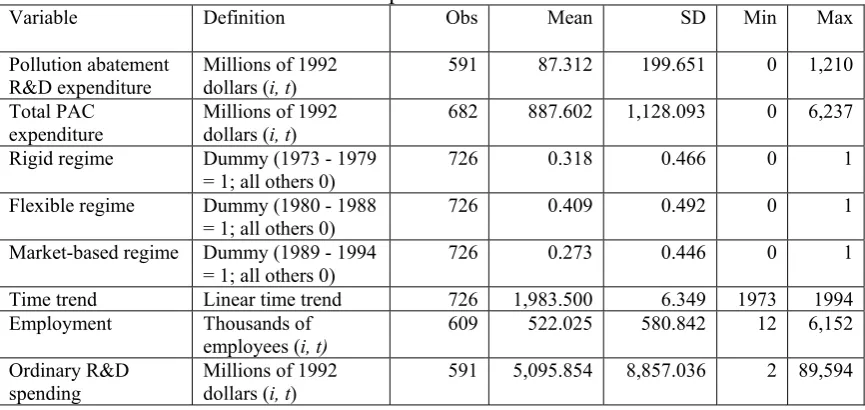
Table 1: Variable definitions and descriptive statistics... 71Table 2: Regression evidence... 73
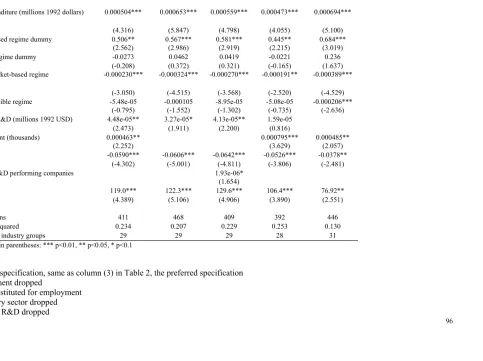
Table 3: Model quality checks ... 96
Table 4: Estimates without industry groups with missing values ... 97
Figure 1: Pollution abatement R&D spending, 1972 - 1994 ... 63
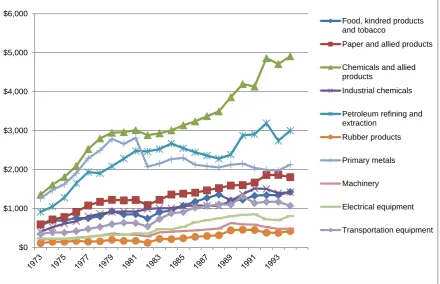
Figure 2: Total pollution abatement R&D spending by industry group ... 64
Figure 3: PAC capital spending by industry group ... 66
Figure 4: PAC operating expenditure by industry group ... 67
Figure 5: Error term distribution ... 78
Paper 2
Table 1: Unit level compliance strategies with Title IV, 1996 – 2005 ... 119Table 2: Coal production by region, 1988 and 1997 ... 128
Table 3: Descriptive statistics ... 145
Table 4: Regressions with change-in-intensity measure ... 148
Table 5: Regressions with growth measure ... 151
Table 6: Summary statistics for skewed residuals ... 155
Table 7: Weighted compliance strategy declarations ... 176
Table 8: Robust regression estimates ... 178
Table 9: Quantile regressions - change in intensity ... 179
Table 10: Quantile regression – growth ... 180
Figure 1: Emission-saving technological change ... 104
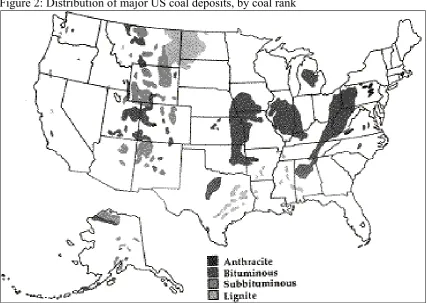
Figure 2: Distribution of major US coal deposits, by coal rank... 126
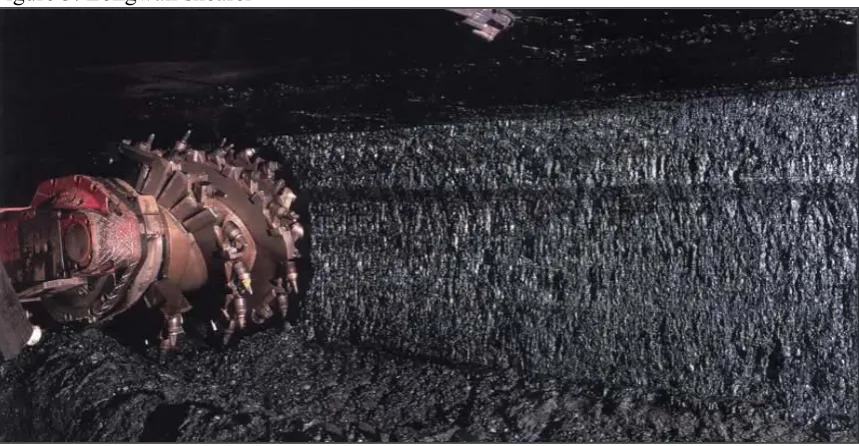
Figure 3: Longwall shearer ... 127
Figure 4: Distribution of change and growth measures ………125
Figure 5: Residuals ... 153
Figure 6: Knowledge coefficients from quantile regressions ... 158
Figure 7: Coefficients from quantile regressions for knowledge unintensive methods ... 160
Paper 3
Table 1: Structure of automobile industry patent dataset... 200Table 2: Descriptive statistics for citations received, by patent type ... 202
Table 3: Characteristics of highly-cited pollution abatement patents: HJT method ... 207
Table 4: Characteristics of highly-cited pollution abatement patents: other measures ... 208
Table 5: Proportion of pollution abatement patents by technology classification ... 210
Table 6: Correlation matrix for knowledge composition variables ... 215
Table 8: Test of the cost of polluting on invention technological influence ... 218
Table 9: Test of knowledge composition on invention technological influence ... 220
Table 10: Discrete change in citations received ... 222
Table 11: Comparison of estimation methods ... 223
Table 12: Estimates with year dummies ... 242
Table 13: Estimates with firm dummies ... 244
Table 14: Split sample and other model quality checks ... 246
Table 15: Time trend regressions ... 247
Figure 1: All patents granted and mean citations received, by year ... 203
Figure 2: Distribution of citations received by patent type ... 204
Introduction
One of the driving forces behind technological advance is the production and accumulation of technical knowledge. This research investigates the role that technical knowledge has played in technological change with respect to pollution emissions in the past, and the role that technical knowledge might play in technological change with respect to greenhouse gas (GHG) pollution in the future.
This research makes several original contributions. It uses new quantitative datasets to test three novel hypotheses about the role that knowledge plays in this specific kind of technological change: pollution-saving technological change. To test these hypotheses it uses method to ‘suspend’ the influence that the design of the policy instrument for controlling emissions tends to exert on the role of knowledge in this kind of change. The findings that flow from this research suggest that R&D and learning play a patterned and systematic role in pollution-saving technological change. On the basis of the body of evidence considered here, ‘advanced’ pollution-saving knowledge has historically played a smaller and more nuanced role in firms’ technical responses to pollution control regulation than might be expected. When firms are left to decide their own technical change pathways, they go to length to adapt and repurpose the knowledge and technologies they already possess to the new problem of conforming to pollution control regulation. Only when firms have exhausted the technical possibilities of their pre-existing knowledge do they begin to search for new knowledge. In the subsequent process of learning and discovery firms tend to disfavour knowledge and technology that has no other purpose than controlling pollution. A pre-existing knowledge stock that is broad and diverse benefits the learning and discovery process more than a pre-existing knowledge stock that is narrow and specialised. This pattern sheds light on how knowledge-related factors shape pollution-saving technological change within the broader growth process.
1. Motivation
2003; Pearce and Warford 1993; Solow 1991). A key question is whether technological progress can be quick enough to compensate for the environmental costs of growth. This question sits today amidst worrying scientific evidence about the impact on human welfare that a destabilised climate could cause. At the heart of the question of how to sanitize the process of wealth creation is therefore technical knowledge: its production, its accumulation, its absorption, its variety and its embodiment in economic action.
In the last five years there has been a burst of interest in the role of knowledge and technology in mitigating the release of GHG emissions in the context of long run growth. Brock and Taylor (2010) for example set up a modified ‘green’ version of the Solow growth model that includes a constant rate of technological progress in pollution abatement. Brock and Taylor assume that this variety of technological progress advances at a constant rate, but they do not explore the role of learning, R&D and technical knowledge in that advance. Similarly, Acemoglu et al (2012) develop a model in which knowledge accumulation through R&D is both endogenous to the production activities of firms and ‘directed’ by policy toward a clean input sector. In their model, the redirection of R&D activity by policy from the dirty sector to the clean sector makes it possible for growth to be sustained indefinitely. Acemoglu et al’s model is not based on empirical evidence about the relationship between R&D activity and clean production, however. Aghion and Howitt (1999) and Aghion, Hemous and Veugelers (2009) recognise that the ‘technology of innovation’ is relatively clean compared to the technology of producing tangible capital goods. They model a growth process in which sustained growth is not beyond the realm of possibility in an economy that continues to produce a steady flow of knowledge capital geared toward environmental protection. Their model would also benefit from empirical evidence about the relationship between knowledge and environmentally favourable growth outcomes. All of these recent contributions situate pollution-saving technological change at the heart of a cleaner growth process. They tend to pay less attention to the role that technical knowledge has played in cleaner growth empirically.
One reason that R&D and learning sit at the heart of these models of indefinitely sustained growth is that these growth models themselves are underpinned by the principles of endogenous growth theory. Endogenous growth theory has moved R&D and learning even closer to the core of the growth process (Aghion and Howitt 1999; Grossman and Helpman 1997). Some of the biggest advances in growth theory in the last 25 years have come from integrating the effects of learning, R&D and knowledge accumulation more fully into the account of how growth happens when it does, and why growth happens in some places but not others (Lucas 1988; Romer 1986). Technological advance also played a role in the neoclassical account of growth (Solow 1956; Nordhaus 1969). The difference in that account was that progress in the chemical, biological and engineering sciences ticked steadily along at a constant rate in the background. Firms benefitted from that constant progress by being able to combine capital and labour in increasingly productive ways. However, firms were unable to influence the rate of progress themselves. There was no feedback linking what firms did themselves in terms of learning or R&D to the economy-wide rate of technological progress.
Endogenous growth theory broke from the old assumption of a constant rate of technological progress (Romer 1994). The rate of progress could now be influenced not just by autonomous scientific advance, but by what firms actually did themselves. In the endogenous growth theory account, firms discover ways to combine inputs more productively by investing in R&D and engaging in by-doing. R&D and learning-by-doing lead to the accumulation of a new kind of capital, knowledge capital. Knowledge capital raises productivity by augmenting how effectively firms use labour and capital. Knowledge capital is an unusual kind of capital because it is expensive to produce but comparably easy and inexpensive to reproduce. This means that the R&D and learning that one firm invests in benefits not just the productivity of the firm that has made the investment, but also the productivity of other firms in the economy that did not make the investment, both competitors and collaborators, through the spillover of knowledge to them (Antonelli 2002; Hall, Mairesse and Mohnen 2009; Jaffe, Trajtenberg and Fogarty 2000; Romer 1987).
Endogenous growth theory makes a convincing case that universally new technical knowledge plays an important role in helping firms derive more output from each unit of ‘ordinary’ inputs like labour and capital. But it may not follow that technical knowledge plays the same role in helping firms derive more output from each unit of an ‘environmental’ input. Productivity gains with respect to an environmental input may involve a different kind of knowledge, or involve using knowledge in a different way, or involve finding substitutes for acquiring new knowledge, or involve less learning and R&D with respect to controlling pollution altogether. Instead, environmental productivity gains may rely more on firms and industries shifting and switching between existing technologies. Productivity gains may arise more through the recycling and repurposing of existing knowledge than through the discovery and refinement of universally new knowledge. It may be incorrect to generalize endogenous growth theory’s predictions about the effect of knowledge on ordinary productivity, to the effect of knowledge on environmental productivity.
A better understanding of the role of knowledge in pollution-saving technological change comes from appreciating the special characteristics of the environment as a production input. This research frames the environment as an ‘input’ that a firm or industry uses in its production process. This input is the capacity of the environment to assimilate pollution emissions (Cropper and Oats 1992; Lopez 1994). The environment as an input has features that set it apart from ‘ordinary’ inputs like labour and capital. It is a special kind of input. For example:
It is possible for many firms to use the environment as a disposal sink all at
once without impinging strongly on one another’s use of that resource. The environment as an input tends to be non-rivalling, at least in the short term.
It is generally costless for a firm to use the environment as a disposal sink in
the absence of regulation.
In the presence of regulation, the cost signal connected to using the
environment is only as valid as the enforcement action of the regulator.
Firms use labour and capital in innumerably different ways, however all
firms use the environment in the same way, as a disposal sink.
believe that learning and R&D play quite a different role in this specific change process than endogenous growth theory might predict.
2. Technology, industry and environment in broader perspective
Several research themes running through the science, technology and innovation studies (STIS), economic history and business and environment studies literatures shed light on the role that knowledge plays in pollution-saving technological change. This section discusses three themes from these literatures: (1) the differences between incremental and radical innovation events, (2) the distinction between ‘hard’ technology and ‘soft’ organisational changes that interact to shape the responses of firms and industries to pollution, and (3) the relationship between pollution reduction responses that involve end-of-pipe controls versus those that involve integrated, clean technology approaches. These three themes help to elaborate the ways that knowledge and technology have mediated the two-way relationship between industry and environment in the past, and they give some indication of the role that knowledge and technology are likely to play in facilitating deep GHG emission reductions in future.
To appreciate the differences between incremental and radical innovation events consider a thought experiment involving a factory in complete initial technological stasis. Imagine that the factory produces a single good and that the production method it uses to produce the good, the technology, never changes. Other things at the factory change, but not the production technology. Factory workers come and go but their skill sets never improve. Machinery eventually wears out and breaks down, and when it does, it gets replaced with the exact same type of machinery. The factory sells the good it produces to consumers who never get tired of the quality or price of the good. Also imagine that the factory pollutes but that the government does not require the factory to do anything about its pollution. The basic state of knowledge that underpins the factory’s production technology stays exactly the same.
Incremental innovation events tend to emerge in response to changes in the producer’s external operating environment, for example a new requirement by government that a producer reduce its pollution emissions (Ashford 1993; Mowrey and Rosenberg 1979; Konnola and Unruh 2007). Incremental innovation events tend to fit comfortably within broader dominant technological forms and they tend not to be threatening to those forms. Rather than being threatening, incremental innovation events tend to refine dominant technological forms in ways that improve their functionality or usefulness (Abernathy 1978; Freeman and Perez 1988). Dozens of incremental innovation events can occur at a factory in the working life of a single worker.
Because incremental innovations are complementary and non-disruptive to prevailing dominant technologies they tend to be inexpensive to adopt. In the hypothetical factory example an incremental innovation introduced by a worker might pass from a suggestion by a worker into factory-wide production practice relatively quickly. If enough incremental innovation events were to occur at the factory then the consumers of the factory’s good might begin to notice price or quality differences in the good.
When industrial facilities have faced the task of complying with pollution control regulation in the past, they have tended to prefer incremental solutions of one kind or another. These solutions might involve end-of-pipe approaches or process-integrated approaches, but they tend overall to be characterised by gradual, non-disruptive changes to the facility or production process. End-of-pipe solutions emphasise capturing regulated substances before they enter the environment (Lee and Rhee 2006). Filters or pollution-removal equipment is installed to remove pollution from the waste stream (Popp 2012). Catalytic converters on automobiles, flue gas desulphurisation units on power plants, and incinerating ozone depleting substances are examples of end-of-pipe solutions. End-of-pipe solutions tend to affect only the physical asset- and raw material flow-aspects of the facility. They tend not to alter the facility or firm’s existing management or organisational structures or basic production strategy (Barney 1991). Once end-of-pipe hardware is installed, the way that the product or service is produced and delivered remains unchanged (Kemp 1993).
so than end-of-pipe approaches (Theyel 2000). Process-integrated changes can be minor, incremental and non-disruptive, but a distinguishing feature is that they involve some consideration by the facility of the original source of pollution.
One reason that industrial facilities have favoured incremental solutions, either end-of-pipe or process-integrated, is that incremental solutions carry a smaller learning burden than non-incremental or radical ones. End-of-pipe solutions in particular ‘contain’ the learning burden to a separate piece of equipment or a separate process that does not perturb the core knowledge structures that the firm depends on for its revenue stream. These knowledge structures insofar as they define the firm’s core production technology are often finely tuned and proprietary and therefore sensitive to alteration.
The amount of learning that a firm engages in when responding to a pollution reduction requirement specifically tends to be proportional to the depth of the reduction required by the regulator for compliance. For example, Murphy and Gouldson (2000) investigated the compliance response of chemicals and cement facilities in England and Wales to Integrated Pollution Control (IPC) regulation. Murphy and Gouldson found that facility managers consistently eschewed deeper, non-incremental changes in favour of simple, incremental, non-disruptive ones. They write:
[This] research also indicates that because IPC is not associated with challenging targets for environmental improvement in the medium- to long-term it fails to establish the imperative for environmental improvement. As a result environmental issues have yet to be adopted as a strategic concern in regulated companies. One outcome of this is that the opportunities for more radical forms of environmental improvement are unlikely to be exploited. (2000: 34)
The industrial facilities considered in Murphy and Gouldson’s study tended to resist more radical forms of technical change because more radical forms of change were not strictly necessary. Incremental changes were sufficient to meet the stringency of the targets set for them by IPC regulation. Production process ‘tweaks’ were commensurate with the shallow learning that was required to comply. More challenging pollution reduction targets on the other hand might have triggered deeper learning. Deeper learning might have led to fundamentally re-designed products and production processes that eliminate pollution and other environmentally harmful effects at the product, process or business model conception stage (Hawken et al 1999; McDonough and Braungart 2002).
a dedicated environmental manager (Theyel 2000), moving environmental impact considerations higher up in the business decision making process or further back in the business planning process (Russo and Harrison 2005), adopting formal environmental management systems (Florida and Davison 2001), setting environmental standards for suppliers, and finding ways to incentivise employees to come forward with environmental improvement suggestions (Shrivastava 1996; Theyel 2000). One reason that organisational changes are attractive to firms is that they exploit well-honed ‘soft’ capabilities to manage people and processes that the firm already possesses. Re-jigging existing managerial hierarchies, existing performance management systems, existing planning frameworks, and existing accounting and inventory procedures to address the pollution problem can be more efficient and effective than inventing new ones. Soft approaches can be cheaper than new capital outlays. The ease of uptake of soft organisational technologies is consistent with the idea that these technologies allow firms to re-purpose and adapt their existing capabilities to new problems in ways that involve a minimum amount of new learning effort.
While organisational changes are often cheap and easy to implement, some argue that they run the risk of locking in ‘inferior’ pollution reduction solutions in the same way that positive network externalities feeding back from a large number of users can lock in ‘inferior’ physical-material technologies (Arthur 1989; David 1989). Organisational technologies like environmental management systems may improve firm environmental performance initially but also introduce structures that inhibit deeper learning and longer term improvements. Environmental management systems can institutionalise accounting standards, consulting relationships, and regulatory structures that perpetuate a focus on squeezing ever smaller environmental gains out of existing production systems rather than a focus on searching for altogether new, discontinuous, fundamentally clean production systems (Christensen 1997; Konnola and Unruh 2007). This sort of soft technology lock in problem underlines the point that whether or not a ‘hard’ technology makes economic sense to a firm partly depends on the organisational and management structures it already has in place (Nelson and Sampat 2001) as well as the short- or long-sightedness of the regulators’ own demands (Kemp 1997).
(Freeman 1974; Garcia and Calantrone 2002; Dahlin and Behrens 2005) and they often transform the way that some primary human need is satisfied (Geels 2002). They tend to affect a wide variety of industries that might not otherwise have a great deal in common (Helpman 1998; Lipsey et al. 1999). The extent of departure from the technological state of the art is much greater than that brought about by an incremental innovation event.
The distinction between ‘incremental’ and ‘radical’ innovation events as they occur in the real world is not as clear cut as these simple labels might imply. This is because the degree of departure or technological novelty that an innovation event marks depends on the technological frame of reference in which that event occurs (Geels 2002; Unruh 2002). An innovation event can be ‘radical’ within a narrow frame of reference but ‘incremental’ in a broader one. Hall and Andriani (2003) give an example of an innovation event that took place in a British firm involved in the production of motorised lawn care equipment. This example helps illustrate how the meaning of the terms ‘incremental’ and ‘radical’ innovation events can be context dependent:
The project was concerned with the relaunch of a grass-cutting machine designed to edge lawns with a vertical cut and to trim borders with a horizontal cut. The old machine, which was to be replaced, was able to carry out both functions by turning the head containing the rotating cutter through 90°. The visionary brief for the new machine was: “Develop an innovative product in half the normal time.” The vision was quickly translated into the following goals: no increased cost, higher margin, and the elimination of the moveable head, which market research had established consumers did not like. The radical innovation involved a breakthrough, which followed the recruitment of an industrial designer who suggested in a brainstorming session that the cutting functions could be changed by turning the whole instrument over, not just the cutting head. (Hall and Andriani 2003: 147)
At the broadest, society-wide frame of technological reference, some of the most recognisable non-incremental innovation events of the last 100 years have involved significant roles for government actors. ‘Mission-oriented’ R&D projects commissioned by government and carried out by industry-government partnerships have been behind some of the most important advances in biological, nuclear, and information & communication sciences (Greenberg 1966; Hall 2012; Sherwin and Isenson 1966; Soete and Arundel 1997). For example, the invention of the modern jet engine which dramatically lowered transportation times in the civilian sphere is often attributed to aerospace innovation in the military sphere directed by military technology planners (Jewkes, Sawers and Stillerman 1961). Direct government action seems to have been less
important in the non-incremental innovation events that defined the 18th and 19th centuries,
however (Brimblecombe 1987; Schmookler 1962; Schmookler 1965). The emergence of the coal combustion /steam engine/mechanical power complex during the industrial revolution in England between 1750 and 1820 was heavily dependent on private finance, private innovation effort and private organisational structures (Meisenzahl and Mokyr 2012; Pearson and Foxon 2012). In the United States, the emergence of the automobile and the railroads as well as in the electrification of homes and factories was closely connected to innovating, risk-taking individuals and firms (Jewkes, Sawers and Stillerman 1961). Government played a more indirect role in these earlier events by funding and performing some basic R&D, by maintaining a system of intellectual property rights and by keeping monopoly forces in check through the enforcement of anti-trust laws.
In the long history of technological transitions in industry the influence of government actors through pollution reduction regulation on those transitions is a relatively recent phenomenon. This does not mean that industry did not engage in
pollution-saving innovation prior to the mid-20th century. The industrial revolution in
Highly polluting, primitive atmospheric engines were eventually replaced by high pressure steam engines designed by James Watt. These new engines introduced a similar firing procedure to Franklin’s that considerably reduced smoke emissions. The Royal Navy is said to have chosen anthracite coals for its steamships so that the passage of its vessels would be less detectable to potential enemies. In the 1840s a brewery called Meux’s Brewery on Tottenham Court Road in London is said to have been forced by local residents to switch to cleaner burning fuels (cleaner coal) because the smoke from the establishment was damaging the residents’ interior furnishings (Brimblecombe 1987: 90 – 106). A good deal of this anti-pollution innovation activity seems to have occurred in response to direct social pressure applied by the sufferers of pollution emissions on the industrial emitters.
Other accounts describe how long-wave technological transitions in energy and transport have reduced the impact of industry on the environment in absence of anti-pollution regulation and in absence of direct social pressure. Ausubel (1989) describes how wood was the dominant construction material for the rapidly expanding railroad
system in the United States in the mid and late 19th century. Railroad trestles, railroad
bridges, some rails, most rail car bodies and especially railroad cross-ties were all fashioned out of wood. Wood also fuelled the locomotives. Voracious consumption of wood placed pressure on forest resources, wood prices began to rise, and innovations emerged to reduce dependence on the resource. Cross-ties came to be impregnated with creosote which tripled their useful life by preventing rotting, and concrete cross ties emerged in regions in Europe where wood was particularly scarce. More directly relevant to pollution emissions specifically is the transition in personal transportation from horses to automobiles at the end of the 19th century. Ausubel (1989: 76) observes that horses as a personal transportation mode emitted about 940 grams of emissions per mile while the automobiles that replaced them emitted about 5 grams per mile. It has also been widely observed that the carbon content of newly developed energy resources has been steadily declining during the last 200 years. Wood came to be replaced by coal in many applications, then coal by oil, then oil by natural gas (National Research Council 1986).
and changing input prices, and the advancement of scientific understanding that made new production methods possible. To the extent that these long-wave transitions did reduce pollution and natural resource use, this effect seems in many instances to have been more incidental or accidental than the result of deliberate innovation activity by industry directed at reducing pollution emissions.
These questions about the role of knowledge creation, innovation and technological change with respect to industrial pollution are taken up empirically in a relatively modern context in the three studies to follow. The next section now turns to setting out a structured way to investigate the role that technical knowledge has played in modern industrial transitions away from ‘consuming’ various regulated conventional pollutants.
3. The meaning of knowledge, technological change and technological progress
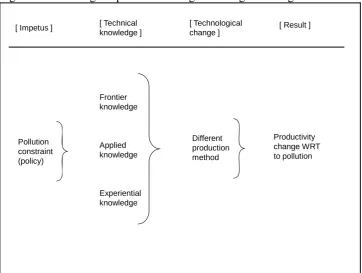
[image:21.595.114.477.468.741.2]This section sets out what is meant by technology and knowledge in this research. It explains how the different attributes of knowledge are conceptualised and measured, including the quantity, the degree of newness, the degree of advancedness, and the type of knowledge. It distinguishes between technological change and technological progress. It elaborates how policy gives rise to a technological change process that is marked by a change in the productivity of output with respect to pollution, as illustrated here.
Figure 1: Knowledge in pollution-saving technological change
Pollution constraint (policy)
Frontier knowledge
Applied knowledge
Experiential knowledge
Different production method
[ Result ]
Productivity change WRT to pollution
[ Impetus ] [ Technological
change ] [ Technical
This research is concerned with the role that learning and R&D play in the space between the enactment of the policy constraint (impetus) and the final productivity change with respect to pollution emissions (result). The fourth column in Figure 1 is the link between this technological change process and the cleanness of the broader growth process. Productivity change with respect to pollution emissions that is insufficiently quick or extensive will eventually retard or truncate growth.
In this research a ‘technology’ is a production possibility. This follows Joseph Schumpeter (1939) and others who considered that a technology is the human possibility to produce something (Romer 1994). A technology is the ability to systematically and repeatedly carry out a productive transformation of materials and energy from lower value form to higher value form (Metcalf 1995: 34), yielding some product or state that is useful to human beings.
A heart transplant procedure, petroleum cracking, and fire are all technologies in this sense. Each of these technologies embodies the possibility to manipulate and recombine lower value materials and energy into higher value goods and services. Each reflects a capability to render in the material world some outcome desirable to human beings. A technology like fire can become embodied in a physical artefact, like a cigarette lighter. Artefacts embody technology in the same way that manufactured goods embody labour. But an artefact is not itself a technology, and to possess an artefact is not necessarily to possess the technology. This is because it is possible to derive the benefit of a technology embedded in an artefact without actually understanding how the technology renders that benefit possible (Layton 1974). The possibility to produce fire exists in its purest and most enduring form separately from the cigarette lighter.
This research considers that knowledge has attributes. Some of the attributes of knowledge are its quantity, advancedness, newness and type.
The unit of denomination of a quantity of knowledge is the ‘idea’ following Peri (2005). An idea is equally ‘sized’ to every other idea in the same way that a dollar is equally sized to every other dollar. A person possesses many ideas at once. Ideas are equal in size but unequal in other attributes. Differences in other attributes make some ideas more ‘useful’ than others. A stock of knowledge (Nadiri and Prucha 1997) is the number of ideas a person or group of persons possesses at a given point in time.
Another attribute of knowledge is its degree of advancedness. The advancedness of an idea refers to its productive potential relative to all other ideas at a given point in space and time. The production possibility frontier (PPF) (also the technology possibility frontier (TPF) and the innovation possibility frontier (IPF) (Binswanger and Ruttan 1978; Nordhaus 1969; Ruttan 1959)) begins to get at the idea of distinguishing among ideas by their degrees of advancedness. In these accounts the most advanced ideas sit on the frontier itself because they hold the possibility for the most productive method of making something that exists at a point in time. At the frontier sits the method of instantly producing a steady flame from the smallest possible quantities of fuel, air, ignition device and labour. Less advanced methods sit before the production possibility frontier because they use more resources to achieve the same result.
As a device for positioning ideas relative to one another in terms of their degree of advancedness, the PPF does not capture the dimension of time. It is a-temporal. A technology may sit on the frontier relative to all other technologies that exist at a single point in time. But the same technology may sit away from the frontier relative to all other technologies that exist at all points in time. To overcome this problem one can think about a continuous envelope of PPFs stretching from the present moment over all previous moments indefinitely backwards in time. This makes it possible to consider an idea’s degree of advancedness relative not just to its idea-contemporaries but to all related ideas that have ever existed in time. This time dimension is important for distinguishing, below, between technological change and technological progress with respect to environmental inputs.
An idea can also be characterised by its degree of newness. Ideas come into existence by taking root in the human mind through research, discovery and learning. Not
all new ideas are of an equal degree of newness. An idea can be new to a single person,
in the everywhere-in-the-world-for-all-points-in-time-to-date sense, then it is universally new (Furman, Porter and Stern 2001). An idea that is universally new tends to also be characterised by the greatest degree of advancedness. An idea coming into existence that falls short of the technological frontier is likely to be a replica of an idea that already existed elsewhere. Sub-frontier ideas are only ‘locally’ new to the individual person, to the firm, to the industry or nation, or to the point in time (Antonelli et al 2006).
Ideas that come into existence can be characterised as frontier, applied or experiential knowledge, as in Figure 1. Frontier knowledge has also been described as ‘basic’, ‘pure’ or ‘scientific’ knowledge (Gibbons and Johnston 1974; Gibbons and Gummett 1977). Frontier knowledge tends to emerge from structured scientific investigations that formally test established scientific laws and principles through the application of established procedures (Vinceti 1990). Applied knowledge tends to emerge from the less-structured investigation of questions of immediate interest to the researcher. These investigations tend to produce knowledge that is useful to the individual researcher but which may not necessarily be useful to a wider community. With applied knowledge, the ideas that are created that are new to the investigator probably already existed elsewhere. Experiential knowledge is relatively easy to replicate and tends not to be particularly advanced. Experiential knowledge is continually being produced and reproduced in very large quantities through learning of common practice and established routine (Arrow 1974; Nelson and Winter 1985).
Firms acquire technical knowledge in ways other than by performing R&D. Firms acquire knowledge through learning by doing, imitating one another, hiring-in knowledge in the form of labour, buying-in knowledge embedded in new equipment, tinkering informally, purchasing technical blueprints, experiencing production accidents, and reverse-engineering products and processes (Archibugi, Howells and Michie 2003; Arrow 1962; Boerner et al 2001). Knowledge acquired in these ways extends the technology frontier for the acquiring firm locally but not the technology frontier for all firms universally in the way that formal R&D tends to. These knowledge acquisition activities often replicate and transfer existing knowledge from one entity to another.
outcome desirable to human beings technically feasible for the first time (Nordhaus 1969; Rosenberg 1985). An invention is not an invention in the truest sense if it has already come into existence elsewhere. Holding the definition of an invention to a standard of universal newness means that no two inventions can be identical. Inventions are heterogeneous by definition (Podolney and Stuart 1995).
Ideas can also be characterised by type. An idea’s type is something like its ‘task relevance’. Knowledge of the principles of fuel combustion is more relevant to discovering a method of producing a steady flame than is an equal amount of knowledge of cell division in biology. Ideas occupy different locations in knowledge space or technology space (Breschi, Lissoni and Malerba 1998; Jaffe 1987; Schankerman 1998). If two ideas are primarily relevant to performing the same task then they occupy the same general location in technology space. If a third idea is primarily relevant to performing a different task then it occupies a different location in technology space.
Locations (or fields) in technology space are separated by distance. Two knowledge fields can be proximate or distant. Distance can be between two ideas within a single technology field or between groups of ideas across technology fields. The distance between two fields is small if a scientist who is a specialist in field A would find it easy to absorb knowledge from field B which is not his or her own, or to apply knowledge from field B in practice, or to produce knowledge in field B him or herself (Breschi, Lissoni and Malerba 1998). The distance between fields is large if the scientist in field A would have difficult doing any of this in field B. The distance between knowledge fields is asymmetrical. The scientist who normally produces new ideas in field A can have an easier time producing new ideas in field B than a scientist working in field B has producing new ideas in field A (Cincera 2005).
This research is interested in the type of knowledge that is created primarily for the purpose of reducing pollution. To this end, all knowledge across the terrain of technology space is divided into two types according to the end use the scientist or engineer had in mind when they produced the knowledge (OECD 1999). If the knowledge was created primarily for reducing pollution then it is ‘environmental’ knowledge. If the idea was created primarily for any other purpose then it is ‘ordinary’ knowledge.
external stimuli in its production environment (Abernathy 1978; Utterback 1979). External stimuli include shifting consumer tastes, rising or falling fuel prices, social phenomena like industrial action, resource scarcity and policy events (Hicks 1932; Blackman and Bannister 1998). In a technological ‘change’ framework, if a technology does a good job of exploiting the features of its production environment then it is a ‘good’ technology. If a technology is ill-suited to its environment then it is a ‘bad’ technology. Within a technological ‘change’ framework it is only possible to compare technologies in terms of their relative suitedness to the production environment.
The idea of technological ‘progress’ by contrast makes it possible to compare technologies in terms of their intrinsic merits by measuring the direction and extent of change that each technology makes possible (Newell, Jaffe and Stavins 1999; Sue Wing 2006). The direction of technological progress is denoted by whatever input the new production method has made it possible to use less of, relative to the previous production method. The direction of technological progress can be universal or it can be local. The input saved can be labour, capital, energy or the environment. The input of interest here is the use of the assimilative capacity of the environment to absorb pollution emissions (Cropper and Oats 1992; Lopez 1994). The extent of technological progress is denoted by the change in the relationship between output and the input of interest. When output increases but the quantity of the input used remains the same, greater productivity with respect to that input has been achieved. The same is true when, symmetrically, output remains fixed but the quantity of the input decreases (Gillingham, Newell and Pizer 2008; Loschel 2002). This relationship is reflected in the final column of Figure 1 above.
4. Research approach
its own, by buying-in abatement technology from elsewhere, by imitating what its competitors do, by finding ways to comply that involve the minimum amount of new knowledge creation possible, or by doing nothing at all. In each such potential response technical knowledge plays a distinctive role.
This means that there are as many potential ‘roles’ for knowledge to play in response to policy as there are policy design permutations. This creates the central methodological problem in this research, namely that the role of knowledge in pollution-saving technological change is fundamentally shaped by the policy context in which that change occurs.
One way to deal with this problem would be to catalogue the many varied roles for knowledge across the range of possible policy designs. Such a catalogue of roles might make it possible to say that under the grams-per-mile standards commonly used to regulate automobile emissions, basic science R&D plays a large role in firms’ compliance strategies. Such a catalogue of roles might also make it possible to say that under a cap and trade regime used to control SO2 from electric power plants, basic scientific knowledge plays a small role in firms’ responses. The problem with cataloguing is the limited predictive power of this approach. A catalogue of roles for knowledge will only ever be as useful in prediction as the catalogue is reflective of future policy designs and future policy contexts. No two pollutants have the same properties, no two policies are designed exactly alike, and the economic context across nations and time is in constant flux. What would be more useful than a descriptive catalogue of the roles for knowledge would be a generalizable statement about knowledge’s singular ‘role’ across these varied policy design contexts and circumstances.
A better research approach than cataloguing is to treat the policy influence effect as a nuisance variable. The policy influence effect can be seen to be distorting and obscuring the underlying role that knowledge truly plays in pollution-saving technological change. The nuisance variable approach recognises that it is inherently difficult to observe the true and basic nature of this singular role for knowledge in empirical reality. This is because, in empirical reality, the distortive influence of policy is every-present in the technological change process of interest. Yet at the same time it is only ever possible to observe any role for knowledge at all in this variety of technological change in the presence of an environmental policy stimulus. This means that the central methodological challenge of
this research is to identify the role that knowledge plays in a change process that generally
stimulus. To glimpse the role of knowledge ‘independent of’ and ‘undistorted by’ the policy influence effect requires that two things be present in the research strategy.
First, there needs to be an appreciation of the possibility that a singular role for knowledge exists ‘net’ of the policy influence effect and somewhat apart from, but rooted in, the varied and unsystematic roles that are empirically observable. Second, there needs to be an appropriate and purposive set of methodological devices in place for testing different aspects of this pattern. Method that is effective in this regard will create the conditions to test for the hypothesised role of knowledge in a way that does not succumb to the nuisance influence of the policy design.
Both of these elements exist in the research strategy in the three papers in this volume. The papers use econometric modelling and original datasets to formally test for the presence of hypothesised relationships. However, statistical modelling is not relied on as the sole arbiter of what is believed to be true. This is because, in a sense, a statistical model is only ever as ‘good’ as the understanding of the modeller of the relationship being modelled. It is fully possible to accurately model relationships that are not in fact true.
In this research strategy, every effort has been made to ensure that the statistical modelling work is rooted firmly in theory. The conceptual framework discussed earlier in this section gave precise meanings to terms commonly used in the literature to discuss technological change. This makes it possible to be clear in the hypotheses about what is being tested, and to be clear in the test results about what constitutes evidence that supports or refutes the hypotheses. Each paper critically and lengthily reviews relevant prior theoretical and empirical work. Each paper examines the findings from the model in the context of the findings of that prior work. Each paper uses empirical analogy to consider the role of knowledge in pollution-saving technological change. It does this by drawing a comparison with the role of knowledge in energy-saving technological change, for example.
effect of non-environmental policies working in the background at the national level, like R&D tax incentives. All three papers go to length to measure the kind of technological change and knowledge that is specifically pollution-saving. This research avoids wherever possible second-best proxies like technological change and knowledge that is energy-saving. There are strong reasons to believe that the forces that drive pollution-saving technological change are very different to the sources that drive energy- and other ordinary input-saving technological change.
The research approach that runs throughout these studies deals with the empirical distortion caused by the policy influence effect by choosing policy contexts selectively and strategically. Case selection is used to study the policy influence effect directly, or to neutralise the effect, or to hold it constant as a background factor. This makes it possible to observe an underlying role for knowledge in pollution-saving technological change that arises across the evidence in the three papers.
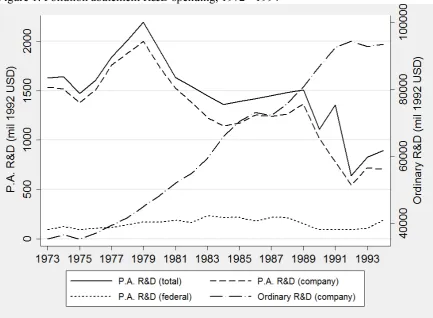
The first paper handles the policy influence effect by embracing it. The dependent variable is industrial environmental R&D spending data from the National Science Foundation covering the years 1972 – 1994, across 30 industry groups. These data show that the level of environmental R&D spending began to decline from about 1979 onwards before dropping off sharply around 1990. The paper operationalises one aspect of environmental policy design: the degree of ‘flexibility’ given to firms to decide how they will go about complying with pollution control regulations. The paper then tests the hypothesis that the degree of flexibility in the prevailing policy regime conditioned the effect of the environmental regulatory burden on the level of environmental R&D spending. That is, the model tests the effect of the abatement burden on environmental R&D spending conditional on policy regime flexibility. The paper deals with the policy influence effect by testing how one aspect of environmental policy design, flexibility, impacts on the creation of pollution-saving technical knowledge.
The first paper finds that the degree of flexibility conditionally diminishes the effect of the regulatory burden on industrial environmental R&D spending. It also finds that flexibility may open the door for less formal, ‘lower-order’ types of knowledge to play a role in compliance. The important methodological point is that this paper handles the policy influence effect by embracing it, rather than by minimising it or effectively holding it constant as do the other two papers.
from electric power plants. It resulted in considerable overall productivity gains in electricity generation with respect to SO2 emissions. This is exactly the kind of productivity outcome that is of interest from the point of view of ‘green’ growth theory. The important methodological point is that while government action induced considerable change in firm production methods in an SO2-saving direction, the form of government action (cap and trade) exerted very little influence over how firms went about achieving this productivity change. Cap and trade was largely technologically neutral.
The dependent variable in the second paper is the extent of productivity change with respect to SO2 emissions undergone by about 600 electric power plants affected by cap and trade. The paper tests the effect of different types of knowledge and techniques on that outcome. It uses a combination of qualitative case material and quantile regression analysis to compare the effect of knowledge intensive and knowledge unintensive techniques in the change process. It finds that some of the most important changes enabling SO2 reductions at the level of the plant occurred far upstream of the plant itself. Very important changes occurred in the coal mining, railroad and industrial boiler manufacturing industries. At plant level, the magnitude of the effect of frontier knowledge tended to be overshadowed by the magnitude of the effect of pre-existing, knowledge un-intensive techniques. The methodological approach of the second paper to dealing with the policy influence effect is to neutralise it. A policy context is chosen that exerts as little influence as possible over the knowledge and technology choices firms made in undergoing the technological change required of them. This reveals a role for knowledge that is relatively undistorted by the policy influence effect.
The policy context in the third paper, automobile emission control, was by contrast anything but neutral with respect to how firms went about complying with regulators’ demands. In the automobile emission control context, the approach of regulators was to set emissions standards just beyond the comfortable technological reach of the automobile companies. This pushed the automobile companies to undertake a considerable amount of original R&D to conform with the standards. The third paper uses this bias in policy design toward frontier knowledge production as a methodological device.
influence is not just the size of the knowledge stock that the automobile company brought to bear on the inventive process, but the composition of the knowledge stock. More diverse knowledge stocks led to more influential inventions. More specialised knowledge stocks led to less influential inventions. In the third paper, a single policy impetus pushes a body of new pollution-saving inventions into existence. This single policy impetus reduces the range of possible causes for why some of those inventions might be more technologically influential than others. The policy influence effect is held constant in this way.
Other specific methods considerations are discussed in the context of each paper. These more specific considerations relate to the econometric and data handling choices taken to test the specific hypotheses. The reader should refer to the econometric evidence sections of the individual studies for the detail of these considerations.
5. References
Abernathy, WJ (1978) Productivity Dilemma. Baltimore, Johns Hopkins MD.
Acemoglu, D, P Aghion, L Bursztyn, and D Hemous (2012) ‘The Environment and
Directed Technical Change’, American Economic Review 102 (1): 131 – 166.
Aghion, P, D Hemous and R Veugelers (2009) ‘No green growth without innovation’, Bruegel policy brief issue 2009/07: 1-8. www.bruegel.org.
Aghion, P and P Howitt (1999) Endogenous Growth Theory. Cambridge, MA: MIT Press.
Amin, A (1999) ‘Learning, proximity and industrial performance: An introduction’,
Cambridge Journal of Economics 23: 121 – 125.
Antonelli, C (2002) The Economics of Innovation, New Technologies and Structural Change. London: Routledge.
Arrow, K (1962) ‘The Economic Implications of Learning by Doing’, Review of Economic
Studies 29 (3): 155-173.
Arrow, K (1969) ‘Classificatory notes on the production and distribution of technological
knowledge’, American Economic Review 59: 29-35.
Arrow, K (1974) The Limits of Organisation. New York: W. Norton.
Arrow, K, B Bolin R Costanza, P Dasgupta, C Folk, CS Holling, BO Jansson, S Levin KG Maler, C Perrings and D Pimentel (1995) ‘Economic Growth, Carrying Capacity, and the
Environment’, Science 268 (28): 520 – 521.
Arthur, WB (1989) ‘Competing Technologies, Increasing Returns, and Lock-In by
Historical Events’, The Economic Journal 99 (394): 116 – 131.
Ashford, N (1993) ‘Understanding Technological Responses of Industrial Firms to Environmental Problems: Implications for Government Policy’, in Environmental Strategies for Industry: International Perspectives on Research Needs and Policy Implications, K Fischer and J Schot, Eds. Washington DC: Island Press.
Ausubel, J (1989) ‘Regularities in technological development: An environmental view’, in Technology and Environment, JH Ausubel and HE Sladovich Eds. Washington, DC: National Academy Press.
Barney, J (1991) ‘Firm resources and sustained competitive advantage’, Journal of
Management 17: 99-120.
Basberg, BL (1987) ‘Patents and the Measurement of Technological Change’, Research
Policy 16: 131-41.
Binswanger, H and V Ruttan (1978) Induced Innovation: Technology, Institutions and Development Baltimore: Johns Hopkins Press.
Mexican Brickmakers’, Journal of Environmental Economics and Management 35 (1): 1 – 21.
Boerner, CS, JT Macher and DJ Teece (2001) ‘A Review and Assessment of Organizational Learning in Economic Theories’, pages 89-177, in Dierkes, MA; A Berthoin; J Child; and I Nonaka (Eds), Handbook of Organisational Learning and Knowledge. New York: OUP.
Breschi, S, F Lissoni and F Malerba (1998) ‘Knowledge Proximity and Technological Diversification’, CESPRI. Bocconi University: Milan.
Brimblecombe, P (1987) The Big Smoke: A History of Air Pollution in London Since Medieval Times. London: Routledge.
Brock, WA and MS Taylor (2010) ‘The Green Solow Model’, Journal of Economic
Growth 15 (2): 127 – 153.
Christensen, CM (1997) The Innovator’s Dilemma. Boston: HBS Press.
Cincera, M (2005) ‘Firms’ productivity growth and R&D spillovers: An analysis of
alternative technological proximity measures’, Economics of Innovation and New
Technology 14 (8): 657 – 682.
Cropper, ML and WE Oates (1992) ‘Environmental Economics: A Survey’, Journal of
Economics Literature 30 (2): 675-740.
Dahlin, KB and DM Behrens (2005) ‘When is an invention really radical? Defining and
measuring technological radicalness’, Research Policy 34 (5): 717–737.
Daly, HE (1992) Steady-State Economics. London: Earthsscan.
Dosi, G (1988) ‘Sources, procedures, and microeconomic effects of innovation’, Journal
of Economic Literature 26 (3): 1120–1171.
Ekins, P (2000) Economic Growth and Environmental Sustainability: The Prospects for Green Growth. London: Routledge.
Florida, R and D Davison (2001) ‘Gaining from green management: environmental
management systems inside and outside the factory’, California Management Review 43:
64-84.
Freeman, C (1974) The Economics of Industrial Innovation. Cambridge, MA: MIT Press.
Freeman, C and C Perez (1988) ‘Structural crises of adjustment, business cycles, and investment behavior’ in Technical Change and Economic Theory, G Dosi, C Freeman, R Nelson, G Silverberg and L Soete Eds. London: Pinter.
Furman, JL, ME Porter and S Stern (2002) ‘The determinants of national innovative
capacity’, Research Policy 31: 899-933.
Garcia, R and R Calantone (2002) ‘A critical look at technological innovation typology
and innovativeness terminology: a literature review’, Journal of Product Innovation
Management 19 (2): 110–132.
Geels, FW (2002) ‘Technological transitions as evolutionary reconfiguration processes: A
multi-level perspective and a case-study’, Research Policy 31 (8-9): 1257-1274.
Gibbons, M and PJ Gummett (1977) ‘Recent changes in Government Administration of Research and Development: A New Context for Innovation?’ Presented to the International Symposium on Industrial Innovation, Strathclyde University.
Gibbons, M and R Johnston (1974). ‘The Roles of Science in Technological Innovation’,
Research Policy 3 (3): 220 - 242.
Gillingham, K., RG Newell and WA Pizer (2008). ‘Modelling endogenous technological
Greenberg, D (1966) ‘HINDSIGHT—DOD study examines return on investment in
Research’, Science 154 (3751): 872.
Grossman, G and E Helpman (1997) Innovation and Growth in the Global Economy. Cambridge, MA: MIT Press.
Hall, R and P Andriani (1998) ‘Analysing intangible resources and managing knowledge
in a supply chain context’, European Management Journal 16 (6): 685-697.
Hall, R and P Andriani (2003) ‘Managing knowledge associated with innovation’, Journal
of Business Research 56 (2): 145-152.
Hall, BH, J Mairesse and P Mohnen (2009) ‘Measuring the Returns to R&D’, NBER working paper 15622. Cambridge, MA.
Hawken, P, A Lovins and LH Lovins (1999) Natural Capitalism: Creating the Next Industrial Revolution. Boston: Little, Brown.
Helpman, E (1998) General purpose technologies and economic growth. Cambridge, MA: MIT Press.
Hicks, JR (1932) The Theory of Wages. London: Macmillan.
Jaffe, AB (1987) ‘Characterizing the “technological position” of firms, with application to
quantifying technological opportunity and research spillovers’, Research Policy 18: 87-97.
Jaffe, AB, M Trajtenberg and MS Fogarty (2000) ‘Knowledge Spillovers and Patent
Citations: Evidence from a Survey of Inventors’, The American Economic Review 90 (2):
215–218.
Kemp, R (1993) ‘An economic analysis of cleaner technology: theory and evidence’, in Environmental Strategies for Industry: International Perspectives on Research Needs and Policy Implications, K Fischer and J Schot, Eds. Washington, DC: Island Press.
Kemp, R (1997) Environmental policy and technical change: A comparison of the technological impact of policy instruments. Cheltenham, UK: Edward Elgar.
Kemp, R and S Pontoglio (2011) ‘The innovation effects of environmental policy
instrumetns – a typical case of the blind men and the elephant?’, Ecological Economics 72:
28 – 36.
Konnola, T and GC Unruh (2007) ‘Really Changing the Course: the Limitations of
Environmental Management Systems for Innovation’, Business Strategy and the
Environment 16: 525-537.
Layton, E (1974) ‘Technology as knowledge’, Technology and Culture 15: 31-41.
Lee, SY and SK Rhee (2006) ‘The change in corporate environmental strategies: a
longitudinal empirical study’, Management Decision 45 (2): 196 – 216.
Lipsey, R, C Bekar and K Carlaw (1998) ‘General Purpose Technologies: What Requires
Explanation?’ in General Purpose Technologies by E Helpman (Ed). Cambridge: MIT
Press.
Lopez, R (1994) ‘The Environment as a Factor of Production: The Effects of Economic
Growth and Trade Liberalization’, Journal of Environmental Economics and Management
27: 163-184.
Loschel, A (2002) ‘Technological change in economic models of environmental policy: A
survey’, Ecological Economics 43 (2-3): 105-126.
Lucas, RE (1988) ‘On the Mechanics of Economic Development’, Journal of Monetary
Malthus, TR (1798) An essay on the principle of population. Oxford, UK: Oxford World Classics.
McDonough, W and M Braungart (2002) Cradle to Cradle: Remaking the Way We Make Things. New York: North Point.
Meisenzahl, R and J Mokyr (2012) ‘The Rate and Direction of Invention in the British Industrial Revolution: Incentives and Institutions’ in The Rate and Direction of Inventive Activity Revisisted, J Learner and S Stern, Eds. Chicago: University of Chicago Press.
Metcalf, JS (1995) ‘Technology systems and technology policy in an evolutionary
framework’, Cambridge Journal of Economics 19: 25-46.
Mowery, D and N Rosenberg (1979) ‘The influence of market demand upon innovation:
a critical review of some recent empirical studies’, Research Policy 8 (2): 102–153.
Murphy, J and A Gouldson (2000) ‘Environmental policy and industrial innovation:
integrating environment and economy through ecological modernisation’, Geoforum 31:
33-44.
Nadiri, MI and Prucha, IR (1993) ‘Estimation of the depreciation rate of physical and R&D capital in the US total manufacturing sector’, NBER working paper no. 4591. Cambridge, MA.
National Research Council (1986) Acid Deposition: Long Term Trends. Washington, DC: NRC.
Nelson, R and B Sampat (2001) ‘Making Sense of Institutions as a Factor Shaping
Economic Performance’, Journal of Economic Behavior and Organization 44: 31–54.
Nelson, RR and SG Winter (1985) An Evolutionary Theory of Economic Change. Cambridge, MA: Harvard University Press.
Nemet, G (2009) ‘Demand-pull, technology-push, and government-led incentives for
Newell, RG, AB Jaffe and RN Stavins (1999) ‘The induced innovation hypothesis and
energy-saving technological change’, Quarterly Journal of Economics 114: 941–975.
Neumayer, E (2003) Weak vs Strong Sustainability. Cheltenham, UK: Edward Elgar.
Nordhaus, WD (1969) Invention, Growth and Welfare: A Theoretical Treatment of Technological Change. Cambridge, MA: MIT Press.
OECD (1987) The Promotion and Diffusion of Clean Technologies. Paris: OECD.
OECD (1999) The Environmental Goods and Services Industry: Manual for Data Collection and Analysis. OECD, Paris.
Pearce, DS and J Warford (1993) World Without End: Economics, Environment and Sustainable Development. Oxford, UK: OUP.
Pearson, PJG and TJ Foxon (2012) ‘A low carbon industrial revolution? Insights and
challenges from past technological and economic transformations’, Energy Policy 50: 117
– 127.
Peri, G (2005) ‘Determinants of Knowledge Flows and Their Effect on Innovation’,
Review of Economics and Statistics 87 (2): 308–322.
Popp, D (2012) ‘The Role of Technological Change in Green Growth’, Research Working Paper 6239, World Bank Development Research Group, Environment and Development Team.
Porter, M and C van der Linde (1995) ‘Toward a New Conception of the
Environment-Competitiveness Relationship’, Journal of Economic Perspectives 9 (4): 97 – 118.
Romer, P (1986) ‘Increasing Returns and Long Run Growth’, Journal of Political
Romer, P (1990) ‘Endogenous Technological Change’, Journal of Political Economy 98: S71–102.
Romer, P (1994) ‘The Origins of Endogenous Growth’, Journal of Economic Perspectives
8 (1): 3–22.
Rosenberg, N (1983) Inside the Black Box. Cambridge, CUP.
Russo, MV and PA Foutes (1997) ‘A Resource-Based Perspective on Corporate
Environmental Performance and Profitability’, Academy of Management Journal 40 (3):
534-559.
Russo, MV and NS Harrison (2005) ‘Organisational design and environmental
performance: Clues from the electronics industry’, Academy of Management Journal 48
(4): 582-593.
Ruttan, VW (1959) ‘Usher and Schumpeter on Invention, Innovation, and Technological
Change’, Quarterly Journal of Economics 73: 596-606.
Schumpeter, JA (1939) Business Cycles, Volumes I and II. New York: McGraw-Hill.
Schankerman, M (1998) ‘How Valuable is Patent Protection? Estimates by Technology
Field’, Rand Journal of Economics 29 (1): 77-107.
Schmookler, J (1962) ‘Sources of inventive activity’, The Journal of Economic History 22
(1): 1-20.
Schmookler, J (1965) ‘Technological change and economic theory’, The American
Economic Review 55 (1/2): 333-341.
Sherwin, CW and RS Isenson (1967) ‘Project HINDSIGHT’, Science 156 (3782): 1571.
Soete, L and A Arundel (1995) ‘European innovation policy for environmentally
sustainable development: Application of a systems model of technical change’, Journal of
European Public Policy 2 (2): 285-315.
Solow, R (1956) ‘A Contribution to the Theory of Economic Growth’, Quarterly Journal
of Economics 70: 65-94.
Solow, R (1991) ‘Sustainability: An Economist’s Perspective’, Eighteenth J. Seward Johnson Lecture, Marine Policy Center, June 14, 1991. Woods Hole, MA: Woods Hole Oceanographic Instiutution.
Theyel, G (2000) ‘Management practices for environmental innovation and performance’,
International Journal of Operations & Production Management 20 (2): 249-266.
Unruh, GC (2002) ‘Escaping carbon lock-in’, Energy Policy 30: 317-325.
Utterback, J (1979) ‘The dynamics of product and process innovations in industry,’ in Hill, C and Utterback, J (eds), Technological Innovations for a Dynamic Economy. Oxford: Pergamon.
Vincetti, WG (1990) What Engineers Know and How They Know It. Baltimore, MD, Johns Hopkins University Press.