Number 6119
Konkoly Observatory Budapest
8 November 2014
HU ISSN 0374 – 0676
LIGHT TIME EFFECT IN THE SYSTEM V2294 Cyg
LIˇSKA, J.
Department of Theoretical Physics and Astrophysics, Masaryk University, Kotl´aˇrsk´a 2, 611 37 Brno, Czech Republic, e-mail: [email protected]
The eclipsing binary star V2294 Cyg (GSC 03564-03059, 2MASS J19402932+5025522, KIC 12019674, ROTSE1 J194028.86+502554.7, ASAS J194029+5026.0) was discovered as a variable object by Akerlof et al. (2000) in data from the ROTSE all-sky survey. They found a preliminary, but incorrect period of variability of 0.26168(4) d. Follow-up observations were performed by Bl¨attler & Diethelm (2000). They detected brightness changes in the range of 13.25–13.58 mag (unfiltered). Subsequently, they determined a better period of 0.35436(4) d, and found the star to be a W UMa type eclipsing binary. The binary star was included in a catalogue of contact binary stars (Pribulla, Kreiner & Tremko 2003) and in the same year it obtained the name V2294 Cyg in the GCVS (Kazarovets et al. 2003). Several different periods have been published up to now, e.g. 0.354317(3) d (Kreiner 2004) or 0.3544890 d (Pigulski et al. 2009). The latter value is taken from a catalogue of variable stars in the Kepler field of view, which is based on ASAS measurements. This catalogue contains information about average brightness in the V -band of 13.158 mag (amplitude 0.37 mag) and in the I-band of 12.210 mag (amplitude 0.31 mag), respectively.
The system V2294 Cyg was measured by the Kepler Space Telescope and the most information about the eclipsing binary come from this great project. Preliminary pa-rameters from the first 44 days of Kepler operations, e.g. period 0.35450 d, effective temperature 5841 K, ratio of temperaturesT2/T1 = 0.91126 and mass ratio 1.06290, were published by Prˇsa et al. (2011). Updated values from a larger dataset (125 days) include the period 0.354492 d, ratio of temperaturesT2/T1 = 1.047 and mass ratioM2/M1 = 0.760 (Slawson et al. 2011).
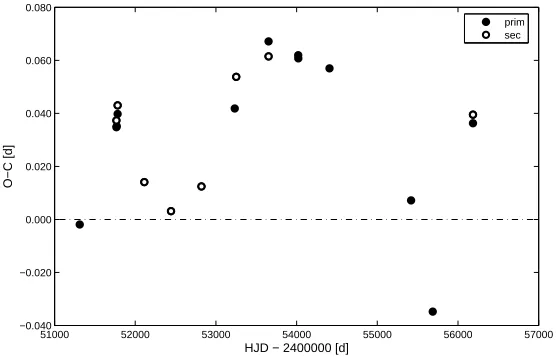
The eclipsing binary V2294 Cyg shows fast and irregular changes with an amplitude of about 2.5 hours in its O–C diagram (Fig. 1). This variability is supported by different published periods. Better orbital elements provided information about cyclic changes in the O–C diagram, which can be explained by the Light Time Effect (LiTE) with an∼8 yr
period (see below).
The latest results from the Kepler project (Conroy et al. 2014) also describe the vari-ability of the period of the V2294 Cyg in terms of LiTE. Unfortunately their results from LiTE modelling are based on measurements obtained over only a short time interval (4 years), therefore the parameters that they found (period of LiTE P3 = 1088.4(34.7) d
51000 52000 53000 54000 55000 56000 57000 −0.040
−0.020 0.000 0.020 0.040 0.060 0.080
HJD − 2400000 [d]
O−C [d]
[image:2.595.156.434.100.281.2]prim sec
Figure 1. O–C diagram of V2294 Cyg constructed with elementsE0= 2451781.365 and P= 0.354328 d adopted from O–C Gateway (Paschke & Br´at 2006).
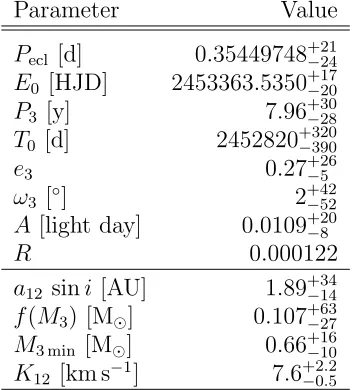
For our study of LiTE in the system, the non-linear least squares method described in Liˇska et al. (2014) was used. All the mid-eclipse timings were used from the O–C Gateway (Paschke & Br´at 2006) and are listed in Table 2 with the corrected types of minima according to our model and original source. All the minima were obtained from CCD light curves and the same value of weights were used for this reason. The best found solution, with the lowest sum of squares of residuals R = 0.000122 and corresponding average uncertainty of individual measurement (0.0024 d), is shown in Fig. 2. Individual parameters together with their uncertainties, determined by the bootstrap method, are summarized in Table 1.
51000 52000 53000 54000 55000 56000 57000 −0.020
−0.015 −0.010 −0.005 0.000 0.005 0.010 0.015
HJD − 2400000 [d]
O−C [d]
KEPLER
model prim sec
Figure 2. O–C diagram of V2294 Cyg with model of 8 years long LiTE according to parameters from Table 1. Baseline of Kepler observations from JD 2454953 to 2456424 is displayed (area between gray
[image:2.595.158.432.506.685.2]Despite the fact that our preliminary solution is based on only 20 times of minima from ground-based observations, it seems that our solution for the three-body system is more convincing than the solution based on the parameters from Conroy et al. (2014). The middle ephemeris for eclipses of the binary system in Heliocentric Julian Date (HJD) can be expressed in the form
Tmin = 2453363.5350+17−20+ 0.35449748 +21
−24d·E. (1)
The orbit of the third body with a period of P3 ∼8 years can be described by
param-eters from Table 1; time of periastron passageT0, eccentricitye3, argument of periastron
ω3 and semi-amplitude of LiTEA. The estimation of the lowest limit of a third body mass from the mass function f(M3) was performed for an assumed total mass of the eclipsing system ofM1+2= 0.9820.173
0.111M⊙ (Huber et al. 2014). Unfortunately, the total mass of the
star V2294 Cyg was determined only from its total brightness in different bands without taking into account that this is a multiple star system. Therefore, the value of M3 min of about 0.66 M⊙ is only a rough estimate. All three stars could have similar masses and
contributions to the total flux.
LiTE allows us to estimate the shape of variations inγ-velocity of an eclipsing binary system caused by the orbit of a third body. Based on our model, the semi-amplitude of these changes is about 8 km s−1
[image:3.595.211.390.456.651.2]. Unfortunately no value for radial velocity for V2294 Cyg has been published yet. High-resolution spectroscopic measurements are necessary for a correct analysis of this system.
Table 1: Determined parameters from LiTE model for the three-body system V2294 Cyg. Mass limit of the third body was estimated from mass functionf(M3), inclination of orbit (i3= 90◦) and mass of
eclipsing binaryM1+2= 0.9820.173
0.111M⊙ adopted from Huber et al. (2014).
Parameter Value
Pecl [d] 0.35449748+21
−24 E0 [HJD] 2453363.5350+17
−20
P3 [y] 7.96+30
−28
T0 [d] 2452820+320
−390
e3 0.27+26
−5 ω3 [◦
] 2+42−52
A[light day] 0.0109+20
−8
R 0.000122
a12 sini[AU] 1.89+34
−14 f(M3) [M⊙] 0.107
+63
−27 M3 min [M⊙] 0.66
+16
−10 K12 [km s−1
] 7.6+2.2
−0.5
part of their Table 4 which therefore have LiTE periods longer than half of the baseline of Kepler observations (more than 2 years). Based on our multi-colour photometry of V2294 Cyg (initiated in 2010) together with high-accuracy Kepler measurements, a more comprehensive study on V2294 Cyg is being prepared.
Table 2: Minima used from the O–C Gateway together with information about corrected minimum-type and used publication.
HJD Type Source
2451311.8785 sec Bl¨attler & Diethelm (2000) 2451766.3434 sec BBSAG 123a
2451766.5180 prim BBSAG 123a 2451771.4790 prim BBSAG 123a 2451781.4048 prim BBSAG 123a 2451781.5852 sec BBSAG 123a 2452112.4986 prim BBSAG 126a 2452443.4300 sec BBSAG 128a 2452820.4443 prim Diethelm (2004) 2453233.4430 prim Diethelm (2005) 2453251.3485 sec Diethelm (2005) 2453652.2840 sec Diethelm (2006) 2453652.4555 prim Diethelm (2006) 2454019.3626 prim Diethelm (2007)
2454020.4244 prim H¨ubscher & Walter (2007) 2454407.3468 sec Diethelm (2008)
2455418.5491 prim H¨ubscher (2011) 2455687.4421 sec BAVM 220b 2456186.4070 prim BAVM 231b 2456186.5874 sec BAVM 231b
Notes: a
BBSAG Bulletins from http://www.astroinfo.ch/bbsag/bbsag e.html, b
BAV Mitteilungen from http://www.bav-astro.de/rb/mitteilungen.php
Acknowledgements: This work was supported by the grant MUNI/A/0773/2013. The author thanks Miloslav Zejda for useful comments and Stephan N. de Villiers for carefully reading and language corrections.
References:
Akerlof, C., Amrose, S., Balsano, R., et al., 2000, AJ, 119, 1901 Bl¨attler, E. & Diethelm, R., 2000,IBVS, 4995, 1
Conroy, K. E., Prˇsa, A., Stassun, K. G., et al., 2014, AJ, 147, 45 Diethelm, R., 2004, IBVS, 5543, 1
Diethelm, R., 2005, IBVS, 5653, 1 Diethelm, R., 2006, IBVS, 5713, 1 Diethelm, R., 2007, IBVS, 5781, 1 Diethelm, R., 2008, IBVS, 5837, 1
H¨ubscher, J. & Walter, F., 2007, IBVS,5761, 1 H¨ubscher, J., 2011,BAVSM,215, 1
Kazarovets, E. V., Kireeva, N. N., Samus, N. N., Durlevich, O. V., 2003,IBVS,5422, 1 Kreiner, J. M., 2004, AcA, 54, 207
Liˇska, J., Skarka, M., Mikul´aˇsek, Z., Zejda, M., 2014, in prep. Paschke, A. & Br´at, L., 2006, OEJV, 23, 13
Pigulski, A., Pojmanski, G., Pilecki, B., Szczygiel, D. M., 2009, AcA, 59, 33 Pribulla, T., Kreiner, J. M. & Tremko, J., 2003,CoSka,33, 38