5
III
March 2017
An Algorithm for Creating Malicious Free
Absolute Trust Peers in P2P Networks
M. Janani1, R. Jeevitha2
1, 2
2nd Semester, Department of CSE, KPR Institute of Engineering & Technology, Coimbatore, TN
Abstract: Peer-to-peer (P2P) computing or networking is a distributed application architecture that partitions tasks or workloads between peers. The peers evaluate other peers based on their past interactions and then aggregate this information in the whole network. However it may not be the true reflection of past behavior of the peers. Moreover such type of aggregation gives only the relative ranking of peers without any absolute evaluation of their past. This is more significant when all the peers responding to a query, are malicious. In such a situation only the peer came to know that who is better among them without knowing their rank in the whole network. Hence to mitigate the attacks by malicious peers and to motivate the peers to share the resources effectively and securely, in this paper, a new algorithm is proposed which accounts for the past behavior of the peers and will estimate the absolute value of the trust of peers. Consequently, good peers or malicious peers are identified. The proposed algorithm converges at some global consensus much faster by choosing suitable parameters. Because of its absolute nature it will equally load all the peers in network. It will also reduce the inauthentic download in the network which was not possible in existing algorithms.
Keywords: Peers, P2P, Malicious, SORT, aggregation.
I. INTRODUCTION
Peer-to-peer (P2P) networking is a distributed application architecture that partitions tasks between peers. Peers are equally privileged, equipotent participants in the application. Distributed Networking is computing network system, said to be "distributed" when the computer programming data worked on more than one computer implemented over a network. Network is a group of two or more computer systems linked together.
In network topology, security is considered as one of the critical parameter. Network uses the client-server model to perform any task.P2P is a type of network in which the nodes act as both the client and server where communication can be made from any peer whereas it differs centralized client-server model client nodes request a servers for resources. P2P network depends on the collaboration of nodes to perform the tasks and classified into two types as structured and unstructured [6].
Every peer in p2p network can initiate the communication and has equal responsibility. But due to lack of functionality of central control, some peers can easily sabotage the network by putting inauthentic contents in the network. Such peers are called malicious peers. Furthermore, rational behavior encourages the peers only to draw the resources from network without sharing anything. These types of peer are called free riders [11].
Figure.1 Peer to Peer network
In reputation systems, all the peers evaluate the other peers, based on the past interactions and assign them some trust value, also called local trust value. These local trust values are basic information, which are aggregated in whole network to form the global reputation of the peer. This aggregation process is different for structured and unstructured p2p network. The interactions are evaluated based on the weight, recentness and satisfaction. The recommendation is used to calculate the feedback of a peer by a trusted peer. These interactions and recommendations are stored in a separate history.
By [7] service trust metric is concerned with the evaluation of trustworthiness of the acquaintances on the basis of service they provide. To evaluate this, a peer needs to calculate two parameters: competence belief and integrity belief values. These parameters are evaluated under two criteria’s: based on the service and based on the recommendation.
A. Organization of this Paper
The remainder of this paper is organized as follows. In Section II, literature review followed by the summary. The related work and comparison table is described in Section III. We present our proposed architecture in Section IV and in Section V conclusion of this paper. Section VI includes further enhancements.
II. LITERATURE REVIEW
In [5] Peer to peer network is network composed of heterogeneous and autonomous peer that cooperate with each other in decentralized manner. All peers are both users and providers of resource. SORT (Self Organizing Trust Model) algorithm used to decrease malicious activity by establishing trust in peers. Each peer develops its local view of trust by past interaction of peer. Using this, good peer form Dynamic trust group and isolate malicious peer. Peer do not tries to collect trust information from other peers. SORT does not provide trust all over the network, in case of changes its point of attachment to the network.
Reputation management system is used to overcome free riding in peer to peer network. Resource allocated for the system seems to better way because node does not have very good reputation about other peer. But peer may serve at least some amount of resources with finite probability .This avoids disconnection among peers. This algorithm optimal shared capacity and does not support when nodes more than actual demand by [2].
From [3] Reputation aggregation in peer to peer networks is generally time and resource consuming process. A peer will not have same reputation in the network. In reputation aggregation network, a variant gossip algorithm is used. It is also called as differential gossip. The estimation of reputation is done for every peers and information is received from immediate neighbor.
The tendency of peer to draw resource from the network but not sharing anything in return is called free riders, the major problem. The free riders are overcome by Gossip algorithm. The differential gossip algorithm is used for spreading information among decentralized network and randomly chooses their communication peer partners. Push, pull and Push Pull are the ways to perform Gossip algorithm. The issue is considering only the feedback of trusted node with higher weight.
In [1] Reputation systems provide a mechanism to reduce risk such as security and operational by building trust relationship and identifying malicious peer. The reputation model is so called flow based model .The system is based on ranking only without absolute values. This makes the system to determine whether peers are actually trustworthy or untrustworthy. The flow based reputation metric gives only absolute value instead of merely a ranking both analytically and numerically based on their past interaction. Computing absolute reputation values makes it possible to quantify trustworthiness of peer.
In this paper the methods used are Eigen trust, page rank, SALSA and peer trust. The flow models are based on theory of Markov chain. The feedback provided by the users is aggregated and normalized in order to obtain a Markov chain. Markov steps are applied until stable state is reached. Metric depends on parameters values 1. Pattern matrix (indirect evidence matrix) stores the feedback. 2. Starting reputation vector provides direct information to the network about trustworthiness.
From reference [6] it provide security in P2P self organizing trust model is proposed. Trustworthiness of peers is calculated based on past interaction and recommendations. The interactions and recommendations are evaluated based on importance, recentness, and satisfaction parameters. By this the good peers form trust relationship in proximity and avoids malicious peers. The interactions are evaluated based on the weight, recentness and satisfaction. The recommendation is used to calculate the feedback of a stranger by a trusted one. These interactions and recommendations are stored in a separate history. For storing the feedback distributed hash table (DHT) approach is used.
Metrics are evaluated using service trust metric, reputation trust metric, recommendation trust metrics and then peers selects the service provider to get needed service. A good peer provides authentic files and an attacker can perform one of the processes such as Naïve, Discriminatory, Hypo critical and oscillatory. Another type of attacker is called pseudo spoofs. The security provided by this method may not provide solution for all the security problems.
In [8] Peers create own trust network by using local information that are available but does not try to learn global trust information. SORT is a technique is used to establish trust relationship among peers. Trust information is based on service and trust values based on past interactions. This trust information helps to build a secure environment to transmit a packet.
In general, trust information computation is not global hence it does not reflect opinions of all peers. In attacker model, the analysis is done on individual attackers by creating network topology. The network topology is tested with four trust calculation methods. They are No trust, No reputation query, SORT and Flood reputation query. Every time peer need to ask server for which peer is to be selected for next interaction so it takes lot of time and bandwidth wastage. If server got failure then all the information about the peers could be lost.
The major problems of service providers are openness and search in P2P. Any peers can join network at any time so the malicious peer intrudes. To select the best service provider there is no efficient search mechanism. But only trust metric is evaluated and relationship is constructed among peer. Trust is measured for particular peer by service providers and recommendation is collected from a peer about another peer. Then malicious peer separated from good peer. The parameters used in trust metrics are satisfaction measure, importance and fading effect. The metrics used are service, recommendation and reputations from [7].
In [10] Nature of peer to peer system exposes themselves to malicious activity. Building trust can mitigate malicious peer attack. Distributed algorithm is enabled for trustworthiness of peer based on past interaction and recommendations. Two contexts of trust, service, and recommendation contexts are defined to measure trustworthiness in providing services and giving recommendations. Interactions and recommendations are evaluated based on importance, recentness, and peer satisfaction parameters.
Peers can provide a more secure environment by reducing risk and uncertainty in future P2P interactions. Classifying peers as either trustworthy or untrustworthy is not sufficient in most cases. Metrics should have precision so peers can be ranked according to trustworthiness. Here trustworthiness is a major challenge while feedbacks contain deceptive information.
In [9] Distributed algorithm is used by peers by peers to know about trustworthiness based on past interaction. The trust peer upload reliable files and gives true recommendation. The malicious peer also performs both service and recommendation based attacks. A service based attack is uploading virus infected or inauthentic files. Self Organizing Trust Model (SORT) detects the service based attack and recommendation based attack. If one peer wants to upload/download file from another peer means peer will send the query to peer interacted in the past to learn the trust information of other peers. This model mitigates sixteen different malicious attacks.
Peers create their self trust network in their nearness by using local information available and do not try to learn worldwide trust information. Metrics should have precision so peers can be ranked according to trustworthiness. Queries are answered by point to point system. By analyzing pseudo spoofs, the two effects (1) it clear bad history which increases malicious attacks[2].Peer become more isolated from good peers which decreases malicious attack. Here pseudo spoofs behavior is avoided. P2P overlay networks do not arise from the collaboration between established and connected groups of systems and without a more reliable set of resources to share.
Finally P2P network, malicious peer attacks needs to be mitigated. The motivation of peers to share the resources should be encouraged. The aggregation process in the reputation system is done based on the past interaction. Aggregation provide ranking for the peers in the network based on the information obtained from past.
trust.
A. Summary
From the above literature survey, the malicious peers and the free riders are the issues in the peer to peer systems. This can be overcome by ranking method based on past interaction of the peers. Any peer can initiate the communication as the network is decentralized. The Blow fish algorithm collects feedback from peers but does not depends on past interaction. SORT algorithm is done based on past interactions and DHT is used for storage. Using this algorithm, malicious peers are isolated by forming trust group. The differential Gossip algorithm in which files are uploaded through which inauthentic content is identified and ranking is provided. Finally, the efficient algorithm used to ignore malicious peers and free riders is Absolute trust. In this algorithm peers are evaluated based on their past interaction and ranking is provided. It also calculates the local trust and global trust value is used to reduce the inauthentic downloads in P2P network.
III. RELATED WORK
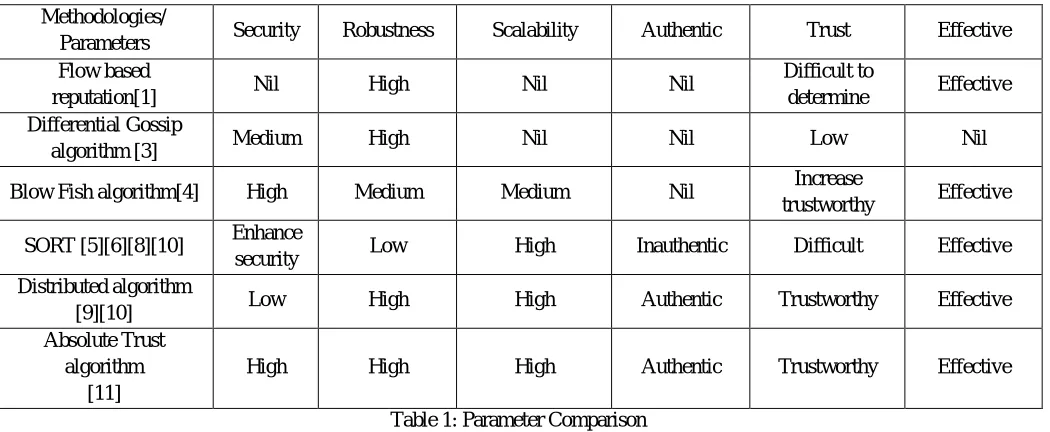
From the above literature review, the methodologies of various peer to peer systems are identified and listed below. The comparison of methodologies with the parameters are evaluated and represented in tabular form.
A. Flow based reputation [1]
B. Reputation Aggregation algorithm [2][3][7]
C. Differential Gossip algorithm [3]
D. Blow Fish algorithm[4]
E. SORT [5][6][8][10]
F. Distributed algorithm[9][10]
G. Absolute Trust algorithm [11]
Flow based reputation algorithm provides a mechanism to reduce risk during building trust relationship among peers. The reputation aggregation algorithm uses the concept of differential gossip algorithm to estimate the reputation systems based on neighbor peers and it collects the information from each and every node. SORT which aims to decrease the malicious activity in P2P system by establishing trust among peers. Blow fish algorithm is an alternative technique for encryption algorithms like AES and DES. It is symmetric block encryption algorithm. Absolute trust is an arrangement of peers which only allows the information to be shared within trusted group of peers. Differential gossip algorithm can be done either by using gossip protocol or by obtaining feedback. The comparison table 1: parameter comparison clearly shows the efficiency of algorithms for parameters such as security, robustness, scalability, authentic contents, trustworthiness of peer and finally system effectiveness. From table, Absolute trust algorithm is more secure, robust and scalable. In this algorithm good peers provide authentic files and right feedback and malicious peers provide inauthentic and wrong feedback. Hence, trustworthiness of P2P network is measured using local and global trust value.
IV. PROPOSED ARCHITECTURE
Absolute trust is the proposed algorithm in which metric values are calculated and feedback is obtained. The aggregation algorithm is used here to capture the past behavior of peers. Initially local trust values are calculated using raw data or information and using local values global trust values are estimated among peers. These values are stored and based on their past interactions, ranking is provided to each peer in peer to peer network.
V. CONCLUSION
In this paper, an algorithm for aggregation of local trust in peer-to peer network is proposed that satisfies all design considerations mentioned in the introduction namely avoiding malicious peer and free riders. In Absolute Trust algorithm, aggregation is done without normalization, hence it provides the feedback of the peer based on their past behavior. The calculation of global trust is done recursively and it converges at some unique value. The updates have to be sent only in case of change of local trust value. So, lesser number of messages is required to update the global trust. This algorithm can be implemented in truly distributed system where no central authority is present. This algorithm shows that it is robust against the various attacks like individual malicious, unpredictable malicious and collective malicious. Distribution of load is even on individual good peer and more uniform compared with relative ranking mechanism.
VI. FURTHER ENHANCEMENT
[image:6.612.47.572.301.517.2]In this paper, The Metric based aggregation algorithm is proposed for finding malicious peers and free riders. However the algorithm is limited only to malicious attacks, further the same algorithm with additional metrics can be used to find the various attacks like Sybil, DOS and SQL injection attacks. Since, the algorithm holds the metrics like past behavior, feedback and trust values of peers, it can also be used to resolve the intruder attacks in p2p networks.
Table 1: Parameter Comparison
REFERENCES
[1] Antonino Simone, Boris Skori and Nicola Zannone, “Flow based reputation: more then just ranking”, International Journal of Information Technology and Decision Making, November 2011.
[2] Ruchir Gupta, Yatindra Nath Singh,” A Reputation Based Framework to Avoid Free-riding in Unstructured Peer-to-Peer network”,IEEE Transaction, July 2013.
[3] Ruchir Gupta and Yatindra Nath Singh,” Reputation Aggregation in Peer-to-Peer Network Using Differential Gossip Algorithm”,IEEE Transaction, January 2014,
[4] Kayalvizhi and Bharathi, “ Efficient and distributed network model for P2P systems”, International Journal of Computer Science and Mobile Computing, Vol. 3, Issue.2 , February 2014,pg.626-632.
[5] R. Gayathri and V.Vaishnavi,”Secure shell transfer through malicious nodes from peer to peer”, International Journal of Advanced Information and Technology,Vol.21, No. 21, January 2014.
[6] G. Samuvelraj and N.Nalini,” Avoiding malicious activities in peer to peer systems using SORT method”, International Journal of Engineering Research and Technology, Vol.3,Issue.3, March 2014.
[7] S. Nithya and Dr. Kannan Balasubramanian,” Trust Metrics Evaluation for Peer-to-Peer Systems”, International Journal of Advanced Research in Computer Science & Technology, Vol. 2 Issue Special 1 Jan-March 2014.
[8] M.Mamatha and E. Chitti Babu,”Building trust relationship among peers using SORT”, International Journal of Scientific Engineering and Technology Research, Vol.3,Issue.22, October 2014.
[9] I. Narasima Rao, K.Vineela and J.V.S.Arundhati ,” A trust model for node to node system using DHT”, International Journal of Advanced Technology and Methodologies/
Parameters Security Robustness Scalability Authentic Trust Effective
Flow based
reputation[1] Nil High Nil Nil
Difficult to
determine Effective
Differential Gossip
algorithm [3] Medium High Nil Nil Low Nil
Blow Fish algorithm[4] High Medium Medium Nil Increase
trustworthy Effective
SORT [5][6][8][10] Enhance
security Low High Inauthentic Difficult Effective
Distributed algorithm
[9][10] Low High High Authentic Trustworthy Effective
Absolute Trust algorithm
[11]
Innovative Research,Vol. 7,Issue.5, June 2015, pg: 0612-0621.
[10] Vasu Deva Rao and Laxmikanth,”SORT: Self Organising Trust Model for P2P systems”, International Journal and Magazine of Engineering , Technology, Management and Research,Vol. 2,Issue 11,November 2015.
[11] Sateesh Kumar Awasthi and Yatindra Nath Singh,” Absolute Trust: Algorithm for Aggregation of Trust in Peer-to- Peer Networks”, IEEE Transaction, January 2016.
AUTHOR(S) PROFILE
M.Janani, M.E Scholar, in the Department of Computer science and Engineering, KPR Institute of Engineering & Technology, Coimbatore, carrying a project in P2P networks had published papers related to the work and participated in many workshops and conferences.
R.Jeevitha, M.E Scholar, in the Department of Computer science and Engineering, KPR Institute of Engineering & Technology, Coimbatore, currently carrying the project in the broad field of Distributed Computing had participated and presented papers in conference related the field of study.