Journal of Chemical and Pharmaceutical Research
__________________________________________________
ISSN No: 0975-7384 CODEN(USA): JCPRC5
J. Chem. Pharm. Res., 2011, 3(1):324-329
Development and validation of a RP-HPLC Method for the Estimation of
Levetiracetam in Bulk and Pharmaceutical Formulation
Abdullah Al Masud1, Md. Shamsul Arefeen2, Mohammad Kaisarul Islam3, Moynul Hasan4* .
1
Department of Pharmaceutical Technology, University of Dhaka, Dhaka, Bangladesh
2
Department of Pharmaceutical Chemistry, University of Dhaka, Dhaka, Bangladesh
3
Department of Pharmacy, Jagannath University, Dhaka, Bangladesh
4
Department of Pharmacy, Dhaka International University, Banani, Dhaka, Bangladesh
_____________________________________________________________________________________
ABSTRACT
A simple, reproducible and efficient reversed phase high performance liquid chromatographic (RP-HPLC) method has been developed for estimation of a recently approved antiepileptic drug, Levetiracetam in raw material and its tablet dosage form. Separation was done by using mobile phase consisting of HPLC grade water and methanol in a ratio of 75:25. The separations were carried out on a Flexit C18 column (150 x 4.6 mm; 5µm) at a flow rate of 1 mL/min.The injection
volume was 20 µl and the peaks were detected at 205 nm. The linear dynamic response was found to be in the concentration range of 45µg-270µg/mL and coefficient of correlation was found to be 0.9989. The %RSD value was below 2.0 for intraday and interday precision indicated that the method was highly precise. The LOD and LOQ were found to be 4.44 and 12.66 ng/mL respectively which revealed that the method was highly sensitive. The percentage recovery value was higher than 100 %, indicating the accuracy of the method and absence of interference of the excipients present in the formulation. The proposed method was simple, fast, accurate, precise and reproducible and hence can be applied for routine quality control analysis of levetiracetam in bulk and pharmaceutical formulation.
Key words: Levetiracetam, Estimation, Tablets, RP-HPLC.
______________________________________________________________________________
INTRODUCTION
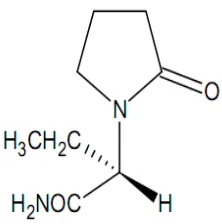
adjunctive therapy for partial, myoclonic and tonic-clonic seizures. Levetiracetam has potential benefits for other psychiatric and neurologic conditions such as Tourette syndrome, autism, and anxiety disorders. Chemically it is (αS)-α-ethyl-2-oxo-1-pyrrolidineacetamide (Figure 1) with a molecular formula of C8H14N2O2 (MW 170.20). This is a structural analog of piracetam, which binds to a synaptic vesicle protein SV2A and is believed to impede nerve conduction across synapses. The precise mechanism by which levetiracetam exerts its antiepileptic effect is still unknown [1,2].
[image:2.595.240.351.210.322.2]Figure 1: Structure of levetiracetam
Various HPLC and LC-MS methods have been reported for the determination of levetiracetam in biological fluids [3-9]. A literature survey revealed that very few HPLC methods have been reported for the determination of levetiracetam from pharmaceutical dosage form [10,11]. So In this present investigation an attempt has been made to develop an accurate, precise and economically viable reversed phase HPLC method for the s estimation of levetiracetam in bulk drug and in pharmaceutical dosage form.
EXPERIMENTAL SECTION
Apparatus and chromatographic condition
The chromatographic separation was performed on a Prominence Shimadzu high performance liquid chromatographic instrument equipped with a Flexit C18 column (150 x 4.6mm; 5µm) integrated with UV detection at 205µm.The mobile phase consisting of HPLC grade water and methanol in a ratio of 75:25 (v/v) and was prepared freshly, filtered and sonicated before use and delivered at a flow rate of 1 mL/ min. The volume of each injection was 20µl. The column and the HPLC system were kept in ambient temperature.
Chemicals and reagents
Levetiracetam was obtained as a gift sample from ACI Pharmaceuticals Ltd. Methanol and
water used were of HPLC grade. The commercially available levetiracetam tablets claimed to contain 250 mg of active ingredients were procured from local market.
Preparation of stock solution
Stock solution of levetiracetam was prepared by dissolving 100 mg of levetiracetam in 100 mL
40-400 µ g/mL. The standard solutions prepared as above were injected into the 20 µ L loop and the chromatogram was recorded (Figure 3).
Analysis of tablet formulation
Ten tablets each claimed to 250 mg of levetiracetam were weighed accurately and powdered. A quantity equivalent to 100 mg of levetiracetam was weighed accurately and transferred to a 100 mL volumetric flask. Then 25mL of the mobile phase was added to it and the mixture was sonicated for 20 min and then diluted up to the mark with the same solvent. The resulting solution was filtered through a membrane filter. The solution obtained was diluted with the mobile phase so as to obtain a concentration in the range of linearity as previously discussed for the pure drug. Sample solution was injected under the chromatographic conditions as mentioned above and the chromatogram was recorded.
RESULT AND DISCUSSION
All of the analytical validation parameters for the proposed method were determined according to Conference on Harmonization (ICH) guidelines [12].
Linearity
The linearity of this method was determined at ten concentration levels ranging from 40µg/ml- 400µg/ml. The plot of peak area of each sample against respective concentration of levetiracetam was found to be linear (Figure 2) in the range of 40–400 µg/mL. Beer’s law was found to be obeyed over this concentration range. The regression equation was found to be Y = 77440x + 469243 and the correlation coefficient (r) of the standard curve was found to be 0.9987 (Table 1).
Figure 2: Calibration curve of levetiracetam
Precision
Table 1: Validation Parameters
Parameters Results
Linearity range (µg/ml) 40 to 400
Standard Regression equation Y = 77440x + 469243
Correlation coefficient 0.998
LOD (ng/ml) 4.22
LOQ (ng/ml) 12.66
Precision (at 120µg/ml)
Intraday (% RSD) Interday (%RSD)
0.354 0.265
Recovery studies (Accuracy)
Recovery studies were performed to judge the accuracy of the method. The studies were carried out by adding a known quantity of pure drug to the pre-analyzed formulation and the proposed method was followed. From the amount of drug found, the percent recovery was calculated. Recovery study was carried out at three levels 80%, 100% and 120% for the formulation concentration of 120µ g/mL. The percentage recovery value (Table 2), which was higher than 100 %, indicated that the accuracy of the method and absence of interference of the excipients present in the formulation.
Table 2: Recovery study
Level of Addition (%)
Formulation (µg/mL)
Addition of pure drug (µg/mL)
% Recovery of pure drug
Recovery (%) ± S.D.
80 120 96 101.33
100 120 120 101.35 101.55±0.37
120 120 144 101.98
[image:4.595.73.528.373.680.2]Sensitivity
Limit of detection (LOD) and limit of quantification (LOQ) were calculated by the using the equation given in ICH guidelines. This may be expressed as LOD = 3.3 σ /S and LOQ = 10 σ / S, where σ is the standard deviation of the response, S is the slope of the calibration curve which may be estimated from the calibration curve of the analyte. The LOD and LOQ for levetiracetam were found to be 4.22 ng/mL and 12.66 ng/mL respectively (Table 1), this demonstrated that the method was highly sensitive.
System suitability test
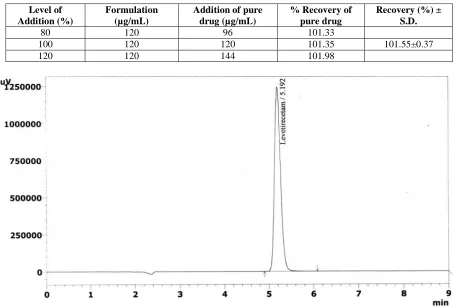
The system suitability tests were carried out on freshly prepared standard stock solution of levetiracetam to evaluate the suitability of the system and the parameters that were studied presented in Table 3. From the typical chromatogram of levetiracetam as shown in Fig 3, it was found that the average retention time ± standard deviation for levetiracetam was found to be 5.192±0.001 min for five replicate injections. The asymmetry factor was found to be 1.78, which indicated asymmetric nature of the peak. The number of theoretical plates was found to be 3346, which suggested an efficient performance of the column. The absence of additional peaks in the chromatogram indicated non-interference by the common excipients used in the tablet formulation. To optimize the chromatographic conditions, various combinations of water and methanol were tested and the ratio of 75:25 v/v afforded peak with good shape and resolution.
Table 3: System Suitability Parameters
Retention time (min) ± S.D. 5.192± 0.001
No. of theoretical plates 3346
Asymmetric factor 1.78
Robustness
Robustness was performed by small but deliberate variation in the chromatographic conditions and was found to be unaffected by small variations like ±2% in volume of mobile phase composition, ±0.1 mL/min in flow rate of mobile phase and ±1% change in column temperature. It was observed that there were no marked changes in the chromatograms, which demonstrated that the proposed method was robust.
Table 4: Determination of active ingredients in tablets
Sample Label claimed Amount found % Amount found*
Levetiracetam 250 mg/Tab 252.72±0.67 101.09
(* Average of three determinations)
CONCLUSION
Acknowledgements
The authors are thankful to ACI Pharmaceuticals Ltd for providing raw materials and other technical supports.
REFERENCES
[1] Martindale-The Complete drug reference, 2005, 34, 366.
[2] Lancelin. F, Franchon. E, Kraoul. L, Garciau. I, Brovedani. S, Tabaouti. K, Landré. E, Chassoux. F, Paubel. P, Piketty. M L, Ther. Drug. Monit. 2007, 29, 576-583.
[3] Guo. T, Oswald. LM, Mendu. DR, Soldin. SJ, Clin. Chim. Acta. 2007, 375, 115-118.
[4] Jain. DS, Subbaiah. G, Sanyal. M, Pal. U, Shrivastav. PS, Rapid. Commun. Mass. Spectrom.
2006, 20, 2539-2547.
[5] Martens-Lobenhoffer. J, Bode-Böger. SM, J. Chromatogr. B. 2005, 819, 197-200.
[6] Pucci. V, Bugamelli. F, Mandrioli. R, Ferranti. A, Kenndler. E, Raggi. MA, Biomed.
Chromatogr.2004, 18, 37-44.
[7] Shihabi. Z K, Oles. K, Hinsdale. M, J. Chromatogr. A. 2003, 1004(1-2), 9-12. [8] Ratnaraj, N., Doheny, H.C., Patsalos, P.N., Ther. Drug. Monit. 1996, 18, 154-157. [9] Matar. KM, J. Pharm. Biomed. Anal. 2008, 48(3), 822-828.
[10]Lakshmana. AR, Naga. VJ, E-Journal of Chemistry. 2010, 7(2), 600-604.
[11]Valarmathy. J, Samueljoshua. L, Rathinavel. G, Selvin CT, Sivakumar T, Res. J. Pharm.
Tech. 2008, 1(3), 395-397.