Populations of certain fishes and invertebrates in the Sacramento-San Joaquin Delta have declined in abundance in recent decades and there is evidence that food supply is partly responsible. While many sources of organic matter in the Delta could be supporting fish popu-lations indirectly through the food web (including aquatic vegetation and decaying organic matter from agricultural drainage), a careful ac-counting shows that phytoplank-ton is the dominant food source. Phytoplankton, communities of microscopic free-floating algae, are the most important food source on a Delta-wide scale when both food quantity and quality are taken into account. These microscopic algae have declined since the late 1960s. Fertilizer and pesticide runoff do not appear to be playing a direct role in long-term phytoplankton changes; rather, species invasions, increasing water transparency and fluctuations in water transport are responsible. Although the potential toxicity of herbicides and pesticides to plank-ton in the Delta is well documented, the ecological significance remains speculative. Nutrient inputs from agricultural runoff at current lev-els, in combination with increasing transparency, could result in harmful algal blooms.
William Sobzcak, former U.S. Geological Survey postdoctoral researcher, samples for zooplankton in the Delta.
Alan D. Jassby
James E. Cloern
Anke B. Müller-Solger
t
Phytoplankton fuels Delta food web
RESEARCH ARTICLET
he Sacramento–San Joaquin River Delta is a complex mosaic of wa-terways that forms the transition zone
between San Francisco Bay and its
wa-tershed (fig. 1). Over the last century,
the original dominant marsh habitat
has been lost through filling and diking. Water flows have changed radically. Ex -otic plants and animals have invaded or
been introduced intentionally, and toxic
contaminants have become widespread
(CALFED 2000). The Delta is now a
focus of ecosystem restoration because these changes have been accompanied by declines in the abundance of many
fish species that use the Delta as a mi -gration route, nursery or permanent
habitat. Some species (thicktail chub) have already become extinct; others (winter-run chinook salmon) are now at risk of extinction; and still others (split
-tail, striped bass) have dramatically
reduced populations.
Several lines of evidence suggest that food limitation has played a role
in these declines. Many fish popula -tions in the Delta are declining because
of poor survival during the first year
of life, which can be caused by food
shortages (Bennett and Moyle 1996). Sport fish such as striped bass (Morone saxatilis), native species such as delta smelt (Hypomesus transpacificus), and
commercial species such as chinook
salmon (Oncorhynchus tshawytscha)
all show evidence of food limitation
during their first year. Zooplankton, a key food for young fishes, has also declined (Orsi and Mecum 1996). Some declining zooplankters, especially a mysid shrimp (Neomysis mercedis)
and smaller species, also appear to be limited by food supply, as does the
clam Corbicula fluminea, a dominant
benthic invertebrate.
Zooplankton, benthic invertebrates and the larger, more visible fish and
waterfowl that feed on them form a food web that depends ultimately on
inputs of organic matter at its base (fig. 2). In many systems, phytoplankton
species play a fundamental role in the organic matter supply to food webs. These microscopic plants are responsi-ble for primary production, the photo-synthetic production of organic matter. Other sources of organic matter are often present, however, and can even be dominant, especially in estuaries. In fact, there has been speculation for many years that organic matter carried in from upstream and from adjacent terrestrial sources is the main source
sustaining the Delta’s food web. What,
then, are the relative roles played by phytoplankton and other sources in the organic matter supply to Delta
water-ways? The question is a basic one for
restoration of the Delta, because it de-termines the focus for increasing food supply to declining populations. In
ad-dition to investigating this, we examine
evidence for a long-term decline in the primary food supply and consider the role of agriculture.
Food comes in many forms
To determine the most important organic matter sources for Delta water-ways, we combined decades of data col-lected by the California Department of
Water Resources (CDWR), U.S. Bureau of Reclamation (USBR) and U.S. Geo
Fig. 2. The metazoan food web can be extremely complex, especially in estuaries, and only a small portion of the Delta’s food web is portrayed here. The energy and nutrient needs of the metazoan food web are sup-ported by a variety of organic mat-ter sources.
Glossary
Algae: Primitive plants usually living in
wa-ter and occurring as single cells, filaments,
colonies and irregular aggregations.
Aquatic vascular plant: Higher plants liv
-ing in water bodies. May be free-float-ing or rooted. Also known as aquatic macrophytes.
Benthic invertebrates: Invertebrates living on or in the bottom sediments.
Benthic microalgae: Microscopic algae liv-ing on or just under the surface of the bot-tom sediments.
Biomass: The weight of biological matter, usually measured in terms of carbon, dry
weight or fresh weight, and expressed on an areal (g m-2) or volumetric (mg m-3) basis.
Chlorophyll: A green pigment present in most plants and essential for the process of photosynthesis, by which these plants obtain most if not all of their energy. Chloro-phyll a is one form that is often assumed an
approximate index of algal biomass.
Detritus: Nonliving particulate and dis-solved organic matter.
Metazoa: Multicellular animals, in contrast to the more primitive protozoa.
Phytoplankton: The plant plankton, consist-ing mostly of microscopic algae.
Plankton: The community of passively sus-pended or only weakly swimming organ-isms in a body of water, which drift along with the water currents; planktonic
organ-isms range in size
from tiny plants and animals to large
jelly-fish, and include the larval stages of many fishes.
Primary productivity: The rate at which plants incorporate inorganic carbon into organic matter. Usually measured on a
volumetric (mg C m-3 d-1) or areal (mg C m-2 yr-1) basis. Primary production is often
used to refer separately to the amount of or-ganic carbon produced in a particular time
interval (mg C m-3 or mg C m-2).
Protozoa: Single-celled animals, including amoeba, ciliates and flagellates in aquatic
systems.
Suspended sediments: Small mineral (clay and silt) particles suspended in waters.
Turbidity: The scattering effect that sus-pended and dissolved solids have on light, imparting a cloudy appearance to water. Primary contributors include suspended sediments, soluble colored organic com-pounds and microscopic organisms.
Zooplankton: The animal plankton, in estu
-aries consisting mostly of protozoa, rotifers
and two crustacean types, the cladocerans and the copepods.
Fig. 3. Organic matter, measured as total organic carbon (TOC), is produced in Delta waterways by photosynthesis and enters from a variety of external sources. Phytoplankton is the biggest internal source and river transport is the biggest external source. Error bars represent standard error among years.
Fig. 1. The Sacramento-San Joaquin River Delta extends upstream from Chipps Island to include leveed islands, river channels, sloughs, flooded islands and tidal marshes. Boxes mark stations used by the California Department of Water Resources to assess wa-ter quality, in some cases since the late 1960s.
Organic matter sources are usually compared in terms of
their total organic carbon (TOC)
content; TOC can come in both
particulate (POC) and dissolved (DOC) forms. River input — or -ganic material carried in by the
Sacramento, San Joaquin and
other rivers and creeks — is the
largest TOC source overall (fig. 3). Some of this river-borne mate -rial is actually phytoplankton and phytoplankton-derived detritus transported from upstream of the Delta.
Phytoplankton production within the Delta and organic matter in agricultural drainage
directly into the Delta are next in
importance. Agricultural drainage upstream of the Delta is included in river inputs and cannot be
esti-mated separately with any confi -dence. Much of the organic matter in agricultural drainage originates from leaching of DOC from is-land peat soils. Discharge from wastewater treatment plants, drainage from tidal marshes and
production of aquatic vascular
plants such as the submerged Egeria densa are tertiary sources. Urban runoff, primary production by benthic microalgae and other sources — although sometimes
important in other estuaries — are negligible sources of organic matter in the Delta. Phytoplankton is clearly the Delta’s dominant primary producer, whereas river input of organic mate-rial from upstream is dominant among
external sources (fig. 3). Many of these
sources are distributed unevenly throughout the Delta, and we can
identify areas where aquatic vascular
[image:2.612.229.539.531.737.2]together account for 90% of average
annual Delta-wide organic matter sources.
Drinking water and organic matter
Aside from its ecological significance,
organic matter also has implications for
drinking-water quality in the Delta. The
Delta provides all or part
of the drinking-water supply for about
22 million California residents. When
disinfectants such as chlorine are added to drinking water to kill microbial pathogens, they react with bromide and naturally occurring organic matter to
form disinfection byproducts (DBPs).
The main DBP groups are total triha-lomethanes, haloacetic acids, bromate
and chlorite. When these are consumed over years in excess of federal stan
-dards, some people may experience
problems with the liver, kidneys or central nervous system, or may have an
increased risk of cancer or anemia (Bull and Kopfler 1991).
A current major challenge for water suppliers in the Delta and elsewhere is how to balance the risks from pathogens and DBPs; it is important to provide protection from these pathogens by us-ing disinfectants while simultaneously containing health risks from DBPs. One way to limit DBP formation is to limit TOC levels in raw water supplies. Our organic matter assessment implies that phytoplankton production, river-borne loading and agricultural drainage should each be a focus of source-control measures with respect to the DBP prob-lem: they are all important sources of naturally occurring organic matter in the Delta.
The participation of phytoplankton in ecosystem food supply and
drinking-water quality points to one example of conflicting aims in the Delta. Although
higher phytoplankton production may be a boon to certain food-limited organ-isms, it can degrade drinking-water
quality through the formation of DBPs.
The diversity of issues in the Delta
cre-ates a complex balancing problem: hu -man health versus ecosystem health. The balancing of different aims is
par-ticularly difficult with regard to phyto -plankton, which has many other effects. Negative impacts include clogging
filters, producing undesirable tastes and
odors, and contributing dangerous
sub-stances directly to raw water, such as
the liver toxin microcystin-LR and neu
-rotoxin anatoxin. On the positive side,
phytoplankton is central in the biocon-centration of contaminants, transport and cycling of plant nutrients, and the atmospheric carbon
dioxide balance.
An inefficient food source
The bulk accounting in figure 3 is an inadequate guide to the relative value of
different organic materials for primary
consumers such as zooplankton and
clams. Particulate and dissolved forms of organic matter differ markedly in their availability to the food web,
mak-ing further refinement necessary. POC
enters the Delta mostly as
phytoplank-ton, bacteria and protozoa, particles of
decaying organic matter, and suspend-ed mineral particles carrying organic matter on their surfaces. These particles
can be utilized directly by primary con
-sumers such as clams and zooplankton.
In contrast, most dissolved organic
carbon must first be transformed into
particles before it can be consumed. This transformation happens primarily via the uptake and metabolism of DOC by bacteria; in other words, the DOC is converted to bacteria cells. Much of the
DOC is not very bioavailable (not eas
-ily assimilated and metabolized) and is simply flushed downstream before bac
-teria can utilize it. Moreover, much of the remaining DOC that is metabolized
by bacteria is lost to respiration and does not end up as bacterial biomass.
We refined our estimates of the three
major organic-matter sources by ac-counting for bioavailability of DOC and
respiratory losses, based on generaliza -tions from previous empirical
stud-ies (Jassby and Cloern 2000). We then categorized each year as either drier or
wetter than average and plotted the
re-fined estimates of TOC in each category by season (fig. 4). The relative impor -tance of organic matter sources changes dramatically because so much of river input and agricultural drainage is in dissolved form. Phytoplankton
pro-duction is seen as a significant source
of bioavailable organic matter in all
seasons, except for winters with
above-normal precipitation. Moreover, phyto-plankton production is comparable to and sometimes greater than river inputs
in spring and summer of both above-normal and below-above-normal years. Spring and summer are particularly critical sea-sons for survival and growth of young
fish and successful recruitment to fish
populations. In contrast, agricultural
drainage is almost never a significant
source of bioavailable organic matter.
Consequently, plans to control organic
matter in agricultural and Delta island drainage because of the DBP problem should have little impact on food sup-ply to the Delta’s food web.
Recently this work was corroborated
with an extensive set of bioassays that
assessed the food value of the Delta’s
organic matter sources (Sobczak et al. 2002). Although dissolved organic
matter is the major energy and carbon source for bacterial metabolism, the dominant food supply to the planktonic food web is bioavailable, particulate organic matter derived primarily from internal phytoplankton production.
Differing nutritional quality
Just as dissolved organic-matter
sources contribute little to the food sup-ply compared with particulate sources, the particulate sources themselves vary
in quality. Delta phytoplankton are a better food source for zooplankton than
other kinds of particles in the POC pool — decaying organic matter, bacteria and organic matter clinging to the surface
of clay and silt particles. The zooplank -ter Daphnia magna, which occurs in the Delta, feeds nonselectively on particles
smaller than 40 micrometers (μm). In
a series of laboratory feeding assays
(Müller-Solger et al. 2002), Daphnia were
exposed using a flow-through system
to water from four Delta habitat types collected during all four seasons, and
growth rates were measured. While
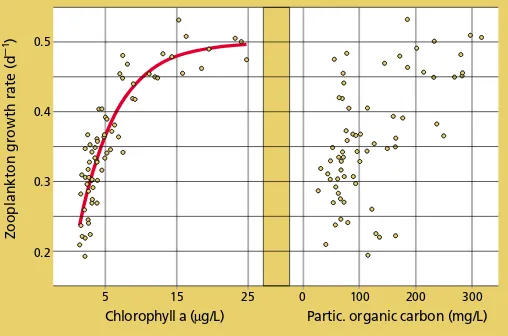
POC concentrations were only weakly related to Daphnia growth, concentra-tions up to a threshold of about 10 μg/L
chlorophyll a — a pigment found in phytoplankton — predicted Daphnia
growth rates across all habitats and
seasons (fig. 5). Chlorophyll is not a
ele-ments such as phosphorus and certain essential fatty acids are candidates.
Supply changes year to year
Phytoplankton are probably the most important portion of the particulate or-ganic matter supply to the Delta’s food web on a Delta-wide basis, and growth rates of primary consumers such as
Daphnia are closely tied to phytoplank-ton availability below about
10 μg/L. But how often is Delta phyto -plankton at levels that can limit
zooplankton growth, and is phyto -plankton variable enough to induce
major changes in zooplankton growth
rates? In fact, Delta chlorophyll levels
quite commonly fall within the range
limiting growth. Thousands of chloro-phyll a measurements have been made in the Delta since the late 1960s by the
CDWR and USBR, and 55% to 93% of
them, depending on the year, are below 10 μg/L(Jassby et al. 2002). Moreover,
large swings have occurred in Delta-wide chlorophyll from one year to the
next, and longer-term changes are evi -dent.
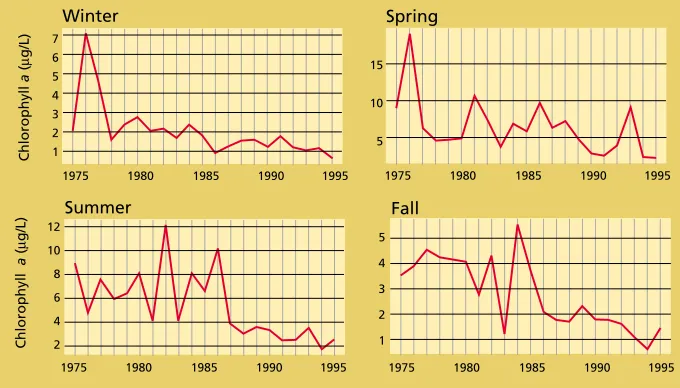
Figure 6 shows the annual average of Delta-wide chlorophyll for each season during a period when analytical meth-ods remained the same and sampling
was sufficiently comprehensive to cover
the entire Delta. Although the trend is not uniformly downward, there has been an overall tendency toward lower phytoplankton concentrations in later
years. In fact, all except spring months (April to June) showed a robust, statisti
-cally significant downward movement from 1975 to 1995 (Jassby et al. 2002).
Phytoplankton variability could there-fore easily lead to a several-fold
differ-ence in zooplankton growth rates. What are the reasons for this variabil -ity? In 1986, an Asian clam (Potamocor-bula amurensis) invaded and established itself in Suisun Bay, presumably after being discharged with ship ballast wa-ter. Its establishment and dispersal were aided by the prolonged drought and
ac-companying low freshwater inflows to
the Delta that began in 1987. Potamocor-bula turned out to be a voracious con-sumer of phytoplankton and changed phytoplankton dynamics in Suisun Bay
(Alpine and Cloern 1992). The effects of
Potamocorbula probably extend into the
western Delta, with a summer down-turn after 1986 even in the Delta-wide
chlorophyll record (fig. 6); Potamocorbula
are feeding most actively during sum-mer.
A recent analysis identified the most
important driving forces for Delta-wide phytoplankton production:
interan-nual variability of water flow; increased
consumption by Potamocorbula; and a downward trend in suspended mineral particles over many decades, which improves water transparency and there-fore phytoplankton photosynthesis and
growth rate (Jassby et al. 2002). The
increase in phytoplankton growth rate partially compensates for increased losses due to consumption by clams, but apparently not by enough to
prevent a decrease in phytoplankton
biomass. The dry weight of suspended mineral particles is much greater than phytoplankton biomass: variations in the latter have relatively little effect on transparency.
Impact of agricultural runoff
Dissolved organic matter in agricul-tural drainage, although an important
issue for drinking-water quality, is not a significant source of energy for the Del
-ta’s food web. What effects might other
constituents of drainage and runoff, namely pesticides and nutrients, have on phytoplankton productivity?
Pesticide toxicity. Herbicide
con-centrations may limit phytoplankton
growth rates during localized occur -rences of elevated concentrations. In
1997, Jody Edmunds and colleagues at the USGS examined 53 water samples
collected from May through September
at nine Delta sites for six herbicides that
inhibit photosynthesis. Only one sample
exceeded concentrations (diuron) re -ported to inhibit primary production in
laboratory experiments (Edmunds et al. 1999). Similarly, bioassays showed no
relationship between ambient herbicide
concentrations and photosynthesis, ex -cept for this one sample. The study de-sign might have missed herbicide runoff events during the rainy season.
In fact, Jeff Miller and others from the Central Valley Regional Water Quality
Control Board, using an algal indicator
species, found toxicity in 22% of sam
-ples from the Sacramento–San Joaquin
[image:4.612.31.287.37.177.2]watershed and Delta during 2000 to
[image:4.612.301.555.44.212.2]Fig. 4. Phytoplankton net primary productivity (NPP), river loading and agricultural drainage make up most of the bulk organic-matter supply. The values shown here have been corrected for losses due to lack of bioavailability and respiration, and are therefore a more realistic comparison of the food value for consumer organisms than the bulk data of figure 3. Phytoplankton provides a significant source especially in spring and summer, a critical period for populations of many fishes and invertebrates.
Fig. 5. The growth of the zooplankter Daphnia magna in Delta wa-ters is closely related to the supply of phytoplankton, as indexed by chlorophyll a concentrations, but not so closely tied to levels of particulate organic carbon in general.
Chlorophyll a (μg/L)
5 15 25
Zooplankton growth rate (d
−
1) 0.5
0.4
0.3
0.2
Partic. organic carbon (mg/L)
2001(Miller et al. 2002). Again, diuron
— an herbicide applied to rights-of-way, alfalfa, vineyards and orchards — was
implicated. Most toxicity occurred from January to March when diuron
is applied and when it is most likely to rain in California; in contrast, most phytoplankton production takes place in spring and summer. The ecological
consequences of this photosynthetic in -hibition may therefore be limited.
Pesticides may also affect primary production through indirect effects
on the zooplankton community, mol -luscs and other organisms that feed on phytoplankton. Data collected by the
USGS National Water-Quality Assess -ment program demonstrate that seven
pesticides in the San Joaquin River Basin frequently exceed criteria for the protection of aquatic life, and diazi -non concentrations sometimes reach
acutely toxic levels in the San Joaquin
River(Dubrovsky et al. 1998). Similarly, diazinon and chlorpyrifos are linked to toxicity in test zooplankton in the
Sacramento River watershed. The Re-gional Monitoring Program of the San Francisco
Estuary Institute has established that these organophosphate pesticides are also of concern in San Francisco Bay.
While there is a growing body of infor -mation that pesticides in surface-water
runoff can be toxic to invertebrates in
the San Francisco Bay and Delta, the
ecological significance has not yet been
established.
Nutrient levels. Largely because of
agricultural drainage, nutrient supplies
are well in excess of phytoplankton
needs in the Delta. The availability of nitrogen and phosphorus are important determinants of phytoplankton growth
and biomass in many aquatic systems.
A low nutrient supply can restrict the growth of phytoplankton and,
ultimate-ly, fish yield. We found that nutrient
concentrations were low enough to limit phytoplankton growth for only about
0.1% of the measurements since the late
1960s, most occurring in the southern
Delta during the extremely dry El Niño–
Southern Oscillation of 1976 to 1977
(Jassby et al. 2002). Nutrient sources and this nutrient excess are not as pro -nounced downstream in San Francisco Bay, and nitrogen can become limiting during spring phytoplankton blooms in the South Bay.
Excessive nutrients from agricul -tural drainage or animal wastewater have promoted huge and harmful phytoplankton blooms in many loca-tions around the world(Anderson et al. 2002). This is not a major problem in the
Delta currently because of high concen-trations of suspended sediments and ac-companying turbidity. High turbidity is in part a legacy of the erosion caused by hydraulic mining in the Sierra Nevada in the 19th century. By decreasing
trans-parency and limiting the penetration of sunlight, turbidity slows phytoplankton photosynthesis and limits its ability to reproduce rapidly to massive levels. However, suspended sediment in the Delta has been decreasing and transpar-ency increasing for decades.
USGS scientists have identified several possible explanations for this
phenomenon(Wright and Schoellhamer in press). First, reservoirs have been
trapping sediment behind dams similar to the decrease in sediment load over the past 50 years. Second, there are still
channel and floodplain deposits of
mining-derived sediments that are being eroded and gradually depleted.
Third, bank stabilization such as
rip-rap retards meandering, eliminating a
sediment source (channel banks) and
contributing to decreasing sediment yield. Finally, the depositional nature
of the lower Sacramento floodplain has
changed in a way that, in principle, could trap additional sediment. The rel-ative importance of these mechanisms is not known precisely. In any case, given
the excess of nutrients in the Delta,
decreasing turbidity means that large phytoplankton blooms may become a
more common phenomenon (Jassby et al. 2002). Moreover, Delta waters are
warming, and higher temperatures
fa-vor the cyanobacteria (blue-green algae)
that constitute nuisance or harmful algal blooms. If such nuisance or harmful blooms become common, control of ni-trogen and phosphorus inputs from ag-ricultural drainage will become a much more important issue.
Ecosystem restoration
The research described here high-lights the importance of phytoplankton
in sustaining the metazoan food web on
a Delta-wide basis, despite the presence of many other organic matter sources. Organic matter in agricultural drain-age is mostly in dissolved form and not an important nutrient or energy source
for the metazoan food web; along with
[image:5.612.58.398.44.238.2]phytoplankton and other sources, how-ever, it reacts with disinfectants during drinking-water treatment to form poten-tially harmful byproducts. Phytoplank-ton biomass — and therefore the food supply for higher organisms — has de-clined over the past few decades, partly
because of the Asian clam invasion. Certain herbicides in agricultural drain-age may at times inhibit phytoplankton production, especially in winter, but their overall effect on annual production is probably limited. Similarly, certain
pesticides can reach toxic levels for pri -mary consumers of phytoplankton, but
any ecological significance has not yet
been demonstrated.
The phytoplankton decline may rep-resent a reduction in the system’s capac-ity to support higher levels of the food
web. Lower phytoplankton levels have been linked to declines in key zooplank -ton populations in the Delta. Although
the evidence for food limitation of fish populations is not as strong as for zoo -plankton and benthic invertebrates, data from many estuaries and other water bodies also points to an overall
corre-spondence between fish production and primary production (Nixon and Buckley 2002). Unless phytoplankton productiv
-ity increases, restoration of fish popula -tions in the Bay-Delta may be limited.
Water transparency has increased over
the past few decades due to declines in suspended sediments, enhancing phy-toplankton photosynthesis and partially offsetting consumption by clams. A continuation of the transparency trend could result in increased
phytoplank-ton production because of the excess
nutrients available in the estuary from
fertilizer runoff and wastewater treat
-ment effluent. Although this could have positive effects on overall fish produc -tion, there is a potential danger from nuisance and harmful phytoplankton species that pose both human and
eco-logical toxicity problems.
As a response to symptoms of gross ecosystem disturbance and the critical role of the Delta as the linkage between San Francisco Bay and its watershed, a consortium of state and federal agencies
was established in 1994. The CALFED
Bay-Delta Program’s mission is to de-velop a long-term and comprehensive plan to “restore ecological health and improve water management for the
beneficial uses of the Bay-Delta system.”
The program is centered around four objectives, one of which focuses on
en-vironmental quality to “improve and increase aquatic and terrestrial habitats
and improve ecological functions in
the Bay-Delta to support sustainable populations of diverse and valuable
plant and animal species” (CALFED 2000). This is one of the largest attempts
at ecosystem restoration worldwide, with a multibillion dollar budget and a period of 25 to 30 years for full imple-mentation. Addressing the decline in system productivity is part of one of the key strategic goals of this ecosystem restoration.
Attainment of the CALFED Bay-Del
-ta Program restoration goals requires a solid base of scientific understanding to
identify key ecosystem functions within the Delta and to describe how they change in response to human activities, including restoration actions. Restora-tion acRestora-tions — including new canals,
flow and fish barriers, increased use of floodplains and increased shallow-water habitat — all have significant
impacts on phyto-plankton produc-tion, some positive and some negative
(Jassby and Cloern 2000). Given the sig
-nificance of phyto-plankton production
to the food base in the Delta, as well as other phytoplankton-related functions,
these impacts must be defined quantita -tively and used to help guide the resto-ration strategy.
A.D. Jassby is Research Ecologist, Depart-ment of EnvironDepart-mental Science and Policy, UC Davis; J.E. Cloern is Research Biologist, Water Resources Division, U.S. Geological Survey (USGS); and A.B. Müller-Solger is Environmental
Specialist, California Department of Water Resources. The authors are grateful for funding from CALFED (1425-98-AA-20-16240), USGS and the U.S. Environmental Protection Agency (EPA) through the Center for Ecological Health Research at UC Davis (R819658). Although EPA partially funded preparation
of this article, it does not necessarily reflect the views of the agency and no official en -dorsement should be inferred.
References
Alpine AE, Cloern JE. 1992. Trophic in-teractions and direct physical effects control phytoplankton biomass and production in an estuary. Limnol Oceanogr 37:946–55.
Anderson DM, Glibert PM, Burkholder JM. 2002. Harmful algal blooms and
eutrophica-tion: Nutrient sources, composition and con-sequences. Estuaries 25:704–26.
Bennett WA, Moyle PB. 1996. Where have all the fishes gone? Interactive factors pro-ducing fish declines in the Sacramento-San
Joaquin estuary. In: Hollibaugh JT (ed.). San
Francisco Bay: The Ecosystem. San Francisco:
Pacific Division, AAAS, California Academy of Sciences. p 519–42.
Bull RJ, Kopfler FC. 1991. Health effects of disinfectants and disinfection by-products. AWWA Research Foundation and American Water Works Association, Denver, CO.
CALFED. 2000. Executive summary, final programmatic Environmental Impact State-ment/Environmental Impact Report. CALFED Bay-Delta Program, Sacramento, CA.
Dubrovsky NM, Kratzer CR, Brown LR, et al. 1998. Water quality in the San Joaquin-Tulare Basins, California, 1992–1995. Circular 1159, US Geological Survey, Denver, CO.
Edmunds JL, Kuivila KM, Cole BE, Cloern JE. 1999. Do herbicides impair phytoplankton primary production in the Sacramento-San Joaquin River Delta? In: Morganwalp DW, Buxton HT (eds.). US Geological Survey Toxic Substances Hydrology Program, Proc Tech Meeting, Charleston, SC, March 8–12, 1999.
Vol. 2. Contamination of Hydrologic Systems
and Related Ecosystems. US Geological
Sur-vey Water Resources Investigation Report 99-4018B. p 81–8.
Jassby AD, Cloern JE. 2000. Organic matter sources and rehabilitation of the Sacramento-San Joaquin Delta (California, USA). Aquatic Conservation: Marine and Freshwater Ecosystems 10:323–52.
Jassby AD, Cloern JE, Cole BE. 2002. Annual primary production: Patterns and mechanisms of change in a nutrient-rich tidal ecosystem. Limnol Oceanogr 47:698–712.
Miller J, Miller M, Larsen K, et al. 2002. Identification of Causes of Algal Toxicity in Sacramento-San Joaquin Delta. Central Valley Regional Water Quality Control Board, Sacra-mento, CA. 29 p.
Müller-Solger AB, Jassby AD, Müller-Na-varra D. 2002. Nutritional value of particulate
organic matter for zooplankton (Daphnia) in
a tidal freshwater system
(Sacramento-San Joaquin River Delta, USA). Limnol Oceanogr 47:1468–76.
Nixon SW, Buckley BA. 2002. “A strikingly rich zone”: Nutrient enrichment and second-ary production in coastal marine ecosystems. Estuaries 25:782–96.
Orsi JJ, Mecum WL. 1996. Food limitation as the probable cause of a long-term decline
in the abundance of Neomysis mercedis
the opossum shrimp in the Sacramento-San
Joaquin Estuary. In: Hollibaugh JT (ed.). San
Francisco Bay: The Ecosystem. San Francisco:
Pacific Division, AAAS, California Academy of Sciences. p 375–401.
Sobczak WV, Cloern JE, Jassby AD, Müller-Solger AB. 2002. Bioavailability of organic matter in a highly disturbed estuary: The role of detrital and algal resources. Proc Nat Ac Sci 99:8101–5.