DEMOGRAPHIC RESEARCH
VOLUME 33, ARTICLE 22, PAGES 611–652
PUBLISHED 18 SEPTEMBER 2015
http://www.demographic-research.org/Volumes/Vol33/22/ DOI: 10.4054/DemRes.2015.33.22
Research Article
Does waiting pay off for couples? Partnership
duration prior to household formation and union
stability
Christine Schnor
©2015Christine Schnor.
This open-access work is published under the terms of the Creative Commons Attribution NonCommercial License 2.0 Germany, which permits use, reproduction & distribution in any medium for non-commercial purposes, provided the original author(s) and source are given credit.
1 Introduction 612
2 Theoretical considerations 614
3 Previous empirical findings 616
4 Methodology 618
4.1 Method and operationalization 618
4.2 Data 620
4.3 Sample 621
4.3.1 Independent control covariates 623
4.3.2 Sample composition 625
4.3.3 Operationalization of partnership duration 626
5 Results 629
5.1 Descriptive results 629
5.1.1 The dynamic of non-coresidential partnership episodes 629 5.1.2 The timing of household formation and union duration 633
5.2 Multivariate results 634
5.2.1 Partnership duration and union stability 634 5.2.2 Other determinants of union stability 634 5.3 Interaction results: Partnership duration and order 636 5.4 Robustness check: Disregarding unions with imputed date
information
637
6 Conclusion – Does waiting pay off? 638
References 641
Does waiting pay off for couples?
Partnership duration prior to household formation and
union stability
Christine Schnor1
Abstract
BACKGROUND
Most couples that live together began their relationship while having separate addresses. In contrast to the large body of literature on the role of pre-marital cohabitation in divorce, very little is known about how the partnership period before moving in together affects union stability.
OBJECTIVE
This article investigates: 1) the timing of household formation in a couple’s history, 2) the impact of such timing on dissolution behavior, and 3) how household formation and dissolution differ for first and higher-order partnerships.
METHODS
Using data based on 15,081 partnerships (of which 45% were coresidential unions) from the German Family Panel, cumulative incidence curves reveal the dynamic of the non-coresidential partnership episode. For the sample of coresidential unions (N=6,741), piecewise constant survival models with a person-specific frailty term are estimated in order to assess the influence of household formation timing on union stability.
RESULTS
Partnership arrangements with partners living in separate households are transitory in nature and may result in either household formation or separation. First partnerships transform into coresidential unions less often and later than higher-order partnerships. Union stability is positively related to the duration of the preceding non-coresidential period. Especially among unions with a non-coresidential period of 7 to 24 months, first partnerships have lower dissolution risks than higher-order partnerships.
1 Centre for Sociological Research / Family & Population Studies (FaPOS), Faculty of Social Sciences,
CONCLUSION
The results suggest that the non-coresidential period is a significant phase in the partnership, as it enables couples to acquire information about the quality of their partnership.
1. Introduction
Over the past few decades, forms of partnership in which partners are not married and may not even share the same residence have emerged in many western countries (Duncan and Phillips 2011; Régnier-Loilier, Beaujouan, and Villeneuve-Gokalp 2009; Sobotka and Toulemon 2008; Trost 2003). The increasing diversity and dynamism of partnership life underline the importance of moving away from classical partnership definitions that refer, for instance, to the marital status (Trost 2003). In recent literature it has therefore become common to refer to the household dimension with respect to couples that live together in cohabitation or marriage as “unions”. The situation in which two persons define themselves (and are defined by significant others) as a couple, although living in separate households, is seen as a distinct partnership type under the label “living apart together” (LAT) (Duncan and Phillips 2011; Levin and Trost 1999). These LAT partnerships are often considered an alternative to coresidential union forms, driven by motives of individualization and mobility (Liefbroer, Poortman, and Seltzer 2015; Poortman and Liefbroer 2010; Levin 2004). This argumentation, however, neglects the fact that non-coresidential partnerships are often temporary arrangements (Ermisch and Siedler 2008), in that couples frequently have separate homes at the start of such a partnership, and that there is considerable progression from non-coresidential partnerships to cohabitation and marriage (Castro-Martín, Domínguez-Folgueras, and Martín-García 2008; Ermisch and Siedler 2008; Konietzka and Tatjes 2014; Liefbroer, Poortman, and Seltzer 2015; Régnier-Loilier, Beaujouan, and Villeneuve-Gokalp 2009).2
Recent research has emphasized that the non-coresidential period should be considered as a preliminary phase in the partnership, in that it prepares the couple for living under the same roof (Régnier-Loilier 2015). It thus seems reasonable to assume
2 The term “LAT” has been used in literature to describe a certain partnership concept that is characterized by
that the non-coresidential partnership period has consequences for the outcome of the union. How well the partners knew each other at the time of household formation and how much time they needed before deciding to move in together are factors likely to be relevant to the stability of the union. According to theoretical considerations by Becker, Landes, and Michael (1977) and Oppenheimer (1988), a relationship is more likely to be stable if the partners have solid information about each other’s personal characteristics. A short non-coresidential episode seems connected to a high degree of uncertainty about one’s partner’s attributes at the time of household formation, which might reduce the prospects of union success. In union stability research, however, the time during which a couple lives together before households are merged usually fades into obscurity. This study aims to address this research gap. It focuses on the duration of the non-coresidential partnership episode as an explanatory factor in the dissolution behavior of couples that have just started living together.
A large number of studies have focused on premarital cohabitation as a stepping-stone to marriage, and have thus examined the role of cohabitation in marital stability (e.g. Bracher et al. 1993; Jalovaara 2013; Thomson and Colella 1992; Lillard, Brien, and Waite 1995; Berrington and Diamond 1999). However, previous studies have rarely accounted for the non-coresidential partnership period prior to household formation, mainly because the appropriate data for studying this partnership phase have not been widely available. This paper uses data from the German Family Panel, detailing partnership histories beyond the household dimension for women and men born between 1971 and 1973 or between 1981 and 1983. The detailed nature of the data allows the influence of the non-coresidential period on the dissolution risk of unions to be described for the first time, irrespective of marital status. German non-coresidential partnerships seem unexceptional with regard to their prevalence and duration, as revealed by a British-German comparison (Ermisch and Siedler 2008). Thus, although this study references only a single country, the results may well be applicable to other settings. Due to the young age of the respondents, the data allow for a study of partnership dynamics at early adulthood but not at the later stages of life.
This study underlines the necessity of considering the entire duration of the partnership in stability analyses.
2. Theoretical considerations
Becker’s economic theory of the family (Becker 1991; Becker, Landes, and Michael 1977) and Oppenheimer’s theory of marriage timing (Oppenheimer 1988) can help explain the link between the first partnership stage and partnership stability under the assumption of rational behavior. Although their focus is on marriage, the arguments can be applied to all unions since both theories deal with partnership dynamics in a more general way. In Becker’s economic theory of the family, household formation is considered essential for the couple because it enables the production of commodities. Becker and colleagues further assume that persons set up a joint household when the utility expected from this union exceeds the utility expected from remaining in separate households (Becker, Landes, and Michael 1977). Indeed, rational reasons do often play a major role in a couple’s decision to move in together, be it saving on rent or the financial, time-related, and emotional costs of commuting between two households (Guizzardi 2011). Even though they may live at different addresses, non-coresidential couples can spend a substantial amount of time together, e.g., they share meals or stay overnight often. Couples may then decide to cohabit because it simplifies their lives (Rindfuss and VandenHeuvel 1990). The step of moving in together can also be interpreted as an investment in the partnership: the couple share their home and household goods, which makes separation more costly than before. At the time of household formation the couple may strongly believe in an ongoing partnership, but there may be uncertainty about one partner’s attributes and needs or about the partners’ capacity to get along with each other. Presumably, persons separating have experienced less favorable outcomes from their union than earlier expected (Becker, Landes, and Michael 1977).
3. Previous empirical findings
There is still very limited knowledge on how the partnership phase between dating and living together influences union stability. Even though it is a common stage on the path to cohabitation and marriage, the non-coresidential partnership phase has often been ignored in social surveys (Castro-Martín, Domínguez-Folgueras, and Martín-García 2008), and, as a consequence, no appropriate data is available (in terms of large representative samples with detailed partnership information). Most surveys only provide information about the household formation date, which prior research has taken as the partnership starting point (Manning 2001; Raley 2001). However, it is not that simple: the time spent in a partnership is not to be equated with the time spent in a coresidential non-marital or marital union (Carmichael 1995).
stage and union stability would be reversed if the non-coresidential episode exceeds a certain duration. Partners who rapidly move in together may be strongly convinced that the relationship will last, while partners who hesitate to move in together may have more doubts about the stability of the relationship, and thus feel less committed to the partnership (Brown 2003).
Very little is known about household formation and dissolution behavior in first-order partnerships compared to higher-first-order partnerships. Cohabitation first-order has been shown to have no effect on stability in previous studies on cohabitation and marriage stability, while higher-order marriages have been found less stable than first-order marriages (Berrington and Diamond 1999; Manlove et al. 2012; Poortman and Lyngstad 2007; Steele et al. 2006).
In Germany a number of studies have examined partnerships with separate households, and have described the transition from the non-coresidential stage to coresidence or separation.3 A study on German marriage cohorts for the period between 1999 and 2005 showed that it took couples an average of 2.4 years to move in together (50% formed a household within the first year of partnership) (Schneider and Rüger 2008). Survival estimates based on German Socio-Economic Panel GSOEP data revealed that 80% of non-coresidential partnership episodes lasted more than one year, while only 13% were still intact after 10 years (Ermisch and Siedler 2008). Around 55% of these partnerships were transformed into coresidential unions (Ermisch and Siedler 2008). Partnerships with separate households mainly occurred among young people: the earlier the couple formed the partnership, the longer the non-coresidential period (Konietzka and Tatjes 2014; Schneider and Rüger 2008). This applied more to first partnerships than to higher-order partnerships (Konietzka and Tatjes 2014). At around the age of 25 this partnership was often transformed into a coresidential union (Asendorpf 2008; Ermisch and Siedler 2008; Régnier-Loilier, Beaujouan, and Villeneuve-Gokalp 2009).
3 These studies referred to data which included information on the non-coresidential episode but with certain
4. Methodology
4.1 Method and operationalization
The issue of primary interest is union dissolution. Different event history techniques were used to analyze the non-coresidential partnership episode and to estimate its effect on union dissolution risks. The transition to household formation versus separation was estimated to illustrate the weeding-out process among non-coresidential partnerships and to define when partners ‘become ready’ to move in together. The dynamic of this partnership episode in the first 10 years of partnership is shown in cumulative incidence functions (Fine and Gray 1999). This type of function accounts for the fact that partners who do not share a household are at risk of two events, household formation or separation.4 If the competing event of separation were to be treated as censored, biased estimates for the rate of household formation would be obtained (Fine and Gray 1999). The observation time started with partnership formation. At any time t, the couples had experienced household formation with hazard h1(t), had experienced separation with
hazard h2(t), or were still at risk of both events. The cumulative incidence function is a
nonlinear function of h1(t) and h2(t) (see Fine and Gray (1999) for the formal model
with a detailed discussion). The dynamics of first and higher-order partnerships are shown separately, because the transition rates to household formation and separation were found to be different.
Subsequent analyses focused on the stability of partnerships in which household formation occurred at some point. In these analyses the observation time started with household formation. Household dissolution was defined as a dependent variable. The data provide information on the date of household dissolution (= union dissolution), as well as the date of partnership dissolution (= separation), since partnership histories beyond coresidential union episodes had been collected. Among couples who first formed a household and then experienced the dissolution of the partnership and the joint household, household and partnership dissolution were close together in time, and occurred within a time frame of one year, as can be seen in Figure A-1 (Appendix). Time until household dissolution was measured in months. Those whose partner had died or who were still partnered at the time of the latest interview were treated as censored observations. The observation was also censored after a household duration of 15 years.
4
Kaplan-Meier survival estimates were used to illustrate union stability within the observation period for partnerships with different non-coresidential partnership durations (see a discussion of this method in Blossfeld, Golsch, and Rohwer 2007: 72pp). Log-Rank and Wilcoxon tests were used to compare the survivor functions. The Wilcoxon test stresses differences at the beginning of the process time, whereas the Log-Rank test stresses differences towards the end of the process time (Blossfeld, Golsch, and Rohwer 2007: 82; Cleves et al. 2008: 125). Both tests are appropriate for testing the equality of survivor functions across two or more groups. Additionally, trend tests were conducted to test whether the failure rate decreases with time spent in the non-coresidential partnership episode.
In the multivariate part, the following piecewise constant event history model with shared frailty was applied to estimate the relative risks of union dissolution (Gutierrez 2002):
ℎ�𝑡𝑖𝑗�𝛼𝑖�=𝛼𝑖ℎ�𝑡𝑖𝑗�=𝛼𝑖ℎ0�𝑡𝑖𝑗�exp (𝑥𝑖𝑗𝑡𝛽) (1)
where ℎ𝑖𝑗(𝑡) denotes the hazard of union dissolution of the jth coresidential union for individual i; ℎ0(𝑡) denotes the baseline hazard, which was specified as a piecewise constant with cuts after two, four, six, eight, and eleven years; and 𝛼𝑖 denotes an unobservable multiplicative effect on the hazard. The model includes a row vector of covariates denoted by 𝑥𝑖𝑗𝑡: their exponentiated effects are estimated by parameter β. The partnership duration prior to household formation was considered as an independent time-constant variable. Complete partnership biographies were used, which means that “individuals may move in and out of coresidential relationships multiple times” (Steele 2008: 14). This implied a multilevel structure of data with coresidential union episodes j nested within individuals i. I assumed that unions of the same individual share a certain frailty and that frailty may vary between individuals. Therefore, a random intercept (“frailty”), 𝛼, for each respondent i was added to the model (Cleves et al. 2008: 326). This intercept was assumed to have mean one and to follow the gamma distribution (for the complete equation, see Gutierrez 2002: 34pp). The frailty variance, θ, was estimated from the data, and was used to measure the variability of the frailty across different individuals.
4.2 Data
The data were taken from the German Family Panel (pairfam/DemoDiff), a nationwide random sample (pairfam) of 13,891 German adults born in 1971-1973, 1981–1983, and 1991–1993, including an oversample (DemoDiff) of eastern German respondents (pairfam: Huinink et al. 2010, Nauck et al. 2012; DemoDiff: Kreyenfeld et al. 2011, 2013a, 2013b)5. Personal standardized interviews were conducted annually from 2008 onwards. The first pairfam wave was launched in 2008/09 with 12,402 respondents, of which 9,069 were re-interviewed in 2009/10 and 7,901 were re-interviewed in 2010/11. The first DemoDiff wave was conducted in 2009/10 and added 1,489 respondents living in eastern Germany to the two oldest pairfam cohorts, of whom 1,173 respondents were re-interviewed in 2010/11. The overall response rate of 37% in the first wave of pairfam and 29% in the first wave of DemoDiff is low but is not very selective (Hiekel, Liefbroer, and Poortman 2015; Huinink et al. 2010). The frequency distributions in the German Family Panel do not differ substantially from those in the Mikrozensus 2007, which is a compulsory survey for a 1% sample of the population (Huinink et al. 2010; Suckow and Schneekloth 2009, 2010, 2011). Still, it is possible that non-respondents were more likely to have complex partnership careers: if that was the case the influence of partnership characteristics is underestimated in this study.
In the first interview, retrospective partnership histories were collected on a monthly basis. The partnership information was updated with each subsequent wave. I made use of a ready-to-use event history dataset by Schnor and Bastin (2014) that incorporates all the relevant partnership and fertility information from the first three waves6 (2008-2012, pairfam Release 3.1, DemoDiff 2.0). Using the complete partnership history has several advantages over a pure panel approach. Panel studies are usually strongly affected by left-truncation (couples are not followed up after the start of their partnership) and panel attrition (Hiekel, Liefbroer, and Poortman 2015). As a consequence the sample in these panel studies is selective and the issue of union stability is difficult to address because less stable couples are under-represented and leave the survey sample more often. The analytical sample in this study is more appropriate for investigating union stability, because it enables the analysis of partnerships from their beginning and includes those partnerships that ended prior to the
5 The German Family Panel is coordinated by Josef Brüderl, Johannes Huinink, Bernhard Nauck, and Sabine
Walper. It is funded as a long-term project by the German Research Foundation (DFG).
6 To date, five pairfam waves are available. The special partnership dataset by Schnor and Bastin includes the
first interview date. Further, this approach has the advantage that the individual is not required to participate in multiple waves, but only in the first wave. The prospective information provides specific details on the partnership (such as relationship quality) and on the partner – all of which are not available retrospectively. Notwithstanding that I thus had to refer to a restricted set of variables, the chosen approach offered the best available information for investigating how partnership duration affects union stability.
The information on the partnership formation date was based on self-reported partnership histories. The questionnaire did not specify any criteria, and thus left the definition to the respondent. Information was gathered on episodes of partnership, coresidential union, and marriage. Unlike the marriage date, the partnership formation date may often be less clearly definable for the partners (Duncan and Phillips 2011; Régnier-Loilier, Beaujouan, and Villeneuve-Gokalp 2009). Partnership formation may be perceived as a period rather than a date, and its definition can be related to the first kiss, the first night spent together, the first declaration of love, or the introduction of the partner to friends/parents. Like any other retrospective data, the information might be subject to recall problems (Dex 1995; Reimer 2005). The respondents might remember the concrete dates incorrectly or might mix up the dates. Difficulties in recalling past events and periods increase with age (Reimer 2005: 40). In this study, the young age structure of the respondents minimizes the risk of recall bias. Sometimes no precise date information was available, except seasonal or yearly information as provided by the respondents. The pairfam group imputed these dates (Nauck et al. 2012). In this study, robustness checks were conducted as part of the empirical analyses.
A design weight was used in the descriptive analyses that accounted for the under-/overrepresentation of birth cohorts in the gross sample and the oversampling of eastern Germans.7
4.3 Sample
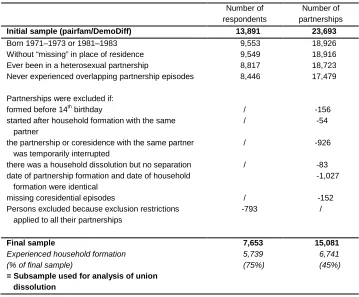
The sample selection is described in Table 1. The number of respondents and number of partnerships are stated, because some restrictions apply to the individual and others to the respective partnership. The analysis was limited to women and men born in the periods 1971–1973 and 1981–1983 who had ever been in a heterosexual8 partnership.
7 In detail, I used the following weights (Kreyenfeld et al. 2013b): birth cohorts 1971–73, Eastern Germany
(including East Berlin): 0.395; birth cohorts 1981–83, eastern Germany (including East Berlin): 0.414; birth cohorts 1971–73, western Germany: 1.098; birth cohorts 1981–83, western Germany: 0.961.
8
Members of the youngest cohort (born 1991–1993) were not considered because most of them (95%) had not experienced household formation at the time of the most recent interview. Due to computational reasons, I had to disregard persons who had overlapping partnership episodes with different partners. Partnerships formed before the respondent’s 14th birthday were excluded because the pairfam questionnaire only asked about partnership episodes that started after that age. Partnerships that started after the partners had moved in together were not considered. These partners are likely to have started coresidence as flat-mates; thus, living together in these cases was not a couple-decision. Partnerships in which partners temporarily interrupted their coresidence were not considered. Several reasons led to their exclusion. During this cohabitation break the unions were not at risk of union disruption (see definition of the event in Section 4.2). Some of the partners maintained their relationship while living in separate households, suggesting that household dissolution was for reasons of mobility. Others temporarily ended their relationship: some of these had other partnerships before they started residing again with their initial partner. The heterogeneity of this group of interrupters made it difficult if not impossible to include them in the analysis, e.g., by considering their first coresidential episode. Similar problems occurred with unions in which the joint household was dissolved while the partnership remained stable, because I could not classify the episode as either censored or ended by an event. In the end I dropped this group of partnerships. I also excluded partnerships that started directly as coresidential unions, because they are likely to present a measurement error. When the date of partnership formation was reported exactly on the date of household formation, it seemed that the respondent had misunderstood the intent of the question and reported only the date of household formation.9 As a consequence the minimum duration of the non-coresidential partnership episode was one month. Partnerships were omitted if information on the coresidential partnership episodes or the country of birth was missing. The final sample included 15,081 partnerships with 7,653 respondents. 75% of the respondents had experienced household formation. Among the considered partnerships, half (45%) transformed into coresidential unions.
9 Some respondents might have had reasons to define the start of the partnership with the household
Table 1: Sample selection procedure
Number of respondents
Number of partnerships
Initial sample (pairfam/DemoDiff) 13,891 23,693
Born 1971–1973 or 1981–1983 9,553 18,926
Without “missing” in place of residence 9,549 18,916
Ever been in a heterosexual partnership 8,817 18,723
Never experienced overlapping partnership episodes 8,446 17,479
Partnerships were excluded if:
formed before 14th birthday / -156
started after household formation with the same partner
/ -54
the partnership or coresidence with the same partner was temporarily interrupted
/ -926
there was a household dissolution but no separation / -83
date of partnership formation and date of household formation were identical
-1,027
missing coresidential episodes / -152
Persons excluded because exclusion restrictions applied to all their partnerships
-793 /
Final sample 7,653 15,081
Experienced household formation (% of final sample)
= Subsample used for analysis of union dissolution
5,739 (75%)
6,741 (45%)
Source: German Family Panel (pairfam/DemoDiff), Release 3.1 (2011/2012)
4.3.1 Independent control covariates
Three groups of control covariates were considered in the multivariate regression models. In the first group, individual background information was taken into account.10 This included the respondents’ gender, birth cohort (1971–1973 or 1981–1983), place of birth, and personal information such as educational, religious, and family
10
background. The levels of school education were broken down into three categories: low (no certificate or lower secondary education), middle (secondary education), and high (high school diploma). Missing information on school education was ascribed to a separate category. More highly educated individuals have better partnership prospects than their less educated counterparts (Brüderl, Diekmann, and Engelhardt 1997; Jalovaara 2013; Berrington and Diamond 1999), because highly educated individuals are expected to make better partner choices and to have fewer communication problems (Amato 1996). Church membership provides information about the person’s religious background11. Catholics marry later and have a lower risk of union dissolution than non-Catholics (Hoem and Hoem 1992; Lehrer 2004; Lillard, Brien, and Waite 1995; Oláh 2001; Teachman 2002). The costs of union dissolution are particularly high in Catholicism, because the church prohibits separation after entry into marriage. The higher costs associated with making a ‘mistake’ suggests that Catholics may engage in a more intensive partner search and take more time to form a household than non-Catholics (Lehrer 2004; Schnor 2012). Individuals who experienced parental separation have been shown to be more likely to dissolve their own unions (Lyngstad and Jalovaara 2010). And since there was information on whether the respondent lived with both biological parents until his or her 18th birthday, this was taken as indicative of whether a parental separation occurred during the respondent’s childhood or adolescence.12
Several covariates provided information about the partnership history of the respondent, thereby forming the second group of covariates. The partnership order is part of this battery of variables and defines whether the partnership was the first in the respondent’s life course. Persons who were quite young, living in the parental home, or enrolled in education at the time the partnership was formed might experience higher risks of union break-up (Berrington and Diamond 1999; Jalovaara 2013; White 1990). These factors may suggest that the individuals were not yet settled and may be less mature and forward-looking with regard to partner choice, all of which could be associated with a higher risk of union disruption (Becker, Landes, and Michael 1977). Age at partnership formation was conceptualized as a yearly continuous variable centered at the median age (age 23 for male respondents and age 21 for female respondents).
The third group of variables refers to fixed characteristics at the time of union formation. A binary variable informs whether the respondent has already lived together
11 Respondents who were neither Catholic nor Protestant but who belonged to another religious community
were grouped into a single category.
12
with a partner (“coresidential union order”). If the marriage had occurred prior to household formation, a time-constant category stated that it is a “direct marriage”. Considering couples who formed a household after a similar partnership duration, those who married before moving together should be more committed to the partnership than their non-married counterparts, because they have entered into a formal arrangement that increases the rewards they can expect from the partnership, let alone the fewer costs of separation (Blossfeld et al. 1999; Le Bourdais, Neill, and Vachon 2000; Perelli-Harris and Sánchez Gassen 2012). Furthermore, partners who get married before moving in together often have very traditional attitudes and represent a selected subgroup (Bennett, Blanc, and Bloom 1988; Klijzing 1992; Köppen 2011: 235; Liefbroer and Dourleijn 2006; Lillard, Brien, and Waite 1995). The respondents might have children from previous partnerships: these are found to be a destabilizing factor in future relationships (Liu 2002; Teachman, Thomas, and Paasch 1991). Stepchildren were defined as the biological offspring of the respondent, or of his/her partner with a previous partner, who lived in the household at the time of household formation. Children, especially when still young, have been found to be related to greater union stability (Guzzo 2009; Jalovaara 2013; Wu 1995). A closer look at the children’s characteristics suggests, however, that children born before household formation might increase the risk of partnership break-up (Liu 2002; Teachman, Thomas, and Paasch 1991). Cases where a common child was present (or underway) at the time of household formation were defined as having a “pre-union child”.
4.3.2 Sample composition
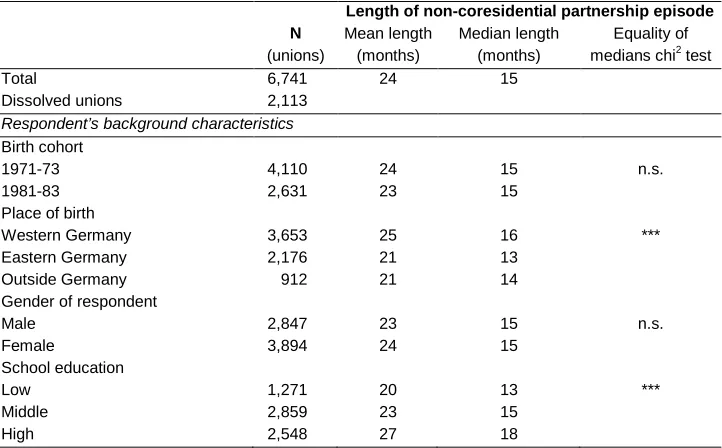
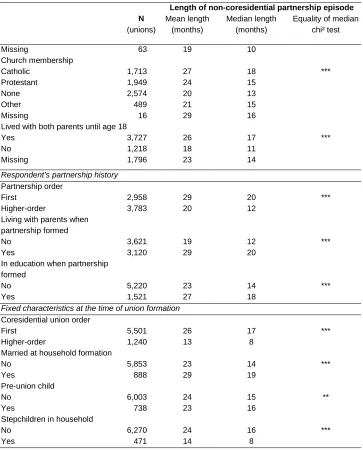
The sample composition of partnerships that were transformed into coresidential unions (N=6,741) is shown in Table 2. The table includes information on the absolute sample sizes in the respective control variable categories and on the (weighted) mean and median lengths of the non-coresidential partnership episodes. The difference between mean and median informs about the skewness of the data. In all categories the median was less than the mean, which means that the distribution is skewed right. A median test examines the equality of the medians; the null hypothesis is that the samples were drawn from populations with the same median.
western Germans, the highly educated, and among those living with both parents until adulthood. Western Germans, the foreign-born, the low-educated, and persons without church membership moved in with their partner more rapidly. From the second group of covariates it can be seen that partnership history is related to partnership length. As to partnership order, the sample composition demonstrates that the majority of households were not formed with the first partner, but with partners of a higher order. Household formation occurred later in first partnerships than in higher-order partnerships (see Chapter 5.1 for a detailed description). Longer median partnership durations prior to household formation were found among persons who were living with their parents or were enrolled in education at the time of partnership formation. Figure A-3 in the Appendix reveals that being younger than age 21 for female respondents and age 23 for male respondents when the partnership was formed especially contributed to more time spent in the non-coresidential partnership form. These characteristics indicate that couples who had waited a long time before moving in together were a special group, consisting mainly of young people who did not have prior partnership experience, and who were not living independently when they fell in love with their partner. In some cases, student lifestyle and still-dominant parental influence may have kept these young adults from moving in together (Brien, Lillard, and Stern 2006; Liefbroer, Poortman, and Seltzer 2015; Thornton, Axinn, and Teachman 1995). As to the characteristics at the time of union formation (third group of covariates), the median partnership durations of first-order coresidential unions and unions in which marriage formation preceded household formation were longer than those of the remaining population. Couples who did and did not conceive a common child prior to household formation had partnership durations of a similar length. The median non-coresidential partnership duration of couples with children with a pre-union child was only about one month longer. Several persons had children from previous partnerships living in their households; their median partnership length before household formation was shorter than for their childless counterparts. Present children might have motivated the partners to rapidly move in together.
4.3.3 Operationalization of partnership duration
categorization in yearly intervals might be too approximate. I therefore decided to use a categorical variable that reflects the household formation behavior in the data. Because of the sparseness of data in the right tail of the distribution, I constructed a variable in which partnership duration prior to household formation was grouped into the following categories: 1 to 6 months (first half of first year), 7 to 12 months (second half of first year), 13 to 24 months (second year), 25 to 36 months (third year), 37 to 60 months (fourth and fifth years), and > 60 months (more than five years). This specification allows for comparing the risk of union dissolution between early, average, and late household formers. Twenty-six percent formed a household within the first six months of their first year and 19% within the next six months (see Figure A-2 in Appendix), thereby confirming the findings of Schneider and Rüger (2008). Another 20% did so within the second year and 15% within the third year of partnership. Twelve percent moved in together during the fourth or fifth years of the relationship, whereas only 9% waited more than five years to move in together.
Table 2: Sample composition, subsample of coresidential unions (N=6,741)
Length of non-coresidential partnership episode N
(unions)
Mean length (months)
Median length (months)
Equality of medians chi2 test
Total 6,741 24 15
Dissolved unions 2,113
Respondent’s background characteristics
Birth cohort
1971-73 4,110 24 15 n.s.
1981-83 2,631 23 15
Place of birth
Western Germany 3,653 25 16 ***
Eastern Germany 2,176 21 13
Outside Germany 912 21 14
Gender of respondent
Male 2,847 23 15 n.s.
Female 3,894 24 15
School education
Low 1,271 20 13 ***
Middle 2,859 23 15
Table 2: (Continued)
Length of non-coresidential partnership episode N
(unions)
Mean length (months)
Median length (months)
Equality of median chi² test
Missing 63 19 10
Church membership
Catholic 1,713 27 18 ***
Protestant 1,949 24 15
None 2,574 20 13
Other 489 21 15
Missing 16 29 16
Lived with both parents until age 18
Yes 3,727 26 17 ***
No 1,218 18 11
Missing 1,796 23 14
Respondent’s partnership history
Partnership order
First 2,958 29 20 ***
Higher-order 3,783 20 12
Living with parents when partnership formed
No 3,621 19 12 ***
Yes 3,120 29 20
In education when partnership formed
No 5,220 23 14 ***
Yes 1,521 27 18
Fixed characteristics at the time of union formation
Coresidential union order
First 5,501 26 17 ***
Higher-order 1,240 13 8
Married at household formation
No 5,853 23 14 ***
Yes 888 29 19
Pre-union child
No 6,003 24 15 **
Yes 738 23 16
Stepchildren in household
No 6,270 24 16 ***
5. Results
5.1 Descriptive results
5.1.1 The dynamic of non-coresidential partnership episodes
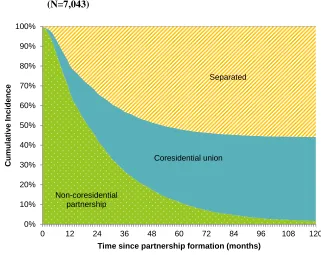
An initial non-coresidential partnership can end either with the formation of a couple’s household or their separation. The percentage of partnerships ending in separation informs on the weeding-out process during the non-coresidential period; the percentage resulting in coresidential unions provides information on the selectivity of these unions. In Figures 1a and 1b the transitions to household formation and separation are described for first and higher-order partnerships with the help of cumulative incidence functions. First partnerships were transformed into coresidential unions later and less often than higher-order partnerships. 67% of first partnerships remained as non-coresidential partnerships throughout the first year, while 20% separated and 14% formed a household. Fifty-six percent of higher-order partnerships remained non-coresidential, 23% experienced household formation, and 21% experienced separation within the first twelve months. By the end of the second year of partnership, 33% of the first and higher-order partnerships had dissolved. Household formation was experienced by 24% of couples in first partnerships and 35% percent of couples in higher-order partnerships. After 10 years, 43% of first partnerships and 51% of higher order partnerships had been transformed into coresidential unions. Separation had occurred more often among first partnerships than among higher-order partnerships (56% and 48%, respectively).
The estimations gave lower survival estimates for non-coresidential partnerships in contrast to a previous study (Ermisch and Siedler 2008), presumably because the previous authors did not account for partner changes and therefore overestimated the duration of this type of partnership. Within the first 10 years of partnership, nearly all couples (98%) experienced a change in their relationship, suggesting that non-coresidential partnerships are mainly transitory. The estimations show that the weeding-out process in the non-coresidential partnership episode is stronger among first partnerships, especially after a partnership duration of some years. On the other hand, a closer look at the percentages reveals that differences in household formation behavior between first and higher-order partnerships can be mainly attributed to the different dynamics during the first years of partnership. Consequently, the selectivity of coresidential unions consisting of first partnerships is higher than in those consisting of higher-order partnerships, especially if they have had a short non-coresidential partnership episode.
multivariate analysis, partnership order was considered as part of the partnership background and entered the respective model as an additional covariate (see Model 3 in Section 5.2). The covariate was considered separately and in interaction with partnership duration in order to test whether the higher selectivity of first partnerships was related to different stability levels.
Figure 1a: Transition to household formation or separation in first partnerships (N=7,043)
0% 10% 20% 30% 40% 50% 60% 70% 80% 90% 100%
0 12 24 36 48 60 72 84 96 108 120
C
u
m
u
lat
ive I
n
ci
d
en
ce
Time since partnership formation (months) Separated
Coresidential union
Figure 1b: Transition to household formation or separation in higher order partnerships (N=8,038)
Source: German family panel (pairfam/DemoDiff), Release 3.1 (2011/2012), sample of partnerships (N= 15,081 [7,043 first
partnerships + 8,038 higher-order partnerships]) 0%
10% 20% 30% 40% 50% 60% 70% 80% 90% 100%
0 12 24 36 48 60 72 84 96 108 120
C
u
m
u
lat
ive I
n
ci
d
en
ce
Time since partnership formation (months) Separated
Coresidential union
Figure 2: Kaplan Meier estimates of proportions remaining in coresidential union in terms of non-coresidential partnership duration
Source: German family panel (pairfam/DemoDiff), Release 3.1 (2011/2012), subsample of coresidential unions (N=6,741) (weighted)
0
.50
0
.60
0
.70
0
.80
0
.90
1
.00
P
rop
or
ti
o
n r
em
ai
ni
ng
i
n c
or
es
ide
nt
ia
l uni
on
0 12 24 36 48 60 72 84 96 108 120 132 144 156 168 180
Analysis time: months since household formation
1-6 months 7-12 months 13-24 months 25-36 months 37-60 months more than 60 months
Table 3: Test statistics results
Log-Rank test Wilcoxon test
Overall sample chi2(5) = 112.65,
Pr > chi = 0.000
chi2(5) = 94.70,
Pr > chi = 0.000 Overall sample – trend test chi2(5) = 111.62,
Pr > chi = 0.000
chi2(5) = 93.40,
Pr > chi = 0.000
Only couples with partnership durations of
1–6 months or 7–12 months chi2(1) = 1.83, Pr > chi = 0.177
chi2(1) = 3.90, Pr > chi = 0.048 7–12 months or 13–24 months chi2(1) = 6.26,
Pr > chi = 0.012
chi2(1) = 2.45, Pr > chi = 0.084 13–24 months or 25–36 months chi2(1) = 1.62,
Pr > chi = 0.203
chi2(1) = 0.90, Pr > chi = 0.342 25–36 months or 37–60 months chi2(1) = 6.95,
Pr > chi = 0.008
chi2(1) = 7.60, Pr > chi = 0.005 37–60 months or more than 60 months chi2(1) = 3.28,
Pr > chi = 0.070
chi2(1) = 2.75, Pr > chi = 0.097
5.1.2 The timing of household formation and union duration
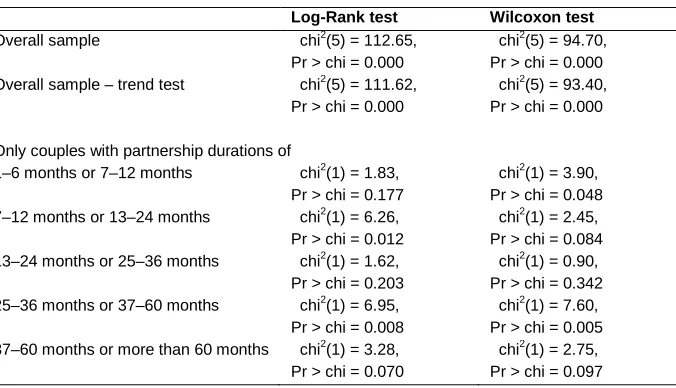
Figure 2 presents the Kaplan-Meier estimates of the proportion of couples remaining living together within the observation period for unions of different prior partnership lengths. The event time in Figure 2 is the period since household formation. The length of the non-coresidential period was clearly linked to union duration after household formation: couples with a short non-coresidential partnership period had lower union stability than couples forming a household after a longer non-coresidential period. Late household formers (= household formation after 60 months) had the highest union stability. The test statistics of the Log-Rank and the Wilcoxon test reveal that the survivor functions significantly differed for couples with different prior partnership lengths. Respective trend test statistics show that the null hypothesis (no difference in failure rate according to non-coresidential partnership duration) could be rejected.
5.2 Multivariate results
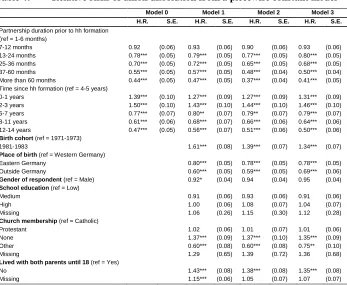
Table 3 gives the multivariate model results (shown in relative risks). Model 0 includes only the ‘clock’ – defined as the time since household formation – and partnership duration prior to household formation as the central covariate of interest. In Model 1, individual background information was taken into account. In Model 2, the respondent’s partnership history was considered. In Model 3, fixed characteristics at the time of household formation were considered as determinants of union stability.
5.2.1 Partnership duration and union stability
The multivariate results remained robust to the inclusion of control covariates and basically confirm the descriptive findings in Figure 2. They show that partnership duration prior to household formation is clearly and positively related to union stability: the longer the non-coresidential partnership period, the lower the risk of union dissolution.13 Partners who moved in together within the first year of partnership had the highest risk of union break-up. As far as stability is concerned, it did not matter whether they moved in within the first six months or thereafter. Persons who waited until the second year to form a household with their partner had a significantly lower risk of union dissolution. The results in Model 0 and Model 1 suggest that partners who moved in together in the second year had a risk of union dissolution similar to those who moved in together in the third year. Significant differences emerged only in Model 2, which also considered that persons who were older at the time of partnership formation moved in with their partner more rapidly and had lower dissolution risks. Risks of union break-up were lowest among partnerships that had exceeded five non-coresidential years.
5.2.2 Other determinants of union stability
Looking at the effect of coresidential union duration, the results reveal that the risk of union dissolution peaked two to three years after household formation, and thereafter decreased. Church membership and living with both parents affected union stability positively. The foreign-born and eastern Germans had lower dissolution risks than
13
western Germans; the latter effect can be attributed to a decomposition effect: Eastern Germans are affiliated to a church much less often than western Germans (Schnor 2012). The age at which the partnership was formed had a positive impact on stability, whereas a higher partnership order increased the risk of union dissolution. Respondents who lived with their parents or were enrolled in education at the time of partnership formation had similar union stability to those who did not. The conception of a common child before household formation was conducive to the couple’s stability. The presence of stepchildren did not necessarily mean the risk of a union break-up. Being married prior to household formation significantly stabilized the union, as did being in a first coresidential union.
Table 4: Relative risks of union dissolution from a piecewise constant model
Model 0 Model 1 Model 2 Model 3 H.R. S.E. H.R. S.E. H.R. S.E. H.R. S.E.
Partnership duration prior to hh formation (ref = 1-6 months)
7-12 months 0.92 (0.06) 0.93 (0.06) 0.90 (0.06) 0.93 (0.06)
13-24 months 0.78*** (0.05) 0.79*** (0.05) 0.77*** (0.05) 0.80*** (0.05) 25-36 months 0.70*** (0.05) 0.72*** (0.05) 0.65*** (0.05) 0.68*** (0.05) 37-60 months 0.55*** (0.05) 0.57*** (0.05) 0.48*** (0.04) 0.50*** (0.04) More than 60 months 0.44*** (0.05) 0.47*** (0.05) 0.37*** (0.04) 0.41*** (0.05) Time since hh formation (ref = 4-5 years)
0-1 years 1.39*** (0.10) 1.27*** (0.09) 1.27*** (0.09) 1.31*** (0.09) 2-3 years 1.50*** (0.10) 1.43*** (0.10) 1.44*** (0.10) 1.46*** (0.10) 6-7 years 0.77*** (0.07) 0.80** (0.07) 0.79** (0.07) 0.79*** (0.07) 8-11 years 0.61*** (0.06) 0.68*** (0.07) 0.66*** (0.06) 0.64*** (0.06) 12-14 years 0.47*** (0.05) 0.56*** (0.07) 0.51*** (0.06) 0.50*** (0.06)
Birth cohort (ref = 1971-1973)
1981-1983 1.61*** (0.08) 1.39*** (0.07) 1.34*** (0.07)
Place of birth (ref = Western Germany)
Eastern Germany 0.80*** (0.05) 0.78*** (0.05) 0.78*** (0.05)
Outside Germany 0.60*** (0.05) 0.59*** (0.05) 0.69*** (0.06)
Gender of respondent (ref = Male) 0.92* (0.04) 0.94 (0.04) 0.95 (0.04)
School education (ref = Low)
Medium 0.91 (0.06) 0.93 (0.06) 0.91 (0.06)
High 1.00 (0.06) 1.08 (0.07) 1.04 (0.07)
Missing 1.06 (0.26) 1.15 (0.30) 1.12 (0.28)
Church membership (ref = Catholic)
Protestant 1.02 (0.06) 1.01 (0.07) 1.01 (0.06)
None 1.37*** (0.09) 1.37*** (0.10) 1.35*** (0.09)
Other 0.60*** (0.08) 0.60*** (0.08) 0.75** (0.10)
Missing 1.29 (0.65) 1.39 (0.72) 1.36 (0.68)
Lived with both parents until 18 (ref = Yes)
No 1.43*** (0.08) 1.38*** (0.08) 1.35*** (0.08)
Table 4: (Continued)
Model 0 Model 1 Model 2 Model 3 H.R. S.E. H.R. S.E. H.R. S.E. H.R. S.E. Age when partnership was formeda 0.94*** (0.01) 0.94*** (0.01)
Partnership order (ref = First partnership)
Higher-order partnership 1.21*** (0.06) 1.15*** (0.06)
Lived with parents when partnership was formed
(ref = No)
0.94 (0.05) 0.95 (0.05)
In education when partnership was formed (ref = No)
0.92 (0.05) 0.93 (0.05)
First common child conceived before hh formation (ref = No)
0.79*** (0.06)
Married with partner at time of hh formation (ref = No)
0.55*** (0.05)
Stepchildren in hh (ref = No) 0.90 (0.09)
Coresidential union order (ref = First union) 1.27*** (0.09)
Theta 0.01 (0.07) 0.00 (0.07) 0.13*** (0.08) 0.00 (0.00)
Constant 0.004*** (0.000) 0.004*** (0.000) 0.004*** (0.001) 0.004*** (0.000)
N Observations 562,677 562,677 562,677 562,677
N unions 6,741 6,741 6,741 6,741
N individuals 5,739 5,739 5,739 5,739
Log-Likelihood -6349 -6207 -6166 -6134
LR-Test (nested model) 285.20 81.94 64.07
Chibar2
(Prob> Chibar2
) 0.000 0.000 0.000
LR-Test of θ = 0 0.03 1.1e-03 2.66 0.00
Chibar2 (Prob> Chibar2) 0.427 0.487 0.051 1.000
Source: German family panel (pairfam/DemoDiff), Release 3.1 (2011/2012), subsample coresidential partnerships (N=6,741)
Significance levels: ***p<.01; ** .01≤p<.05; * .05≤p<.10. H.R. Hazard Ratios
S.E. Standard errors (in parentheses)
a
centered at median age (age 23 for male respondents and age 21 for female respondents)
5.3 Interaction results: Partnership duration and order
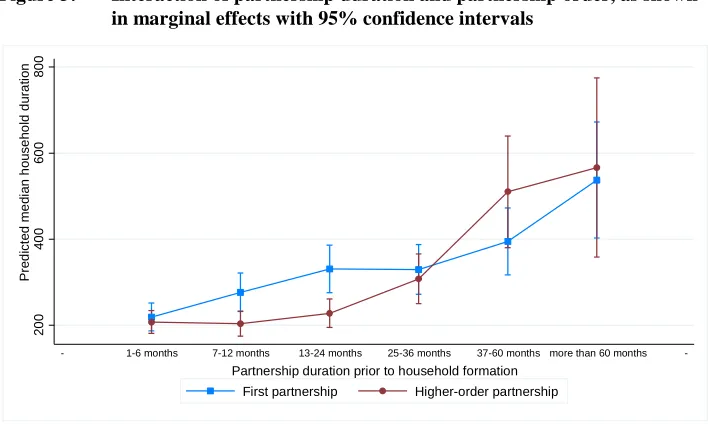
Figure 3 illustrates that a shorter non-coresidential period is related to a shorter median household duration in both first and higher-order partnerships. First partnerships have significantly longer duration outcomes than higher-order partnerships if they have a non-coresidential partnership period of 7 to 24 months. There is no significant difference between partnerships with a non-coresidential partnership period of one to six months or more than two years.
Figure 3: Interaction of partnership duration and partnership order, as shown in marginal effects with 95% confidence intervals
Source: German family panel (pairfam/DemoDiff), Release 3.1 (2011/2012), subsample coresidential partnerships (N=6,741)
Notes: Marginal effects calculated based on results of Model 4 (complete results in Table 4, Appendix)
5.4 Robustness check: Disregarding unions with imputed date information
For a substantial proportion (35%, N=2,405) of the coresidential unions, the information on partnership formation or/and household formation date was incomplete: in the interviews the respondent provided only seasonal or annual information instead of monthly information. These dates were imputed by the pairfam group (Nauck et al. 2012). As a robustness check, all multivariate models were estimated for the subsample of partnerships, for which all required information was available on a monthly basis.
20
0
40
0
60
0
80
0
P
red
ic
ted
m
e
di
an
h
ous
e
ho
ld
d
ur
a
ti
on
1-6 months 7-12 months 13-24 months 25-36 months 37-60 months more than 60 months
-
-Partnership duration prior to household formation
Due to the smaller sample size, confidence intervals were larger, but the model coefficients did not differ in size or direction from the estimations based on the full sample (results available upon request from the author).
6. Conclusion – Does waiting pay off?
In this study, the non-coresidential episode has been considered an integral part of partnership and a stepping-stone to a more committed coresidential partnership. In this sense, two persons meet, fall in love, and become a couple: this is the start of partnership. This is followed by a partnership stage of separate households during which the partners get to know each other better while spending time regularly and frequently together (Trost 2003). After some time they may decide to move in together. With household formation, a new era in the partnership begins in which the partners share their economies and daily life. The time they spent together before their households merged may then become crucial for the chances of their union’s survival.
This study examined the effects of partnership duration prior to household formation on union stability. A number of previous studies have focused on the antecedents of union stability, but the influence of the non-coresidential period has rarely been examined. The empirical findings revealed that a partnership that started with the partners living in separate households was usually of a transitory nature, resulting either in a coresidential union or separation of the partners. Due to the high transition rates into household formation and separation, partnerships in which household formation occurred relatively late in time were quite selective, which could have affected their risk of separation. The economic theory of the family (Becker 1991; Becker, Landes, and Michael 1977; Oppenheimer 1988) stresses the importance of couples knowing each other’s attributes. Couples should experience higher levels of union stability if they have had sufficient time to gather information about their partner before they invest in a partnership through household formation. Research on premarital cohabitation has led to the assumption that the positive effect of prior partnership duration on stability might reverse at some point.
duration. While keeping their separate residences, a couple can spend their day-to-day life together in a ‘trial union’ that allows them to evaluate each other’s characteristics. Several traits can be readily assessed after the first meeting (e.g., education, religion, family background, race, appearance). During the courtship process, traits that are more difficult to assess, such as honesty, reliability, and personality, can then be evaluated (Oppenheimer 1988). The non-coresidential period functions as a testing stage that enables individuals not only to select the appropriate partner but also to adapt to each other in daily life and formulate common strategies. The shorter the non-coresidential period, the more likely that partnership difficulties will emerge after household formation, leading to stability differentials, especially in the first years of partnership. Late household-formers are at risk of union dissolution only after the very unstable first period, which means that they were more positively selected on stability than couples that formed their household in the first year of partnership.
The individual’s as well as the partnership’s background influences the length of the non-coresidential partnership episode: late household formation was more common among Catholics, the more highly educated, and those that started their partnership at a young age, did not have prior partnership experiences, or were not living independently when the partnership was formed. However, the positive link between partnership duration and union stability could not be explained by the observed characteristics. It would have been interesting to take a closer look at the composition of the couple. The theoretical literature suggests that in explaining the transition to household formation, personality traits could be more relevant than socio-demographic characteristics. This issue was not addressed because individual information on partners was lacking.
In this study, partnerships which immediately started as coresidential unions were excluded from the analysis because there might be problems of recall or understanding: respondents who reported entering cohabitation directly may have in fact had a prior non-coresidential period that they could not no longer remember, or they may have misunderstood the intent of the question. On the other hand, it may also show that these partners are highly committed; i.e., they decided to directly start their partnership in the more committed form of coresidential union instead of the less committed form of non-coresidential partnership because they were convinced that the partnership would last. From the data used in this study it was not possible to disentangle ‘real’ direct household-formers from misreports. This issue demonstrates that more detailed data on the private life course requires new reflections about the definition of a partnership. Research will have to decide whether the definition should be left up to the respondent or whether specific criteria should be applied. In the latter case, the use of common criteria is essential to enable comparison across different data sets.
In sum, this study has shown that it is necessary to look beyond the household dimension and consider the non-coresidential partnership episode as an integral part of any partnership. New forms of private living arrangement, such as cohabitation and non-coresidential partnerships, have become common in many societies in recent decades. This implies that in the course of many individuals’ private lives, the dates of partnership, coresidence, and marrriage are often far apart. The date of partnership formation represents a more realistic marker of the beginning of partnership than the date when the couple moved in together. The detailed partnership information included in the German Family Panel makes it possible to distinguish the dates of partnership formation and household formation, as well as the dates of separation and household dissolution. Fortunately, a growing number of surveys are gathering detailed information on partnership. In future the distinction in the data between partnership formation and household formation should be less of a concern. The fact that couples spend part of their time in non-coresidential partnership forms should enhance researchers’ interest in the subject, and should not necessarily lead to the assumption that partnerships are becoming more fragile. A long non-coresidential partnership episode helps increase union stability. In other words, waiting pays off for couples.
Corrections:
References
Amato, P.R. (1996). Explaining the intergenerational transmission of divorce. Journal of Marriage and the Family 58(2): 628–640. doi:10.2307/353723.
Andersson, G., Noack, T., Seierstad, A., and Weedon-Fekjær, H. (2006). The demographics of same-sex marriages in Norway and Sweden. Demography 43(1): 79–98. doi:10.1353/dem.2006.0001.
Asendorpf, J. B. (2008). Living apart together: Alters-und Kohortenabhängigkeit einer heterogenen Lebensform. Kölner Zeitschrift für Soziologie und Sozialpsychologie 60(4): 749–764. doi:10.1007/s11577-008-0035-4.
Becker, G.S., Landes, E.M., and Michael, R.T. (1977). An economic analysis of marital stability. The Journal of Political Economy 85: 1141–1187. doi:10.1086/260631. Becker, G.S. (1991). A treatise on the family (Enlarged Edition). Cambridge,
Massachusetts: Harvard University Press.
Bennett, N.G., Blanc, A.K., and Bloom, D.E. (1988). Commitment and the modern union: assessing the link between premarital cohabitation and subsequent marital stability. American Sociological Review 53(1): 127–138. doi:10.2307/2095738. Berrington, A. and Diamond, I. (1999). Marital dissolution among the 1958 british birth
cohort: the role of cohabitation. Population Studies 53(1): 19–38.
doi:10.1080/00324720308066.
Blossfeld, H.-P., Klijzing, E., Pohl, K., and Rohwer, G. (1999). Why do cohabiting couples marry? An example of a causal event history approach to interdependent systems. Quality and Quantity 33: 229–242. doi:10.1023/A:1004644703306. Blossfeld, H.-P., Golsch, K., Rohwer, G. (2007). Event history analysis with Stata. New
York/London: Taylor and Francis.
Bracher, M., Santow, G., Morgan, S.P., and Trussell, J. (1993). Marriage dissolution in Australia: models and explanations. Population Studies 47 (3): 403–425.
doi:10.1080/0032472031000147216.
Brien, M.J., Lillard, L.A., and Stern, S. (2006). Cohabitation, marriage, and divorce in a model of match quality. International Economic Review 47(2): 451–494.
doi:10.1111/j.1468-2354.2006.00385.x.
Brüderl, J., Diekmann, A., and Engelhardt, H. (1999). Artefakte in der Scheidungsursachenforschung? Eine Erwiderung auf einen Artikel von Yasemin Niephaus. Kölner Zeitschrift für Soziologie und Sozialpsychologie 51: 744–753. Brüderl, J. and Kalter, F. (2001). The dissolution of marriages: the role of information
and marital-specific capital. Journal of Mathematical Sociology 25(4): 403–421.
doi:10.1080/0022250X.2001.9990262.
Brüderl, J., Diekmann, A., and Engelhardt, H. (1997). Erhöht eine Probeehe das Scheidungsrisiko? Kölner Zeitschrift für Soziologie und Sozialpsychologie 49: 205–222.
Carmichael, G.A. (1995). Consensual partnering in the more developed countries. Journal of the Australian Population Association 12(1): 51–86. doi:10.1007/ BF03029310.
Castro-Martín, T., Domínguez-Folgueras, M., and Martín-García, T. (2008). Not truly partnerless: non-coresidential partnerships and retreat from marriage in Spain. Demographic Research 18(16): 443–468. doi:10.4054/DemRes.2008.18.16. Cleves, M., Gutierrez, R., Gould, W., and Marchenko, Y. (2008). An introduction to
survival analysis using Stata. Texas, College Station: Stata Press.
Dex, S. (1995). The reliability of recall data: a literature review. Bulletin de Méthodologie Sociologique 49: 58–89. doi:10.1177/075910639504900105. Duncan, S. and Phillips, M. (2011). People who live apart together (LATs): new family
form or just a stage? International Review of Sociology 21(3): 513–532.
doi:10.1080/03906701.2011.625660.
Engelhardt, H. (2002). Zur Dynamik von Ehescheidungen. Theoretische und empirische Analysen. Berlin: Duncker and Humboldt.
Ermisch, J. and Siedler, T. (2008). Living apart together. In: Brynin, M. and Ermisch, J. (eds.). Changing relationships. New York: Taylor and Francis: 29–43.
Fine, J.P. and Gray, R.J. (1999). A proportional hazards model for the subdistribution of a competing risk. Journal of the American Statistical Association 94: 496– 509. doi:10.1080/01621459.1999.10474144.
Gutierrez, R.G. (2002). Parametric frailty and shared frailty survival models. Stata Journal 2(1): 22–44.
Guzzo, K.B. (2009). Marital intentions and the stability of first cohabitations. Journal of Family Issues 30(2): 179–205. doi:10.1177/0192513X08323694.
Hiekel, N., Liefbroer, A.C., and Poortman, A.-R. (2015). Marriage and separation risks among German cohabiters: Differences between types of cohabiters. Population Studies. doi:10.1080/00324728.2015.1037334.
Hoem, J.M. (1989). Limitations of a heterogeneity technique: selectivity issues in conjugal union disruption at parity zero in contemporary Sweden. Stockholm Research Reports in Demography No. 56.
Hoem, B. and Hoem, J. (1992). The disruption of marital and non-marital unions in contemporary Sweden. In: Trussel, J., Hankinson, R., Tilton, J. (eds.). Demographic applications of event history analysis. Oxford: Clarendon Press: 61–93.
Huinink, J., Brüderl, J., Nauck, B., Walper, S., Castiglioni, L., and Feldhaus, M. (2010). Panel analysis of intimate relationships and family dynamics (pairfam): conceptual framework and design. Arbeitspapier des Beziehungs- und Familienpanels, No.17.
Jalovaara, M. (2013). Socioeconomic resources and the dissolution of cohabitations and marriages. European Journal of Population 29 (2): 167–193. doi:10.1007/s106 80-012-9280-3.
Klijzing, E. (1992). ‘Weeding’ in the Netherlands: first-union disruption among men and women born between 1928 and 1965. European Sociological Review 8(1): 53–70.
Konietzka, D. and Tatjes, A. (2014). Two steps of union formation: first intimate relationships and first coresidential unions in the life courses of the German Cohorts 1971–1973 and 1981–1983. Journal of Youth Studies 17(8): 1077–1096.
doi:10.1080/13676261.2014.888405.
Köppen, K. (2011). Marriage and cohabitation in western Germany and France. Rostock: University of Rostock.
Kreyenfeld, M., Goldstein, J., Walke, R., Trappe, H., and Huinink, J. (2013a): Demographic differences in life course dynamics in eastern and western Germany (DemoDiff). Köln: GESIS Datenarchiv (ZA5684 Datenfile Version 3.0.0). doi:10.4232/demodiff.5684.3.1.0.
Kreyenfeld, M., Walke, R., Salzburger, V., Lenke, R., Hensel, T. and Mir Mousavi, B. (2013b). DemoDiff supplement to the pairfam data manual (Release 3.0). Rostock: Max Planck Institute for Demographic Research.
Kulu, H. and Boyle, P.J. (2009). Premarital cohabitation and divorce: support for the ‘trial marriage’ theory? Demographic Research 23(31): 879–904.
Le Bourdais, C., Neill, G., and Vachon, N. (2000). Family disruption in Canada: Impact of the changing patterns of family formation and of female employment. Canadian Studies in Population 27: 85–105.
Lehrer, E.L. (2004). Religion as a determinant of economic and demographic behavior in the United States. Population and Development Review 30: 707–726.
doi:10.1111/j.1728-4457.2004.00038.x.
Levin, I. (2004). Living apart together: a new family form. Current Sociology 52(2): 223–240. doi:10.1177/0011392104041809.
Levin, I. and Trost, J. (1999). Living apart together. Community, Work and Family 2(3): 279–294. doi:10.1080/13668809908412186.
Liefbroer, A.C., Poortman, A.R., and Seltzer, J.A. (2015). Why do intimate partners live apart? Evidence on LAT relationships across Europe. Demographic Research 32(8): 251–286. doi:10.4054/DemRes.2015.32.8.
Liefbroer, A.C., and Dourleijn, E. (2006). Unmarried cohabitation and union stability: Testing the role of diffusion using data from 16 European countries. Demography 43(2): 203-221. doi:10.1353/dem.2006.0018.
Lillard, L.A., Brien, M.J., and Waite, L.J. (1995). Premarital cohabitation and subsequent marital dissolution: a matter of self-selection? Demography 32: 437– 457. doi:10.2307/2061690.
Liu, G. (2002). How premarital children and childbearing in current marriage influence divorce of Swedish women in their first marriages. Demographic Research 7: 389–406. doi:10.4054/DemRes.2002.7.10.