DEMOGRAPHIC RESEARCH
VOLUME 35, ARTICLE 46, PAGES 1343
−
1372
PUBLISHED 23 NOVEMBER 2016
http://www.demographic-research.org/Volumes/Vol35/46/ DOI: 10.4054/DemRes.2016.35.46
Research Article
Fertility and the changing pattern of the timing
of childbearing in Colombia
Ewa Batyra
©2016 Ewa Batyra.
This open-access work is published under the terms of the Creative Commons Attribution NonCommercial License 2.0 Germany, which permits use, reproduction & distribution in any medium for non-commercial purposes, provided the original author(s) and source are given credit.
1 Introduction 1344
2 Background 1345
2.1 Fertility transition in Colombia and Latin America 1345
2.2 Fertility level and timing of childbearing 1347
2.3 Timing of childbearing and education 1348
3 Data 1349
4 Methods 1350
4.1 Fertility and timing of childbearing trend analysis 1350 4.2 Multivariate analysis of the timing of childbearing 1351
5 Results 1353
5.1 Fertility and timing of childbearing trend analysis 1353 5.2 Multivariate analysis of the timing of childbearing 1357
6 Discussion 1363
7 Acknowledgments 1366
Fertility and the changing pattern of the
timing of childbearing in Colombia
Ewa Batyra1
Abstract
BACKGROUND
According to the latest 2010 CDHS, Colombia’s total fertility rate (TFR) reached the level of 2.1. Studies show that the long-observed early childbearing pattern there might be changing, in particular for highly educated women, yet detailed analysis of timing of motherhood by birth order is lacking. In low fertility contexts, changes in the timing of childbearing are vital for interpreting period fertility measures and anticipating future trajectories.
OBJECTIVE
To study the fertility trend in Colombia since 1990 and examine how the timing of childbearing changed by birth order and across cohorts. The relationship between education and timing of motherhood is analysed in depth across cohorts.
METHODS
To analyse the trend in fertility and timing of childbearing, order-specific mean age at birth and tempo-adjusted TFR are calculated using CDHS. Discrete-time logit models are fitted to study the transition to first and second births across cohorts and educational groups.
RESULTS
Opposing trends in the timing of first and second births are found, with early transition to motherhood existing alongside postponement of second births. This process and the documented halt to the decrease in the age at first birth contribute to the end of the inflating effect of childbearing timing changes on TFR. Multivariate analysis reveals that norms relating to later transition to motherhood are emerging not only among women with university education but also among women with lower educational levels. Postponement of second births is observed in all educational strata.
1
CONCLUSION
With continuation of the documented trends, a depressing effect of the changes in the timing of childbearing on TFR could be expected in Colombia, possibly bringing it to below replacementlevel.
1. Introduction
Many Latin American countries have experienced notable fertility declines during the second half of the 20th century, with some of them approaching and others already below replacement level fertility. Although according to the latest Demographic and Health Survey (CDHS) Colombia’s total fertility rate (TFR) is 2.1 children per women, little is known about the dimensions of the fertility decline there. Even less is known about the timing of childbearing and how it has changed across birth orders and cohorts. Fertility decline in Colombia has been accompanied by a stable, or at times decreasing, age at first birth. There is evidence, however, from a study by Rosero-Bixby, Castro-Martín, and Martín-García (2009) that the timing of childbearing is changing across Latin America and the shift away from early childbearing is particularly pronounced among highly educated. In addition to establishing that a growing proportion of women in their twenties did not make the transition to motherhood in the region as a whole, their study finds that the change observed in Colombia between the two last censuses was particularly pronounced. These findings, together with fertility reaching low levels in Colombia, warrant the examination of the processes underlying these changes.
Second, this study uses event history analysis to examine changes in the timing of childbearing across cohorts and educational groups. Specifically, the transitions to first and second births are investigated. The models assess if, and to what extent, the risk of birth of a given order increases or decreases with regard to women’s birth cohort. Finally, this study examines in detail the relationship between women’s education and the timing of motherhood. Changes in the risk of transition to first and second births within educational groups across cohorts are analysed. This is to clarify not only how the timing of childbearing has differed between women with different levels of education but also how it has been changing within these subgroups. This is the first analysis of changes in the timing of childbearing in Colombia using statistical models and incorporating the most recent (CDHS 2010) survey data.
2. Background
2.1 Fertility transition in Colombia and Latin America
The evolution of fertility changes in Latin America has been widely documented (Guzmán et al. 1996). A characteristic of the region has been sustained fertility decline without significant change in the timing of the onset of childbearing. The absence of a trend in delayed motherhood has been attributed to a stalling or at times increasing teenage fertility, a so-called “fertility rejuvenation” process (Bozon, Gayet, and Barrientos 2009; Cavenaghi and Diniz Alves 2009; Chackiel and Schkolnik 1996; Flórez and Núñez 2001).
Colombia has one of the lowest TFRs in Latin America, a decline which started in the mid-20th century (United Nations 2015). According to the CDHS, TFR reached a replacement level of 2.1 in 2010, down from 6.8 children in the 1960s. Fertility decline in the 1960s and 1970s was attributed to the introduction of Profamilia and increased availability of modern contraceptives. This allowed young women aged 15−19 years to postpone first births through lowering the costs of delaying motherhood (Miller 2010). Nevertheless, previous studies have identified birth-limiting behaviour as opposed to birth-spacing behaviour as the more important component of Colombian fertility decline (Parrado 2000). However, recent cross-country comparative analysis by Casterline and Odden (2016) uncovered the existence of particularly long birth intervals between first and second births at low fertility levels in Latin American countries, including Colombia.
stages of their reproductive life, with a simultaneous increase in fertility among youngest women (Álvarez Castaño 2015; di Cesare and Rodríguez Vignoli 2006). Consequently, the peak of the curve depicting the age-specific fertility rates has shifted towards younger age groups.
Although an increase in teenage childbearing since 1990 has been observed among women in all socioeconomic strata, early motherhood initiation has been most common among those from disadvantaged backgrounds (Flórez and Soto 2007, 2013; Flórez 2005). Elevation in adolescent fertility was not limited to but was most pronounced among women living in rural areas, the poorest households, and the least educated. The marked fertility increase among these subgroups has been associated with poverty and low levels of education, which are related to lack of opportunities (Azevedo et al. 2012; Flórez and Soto 2007). Studies argue that young women regard motherhood as a source of personal realisation and an alternative in the face of barriers to social and economic mobility and low expectations regarding future labour market prospects (Flórez 2005; Gaviria 2000).
Considering the proximate determinants of adolescent fertility rise, the change towards earlier initiation of sexual activity, in particular among women from the lowest socioeconomic strata, worked in the direction of increasing the contribution of women aged 15−19 years to total fertility (Flórez and Núñez 2001). Although the proportion of adolescents using contraception has been increasing since 1990, studies show that this increase was not sufficient to offset the observed rise in early sexual activity (Ali, Cleland, and Shah 2003). Moreover, high levels of contraceptive failure among young women due to incorrect use and use of less effective methods compared to all women, has translated into substantial levels of unintended pregnancies in that subgroup (Flórez and Soto 2007; Parada Rico 2011).
Recent evidence shows that young cohorts of women in Latin American countries, including Colombia, are starting to postpone first births (Esteve et al. 2012; Rosero-Bixby, Castro-Martín, and Martín-García 2009). The analysis of the available 2000 census rounds shows that a growing proportion of women in their twenties in the region had not made the transition to motherhood. Rosero-Bixby, Castro-Martín, and Martín-García (2009) highlight that Colombia exhibits an extreme case in this respect. The proportion of women aged 25−29 years that made a transition to motherhood dropped by more than ten percentage points between the 1993 and 2005 censuses (from 82% to 70%, respectively). This new trend deserves further investigation using more recent data sources, as it might mark a shift in the timing of the childbearing pattern observed so far in Colombia. Moreover, its continuation might have an influence on the already at the replacement level TFR in the country.
childbearing pathways after first birth in the region are poorly understood and there are few studies that also analyse timing of second and higher-order births. Miranda-Ribeiro, Rios-Neto, and Ortega (2008) document the coexistence of a negative tempo effect of first births and positive tempo effect of second births in Brazil during the 1990s. In further analysis Rios-Neto and Miranda-Ribeiro (2015) find a change in the trend towards a slight increase in age at first birth between the end of the 1990s and 2010, together with a continued and more pronounced rise in the mean age at second birth. On the other hand, Nathan, Pardo, and Cabella (2016) find concurrent increases in the mean age at first, second, and third births in Uruguay between 1996 and 2011. These studies provide evidence that the parity-specific patterns of change in the timing of childbearing in the region vary between countries. Moreover, as in the case of Brazil, they do not conform to the pattern observed in European countries. In Europe the postponement of higher-order births usually started after the postponement of first births as a consequence of the initial process of later entrance into motherhood (Sobotka 2004).
There is currently no research on the timing of childbearing after first birth in Colombia, considered in the light of the acceleration of transition to motherhood observed during the 1990s and the recent evidence of childbearing postponement. It has not been previously examined whether or how the changes in the timing of first births are related to the changes in the timing of subsequent births. The availability of detailed reproductive histories for Colombia from the CDHS used in this study permits extending the current body of knowledge about the parity-specific changes in fertility timing in the region.
2.2 Fertility level and timing of childbearing
2013; Sobotka 2004). It is, however, an aspect rarely studied in the Latin American context and to the best of the author’s knowledge there are currently no studies that look at these processes for Colombia.
2.3 Timing of childbearing and education
Literature on changes in the timing of childbearing, in particular first-birth postponement, provides a wide description of factors contributing to this phenomenon. These pertain to increases in women’s education and career opportunities, less orientation towards family-centred values, use of effective contraception, partnership changes, and economic conditions such as unemployment, housing factors, and availability of supportive family policies (Billari, Liefbroer, and Philipov 2006; Kohler, Billari, and Ortega 2002; Mills et al. 2011; Rindfuss, Morgan, and Swicegood 1988; Sobotka 2004).
The effect of prolonged education on childbearing postponement has been documented as one of the most important factors. There is consensus in the literature that highly educated women are the forerunners in the process of delayed transition to motherhood, as staying longer in education contributes to the reduced risk of having a first child (Blossfeld and Huinink 1991; Rindfuss, Bumpass, and John 1980). Previous research on Latin America in particular has found a strong relationship between transition to motherhood and education, with highly educated women being less likely to experience first birth at younger ages (Bozon, Gayet, and Barrientos 2009; Castro-Martín and Juarez 1995; Heaton, Forste, and Otterstrom 2002).
At the individual level there is a clear association between education and childbearing postponement. The aggregate population-level changes in the timing of parenthood can be related to either compositional change with respect to education (rising educational participation) or change over time in the association between education and motherhood timing (e.g., Neels et al. 2014; Ní Bhrolcháin and Beaujouan 2012). Regarding the latter, the delay of first birth across time can proceed among women in all educational strata, but the process might also be differentiated by education level. Consequently, some previous studies have identified a greater extent of postponement among women with higher levels of education, leading to widening differences in the timing of first birth between the subgroups (e.g., Rindfuss, Morgan, and Offutt 1996).
authors, female education participation in Latin America has increased since the 1970s. However, it was only recently that a particularly pronounced expansion of secondary and university education occurred. This might have been an important factor in the onset of delayed childbearing at the population level in the region. Nevertheless, the authors suggest that it was not only compositional changes that contributed to this process. They document that in several countries of Latin America, including Colombia, there have been increases in the proportion of women who have not transitioned to motherhood within the educational groups. This finding and the previous evidence of the advancement of transition to motherhood among women in all educational strata in Colombia (Flórez and Soto 2007) suggest that the relationship between timing of childbearing and education might have changed in the country. However, studies capturing the extent of these changes using statistical models are lacking.
Given the identified gaps in the existing literature and recent findings on the emergent postponement transition in Latin America, this study aims to answer the following research questions:
♦ What changes in the timing of first and higher-order births took place in Colombia between 1990 and 2010?
♦ How have these changes shaped the observed trend in the TFR?
♦ What changes in the timing of first and second births took place for cohorts of women born between 1960 and 1995?
♦ What has been the relationship between the timing of transition to first and second births and education level for these cohorts?
3. Data
The study uses cross-sectional, secondary data from five rounds of the nationally representative Colombian Demographic and Health Survey (CDHS), conducted in 1990, 1995, 2000, 2005, and 2010.2 These collect information about women of all marital statuses aged 15−49 with sample sizes ranging from 7,412 in 1990 to 51,447 in 2010. In the analysis of period fertility and timing of childbearing trends all survey rounds are used. In the following multivariate analysis, only the CDHS2010 is utilized. For the analyses, birth recodes as well as individual women recodes are used. These contain women’s detailed retrospective birth histories and information about the
2
socioeconomic characteristics of individuals. The CDHS datasets are weighted by the sample weights to account for the design of the surveys (Rustein and Rojas 2006).
4. Methods
4.1 Fertility and timing of childbearing trend analysis
First, the trends in fertility and the timing of childbearing by birth order are examined. Second, an analysis is conducted of how changes in the timing of childbearing shaped the observed trend in the TFR between 1990 and 2010.
Order-specific period fertility
In order to follow the evolution of changes in the first- and higher-order births, trends in TFR and its birth order components (TFRi, i=1,2,3,4,5+) are calculated across the CDHS rounds. These are obtained from the period age-order-specific fertility rates calculated from birth histories using the STATA tfr2 module, as described by Schoumaker (2013). First the events (births) and exposure in age groups for three years preceding the survey for a given birth order are computed. In the next step the Poisson regression is used to calculate the fertility rates. The TFR birth-order components calculated this way have the same interpretation as the TFR, while referring to the specified birth order. The period changes in the timing of childbearing are examined by calculating the corresponding mean ages at birth of different birth orders.
Tempo-adjusted order-specific fertility
𝑎𝑑𝑗𝑇𝐹𝑅𝑖= 𝑇𝐹𝑅𝑖/(1− 𝑟𝑖) (1)
𝑇𝐹𝑅𝑖 – observed total fertility rate in a given year at birth order i 3
𝑟𝑖 – annual rate of change in the mean age at birth order i
The increase in the mean age results in the adjusted rate being greater than the observed fertility value. The decrease in the mean age results in the adjusted measure being smaller than the unadjusted one. If no changes in the timing of births by parity occurred, the adjusted and unadjusted rates are of the same value. The adjusted TFR is calculated by summing all of the birth-order values (adjTFRi) obtained from the above procedure in the following way:
𝑎𝑑𝑗𝑇𝐹𝑅= ∑ 𝑎𝑑𝑗𝑇𝐹𝑅𝑖 (2)
The measurement of tempo effects from survey data is more challenging than that from census or vital registration data, as these are subject to sampling errors. While, according to Bongaarts and Feeney (1998), survey samples might be too small to derive reliable measures, other studies show that the tempo adjustments performed using DHS can provide insight into fertility changes (Bongaarts 1999). According to Bongaarts (1999), surveys only make it possible to determine the existence of the tempo effects and do not allow researchers to measure their size accurately. The purpose of this analysis is to study the existence of such tempo effects, acknowledging that it is not possible to study the exact amount of fertility tempo distortion. To ensure that the changes in the mean age at birth of a given parity are not just due to sampling variation, the 95% confidence intervals for the point estimates have been calculated and compared. The overlapping confidence intervals of the estimates between two time periods are an indication of a lack of a statistically significant change in the mean age at birth of the given parity. Further, the plausible values of the mean age at birth represented by the confidence intervals are examined, in order to discuss the possible influence of the sampling variation on the estimated tempo effects.
4.2 Multivariate analysis of the timing of childbearing
To analyse changes in the timing of first and second births across cohorts and educational groups, an event history discrete-time logit model is applied. For the purpose of the multivariate analysis only the latest 2010 CDHS round is used. The model is described by the following equation (Yamaguchi 1991):
ln�[1−𝜆(𝜆𝑡(𝑖;𝑡𝑋)
𝑖;𝑋)]�= 𝑎𝑖+ ∑ 𝑏𝑘𝑋𝑘
𝑘
𝑖=1 (3)
where 𝜆(𝑡𝑖;𝑋) is the probability of the event occurring at time ti; ai corresponds to the baseline hazard at time ti; ∑ 𝑏𝑘𝑖=1 𝑘𝑋𝑘 describes the effects of explanatory variables on
the hazard.
The discrete-time logit model was chosen because of the discrete character of the variable of interest, time to event (first birth or second birth) in years, which, together with the big sample size of the 2010 CDHS (51,447 women), makes it possible to handle ties in an appropriate manner (Yamaguchi 1991). Four models were fitted:
1. interval between age 15 and age at first birth 2. interval between first birth and second birth
3. interval between age 15 and age at first birth with an interaction between the birth cohort and education variable
4. interval between first birth and second birth with an interaction between the birth cohort and education variable
All information used in these analyses, including the age at first and second births, is derived from the CDHS 2010 women’s recode which reports the exact year in which a women gave birth to her children (if any). Age 15 is taken as the beginning of the interval in the model in which the timing of first birth is analysed.4 In that model the dependent variable is a dummy variable that indicates whether the event happened (first birth) or if the observation was censored. In the model examining the first-to-second-birth interval analogously the time of second first-to-second-birth is analysed for women who have had at least one child. In each case the dependence of hazard on time is unrestricted with a dummy variable for each study time (e.g., t=15,16,…,49 in the first-birth model).
In the models, the main explanatory variables are those describing woman’s birth cohort and education level. In the models 1 and 2, the birth cohort is a categorical variable and women have been grouped into seven categories (1960-64, 1965-69,…, 1990-1995). In the models 3 and 4, the birth cohort is a continuous variable describing women’s year of birth. The education variable is the highest education level attended by an individual and is the primary measure of socioeconomic status in the analysis. Apart from cohort and education, the following variables have been controlled for: ethnicity, place of residence, and region of residence. Lastly, in the model analysing the interval between first and second birth the age at first birth has been included as a covariate.
4 According to the CDHS 2010 (author’s calculation) only 2.9% of women had their first birth below age 15
All of the variables are included as time-constant. The cross-sectional character of the DHS and lack of distinction between the current status and status at the time of pregnancy and birth of the socioeconomic variables is a limitation when conducting event history analysis. Therefore the inclusion of socioeconomic controls is minimal in this study, in spite of a variety of measures available in the DHS. For the same reason, the education variable used describes the highest level of education attended, as opposed to educational attainment. Some women might have entered a given education level but never completed it; for example, because they dropped out due to pregnancy (Flórez and Soto 2007). The use of highest education level attended is therefore a better measure of status at the time of risk of pregnancy than educational attainment.
5. Results
5.1 Fertility and timing of childbearing trend analysis
Figure 1 shows the trend in the TFR in Colombia throughout the 20-year period. The TFR reached the replacement level in 2010; however, in 1995 a temporary plateau interrupted the decline.
Figure 1: Total fertility rate, Colombia 1990−2010
Order-specific period fertility
Trends in TFR and its birth order components (Figure 2)reveal that the TFR decrease in the last 20 years in Colombia, although interrupted in 1995, was almost entirely due to decreases in the fertility of the highest birth orders (3, 4, and 5+). The contribution of parities 1 and 2 to the TFR decline between 1990 and 2010 was much smaller. Nevertheless, after an initial plateau in the TFR in 1995, the fertility rates for all birth orders declined.
Figure 2: Total fertility rate by birth order, Colombia 1990−2010
Source: Author’s calculations from individual datasets (CDHS 1990, 1995, 2000, 2005, 2010).
Figure 3 depicts the trends in the mean age at birth (MAB) by parity with 95% confidence intervals of the estimates. It shows that for all parities the MAB was stable between 1990 and 1995, with the confidence intervals of the estimates for these two periods overlapping. Since 1995 two distinct timing-of-childbearing changes emerged: decreasing MAB for first births and increasing MAB for second births. This means that from 1995 two divergent trends in the MAB can be observed. Whereas the age at first birth in 2010 was at a level even lower than that observed in 1995, the opposite change occurred for second births, suggesting postponement of second births without the first-birth postponement. 2.8 3.0 2.6 2.4 5+ 4 3 2 2.1 1 0 0.5 1 1.5 2 2.5 3 3.5
1990 1995 2000 2005 2010
Figure 3: Mean age at birth by parity with 95% confidence intervals, Colombia 1990−2010
Note: Solid lines represent a statistically significant change in the mean age at birth of a given parity between two time periods. Source: Author’s calculation from individual datasets(CDHS 1990, 1995, 2000, 2005, 2010).
A feature of fertility pattern in Colombia since 1995 is having children of higher parity later, but starting childbearing early.
The tempo-adjusted order-specific fertility
Figure 4allows for investigation of the tempo effect in the fertility change through the comparison of the TFR and tempo-adjusted TFR (adjTFR). After 1995 there occurred a decrease in the MAB of the first child. The upper part of Figure 4 shows that in the absence of such a decrease, the TFR1 would have been lower than that observed, which is represented by the AdjTFR1 being below TFR1 in 2000. After 2005, however, the trend towards decreasing age at first birth came to a halt (adjusted and unadjusted values are equal). This means that after 1995 there was a tempo-inflating effect with regards to the observed change in the TFR1.
4
3
2
1
22 23 24 25 26 27 28 29 30 31 32
1990 1995 2000 2005 2010
M
e
a
n a
ge
a
t
bi
rth
(by
bi
rth or
de
Figure 4: Total fertility rate (TFR) and tempo-adjusted total fertility rate (adjTFR) for first births (TFR1) and all birth orders combined (TFR), Colombia 1990‒2010
Source: Author’s calculation from individual datasets (CDHS 1990, 1995, 2000, 2005, 2010).
These changes are reflected in the TFR trend for all birth orders combined. The advancement of childbearing produced a fertility level that would have been lower if the mean age at birth had not decreased in year 2000. In the consecutive period, however, the adjusted TFR was higher than the observed TFR, marking the end of the previous fertility-inflating effect of earlier childbearing. Interestingly, in the periods in which the age at first birth was stable (where TFR1=AdjTFR1in 1995 and 2005), the adjusted TFR (AdjTFR for all birth orders) was higher than the observed TFR. These
0 0.2 0.4 0.6 0.8 1
1990 1995 2000 2005 2010
TFR1
TFR1 AdjTFR1
1 1.5 2 2.5 3 3.5
1990 1995 2000 2005 2010
TFR
findings suggest that the tempo changes of first-order births worked towards increasing fertility, whereas those of the higher-order births worked towards decreasing it. After 1995 the TFR declined steadily. The finding of the presence of a negative tempo effect of first births and a positive tempo effect of births of order 2+ suggests that the fertility decline after 1995 was both due to the quantum of fertility effect and a tempo effect of higher order births.
For the calculation of the tempo effects, the annual changes in the mean age at each of the birth orders are incorporated (Equation 1). Figure 3 shows that the observed increases and decreases in the MAB between certain survey rounds, represented by the point estimates, are not statistically significant. It is useful to consider whether, and how, the results of these analyses would change if, in the calculation of Equation 1,
only statistically significant changes in the MAB were taken into account. Even in such a scenario, the direction of the tempo effects would be the same as in the bottom part of Figure 4: 1) between 1995 and 2000 the statistically significant increase in the mean age at second birth would be responsible for the positive tempo effect during that period, 2) between 2000 and 2005 the decrease in the mean age at first birth would be reflected in the negative tempo effect in that time frame, and 3) in the last time period 2005−2010 the disappearance of the decrease in the mean age at first birth and further increase in the mean age at second birth would contribute to the positive tempo effect.
Moreover, the variation in the changes in the mean age at given birth order, as represented by the confidence bounds, might be responsible for the adjusted TFR having a more erratic evolution than the TFR. According to Bongaarts (1999), even small errors in the measurement of the changes in the MAB can have an influence on the estimated tempo effects. Therefore, in this study the tempo distortions could actually be smaller (or bigger), as shown by the plausible values of the MAB of a given order across survey rounds. The true magnitude of these tempo effects is not possible to establish; however, the analysis of the confidence intervals provides confirmation of their existence.
5.2 Multivariate analysis of the timing of childbearing
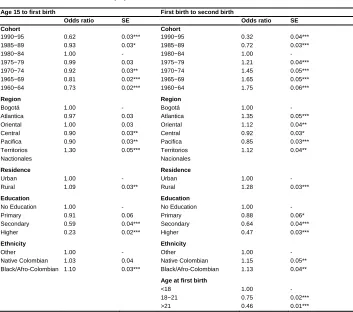
1990–1995 such odds were lower by 38%. This means the reversal of the observed trend towards earlier transition to motherhood, which was characteristic of older cohorts.
Table 1: Discrete-time logit models: Age 15 to first birth(I),first birth to second birth (II)
Age 15 to first birth First birth to second birth
Odds ratio SE Odds ratio SE
Cohort Cohort
1990−95 0.62 0.03*** 1990−95 0.32 0.04*** 1985−89 0.93 0.03* 1985−89 0.72 0.03*** 1980−84 1.00 - 1980−84 1.00 - 1975−79 0.99 0.03 1975−79 1.21 0.04*** 1970−74 0.92 0.03** 1970−74 1.45 0.05*** 1965−69 0.81 0.02*** 1965−69 1.65 0.05*** 1960−64 0.73 0.02*** 1960−64 1.75 0.06***
Region Region
Bogotá 1.00 - Bogotá 1.00 - Atlantica 0.97 0.03 Atlantica 1.35 0.05*** Oriental 1.00 0.03 Oriental 1.12 0.04** Central 0.90 0.03** Central 0.92 0.03* Pacifica 0.90 0.03** Pacifica 0.85 0.03*** Territorios 1.30 0.05*** Territorios 1.12 0.04** Nactionales Nacionales
Residence Residence
Urban 1.00 - Urban 1.00 - Rural 1.09 0.03** Rural 1.28 0.03***
Education Education
No Education 1.00 - No Education 1.00 - Primary 0.91 0.06 Primary 0.88 0.06* Secondary 0.59 0.04*** Secondary 0.64 0.04*** Higher 0.23 0.02*** Higher 0.47 0.03***
Ethnicity Ethnicity
Other 1.00 - Other 1.00 - Native Colombian 1.03 0.04 Native Colombian 1.15 0.05** Black/Afro-Colombian 1.10 0.03*** Black/Afro-Colombian 1.13 0.04**
Age at first birth
<18 1.00 - 18−21 0.75 0.02*** >21 0.46 0.01***
Note: Reference category has an odds ratio of 1.00. †p<0.10; *p<0.05; **p<0.01; ***p<0.001.
These changes were occurring hand in hand with an increasing interval between the first and the second birth. This is represented by the continuously decreasing hazard of having a second birth across all cohorts for women who are already mothers, a highly significant result in model (II). This was also the case for cohorts for which the increasing risk of first birth was identified. This result is obtained while controlling for age at first birth, which means that in each consecutive cohort women were postponing the transition to second birth. These findings are in line with the results presented in Figure 3,which reveal the trend towards increasing mean age at second birth without an increasing, or at times decreasing, mean age at first birth.
Education appears to be the strongest factor associated with the timing of childbearing, inversely related to the risk of first as well as second births. Respondents whose highest level of education attended is higher education have a 77% lower odds of first-birth risk than women in the category ‘no education.’ For women in the higher education category who are already mothers, the odds of the risk of a second child are 53% lower compared to women in the category ‘no education.’
Among other explanatory variables, the place of residence has a significant effect on the timing of childbearing. Living in a rural area is associated with an increased risk of having a first as well as a second child. The association between the risk of having a second birth and place of residence is particularly strong, with women living in rural areas having 28% higher odds of the hazard than women living in urban areas. This means that once women in rural areas have a first child they progress faster to a second child, compared to urban residents. Moreover, women living in the Central and Pacifica regions are at lower risk of having a first as well as a second child when compared to Bogotá. The opposite direction of association is found for those living in Territorios Nacionales. Inclusion of the ethnicity variable in both models reveals that the risk of first birth is higher for Black/Afro-Colombian women than for Native Colombian women and women in the category ‘Other.’ Moreover, not only are Black/Afro-Colombian women entering motherhood earlier, they are also spacing the first and the second birth more tightly. Shorter spacing of first and second births is also a characteristic of Native Colombian women.
Timing of childbearing and education level: Transition to first birth
continuous variable of the year of birth) and the change in the trend of increasing risk of first birth for cohorts born starting 1980, presented in the model (I).
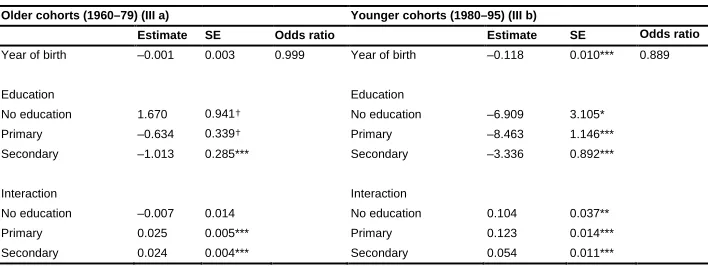
Table 2: Discrete-time logit models: Age 15 to first birth, interaction term between the year of birth and education level (III a and III b)
Older cohorts (1960–79) (III a) Younger cohorts (1980–95) (III b) Estimate SE Odds ratio Estimate SE Odds ratio
Year of birth –0.001 0.003 0.999 Year of birth –0.118 0.010*** 0.889
Education Education
No education 1.670 0.941† No education –6.909 3.105* Primary –0.634 0.339† Primary –8.463 1.146*** Secondary –1.013 0.285*** Secondary –3.336 0.892***
Interaction Interaction
No education –0.007 0.014 No education 0.104 0.037** Primary 0.025 0.005*** Primary 0.123 0.014*** Secondary 0.024 0.004*** Secondary 0.054 0.011***
Note: Reference category of education variable: higher. Year of birth is a continuous variable centred around year 1900. Control variables as in the model (I), omitted from the output.
†
p<0.10; *p<0.05; **p<0.01; ***p<0.001
Source: Author’s calculation from individual dataset (CDHS 2010).
Considering both models, compared to women with higher education there is a statistically significant difference in the trend of the risk of first birth for women in the primary and secondary education categories and for younger cohorts in the category ‘no education.’ This means that the relationship between the risk of first birth and birth cohort differs by educational group.
Moreover, the models provide evidence that the relationship between the timing of childbearing and education level changed over time. The coefficient of the ‘year of birth’variable represents the trend of the risk of first birth for women in the reference category ‘higher education.’ For older cohorts (model III a) it is close to 0, indicating that the risk of first birth has not changed for consecutive cohorts in that educational group. On the other hand, for the cohorts of women born after 1980 (model III b) there is a statistically significant decline in the hazard of first birth for younger women: the odds of the risk of first-birth decrease by 11% with each increment in the year of birth. This means that women born after 1980 who attended higher education are increasingly postponing their transition to motherhood, a trend not observed for older cohorts.
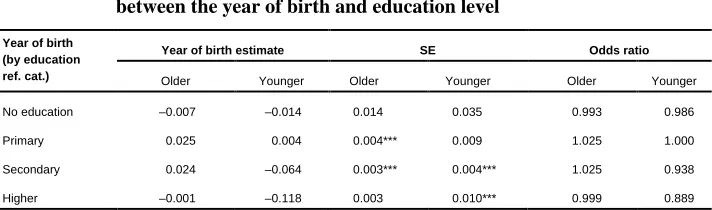
distinct educational groups. In line with the previous literature on the relationship between education level and timing of first births (e.g., for the United States, Rindfuss, Morgan, and Offutt 1996), in Colombia individuals with more years of education are postponing motherhood to a greater extent than those with fewer years of education. To obtain information about the magnitude of this and whether the change in the risk of first birth has been statistically significant by itself for particular educational groups, the same models have been fitted by changing the reference category (ref. cat.) of the education variable (Table 3).
Table 3: Discrete-time logit models: Age 15 to first birth, interaction term between the year of birth and education level
Year of birth (by education ref. cat.)
Year of birth estimate SE Odds ratio
Older Younger Older Younger Older Younger
No education –0.007 –0.014 0.014 0.035 0.993 0.986
Primary 0.025 0.004 0.004*** 0.009 1.025 1.000
Secondary 0.024 –0.064 0.003*** 0.004*** 1.025 0.938
Higher –0.001 –0.118 0.003 0.010*** 0.999 0.889
Note: Year of birth is a continuous variable centred around year 1900. Control variables as in the model (I), omitted from the output.
†p<0.10; *p<0.05; **p<0.01; ***p<0.001
Source: Author’s calculation from individual dataset (CDHS 2010).
Timing of childbearing and education level: Transition to second birth
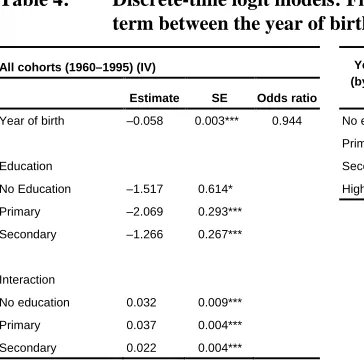
A model with an interaction term between the level of education and the birth cohort was fitted for the interval between the first and the second births, controlling for the age at first birth. No distinction has been made between the two cohorts as in the case of first births, because no change in the trend of the risk of transition to second birth between the cohorts has been identified in the model (II). Results in Table 4 show a statistically significant interaction term between the year of birth and educational level, indicating the differentiated magnitude of the change between the subgroups in the risk of second birth.
Table 4: Discrete-time logit models: First birth to second birth, interaction term between the year of birth and education level (IV)
All cohorts (1960–1995) (IV) Year of birth (by education
ref. cat.)
Year of birth
estimate SE Odds ratio
Estimate SE Odds ratio
Year of birth –0.058 0.003*** 0.944 No education –0.027 0.008*** 0.974 Primary –0.021 0.002*** 0.979 Education Secondary –0.037 0.002*** 0.964 No Education –1.517 0.614* Higher –0.058 0.003*** 0.944 Primary –2.069 0.293***
Secondary –1.266 0.267***
Interaction
No education 0.032 0.009*** Primary 0.037 0.004*** Secondary 0.022 0.004***
Note: Year of birth is a continuous variable centred around year 1900. Control variables as in the model (II), omitted from the output. †p<0.10; *p<0.05; **p<0.01; ***p<0.001
Reference category of education variable: higher.
Source: Author’s calculation from individual dataset (CDHS 2010).
second birth, a trend in the same direction could have been observed for all educational groups.
6. Discussion
The present study provides an analysis of the changes in the fertility and timing of childbearing in Colombia. This analysis demonstrated that fertility decline in the country after 1995 occurred in spite of the fertility inflating tempo effect of first births. Nevertheless, evidence of a halt in the trend towards earlier childbearing in Colombia was found. Such changes can be viewed as positive, considering studies that emphasise the adverse economic, social, and health-related implications of adolescent motherhood, which in Colombia has been an issue of major concern in recent years (Flórez and Núñez 2001; Urdinola and Ospino 2015). Although age at first birth in Colombia is still low, this study demonstrates a changing pattern of the timing of childbearing. Norms relating to later motherhood have not only emerged among women who attended university, but are also spreading to lower educational groups. Finally, for younger cohorts of women, the trend toward earlier entrance into parenthood is observed in none of the educational subgroups analysed.
The decreasing risk of first birth across younger cohorts of women who attended secondary and higher educational-level institutions, and the halt to the increasing risk among women who attended primary school, provides evidence of the changes in the timing of first birth within educational groups in Colombia. This could have implications for future changes in the timing of childbearing at the population level. In 1990 around 55% of women had attended secondary or higher education, and the corresponding value in 2010 was around 75% (Measure DHS 2015). If the educational expansion in Colombia continues, not only could the compositional population changes with regard to education work towards pushing the age at first birth upwards but also the additional postponement of childbearing within these groups could further intensify the process. These findings suggest that the general trend towards delayed entrance into motherhood at the population level in Colombia could emerge in the future.
This suggests that each consecutive cohort of women increasingly postponed transition to second birth and this occurred not only without a similar process of first-birth postponement but also at times with an advancement of childbearing. Moreover, although most pronounced among women with higher education, the decreased risk of transition to second birth was found across all educational groups.
These results complement knowledge about fertility changes in countries where fertility has fallen to replacement levels and norms favouring early motherhood have long prevailed. The presented findings do not fit into the pattern of timing of childbearing changes observed in Europe, where the postponement of higher parity births followed an initial first-birth postponement (Sobotka 2004). They do align, however, with the Brazilian pattern, where the transition to second birth has been identified as being postponed without first-birth postponement (Miranda-Ribeiro, Rios-Neto, and Ortega 2008). It could be a direction for further research to explore the trends in the timing of childbearing by birth order in other Latin American countries that experienced a fast fertility decline from high to low levels in the second half of the 20th century and a subsequent teenage childbearing stall or increase. This could help clarify whether the similarity in trajectories found in Colombia and Brazil could be suggestive of a regional pattern of motherhood timing.
The exploration of the factors underlying these processes could also be a direction for further research. For Colombia, some authors explain the unusual increase in teenage childbearing as related to young women’s conscious decisions to become mothers early in life in order to acquire social recognition and status in the face of limited social mobility prospects (Flórez 2005; Gaviria 2000). The meaning of motherhood and attitudes towards subsequent childbearing could be further explored as potential explanations of the observed coexistence of the trend towards later transition to second birth while still entering motherhood early in life. This could be considered in particular in light of the finding that second births have been postponed among women in all, even low, socioeconomic strata.
The uncovered trends in the timing of transition to motherhood and subsequent childbearing might have an influence on the already low period fertility levels in Colombia. Considering that once the postponement transition is initiated it usually continues (Kohler, Billari, and Ortega 2002), and the identified changes in the timing of childbearing within educational subgroups, an increase in the mean age at first birth in Colombia could be expected. The total fertility rate is therefore likely to continue declining to below replacement level due to the emerging positive tempo changes. Moreover, if the identified postponement of subsequent childbearing continues, period fertility decline in the future could be further enhanced by the decreasing risk of transition to second birth. The presented changing pattern of childbearing timing should be considered when interpreting future period fertility measures in Colombia. An important question and aspect for future examination is how the observed tempo changes will be related to women’s completed fertility. There exist marked differences in reproductive behaviour between population subgroups in Colombia and other Latin American countries. The understanding of the evolution of heterogeneity in the relationship between the changing pattern of motherhood timing and completed fertility between socioeconomic strata will be crucial in order to better understand the demographic future of the region.
tempo-adjusted TFR together with event history analysis, as used in this study, deepens the understanding of ongoing fertility changes in Latin America.
7. Acknowledgements
References
Ali, M.M., Cleland, J., and Shah, I.H. (2003). Trends in reproductive behaviour among young single women in Colombia and Peru: 1985−1999. Demography 40(4): 659–673. doi:10.1353/dem.2003.0031.
Álvarez Castaño, V.H. (2015). Distribución territorial y determinantes de la fecundidad adolescente en Colombia. Notas de Población 101:79–107.
Azevedo, J.P., Favara, M., Haddock, S.E., Lopez-Calva, L.F., Müller, M., and Perova, E. (2012). Teenage pregnancy and opportunities in Latin America and the Caribbean. Washington, DC: World Bank Group.
Billari, F.C., Liefbroer, A.C., and Philipov, D. (2006). The postponement of childbearing in Europe: Driving forces and implications. Vienna Yearbook of Population Research 4: 1–17. doi:10.1553/populationyearbook2006s1.
Blossfeld, H.-P. and Huinink, J. (1991). Human capital investments or norms of role transition? How women’s schooling and career affect the process of family formation. American Journal of Sociology 97(1): 143–168. doi:10.1086/229743.
Bongaarts, J. (1999). The fertility impact of changes in the timing of childbearing in the developing world. Population Studies 53(3): 277–289. doi:10.1080/0032472 0308088.
Bongaarts, J. and Feeney, G. (1998). On the quantum and tempo of fertility. Population and Development Review 24(2): 271–291. doi:10.2307/2807974.
Bonneuil, N. and Medina, M. (2009). Between tradition and modernity: The transition of contraception use in Colombia. Desarrollo Y Sociedad 64: 119–152.
Bozon, M., Gayet, C., and Barrientos, J. (2009). A life course approach to patterns and trends in modern Latin American sexual behavior. Journal of Acquired Immune Deficiency Syndromes 51(Suppl 1): S4–S12. doi:10.1097/QAI.0b013e3181a 2652f.
Casterline, J.B. and Odden, C. (2016). Trends in inter-birth intervals in developing countries 1965–2014. Population and Development Review 42(2): 173–194.
doi:10.1111/j.1728-4457.2016.00134.x.
Cavenaghi, S. and Diniz Alves, J.E. (2009). Fertility and contraception in Latin America: Historical trends, recent patterns. Paper presented at the Annual Meeting of the Population Association of America, Detroit, April 20 − May 2 2009.
di Cesare, M. and Rodríguez Vignoli, J. (2006). Micro analysis of adolescent fertility determinants: the case of Brazil and Colombia. Papeles de Población 48: 107– 140.
Chackiel, J. and Schkolnik, S. (1996). Latin America: Overview of the fertility transition, 1950−1990. In: Guzmán, J.M., Singh, S., Rodríguez, G., and Pantelides, E.A. (eds.). The fertility transition in Latin America. Oxford: Clarendon Press: 3–26.
Esteve, A., Garcia-Roman, J., Lesthaeghe, R., and Lopez-Gay, A. (2012). The ‘second demographic transition’ features in Latin America: The 2010 update [unpublished manuscript]. Barcelona: Centre d’Estudis Demogràfics.
Flórez, C.E. (2005). Factores socioeconómicos y contextuales que determinan la actividad reproductiva de las adolescentes en Colombia. Revista Panamericana de Salud Pública 18(6): 388–402. doi:10.1590/S1020-49892005001000002.
Flórez, C.E. and Núñez, J. (2001). Teenage childbearing in Latinamerican countries. Washington, D.C.: Inter-American Development Bank, Research Network working papers; #R-434.
Flórez, C.E. and Soto, V.E. (2007). Fecundidad adolescente y desigualdad en Colombia. Notas de Población 83: 41–74.
Flórez, C.E. and Soto, V.E. (2013). Factores protectores y de riesgo del embarazo adolescente en Colombia. Profamilia Series: Estudios a profundidad 2010. Encuesta Nacional de Demografía y Salud ENDS 1990/2010.
Gaviria, A. (2000). Decisiones: sexo y embarazo entre las jóvenes colombianas.
Coyuntura Social 84: 83–95.
Guzmán, J.M., Singh, S., Rodríguez, G., and Pantelides, E.A. (1996). The fertility transition in Latin America. Oxford: Clarendon Press.
van Imhoff, E. and Keilman, N. (2000). On the quantum and tempo of fertility: Comment. Population and Development Review 26(3): 549−553. doi:10.1111/ j.1728-4457.2000.00549.x.
Kohler, H.-P., Billari, F.C., and Ortega, J.A. (2002). The emergence of lowest-low fertility in Europe during the 1990s. Population and Development Review 28(4): 641–680. doi:10.1111/j.1728-4457.2002.00641.x.
Kohler, H.P. and Philipov, D. (2001). Variance effects in the Bongaarts-Feeney formula. Demography 38(1): 1–16. doi:10.1353/dem.2001.0004.
Measure DHS (2015). STATcompiler [electronic resource]. Calverton, Maryland: ICF Macro. http://www.statcompiler.com/.
Miller, G. (2010). Contraception as development? New evidence from family planning in Colombia. The Economic Journal 120(June): 709–736. doi:10.1111/j.1468-0297.2009.02306.x.
Mills, M., Rindfuss, R.R., McDonald, P., and te Velde, E. (2011). Why do people postpone parenthood? Reasons and social policy incentives. Human Reproduction Update 17(6): 848–860. doi:10.1093/humupd/dmr026.
Miranda-Ribeiro, A., Rios-Neto, E.L.G., and Ortega, J.A. (2008). Declínio da fecundidade no Brasil e México e o nível de reposição: efeitos tempo, parturição e quantum. In: Rodríguez Wong, L. (ed.). Población y salud sexual y reproductiva en América Latina. Rio de Janeiro: ALAP: 81–100.
Myrskylä, M., Goldstein, J.R., and Cheng, Y.H.A. (2013). New cohort fertility forecasts for the developed world: Rises, falls, and reversals. Population and Development Review 39(1): 31–56. doi:10.1111/j.1728-4457.2013.00572.x.
Nathan, M., Pardo, I., and Cabella, W. (2016). Diverging patterns of fertility decline in Uruguay. Demographic Research 34(20): 563–586. doi:10.4054/DemRes. 2016.34.20.
Neels, K., Murphy, M., Ní Bhrolcháin, M., and Beaujouan, É. (2014). Further estimates of the contribution of rising educaitonal participation to fertility postponement. Paper presented at the Annual Meeting of the Population Association of America, Boston, 1–3 May 2014.
Ní Bhrolcháin, M. and Beaujouan, É. (2012). Fertility postponement is largely due to rising educational enrolment. Population Studies 66(3): 311–327. doi:10.1080/ 00324728.2012.697569.
Parada Rico, D.A. (2011). Prácticas anticonceptivas postparto de las usuarias egresadas del programa ‘atención a la adolescente gestante’ en los municipios de Cúcuta y Los Patios. Respuestas 16(1): 18–29.
Parrado, E.A. (2000). Social change, population policies, and fertility decline in Colombia and Venezuela. Population Research and Policy Review 19(5): 421– 457. doi:10.1023/A:1010676303313.
Rindfuss, R.R., Bumpass, L., and John, C.S.T. (1980). Education and fertility: Implications for the roles women occupy. American Sociological Review 45(3): 431–447. doi:10.2307/2095176.
Rindfuss, R.R., Morgan, S.P., and Offutt, K. (1996). Education and the changing age pattern of american fertility: 1963−1989. Demography 33(3): 277–290.
doi:10.2307/2061761.
Rindfuss, R.R., Morgan, S.P., and Swicegood, G. (1988). First births in America :
Changes in the timing of parenthood. London: University of California Press.
Rios-Neto, E. and Miranda-Ribeiro, A. (2015) Fertility decline in Brazil: Tempo, quantum and parity composition effects. Paper presented atthe Annual Meeting of the Population Association of America, San Diego CA, April 30 – May 2 2015.
Rosero-Bixby, L., Castro-Martín, T., and Martín-García, T. (2009). Is Latin America starting to retreat from early and universal childbearing? Demographic Research
20(9): 169–194. doi:10.4054/DemRes.2009.20.9.
Rutstein, S.O. and Rojas, G. (2006). Guide to DHS Statistics. Demographic and Health Surveys, Calverton, MD: ORC Macro.
Schoumaker, B. (2013). A Stata module for computing fertility rates and TFRs from birth histories: tfr2. Demographic Research 28(38): 1093–1144. doi:10.4054/ DemRes.2013.28.38.
Sobotka, T. (2004). Postponement of childbearing and low fertility in Europe. [PhD Thesis]. University of Groningen.
Urdinola, B.P. and Ospino, C. (2015). Long-term consequences of adolescent fertility: The Colombian case. Demographic Research 32(55): 1487–1518. doi:10.4054/ DemRes.2015.32.55.