_______________
*Corresponding author
E-mail address: [email protected] Received January 15, 2019
Available online at http://scik.org
J. Math. Comput. Sci. 9 (2019), No. 3, 288-302 https://doi.org/10.28919/jmcs/3996
ISSN: 1927-5307
CHAOS SYNCHRONIZATION BETWEEN TWO IDENTICAL RESTRICTED THREE BODY PROBLEM VIA ACTIVE CONTROL AND ADAPTIVE
CONTROL METHOD
MOHD ARIF*
Zakir Husain Delhi College (Delhi University), Jawaharlal Nehru Marg N. Delhi-2, India
Copyright © 2019 the author(s). This is an open access article distributed under the Creative Commons Attribution License,which permits unrestricted use, distribution, and reproduction in any medium, provided the original work is properly cited.
Abstract: This article presents the chaos synchronization problem of the restricted three body problem (RTBP) when the massive primary is supposed to be oblate spheroid and the smaller one is a uniform circular ring. The feedback controller for the stability of the closed-loop system are designed using the active control and adaptive control strategy. It is shown that the two methods have excellent performance, with the active control marginally outperforming the adaptive control in terms of transient analysis. Simulation results satisfy the theoretical findings. For validation of results by numerical simulations, the Mathematica 10 is used when the primaries are Saturn and Jupiter.
Keywords:chaos; synchronization; active control; adaptive control; restricted three body problem. 2010 AMS Subject Classification: 70P05, 37N35.
1.
I
NTRODUCTIONCHAOS SYNCHRONIZATION
master and slave system and they demonstrated that chaotic synchronization could be achieved by driving or replacing one of the variables of a chaotic system with a variable of another similar chaotic device. Many methods for chaos synchronization of various chaotic systems have been developed, such as non linear feedback control [2], OGY approach [3], sliding mode control [4], anti synchronization method [5], adaptive synchronization [6], active control [7] and so on. The active control methods for synchronizing the chaotic systems has been applied to many practical systems such as spatiotemporal dynamical systems (Codreanu [8]), the Rikitake two-disc dynamo-a geographical systems (Vincent 9]), Complex dynamos (Mahmoud [10]) and Hyper-chaotic and time delay systems (Israr Ahmad et al. [11]) etc. Shihua Chen and Jinhu [12] proposed a new adaptive control method for adaptive synchronization of two uncertain chaotic systems, using a speci_c uncertain uni_ed chaotic model.
Many mathematicians have investigated the circular restricted three body problem such as the Euler [13], Hill [14], Poincare [15], Lagrange [16], Deprit [17], Hadjidemetriou [18], Bhatnagar [19,20], Sharma et al. [21,22], Sahoo and Ishwar [23] and many others. These studies focus on the analytical, qualitative and numerical studies of the problem. A detailed analysis of this problem is illustrated in the work of American mathematician Szebehely [24]. Khan and Shahzad [25] investigated the synchronization behavior of the two identical circular restricted three body problem inuenced by radiation evolving from di_erent initial conditions via the active control Arif [26] studied the complete synchronization, anti-synchronization and hybrid synchronization in the planar restricted three p0roblem by taking into consideration the small primary is ellipsoid and bigger primary an oblate spheroid via active control technique.
master system in the course of time. The paper is organized as follows. In section 2 we derive the equations of motion of the system. Section 3 deals with the complete synchronization of the problem via active control and section 4 via adaptive control. Finally, we conclude the paper in section 5.
2.
Equation of motion
The equation of motion for the restricted three body problem when the massive primary is supposed to be oblate spheroid and the smaller one is a uniform circular ring in a dimensionless rotating, co-ordinate system are as follows,
𝑥̈ − 2 𝜔 𝑦̇ = 𝑈𝑥 (1)
𝑦̈ + 2 𝜔 𝑥̇ = 𝑈𝑦 (2) Where
𝑈𝑥 =𝜕𝑈𝜕𝑥 and 𝑈𝑦 = 𝜕𝑈𝜕𝑦 𝑈 = 𝜔22 (𝑥2 + 𝑦2) + {1−µ
r1 +
𝐼 2 𝑟13} +
2 µ
π (𝑎2−𝑏2) [(𝑏 + r2) 𝐸(𝜃, 𝑘𝑏) + (𝑏 − r2) 𝐾(𝜃, 𝑘𝑏) −
(𝑎 + r2) 𝐸(𝜃, 𝑘𝑎) − (𝑎 − r2) 𝐾(𝜃, 𝑘𝑎)] (3) 𝜔 = mean motion of the primaries, µ = mass ratio, 𝑎, 𝑏 = outer and inner radii of the ring
respectively. 𝐼 = µ(R2e− Rp2)/5, 𝑅𝑒 , 𝑅𝑝 equatorial and polar radius of oblate spheroid respectively.
K(𝜃, 𝑘𝑎,𝑏) = ∫ dθ
√1−𝑘𝑎,𝑏2 𝑠𝑖𝑛2𝜃 π
2
0 Elliptic integral of first kind,
E(𝜃, 𝑘𝑎,𝑏) = ∫ √1 − 𝑘π2 𝑎,𝑏2 𝑠𝑖𝑛2𝜃 dθ
0 Elliptic integral of second kind, 𝑘𝑎 =
√4𝑎r2
(𝑎+r2) , 𝑘𝑏 =
√4br2
(b+r2) .
𝑟12= (𝑥 − µ)2+ 𝑦2, 𝑟
22 = (𝑥 + 1 − µ)2+ 𝑦2.
The only integral of motion available for the system of equations 1and 2 is the Jacobi constant
𝑥̇2 + 𝑦̇2 = 2U − C (4)
CHAOS SYNCHRONIZATION
forbidden region and allowed regions of motion bounded by the Hill’s surfaces. Let S be that energy surface,
i.e.,
𝑆(𝜇, 𝐶) = {(𝑥, 𝑦, 𝑥̇, 𝑦̇ )| 𝐶(𝑥, 𝑦, 𝑥̇, 𝑦̇ ) = 𝑐𝑜𝑛𝑠𝑡𝑎𝑛𝑡} (5)
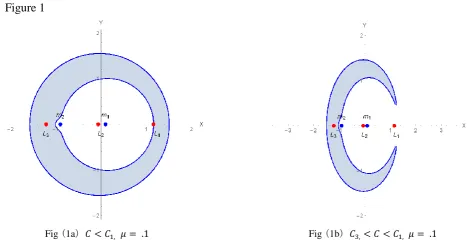
The projection of this surface onto position space is called a Hill's region
𝑆(𝜇, 𝐶) = {(𝑥, 𝑦)| U(𝑥, 𝑦 ) ≥𝐶2}. (6)
The boundary of 𝑆(𝜇, 𝐶) is the zero velocity curve. The negligible mass can move only within this region in the (𝑥, 𝑦)-plane. There are basic two configurations for the Hill's region for a given value of 𝜇.
Figure 1
Fig (1a) 𝐶 < 𝐶1, 𝜇 = .1 Fig (1b) 𝐶3,< 𝐶 < 𝐶1, 𝜇 = .1
The values of C which separate these two cases will be denoted 𝐶𝑖 𝑖 = 1,3 which are the values corresponding to the equilibrium points 𝐿1 and 𝐿3. These values can be easily calculated for small 𝜇 and their graphs are shown in Figure 1. For case 2, the Jacobi constant lies between
𝐶1 and 𝐶3 which are the Jacobi constants of the libration points 𝐿1 and 𝐿3 respectively. In
3.
Synchronization via Active Control
Let
𝑥 = 𝑥1, 𝑥̇ = 𝑥2, 𝑦 = 𝑥3, 𝑦̇ = 𝑥4
Then the equation (1) and (2) can be written as:
𝑥̇1 = 𝑥2 (7)
𝑥̇2 = 2𝜔𝑥4 + 𝜔2𝑥
1+ 𝐴1 (8) 𝑥̇3 = 𝑥4 (9)
𝑥̇4 = −2𝜔𝑥2+ 𝜔2𝑥3 + 𝐴2 (10)
Where
𝐴1 =
−(1 − µ )(𝑥1− µ)
r13 −
3 I (𝑥1− µ) 2r15
− 2 µ (𝑥1+ 1 − µ) 𝜋(𝑎2− 𝑏2) 𝑟
2 [(E(𝜃, 𝑘𝑏) − K(𝜃, 𝑘𝑏)) (1 +
4𝑏(𝑏 − 𝑟2) 𝑘𝑏(𝑏 + r22))
+4𝑏(𝑏 − 𝑟2) 2
(𝑏 + 𝑟2)3 (
(E(𝜃, 𝑘𝑏) − (1 − 𝑘𝑏2)K(𝜃, 𝑘𝑏))
𝑘𝑏(1 − 𝑘𝑏2) )
+ (E(𝜃, 𝑘𝑎) − K(𝜃, 𝑘𝑎)) (1 +
4𝑎(𝑎 − 𝑟2) 𝑘𝑎(𝑎 + r22))
+4𝑎(𝑎 − 𝑟2)2 (𝑎 + 𝑟2)3 (
(E(𝜃, 𝑘𝑎) − (1 − 𝑘𝑏2)K(𝜃, 𝑘𝑎))
𝑘𝑎(1 − 𝑘𝑎2) )]
𝐴2 =−(1−µ )𝑥3
r13 −
3I 𝑥3
2r15 −
2 (µ) 𝑥3
𝜋(𝑎2−𝑏2) 𝑟2[(E(𝜃, 𝑘𝑏) − K(𝜃, 𝑘𝑏)) (1 +
4𝑏(𝑏−𝑟2)
𝑘𝑏(𝑏+r22)) +
4𝑏(𝑏−𝑟2)2
(𝑏+𝑟2)3 (
(E(𝜃,𝑘𝑏)−(1−𝑘𝑏2)K(𝜃,𝑘𝑏))
𝑘𝑏(1−𝑘𝑏2) ) + (E(𝜃, 𝑘𝑎) − K(𝜃, 𝑘𝑎)) (1 +
4𝑎(𝑎−𝑟2)
𝑘𝑎(𝑎+r22)) +
4𝑎(𝑎−𝑟2)2
(𝑎+𝑟2)3 (
(E(𝜃,𝑘𝑎)−(1−𝑘𝑏2)K(𝜃,𝑘𝑎))
𝑘𝑎(1−𝑘𝑎2) )]
𝑟12= (𝑥1− µ)2+ 𝑥32, 𝑟22 = (𝑥1+ 1 − µ)2+ 𝑥32.
CHAOS SYNCHRONIZATION
Fig(2)
Corresponding to master system ((7), … (10)), the identical slave system is defined as:
𝑦̇1 = 𝑦2+ 𝑢1(𝑡) (11)
𝑦̇2 = 2𝜔𝑦4+ 𝜔2𝑦1+ 𝐵1+ 𝑢2(𝑡) (12)
𝑦̇3 = 𝑦4 +𝑢3(𝑡) (13)
𝑦̇4 = −2𝜔𝑦2+ 𝜔2𝑦3+ 𝐵2+ 𝑢4(𝑡) (14)
Where
𝐵1 =
−(1 − µ )(𝑦1− µ)
r113 −
3 I (𝑦1− µ) 2r115
− 2 (µ) (𝑦1+ 1 − µ) 𝜋(𝑎2− 𝑏2) 𝑟
21 [(E(𝜃, 𝑘𝑏) − K(𝜃, 𝑘𝑏)) (1 +
4𝑏(𝑏 − 𝑟21) 𝑘𝑏(𝑏 + r212 ))
+4𝑏(𝑏 − 𝑟21) 2
(𝑏 + 𝑟21)3 (
(E(𝜃, 𝑘𝑏) − (1 − 𝑘𝑏2)K(𝜃, 𝑘𝑏))
𝑘𝑏(1 − 𝑘𝑏2) )
+ (E(𝜃, 𝑘𝑎) − K(𝜃, 𝑘𝑎)) (1 +
4𝑎(𝑎 − 𝑟21) 𝑘𝑎(𝑎 + r212 ) )
+4𝑎(𝑎 − 𝑟21)2 (𝑎 + 𝑟21)3 (
(E(𝜃, 𝑘𝑎) − (1 − 𝑘𝑏2)K(𝜃, 𝑘𝑎))
𝑘𝑎(1 − 𝑘𝑎2) )]
4000 2000 2000 4000 x
𝐵2 = −(1−µ )𝑦r 3
11 3 −
3 I 𝑦3
2r115 −
2 (µ) 𝑦3
𝜋(𝑎2−𝑏2) 𝑟21[(E(𝜃, 𝑘𝑏) − K(𝜃, 𝑘𝑏)) (1 +
4𝑏(𝑏−𝑟21)
𝑘𝑏(𝑏+r212 )) +
4𝑏(𝑏−𝑟21)2
(𝑏+𝑟21)3 (
(E(𝜃,𝑘𝑏)−(1−𝑘𝑏2)K(𝜃,𝑘𝑏))
𝑘𝑏(1−𝑘𝑏2) ) + (E(𝜃, 𝑘𝑎) − K(𝜃, 𝑘𝑎)) (1 +
4𝑎(𝑎−𝑟21)
𝑘𝑎(𝑎+r212 )) +
4𝑎(𝑎−𝑟21)2
(𝑎+𝑟21)3 (
(E(𝜃,𝑘𝑎)−(1−𝑘𝑏2)K(𝜃,𝑘𝑎))
𝑘𝑎(1−𝑘𝑎2) )]
𝑟112= (𝑦1− µ)2+ 𝑦32, 𝑟212 = (𝑦1+ 1 − µ)2+ 𝑦32.
where 𝑢𝑖(𝑡); 𝑖 =1 ,2,3,4 are control functions to be determined.
Let 𝑒𝑖 = 𝑦𝑖 − 𝑥𝑖 ; i = 1, 2, 3, 4 be the synchronization errors. From ((7)….(10)) and ((11)….(14)), we obtain the error dynamics as follows:
𝑒1̇ = 𝑒2+ 𝑢1(𝑡) (15)
𝑒2̇ = 2𝜔𝑒4 + 𝜔2𝑒
1+ 𝐵1− 𝐴1+ 𝑢2(𝑡) (16) 𝑒3̇ = 𝑒4 + 𝑢3(𝑡) (17)
𝑒4̇ = −2𝜔𝑒2+ 𝜔2𝑒
3+ 𝐵2− 𝐴2 + 𝑢4(𝑡) (18)
Let us redefine the control functions so that the terms in (15) to (18) which cannot be expressed as linear terms in 𝑒𝑖's are eliminated :
𝑢1(𝑡) = 𝑣1(𝑡)
𝑢2(𝑡) = −𝐵1+ 𝐴1+ 𝑣2(𝑡) 𝑢3(𝑡) = 𝑣3(𝑡)
𝑢4(𝑡) = −𝐵2+ 𝐴2+ 𝑣4(𝑡)
The new error system can be expressed as:
𝑒1̇ = 𝑒2+ 𝑣1(𝑡)
𝑒2̇ = 2𝜔𝑒4 + 𝜔2𝑒
1+ 𝑣2(𝑡) 𝑒3̇ = 𝑒4 + 𝑣3(𝑡)
𝑒4̇ = −2𝜔𝑒2+ 𝜔2𝑒3+ 𝑣4(𝑡)
The above error system to be controlled is a linear system with a control input 𝑣𝑖(𝑡) ( 𝑖 =
1, … 4) as function of the error states 𝑒𝑖 ( 𝑖 = 1, … 4). As long as these feedbacks stabilize the system 𝑒𝑖 ( 𝑖 = 1, … 4) converge to zero as time 𝑡 tends to infinity. This implies that master
CHAOS SYNCHRONIZATION
[ 𝑣1(𝑡) 𝑣2(𝑡) 𝑣3(𝑡) 𝑣4(𝑡)
] = 𝐴 [ 𝑒1 𝑒2 𝑒3 𝑒4 ]
Here 𝐴 is a 4 × 4 coefficient matrix to be determined. As per Lyapunov stability theory and Routh-Hurwitz criterion, in order to make the closed loop system (20) stable, proper choice of elements of 𝐴 has to be made so that the system (20) must have all eigen values with negative real parts. Choosing
𝐴 = [
−1 −1 0 0
−𝜔2 −1 0 −2𝜔
0 0 −1 −1
0 2𝜔 −𝜔2 −1
]
and, defining a matrix 𝐵 as
[ 𝑒1̇ 𝑒2̇ 𝑒3̇ 𝑒4̇
] = 𝐵 [ 𝑒1 𝑒2 𝑒3 𝑒4 ]
Where 𝐵 is
𝐵 = [
−1 0 0 0
0 −1 0 0
0 0 −1 0
0 0 0 −1
]
Clearly, 𝐵 has eigen values with negative real parts. This implies lim
𝑡→∞|𝑒𝑖| = 0; 𝑖 = 1, 2, 3, 4
and hence, complete synchronization is achieved between the master and slave systems.
4. Synchronization via Adaptive Control
In this section we design an adaptive controller for the slave system (11)...(14). Lyapunov stability theory state that when controller satisfies the assumption with V (e) = 12 𝑒𝑡𝑒 a positive definite function and the first derivative of this function 𝑉̇< 0, the chaos synchronization of two identical systems (master and slave) for different initial conditions is achieved. Construct a Lyapunov function as:
(20)
(21)
(22)
𝑉̇ =12(𝑒12+ 𝑒
22+ 𝑒32+ 𝑒42).
Then its derivative along the error system (15) to (18) is
𝑉̇ = 𝑒1(𝑒2+ 𝑢1) + 𝑒2{2𝜔𝑒4+ 𝜔2𝑒1+ 𝐵1− 𝐴1+ 𝑢2} + 𝑒3(𝑒4+ 𝑢3) +𝑒4{−2𝜔𝑒2+ 𝜔2𝑒3+ 𝐵2− 𝐴2+ 𝑢4} .
Hence, if we choose the controller 𝑢 as follows,
𝑢1 = −𝑒1− 𝑒2
𝑢2 = −𝜔2𝑒1− 𝐵1+ 𝐴1− 𝑒2
𝑢3 = −𝑒3− 𝑒4
𝑢4 = −𝜔2𝑒3− 𝐵2+ 𝐴2− 𝑒4
Then
𝑉̇ = −𝑒12− 𝑒22− 𝑒32− 𝑒42 < 0.
Hence the error state
lim
𝑡→∞‖𝑒(𝑡)‖ = 0.
which gives asymptotic stability of the system. This means that the controlled chaotic systems (master and slave) are synchronized for deferent initial conditions.
NUMERICAL SIMULATION
Let us consider an example of Jupiter-Saturn system in the restricted three body problem in which the primary 𝑚2is taken as the Saturn and primary 𝑚1 as the Jupiter and small body as a space- craft. From the astrophysical data we have
Mass of the Saturn 𝑚2 = 5:683 × 1026kg Mass of the Jupiter 𝑚1 = 1:89712 × 1027kg
The distance between the Jupiter and Saturn = 646,270,000 Km.
In dimensionless system we have 𝑚1+𝑚2 = 1 unit and the distance between the Jupiter-Saturn
is 1 unit.
CHAOS SYNCHRONIZATION
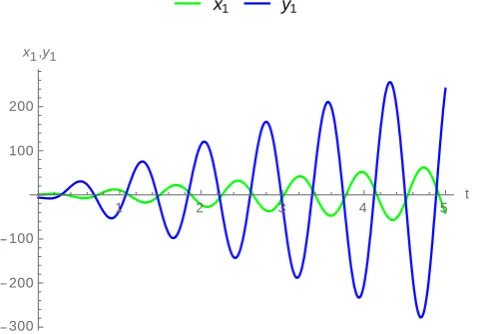
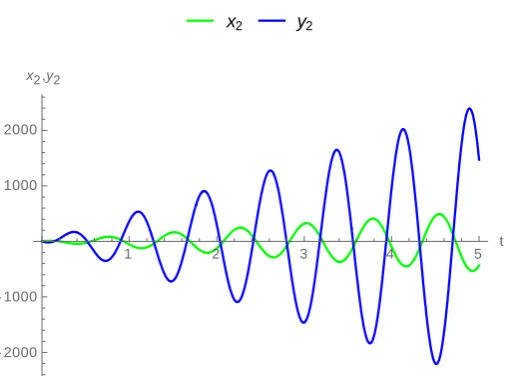
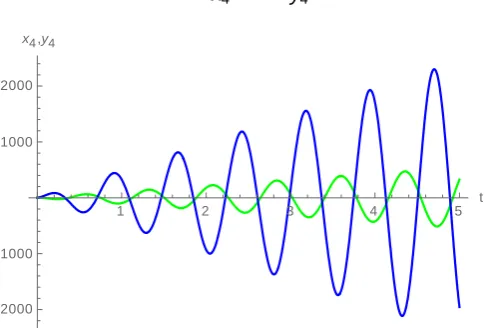
controlled system Via active control are shown in figures 4,7,10 and 13 and via Adaptive control are shown in figures 5,8,11,14 respectively. These figures shows that the state [𝑥1(𝑡), 𝑥2(𝑡),
𝑥3(𝑡), 𝑥4(𝑡)] of master system [7 to 10] asymptotically synchronize with the state [𝑦1(𝑡), 𝑦2(𝑡),
𝑦3(𝑡), 𝑦4(𝑡)]of slave system [11 to 14]. Fig. (15) shows the synchronization error (e) for the two system. We find that at t = 6s, the synchronization was already attained for adaptive control while synchronization was attained at a later time (t = 10s) for active control, the time delay being 4 s. Though it is clear that the adaptive control performs better and is much easier to design.
Fig (3): Time series of the Uncontrolled states 𝑥1, 𝑦1.
Fig (4): Time series of the controlled states 𝑥1, 𝑦1via Active control Fig (5): Time series of the controlled states 𝑥1, 𝑦1via Adaptive control
x1 y1
1 2 3 4 5 t
300 200 100 100 200
x1,y1
x1 y1 x1 y1
0.5 1.0 1.5 2.0 2.5 3.0 t
40 30 20 10 10 20 30
x1,y1
0.5 1.0 1.5 2.0 2.5 3.0 t
40 30 20 10 10 20 30
Fig (6) :Time series of the Uncontrolled states 𝑥2, 𝑦2.
Fig (7) :Time series of the controlled states 𝑥2, 𝑦2via Active control Fig (8) :Time series of the controlled states 𝑥2, 𝑦2via Adaptive control
x2 y2
1 2 3 4 5 t
2000 1000 1000 2000
x2,y2
x2 y2 x2 y2
0.5 1.0 1.5 2.0 2.5 3.0 t
300 200 100 100 200 300
x2,y2
0.5 1.0 1.5 2.0 t
200 100 100
CHAOS SYNCHRONIZATION
Fig (9) :Time series of the Uncontrolled states 𝑥3, 𝑦3.
Fig (10) :Time series of the controlled states 𝑥2, 𝑦2via Active control Fig (11) :Time series of the controlled states 𝑥2, 𝑦2via Adaptive control
Fig (12) :Time series of the Uncontrolled states 𝑥3, 𝑦3.
x3 y3
1 2 3 4 5 t
200 100 100 200 300
x3,y3
x3 y3 x3 y3
0.5 1.0 1.5 2.0
t
20 10 10 20
x3,y3
0.5 1.0 1.5 2.0
t
20 10 10 20
x3 ,y3
x4 y4
1 2 3 4 5 t
2000 1000 1000 2000
Fig (13) :Time series of the controlled states 𝑥2, 𝑦2via Active control Fig (14) :Time series of the controlled states 𝑥2, 𝑦2via Adaptive control
Fig (15a) :Error system via Active control Fig ( 15 b) :Error system via Adaptive control
5. Conclusions
The equation of motion of the restricted three-body problem when the massive primary is supposed to be oblate spheroid and the smaller one is an uniform circular ring formulated. We have investigated the complete synchronization behavior of the problem via adaptive and active control method. Here two systems (master and slave) are compete synchronized when start with deferent initial conditions. Hence the slave chaotic system completely traces the dynamics of the master system in the course of time. For validation of results by numerical simulations we used
x4 y4 x4 y4
0.5 1.0 1.5 2.0
t
200 100 100
x4,y4
0.5 1.0 1.5 2.0 t
200 100 100 200
x4,y4
e11Adaptive control e21 Adaptive control e31Adaptive control e41 Adaptive control
2 4 6 8 10 12 14 t
0.1 0.2 0.3 0.4 0.5
e1 ,e2 ,e3 ,e4
2 4 6 8 10 12 14 t
0.1 0.2 0.3 0.4 0.5 0.6 0.7 e1,e2,e3,e4
CHAOS SYNCHRONIZATION
the Mathematica 10 when the primaries are Jupiter and Saturn. Conflict of Interests
The authors declare that there is no conflict of interests.
REFERENCES
[1] Pecora L. M.,Carroll T.L., Synchronization in chaotic systems, Rev. Lett. 64 (1990), 821- 824.
[2] Lu L., Zhang C., Guo Z. A. Synchronization between two different chaotic systems with non linear feedback control, Chinese Phys. 16-6 (2007), 1603-1607.
[3] Ott., Grebogi C., Yorke J. A. Controlling Chaos, Phys. Rev. Lett., 64 (1990), 1196-1199.
[4] Haeri M., Emadzadeh A. Synchronizing different chaotic systems using active sliding mode control, Chaos Solitons Fractals, 1 (2003). 119-129.
[5] Park J. H., Chaos synchronization between two different chaotic dynamical systems. Chaos Solitons Fractals, 27-2 (2006), 549-554.
[6] Wang Y., Guan Z. H.,Wang H. O., Feedback and adaptive control for the synchronization of Chen system via a single variable, Phys. Lett. , 312-1 (2003), 30-40.
[7] Bai E.W., Lonngren K.E., Synchronization of two Lorenz systems using active control, Chaos Solitons Fractals, 8 (1997), 51-58.
[8] Codreanu, S., Synchronization of spatiotemporal nonlinear dynamical systems by an active control. Chaos Solitons Fractals, 15 (2003), 507-510.
[9] Vincent, U. E., Synchronization of Rikitake chaotic attractor via active control. Phys. Lett. A, 343 (2005), 133-138.
[10]Mahmoud, G. M., Aly, S. A. and Farghaly, A. On chaos synchronization of a complex two coupled dynamos system. Chaos Solitons Fractals, 33 (2007), 178-187.
[12] Shihua Chen, Jinhu Leu., Synchronization of an uncertain unified chaotic system via adaptive control. Chaos Solitons Fractals 14 (2002), 643–647.
[13]Euler, L., Un corps etant attire en raison reciproque quarree des distances vers deux points fixes donnes. Mem. Berlin (1760), 228.
[14]Hill, G. W., Reasearches in the lunar theory. Am. J. Math. 1 (1878). [15]Poincare, H., Sciences et Methode. (1908).
[16]Lagrange, J. Ocuvres 14, vols Gauthier-Villars, Paris. (1772).
[17]Deprit A. and Price J. F., The computation of characteristic exponents in the planar restricted three body problem. Astro. J.,70 (1964), 836-849.
[18]Hadjidemetriou, J. D., Asteroid motion near the 3:1. Celest Mech. Dyn. Astron., 56 (1- 2) (1993), 201-219. [19]Bhatnagar, K. B., Periodic orbits of collision in the restricted problem of three bodies in a three-dimensional
co-ordinate system. Ind. J. Pure Appl. Math., 3 (1) (1969), 101-117.
[20]Bhatnagar, K. B. and Chawla, J. M., A study of the Lagrangian points in the photogravitational restricted three body problem. Ind. J. Pure Appl. Math., 10(11) (1979), 1443-1451.
[21]Sharma, R. K. and Subbarao, collinear equilibria and their characteristic exponents in the restricted three body problem when the primaries are oblate spheroids. Celestial Mechanics, 12 (1975), 189-201.
[22]Sharma, R. K., Taqvi, Z. A. and Bhatnagar, K.B., Existence and stability of the libration point of the restricted three body problem when the bigger primary is a triaxial body and a source of radiation. Indian J. Pure Appl. Math. 32(2) (2001), 255-266.
[23]Sahoo, S. k. and Ishwar, B., Stability of the collinear equilibrium points in generalized the photogravitational elliptical restricted three body problem. Bull Astr. Soc. India, 28, (2000), 579-586.
[24]Szebehely, V., Theory of Orbits., Academic press, New York. (1967).
[25]Khan, A., Shahzad, M., Chaos Synchronization in a Circular Restricted Three Body Problem Under the Effect of Radiation. Chaos Complex Syst. (2012), 59-68.