Open Access
Research
Forage quality and composition measurements as predictors of
ethanol yield from maize (
Zea mays
L.) stover
Aaron J Lorenz*
1, Rob P Anex
2, Asli Isci
2, James G Coors
1, Natalia de Leon
1and Paul J Weimer
3Address: 1Department of Agronomy, University of Wisconsin, Linden Drive, Madison, WI 53706, USA, 2Department of Agricultural and Biosystems Engineering, Iowa State University, Ames, IA 50011, USA and 3USDA-ARS, US Dairy Forage Research Center, Linden Drive West, Madison, WI 53706, USA
Email: Aaron J Lorenz* - [email protected]; Rob P Anex - [email protected]; Asli Isci - [email protected]; James G Coors - [email protected]; Natalia de Leon - [email protected]; Paul J Weimer - [email protected]
* Corresponding author
Abstract
Background: Improvement of biofeedstock quality for cellulosic ethanol production will be facilitated by inexpensive and rapid methods of evaluation, such as those already employed in the field of ruminant nutrition. Our objective was to evaluate whether forage quality and compositional measurements could be used to estimate ethanol yield of maize stover as measured by a simplified pretreatment and simultaneous saccharification and fermentation assay. Twelve maize varieties selected to be diverse for stover digestibility and composition were evaluated.
Results: Variation in ethanol yield was driven by glucan convertibility rather than by glucan content. Convertibility was highly correlated with ruminal digestibility and lignin content. There was no relationship between structural carbohydrate content (glucan and neutral detergent fiber) and ethanol yield. However, when these variables were included in multiple regression equations including convertibility or neutral detergent fiber digestibility, their partial regression coefficients were significant and positive. A regression model including both neutral detergent fiber and its ruminal digestibility explained 95% of the variation in ethanol yield.
Conclusion: Forage quality and composition measurements may be used to predict cellulosic ethanol yield to guide biofeedstock improvement through agronomic research and plant breeding.
Background
Decreasing the cost of producing cellulosic biofuels to be competitive with gasoline and grain-based ethanol is a major goal of the US Department of Energy [1]. Three basic steps are currently used in the biochemical conver-sion of cellulosic biomass to ethanol: 1) physical size reduction and thermochemical pretreatment of the bio-feedstock; 2) enzymatic hydrolysis of cell wall polysaccha-rides; and 3) fermentation of released simple sugars. The
last two steps, enzymatic hydrolysis and fermentation, can be combined into a single-unit operation known as simul-taneous saccharification and fermentation (SSF), which avoids end-product inhibition of hydrolytic enzymes and eliminates the need for separate hydrolysis and fermenta-tion reactors [2]. While reducing conversion costs and increasing ethanol yield per unit mass of feedstock will initially be achieved through optimizing processing tools and techniques, further cost reductions and yield
Published: 9 March 2009
Biotechnology for Biofuels 2009, 2:5 doi:10.1186/1754-6834-2-5
Received: 25 October 2008 Accepted: 9 March 2009
This article is available from: http://www.biotechnologyforbiofuels.com/content/2/1/5 © 2009 Lorenz et al; licensee BioMed Central Ltd.
increases could be attained through improving biofeed-stock quality [3]. Based on current technologies and the biological platform for producing cellulosic biofuels, increasing the polysaccharide to lignin ratio is one possi-ble route to increasing biofeedstock quality. Exploring alternative harvesting techniques, agronomic practices, and on-farm storage methods, as well as developing high-quality crop varieties through plant breeding and trans-genic approaches, are ways biofeedstocks could be improved to increase ethanol yield per dollar spent on biofeedstock production, thermochemical pretreatment, and enzymatic hydrolysis.
Experiments to study and accomplish biofeedstock improvement often generate large numbers of samples needing quality evaluation. This is especially true for plant breeding projects, where sample numbers greater than 1000 per season are typical. Standard methods for meas-uring ethanol yield after pretreatment and SSF [4] are laborious and impractical for evaluating large numbers of samples, but alternative assays have been developed that are more rapid and suitable for analyzing moderately large sample sets [5,6]. Normally these assays mimic the aforementioned steps of cellulosic ethanol production, and then measure either released glucose and xylose, eth-anol concentration after fermentation, or both. An alter-native to this approach is to determine sample composition, especially structural carbohydrate and lignin concentration, and use this information to predict relative performance for realizable ethanol yield. The National Renewable Energy Laboratory (NREL; Golden, CO, USA) developed a near-infrared spectroscopy (NIRS) calibration that provides predictions of constituent con-centrations in maize stover [7,8]. As no wet chemistry is required for samples that are spectrally within range of the calibration set, this method has the advantage of being much faster and cheaper than methods involving wet chemistry. However, variation in structural composition has yet to be linked to feasible ethanol yield via pretreat-ment and SSF.
The plant cell wall is the primary energy source for rumi-nant animals, and organisms in rumen fluid face barriers to accessing cell wall carbohydrates that are similar to those experienced in SSF procedures. Therefore, forage quality assays used in ruminant nutrition are also poten-tially useful as primary screens in evaluating biofeedstock conversion potential. Ruminal microorganisms produce gas as they degrade forages. Weimer et al [9] showed that gas production measurements obtained from an in vitro ruminal fermentation (IVR) assay were correlated with bench-scale SSF ethanol measurements. However, the SSF procedure used by Weimer et al [9] was not preceded by a chemical pretreatment, which could alter the availability of structural carbohydrates. In vitro true digestibility
(IVTD) is similar to IVR, except digestibility is determined by dry matter disappearance after a 48-hour incubation period with rumen fluid [10]. Other forage quality meas-urements, such as neutral detergent fiber (NDF) and acid detergent lignin (ADL), involve the detergent system methodology of Van Soest [11]. NDF is defined by insol-ubility in neutral detergent and approximates total cell wall concentration, especially for purposes of ruminant nutrition. NDF can be combined with IVTD to calculate NDF digestibility (NDFD) [11,12]. This quantity repre-sents availability of cell wall carbohydrates and may be particularly relevant to the convertibility of biofeedstock to biofuels. ADL is measured as the insoluble organic mat-ter afmat-ter extraction with acid demat-tergent solution and 72% sulfuric acid. These methods are well established and are routinely used by forage quality laboratories and research programs. Also, protocols have been automated and sim-plified by companies such as ANKOM Technology (Mace-don, NY, USA) [13], measurements are easily calibrated with NIRS [8,14], and there is a wealth of historical data [15,16]. For these reasons, it would be very advantageous if forage quality measurements were predictive of ethanol yield using chemical pretreatment and SSF.
One way to compare potential measurements of biofeed-stock quality is to utilize genetic variation for cell wall digestibility and composition. It is well known that natu-ral genetic variation for ruminal digestibility exists within crop species [17], which is often associated with variation in total lignin concentration and ferulate cross-linking [18]. Down-regulation of key enzymes in the lignin bio-synthetic pathway has been shown to produce alfalfa (Medicago sativa) plants with greater saccharification effi-ciency [19]. Also, mutations conferring lesions in the lignin biosynthetic pathway, such as the brown-midrib mutants of maize and sorghum (Sorghum bicolor L.), have been discovered and are well studied [20,21]. Cell walls of plants carrying the brown-midrib3 (bm3) allele typically have greater ruminal digestibility [22] and produce more glucose after enzymatic saccharification [23,24].
It was our objective to compare compositional and forage quality measurements with a rapid SSF assay preceded by chemical pretreatment. We used stover samples obtained from 12 maize varieties selected to be diverse in stover composition and digestibility. Our findings will help determine the feasibility of accurately ranking cultivars or agronomic treatments for SSF ethanol yield using high-throughput methods and without the apparatus for SSF-type assays.
Results and discussion
lignin, IVTD, NDFD – are related to cell wall digestibility and thus availability of cell wall carbohydrates. Carbohy-drate concentration measurements – glucan, xylan, NDF – relate to total cell wall concentration and thus the total amount of cell wall carbohydrates that could be converted into ethanol. All measurements were compared against ethanol yield measured by the pretreatment-Rapid SSF assay, which should reflect both convertibility and struc-tural carbohydrate concentration. Actual convertibility achieved using Rapid SSF was calculated as the percentage of glucan converted into ethanol. IVR fermentation also reflects both types of measurements since the amount of gas produced upon ruminal fermentation is directly pro-portional to amount of carbohydrate accessed and fer-mented by the rumen microflora [10].
The range of each measurement as a percentage of the mean was at least 17% (NDF) and at most 87% (ADL) (Additional file 1). Because the fermentative organism (Saccharomyces cerevisiae) used in the Rapid SSF assay could only utilize six-carbon sugars, we will concentrate discussion on glucan content. There was more variability among varieties for convertibility than for glucan concen-tration and, therefore, Rapid SSF ethanol yield was mainly a function of convertibility (Additional files 1 and 2). The clearest examples are the bm3 varieties, which were lowest for glucan, but highest for convertibility and ethanol yield (Additional file 1). The bm3 varieties were also highest for IVR, IVTD, and NDFD and were lowest for ADL, lignin, and NDF. The variety with the lowest ethanol yield, W64A × A619, was average for convertibility and below average for glucan concentration. The combination of average
convertibility and below average glucan concentration was likely responsible for its poor ethanol yield.
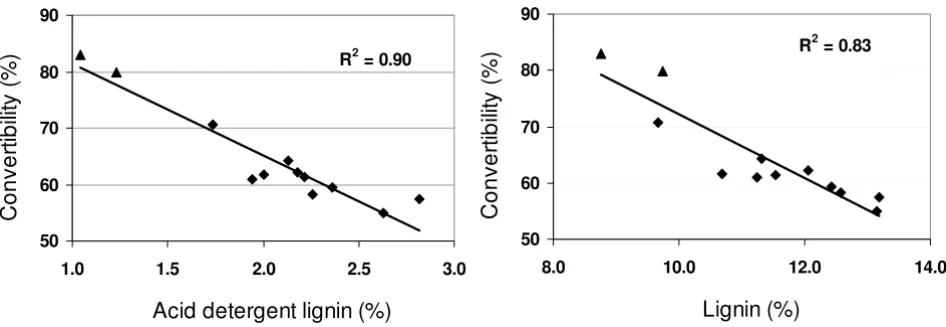
There was no relationship between glucan concentration and ethanol yield, probably because of the negative corre-lation between glucan and convertibility (Additional file 2). Convertibility values in this study were lower on aver-age than some convertibility values previously reported in the literature [25] and it is unknown how higher average convertibility would impact variability in ethanol yield and its relationship to glucan, convertibility, or other measurements. As expected, there was a strong negative correlation between convertibility and both ADL and total lignin (Figure 1). Although convertibility of glucan will improve as pretreatment and hydrolysis technology improves, developing biofeedstocks with inherently higher convertibility will decrease processing costs and will improve cellulosic ethanol economics.
Rapid SSF ethanol yield was highly correlated with forage quality methods IVR, IVTD, and NDFD (Additional file 2). These methods, which are commonly used in rumi-nant nutrition research and easily performed and cali-brated with NIRS [18,19], may be well-suited for determining biofeedstock quality. We expected cell wall digestibility (NDFD) to be a better predictor of SSF etha-nol yield than dry matter digestibility (IVTD) because the majority of carbohydrates converted to ethanol in this process are derived from the cell wall. We did observe a slightly greater correlation between NDFD and ethanol yield compared with that between IVTD and ethanol yield.
Convertibility versus acid detergent lignin and total lignin Figure 1
Convertibility versus acid detergent lignin and total lignin. Convertibility is the percentage of glucan converted to eth-anol in the Rapid SSF assay. Points represent variety (n = 12) means. Varieties carrying the brown-midrib-3 mutation are symbol-ized by triangles.
R2 = 0.90
50 60 70 80 90
1.0 1.5 2.0 2.5 3.0
Acid detergent lignin (%)
C
o
n
v
e
rti
b
ili
ty
(%
)
R2 = 0.8350 60 70 80 90
8.0 10.0 12.0 14.0
Lignin (%)
C
onver
ti
bi
lity
(%
Scatter plots for a subset of the regression models listed in Additional file 3 Figure 2
Scatter plots for a subset of the regression models listed in Additional file 3. Ethanol yield predicted by the explana-tory variables labeling the y-axis are plotted over observed ethanol yield from maize stover samples treated with the pretreat-ment-Rapid SSF assay. Regressions were performed on variety means (n = 12). Units for both axes are g ethanol per g dry maize stover. Varieties carrying the brown-midrib-3 mutation are symbolized by triangles.
R2 = 0.70
0.08 0.09 0.10 0.11 0.12
0.08 0.09 0.10 0.11 0.12
Observed EtOH yield
C
o
nver
ti
bi
lit
y
R2 = 0.98
0.08 0.09 0.10 0.11 0.12
0.08 0.09 0.10 0.11 0.12
Observed EtOH yield
Convertibility +
Glucan
R2 = 0.77
0.08 0.09 0.10 0.11 0.12
0.08 0.09 0.10 0.11 0.12
Observed EtOH yield
NDF
D
R2 = 0.95
0.08 0.09 0.10 0.11 0.12
0.08 0.09 0.10 0.11 0.12
Observed EtOH yield
NDF
D +
NDF
R2 = 0.51
0.08 0.09 0.10 0.11 0.12
0.08 0.09 0.10 0.11 0.12
Observed EtOH yield
ADL
R2 = 0.74
0.08 0.09 0.10 0.11 0.12
0.08 0.09 0.10 0.11 0.12
Observed EtOH yield
ADL
+
Convertibility was not a perfect predictor of ethanol yield (Figure 2), suggesting that variation in carbohydrate quantity is partially influencing ethanol yield. Linear regression models including convertibility, NDFD, ADL, or lignin were compared with models that included any one of the aforementioned variables in addition to either glucan or NDF concentration (Additional file 3). Models that included both types of measurements were superior to simple linear regression models in explaining variation in Rapid SSF ethanol yield (Additional file 3). With the exception of the lignin + glucan model, the regression coefficients of glucan and NDF were all significant and positive when combined with convertibility, NDFD, or ADL. The positive regression coefficients for glucan and NDF in the multiple regression models contrast with the negative correlation coefficients observed between these variables alone and ethanol yield (Additional file 2), and suggest that greater structural carbohydrate concentra-tions increase ethanol yield when variation in convertibil-ity is controlled. The NDFD + NDF model performed well (Figure 2), explaining 18% more variation than NDFD alone. While models including NDFD were superior to those including ADL, the regression coefficients in the ADL + NDF model were both significant, explaining 74% of the variation. Therefore, when NDFD measurements are difficult to obtain, ADL could adequately serve as a substitute. It should be noted that ADL measurements are known to substantially underestimate total lignin content (Additional file 1, [26]). However, our results suggest that it is a better predictor of convertibility (Figure 1) and eth-anol yield (Additional file 3) than total lignin.
Conclusion
Improvement of biofeedstock quality would increase cel-lulosic ethanol yield and improve profitability at a given feedstock price. Variation in biofeedstock composition and quality can be evaluated in agronomic research and breeding programs with high-throughput methods, including NIRS prediction of composition and forage quality. Our results indicate that Rapid SSF ethanol yield is mostly a function of carbohydrate convertibility, and that the contribution from glucan concentration is rela-tively minor. Convertibility and ethanol yield are highly correlated with forage quality measurements such as IVR fermentation, IVTD, and NDFD. Convertibility was strongly and negatively influenced by lignin content. Glu-can or NDF concentration were also negatively correlated to convertibility, but when these variables were included in multiple regression models along with convertibility, NDFD, or ADL, their coefficients were significant and pos-itive. This indicates that greater structural carbohydrate content increases Rapid SSF ethanol yield when variability in convertibility is controlled. Including glucan and NDF concentration in models along with convertibility-type measurements will increase the accuracy of biofeedstock quality predictions using surrogate measurements. More
data are needed to firmly establish these relationships and build comprehensive models to predict biofeedstock quality from inexpensive and rapid measurements of digestibility and composition. The research presented here is a preliminary step in establishing such models and indicates forage quality assays are likely to be useful for evaluating biofeedstock quality.
Methods
Varieties and sampling
Stover samples were obtained from a set of maize varieties that were diverse for stover composition and digestibility (Additional file 1). Two varieties (entries 2 and 3) carried the bm3 allele. The bm3 allele used was from University of Wisconsin-Madison genetic stocks and is not otherwise of known origin. The non-mutant isogenic variety, W64A × A619, was also included (entry 1). The Wisconsin Quality Synthetic (WQS C3 Syn2) is a breeding population that has been improved for silage quality [14]. Entries 5 to 10 are hybrids including one parent bred for silage produc-tion, and entries 11 and 12 are hybrids bred for grain pro-duction. The 12 varieties were grown in two-row field plots as part of a larger experiment during 2005 and 2006 [8]. Plots were arranged in a randomized complete block design with three replications at two locations (Madison and Arlington, WI, USA). The planting density was 79,040 plants per hectare. One stover sample (~500 g) was obtained from each plot at grain harvest. Samples were dried at 55°C for 7 days and ground with a hammer mill to pass a 1 mm screen. An equal weight from each of the six samples in each year (three replications × two loca-tions) was bulked to form 24 composite samples (12 vari-eties and two years).
Rapid SSF analysis
to ethanol based on a theoretical ethanol yield of 51 g eth-anol per 100 g of glucose for yeast:
The maximum value of convertibility is 100%.
Forage quality methods
NDF and ADL were determined sequentially with the ANKOM Filter Bag method (ANKOM Technology, Mace-don, NY, USA) and ANKOM-200 Fiber Analyzer. Five hun-dred mg of ground stover was placed in ANKOM F57 filter bags, which were heat sealed. Samples were extracted with neutral detergent, and the residue was weighed to deter-mine percent NDF. The NDF residue was extracted with acid detergent solution, followed by extraction with 72% H2SO4 and ashing to determine percent ADL [11]. Detailed protocols can be found at the website of ANKOM Technol-ogy http://ANKOM.com/09_procedures/procedures.shtml.
Stover IVTD is the dry matter fraction digested after a 48-hour incubation period in rumen fluid from a lactating Holstein cow and buffer solution [27]. ANKOM F57 filter bags were filled with 250 mg ground stover and incubated with rumen fluid and buffer solution in the Daisy II Incu-bator (ANKOM Technology, Macedon, NY, USA). After incubation, filter bags were washed with neutral detergent solution in an ANKOM-200 Fiber Analyzer to remove rumen fluid particles and non-cell wall materials. IVTD and NDF values were used to calculate NDFD by the equa-tion: NDFD = 100{[NDF-(100-IVTD)]/NDF}. NDFD is the proportion of NDF digested during the 48-hour rumen fluid incubation.
IVR fermentation measurements were performed in dupli-cate on each of six samples from 2005. Incubations were conducted in nominal 60 ml serum bottles that contained 100 mg (weighed to 0.1 mg) of ground stover, 6.7 ml of Goering and Van Soest buffer [27], and 0.3 ml of cysteine-sulfide reducing agent (6.25 g/l each of cysteine HCl and Na2S·9H2O) and a CO2 phase. All inoculations and incu-bations were conducted in a 39°C room. Diluted ruminal inoculum, under continuous stirring and continuous sparging with CO2 in a water-jacketed vessel, was trans-ferred by hypodermic syringe and added to the incubation bottle. Bottles were tared before adding the inoculum and weighed immediately thereafter to determine the exact amount of ruminal fluid added. Gas pressure readings were taken with a digital pressure gauge immediately after inoculum addition and after 24 h. Net gas accumulation, reported as ml gas per g of dry biomass, was calculated by subtracting the mean gas accumulation of six blank vials that contained reduced buffer and ruminal inoculum, but
no biomass sample. A more detailed description of this method is given by Weimer et al [9].
NIRS compositional analysis
Samples were scanned with a NIR Systems 6500 near infrared reflectance spectrophotometer. We used the Stover9 NIRS calibration [7,8] of NREL (Golden, CO, USA) for predictions of glucan, xylan, and lignin concen-tration. Samples in the Stover9 calibration set were ana-lyzed for their structural carbohydrate and total lignin (sum of acid soluble and acid insoluble lignin) concentra-tion using HPLC-based methods. The lignin and struc-tural carbohydrate protocol can be found at NREL's website (see http://www.nrel.gov/biomass/ analytical_procedures.html#lap-002). Stover9 calibration statistics are given in Lorenz et al [8].
Statistical analysis
Laboratory replications were averaged and analysis of var-iance was conducted using the GLM procedure of SAS. For all traits but IVR gas production, linear models included variety (fixed), year (random), and variety-by-year inter-action (random). Variety-by-year interinter-action mean squares were used as the error term for calculating signifi-cant differences between variety means. For IVR gas pro-duction, individual samples from 2005 were analyzed, and the general linear model included variety (fixed), location (random), variety-by-location interaction (ran-dom), and block nested within location (random). Differ-ences between entries for IVR gas production were tested for significance using the entry-by-location interaction mean squares. Variability for the forage quality and com-position measurements was generated by selecting maize varieties differing in these properties. Therefore, the vari-ety source of variation was of primary interest, and the 12 entry means were used for comparing quality methods. Forage quality and compositional measurements were compared with each other and with Rapid SSF assay meas-urements by Pearson product-moment and Spearman rank correlations of variety means. Spearman rank corre-lations reflect consistency in variety rank between meth-ods (an important criterion for plant breeders) and are less influenced by individuals at the tails of the distribu-tion. Because IVR gas production was measured only on 2005 samples, 2006 data was excluded when comparing IVR with all other measurements. Multiple linear regres-sion was used to determine the effect of glucan and NDF on Rapid SSF ethanol yield while controlling for variabil-ity in convertibilvariabil-ity, NDFD, lignin, or ADL. The signifi-cance of the glucan and NDF regression coefficients, and the amount of additional variation in Rapid SSF ethanol yield explained by adding glucan or NDF to simple linear regression models including convertibility, NDFD, lignin, or ADL alone were evaluated.
Convertibility Ethanol produced g in reactor
Initial
(%)= ( )
Abbreviations
ADL: Acid Detergent Lignin; IVR: In Vitro Ruminal Fer-mentation; IVTD: In Vitro True Digestibility; NDF: Neutral Detergent Fiber; NDFD: Neutral Detergent Fiber Digesti-bility; NIRS: Near Infrared Spectroscopy; NREL: National Renewable Energy Laboratory; SSF: Simultaneous Saccha-rification and Fermentation.
Competing interests
The authors declare that they have no competing interests.
Authors' contributions
AJL helped conceive and design the study, collected and processed the stover samples, made NDF, ADL, and IVTD measurements, performed the statistical analysis, and drafted the manuscript. RPA helped conceive and design the study, supervised the collection of SSF ethanol yield data, and reviewed and commented on the manuscript. AI collected the SSF ethanol yield data and drafted the Rapid SSF analysis section. JGC and NDL helped conceive and design the study, supervised sample collection and analy-sis, and reviewed and commented on the manuscript. PJW made IVR measurements, participated in IVTD measure-ments, and reviewed and commented on the manuscript. All authors read and approved the final manuscript.
Additional material
Acknowledgements
We thank Dr. Edward Wolfrum, Dr. Bonnie Hames, and Amie Sluiter (National Bioenergy Center at NREL) for providing NIRS predictions for glucan and lignin concentration. This work was supported by the USDA and DOE grant Integrated Feedstock Supply Systems for Corn Stover Biomass (grant no. 144-144NR81).
References
1. US DOE: Breaking the biological barriers to cellulosic
etha-nol: a joint research agenda. Workshop Proceedings 2005 [http://
genomicsgtl.energy.gov/biofuels/b2bworkshop.shtml]. Rockville, MD 2. Lin Y, Tanaka S: Ethanol fermentation from biomass
resources: current state and prospects. Appl Microbiol Biotechnol
2006, 69:627-642.
3. Wyman CE: What is (and is not) vital to advancing cellulosic
ethanol. Trends Biotechnol 2007, 25:153-157.
4. Dowe N, McMillan J: SSF experimental protocols:
lignocellu-losic biomass hydrolysis and fermentation. National Renewable
Energy Laboratory (NREL) Analytical Procedures 2001 [http:// www.nrel.gov/biomass/pdfs/42630.pdf].
5. Isci A, Murphy PT, Anex RP, Moore KJ: A rapid simultaneous sac-charification and fermentation (SSF) technique to
deter-mine ethanol yields. Bioenerg Res 2008, 1:163-169.
6. Dien BS, Jung HJG, Vogel KP, Casler MD, Lamb JFS, Iten L, Mitchell RB, Sarath G: Chemical composition and response to dilute-acid pretreatment and enzymatic saccharification of alfalfa,
reed canarygrass, and switchgrass. Biomass Bioenergy 2006,
30:880-891.
7. Hames BR, Thomas SR, Sluiter AD, Roth CJ, Templeton DW: Rapid biomass analysis – New tools for compositional analysis of corn stover feedstocks and process intermediates from
eth-anol production. Appl Biochem Biotechnol 2003, 105:5-16.
8. Lorenz AJ, Coors JG, de Leon N, Wolfrum EJ, Hames BR, Sluiter AD, Weimer PJ: Characterization, variation, and combining ability of maize traits relevant to cellulosic ethanol production.
Crop Sci 2009, 49:85-98.
9. Weimer PJ, Dien BS, Springer TL, Vogel KP: In vitro gas produc-tion as a surrogate measure of the fermentability of
cellu-losic biomass to ethanol. Appl Microbiol Biotechnol 2005, 67:52-58.
10. Stern MD, Bach A, Calsamiglia S: Alternative techniques for
measuring nutrient digestion in ruminants. J Anim Sci 1997,
75:2256-2276.
11. Van Soest PJ: Nutritional Ecology of the Ruminant Cornell University Press; 1994.
12. Struik PC: Physiology of forage maize (Zea mays L.) in relation
to its production and quality. In PhD thesis Agricultural
Univer-sity, Wageningen, Netherlands, Department of Field Crops and Grassland Science; 1983.
13. Vogel KP, Pedersen JF, Masterson SD, Toy JJ: Evaluation of a filter
bag system for NDF, ADF, and IVDMD forage analysis. Crop
Sci 1999, 39:276-279.
14. Frey TJ, Coors JG, Shaver RD, Lauer JG, Eilert DT, Flannery PJ: Selec-tion for silage quality in the Wisconsin Quality Synthetic and
related maize populations. Crop Sci 2004, 44:1200-1208.
15. Roth LS, Marten GC, Compton WA, Stuthman DD: Genetic
varia-tion of quality traits in maize (Zea mays L.) forage. Crop Sci
1970, 10:365-367.
16. Lundvall JP, Buxton DR, Hallauer AR, George JR: Forage quality variation among maize inbreds: In vitro digestibility and
cell-wall components. Crop Sci 1994, 34:1672-1678.
17. Casler MD, Vogel KP: Accomplishments and impact from
breeding for increased forage nutritional value. Crop Sci 1999,
39:12-20.
18. Grabber JH, Mertens DR, Kim H, Funk C, Lu F, Ralph J: Cell wall fer-mentation kinetics are impacted more by lignin content and
ferulate cross-linking than by lignin composition. J Sci Food
Agric 2008, 89:122-129.
19. Jackson LA, Shadle GL, Zhou R, Nakashima J, Chen F, Dixon RA:
Improving saccharification efficiency of alfalfa stems through modification of the terminal stages of monolignol biosynthe-sis. Bioenerg Res 2008, 1:180-192.
20. Barriere Y, Argillier O: Brown-midrib genes of maize – a
review. Agronomie 1993, 13:865-876.
Additional File 1
Table S1. Variety means. Abbreviations: Rapid SSF ethanol yield (EtOH yield), percent glucan converted to ethanol (convertibility), acid detergent lignin (ADL), neutral detergent fiber (NDF), in vitro ruminal fermen-tation (IVR), in vitro true digestibility (IVTD), and neutral detergent fiber digestibility (NDFD). Glucan, EtOH yield, convertibility, xylan, NDF, IVR, IVTD, and NDFD variety means were ranked in descending order. ADL and lignin variety means were ranked in ascending order.
Click here for file
[http://www.biomedcentral.com/content/supplementary/1754-6834-2-5-S1.doc]
Additional File 2
Table S2. Correlations. Pearson product-moment (top diagonal) and Spearman rank (bottom diagonal) correlations between biofeedstock qual-ity, ruminal digestibilqual-ity, and composition measurements. Correlations were calculated using variety means (n = 12).
Click here for file
[http://www.biomedcentral.com/content/supplementary/1754-6834-2-5-S2.doc]
Additional File 3
Table S3. Linear regression models for predicting Rapid SSF ethanol yield. Regression was performed on variety means (n = 12).
Click here for file
Publish with BioMed Central and every scientist can read your work free of charge "BioMed Central will be the most significant development for disseminating the results of biomedical researc h in our lifetime."
Sir Paul Nurse, Cancer Research UK
Your research papers will be:
available free of charge to the entire biomedical community
peer reviewed and published immediately upon acceptance
cited in PubMed and archived on PubMed Central
yours — you keep the copyright
Submit your manuscript here:
http://www.biomedcentral.com/info/publishing_adv.asp
BioMedcentral
21. Porter KS, Axtell JD, Lechtenberg VL, Colenbrander VF: Pheno-type, fiber composition, and in vitro dry matter disappear-ance of chemically induced brown midrib (bmr) mutants of
sorghum. Crop Sci 1978, 18:205-208.
22. Oba M, Allen MS: Effects of brown midrib 3 mutation in corn silage on dry matter intake and productivity of high yielding
dairy cows. J Dairy Sci 1999, 82:135-142.
23. Vermerris W, Saballos A, Ejeta G, Mosier NS, Ladisch MR, Carpita
NC: Molecular breeding to enhance ethanol production from
corn and sorghum stover. Crop Sci 2007, 47:S142-S153.
24. Saballos A, Vermerris W, Rivera L, Ejeta G: Allelic association, chemical characterization and saccharification properties of brown midrib mutants of sorghum (Sorghum bicolor (L.)
Moench). Bioenerg Res 2008, 1:193-204.
25. Kim TH, Lee YY, Sunwoo C, Kim JS: Pretreatment of corn stover
by low-liquid ammonia recycle percolation process. Appl
Bio-chem Biotechnol 2006, 133:41-57.
26. Hatfield R, Fukushima RS: Can lignin be accurately measured?
Crop Sci 2005, 45:832-839.
27. Goering HK, Van Soest PJ: Forage Fiber Analysis: Apparatus
Reagents, Procedures and Some Applications. Agricultural