Research Journal
Volume 8, No. 22, June 2014, pp. 12–18
DOI: 10.12913/22998624.1105141 Research Article
Received: 2014.03.07 Accepted: 2014.05.20 Published: 2014.06.05
AUTHENTICATION ARCHITECTURE USING THRESHOLD CRYPTOGRAPHY
IN KERBEROS FOR MOBILE AD HOC NETWORKS
Hadj Gharib1, Kamel Belloulata2
1 Mathematics laboratory, Djillali LIABES University, Sidi Bel Abbes, Algeria, e-mail: [email protected]
2 RCAM laboratory, Djillali LIABES University, Sidi Bel Abbes, Algeria, e-mail: [email protected]
ABSTRACT
The use of wireless technologies is gradually increasing and risks related to the use of these technologies are considerable. Due to their dynamically changing topol-ogy and open environment without a centralized policy control of a traditional net-work, a mobile ad hoc network (MANET) is vulnerable to the presence of malicious nodes and attacks. The ideal solution to overcome a myriad of security concerns in MANET’s is the use of reliable authentication architecture. In this paper we propose a new key management scheme based on threshold cryptography in kerberos for MA-NET’s, the proposed scheme uses the elliptic curve cryptography method that con -sumes fewer resources well adapted to the wireless environment. Our approach shows a strength and effectiveness against attacks.
Keywords: authentication, attacks, Kerberos, MANET, threshold cryptography.
INTRODUCTION
BackgroundA mobile ad hoc network is formed by a population of wireless nodes without preexistent network infrastructure or central administration. This nature makes it easy to deploy especially in
environments where it’s difficult to implement a
regular network. MANET networks can be used in both civilian and military applications where security of exchanges must be ensured.
Motivation
User authentication is an important security
measure to protect confidential data. Without a
way to check a user, data access can be granted to users or groups which are not normally allowed. If the number of nodes is small, an authentica-tion node to node is relatively easy to implement, but if the number of nodes becomes large, a total security strategy must be carefully implemented. The introduction of a Trusted Third Party (TTP) is highly recommended. Pirzada and McDonald in
[1] used a TTP based on Kerberos, which inspired our idea. Although this model is widely used, it has inherited all the weaknesses of the Kerbe-ros authentication system [2], such as guessing and replay attacks; but the most important is the presence of a single point of failure, it requires continuous availability of a central server. When the Kerberos server is down, no one can log in. This can be mitigated by using an improved dis-tribution of authentication servers using threshold cryptography on elliptic curves that produces less computation which is well suited to MANETs.
Related work
described some challenges to take into account. In [6] Govindan and Mohapatra present a detailed survey on various trust computing approaches that are geared towards MANETs. A distributed key management and authentication approach by deploying the concepts of identity-based cryptog-raphy and threshold secret sharing was proposed in [7]. In [8] RSA-threshold cryptography-based
scheme for MANETs using verifiable secret shar -ing (VSS) scheme is presented. Another scheme presented in [9] proposes a fully distributed
pub-lic key certificate management system based on
trust graphs and threshold cryptography. In [10] the authors use a threshold Signature in
Anony-mous Cluster-Based MANETs. However none
of the above works use kerberos [11] as TTP in threshold cryptography in MANETs. To the best of our knowledge, our proposed security
archi-tecture is the first in which the authentication is
based on the distribution of Kerberos TGS com-bined with threshold cryptography in mobile ad hoc networks (MANETs).
Challenging issues
The main vulnerability of MANETs comes from their open architecture. Unlike wired net-works that have dedicated routers, each mobile node in an ad hoc network can function as a rout-er and forwards packets for othrout-er nodes [12]. The wireless channel is accessible to both legitimate network users and malicious attackers. The secu-rity of wireless networks is sensitive to a series of non-existent problems in wired networks, in
wire-less networks, data flows in the air, which makes
it easy to sniff by eavesdroppers who can inject malicious messages. Wireless networks also have
fuzzy boundaries difficult to control. Wireless de -vices in the network can be the target of physi-cal attacks. Consequently, the secrets and sensi-tive data could be extracted. The computational capacity of a mobile node is also a constraint as the node can hardly perform computationally in-tensive tasks as asymmetric cryptographic calcu-lation due to the limited energy resources of the batteries.
The network topology is very dynamic as nodes frequently join and leave the network. The wireless channel is also subject to interference and errors which affect the bandwidth and delay. Despite such dynamics, mobile users may request for anytime, anywhere security services as they move from one place to another.
Security solution must take into account all these aspects for the performance and quality of service desired.
The ideal solution must take into account: • The collaboration of all mobile nodes is
in-volved in thwart attacks.
• The solution must extend across all layers of networks each layer contributing to a line of defense.
• Security solution must thwart internal and ex-ternal threats.
• Finally and most importantly, the security so-lution must be feasibly adapted to the network to be secured.
Organization
The rest of the paper is organized as follows: First we present a brief overview of the Kerbe-ros authentication system and ElGamal threshold cryptosystem. Then, we present our proposed model with security analysis. Finally, we compare our proposal with threshold-RSA based schemes.
PRELIMINARIES
The Kerberos authentication protocol
Kerberos is a network authentication protocol created by MIT utilizing a symmetric key cryp-tography to authenticate users to network ser-vices. Kerberos uses tickets instead of passwords, thus avoiding the risk of fraudulent interception
of users’ passwords.
Kerberos credentials. Kerberos has two types of credentials: tickets and authenticators. A ticket is used by a user to authenticate itself to a server from which it requests a service, it contains the
server ID (Identifier), the user ID, a timestamp, a
lifetime, and a session key encrypted by the au-thentication server key. An authenticator is used to prevent replay attacks. Generally, an
authen-ticator contains the user’s ID and a timestamp
encrypted with a session key shared between the user and the authentication server.
a service ticket for the desired service. AP ex-change is performed between the client and the service to authenticate the client before granting access to resources (Figure 1).
Shamir’s Secret Sharing
Secret sharing refers to methods for distribut-ing a secret among a group of participants (also called shareholders), each of which is assigned a share of the secret. The secret can be
reconstruct-ed if a sufficient number of shares are combinreconstruct-ed.
In the (k, n) threshold secret sharing, the secret is distributed to n shareholders, and any k out of these n shareholders can reconstruct the secret, but any collection of less than k partial shares
can’t get any information about the secret [13]. Description. Dealing phase:
• Let s be a secret from some Zp, p prime • Select a random polynomial
under the condition that f(0) = s: • Select f 1,... , f k-1←R Zp randomly • Set f0 ←s
• For , distribute the share si= (i, f(i)) to the ith party
The secret s can be reconstructed from every subset of k shares by the Lagrange formula,
Given k points (xi, yi), i = 1, ..., k,
and
Any subset of up to k–1 shares does not leak any information on the secret.
Elliptic Curve ElGamal threshold cryptosystem ElGamal cryptosystem is based on the diffi -culty of solving the discrete logarithm problem
[14]. We’ll assume that we have a Trusted Third
Party (TTP) – Kerberos in our case – that sets up the system.
Phase 1: Key generation for (t, n)
• Choose a large prime: a prime p such that p = 2q + 1, q also prime.
• Find a generator g of order q.
• Choose a random and compute y=β x.
• Compute a random degree t – 1 polynomial
The ai are chosen randomly.
• Compute n shares of a: si = f(xi) for each user i.
The public key is pk = (p, g, β) and the master private key is sk = (x). The master private key is not given to anyone.
Phase 2: Encryption
• Choose a random and compute c1 = gk
mod p.
• Compute c2 = mβk mod p.
• The ciphertext is:
.
Phase 3: Decryption
To decrypt a ciphertext c = (c1, c2), t partici-pants must ask the TTP for their decryption shares for this ciphertext.
TTP compute , for
each user i that asks for decryption share.
Suppose that I is the set of t participants that requested a decryption share . Once each user has their decryption share , the users cooperate to compute:
The participants must cooperate so that can • Compute the values, and
• Compute gka.
The plaintext is computed as [15]:
Phase 4: Elliptic Curve ElGamal Threshold This operation can be done by converting message to a point on an elliptic curve and
vice-versa using the Koblitz’s method [16, 17]. Phase 5: Finally, we use the Lagrange interpola-tion formula to recover the message.
OUR PROPOSAL
Mobile node sends resource ticket and au-thenticator to the service encrypted with the MN/ AS key (pre-distributed via a secure channel in
the registration phase). The AS confirms the iden -tity of MN, if valid, it responds back to MN with
a modified version of timestamp in the authenti -cator encrypted with MN/AS key. In this phase instead of using only one TGS, we use the ECC-ElGamal Threshold Cryptosystem to divide TGS into multiple parts to allow threshold authentica-tion, it means one TGS cannot ensure the comple-tion of the authenticacomple-tion process without the
par-ticipation of a number predefined of TGS.
Table 1. Notations used in this paper
Notations Descriptions
MN Mobile Node
AS Authentication Server
TGS Ticket-Granting Server
IDx Identity of x
TKTx Ticket x
Ti Timestamp i = ’,’’,’’’,’’’’,’’’’’
Ek Encryption by using key
Kx,y The shared key between x and y
Details of the proposal description
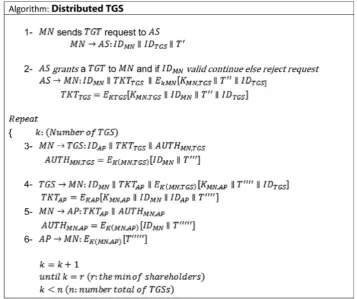
1. The MN (Mobile Node) asks for a TGT (Ticket Granting Ticket), the MN send a message to the AS requesting services, which includes the
MN ID and TGT ID.
2. The AS grants a TGT to MN. The AS will check the MN’s ID. If the MN is valid, the AS
create a TGT Ticket tgs and generate a Session key KMN,TGS encrypted by the MN key KMN to protect communication between MN and TGS, and send all this to MN. The Ticket TGS in-cludes MN ID, the TGS ID – of shareholders TGS – timestamp, ticket validity period, and the KMN,TGS session key. The KMN is only known by the MN and the AS.
3. After receiving the message from sharehold-ers TGS, the MN decrypts the message to ob-tain the Ticket TGS and KMN,TGS. When asking for a Ticket AP, the MN must send a request message to TGS, which includes AP’s ID, the
Ticket TGS and the encrypted authenticator
AUTHMN,TGS by using KMN,TGS.
4. Shareholders TGS grant Ticket AP to MN. Upon receiving the MN’s request message, the TGSs decrypts Ticket TGS using its own secret key to get KMN,TGS, then uses it to de-crypt AUTHMN,TGS, thus it can confirm the MN
through the decrypted message and if the op-eration is right they generate a session key
KMN,AP for the communication service between
MN and the AP, then create a Ticket AP, which includes MN’s ID, AP’s ID, new timestamp,
Ticket AP validity period and KMN,AP. Then
TGS encrypts Ticket AP using KAP and session key KMN,AP using KMN,TGS and sends them to MN
which can decrypt the replay message by us-ing KMN,TGS to obtain Ticket AP and KMN,AP. 5. The MN forwards the Ticket AP to the
applica-tion server with a new authenticator AUTHMN,AP. 6. AP decrypts Ticket AP and AUTHMN,AP sepa-rately, and judges whether the requests is ef-fective by comparing the all containing infor-mation and more precisely the timestamps to prevent a replay attack.
Advantage of our proposed architecture
Our scheme ensures the availability of the service; in traditional kerberos the KDC is single point of failure, by dividing the TGS into n parts
and at least k parts are need to achieving the au-thentication operation, doing this we provide a
deterministic security guarantees. Besides these,
our ECC-TC architecture can provide equivalent security with shorter processing time and smaller key size [18] (Table 2).
Table 2. Key sizes in bits for equivalent levels
RSA Elliptic Curve
1024 160
2048 224
3072 256
ANALYSIS
Measuring the security level for distributed TGSs
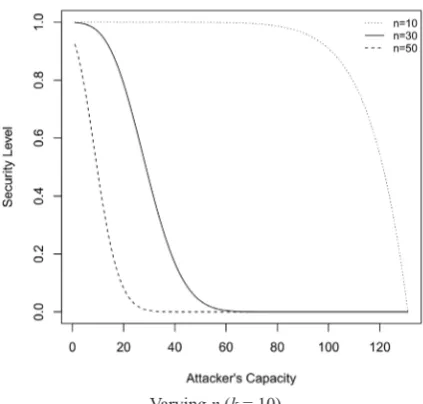
Assuming the distributed TGS nodes are anonymous and an adversary cannot discover their identity, the best approach for the adver-sary is to compromise as many nodes as possible in a given amount of time, hoping that enough TGS nodes are included among the compromised nodes. The following equation captures this situ-ation [19], which was simulated with the R lan-guage [20] (Figure 2):
Emphasize that if the difference between n
and k is too large, the system security is deterio-rating.
Varying n (k = 10)
Computational complexity
The computations in our proposal depend on key generation and operations such as
encryp-tion, decrypencryp-tion, distribution and verification.
The master key generation uses threshold secret sharing, and the computational complexity comes from the number of shareholders.
Processing time
According to the results presented in [21, 22,
23]. It is very clear that the use of elliptic curves cryptography is very suitable for wireless envi-ronments, as shown in Figure 3. At the 192-bit
ECCEG-TC is roughly 2 to 3 times as fast as
an 1024-bit RSA private key operation which is higher than the required security level security level (Table 2).
ments is not preferable. The proposed authenti-cation scheme based on Elliptic curve ElGamal threshold cryptosystem offers both availability and strong security level required in mobile Ad hoc networks and has proven to be a best method
for resistance at offline guessing attack and reply attack. By using elliptic curve cryptography, our scheme is efficient to be implemented in mobile
devices. Future work focuses on validation of our study by simulations.
REFERENCES
1. Asad A., Pirzada McDonald C., Kerberos Assisted Authentication in Mobile Ad-hoc Networks. In: CRPIT ’04 Proceedings of the 27th conference on Australasian computer science, Vol. 56, 41–46, Australian Computer Society, Inc., 2004.
2. Bellovin S.M., Merritt M. Limitations of the Ker -beros authentication system. ACM SIGCOMM Computer Communication Review, vol. 20(5), 1990, 119-132.
3. Shamir A. How to share a secret. Communica-tions of the ACM, Vol. 22(11), 1979, 612-613. 4. Zhou L. and Haas Z.J., Securing Ad Hoc Networks.
IEEE Network., vol. 13, 1999, 24-30.
5. Azer M.A., El-Kassas S.M. and El-Soudani M.S. Threshold cryptography and authentication in ad hoc networks survey and challenges. In: Systems and Networks Communications, ICSNC 2007. IEEE Second International Conference on, p. 5. 6. Govindan K. and Mohapatra P. Trust computations
and trust dynamics in mobile adhoc networks: a survey. Communications Surveys & Tutorials, IEEE, 14(2), 2012, 279-298.
7. Deng H., Mukherjee A., and Agrawal D.P. Thresh-old and identity-based key management and au-thentication for wireless ad hoc networks. In: In-formation Technology: Coding and Computing, Proceedings. ITCC 2004. IEEE International Con-ference on, p. 107-111.
8. Sarkar S., Kisku B., Misra S., Obaidat M.S. Chi -nese Remainder Theorem-Based RSA-Threshold Cryptography in MANET Using Verifiable Secret Sharing Scheme. Wireless and Mobile Computing, Networking and Communications. WIMOB 2009. IEEE International Conference on, p. 258-262. 9. Omar M., Challal Y., and Bouabdallah A. Reliable and
fully distributed trust model for mobile ad hoc net-works. Computers & Security, 28(3), 2009, 199-214. 10. Park Y. and Moon S. Anonymous cluster-based
MANETs with threshold signature. International Journal of Distributed Sensor Networks, Article ID 374713, 9 pages, 2013.
Fig. 3. Processing time
Guessing attacks prevention
Our system is resistant to guessing attacks, the introduction of encrypted timestamps in
ex-changed messages, make the task difficult for an
attacker trying to enter guessed passwords. [24, 25, 26, 27].
Replay attack prevention
We use a synchronized timestamp embedded in the message within acceptance time window to prevent replay attack; this countermeasure ensures the freshness of messages in a session.
CONCLUSION
environ-11. Neuman T.Y., Hartman S., and Raeburn K. The Kerberos Network Authentication Service (V5). RFC 4120, July 2005.
12. Yang Hao, Luo Haiyun, Ye Fan, et al. Security in mobile ad hoc networks: challenges and solutions. Wireless Communications, IEEE, vol. 11(1), 2004, 38-47.
13. Dey H. and Datta R. A threshold cryptography based authentication scheme for mobile ad-hoc network. In: Advances in Networks and Com-munications. Springer Berlin Heidelberg, 2011. p. 400-409.
14. ElGamal T. A public key cryptosystem and a signa-ture scheme based on discrete logarithms. Informa-tion Theory, IEEE TransacInforma-tions on, vol. 31, 1985, p. 469-472.
15. https://www.scs.carleton.ca/sites/default/files/ course_page/secretsharing.pdf, Last accessed: 14-02-2014.
16. Koblitz N. A Course in Number Theory and Cryp-tography (Graduate Texts in Mathematics, No 114), Springer-Verlag, 1994.
17. Padma B.H., Chandravathi D. and Roja P. Pra -poorna. Encoding and decoding of a message in the implementation of Elliptic Curve cryp-tography using Koblitz’s method. International Journal on Computer Science and Engineering, vol. 2(5), 2010.
18. http://www.nsa.gov/business/programs/elliptic_ curve.shtml, Last accessed: 27-01-2014.
19. Yi Seung and Kravets R. MOCA: Mobile certificate authority for wireless ad hoc networks. In: 2nd Annual PKI Research Workshop Program (PKI 03), Gaithersburg, Maryland 2003, p. 3-8.
20. http://www.r-project.org/ Last accessed: 02-03-2014.
21. Ertaul L., and Chavan N.J. RSA and Elliptic Curve-ElGamal Threshold Cryptography (ECCEG-TC) Implementations for Secure Data Forwarding in MANETs. Threshold, vol. 7(8), 2007, p. 9.
22. Ertaul L. and Lu Weimin. ECC based threshold cryptography for secure data forwarding and se-cure key exchange in MANET (I). In: NETWORK-ING 2005. Networking Technologies, Services, and Protocols; Performance of Computer and Communication Networks; Mobile and Wireless Communications Systems. Springer Berlin Heidel -berg, 2005, 102-113.
23. Lauter K. The advantages of elliptic curve cryp-tography for wireless security. Wireless Commu-nications, IEEE, vol. 11(1), 2004, 62-67.
24. Li Chun-Ta and Chu Yen-Ping. Cryptanalysis of Threshold Password Authentication Against Guessing Attacks in Ad Hoc Networks. IJ Network Security, vol. 8(2), 2009, 166-168.
25. Corin R., Malladi S., Alves-Foss J., et al. Guess what? Here is a new tool that finds some new guessing attacks. Twente Univ. Enschede (Netherlands), Dept of Computer Science, 2003. 26. Chai Zhenchuan, Cao Zhenfu and Lu Rongxing.
Threshold password authentication against guess-ing attacks in ad hoc networks. Ad Hoc Net-works, vol. 5(7), 2007, 1046-1054.