Impact Assessment and Project AppraisalSeptember 2001 187
Impact Assessment and Project Appraisal, volume 19, number 3, September 2001, pages 187–193, Beech Tree Publishing, 10 Watford Close, Guildford, Surrey GU1 2EP, UK
Developing-country EIA
Developing and evaluating environmental
impact assessment systems for small developing
countries
David Annandale
This paper categorizes and reviews different ap-proaches to environmental impact assessment (EIA) system evaluation. It then describes the application of Wood’s (1995) ‘ideal’ EIA system evaluation criteria to the Republic of Maldives. Few of the criteria are actually met. Is the Mal-divian EIA system therefore fundamentally flawed or deficient? Field observations suggest that this is not so and, while many improvements can be made, the system is quite locally appro-priate. It is concluded that there are a number of factors contributing to the positive development of the Maldavian EIA system, and these should be added on to Wood’s list as supplementary cri-teria appropriate to small developing countries.
Keywords: environmental impact assessment; developing countries; Maldives
David Annandale is Lecturer in Environmental Impact Assess-ment, School of Environmental Science, Murdoch University, South St, Murdoch, Perth, Western Australia; Tel: +61 8 9360 6081; Fax: +61 8 9360 6787; E-mail: annandal @essun1.murdoch.edu.au and Environmental Adviser to the Ministry of Home Affairs, Housing and Environment, Republic of Maldives.
Some of the initiatives described here were undertaken as part of the UNDP’s Capacity Enhancement in Environmental Planning and Management project for the Republic of Maldives. The support of the UNDP for strengthening EIA in Maldives is gratefully acknowledged. Simad Saeed of the Ministry of Home Affairs, Housing and Environment, Republic of Maldives strongly influenced the direction of this paper. The ideas and conclusion are the private views of the author.
HE IMPORTANCE OF EIA in the mix of environmental policy instruments is now in-ternationally accepted. It has only been in the last ten years or so, however, that the development of ‘formal’ EIA systems (those given legal or ad-ministrative backing) has accele rated. This rapid growth has been predominantly in the developing world, where multilateral and bilateral donors and development agencies have supported the formaliza-tion of EIA systems.
Clearly we now have much experience in the design of EIA systems at the national level. As a consequence we have a better understanding of how to compare and evaluate EIA systems, so as to strengthen and improve them.
The purpose of this paper is to apply a set of EIA system evaluation criteria to an existing impact as-sessment administrative process in a small develop-ing country (the Republic of Maldives), as a method of review leading to administrative reform. It begins with a brief discussion focused on choosing an ap-propriate set of EIA system evaluation criteria. It then moves on to outline the historical development of the Maldivian EIA system.
The next section applies the chosen set of EIA system evaluation criteria to the Maldives EIA proc-ess and analyses the outcomes of the evaluation. The paper concludes by suggesting a range of EIA sys-tem evaluation criteria that might be appropriate for small developing countries.
Appropriate EIA system evaluation criteria
The issue of examining or evaluating EIA processes has been approached with differing intentions, and
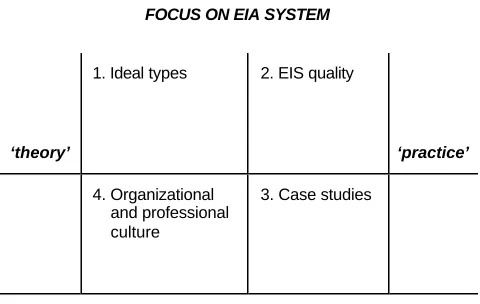
by a range of commentators. While little work has been done on categorising EIA evaluation ap-proaches, Emmelin (1998) provides a useful starting point. He claims that there are four categories of EIA evaluation, formed around two dimensions. This concept is explained graphically in Figure 1.
The first dimension is based on a distinction be-tween EIA systems structures on the one hand, and implementation structures on the other. The idea here is that some attempts to evaluate EIA focus on the design of the administrative process, while oth-ers focus on outcomes by evaluating the impact that EIA has had on actual environmental performance.
The second dimension is based on a distinction between theory and practice. Emmelin (1998, page 132) explains this distinction when he says that:
“(a)ny EIA system might be said to have a theoretical side in the sense that it is designed to operate on certain principles. On the other hand there is the practice of how it operates.”
Using this two-dimensional categorization system, Emmelin distinguishes between four different types of evaluation of EIA.
Category 1 consists of approaches that focus on EIA system design from an administrative process point of view. The best known of these is the inter-national comparative review work undertaken by Christopher Wood (Wood, 1995; Wood and Cop-pell, 1999). Other examples include Hollick (1986), Gibson (1993), and Leu et al (1996). These studies establish evaluation criteria based on one or more ‘ideal types’.
The second category consists of ex ante evalua-tions of EIA documentation against ideal type cri- teria for ‘good’ documents, or ‘good’ practice. The seminal literature representing this category is the Lee and Colley (1992) package for EIS evaluation. A more recent exemplar is an evaluation of EIA reports in eight EU countries by Barker and Wood (1999).
The third category of EIA evaluation approaches focuses on the practical implementation of EIA. In this category, implementation tends to be measured by way of case study surveys, with a specific interest in ‘effectiveness’. The best example of this approach is probably the work undertaken by Sadler (1996) and others for the International Study of the Ef-fectiveness of Environmental Assessment.
Emmelin’s final category of evaluation ap-proaches consists of those that attempt to understand the functio ning of EIA, and the quality of processes and documents, in the context of organizational and professional culture. Emmelin (1998) uses this ap-proach in his own analysis of Nordic and Nether-lands EIA. Arguably, this approach is also followed by Ebisemiju (1993) in his prescription for EIA in developing countries.
This categorization scheme suggests that re-searchers can make choices about how to approach the task of EIA system evaluation. Choices will be equally valid, but arguably should be explicit and targeted according to desired outcomes.
This paper reports on an exercise undertaken in the Republic of Maldives to review and reform an already existing EIA system. The purpose of the ex-ercise was to compare the Maldivia n system against an ‘ideal’, so as to pass comment on the system structure. According to Figure 1, this aim would re-quire choosing an evaluation method from Category 1. Experience in the Maldives, however, suggests that there might be issues of organizational and ju-risdictional culture that affect the performance, and hence design, of the national EIA system.
As a consequence, the EIA review reported in this paper used a combination of Category 1 and Cat- egory 4 approaches. The Category 1 model chosen for this exercise was the well known one developed by Wood (1995) for his comparison of EIA in seven jurisdictions.
Modifications were made to Wood’s criteria to take account of local organizational and jurisdic-tional cultural issues. The details of this modif ica-tion are explained later in this paper. The next section provides a brief coverage of the development of EIA in Maldives.
History of EIA development in Maldives
The development of a bureaucratic system specifi-cally aimed at environmental protection did not be-gin in Ma ldives until the mid-1980s. Perhaps the most significant driving force behind this develop-ment was the production of a study commissioned by UNESCO (UN Educational, Scientific and Cul-tural Organization) that examined the feasibility of establishing a ‘Man and the Biosphere’ reserve (Kenchington, 1983). Among other things, this report recommended the initiation of an Environ-mental Commission to advise the Government on environmental issues. This occurred in 1985 when FOCUS ON EIA SYSTEM
‘theory’
1. Ideal types 2. EIS quality
‘practice’
4. Organizational and professional culture
3. Case studies
FOCUS ON IMPLEMENTATION STRUCTURES
Figure 1. A categorization system for approaches to EIA system evaluation
EIA systems for small developing countries
Impact Assessment and Project AppraisalSeptember 2001 189
the Government established a National Council for Environmental Protection, and an Environment Division within the Ministry for Home Affairs.
In the late 1980s, the possible impacts of climate change became a real concern for Maldives, given its extremely low topographic profile. UNEP (UN Environment Programme) assisted the Government to examine responses to potential sea-level rise and one of the outcomes was the first National Environ-mental Action Plan (NEAP), which was published in 1990. This recommended a number of policy re-sponses, including the need for an environmental research capability and an EIA system. As a conse-quence of the NEAP recommendations, the Presi-dent’s Office issued a direction making EIA mandatory.
Eventually this direction was formalized, and in 1993 it became part of a broad, framework environ-mental law known as the Environmental Protection
and Preservation Act of Maldives (Law No. 4/93).
This Act sets the stage for regulations and policies related to protected areas/nature reserves, environ-mental impact assessment (EIA), and to some extent, waste disposal (including hazardous waste).
The benefit of a framework law such as exists in Maldives is that, as long as the power is explicitly provided in the law, it allows the delegated Govern-ment authority (in this case Ministry for Planning, Human Resources and Environment [MPHRE]) considerable discretion to develop its own more de-tailed administrative procedures.
With the help of the Asian Development Bank (Hatfield Consultants Ltd, 1994), a set of Adminis-trative Procedures for EIA was written and agreed to by Cabinet in December of 1994. However, these procedures have not been closely adhered to, nor have they been officially designated as formal regulations.
It is, however, this combination of framework law and Administrative Procedures that will be evalu- ated in the next section, using the modified Wood criteria.
More recently, another step has been taken to re-view and extend the EIA process. In the early 1990s, the UNDP (UN Development Programme) in Mal-dives began a long-term project to strengthen the
environmental bureaucracy in the country. Towards the end of this project (known as Capacity En-hancement in Environmental Planning and Man-agement) in 1997, the UNDP funded a short consultancy to review the existing EIA process. This work resulted in the redrafting of detailed EIA administrative procedures, with the hope that they will become official regulations under Law No. 4/93.
Applying the modified Wood criteria
Wood (1995, page 12) introduces 14 EIA system evaluation criteria, each of which consists of groups of ‘sub-criteria’. For example, Wood’s first evalua-tion criterion (“is the EIA system based on clear and specific legal provisions?”) is applied to seven juris-dictions by way of seven sub-questions.
The approach developed by Wood can be applied to any jurisdiction. However, not all his EIA system evaluation criteria are relevant to small developing countries. In line with this paper’s professed inten-tion to take account of local organizainten-tional and ju-risdictional culture issues, some modifications were made to Wood’s criteria before they were applied to the Maldivian EIA system.
Wood’s 14 criteria were regrouped into the fol-lowing seven categories:
• legal/administrative backing;
• preliminary assessment;
• detailed assessment;
• EIA study review;
• decision-making;
• follow-up; and
• administrative support.
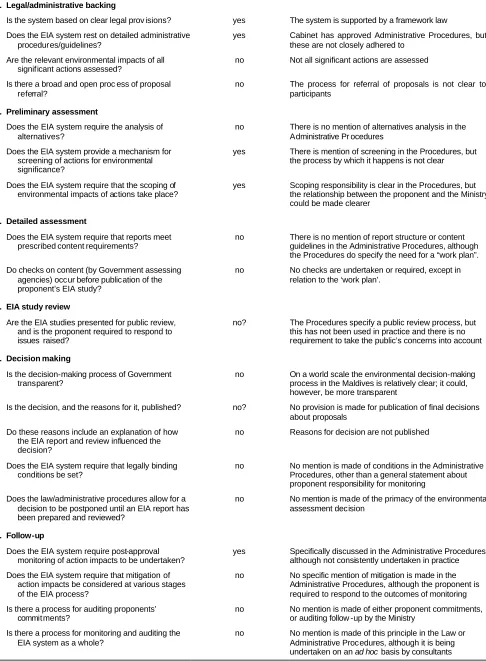
Each of these categories was supported by between two and five sub-criteria, and all are listed in Table 1. The resulting ‘evaluation principles’ were then applie d to a combination of the Environmental Pro-tection and Preservation Act of Maldives (Law No. 4/93), and the Administrative Procedures agreed to by Cabinet in 1994. Table 1 presents a summary of the application of Wood’s criteria to the Maldivian EIA system.This kind of full evaluation is valuable because it provides a structure for discussion as to how individual elements of the EIA system might be improved. This is, in fact, what happened as part of the UNDP’s Capacity Enhancement in Environ-mental Planning and Management project.
The evaluation is also useful because it allows for an overall judgement to be made about how a ‘real’, operating EIA system compares with an ideal-type.
A bald reading of Table 1 suggests that the Mal-divian EIA system is a long way from meeting the ideal. Of the 23 criteria used, ‘yes’ responses are provided for only six. The question can then be raised as to whether the Maldivian EIA system is therefore fundamentally flawed or deficient.1
In the late 1980s, UNEP assisted the
Maldives Government to examine
responses to potential sea-level rise:
one outcome was the National
Evaluative principles Rating Comment
1. Legal/administrative backing
Is the system based on clear legal prov isions? yes The system is supported by a framework law
Does the EIA system rest on detailed administrative procedures/guidelines?
yes Cabinet has approved Administrative Procedures, but these are not closely adhered to
Are the relevant environmental impacts of all significant actions assessed?
no Not all significant actions are assessed
Is there a broad and open proc ess of proposal referral?
no The process for referral of proposals is not clear to participants
2. Preliminary assessment
Does the EIA system require the analysis of alternatives?
no There is no mention of alternatives analysis in the Administrative Pr ocedures
Does the EIA system provide a mechanism for screening of actions for environmental significance?
yes There is mention of screening in the Procedures, but the process by which it happens is not clear
Does the EIA system require that the scoping of environmental impacts of actions take place?
yes Scoping responsibility is clear in the Procedures, but the relationship between the proponent and the Ministry could be made clearer
3. Detailed assessment
Does the EIA system require that reports meet prescribed content requirements?
no There is no mention of report structure or content guidelines in the Administrative Procedures, although the Procedures do specify the need for a “work plan”.
Do checks on content (by Government assessing agencies) occur before publication of the proponent’s EIA study?
no No checks are undertaken or required, except in relation to the ‘work plan’.
4. EIA study review
Are the EIA studies presented for public review, and is the proponent required to respond to issues raised?
no? The Procedures specify a public review process, but this has not been used in practice and there is no requirement to take the public’s concerns into account
5. Decision making
Is the decision-making process of Government transparent?
no On a world scale the environmental decision-making process in the Maldives is relatively clear; it could, however, be more transparent
Is the decision, and the reasons for it, published? no? No provision is made for publication of final decisions about proposals
Do these reasons include an explanation of how the EIA report and review influenced the decision?
no Reasons for decision are not published
Does the EIA system require that legally binding conditions be set?
no No mention is made of conditions in the Administrative Procedures, other than a general statement about proponent responsibility for monitoring
Does the law/administrative procedures allow for a decision to be postponed until an EIA report has been prepared and reviewed?
no No mention is made of the primacy of the environmental assessment decision
6. Follow-up
Does the EIA system require post-approval monitoring of action impacts to be undertaken?
yes Specifically discussed in the Administrative Procedures, although not consistently undertaken in practice
Does the EIA system require that mitigation of action impacts be considered at various stages of the EIA process?
no No specific mention of mitigation is made in the Administrative Procedures, although the proponent is required to respond to the outcomes of monitoring
Is there a process for auditing proponents’ commitments?
no No mention is made of either proponent commitments, or auditing follow -up by the Ministry
Is there a process for monitoring and auditing the EIA system as a whole?
no No mention is made of this principle in the Law or Administrative Procedures, although it is being undertaken on an ad hoc basis by consultants
EIA systems for small developing countries
Impact Assessment and Project AppraisalSeptember 2001 191
While acknowledging that much can be done to improve the EIA process in Maldives, especially in the area of administrative resources, personal ex-perience suggests that the basic structure of the EIA system is sound. As a general rule, proponents prepare EIA studies that include predictions, eval- uations as to the significance of impacts, and mitigation/monitoring recommendations. Bureau-crats assess the EIA documents, and Government approvals are given based on bureaucratic advice.
If this is the case, and the system is not fundamen-tally flawed, then further questions can be raised about which of Wood’s criteria are ‘core’ (meaning that they must be met for the EIA system to be considered to be viable) and whether there might be additional criteria that should be added to Wood’s list to better reflect the position of small developing countries.
‘Core’ EIA system evaluation criteria
The literature dealing with the effectiveness of EIA is still young. Recent research into effectiveness concentrates on outcomes, which is understandable. People want to know whether the public and private time and money invested in the EIA process actually leads to improved environmental quality (or at least, maintains the status quo).
As a consequence of this focus on outcomes in EIA effectiveness research, there is little that has been said about the organizational preconditions for success.
The first ‘core’ or necessary criterion that would appear to be undeniable is some kind of direction from government that EIA should take place. In the past, many jurisdictions relied on a system of ad hoc
decisions from either bureaucrats or politicians about whether or not a proposal should undergo en-vironmental assessment. These jurisdictions are in the minority now, as proponents demand a degree of certainty from regulators.
A law and/or written administrative direction
spelling out how the EIA process is to work would arguably be a necessary condition for a viable EIA system. As has already been mentioned, Maldives has a framework environmental law that requires EIA, and a set of more detailed Administrative Pro-cedures that are currently being strengthened.
The second ‘core’ criterion that is arguably a necessary organizational precondition for success relates to the preparation of a set of guidelines by which the EIA study should be undertaken. Clearly proponents will do this themselves as a project man-agement imperative. The involvement of a regula-tory agency is crucial, however, because it allows negotiation about the issues to be focused on, and an agreement to be reached about the technical content and style of the EIA document itself.
Once the conditions for an EIA study and its con-ceptual framework have been established through a scoping and guidelines-setting stage, the next fundamental requirement of an EIA process is a decision-making stage by government. EIA is a technical process, but it is also part of the politics of project approvals. It could be argued that a success-ful EIA process needs to have a transparent govern-ment decision-making and approvals stage where what is required of proponents and government agencies is made clear to all.
The final ‘core’ precondition for success appears to be adequate administrative support. One
Table 1 (continued)
Evaluative principles Rating Comment
7. Administrative support
Is the EIA system given adequate resources?
no The Environment Section of MPHRE does not have enough staff to assist proponents in the design of EIA studies, and in the evaluation of completed EIA studies
Do existing staff have the appropriate skills to operate the EIA system?
yes Collectively, the Environment Section and the Environment Research Unit have the skills to make the EIA system work
Does a well qualified, private local consulting sector exist?
no There is a strong need for the Government and donors to assist with the establishment of a local private consulting sector
Is the ‘across-Government’ environmental administrative system supportive of EIA?
no Various reforms need to be undertaken before the administrative system for EIA will work efficiently and effectively
component of this requirement is the existence of enough regulatory agency staff to ensure that the scoping/guidelines precondition, and the government decision-making core precondition are met.
Another, perhaps less obvious, component of this administrative support precondit ion is the existence of a well qualified, independent private consulting sector. The Republic of Maldives is handicapped in this regard because it has a small population and most of its qualified environmental professionals work inside the Government. It is faced with a con- flict-of-interest problem where proponents hire envi-ronmental professionals to produce EIA studies who also often happen to work for Government agencies with an environmental mandate. The solution to this problem is for proponents to begin to hire their own environmental staff, and for donor agencies to assist in the development of a private consulting sector.
Additional EIA system evaluation criteria
The above discussion outlines the four fundamental criteria that need to be met before a jurisdiction’s EIA process can be considered to be viable. This implies that the remainder of Wood’s criteria are not necessary preconditions for viability, but add to the skeleton provided by the four core requirements and give it strength.
Based on experience with the development of the Maldivian EIA system, it appears that there are addi-tional, non-core EIA system evaluation criteria that are not in Wood’s list, but are nonetheless import- ant determinants of viability for small developing countries. Five of these additional criteria will now be briefly introduced.
The first relates to the speed of development and implementation of the first-mentioned ‘core’ pre-condition: the legal/administrative hierarchy. It was effectively almost ten years from the time that EIA was first mooted until it became enshrined in Mal-divian law. This relatively lengthy period allowed proponents, many of whom were Government agen-cies, time to adapt to the concept of EIA and learn how to produce EIA studies, and integrate them into project planning. While this concept of integration is by no means universally accepted, the coming of the law in 1994 did little more than formalize an already existing part of project development.
It is suggested then that gradual development over time of a formal legal/administrative structure for EIA is a factor contributing to a successful EIA sys-tem in Maldives. The point here is that small developing countries cannot easily adapt to regula-tory ‘shocks’. It should be noted, however, that time limits do need to be placed on the development of EIA systems, and these limits need to be specified publicly as a policy goal.
The second additional criterion is closely related to the first. Until the Environmental Protection and Preservation Act of Mald ives was promulgated, EIA
was undertaken on an ad hoc basis when required by Ministers and bureaucrats. While this is not an ideal system for proponents, who are never sure whether their particular project is going to require EIA, it is a practical method for under-resourced environmental regulators coming to terms with the demands of ad-ministering an EIA system.
It is therefore suggested that ad hoc application of EIA requirements working in parallel with the de-velopment of a structured legal/administrative sys-tem is another factor contributing to a successful EIA system in Maldives. However, it needs to be acknowledged that structured legal/administrative systems are the end goal, and that ad hoc application of EIA should cease as soon as more rigorous ad-ministrative procedures are in place.
As with other areas of development in Maldivian society, environmental policy has expanded rapidly over the last 15 years. Despite its small size, Mal-dives is a major player in international environ-mental policy-making, especially in relation to the issues facing island developing states. It participates in all significant international environmental treaties and agreements.
As a consequence, it has had to develop its own national suite of environmental policies, if only to meet the reporting requirements of international agreements. A positive aspect of being small is that policies can be developed in an inclusive, integrative fashion. While Maldives is not immune to bureau-cratic isolationism, it shows evidence of real at-tempts to build policy ‘bridges’.
For example, the country recently embarked on a consultative process to draft a Second National En-vironmental Action Plan (NEAP) (the first was pub-lished in 1990). Produced with wide consultation across Government, the NGO (non-governmental organization)sectorandtheprivatesector,theSecond NEAP makes specific recommendations about strengthening the EIA process, and draws links to other areas of environmental policy.
A second example relates to the process for de-velopment planning. In common with many devel- oping countries, Maldives produces regular National Development Plans (on a five-yearly basis). The recently completed Fifth National Development Plan stresses, in a number of places, the importance of EIA in both strategic planning and project approval.
This direction is carried through from high-level policy to specific project development. Public -sector project feasibility studies have an environmental impact checklist component, and designs for projects such as tourist resorts are required to meet environ-mental criteria.
The third suggested additional EIA system evaluation criterion is that there should be a strong link between revision and improvement of the EIA system and other areas of policy development, par-ticularly those relating to national economic devel-opment and the approval of new projects.
EIA systems for small developing countries
Impact Assessment and Project AppraisalSeptember 2001 193
consultation across traditional departmental lines. The EIA system in Maldives has benefited from ad-ditional ongoing consultation with proponents and NGOs. The drafting of the Second NEAP was achieved using a range of working groups, one of which focused entirely on EIA procedures and in-volved active participation from private proponents, public proponents and NGOs. They all provided verbal input to meetings, and detailed written com-ments on proposed new procedures for EIA.
A fourth suggested additional EIA system eval- uationcriterionisthenecessityforregularinvolvement of proponents (public and private) and NGOs in on-going revision and strengthening of the EIA system. Finally, a common thread throughout this paper is the importance of deliberation and incremental change in reforming the Maldivian EIA system. A fifth suggested additional EIA system evaluation criterion is the importance of maintaining an itera-tive and ‘continuous improvement’ philosophy.
Conclusion
The strong international interest in developing EIA systems over the last 20 years has necessitated the establishment of ‘models’ that can act as guides. The literature dealing with comparative analysis of EIA systems has also grown over this period, to the point where countries, and other jurisdictions developing new administrative systems and reforming old ones, have plenty of guidance.
This paper compared the EIA system of the Re-public of Maldives against one recent ‘ideal–typical’ model (Wood, 1995) and concluded that, although practical experience with the operation of the admin-istrative process appeared to indicate that it was fundamentally well designed, it failed to meet many of the performance standards implied by the model.
This led to the conclusion that there is perhaps a set of ‘core’ criteria that must be met for an EIA system to work, and there may be additional criteria missing from Wood’s list that are especially appro-priate and important for small developing countries.
We suggest that the required ‘core’ criteria are:
• the existence of legal and administrative backing for the EIA system;
• the involvement of regulators in the establishment of ‘scoping’ guidelines;
• the existence of a transparent government deci-sion-making and approvals stage; and
• adequate administrative support and a viable pr i-vate consulting sector.
A further analysis of the Maldivian EIA system in-dicated that there are perhaps five additional criteria that should be added to Wood’s list for the specific attention of small developing countries. This is be-cause the additional criteria are based on a philoso-phy of incremental improvement that is most
appropriate for countries that will always tend to be under-resourced. The suggested criteria are:
• the importance of gradual development over time of a formal legal/administrative structure for EIA;
• the ad hoc application of EIA requirements
working in parallel with the development of a structured legal/administrative system;
• the importance a strong link between revision and improvement of the EIA system and other areas of policy development, particularly those relating to national economic development and the approval of new projects;
• necessity for regular involvement of proponents (public and private) and NGOs in the ongoing re-vision and strengthening of EIA systems; and,
• the importance of maintaining an iterative and ‘continuous improvement’ philosophy.
Note
1. It should be noted at this stage that Wood (1995) does not suggest that an EIA system must provide affirmative an-swers for all criteria before it can be considered to be ‘suc-cessful’ or well designed. The question of how to determine the effectiveness of an EIA system is a complex one. Wood’s aim is rather to point to the many different aspects of EIA system design that lead to an ‘ideal–typical’ model.
References
A Barker and C Wood (1999), “An evaluation of EIA system per-formance in eight EU countries”, Environmental Impact Assessment Review, 19, pages 387–404.
F Ebisemiju (1993), “Environmental impact assessment: making it work in developing countries”, Journal of Environmental Man-agement, 38(4), pages 247–273.
L Emmelin (1998), “Evaluating environmental impact assessment systems — part 1: Theoretical and methodological considera-tions”, Scandinavian Housing and Planning Research, 15, pages 129–148.
R Gibson (1993), “Environmental assessment design: Lessons from the Canadian experience”, The Environmental Profes-sional, 15, pages 12–24.
Hatfield Consultants Ltd (1994), Preparation on an Environmental Management Strategy for the Republic of Maldives, T.A. No 1601-MLD, prepared for Asian Development Bank and Minis-try for Planning, Human Resources and Environment. M Hollick (1986), “Environmental impact assessment: an inter-
national evaluation”, Environmental Management, 10, pages 157–178.
R Kenchington (1983), Report on Mission to the Republic of Maldives (unpublished).
N Lee and R Colley (1992), “Reviewing the quality of envir- onmental statements”, occasional paper 24, Department of Planning and Landscape, University of Manchester.
W-S Leu, W Williams and A Bark (1996), “Development of an environmental impact assessment evaluation model and its application: Taiwan case study”, Environmental Impact As-sessment Review, 16, pages 115–133.
B Sadler (1996), Environmental Assessment in a Changing World: Evaluating Practice to Improve Performance. Final Re-port of the International Study of the Effectiveness of EIA (Canadian Environmental Assessment Agency and the Inter-national Association for Impact Assessment, Ottawa). C Wood (1995), Environmental Impact Assessment: A
Compara-tive Review (Longman, Harlow).