Key Knowledge Generation
Publication details, including instructions for authors and subscription information:
http://kkgpublications.com/applied-sciences/
Effect of Plant Density in Constructed Wetland
on Domestic Wastewater Treating Efficiency
AKARAT PANRARE 1, TUSANEE TONDEE 2, PRAPA SOHSALAM 3
1, 2 Rattanakosin College for Sustainable Energy and Environment (RCSEE),
Rajamangala University of Technology Rattanakosin, Thailand.
3 Science and Environmental Technology Program, Faculty of Liberal Arts and
Science, Kasetsart University, Khamphaeng Saen Campus, 73140, Nakhon Pathom, Thailand
Published online: 16 March 2016
PLEASE SCROLL DOWN FOR ARTICLE
This article was downloaded by:
Publisher: KKG Publications
Registered office: 8, Jalan Kenanga SD 9/7 Bandar Sri Damansara, 52200 Malaysia
To cite this article: A. Panrare, T. Tondee and P. Sohsalam, “Effect of plant density in constructed wetland on domestic wastewater treating efficiency” International Journal of Applied and Physical Sciences, vol. 2, no. 1, pp. 7-12, 2016.
DOI: https://dx.doi.org/10.20469/ijaps.2.50002-1
To link to this article: http://kkgpublications.com/wp-content/uploads/2016/2/Volume2/IJAPS-50002-1.pdf
KKG Publications makes every effort to ascertain the precision of all the information (the “Content”) contained in the publications on our platform. However, KKG Publications, our agents, and our licensors make no representations or warranties whatsoever as to the accuracy, completeness, or suitability for any purpose of the content. All opinions and views stated in this publication are not endorsed by KKG Publications. These are purely the opinions and views of authors. The accuracy of the content should not be relied upon and primary sources of information should be considered for any verification. KKG Publications shall not be liable for any costs, expenses, proceedings, loss, actions, demands, damages, expenses and other liabilities directly or indirectly caused in connection with given content.
2016, 2(1): 7-12
Content from this work is copyrighted by KKG Publications, which permits restricted commercial use, distribution and reproduction in any medium under a written permission. Users may print articles for educational and research uses only, provided the original author and source are credited. Any further utilization of this work must maintain attribution to the author(s), the title of the work and journal citation in the form of a proper scientific referencing.
EFFECT OF PLANT DENSITY IN CONSTRUCTED WETLAND ON DOMESTIC
WASTEWATER TREATING EFFICIENCY
AKARAT PANRARE 1, TUSANEE TONDEE 2*, PRAPA SOHSALAM 3
1, 2
Rattanakosin College for Sustainable Energy and Environment (RCSEE), Rajamangala University of Technology Rattanakosin Nakhon Pathom 73170, Thailand
3 Science and Environmental Technology Program, Faculty of Liberal Arts and Science, Kasetsart University, Khamphaeng Saen Campus,
73140, Nakhon Pathom, Thailand
Keywords: Constructed Wetland Wasterwater Treating Pollutant Plant Density
Domestic Wastewater Heat Reduction
Received: 9 November 2015 Accepted: 11 January 2016 Published: 16 March 2016
Abstract. Constructed wetland was applied for initiating domestic wastewater treatment process. Variation of plant density and Hydraulic Retention Time (HRT) were observed. Domestic treatment performance was improved by increasing plant density and HRT but only HRT of 4 days could be achieved. Thailand’s effluent discharge standard was studied. Vegetation or non-vegetation wetland could remove total suspended solid due to physical mechanisms (filtration, sedimentation and adsorption) while Chemical Oxygen Demand (COD) and ammonium were removed by plant and microorganisms which attached at root zone and wetland media. Using constructed wetland for thermal transfer reduction and sewage treatment purpose could be applied at plant density of 20 plants/m2 and HRT of 4 days. Moreover, increasing of plant density could reduce heat transfer to house because of rising relative humidity around wetland area and nearby atmosphere.
© 2016 KKG Publications. All rights reserved.
NTRODUCTION
Constructed wastelands are immensely applied for various sources of wastewater e.g. agriculture, municipal, heavy industry or intensive freshwater aquaculture [1]. The main purpose of the constructed wetlands application was standing for
wastewater treatment and ecological conservation [2]. Various
parameters for optimization such as wet land design, sedimentation type and plant assemblage were studied and
researched [3], [4], [5], [6]. In domestic area, housing wastewater
was approximately produced up to 200 liter/person for the daily consumptions. Urban areas tend to have higher water usage than rural areas and according to Thailand’s regulation, wastewater treatment unit should be installed into each residential house which costs 15,000 baht/unit (4 persons per house). The constructed wetland could be counted as low-cost and eco-friendly wastewater treatment process and also provides a beautiful landscape [7]. In this research, the constructed wetlands were applied for domestic wastewater treatment with Canna indica L. as the high pollutants removal efficiency vegetation [8]. The effect of plant density and Hydraulic retention time on treatment efficiency were investigated [21].
MATERIALS AND METHODS
Synthetic Wastewater and Feeding System
Synthetic wastewater was used instead of domestic wastewater due to precision of component composition. The synthetic wastewater consisted of 170 mg/l of Biochemical
*Corresponding author: Tusanee Tondee E-mail: [email protected]
Oxygen Demand (BOD5), 100 mg of total suspended solids (TSS) and 50 mg/l of ammonia which are prepared by mixing tapioca starch and urea dissolved into nearby water source (canal water). Synthetic wastewater was kept in 2 m3 storage tank and connected with 0.5 HP pump as shown in the fig 1. Flow rate will be adjusted to 6.25 and 12.5 l/day for HRT of 2 and 4 days.
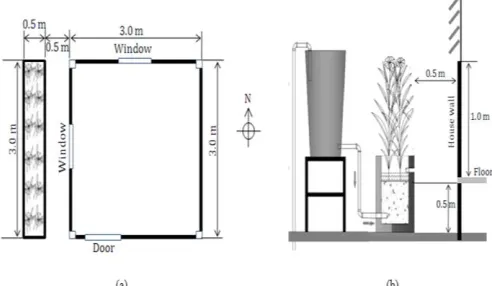
Fig. 1. Constructed wetland system and model house schematic
Constructed Wetland Installation
2016 Int. J. Appl. Phys. Sci. 8
The effluent tube was installed 0.6 m above the ground level to maintain the water level at 0.1 m above the wetland media as free water flow. Canna indica L. (1 m height in average) were used as vegetation with the density of 15, 20 and 25 plants/m2. Plant density and HRT were varied and operated for 14 days for each condition. The experiment was set up at Kasetsart University, Khamphaeng Saen Campus, Nakhon Pathom, Thailand (14.023473N, 99.974945E).
Model House
The model house had 9 m2 floor areas (3x3 m), the height of the ceiling was 2.5 m, the distance from ceiling to roof ridge was 1 m and roof eave was 50 cm. The wall was 9 mm thick with single layer gypsum board and the floor was 16 mm thick plywood. Louvers windows were installed in western and southern walls with the window with dimensions of 0.70 m width and 1.2 m height and the lower frame of the window was 1.0 m above the house floor. The model house was raised above the ground surface for 50 [20].
Water Quality Analysis
Influent and effluent of constructed wetland system were collected every 2 days in each set of an experiment. Total
Suspended Solid (TSS), Chemical Oxygen Demand (COD), ammonium and Dissolved Oxygen were analyzed following the APHA standard method for water and wastewater examination (2005) [9].
Statistical Analysis
Data was presented as mean and significant letter at p<0.05. Statistical comparisons were performed using SPSS 16.0 by SPSS Inc. The significant difference in each condition was tested using a One-way ANOVA with a Duncan’s Multiple Range Test (DMRT). A p<0.05 was considered statistically significant.
RESULTS
Optimum HRT on Constructed Wetland Treatment Performance
Referring to previous work, the effect of vegetation and Hydraulic Retention Time (HRT) of constructed wetlands has been studied [10], [21].
The BOD, TSS and ammonia removing performance has been determined and compared to find the optimization. Constructed wetland with vegetation is shown in fig 2.
Fig. 2. Pollutant removing efficiency of various conditions [10]
According to Fig. 2, the results showed that the constructed wetland at 4-day HRT with Canna indica L. gave highest pollutant removing efficiency for treating TSS, BOD, NH4 and PO3. At 4th day of HRT, the effluent quality could
achieve the wastewater discharge standard (Department of Industrial Works of Thailand) then HRT of 4th day was chosen for condition optimization in this experiment.
0 20 40 60 80 100
TSS BOD Ammonia Phosphate
R
emo
v
in
g
e
ff
ic
ie
n
cy
Pollutant
non-vegetation 2 day HRT non-vegetation 4 day HRT
Pollutant Treatment Performance
Fig. 3 demonstrated the comparisons of COD and Dissolved Oxygen (DO) at various plant densities. The influent COD was in range of 174 – 228 mg/l. COD removal efficiencies
at 4th day of HRT at various plant densities were 41%, 60% and 74% for 15, 20 and 25 plant/m2 respectively. Moreover, the DO concentration in all varied plant densities was in aerobic condition with effluent DO higher than 2 mg/l.
Fig. 3. Effluent COD and OD in various plant densities
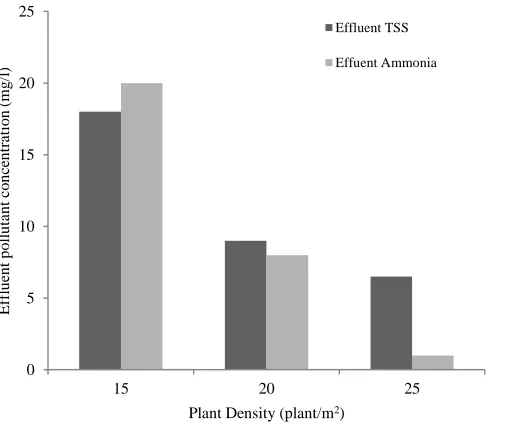
Fig. 4 displayed comparisons of the effluent TSS and ammonium. Similar to effect on COD treating performance, the higher plant density provided more TSS and ammonium removing efficiency. The influent TSS was in range of 66 – 83 mg/l and influent ammonium was in range of 47 – 68 mg/l. TSS
removal efficiencies at 4th day of HRT were 75%, 88% and 93% for plant densities of 15, 20 and 25 plant/m2, respectively. Ammonium removal efficiencies at 4th day of HRT were 65%, 86% and 99% for plant densities of 15, 20 and 25 plant/m2, respectively.
Fig. 4. Effluent TSS and Ammonia in various plant densities Heat Transfer Reduction
Besides wastewater treatment potency, the constructed wetland also provided beautiful landscape and reduced the heat transfer to model house [24]. Fig. 5 showed the heat reduction of the model house with vegetated constructed wetland at various plant densities. Variation of plant density in wetland resulted in heat reduction (∆T) to the model house which was accounted by eq. 1
𝐻𝑒𝑎𝑡 𝑟𝑒𝑑𝑢𝑐𝑡𝑖𝑜𝑛 (∆𝑇) =
𝑂𝑢𝑡𝑠𝑖𝑑𝑒 𝑡𝑒𝑚𝑝. (°𝐶) − 𝐼𝑛𝑠𝑖𝑑𝑒 𝑡𝑒𝑚𝑝. (°𝐶)…… eq.1
Likewise other parameters, increasing plant density also gave a positive result for heat reduction. Constructed wetlands with 0, 15, 20 and 25 plant/m2 of plant density provided 1.8, 2.7, 3.1 and 5.3 °C of heat reduction, respectively.
0 0.5 1 1.5 2 2.5 3 3.5 4 4.5 5 0 20 40 60 80 100 120 140
15 20 25
Ef fl u en t D O ( mg /) Ef fl u en t C O D ( mg /l )
Plant Density (plant/m2)
Effluent COD Effuent DO 0 5 10 15 20 25
15 20 25
Ef fl u en t p o ll u ta n t co n ce n tr at io n ( mg /l )
Plant Density (plant/m2) Effluent TSS
2016 Int. J. Appl. Phys. Sci. 10
Fig. 5. Comparison of heat reduction for model house by various plant densities on constructed wetlands
DISCUSSION AND CONCLUSIONS
COD Treating Performance and DO Escalation
Higher plant density tends to give better performance for COD removing and DO increasing significantly (p<0.05). COD or other organic substances were adsorbed or assimilated by a root zone microorganism and/or biofilm of constructed wetland media surface [2]. Oxygen is required for plant aerobic respiration but the wetland plants are partially submerged. The plants needed to develop the aerenchyma, the plant tissue which allows oxygen to move from aerial part to aquatic part of plant. This oxygen promotes microbial activity and nitrification process [11]. All experimental conditions gave higher DO than 1 mg/l which is considered as aerobic condition and also prevents the malodor.
TSS and Ammonia Treating Performance
Reduction of TSS was because most TSS had been trapped in the root zone of constructed wetland and settled at the bottom of the wetland system. While the microorganism which
grew in the submerged region of plant took the main role of the contributor for nitrogen removal in wastewater treatment by forming the biofilm layer [12]. Most TSS was filtrated and sedimented at the inlet zone of wetland even in low HRT [8]. The suspended solids were removed entirely by physical processes, involving sedimentation, filtration and adsorption [13]. These processes are influenced by temperature, pH, and alkalinity of the water, inorganic carbon source, microbial population and concentrations of dissolved oxygen [14]. Most ammonium was oxidized within the system using oxygen through nitrification process [2]. Increase of plant density provided higher TSS and ammonium removing efficiency, it is claimed that the actual wetland efficiency is not only primarily achieved from the activity of the principal wetland components, but reached through cooperation of all components.
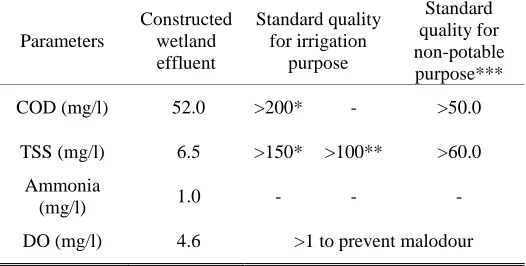
The comparison of effluent quality and standard quality for non-potable and irrigation purpose is as illustrated in Table 1.
TABLE 1
QUALITY COMPARISON OF EFFLUENT AND STANDARD
Parameters
Constructed wetland effluent
Standard quality for irrigation
purpose
Standard quality for non-potable purpose***
COD (mg/l) 52.0 >200* - >50.0
TSS (mg/l) 6.5 >150* >100** >60.0
Ammonia
(mg/l) 1.0 - - -
DO (mg/l) 4.6 >1 to prevent malodour
(Adopt from [15]; *China, **Taiwan) (***On-site non-potable water use, [16])
According to the compared results, Effluent parameters quality was passing through the standard quality. Therefore,
constructed wetland effluent was capable to be utilized for non-potable or irrigation purpose.
0 1 2 3 4 5 6
non-vegetation 15 20 25
H
ea
t r
ed
uc
ti
on
(∆T
)
Indirect Benefits
Constructed wetland also provided the heat transfer reduction as indirect effect because of plant photosynthesis, evapotranspiration, oxygen and water vapors were emitted to surrounding atmosphere. The emitted water vapors could reduce the temperature around the vegetation by adsorption of heat for phase transformation from liquid to vapor. Planting many kinds of tree near the house could reduce heat transfer to house due to tree’s shade, absorption of heat and reduction of scattered heat [17], [19], [23].
Generally, reduction of ambient temperature by 1 °C can reduce electricity cost from air-conditioning by 10% (EGAT, 2016). For the model house with 9 m2floor area required 9,000 BTU (2.637 kW) size in minimum for sufficient cooling efficiency which costs the electricity for 411 Thai-Baht/month approximately [18], [22], [25].
𝐸𝑙𝑒𝑐𝑡𝑟𝑖𝑐𝑖𝑡𝑦 𝑐𝑜𝑠𝑡 (𝑝𝑒𝑟 𝑚𝑜𝑛𝑡ℎ)
=𝑐𝑜𝑜𝑙𝑖𝑛𝑔 𝑐𝑎𝑝𝑎𝑐𝑖𝑡𝑦 × ℎ𝑜𝑢𝑟 𝑜𝑓 𝑢𝑠𝑎𝑔𝑒 (80%) × 𝑐𝑜𝑠𝑡/𝑢𝑛𝑖𝑡 × 𝑑𝑎𝑦
𝐶𝑜𝑒𝑓𝑓𝑖𝑐𝑖𝑒𝑛𝑡 𝑜𝑓 𝑃𝑒𝑟𝑓𝑜𝑟𝑚𝑎𝑛𝑐𝑒
=2.637 𝑘𝑊 × 8 ℎ𝑟 (80%) × 3 𝑇𝐻𝐵 𝑝𝑒𝑟 𝑢𝑛𝑖𝑡 × 30 𝑑𝑎𝑦
3.46 = 411 𝑇𝐻𝐵/𝑚𝑜𝑛𝑡ℎ
If constructed wetland with 25 plant/m2 plant density were installed near house, the electricity cost could reduce by 53%. The final electricity cost would save up to about 215 THB/month
CONCLUSION
Increasing plant density directly improved the treatment performance. Higher plant density resulted in higher COD, Ammonia and TSS removing efficiency. Constructed wetland in this experiment is capable for domestic wastewater treatment in house because this system could provide the acceptable effluent quality which allowed to use the effluent for non-potable purpose and also provided heat reduction which leads to lower house temperature and reduce usage of air-conditioning by 50% approximately.
REFERENCES
[1] J. Vymazal, “Removal of nutrients in various types of constructed wetlands,” Science of the Total Environment, vol. 380, no. 1,
pp. 48-65, 2007.
[2] R. H. Kadlec and R. L. Knight, Treatment Wetlands, Boca Raton, FL: Lewis Publishers, 1996.
[3] C. C. Tanner, J. P. S. Sukias, T. R. Headley, C. R. Yates and R. Stott, “Constructed wetlands and denitrifying bioreactors for on-site and decentralised wastewater treatment: Comparison of five alternative configurations,” Ecological Engineering, vol. 42, pp. 112-123, 2012.
[4] Y. F. Lin, S. Jing, D. Y. Lee, Y. F. Chang, Y. M. Chen and K. C. Shih, “Performance of a constructed wetland treating intensive shrimp aquaculture wastewater under high hydraulic loading rate,” Environmental Pollution, vol. 134, no. 3, pp. 411-421, 2005. [5] C. Schulz, J. Gelbrecht and B. Rennert, “Treatment of rainbow trout farm effluents in constructed wetland with emergent plants
and subsurface horizontal water flow,” Aquaculture, vol. 217, no. 1, pp. 207–221, 2003.
[6] H. R. Hadad, M. A. Maine and C. A. Bonetto, “Macrophyte growth in a pilot-scale constructed wetland for industrial wastewater
treatment,” Chemosphere, vol. 63, no. 10, pp. 1744-1753, 2006.
[7] S. Y. Chan, Y. F. Tsang, L. H. Cui and H. Chua, “Domestic wastewater treatment using batch-fed constructed wetland and predictive model development for NH 3-N removal,” Process Biochemistry, vol. 43, no. 3, pp. 297-305, 2008.
[8] P. Sohsalam, A. J. Englande and S. Sirianuntapiboon, “A study of six plant species for seafood wastewater treatment in constructed wetland: Tropical case,” Bioresource Technology, vol. 99, no. 5, pp. 1218-1224, 2007.
[9] APHA, AWWA, WEF, Standard Methods for the Examination of Water and Wastewater, 22nd ed., Washington, D.C., USA. 2012.
[10] A. Panrare, P. Sohsalam and T. Tondee,“Constructed wetland for sewage treatment and thermal transfer reduction,” Energy
Procedia, vol. 79, pp. 567-575, 2015.
[11] K. C. Julie and F. M. Siobhan, Wetland Plants; Biology and Ecology, CRC Press, 2001.
[12] C. Polprasert, N. R. Khatiwada and J. Bhurtel, “Design model for COD removal in constructed wetlands based on biofilm activity,” Environmental Engineering, vol. 124, no. 9, pp. 838-843, 1998.
[13] USEPA, “Constructed wetlands treatment of municipal wastewaters,” Office of Research and Development, Cincinati, Ohio, US, 2000.
[14] J. Vymazal, “Constructed wetlands for wastewater treatment in the Czech Republic the first 5 years’ experience,” Water Science and Technology, vol. 34, no. 11, pp. 159–164, 1996.
[15] C. C. Andrew, L. P. Albert, T. Asano and I. Hesphanhol, “Developing human health related chemical guidelines for reclaimed wastewater irrigation,” Water Science & Technology, vol. 33, no. 10-11, pp. 463-472, 1996.
[16] Anonymous, “The San Francisco Water Website,” http://goo.gl/EzfcI3, 2016.
2016 Int. J. Appl. Phys. Sci. 12
[18] Anonymous, The Electricity Generating Authority of Thailand [Online]. Available at http://goo.gl/LMPqL2, 2016.
[19] R. G. Allen, L. S. Pereira, D. Raes and M. Smith, Crop evapotranspiration—guidelines for computing crop water requirements, FAO irrigation and drainage paper 56, [Online]. Rome, Italy. Available at http://goo.gl/TiLa1y, 1998.
[20] K. M. Al-Obaidi, M. Ismail, A and M. A. Rahman, “Passive cooling techniques through reflective and radiative roofs in tropical houses in Southeast Asia: A literature review,” Frontiers of Architectural Research, vol. 3, no. 3, pp. 283–297, 2014
[21] G. Deblina and B. Gopal, “Effect of hydraulic retention time on the treatment of secondary effluent in a subsurface flow constructed wetland,” Ecological Engineering, vol. 36, no. 8, pp. 1044-1051, 2010.
[22] G. Gan, “A parametric study of Trombe walls for passive cooling of buildings,” Energy and Buildings, vol. 27, no. 1, pp. 37-43, 1998.
[23] S. Jasechko, D. S. Zachary, J. G. John, S. Jean Birks, Y. Yi and P. J. Fawcett, “Terrestrial water fluxes dominated by transpiration,” Nature, vol. 496, no. 7445, pp. 347-350, 2013.
[24] P. W. Niles and K. L. Haggard, Passive Solar Handbook. California Energy Commission, Sacramento: CA, 1980.
[25] C. Surawut, C. Pipat, R. Pattana and C. Surapong, “Reducing energy consumption cost and greenhouse gas emission for tropical low-income housing: Thailand contribution,” In 5th International Conference on Sustainable Energy and Environment (SEE) 2014.
![Fig. 2. Pollutant removing efficiency of various conditions [10]](https://thumb-us.123doks.com/thumbv2/123dok_us/10091891.1995890/3.612.143.472.350.616/fig-pollutant-removing-efficiency-various-conditions.webp)