Chemistry Publications
Chemistry
2013
Communication: Structure, formation, and
equilibration of ensembles of Ag-S complexes on
an Ag surface
Selena M. Russell
Iowa State University, [email protected]
Yousoo Kim
RIKEN Advanced Science Institute
Da-Jiang Liu
Iowa State University, [email protected]
James W. Evans
Iowa State University, [email protected]
Patricia A. Thiel
Iowa State University, [email protected]
Follow this and additional works at:
http://lib.dr.iastate.edu/chem_pubs
Part of the
Chemistry Commons
,
Materials Science and Engineering Commons
, and the
Physics
Commons
The complete bibliographic information for this item can be found at
http://lib.dr.iastate.edu/
chem_pubs/6
. For information on how to cite this item, please visit
http://lib.dr.iastate.edu/
howtocite.html
.
Communication: Structure, formation, and equilibration of ensembles of
Ag-S complexes on an Ag surface
Abstract
We have utilized conditions of very low temperature (4.7 K) and very low sulfur coverage to isolate and
identify Ag-S complexes that exist on the Ag(111) surface. The experimental conditions are such that the
complexes form at temperatures above the temperature of observation. These complexes can be regarded as
polymeric chains of varying length, with an Ag
4S pyramid at the core of each monomeric unit. Steps may
catalyze the formation of the chains and this mechanism may be reflected in the chain length distribution.
Keywords
catalysis, silver, sulphur, surface chemistry, surface reconstruction, Ames Laboratory, Physics and Astronomy,
Materials Science and Engineering
Disciplines
Chemistry | Materials Science and Engineering | Physics
Comments
The following article appeared in
Journal of Chemical Physics
138, no. 7 (2013): 071101 and may be found at
doi:
10.1063/1.4790571
.
Rights
Copyright 2013 American Institute of Physics. This article may be downloaded for personal use only. Any
other use requires prior permission of the author and the American Institute of Physics.
Communication: Structure, formation, and equilibration of ensembles of Ag-S
complexes on an Ag surface
Selena M. Russell, Yousoo Kim, Da-Jiang Liu, J. W. Evans, and P. A. Thiel
Citation: The Journal of Chemical Physics 138, 071101 (2013); doi: 10.1063/1.4790571 View online: http://dx.doi.org/10.1063/1.4790571
View Table of Contents: http://scitation.aip.org/content/aip/journal/jcp/138/7?ver=pdfcov
Published by the AIP Publishing
Articles you may be interested in
Erratum: “Charge effect in S enhanced CO adsorption: A theoretical study of CO on Au, Ag, Cu, and Pd (111) surfaces coadsorbed with S, O, Cl, and Na” [J. Chem. Phys.133, 094703 (2010)]
J. Chem. Phys. 134, 069902 (2011); 10.1063/1.3553260
Atomic and electronic structure of S-terminated GaAs(001) surface
J. Appl. Phys. 108, 063713 (2010); 10.1063/1.3477244
Charge effect in S enhanced CO adsorption: A theoretical study of CO on Au, Ag, Cu, and Pd (111) surfaces coadsorbed with S, O, Cl, and Na
J. Chem. Phys. 133, 094703 (2010); 10.1063/1.3483235
When seeing is not believing: Oxygen on Ag(111), a simple adsorption system?
J. Vac. Sci. Technol. A 23, 1487 (2005); 10.1116/1.2049302
The influence of surface steps on the formation of Ag-induced reconstructions on Si(111)
Appl. Phys. Lett. 86, 161906 (2005); 10.1063/1.1906310
THE JOURNAL OF CHEMICAL PHYSICS138, 071101 (2013)
Communication: Structure, formation, and equilibration
of ensembles of Ag-S complexes on an Ag surface
Selena M. Russell,1,a)Yousoo Kim,2Da-Jiang Liu,3J. W. Evans,3,4and P. A. Thiel1,3,5,b) 1Department of Chemistry, Iowa State University, Ames, Iowa 50011, USA
2RIKEN Advanced Science Institute, Wako, Saitama 351-0198, Japan 3The Ames Laboratory, Iowa State University, Ames, Iowa 50011, USA
4Department of Physics and Astronomy, Iowa State University, Ames, Iowa 50011, USA
5Department of Materials Science and Engineering, Iowa State University, Ames, Iowa 50011, USA
(Received 12 December 2012; accepted 18 January 2013; published online 15 February 2013)
We have utilized conditions of very low temperature (4.7 K) and very low sulfur coverage to iso-late and identify Ag-S complexes that exist on the Ag(111) surface. The experimental conditions are such that the complexes form at temperatures above the temperature of observation. These complexes can be regarded as polymeric chains of varying length, with an Ag4S pyramid at the
core of each monomeric unit. Steps may catalyze the formation of the chains and this mech-anism may be reflected in the chain length distribution. © 2013 American Institute of Physics. [http://dx.doi.org/10.1063/1.4790571]
The inadequacy of the traditional picture that chemisorp-tion and catalytic processes occur on metal surfaces which are static bystanders is now well-recognized. One manifesta-tion of this inadequacy is the formamanifesta-tion of intricate and some-times beautifully ordered sulfur- and oxygen-induced recon-structions of metal surfaces.1–5 The reconstructions can have large, semi-three-dimensional unit cells, in which the metal atom density differs from that of the clean surface. These structures have different chemical properties than either the metal surface or the bulk oxide/sulfide surface, and can play a key role in catalysis, for example.2,6,7Another manifestation of non-static metal surfaces is the existence of small metal-additive complexes that form when a clean surface is exposed to additives (such as O or S). These complexes are generally mobile and can even facilitate metal surface dynamics and mass transport across the surface.8–13More specifically, these complexes can destabilize metal nanostructures and can ac-celerate coarsening or sintering of arrays of nanoclusters via a reactive version of Ostwald ripening.11,14The modern tools of surface science—particularly scanning tunneling microscopy (STM), diffraction techniques, and density functional theory (DFT)—have proven powerful enough to decipher even intri-cate extended structures, butdirectexperimental observations of isolated complexes between adsorbates and metal atoms extracted from the surface have been limited, due in part to difficulties in imaging mobile species. Also missing from the above observations is a characterization of the formation mechanism for complexes, the possibility that there exists a variety of distinct complexes interacting with each other, and a potential connection between these complexes and extended reconstructions.
a)Present address: Electrochemistry Branch, Power and Energy Division, Sensor and Electron Devices Directorate, U.S. Army Research Laboratory, Adelphi, Maryland 20783, USA.
b)Author to whom correspondence should be addressed. Electronic mail: [email protected].
The focus of this paper is on the system S/Ag(111). In order to isolate and identify Ag-S complexes, we uti-lize conditions of very low temperature where complexes are likely to be immobile, and very low S coverage where complexes are unlikely to be subsumed into, or replaced by, extended reconstructions. In addition, we will pro-vide insight into the formation and equilibration of these moieties at temperatures higher than the temperature of observation.
A partial phase diagram has been established for this system, which helps guide expectation.15 There is a (√7 ×√7)R19◦reconstruction, in which the Ag atom density is not conserved, relative to the clean surface.15–19 This recon-struction is stable at 135–300 K and at coverages of 0.4 ML or higher. At lower temperature and lower coverage, two other equilibrium phases exist, both of which are also thought to in-volve a change in Ag atom density.15In the first, Ag
3S3
clus-ters are aligned in rows and embedded in an ordered S over-layer, at coverages ranging from 0.03 to 0.3 monolayers (ML) of S at 200 K. The second phase is stable at 135 K, and con-sists of parallel stripes. It has been observed at 0.09 ML S, but its coverage-dependence has not been explored. Both phases disappear and reappear reversibly with thermal cycling. Over-all, the richness of these phase equilibria, involving multiple phases in which Ag is displaced from lattice sites, suggests that S-Ag interactions are strongly attractive, which should favor the formation of complexes under the conditions de-scribed above.
In the present work, STM images were acquired us-ing a low-temperature STM (Omicron GmbH) in ultra-high vacuum.20 The Ag(111) sample (MaTecK GmbH) was cleaned by repeated cycles of Ar+ sputtering and annealing at∼670 K. S2(gas) was generated from a solid-state
electro-chemical Ag|AgI|Ag2S|Pt cellin situ.21Sulfur coverage was
determined by comparing STM image areas with prior data, in which Auger electron spectroscopy was implemented as an absolute measure.15
071101-2 Russellet al. J. Chem. Phys.138, 071101 (2013)
FIG. 1. STM images. (a) A 5×5 nm2topographic image of clean Ag(111). Scanning parameters are current (I)=2.0 nA and sample bias voltage (Vs)=6.8 mV. (b) A 50×50 nm2 differentiated image of Ag(111) with 0.01 ML S at 4.7 K. I=0.32 nA, Vs= −1.1 V. (c) A 5×5 nm2topographic image of a chain. I=0.37 nA, Vs= −0.69 V. (d) A 5×5 nm2topographic image of a monomer. I=2.1 nA, Vs=7.6 mV.
The Ag(111) sample was held at 300 K during S2
expo-sure to enexpo-sure dissociative adsorption of S2, then cooled to
4.7 K for observation. In some experiments, it was re-heated to 200–300 K and re-cooled to 4.7 K; this treatment made no difference in the observations. Furthermore, at 4.7 K, the features observed were purely static; there was no evidence of motion or rearrangement. Thus, the features observed at 4.7 K must have formed at higher temperature.
An STM image of clean Ag(111) is shown in Fig.1(a). Fig. 1(b) shows a typical STM image after adsorption of 0.01 monolayer (ML) sulfur at 300 K, followed by cooling to 4.7 K. The most striking features are “chains” of variable length but constant width. One is shown at higher magnifica-tion in Fig.1(c). These chains are always oriented with their long axis parallel to one of the three−110directions. The shortest chain unit, a monomer, is shown in Fig.1(d).
These high-quality, high-magnification images reveal that the chains consist of cross-like units, each unit hav-ing a bright central protrusion and diamond-like lobes. (We call lobes that span the short width of the chain “equato-rial” and the others “axial.”) The chains can be regarded as inorganic polymers. In the direction of the long axis, two-unit chains are significantly shorter than twice the length of a single unit, so the two-unit chains are not simply stacked monomers. Rather, each pair of units shares an axial link between the central protrusions. In multiple-unit chains, the central protrusion-to-central protrusion separation is 4 to 5 times the Ag(111) surface lattice constant. (The uncertainty is due to drift and possible slight miscalibration of XY piezo-electrics in STM.)
We have analyzed a large number of possible structures and compositions with density functional theory (DFT), using the Vienna Ab initioSimulation Package (VASP) code,22–24 with the Perdew-Burke-Ernzerhof (PBE) approximation25for exchange-correlation functional. We have identified a few
FIG. 2. Simulated and measured STM images. In panels (a) and (e), small yellow circles are sulfur atoms. Large white circles are cluster Ag atoms. Large gray circles are Ag atoms in the Ag(111) surface. (a) Ag16S13 monomer model. (b) STM image predicted from monomer model, with (9
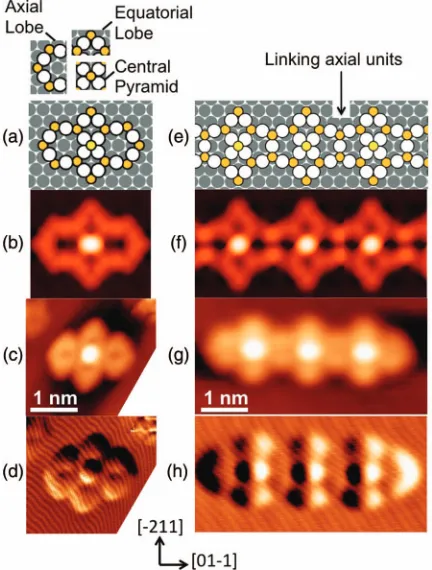
×9) supercell, (2×2×1) k-points, and 2 Ag layers. (c) Measured STM image at same spatial scale and crystallographic orientation as in panels (a) and (b). The image is distorted due to drift. I=0.05 nA, Vs =1.0 V. (d) Differentiated version of image in panel (c). (e) Chain model. (f) STM im-age predicted from chain model, with (5×8) supercell, (2×2×1) k-points, and 4 Ag layers. (g) Measured STM image at same scale and orientation as in panels (e) and (f). I=1.0 nA, Vs= −0.5 V. (h) Differentiated version of image in panel (g).
candidates that satisfy all of the following requirements: (1) Close fit between shape and size of the electron density contours in the model (Tersoff-Hamman method) and in the STM images; (2) Long axis of cluster oriented parallel to the close-packed directions of Ag(111); (3) Low chemical poten-tial of sulfur,μS.
Within these constraints, a family of related clusters emerges as good candidates. Consider first the monomer. The favored structure is an Ag16S13cluster, shown in Fig.2(a). At
its center is a square pyramid, with 4 Ag atoms at the base in the shape of a slightly-distorted square [incommensurate with the underlying Ag(111) substrate], and a S atom at the apex. This pyramid is the central protrusion observed in the STM images, and it is a defining feature of the family of favorable structures. Its stability can be understood in terms of the very strong affinity of S for four-fold hollow sites on Ag. It resembles the basic structural unit of a S-induced reconstruc-tion on Ag(100).5On opposite sides of the Ag
4S pyramid, in −211directions, lie 2 small rings comprised of alternating Ag and S atoms. These would be the equatorial lobes in STM. In the−110directions, there are 2 larger rings of Ag-S-Ag-S atoms, which would be the axial lobes. The predicted Ag-S-Ag-STM
[image:5.612.328.544.52.337.2]071101-3 Russellet al. J. Chem. Phys.138, 071101 (2013)
image for this monomer model compares well with the mea-sured image, as shown in Figs.2(b)–2(d).
For the multiple-unit (polymeric) chains, the correspond-ing model is shown in Fig.2(e). The pyramids are linked by new Ag-S units that essentially replace the axial lobes of the 2 erstwhile monomers. The projected image and STM image of the chain are reasonably similar (compare Figs.2(f)–2(h)). Models that provide better fits with the data may yet be found, but it is likely that any such would be closely related to the structures shown in Fig.2, particularly in terms of the Ag4S
pyramid as a central building block.
We note that the Ag(111) substrate is minimally per-turbed by the presence of the chains, according to DFT. This is consistent with our other DFT investigations of other S-related phases on Ag(111), where we have found that ad-sorbed atomic S can induce large displacements in the surface Ag layer. However, such configurations are always less favor-able than S-Ag clusters that exist on top of an essentially in-tact Ag(111) substrate. For example, in our study of the (√7 × √7)R19◦ phase of S on Ag(111) at 3/7 ML S coverage, Ag3S3 clusters on a relatively unperturbed Ag(111) surface
are more energetically favorable than a competing structure in which three S atoms induce reconstruction of the Ag(111) surface.15,19 The weak perturbation of the Ag(111) surface implies that the cluster-surface interaction is weak, while Ag-S bonding within the cluster is strong.
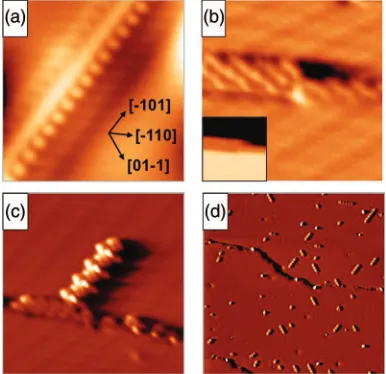
Having identified a reasonable structural model, we now comment on the kinetics and thermodynamics of chain for-mation. Steps may play a role in catalyzing or assisting chain formation, because S atoms preferentially decorate step edges on Ag(111) before occupying sites on terraces. Fig.3(a)is an STM image, showing an Ag(111) step decorated by bright dots that we assign as S atoms. The dots are about 0.58 nm apart, which is twice the Ag-Ag separation along the steps, indicating that S atoms occupy every other site. We also
con-FIG. 3. STM images showing phenomena at steps. In all panels, tunneling conditions are I=0.30 nA and Vs= −1.0 V. (a) A 5×5 nm2topographic image of sulfur atoms at a step edge. (b) A 5×5 nm2differentiated image of step reconstruction. Topographic image is shown in the inset. (c) A 10
×10 nm2differentiated image showing a chain attached to a step. (d) A 75
×75 nm2differentiated image showing chain orientations in the vicinity of ascending steps.
firmed this preference by DFT.10The main point is that S con-centration is much higher at steps than on terraces when total S coverage is low, as it is in these experiments, because step sites are energetically favored over terrace sites. We propose that this high S concentration at steps facilitates formation of the S-rich chains.
Most steps have the appearance of Fig.3(a), but a few are decorated with other types of structures. Examples are shown in Fig.3(b). These other decorations grow out from the lower step edge, often forming a single or double zig-zag-like row of material. These are probably sulfur-induced reconstructions of the step edge.
Sometimes chains are attached directly to steps, in which case they extend out onto the lower terrace, making an angle of 60◦ or 120◦ with the step edge, parallel to a close-packed direction of the Ag substrate. [Note that the segment of the step connected to the chain is aligned with the third close-packed direction of Ag(111).] A chain attached to a step is shown in Fig. 3(c). In this particular example, the chain is attached to a reconstructed area of the step, but chains can be found at a variety of step decorations.
There is some evidence that the isolated chains on a ter-race may adopt a preferred orientation of 60◦ or 120◦ with the nearest ascending step edge. In Fig. 3(d), there are two steps oriented mainly along the [−110] direction. Most of the chains are oriented along the other two close-packed direc-tions, with only a few parallel to [−110]. A similar trend can be seen in Fig.1(b), where there are very few near-horizontal chains or monomers, suggesting that a [−110]-aligned step is close by.
We caution that the available data are not statistically ade-quate to reach a definitive conclusion about the distribution of terrace chain orientations with respect to step edges, and that this topic warrants further investigation. However, if preferred orientations of 60◦or 120◦exist, they could be explained with the following model. Chains form at step edges, with favored angles of 60◦and 120◦. Eventually, the chains separate from the steps and diffuse onto the terraces (at higher temperature than 4.7 K), but they retain their original orientation. Diffu-sion of the intact chain could be facilitated by the relatively weak interaction between the chain and the Ag(111) substrate, noted above.
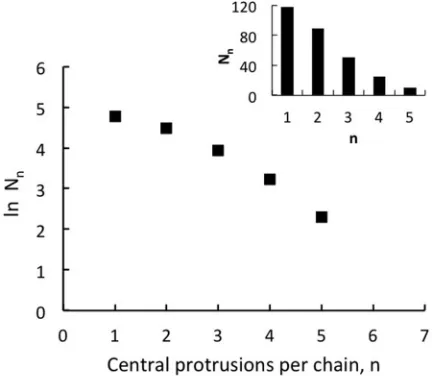
The chain length distribution is also of interest. Consider a simple equilibrium model, where the chains are built of n repeated units (each unit denoted by C), stabilized by a neigh-boring attractionφC<0 between units. If the chain energy En
varies linearly with n, then the population of chains of length n satisfies Pn ≈θC exp[−φC/(kBT)] Pn-1, so Pn should
de-cay exponentially. Here,θC1 reflects the low equilibrium
concentration of units C due to the small amount of excess S (above that decorating steps) on the surface. The logarithm of Pn vs. n (for chains which are well separated from steps,
[image:6.612.78.271.489.676.2]071101-4 Russellet al. J. Chem. Phys.138, 071101 (2013)
FIG. 4. Semi-log plot of the distribution of chain lengths, Nn, for chains on terraces. In this distribution, chains are only included if they are well sepa-rated from steps and not pinned by any obvious defects. The inset shows the raw data.
a growing chain, which could favor detachment over growth for longer chains.
In conclusion, our studies reveal the existence of an en-tire ensemble of linear nanoscale Ag-S complexes of vari-ous lengths on an Ag(111) surface at low coverage and low temperature. There have been various suggestions of the exis-tence of metal-S or metal-O complexes on surfaces, but no observations of such individual isolated moieties for softer metals where they are presumably too dynamic to be im-aged under normal conditions. Our use of ultra-low temper-ature imaging resolves this difficulty. In addition, the STM studies provide a window into formation of the complexes, which appears to occur at steps on the surface decorated with S adatoms, and into the extent of equilibration. However, it should be noted that both formation and equilibration oc-cur at temperatures higher than the temperature of observa-tion. DFT analysis leads to a detailed structural model of the chains, in which the core of the building block is an Ag4S
pyramid.
The experimental component of this work was supported by three sources. From the US, it was the NSF (Grant No. CHE-1111500). From Japan, support was provided by a Grant-in-Aid for Scientific Research on Priority Areas “Electron Transport Through a Linked Molecule in Nano-scale”; and a Grant-in-Aid for Scientific Research(S) “Single
Molecule Spectroscopy using Probe Microscope” from the Ministry of Education, Culture, Sports, Science, and Tech-nology (MEXT). The theoretical component of this work was supported by the Division of Chemical Sciences, Basic En-ergy Sciences, US Department of EnEn-ergy (USDOE), and it utilized resources of the National Energy Research Scien-tific Computing Center, which is supported by the Office of Science of the US Department of Energy (Contract No. DE-AC02-05CH11231). We thank Tomoko Shimizu, Hiroshi Imada, Ju-Hyung Kim, and Hyun Jin Yang for assistance with the experiments.
1M. L. Colaianni and I. Chorkendorff,Phys. Rev. B50, 8798–8806 (1994). 2H. Over, Y. D. Kim, A. P. Seitsonen, S. Wendt, E. Lundgren, M. Schmid,
P. Varga, A. Morgante, and G. Ertl,Science287, 1474 (2000).
3M. Schmid, A. Reicho, A. Stierle, I. Costina, J. Klikovits, P. Kostelnik, O. Dubay, G. Kresse, J. Gustafson, E. Lundgren, J. N. Andersen, H. Dosch, and P. Varga,Phys. Rev. Lett.96, 146102 (2006).
4J. Schnadt, A. Michaelides, J. Knudsen, R. T. Vang, K. Reuter, E. Laegs-gaard, M. Scheffler, and F. Besenbacher, Phys. Rev. Lett. 96, 146101 (2006).
5S. M. Russell, M. Shen, D.-J. Liu, and P. A. Thiel,Surf. Sci.605, 520–527 (2011).
6B. L. M. Henriksen and J. W. M. Frenken,Phys. Rev. Lett.89, 046101 (2002).
7W.-X. Li, C. Stampfl, and M. Scheffler,Phys. Rev. Lett.90, 256102 (2003). 8S. Horch, H. T. Lorensen, S. Helveg, E. Laegsgaard, I. Stensgaard, K. W. Jacobsen, J. K. Norskov, and F. Besenbacher,Nature (London)398, 134– 136 (1999).
9P. J. Feibelman,Phys. Rev. Lett.85, 606–609 (2000).
10M. Shen, D.-J. Liu, C. J. Jenks, P. A. Thiel, and J. W. Evans,J. Chem. Phys. 130, 094701 (2009).
11P. A. Thiel, M. Shen, D.-J. Liu, and J. W. Evans,J. Phys. Chem. C113, 5047–5067 (2009).
12M. Shen, S. M. Russell, D.-J. Liu, and P. A. Thiel,J. Chem. Phys.135, 154701 (2011).
13J. Kibsgaard, K. Morgenstern, E. Laegsgaard, J. V. Lauritsen, and F. Be-senbacher,Phys. Rev. Lett.100, 116104 (2008).
14P. A. Thiel, M. Shen, D.-J. Liu, and J. W. Evans,J. Vac. Sci. Technol. A28, 1285 (2010).
15M. Shen, D.-J. Liu, C. J. Jenks, and P. A. Thiel,J. Phys. Chem. C112, 4281–4290 (2008).
16K. Schwaha, N. D. Spencer, and R. M. Lambert,Surf. Sci.81, 273–284 (1979).
17G. Rovida and F. Pratesi,Surf. Sci.104, 609–624 (1981).
18M. Yu, D. P. Woodruff, C. J. Satterley, R. G. Jones, and V. R. Dhanak,J.
Phys. Chem. C111, 3152–3162 (2007).
19M. Shen, D.-J. Liu, C. J. Jenks, and P. A. Thiel,J. Phys. Chem. C115, 23651–23651 (2011).
20S. M. Russell, D.-J. Liu, M. Kawai, Y. Kim, and P. A. Thiel,J. Chem. Phys. 133, 124705 (2010).
21C. Wagner,J. Chem. Phys.21, 1819–1827 (1953). 22G. Kresse and J. Hafner,Phys. Rev. B49, 14251 (1994). 23G. Kresse and J. Hafner,Phys. Rev. B47, 558 (1993).
24G. Kresse and J. Furthmüller,Comput. Mater. Sci.6, 15–50 (1996). 25J. P. Perdew, K. Burke, and M. Ernzerhof,Phys. Rev. Lett.77, 3865 (1996).