Vol. 14, No. 2 (2019), pp 33-42 DOI: 10.7508/ijmsi.2019.02.004
Solving A Fractional Program with Second Order Cone
Constraint
Ali Sadeghia, Mansour Saraja,∗ , Nezam Mahdavi Amirib a Faculty of Mathematical Sciences and Computer,
Shahid Chamran University of Ahvaz, Iran.
b Faculty of Mathematical Sciences, Sharif University of Technology, Tehran, Iran.
E-mail: [email protected] E-mail: [email protected] E-mail: [email protected]
Abstract. Our main interest in the present article is to consider a frac-tional program with both linear and quadratic equation in numerator and denominator with second order cone (SOC) constraints. With a suitable change of variable, we transform the problem into a second order cone programming (SOCP) problem. For the quadratic fractional case, using a relaxation, then the problem is reduced to a semi-definite optimiza-tion (SDO) ) program. The problem is solved with SDO relaxaoptimiza-tion and the obtained results are compared with the interior point method (IPM), sequential quadratic programming approach (SQP), active set, genetic algorithm. It is observe that the SDO relaxation method is much more accurate and faster than the other methods. Finally, two numerical ex-amples are given to demonstrate the procedure for the proposed method to guarantee the approach.
Keywords: Fractional Programming, Second Order Cone, SDP Relaxation.
2000 Mathematics Subject Classification: Primary 90C32, Secondary 90C46.
∗Corresponding Author
Received 25 April 2018; Accepted 27 April 2019 c
2019 Academic Center for Education, Culture and Research TMU 33
1. Introduction
In the past few decades, fractional programming problems have attracted the interests of many investigators due to their applications in real physical world such as finance, production planning, electronics, etc. Fractional pro-gramming is being used for modelling a real life problem involving one or more objective(s) such as actual cost/standard cost, inventory/sales and profit/cost. There are different algorithms for determining the solutions of particular kinds of fractional programming problems. For example, Charnes and Cooper [2] converted a linear fractional program (LFP) to a linear program (LP) by a variable transformation technique. Tantawy [3] proposed an iterative method based on a conjugate gradient projection approach. Dinkelbach [6] considered the same objective over a convex feasible set and solved the problem by means of a sequence of nonlinear convex programming problems.
On the other hand second order cone programming (SOCP) problems are con-vex optimization problems in which a linear function is minimized over the intersection of an affine linear manifold with the Cartesian product of sec-ond order (Lorentz) cones. Linear programs, convex quadratic programs and quadratically constrained convex quadratic programs can all be formulated as SOCP problems. Other problems not falling into these three categories can be seen in [7, 9].
Lobo et al. [7] disscused several applications of SOCP in engineering. Nes-terov and Nemirovski [4] and Lobo et al. [7, 8] showed that many kinds of problems can be formulated as SOCPs, such as filter design, truss design, an-tenna array weight design, grasping force optimization in robotics and more. In a pioneering paper, Nesterov and Nemirovski [4] applied the concept of self-concordant barrier to SOCP problems and for the problems with m second order cone inequalities the interior point algorithm for SOCP has an iteration complexity of√m.
Alizadeh and Goldfarb [9] discussed and over-viewed a large class of SOCP problems, in which they considered the logarithmic barrier function and equa-tions defining the central path for an SOCP problem with a and primal-dual path following interior point method (IPM) for its solution.
Salahi et al. [10] investigated a fractional optimization programming prob-lem minimizing the ratio of two quadratic functions. The author showed that under certain assumptions, the problem can be solved to yield a global optimal solution using semi-definite optimization (SDO) relaxation in polynomial time. Kim and Kojima [1] showed that SDP and SOCP relaxations provide exact optimal solutions for a class of non-convex quadratic optimization problems.
Few example were considered in [5, 10, 11, 12]. For instance, total least squares (TLS), is used in a variety of disciplines such as signal processing,
statistics, physics, economic, biology and medicine requiring the following frac-tional problem to be solved [6, 10]:
M in kAx−bk 2
1+kxk2
Some Farkas-type results for a fractional programming problem by using the properties of dualizing parameterization function, Lagrangian function, and the epigraph of the conjugate functions is due to Xiang-Kai Sun and et. al [13], in which they have introduced some new notion of regularity conditions to obtain dual form of the Farkas-type results.
The problem of Some characterization of robust optimal solutions for uncertain fractional optimization and applications is due to Xian-Kai -Sun and et. al [14]. A good result on using closeness condition to obtain some Farka’s type results for a constrained fractional programming problem with Dc functions is studied by Xiang-Kai Sun and et. al [15].
The rest of our work is organized as follows. In Section 2, we introduce fractional programming problem involving second order cone constraints and then transform the problem to a second order cone programming problem by a variable transformation technique in such a way that the problem size remains the same.
In Section 3, we use the extended Charnes-Cooper transformation to represent a homogenized quadratic optimization problem with two quadratic constraints. In Section 4, a semi-definite optimization (SDO) is used relaxation for solving the semi-definite optimization problem. There, we show that under certain assumptions on the SDO relaxation, the global optimal solution can be found in polynomial time. In Section 5, some numerical examples are worked through. A conclusion is provided in Section 6.
2. Linear Fractional Programming Problem with Second Order Cone Constraint
A linear fractional programming problem is defined as follows:
(P1) : M ax F(x) = c
Tx+α
dTx+β Ax≤b,
x≥0,
where x= (x1, x2, ..., xn)T ∈Rn, c= (c1, c2, ..., cn)∈Rn, andαand β are given real numbers,Ais anm×nmatrix,c,d∈Rn, andb
∈Rm. The above fractional programming problem can easily be solved by a suitable transforma-tion as by Charnes and Cooper [2].
Now, consider the above fractional program with an additional second order cone (SOC) constraint
(P1) : M ax F(x) = c
Tx+α
dTx+β Ax≤b, x∈Qn.
where
Qn={x= (x0;x)∈Rn :x0≥kxk},
It is assumed that the feasible set is a bounded and closed set and thus compact. Moreover,dTx+β >0.
If we assumeβ6= 0, then (P1) can be written as
(P2) : M ax G(y) = (cT −α
βd
T) x
dTx+β + α β
(A+ b βd
T
) x
dTx+β ≤ b β,
x
dTx+β ∈Qn. Ify= x
dTx+β ≥0, then (P2) can be reformulated as
(P3) : M ax G(y) = (cT −α
βd
T)y+α
β
(A+ b βd
T)y
≤ b β,
y∈Qn.
Now, the above programming can be written as
(P4) : M ax G(y) =pTy+α β
Gy≤g,
y∈Qn,
where
pT =cT −α βd
T
G=A+ b βd
T
g= b β
x=β y 1−dTy (1) The following result is immediately at hand.
Theorem 2.1. If x∈Qn, theny=dTxx+β ∈Qn.
Proof. Sincex∈Qn, we havex0≥kxk, which yields x0
dTx+β ≥ kxk dTx+β,
givingy0≥kykandy∈Qn.
3. Quadratic Fractional Programming Problem with Second Order Cone Constraint
In this section, we consider a quadratic fractional programming problem with second order cone constraint
(P5) : M in F(x) =f(x) g(x) kAx+bk≤cTx+d,
where
f(x) =xTA1x+bT1x+c1, g(x) =xTA2x+bT2x+c2. The above constraint can be rewritten as
xTA3x+bT3x+c3≤0, where
A3=ATA−ccT, b3= 2bT
A−2dT
cT, c3=bTb−dTd,
with Ai = ATi , , bi ∈ Rn×n, ci ∈ R, i = 1,2,3. Also, the Ai’s are positive semi-definite matrices andxTA2x+bT
2x+c2>0.
Using the well-known Charnes-Cooper transformation, we show that (P5) has an inherent hidden homogeneity and thus semi-definite relaxation technique
can be applied
Using the generalized Charnes-Cooper transformation, we have
z=p 1
xTA2x+bT 2x+c2
,
and
y=p x
xTA2x+bT 2x+c2
,
Then problem (P5) is reduced to the following equivalent minimization prob-lem:
(P6) : M in F(x) =yTA1y+bT1yz+c1z2 yTA2y+bT2yz+c2z2= 1,
yTA3y+bT3yz+c3z2≤0 z6= 0.
4. Semi-definite Optimization (SDO) Relaxation
Here, we provide, an SDO relaxation approach to solve (P6) globally. Prob-lem (P6) in the matrix form is given by
(P7) : M in M0•Xˆ M1•Xˆ = 1,
M2•Xˆ ≤0,
where
M0= c1
bT1
2
b1
2 A1
!
,
M1= b T
b−dTd (2b
T
A−2dTcT)T
2 2bT
A−2dT
cT
2 A2
!
,
and
M2= c3
bT
3
2
b3
2 A3
!
,
A•B=T r(ATB), Xˆ =
z2 yTz yz yyT
.
The semi-defnite optimization relaxation of (P6) is given by
(P8) : M in M0•Xˆ M1•Xˆ = 1,
M2•Xˆ ≤0, X 0(n+1)×(n+1),
in which the dimensions of y, z are the same as (P6) and also
X=
X00 xT 0 x0 Xˆ
.
Proposition 4.1. Both (P8) and (P9) satisfy the Slater’s regularity condi-tions. Hence both problems attain their optimal values and the duality gap is zero.
Proposition 4.2. SDO relaxation(P8)gives a global optimal solution of(P6)
in a polynomial time.
5. Numerical Results
Here, two examples are worked through using different methods. We use
fmincon command and optimization toolbox of MATLAB. All computations are performed on MATLAB R2015a (8.5) using a laptop with Intel(R) Core i3 CPU 2.53 GHz and 5.00 GB of RAM.
Consider the following two simple fractional programs as (P2) and (P5). Example 5.1. Consider the following linear fractional program:
M ax z=x1+x2+ 2 x1+ 1 x1+x2≤4, −x1+ 2x2≤2.
x∈Q2,
where cT = (1,1), dT = (1,0), α = 2 and β = 1. The optimal solution is x∗ = (
−.667, .667), with z∗ = 6. The above problem can be rewritten as a
linear programming model using the Charnes-Cooper technique as follows:
M ax w=−y1+y2+ 2 5y1+y2≤4, y1+ 2y2≤2, y∈Q2.
The optimal solution for this problem is obtained to be y∗
= (−2,2), with w∗= 6 which can be considered as an equivalent SOCP with exactly the same
dimension as the original fractional programming problem with a second order cone constraint.
Furthermore, the dual problem of this SOCP is obtained to be
M in H(u) = 4u1+ 2u2 5u1+u2+z1=−1, u1+ 2u2+z2= 1, z∈Q2.
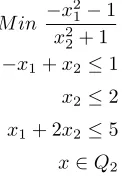
Example5.2. Consider the following quadratic fractional programming prob-lem
M in −x 2 1−1 x2
2+ 1 −x1+x2≤1
x2≤2 x1+ 2x2≤5 x∈Q2
The solutions obtained by different approaches are summarised in Table 1, Table 1. The Comparision of Methods
Method Objective function value Number of iterations Interior point method -.99999999999998026 32
SQP .99999990463122402 10
Active set -.9999990463120583 10
Genetic algorithm -1.0002471385939868 3
SDO relaxation -1
the above optimization techniques are provided in MATLAB toolbox soft-ware.
Where
M0=
−1 0 0 0 −1 0
0 0 0
,
M1=
1 0 0
0 −1 0
0 0 1
,
M2=
−1 −1 1 −1 −1 1
1 1 −1
,
M3=
−1 0 0 0 −1 0
0 0 0
,
M4=
−1 0 0 0 −1 0
0 0 0
,
M5=
−1 0 0 0 −1 0
0 0 0
,
Where Mi’s, i = 1,2, ...,5 are the values which can be obtained through the Sections 3 and 4.
6. Conclusion
We considered a new fractional programming problem involving a second order cone constraint. We showed how to transform the problem into a sec-ond order cone programming (SOCP) problem and obtained the solution of the original problem by solving the SOCP problem. We solved the problem on using a semi-definite optimization relaxation and the result was compared with the other methods such as interior point method, SQP, Active set, Ge-netic algorithm. The results were summarized in a table, and we pointed out that the SDO relaxation is much more accurate and faster in time than the other methods. Finally We worked through numerical examples to illustrate
the methodology and the efficiency of our approach with solving linear and nonlinear fractional programming problems.
Acknowledgement
We are very grateful to the anonymous referees for the valuable suggestions and comments.
References
1. S. Kim, M. Kojima, Exact solutions of some nonconvex quadratic optimization prob-lems via SDP and SOCP relaxations,Computational optimization and applications,26, (2003), 143-154.
2. A. Charnes, WW. Cooper, Programs with linear fractional functions, Naval Research Logistics Quarterly,9, (1962), 181-196.
3. SF. Tantawy, A new procedure for solving linear fractional programming problems, Jour-nal of Mathematical and Computer Modeling,48, (2008), 969-973.
4. Y. Nesterov, A. Nemirovski, Interior Point Polynomial Methods in Convex Program-ming: Theory and Applications, SIAM publications, 1994.
5. A. Beck, M. Teboulle, A convex optimization approach for minimizing the ratio of indef-inite quadratic functions over an ellipsoid,Mathematical Programming,118(1), (2009), 13-35.
6. W. Dinkelbach, On nonlinear fractional programming,Management Science,13, (1967), 492-498.
7. MS. Lobo, L. Vandenberghe, S. Boyd, H. Lebret, Applications of second order cone programming,Linear Algebra Appl.,284, (1998), 193-228.
8. MS. Lobo, L. Vandenberghe, S. Boyd ,Socp: Software for Second-Order Cone Program-ming, Information Systems Laboratory, Stanford University, 1997.
9. F. Alizadeh, D. Goldfarb, Second-order cone programming,Math. Program. Ser. B,95, (2003), 35-51.
10. M. Salahi, A short note onM inx∈Rn kAx−bk 2
1+kxk2 ,Applied Mathematics and Computation,
212, (2009), 270-272.
11. M. Salahi, S. Fallahi, A semidefinite optimization approach to quadratic fractional op-timization with a strictly convex quadratic constraint,Iranian Journal of Mathematical Sciences and Informatics,9(2), (2014), 65-71.
12. JF. Sturm, S. Zhang, On cones of nonnegative quadratic functions,Mathematics of Op-erations Research,28, (2003), 246-267.
13. S. Xian-Kai, T. Liping , L. Xian-Jun, L. Minghua, Some dual characterization of Farkas-type results for fractional programming problems,Optimization Letters,12(6), (2018), 1403-1420.
14. S. Xian-Kai, L. Xian-Jun, F. Hong-Yong, L. Xiao-Bing, Some characterization of ro-bust optimal solutions for uncertain fractional optimization and applications,Journal of industrial and management optimization,13(2), (2017), 803-824.
15. S. Xiang-Kai, Ch. Yi, Z. Jing, Farkas-type results for constrained fractional programming with DC functions,Optimization Letters,8(8), (2014), 2299-2313.