IJPSR (2014), Vol. 5, Issue 5 (Research Article)
Received on 21 November, 2013; received in revised form, 08 January, 2014; accepted, 09 March, 2014; published 01 May, 2014
FORMULATION AND EVALUATION OF ORAL FAST DISSOLVING FILMS OF MONTELUKAST SODIUM
Naziya Khatoon, N. G. Raghavendra Rao*, B. Mahipal Reddy
PG Department of Pharmaceutics, Jyothishmathi Institute of Pharmaceutical Science, Thimmapur, Karimnagar -505481, A.P. India.
ABSTRACT: Montelukast Sodium is a leukotriene receptor antagonist (LTRA) used for the treatment of asthma and to relieve symptoms of seasonal allergies. In present research work an attempt has been made to prepare mouth dissolving films of Montelukast Sodiumwere prepared using different polymers like PVA, HPMC by solvent casting method. The fast dissolving oral film evaluated for folding endurance, swelling index, surface pH, in-vitro disintegration time, drug content, drug polymer compatibility (IR Study), and in-vitro drug release. The physical appearance and folding endurance properties were found to be good and electron microscopy shows that films are clear, colorless with smooth surface without any scratches. The surface pH was found to be in the range of 6.35 to 6.75 which is close to salivary pH, which indicates that films may have less potential to irritate the oral mucosa, thereby they are comfortable. The drug content of all the films was in the range of 95.54 to 98.68 suggesting that drug was uniformly dispersed throughout all films. The In-vitro disintegration time of films prepared with HPMC was in the range of 21.00 to 66.67 sec. As the concentration of SSG increases the in-vitro disintegration time of the films decreases. The formulation FA3 and FA4 were found to be promising and showed a disintegration time of 21.00 and 24.33 sec respectively. The dissolution rate increased with increase in the concentration of SSG up to 8%. Hence it can be inferred that the fast dissolving oral film of Montelukast sodium may produce the rapid action thereby improving bioavailability and enhance the absorption by avoiding the first pass effect.
INTRODUCTION: Despite of tremendous
advancement in drug delivery the oral route of drug administration is the most important method of administration of drug for systemic effect. Oral route is most preferred route by medical practitioners and manufacturer due to highest acceptability of patients. About 60% of all dosage forms available are the oral solid dosage form. About 60% of all dosage forms available are the or-
QUICK RESPONSE CODE
DOI:
10.13040/IJPSR.0975-8232.5(5).1780-87
Article can be accessed online on:
www.ijpsr.com
DOI link: http://dx.doi.org/10.13040/IJPSR.0975-8232.5(5).1780-87
al solid dosage form. The lower bioavailability, long onset time and dysphagia patients turned the manufacturer to the parenterals and liquid orals. But the liquid orals (syrup, suspension, emulsion etc) have the problem of accurate dosing mainly and parenterals are painful drug delivery, so most patient incompliance. Each pharmaceutical company wants to formulate the novel oral dosage form which has the higher bioavailability, quick action and most patient compliance.1 Many pharmaceutical companies have directed their research activity in reformulating existing drugs into new dosage forms. One such relatively new dosage form is the oral strip, a thin film that is prepared using hydrophilic polymers that rapidly dissolves on the tongue or buccal cavity 2, 3. Oral Thin Films are typically the size of a postage stamp
Keywords:
Montelukast sodium, PVA, HPMC, fast dissolving film
Correspondence to Author:
Dr. N. G. Raghavendra Rao
Jyothishmathi Institute of Pharma. Science, Ramakrishna Colony, Thimmapur, Karimnagar -505481, Andhra Pradesh, India
and disintegrate on a patient’s tongue matter of seconds for the rapid release of one or more APIs.
Rapidly dissolving or quick dissolving dosage forms have acquired great importance in the pharmaceutical industry due 4, 5 to their unique properties and advantages. They undergo disintegration in the salivary fluids of the oral cavity within a minute, where they release the active pharmaceutical ingredient. The major amount of the active pharmaceutical ingredient is swallowed orally with the saliva where subsequent absorption takes place in the gastro-intestinal tract 6, 7
. The rapidly dissolving dosage forms are referred by various names by researchers like quick disintegrating, orally disintegrating, mouth dissolve or melt in mouth dosage forms 4, 6, 7.
Rapidly dissolving tablets are available in the market for a variety of drugs. Rapidly dissolving films (RDF) were initially introduced in the market as breath fresheners and personal care products such as dental care strips and soap strips.
However these dosage forms are introduced in the United States and European pharmaceutical markets for 5, 8-10 therapeutic benefits. A film or strip comprises of water soluble and/or water swellable film forming polymer due to which the film or strip dissolves instantaneously when placed on the tongue in the oral cavity. The first of this kind of oral strips were developed by the major pharmaceutical company Pfizer who named it as Listerine® pocket packs™ and were used for mouth freshening. Chloraseptic® relief strips were the first therapeutic oral thin films which contained 10
benzocaine and were used for the treatment of sore throat. The RDF are essentially prepared using water soluble and fast disintegrating polymers which also possess good film forming properties
like hydroxy propyl methylcellulose (HPMC), polyethylene oxide (PEO), polyvinyl pyrrolidone (PVP) and hydroxy propyl cellulose (HPC) 8, 11. The montelukast sodium is a leukotriene receptor antagonist (LTRA) used for the maintenance treatment of asthma, chronic asthma attacks and to relive symptoms of seasonal allergies12. The main drawback of conventional montelukast sodium formulation is that it undergoes hepatic first pass metabolism. Thus, it shows plasma or biological half-life 2.5 to 5.5 h 13, thereby decreasing bioavailability upto 64% 14-15. Montelukast Sodium is given in a dose of 10mg once daily. The present study is aim to formulate and characterized fast dissolving oral films of Montelukast Sodium for rapid dissolution of drug and absorption which may produce the rapid onset of action in the management of asthma and also to improve the bioavailability of the drug.
MATERIALS AND METHODS:
Montelukast Sodium was obtained as a gift sample from Unimark Remedies Ltd, Mumbai. HPMC, PEG-400, Tween 80, Crosscarmellose Sodium were obtained from SD Fine chem. Mumbai. All the chemicals were of analytical grade.
Methods:
Preparation of blank films: The films were prepared by solvent casting method. Many blank films were prepared using different polymers like HPMC (15cps) and PVA in various combination and concentration. The various formulations of the blank film are given in Table 1. From the preliminary physical observation of these prepared films the best were selected for incorporation of montelukast sodium.
TABLE 1: FORMULATIONS OF BLANK FILMS
FC HPMC
(15CPS) (mg) PVA (mg) PEG 400 (mg)
Tween 80 (ml)
Water
(ml) Remarks
F1 100 100 300 0.2 10 +
F2 100 150 300 0.2 10 +
F3 200 200 300 0.2 10 +
F4 400 400 300 0.2 10 +
F5 500 500 300 0.2 10 +
F6 250 - 300 0.2 10 +
F7 500 - 300 0.2 10 +++
F8 750 - 300 0.2 10 +++
F9 1000 - 300 0.2 10 +++
Calculation of dose: The dose of montelukast sodium is 5mg. Therefore the amount of montelukast sodium in a film of diameter 1.5cm is 5mg.
Area of the petri dish of 9cm diameter is 63.64cm2.
Area of the film of 1.5cm diameter is 1.77cm2.
Amount of drug to be present in 1.77cm2 of film is 5mg.
Amount of drug present to be added to the 63.64cm2 area of petri dish is 179.78mg.
The amount of montelukast sodium required for petri dish of area 63.64cm2 is 179.78 mg so that each film of 1.5cm diameter contains 5mg of montelukast sodium.
Preparation of fast dissolving films
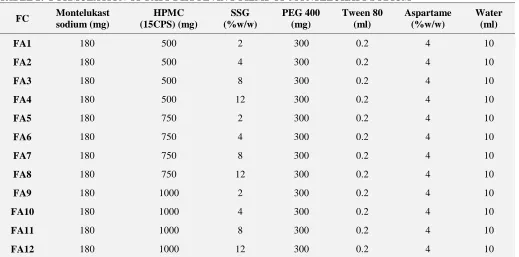
The fast dissolving films of montelukast sodium were prepared by solvent casting technique using HPMC as a film forming polymer. PEG is used as plasticizer. The required amount of polymer was dispersed in ethanol and 3/4th volume of water was added with continuous stirring using magnetic stirrer. The calculated amount of montelukast sodium was dissolved in distilled water and added to polymer solution along with the other excipients. The solution was casted on to Petri dish (area of 66.31cm2) then kept in hot air oven at 40oC for 24 hrs. Films of various formulations are mentioned in
[image:3.612.49.568.313.570.2]Table 2. The films were punched in to size of 1.5cm diameter (an area of 6.28 cm2) containing 5 mg of montelukast sodium
TABLE 2: FORMULATION OF FAST DISSOLVING FILMS OF MONTELUKAST SODIUM
FC Montelukast sodium (mg)
HPMC (15CPS) (mg)
SSG (%w/w)
PEG 400 (mg)
Tween 80 (ml)
Aspartame (%w/w)
Water (ml)
FA1 180 500 2 300 0.2 4 10
FA2 180 500 4 300 0.2 4 10
FA3 180 500 8 300 0.2 4 10
FA4 180 500 12 300 0.2 4 10
FA5 180 750 2 300 0.2 4 10
FA6 180 750 4 300 0.2 4 10
FA7 180 750 8 300 0.2 4 10
FA8 180 750 12 300 0.2 4 10
FA9 180 1000 2 300 0.2 4 10
FA10 180 1000 4 300 0.2 4 10
FA11 180 1000 8 300 0.2 4 10
FA12 180 1000 12 300 0.2 4 10
*FC=Formulation code, SSG= Sodium starch glycolate
Evaluation of Fast Dissolving Films:
Weight variation: For weight variation three films of every formulation were taken weighed individually on digital balance then average weight was calculated.
Film thickness: The thickness of each film was measured using micrometer screw gauge at different positions of the film and the average was calculated 16.
Surface pH: Film is slightly wet with the help of water. The pH is measured by bringing the electrode in contact with the surface of the oral film. This study is performed on three films of each formulation and means ± S.D calculated 17.
Folding endurance: The folding endurance was determined by repeatedly folding one film at the same place till it broke. The number of times the film could be folded at the same place without breaking gives the value of the folding endurance 18
Drug content: A circular film of 1.5cm diameter was cut and dissolved in 100ml of 0.5%SLS and filtered. The contents were transferred to a volumetric flask (100 ml). The drug is determined spectroscopically after appropriate dilution.
Disintegration time: Disintegration test was performed in the USP disintegration time testing apparatus. One film from formulation was introduced into the tube of disintegration apparatus IP. A disc was added into the tube. The assembly was suspended in 0.5%SLS and operated until the film disintegrated.
In vitro dissolution studies: In-vitrodissolution of fast dissolving film was studied in USP paddle dissolution test apparatus using phosphate buffer pH 6.8 as the dissolution medium. The temperature was maintained at 37±0.5ºC throughout the experiment. 5ml Sample was withdrawn at 50sec intervals and the same quantity was replaced with phosphate buffer of pH 6.8. The cumulative percentage of drug released was determined using UV visible spectrophotometer at 342 nm.
Stability studies: The purpose of the stability testing is to provide evidence on how the quality of a drug substance or drug product varies with time under the influence of a variety of environmental factors such as temperature, humidity and light, enabling recommended storage condition, re-test periods and shelf life. The stability studies were carried out as per International Conference of harmonization (ICH) Guidelines. Stability studies were carried out at 40º C / 75% RH for 3 months. The optimized film formulations were packed in amber-colored bottles, which were tightly plugged with cotton and capped. They were then stored at 40ºC / 75% RH for 3months and evaluated for their physical appearance, drug content and in-vitro dispersion time at specified intervals of time.
RESULTS AND DISCUSSION: In present
research work, an attempt has been made to prepare mouth dissolving films of Montelukast Sodium by solvent casting method.
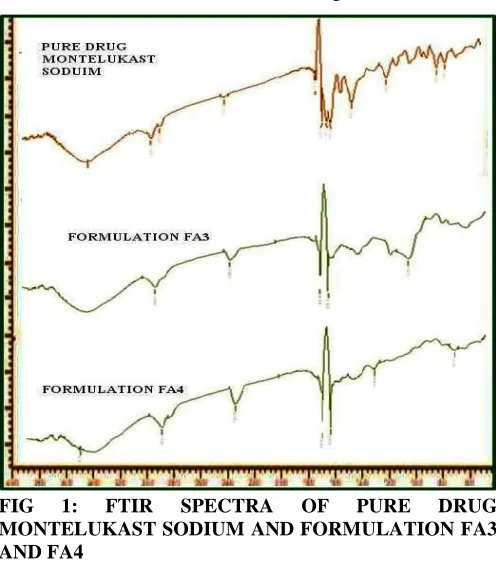
The possible interaction between drug and excipients used in the formulation development of montelukast sodium was studied by FTIR spectroscopy. The FT-IR spectra of pure drug and
drug + excipients are shown in Fig. 1. The FTIR spectrum of Montelukast sodium pure drug exhibited characteristic broad absorption band at 3406 cm−1 representing the presence of OH group (OH stretching).
The aromatic C-H stretching and aliphatic C-H stretching bands were appeared at 2924 cm−1 and 2860 cm−1 respectively. Whereas a characteristic absorption band at 1680 cm−1 is due to the presence of C=O of COONa (C=O stretching).
FIG 1: FTIR SPECTRA OF PURE DRUG
MONTELUKAST SODIUM AND FORMULATION FA3 AND FA4
Similarly the IR spectrum of montelukast sodium and other polymers namely HPMC + SSG, showed characteristic absorption bands for the functional groups OH, Aromatic CH=CH, aliphatic CH=CH and C=O at or near that of montelukast sodium absorption bands values indicating that there was no chemical and physical change in the functional groups present in montelukast sodium.
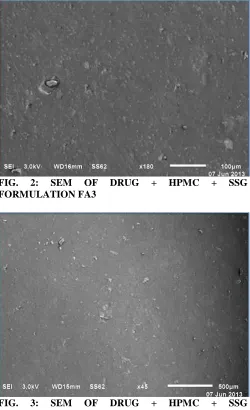
Scanning Electron Microscopy (SEM):
[image:4.612.315.563.201.485.2]FIG. 2: SEM OF DRUG + HPMC + SSG FORMULATION FA3
FIG. 3: SEM OF DRUG + HPMC + SSG FORMULATION FA4
Physical appearance and surface texture: The appearance of all the films were uniform having transparent in appearance the observation suggests that the films were having smooth surface and they were elegant enough to see. The results are shown in Table 3.
Weight uniformity of films: The weight of the prepared films was determined by using digital balance. All the films were tested for uniformity of weight and the results are given in Table 3. The films showed weight variation ranging from 43.50 to 61.07 mg for the films containing 500mg, 750mg, 1000mg of film forming polymer (HPMC) respectively. In all the cases the standard deviation values are very low which suggest the prepared films were uniform in weight.
Thickness of the films: All the films have uniform thickness throughout. The thickness of all the formulations ranged between 0.177 to 0.256 mm. In all the cases the standard deviation values are very low which suggest the prepared films were uniform in thickness. The results are given in
Table 3.
Folding endurance: The folding endurance was determined by repeatedly folding one film at the same place till it broke. The number of times the film could be folded at the same place without breaking gives the value of the folding endurance. The folding endurance of all the formulations was in the range of 232 to 278 results was given in
Table 3.
Surface pH of films: The surface pH was found to be in the range of 6.35 to 6.75 which is close to salivary pH, which indicates that films may have less potential to irritate the oral mucosa, thereby they are comfortable. The results are given in
Table 3.
Drug content uniformity of films: The drug content of all the films was in the range of 95.54 to 98.68 suggesting that drug was uniformly dispersed throughout all films.
In-vitro disintegration time of films: The In-vitro disintegration time of films prepared with HPMC was in the range of 21.00 to 66.67 sec. As the concentration of superdisintegrants increases the in-vitro disintegration time of the films decreases. Based on the in-vitro disintegration time, formulation FA2, FA3 and FA4 were found to be promising and showed a disintegration time of 27.33, 21.00 and 24.33 sec respectively. The results are given in Table 3.
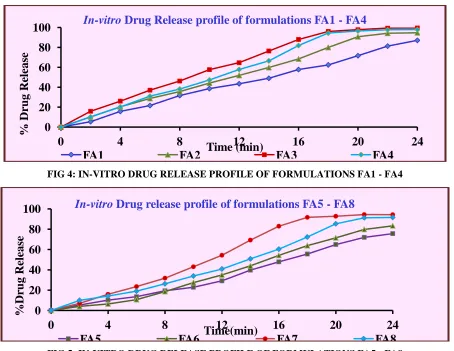
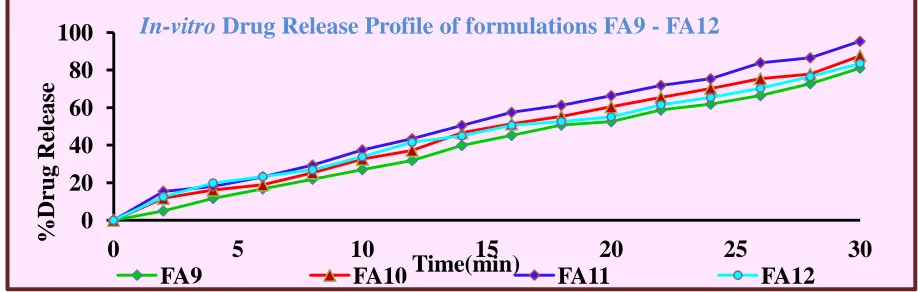
[image:5.612.50.300.59.469.2]The drug release for the formulations (FA1 –FA4) which contains 5% HPMC15cps and increasing concentration of SSG (2, 4, 8, 12%) was about 71.66; 90.73; 97.80; 96.52 respectively and for the formulations (FA5 –FA8) which contains 7.5% HPMC15cps and increasing concentration of SSG (2, 4, 8, 12%) the drug release was about 64.94; 71.52; 92.74; 85.32 respectively and for the formulations (FA9 –FA12) which contains 10%
HPMC15cps and increasing concentration of SSG (2, 4, 8, 12%) the drug release was about 52.54; 60.47; 66.34; 55.07 respectively in 20 min.
The dissolution rate increased with increase in the concentration of SSG up to 8%. At higher concentration above 8% dissolution rate decreased. The In-vitro results are shown in Fig 4-6.
TABLE 3: EVALUATION OF FAST DISSOLVING FILMS OF MONTELUKAST SODIUM
FC Weight (mg) ± SD
Thickness (mm) ± SD
Surface pH ± SD
Folding endurance ±SD
Disintegration time (sec) ±SD
[image:6.612.81.535.381.732.2]Drug content (%) ±SD FA1 45.16 ± 0.178 0.212 ± 0.013 6.65 ± 0.125 254 ± 6.08 30.67 ± 1.15 96.77 ± 1.745 FA2 43.50 ± 0.289 0.196 ± 0.007 6.50 ± 0.323 260 ± 5.13 27.33 ± 2.08 97.12 ± 0.460 FA3 48.15 ± 0.065 0.218 ± 0.004 6.45 ± 0.065 263 ± 1.15 21.00 ± 2.00 97.82 ± 0.204 FA4 46.00 ± 0.121 0.237 ± 0.012 6.40 ± 0.272 278 ± 4.04 24.33 ± 3.57 98.07 ± 0.825 FA5 53.06 ± 0.061 0.177 ± 0.005 6.37 ± 0.207 263 ± 2.65 50.33 ± 0.58 96.20 ± 0.276 FA6 57.74 ± 0.552 0.179 ± 0.019 6.46 ± 0.133 247 ± 2.65 47.00 ± 2.00 97.33 ± 0.270 FA7 54.26 ± 0.351 0.223 ± 0.005 6.46 ± 0.250 265 ± 3.06 37.67 ± 1.15 96.53 ± 0.948 FA8 56.74 ± 0.564 0.240 ± 0.026 6.49 ± 0.325 248 ± 2.08 41.33 ± 1.53 97.51 ± 1.529 FA9 58.00 ± 0.100 0.256 ± 0.005 6.31 ± 0.258 262 ± 4.58 66.33 ± 1.53 98.68 ± 0.771 FA10 59.71 ± 0.190 0.202 ± 0.005 6.37 ± 0.291 232 ± 4.73 65.67 ± 1.15 95.54 ± 0.550 FA11 61.07 ± 0.306 0.233 ± 0.033 6.35 ± 0.167 255 ± 7.51 51.33 ± 1.15 98.18 ± 0.524 FA12 58.51 ± 0.069 0.191 ±0.018 6.75 ± 0.135 254 ± 2.65 66.67 ± 5.51 97.57 ± 0.536 Average of three determinations
FIG 4: IN-VITRO DRUG RELEASE PROFILE OF FORMULATIONS FA1 - FA4
FIG 5: IN-VITRO DRUG RELEASE PROFILE OF FORMULATIONS FA5 - FA8 0
20 40 60 80 100
0 4 8 12 16 20 24
%
Dr
u
g Re
lease
Time (min)
In-vitro Drug Release profile of formulations FA1 - FA4
FA1 FA2 FA3 FA4
0 20 40 60 80 100
0 4 8 12 16 20 24
%
Dr
u
g
Re
lease
Time(min)
In-vitro Drug release profile of formulations FA5 - FA8
FIG 6: IN-VITRO DRUG RELEASE PROFILE OF FORMULATIONS FA9 - FA12
STABILITY STUDIES: The promising
formulations were subjected to short term stability studies. The formulations FA3 and FA4 were selected and were stored at 40°C/75%RH and tested for three month. The films were again analyzed for the Surface pH, drug content
uniformity and disintegration time. The increase in the disintegration time was observed. The drug content of the formulations was found to be within the permissible limits and the results were shown in the Table 4.
TABLE 4: STABILITY STUDY DATA
Formulation Month Disintegration time
(sec)
Surface pH Drug content (%)
FA3
1st 21 6.45 97.82
2nd 23 6.44 97.74
3rd 24 6.44 97.56
FA4
1st 24 6.40 98.07
2nd 25 6.39 97.89
3rd 26 6.38 97.74
CONCLUSION: In present research work, an attempt has been made to prepare mouth dissolving films of Montelukast Sodium by solvent casting method. The fast dissolving films of montelukast sodium were prepared by solvent casting technique using film forming polymer HPMC, PVA and superdisintegrants like SSG. Montelukast Sodium is freely soluble in water but its bioavailability is about 64%. Based on the in-vitro disintegration time, formulation FA3 and FA4 were found to be promising and showed a disintegration time of 21.00 and 24.33 sec respectively. However this FDF is useful for the improving of the bioavailability of the drug.
ACKNOWLEDGEMENTS: The authors are
thankful Redefining Healthcare, Unimark
Remedies Limited, Vapi, Gujarat, India for providing Montelukast Sodium as a Gift sample.
The authors are also thankful to Sri. Juvadi Sagar Rao Garu, Chairman and Sri. K. Venkat Rao Garu, Director, Jyothishmathi Institute of Pharmaceutical Science, Karimnagar, for providing the facilities to carry out this research work.
REFERENCES:
1. Galey WR, H K. Lonsdale and S. Nacht. 1976 Clinical The in vitro permeability of skin and buccal mucosa to selected drugs and tritiated water. J. Investigative Dermatol. 67(6):713-717.
2. Crama A, Breitkreutzb J, Desset‐Brèthesc S, Nunnd T and
Tuleuf C. Challenges of developing palatable oral pediatric formulations, Int J Pharm 2009; 365: 1‐3.
3. Florence AT, Neglected diseases, neglected technologies, neglected patients? Int J Pharm. 2008; 350: 1‐2.
4. Liang AC, Chen LH. Fast Dissolving Intraoral Drug
Delivery Systems. Exp. Opin. Ther. Patents
2001;11(6):981–6.
5. Borsadia S, O'Halloran D, Osborne JL. Quick Dissolving Films-A Novel Approach to Drug Delivery. Drug Delivery Technology 2003; 3(3):63-66.
6. Klancke J. Dissolution Testing of Orally Disintegrating Tablets. Dissolution Technologies 2003; 10(2):6–8.
0 20 40 60 80 100
0 5 10 15 20 25 30
%
Dr
u
g
Re
lease
Time(min)
In-vitro Drug Release Profile of formulations FA9 - FA12
7. Parakh SR, Gothoskar AV. Review of Mouth Dissolving Tablet Technologies. Pharma Tech 2003; 27(11):92–100. 8. Vondrak B, Barnhart S. Dissolvable films for flexible
product format in drug delivery Pharm Tech
2008;Suppl:S20-28.
9. Arnum PV. Outsourcing Solid Dosage Manufacturing.
Pharma Tech 2006; 30(6):44–52.
10. Ghosh T, Pfister W. Drug Delivery to the Oral Cavity: Molecules to Market. Florida: CRC Press, Taylor & Francis; 2005.
11. Corniello CM. Quick-Dissolving Strips: From Concept to Commercialization. Drug Delivery Technology 2006;6(2): 68-71.
12. Sean CS. Martindale-The Complete Drug Reference, 33rd
edition; Pharmaceutical Press, London 2002, pp.455-456. 13. Anthony C, Moffat M, David Osselton, Brian Widdop.
Clark’s Analysis of Drugs and Poisons, 3rd Edition 2004, pp. 1299-1300.
14. Availablefromhttp://www.drugs.com/cons/Montelukast.ht
ml.
15. Raghavendra Rao NG, Mohd Abdul Hadi, Harsh A
Panchal. A novel approach to sustained montelukast sodium release: Differentially coated mini-tablets in HPMC capsules. Int J Pharm Biomed Res 2011, 2(2), 90-97.
16. Cilurzo FIE, Cupone P, Minghetti F, Selmin L. Montanari.
2008. Fast dissolving films made of maltodextrins. European J. Pharmaceutics and Biopharmaceutics. 70: 895-900.
17. Dinge A. and Nagarsenker M. “Formulation and
evaluation of fast dissolving films for delivery of triclosan to the oral cavity”, AAPS Pharm. Sci. Tech. 2008, 9(2), 349-356.
18. Shinde AJ, Garala KC and More HN, Development and characterization of transdermal therapeutics system of tramadol hydrochloride, Asian J. Pharm. 2008; 4: 265 ‐ 269.
All © 2013 are reserved by International Journal of Pharmaceutical Sciences and Research. This Journal licensed under a Creative Commons Attribution-NonCommercial-ShareAlike 3.0 Unported License
This article can be downloaded to ANDROID OS based mobile. Scan QR Code using Code/Bar Scanner from your mobile. (Scanners are
available on Google Playstore)
How to cite this article:
Khatoon N, Rao NGR and Reddy BM: Formulation and evaluation of oral fast dissolving films of montelukast sodium. Int