Iran University of Medical Sciences
____________________________________________________________________________________________________________________
1. PhD of Health Education and Promotion, Academic Member of Health Education Department, Saveh University of Medical Sciences, Saveh,
Iran. [email protected]
2. (Corresponding author) PhD candidate of Nursing Education, MSN, BSN, RN, Academic Member of Medical–Surgical Department,
School of Nursing & Midwifery, Arak University of Medical Sciences, Arak, Iran. [email protected]
3. MSN, BSN, RN of Nursing, Academic Member of Saveh University of Medical Sciences, & Kaveh Industrial Estate Company Saveh, Iran.
4. MSN, BSN, RN of Nursing, Academic Member of Saveh University of Medical Sciences, & Kaveh Industrial Estate Company Saveh, Iran.
5. MSc, Department of nursing, college of nursing, Saveh Branch, Islamic Azad University, Saveh, Iran. [email protected] 6. MSN, BSN, RN of Nursing, Academic Member of Saveh University of Medical Sciences, & Kaveh Industrial Estate Company Saveh, Iran.
Does the theory-driven program affect the risky behavior of drug
injecting users in a healthy city? A quasi-experimental study
Mahmood Karimy1, Ahmad Reza Abedi*2, Hamid Abredari3, Mohammad Taher4
Fatemeh Zarei5, Zahra Rezaie Shahsavarloo6
Received:20 January 2015 Accepted:3 March 2015 Published:5 January 2016
Abstract
Background: The horror of HIV/AIDS as a non-curable, grueling disease is a destructive issue for every country. Drug use, shared needles and unsafe sex are closely linked to the transmission of HIV/AIDS. Modification or changing unhealthy behavior through educational programs can lead to HIV prevention. The aim of this study was to evaluate the efficiency of theory-based education in-tervention on HIV prevention transmission in drug addicts.
Methods: In this quasi-experimental study, 69 male drug injecting users were entered in to the the-ory-based educational intervention. Data were collected using a questionnaire, before and 3 months after four sessions (group discussions, lecture, film displaying and role play) of educational interven-tion.
Results: The findings signified that the mean scores of constructs (self-efficacy, susceptibility, se-verity and benefit) significantly increased after the educational intervention, and the perceived barri-ers decreased (p< 0.001). Also, the history of HIV testing was reported to be 9% before the interven-tion, while the rate increased to 88% after the intervention.
Conclusion: The present research offers a primary founding for planning and implementing a theo-ry based educational program to prevent HIV/AIDS transmission in drug injecting addicts. This re-search revealed that health educational intervention improved preventive behaviors and the knowledge of HIV/AIDS participants.
Keywords: Drug abusers, Addiction, Substance, Preventive Health Education.
Cite this article as:Karimy M, Abedi AR, Abredari H, Taher M, Zarei F, Rezaie Shahsavarloo Z. Does the theory-driven program affect the risky behavior of drug injecting users in a healthy city? A quasi-experimental study.Med J Islam Repub Iran2016 (5 January). Vol. 30:314.
Introduction
Nowadays, injecting drug use is a de-structive issue for every country. It is esti-mated that 16 million people inject drugs around the world. The fastest progressive increase of epidemics is related to HIV that is largely being driven by injecting drug use particularly in Asia (1).
According to the report of the United Na-tions Office on Drugs and Crime (UNODC), drug use is one of the serious challenging issues in Iran. Drug use is closely linked to both the transmission of HIV and high rates of imprisonment. Based on this report, there are over 1,325,000 opi-ate dependents and drug users in the
try (2.26% of the adult population), placing Iran among the countries with the highest prevalence worldwide (2,3). Recent (2013) estimation of the Joint United Nations Pro-gramme on HIV and AIDS (UNAIDS) re-vealed that 47,000 - 110,000 people live with HIV, with prevalence rate of 0.1% in adults aged 15 to 49 in Iran (4). Activities such as drug use, unsafe tattooing and un-safe sex in victims, put these individuals at high risk of acquiring HIV and Hepatitis C (2). Also, shared needles infected cases were estimated 69.8% of which only 10% were infected by unprotected sexual rela-tionship, 10% through sexual relationship and 18.3% through an unknown cause. Drug injecting users are the main group affected by sexually transmitted diseases (STDs) or HIV. In this country, about two-third of the individuals who were infected by STDs or HIV are drug injecting users (5,6). A project named “Healthy Cities”, which started in 1986 in developed coun-tries (i.e., Canada, USA, Australia, and many European nations) aimed to create a
health-supportive environment and
achieved a good quality of life and supply access to health care as the first Healthy Cities Programs (HCPs) (7); then 17
devel-oping countries joined this program (8). Islamic Republic of Iran (IRI) started its HCP in 1991 (9,10). Saveh was selected as one of the cites for implementation of this project in Eastern Mediterranean Regional office of the World Health organization (EMRO) (11). Saveh with population of 238,000 over an area of 10,279 km 2 (12), is situated in central part of Iran near Teh-ran (120Km), for which HCP was started in 1996(9). At least 27 members such as Saveh University of Medical Sciences (SUMSc) and Narcotic Anonymous NGO (NA-NGO) participated in this program (13). Schematic map of relationships in Saveh Healthy City is presented as follows. (Map 1)
The modification or changing of un-healthy behavior to reduce the load of mor-bidity and mortality of the involved partici-pants has been our ultimate goal as aca-demic members of SUMSc in Saveh HCP.
Several health behavior theories applied to changing health behavior or planning programs for HIV prevention (14). Because of the positive relationship between many of the concepts and the desired behavior, the health belief model (HBM), among the-se theories, is an applicable tool for
exami-Map 1. Schematic map of relationships in Saveh Healthy City
nations and screening behaviors in the Asians (15,16). According to this model, AIDS-protective behavior decisions are function of the perceived risk of contract-ing the disease, perceived severity of the disease and perceptions of benefits and bar-riers to specific AIDS-protective behaviors (17). This HBT proposes that for persons who show high-risk behaviors, the per-ceived susceptibility is essential before ob-ligation to change these risky behaviors. However, for those who do not believe that they are at risk, the benefits or barriers to an action are irrelevant. Self-efficacy has been considered in relation to HIV-protective behaviors and defines an indi-vidual’s supposed ability to perform a be-havior believed to be essential to prevent infection with HIV (18). Dependency be-tween unsafe drug injecting activates, HIV infection and spread of HIV among com-munity represent a serious potential source of HIV infection for the marital and non-marital sexual partners (2,19). UNODC ar-gued that although Iran is a pioneer country in the fields of opium substitution thera-pies, HIV prevention and treatment of AIDS and successful HIV prevention and treatment programs, still there is an urgent need for the quantitative and qualitative expansion of the existing programs as well as introduction of new programs for a proper response to the problem of HIV and drug use in the country (2). Therefore, we decided to conduct this study to evaluate the efficiency of theory-based education intervention on HIV prevention transmis-sion in drug addicts in Saveh.
Methods
Seventy- three males admitted to single gender Saveh rehabilitation center of ad-dicted Volunteer NA-NGO were entered to our quasi-experimental study. Inclusion criteria were voluntary participation and no previous course participation. Exclusion criteria included senility (>59Y/O), absence in courses (>2 session), self-decision to discontinue, early probable discharge from the center. Finally, 68 participants
complet-ed the survey. Our instrument for data col-lection consisted of two sectional question-naires (20,21). For ethical considerations, a number was assigned to each participant instead of a real name. The first section included basic data such as age, name of the drug, drug starting age, job, revenue, education, marital status, settlement, past venereal disease; and the second section assessed HIV knowledge using DiClemen-te’s AIDS Knowledge scale (22), which has recently been used in other studies (20,23) . This scale was a 15-item instrument with a dichotomous response option (yes/no) to several statements on the prevention and transmission of HIV/AIDS. One point was assigned to a true answer and 0 to a false; in total, there were 15 points for all items. The collected data were categorized in de-sirable, intermediate and weak levels (10-15,5-9,0-4), respectively. Then, the HBM questionnaire was applied as the most fre-quent used instrument in this field (5) with 32 statements which may be responded with one of these options: agree/not sure or disagree. This questionnaire composed of 7 parts: the first section was a 5-item scale to assess perceived susceptibility, the second section was a 5-item scale to measure per-ceived severity, the third section was a 10-item scale to assess perceived benefits and barriers, the fourth section was a 5-item scale to measure self-efficacy, and the sixth section was a one-item scale to assess cues to action and preventive behaviors, which were measured using six items. The HBM constructs related to HIV were rated on a 3-point scale and ranged from 0 (disagree) to 2 (agree). In the preventive behavior part, the total scores were categorized conventionally in three groups of desirable (5-6), intermedi-ate (3-4) and undesirable (0-2). The content validity of the questionnaire was determined by a panel of reviewers. Ten expert profes-sors confirmed the questionnaires that had been previously designed in accordance with the HBM and with certain reliable scientific sources (24,26). The professors were asked to evaluate the quality of the tools in terms of grammar, appropriate wording, order of
items and scoring. Then, the ambiguities and problems were resolved. A panel of ten ex-perts helped to assess the content validity by means of a quantitative method in which two coefficients of Content Validity Ratio and Content Validity Index were used in accordance with the Lawshe table (27) that confirms a content validity ratio if it is over 0.62 and a content validity index if over 0.79. To determine the internal consistency of the instrument items, the Cronbach’s Al-pha formula was applied to measure the reli-ability of the questionnaire. The results re-vealed the reliability rates, which were in an acceptable level (0.76).
Intervention of the study was made by analyses of pertest findings. According to these guidelines, an educational plan con-sisting of 4 two-hour sessions were estab-lished; each session composed of group dis-cussions, lecture and film followed by role play. Then, the participants were entered to the health educational program as an inter-vention, based on which the preventive be-haviors were: feeling hazard against the problem (HIV/AIDS involvement), perceiv-ing hazard (perceived sensitivity), severity and depth of hazard perceived by partici-pants and its effects on one's physical, men-tal, social and economical domains (per-ceived intensity), positive signals re(per-ceived by external as well as internal environment (action guide), believing the applicability and usefulness of behaviors (perceived ben-efits) and outcome of cost – benefit assess-ment of preventing measure or conducting behaviors (perceived obstacles) that could lead to deciding to perform preventive be-haviors. In the post–test (3 months later), the HBM dimensions and the preventive behav-iors were assessed using the same question-naires, and the collected data were analyzed using SPSS 16. Statistical significance was determined at p< 0.05 (T-test, paired T-test, correlation, ANOVA and regression).
This study was conducted after approval by the Ethics Research Committee of SUMSc with Code No. 1491. In addition; and informed consent was obtained from each participant. All participants signed an
informed consent and were assured that their information would remain private and would be analyzed anonymously. Questionnaires were completed in approximately 30 minutes.
Results
About 72% (n= 50) of the participants were young with the age range of 25-29 Y/o, and the mean (±SD) age of 25.5 (±2.75) years (range: 19-51 years); of the participants, 89% (n= 61) were educated (ranging from reading-writing to a graduate level). Content Validity Index (CVI) of 0.84 and Content Validity Rate (CVR) of 0.90 were obtained for the questionnaire. Test re-test reliability was done for the questionnaire. Cronbach’s results for knowledge, the dimension of HBM and practices were 81%, 75% and 74%, respec-tively. The ANOVA test results revealed a significant relation between educational level and knowledge (p< 0.001), but no significant difference was observed be-tween educational level and behaviors. Among participants, 38% (n= 26) had in-termediate and 42% (n= 29) had good knowledge. However, only 20.5% (n= 14) had good practice, 42.6% (29) intermediate and the remaining had weak practice. Moreover, paired t-test revealed a signifi-cant difference (p<0.001) between the mean of knowledge and practice in the pre-post of the intervention (Tables 1 and 2).
Findings about the most important factors for action guide (External) are as follows, respectively: friends and significant others (49%), radio and TV (29%), newspapers and magazines (13%), health care staffs (11%) and books (8%).
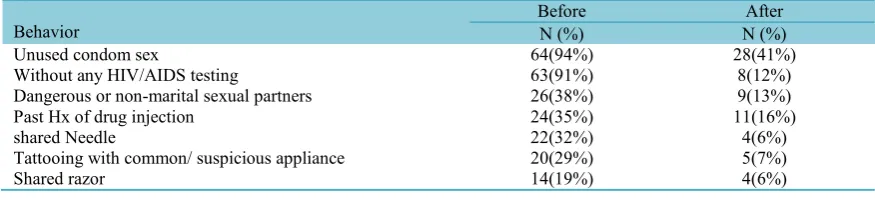
Before the educational program, past his-tory (Hx) of drug injection was found in 24 participants (35%), 20 were infected through tattooing with common/suspicious appliance (29%), and 26 (38%) were in-fected through dangerous or non-marital sexual contact with multiple partners; of this number, 94% had unprotected sexual activity and none of them was aware of HIV/AIDS contamination of their sexual
partners. Only 7(10%) of the participants claimed that they visited a physician be-cause of venereal diseases. The majority [63(91%)] of the participants asserted that they had never referred or Hx for HIV/AIDS lab testing. Other significant findings are demonstrated in Table 3.
Significant differences were observed be-tween the means scores of the perceived susceptibility, perceived severity, perceived benefits, barriers and self-efficacy and pre and post educational intervention (p<0/001)
(Table 4).
The multiple regression output revealed that all HBM constituents were significant predicting properties for preventive behav-iors. Also, this finding indicated that self-efficacy was the strongest predictor of pre-ventive behaviors (p< 0.00l), followed by perceived susceptibility (p< 0.01) and per-ceived barriers (p< 0.0l) (Table 5).
Discussion
In this research, we examined the applica-Table 1. Frequency distribution of knowledge before and after the educational intervention
Grade Before Intervention After
No (%) No (%)
Weak (0-4) 14 (21%) 7 (10%)
Intermediate (5-9) 26 (38%) 30 (44%)
Good (10-15) 28 (41%) 31 (46%)
Total 68 (100%) 68 (100%)
Mean and SD 8.6±4 9.9±3.4
(p<0.0001)
Table 2. Frequency distribution of practice before and after the educational intervention
Grade Before Intervention After
No (%) No (%)
Weak (0-2) 25 (37%) 12 (18%)
Intermediate (3-4) 29 (42%) 30 (44%)
Good (5-6) 14 (21%) 26 (38%)
Total 68 (100%) 68 (100%)
Mean and SD 2.9±2.3 1.2±3.3
(p<0.0001)
Table 3. Risky behaviors for HIV/AIDS
Behavior BeforeN (%) N (%)After
Unused condom sex 64(94%) 28(41%)
Without any HIV/AIDS testing 63(91%) 8(12%)
Dangerous or non-marital sexual partners 26(38%) 9(13%)
Past Hx of drug injection 24(35%) 11(16%)
shared Needle 22(32%) 4(6%)
Tattooing with common/ suspicious appliance 20(29%) 5(7%)
Shared razor 14(19%) 4(6%)
Table 4. Descriptive statistics of the Theory-based models' constructs before and after the educational intervention
Constructs Before InterventionAfter p*
Mean SD Mean SD
Perceived Susceptibility 4.43 0.32 7.15 0.41 0.0001
Perceived Severity 7.15 0.35 9.01 0.32 0.0001
Perceived Benefits 3.35 0.29 6.72 0.33 0.0001
Perceived Barriers 6.92 0.33 4.01 0.28 0.0001
Self-efficacy 4.25 0.85 7.10 0.45 0.0001
Cues to Action 2.10 0.27 3.61 0.24 0.0001
*Using paired t test
Table 5. Results of the multiple linear regression analysis of Perceived Susceptibility, Severity, Benefits, Barriers & Self-Efficacy
Parameter Standardized β 95% CI for β p
Perceived Susceptibility 0.32 0.15-0.57 <0.001
Perceived Severity 0.21 0.17-0.45 <0.001
Perceived Benefits 0.14 0.07-0.31 <0.001
Perceived Barriers 0.27 0.18-0.34 <0.001
Self-Efficacy 0.36 0.20-0.86 <0.001
bility of the theory-based education inter-vention on preventive behaviors of HIV/AIDS transmission in drug addicts in Saveh. Our findings revealed that an educa-tional intervention based on a theory due to progression of participants’ knowledge and positive effect on the perceived intensity, sensitivity, threat, perceived benefits and barriers and self-efficacy can lead to devel-opment, change or elimination of the behav-iors that impact the prevention of HIV/AIDS; these results were in agreement with those of Reback (17), Rahmati (23) and Altschuler (28); the results were also ap-proved by Bully (18) and Woodson (29). Our results signified that despite the fact that considerable portion of this study popu-lation had a good knowledge (42%), 37% had weak performance and it seems that to adopt preventive behaviors or actions, merely having knowledge is not enough, but the way of thinking as well as attitude toward a disease is a fundamental element in doing or undoing a preventive measure (30,31). In this regard, some researchers argued that regardless of the culture or race, individuals despite having a high level of knowledge about STDs/HIV, may tend to exhibit a propensity toward engaging in having unprotected sexual contact with multiple partners as risky sexual behaviors (32-34). In this study, 35% of the partici-pants had a history of drug injection, 38% had the experience of risky sexual behav-iors, but rarely used condom. Marshall (35) and Maher (36) revealed that lack or limita-tion of access to the single use injecting syringe may lead to reuse of the syringe and needle between peer groups, leading to spread of HIV/AIDS among the involved population.
Parallel to studies of Karimi (38), Be-atriceBean'E (39) and Ghafari (40), our re-search also revealed that health educational intervention had an impact on improving the knowledge of HIV/AIDS participants as well as preventive behaviors. However, ac-cording to the researchers' opinion, advis-ing about the transmission route and pre-ventive measures of HIV, and the
partici-pants’ acceptance aimed at changing the risky behaviors, may lead to decrease of HIV transmission (36,38).
Many of the participants in this study did not find themselves at risk of HIV/AIDS infection before the educational interven-tion, so the mean of perceived susceptibil-ity before the intervention was 4.43. This dilemma may reduce their attention and sensitivity to adopt cautious behaviors and may expose many participants to HIV/AIDS infection risk. On the other hand, the findings signified that the partici-pants had a low insight of their own vulner-ability to HIV infection. Similarly a study by Lewis (41) and Parsons (42) showed that most college students who were en-gaged in sexual relationships have a ten-dency to perceive themselves as invulnera-ble to contracting sexually transmitted dis-eases (STDs) and do not feel the need for behavioral changes. In another study, Blashill and Safren found that perceived susceptibility was associated with increased safer sex intentions including abstinence intention (43). In the USA, Gielen et al. (2007) found that young women with a high level of perceived susceptibility were more likely to decide not to have sex with someone (44).
Our findings also indicated that perceived severity mean was 7.15 before the interven-tion. This means the participants had a good knowledge about this risk, because of the current educational programs and the type of training in our society. They know that AIDS is a dangerous and incurable dis-ease. A study by Adefuye et al. (2009) showed that perceived severity is a particu-larly important determinant in reducing sexual partners and in encouraging careful selection of sexual partners (45). Maher's research in Bangkok revealed that 95% of the addicted people believed the same and 100% knew the possibility of a suffering death (36). Rahmati's investigation revealed that most of the students are sensitive to AIDS as a serious disease (23). Study of Iriyama in Nepal also showed that students with high scores in perceived severity of
HIV/AIDS had strong intentions to abstain from sexual activity (46). Also, Lollis et al. found a direct relation between the amount of perceived threat and using condom in American students (47). The study of Lin among the Taiwanese immigrants also showed a significant relation between the severity and perceived threat of AIDS and the reduction of risky behaviors (48).
The findings of our study revealed a sig-nificant difference between the means score of the perceived benefits and barriers, be-fore and after the educational intervention. Moreover, previous studies have shown a strong relation between the perceived bene-fits and adopting preventive behaviors and the individual's perception of the benefits which could facilitate carrying out preven-tive behaviors (33,49,50). For example, in a study by Iriyama et al. it was found that perceived benefits and barriers were signif-icant predictors of HIV testing (46). Crosby (33) and De Visser (34) also revealed a re-lation between the individual's attitudes to-ward the advantages of using condom and AIDS prevention. Volk (2001) investigated this subject in Kenya with an analytic atti-tude to the findings. The barriers of adopt-ing preventive behaviors can be summa-rized as: lack of access to single use syringe and condom when needed, fear of being morbid and punished by the family in the case of HIV diagnosis (51). According to Hounton's study in Benin's rural areas, among the main barriers of using condom were the lack of access and tendency when having risky behaviors (52). Eshrati et al. also showed that the prisoners' right percep-tion to perceived barriers and benefits may affect the reduction of high-risk behaviors relating to HIV/AIDS (53). Karimy also showed that self-efficacy, safe sexual con-sultation and perceived barriers are the main variables of using condom and safe sexual behaviors (5). Considering the above men-tioned findings, planning and implementing educational programs seem to be necessary to amend the beliefs of drug users.
In the present study, the findings of re-gression analysis suggested that
self-efficacy was the strongest predictor of pre-ventive behavior. Parallel to our study, Mutinta and Simuzoshya suggested that self-efficacy had the highest impact and association with the use of condom (54). Similarly, Lyon et al. established that the participants who had a low self-efficacy for sustaining a single-partner relationship had a tendency toward being involved in multi-ple-partner relationship (48); it justifies the relation between low self-efficacy and high risk behaviors. However, this study may help health educators who are committed to develop HIV education and preventive pro-grams aiming at considering negotiation and communication skills, to increase the self-efficacy role in refraining from risky behaviors.
Conclusion
With regards to the findings of our study, it can be concluded that HBM has a signifi-cant role in health behavior research; it highlights individuals’ understanding of perceived susceptibility, self-efficacy, ceived severity, perceived benefits, per-ceived barriers and signals to action leading to preventive behaviors. Similar interven-tions based on other theories and models of behavior change are suggested for eradicat-ing the barriers of the preventive behaviors.
Acknowledgments
This study was conducted under the su-pervision of the Research Deputy of SUMSc. We would like to acknowledge Dr. A. Arzani, for statistical editing, M.M. Saeidi, MSc at Tehran UAST-Branch 49 for linguistic revision, and Mrs. Zahra Roosta, staff of the Shahid Asadi Student Research Center, Saveh, for the local data gathering. The authors would like to ex-press their deep gratitude to the participat-ing addicts of NA-NGO of Saveh healthy City who cooperated with the faculty of SUMSc to complete the research success-fully.
References
1. Spina A, Eramova I, Lazarus JV. Policy responses to viral hepatitis B and C among people who inject drugs in Member States of the WHO European region: a sub-analysis of the WHO 2013 global hepatitis policy survey. BMC infectious diseases 2014;14(Suppl 6): S15.
2. (UNODC), T.U.N.O.O.D.a.C. Drug Prevention, Treatment and HIV/AIDS , Situation Analysis 2015 [cited 2015 1/14/2015]; Available from: http://www.unodc.org/islamicrepublicofiran/drug-prevention- treatment-and-hiv-aids.html.
3. Fallahi H, Tavafian SS, Yaghmaie F, Hajizadeh E. Stigma, discrimination, and the consequences of HIV-AIDS for people living with it in Iran. Life Science Journal-ACTA Zhengzhou University Overseas Edition 2011;8(4): 503-510.
4. (UNAIDS), T.J.U.N.P.O.H.a.A. HIV and AIDS estimates (2013). 2013 [cited 2015 1/14/2015]; Available from: http://www.unaids.org/en/ regionscountries/countries/islamicrepublicofiran.
5. Karimy M, Zareban I, Sarani M, Rakhshani F, Kuhpayehzadeh J, Baradaran H. Factors affecting adherence to the treatment regimen of tuberculosis patients: Assessing the efficiency of health belief model constructs. Journal of Kermanshah University of Medical Sciences 2014;18(4): 213-219.
6. Rakhimova DA, Talgatovna SZ, Abedi A. Influence of ozonotherapy on the functional status and medical aspects of quality of life in patients with bronchial asthma. International Research Journal of Medicine and Medical Sciences 2015; 3(1): 17-21.
7. Chu C, Breucker G, Harris N, Stitzel A, Gan X, Gu X, et al. Health-promoting workplaces— international settings development. Health Promotion International 2000;15(2): 155-167.
8. (EMRO), E.M.R.O.O.T.W.H.O. Types of Healthy Settings , Healthy Cities. 2015 [cited 2015 1/14/2015]; Available from: http://www.who.int/ healthy_settings/types/cities/en/.
9. Motevalian SA. A case study on intersectoral action for health in IR of Iran: community based initiatives experience. School of Public Health, Iran University of Medical Sciences. Tehran: Iran University of Medical Sciences, 2007.
10. Taher M, Safavi Bayat Z, Niromand zandi K, Ghasemi E, Abredari H, Karimy M, et al. Correlation between compliance regimens with health locus of control in patients with hypertension. Medical Journal Of The Islamic Republic Of Iran 2015;29(0): 194-0.
11. Sabri B. Thirty years of primary health care in the Eastern Mediterranean Region. Eastern Mediterranean Health Journal 2008;14: S12-S14.
12. Safa M, Mohtasebi S, Lar MB, Ghasemi-Varnamkhasti M. Energy consumption in production of grains prevalent in Saveh, Iran. African Journal of Agricultural Research 2010;
5(19): 2637-2646.
13. Koohestani H, Baghcheghi N, Rezaei K, Abedi A, Seraji A, Zand S. Occupational violence in nursing students in arak, iran. Iranian journal of epidemiology, 2011.
14. Noar SM, Zimmerman RS. Health Behavior Theory and cumulative knowledge regarding health behaviors: are we moving in the right direction? Health education research 2005; 20(3): 275-290.
15. Beach MC, Price EG, Gary TL, Robinson KA, Gozu A, Palacio A, et al. Cultural competency: A systematic review of health care provider educational interventions. Medical care 2005; 43(4): 356.
16. Choi KH, Yep GA, Kumekawa E. HIV prevention among Asian and Pacific Islander American men who have sex with men: A critical review of theoretical models and directions for future research. AIDS Education and Prevention, 1998.
17. Reback CJ, Fletcher JB, Shoptaw S, Mansergh G. Exposure to Theory-Driven Text Messages is Associated with HIV Risk Reduction Among Methamphetamine-Using Men Who have Sex with Men. AIDS and Behavior 2015; p. 1-12.
18. Bully P, Sánchez Á, Zabaleta-del-Olmo E, Pombo H, Grandes G. Evidence from interventions based on theoretical models for lifestyle modification (physical activity, diet, alcohol and tobacco use) in primary care settings: A systematic review. Preventive Medicine, 2015.
19. Rahimi-Movaghar A, Amin-Esmaeili M, Haghdoost AA, Sadeghirad B, Mohraz M. HIV prevalence amongst injecting drug users in Iran: a systematic review of studies conducted during the decade 1998–2007. International Journal of Drug Policy 2012; 23(4): 271-278.
20. Mahmoud K, Ghofranipour F, Heydarnia AR. The effect of health education based on health belief model on preventive actions of AIDS on addict in Zarandieh. Journal of Guilan University of Medical Sciences 2009; 18(70): 64-73.
21. Sharafkhani N, Khorsandi M, Shamsi M, Ranjbaran M. Low Back Pain Preventive Behaviors Among Nurses Based on the Health Belief Model Constructs. SAGE Open 2014; 4(4):
22. Diclemente RJ, Boyer CB, Morales ES. Minorities and AIDS: knowledge, attitudes, and misconceptions among black and Latino adolescents. American Journal of Public Health 1988; 78(1): 55-57.
23. Rahmati NKF, Niknami S, Aminshokravi F, Ahmadi F, Gafari M, Rahnama P. The implication of health belief model in planning educational programms for preventing HIV/AIDS among university students. Payesh, 2009.
24. Karimy M, Niknami S, Heidarnia A, Hajizadeh E. Psychometric properties of a theory of planned behavior questionnaire for tobacco use in male adolescents. Journal of Sabzevar University of
Medical Sciences 2012; 19(2): 190-7.
25. Karimy M, Niknami S, Reza A, Hidarnia EH, Shamsi M. Evaluation of intrapersonal and interpersonal factors of male adolescent smoking. J Research Health 2013; 3(3): 445-51.
26. Abedi A, Koohestani H, Roosta Z. The short-term effect of chest physiotherapy on spirometric indices in chemical warfare victims exposed to mustard gas. Armaghane danesh 2008;13(51-52): 81-91.
27. Devon HA, Block ME, Moyle‐Wright P, Ernst DM, Hayden SJ, Lazzara DJ, et al. A psychometric toolbox for testing validity and reliability. Journal of Nursing scholarship 2007;39(2): 155-164.
28. Altschuler J, Katz A. “Of course it’s relevant!”: A focus group study of older adults' perceived importance of HIV/AIDS prevention education. Qualitative Social Work 2015.
29. Woodson KD. A systematic review of preventive interventions for HIV/AIDS in high-risk adults. in 142nd APHA Annual Meeting and Exposition (November 15-November 19, 2014). 2014. APHA.
30. Mulu W, Abera B, Yimer M. Knowledge, attitude and practices on HIV/AIDS among students of Bahir Dar University. Science 2014; 2(2): 78-86.
31. Michael P, Pham HN, Nguyen HV. Knowledge of HIV and factors associated with attitudes towards HIV among final-year medical students at Hanoi medical university in Vietnam. BMC public health 2014;14(1): 265.
32. Nyembezi A, Resnicow K, Ruiter RA, van den Borne B, Sifunda S, Funani I, et al. The association between ethnic identity and condom use among young men in the Eastern Cape Province, South Africa. Archives of sexual behavior 2014;43(6): 1097-1103.
33. Crosby RA, Milhausen RR, Graham CA, Yarber WL, Sanders SA, Charnigo R, et al. Likelihood of Condom Use When Sexually Transmitted Diseases Are Suspected Results From a Clinic Sample. Health Education & Behavior 2014.
34. De Visser R. One size fits all? Promoting condom use for sexually transmitted infection prevention among heterosexual young adults. Health education research 2005; 20(5): 557-566.
35. Marshall BD, Friedman SR, Monteiro JF, Paczkowski M, Tempalski B, Pouget ER, et al. Prevention And Treatment Produced Large Decreases In HIV Incidence In A Model Of People Who Inject Drugs. Health Affairs 2014; 33(3): 401-409.
36. Maher D, Floyd K, Raviglione MC, Initiative ST, Organization WH, Organization WH. Strategic framework to decrease the burden of TB/HIV. 2002: Stop TB Department and Department of HIV/AIDS, World Health Organization Geneva.
37. Baghcheghi N, Koohestani H, Abedi A. Prevalence needlestick/sharps injuries among
nursing student and related factor. Iran Occupational Health Journal 2011;7(4): 6-10.
38. Karimi Mahmoud NS, Heydarnia A, Ramezankhani A. The effect of health education program on the AIDS preventive behaviors of prisoners aged under 25 years old (ghezalhesar prison-tehran). Journal of Research In Medical Sciences (JRMS), 2003.
39. Beatricebean'e R, Bockting WO, Rosser BS, Miner M, Coleman E. The sexual health model: application of a sexological approach to HIV prevention. Health Education Research 2002; 17(1): 43-57.
40. Ghafari M. Comparing the efficacy of health belief model and its integrated model in AIDS education among male high school students in Tehran, in A thesis for degree of PhD, Tehran: Tarbiat Modares University. 2007.
41. Lewis JE, Malow RM, Ireland SJ. HIV/AIDS risk in heterosexual college students: A review of a decade of literature. Journal of American College Health 1997; 45(4): 147-158.
42. Parsons JT, Halkitis PN, Bimbi D, Borkowski T. Perceptions of the benefits and costs associated with condom use and unprotected sex among late adolescent college students. Journal of adolescence 2000; 23(4): 377-391.
43. Blashill AJ, Safren SA. Body dissatisfaction and condom use self-efficacy: A meta-analysis. Body image 2015;12: 73-77.
44. Gielen AC, Ghandour RM, Burke JG, Mahoney P, McDonnell KA, O'Campo P. HIV/AIDS and intimate partner violence intersecting women's health issues in the united states. Trauma, Violence, & Abuse 2007; 8(2): 178-198.
45. Adefuye AS, Abiona TC, Balogun JA, Lukobo-Durrell M. HIV sexual risk behaviors and perception of risk among college students: implications for planning interventions. BMC Public Health 2009; 9(1): 281.
46. Iriyama S, Nakahara S, Jimba M, Ichikawa M, Wakai S. AIDS health beliefs and intention for sexual abstinence among male adolescent students in Kathmandu, Nepal: a test of perceived severity and susceptibility. Public Health 2007; 121(1): 64-72.
47. Lollis CM, Johnson EH, Antoni MH. The efficacy of the health belief model for predicting condom usage and risky sexual practices in university students. AIDS Education and Prevention, 1997.
48. Lin P, Simoni JM, Zemon V. The health belief model, sexual behaviors, and HIV risk among Taiwanese immigrants. AIDS Education & Prevention 2005; 17(5): 469-483.
49. Cai Y, Shi R, Shen T, Pei B, Jiang X, Ye X, et al. A study of HIV/AIDS related knowledge, attitude and behaviors among female sex workers in Shanghai China. BMC Public Health 2010; 10(1):
377.
50. Gaba D. The HIV Response in regard to People who Inject Drugs: Intricacies and Challenges. Revista de Asistenţă Socială 2014;(1): 143-158.
51. Volk JE, Koopman C. Factors associated with condom use in Kenya: a test of the health belief model. AIDS education and prevention 2001; 13(6): 495-508.
52. Hounton SH, Carabin H, Henderson NJ. Towards an understanding of barriers to condom use in rural Benin using the Health Belief Model: A
cross sectional survey. BMC Public Health 2005; 5(1): 8.
53. Eshrati B, Asl RT, Dell CA, Afshar P, Millson P, Kamali M, et al. Preventing HIV transmission among Iranian prisoners: initial support for providing education on the benefits of harm reduction practices. Harm Reduct J 2008;5(21):1-7.
54. Mutinta R, Simuzoshya M. Variables associated with condom use among college freshmen within the health belief model framework. , PhD thesis in Public Health. Virginia: Faculty of Public Health, Walden University 2009.