Usability Studies in Virtual and Traditional Computer Aided
Design Environments for Benchmark 2 (Find and Repair
Manipulation)
Dr. Syed Adeel Ahmed, Drexel Dr.
Xavier University of Louisiana, New Orleans, LA 70125. Assistant Professor of Management at Xavier University of Louisiana
Abstract - A usability study was used to measure user performance and user preferences for a CAVETM immersive stereoscopic virtual environment with wand interfaces compared directly with a workstation non-stereoscopic traditional CAD interface with keyboard and mouse. In both the CAVETM and the adaptable technology environments, crystal eye glasses are used to produce a stereoscopic view. An ascension flock of birds tracking system is used for tracking the user’s head and wand pointing device positions in 3D space. It is argued that with these immersive technologies, including the use of gestures and hand movements, a more natural interface in immersive virtual environments is possible. Such an interface allows a more rapid and efficient set of actions to recognize geometry, interaction within a spatial environment, the ability to find errors, and navigate through a virtual environment. The wand interface provides a significantly improved means of interaction. This study quantitatively measures the differences in interaction when compared with traditional human computer interfaces.
This paper provides analysis via usability study methods for Find and Repair Manipulation termed as Benchmark 2. During testing, testers are given some time to “play around” with the CAVETM environment for familiarity before undertaking a specific exercise. The testers are then instructed regarding tasks to be completed, and are asked to work quickly without sacrificing accuracy. The research team timed each task, and recorded activity on evaluation sheets for Find and Repair Manipulation Test. At the completion of the testing scenario involving navigation, the subject/testers were given a survey document and asked to respond by checking boxes to communicate their subjective opinions.
Keywords-Usability Analysis, CAVETM (Cave Automatic Virtual Environments), Human Computer Interface (HCI), Benchmark, Virtual Reality, Virtual Environments, Competitive Comparison,
I. Introduction
This paper is an extension of the work done by Satter (2005) on Competitive Usability Studies of Virtual Environments for Shipbuilding. The key difference is the use of a new immersive environment called CAVETM. The significance and the detail description of this study is very well explained by Satter (2012) in his recent paper. Here we only present the details of this usability study. The CAVETM was developed at the University of Illinois at Chicago and provides the illusion of immersion by projecting stereo images on the walls and floor of a room-sized cube. Several users wearing lightweight stereo glasses can enter and walk freely inside the CAVETM. A head tracking system continuously adjusts the stereo projection to the current position of the leading viewer. A CAVETM and wand system schematic is shown in Figure 1&2.
Figure 1: Schematic of the CAVETM System Figure 2: The Wand Interface
Environments and Usability Study
required item/part, and return to the starting point. Each of the thirty users performed this Benchmark three times in each of the two environments. The analysis of the final pass results of these Benchmark 2 tests by the users is presented in the following sections. Pass 3 results represent each user’s final exposure to each environment within each scenario. Therefore, pass 3 results tend to show the user’s best ability to perform the required tasks. Each environment/interface (Non-stereoscopic workstation and Stereoscopic CAVETM) is represented in a distinct chart.
II. Description
Using the same virtual factory space as used for Benchmark 1[5] , in Benchmark 2 users were required to navigate through the space looking for “errors’ that had been injected into the design. Typical “errors” were a screen, turbine or fan, eyewash or conveyor belt, or cyclone separator all placed at a different place from their original place. Users were then required to “fix” the error. The “fix” required the user to utilize the interface (environment) under test (CAVETM, workstation), typically, re-positioning the part to a more suitable location/orientation. Elapsed times were noted for each activity. The elapsed time recorded was the time required to locate and identify the 1st error; the time to “fix” the 1st error; the time to locate and identify the 2nd error; the time to “fix” the 2nd
error; and the time to return to the starting position within the space.
The find/repair exercise (Benchmark 2) was repeated three times (three passes) for each of the thirty users in each of the two environments under test and the User Survey was administered to each user after each pass in each environment. As with the Benchmark 1 testing, sequencing of the testers through the two environments was randomized so that not all of the users were testing the same interface at the same time.
Benchmark 2 – pass 3 Elapsed timing analysis:
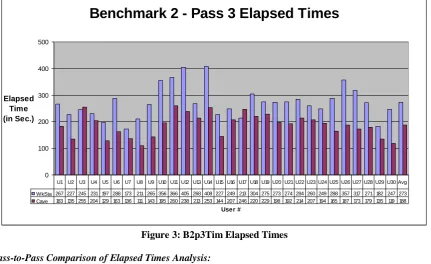
Figure 1 (Benchmark 2 Pass 3 Elapsed Timings / B2p3Tim) presents a representation of the elapsed times required by users to perform a typical set of find/repair operations as defined in the Benchmark 2 scenarios. The results presented are for the last (3rd) execution of the test. All other results are presented in Appendix B. These times should, and do, represent the “best/fastest” execution times for the group. It should be noted that
stereoscopic interface resulted in shorter execution times (as compared to the non-stereoscopic interface). This proves that CAVETM is faster, efficient and better environment workstation.
Figure 3: B2p3Tim Elapsed Times
Pass-to-Pass Comparison of Elapsed Times Analysis:
Benchmark 2 - Pass 3 Elapsed Times
0 100 200 300 400 500
User # Elapsed
Time (in Sec.)
WkSta 267 227 245 231 197 288 173 211 265 356 366 405 268 408 227 249 213 304 275 273 274 284 260 249 288 357 317 271 182 247 273 Cave 183 135 255 204 129 163 136 111 143 195 260 238 213 253 144 207 246 220 229 198 192 214 207 194 165 187 173 179 135 119 188 U1 U2 U3 U4 U5 U6 U7 U8 U9 U10 U11 U12 U13 U14 U15 U16 U17 U18 U19 U20 U21 U22 U23 U24 U25 U26 U27 U28 U29 U30 Avg
B2 Pass to Pass Comparison
Table 1 presents the improvement in find/repair (manipulation) times for users with each successive exposure to each of the two test environments. Note that there appears to beabout a42% improvement in CAVETM from pass 1 to pass 3 against 36% improvement in workstation from pass 1 to pass 3. This means that the stereoscopic interface appeared to produce reduced find/repair elapsed times over the non-stereoscopic interface.
III. Detailed Statistical Analysis
As described for the Benchmark 1 testing, all statistical analyses of the test data were performed using NCSS. The K.S. normality testing was performed on the Benchmark 2 results. Levene’s test was used to test for equal variance of the data. The null hypothesis (H0) and alternative hypothesis (Ha) as discussed in last paper Benchmark 1 [5] statistical analysis testing applies here (Benchmark 2) as well.
IV. Pass 3 Statistical Analysis
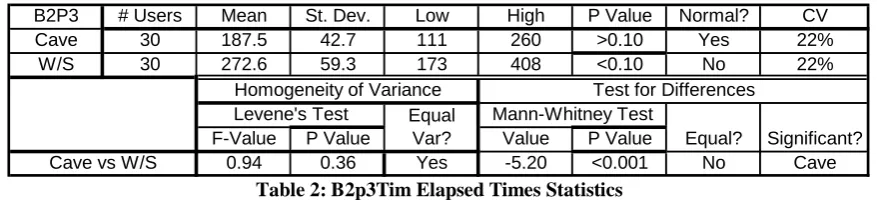
Table 2 presents the descriptive statistics test results normality testing and variance test results of each Benchmark 2 pass 3 dataset by environment. All other results are presented in Appendix B. In this analysis, it is important to note the results of the Kolmogorov-Smirnov test (KS test statistic) for normal (Gaussian) distribution. In this case, note that the pass 3 B2 datasets for the non-stereoscopic environment fail the KS statistic test for normal distribution of the data. Thus the NCSS software performs a nonparametric, Levene’s
test to test for equal variance.
Table 2: B2p3Tim Elapsed Times Statistics
For table 2, the K.S. test is used to test for normality of data. Since the P value is less than 0.1 for workstation, the data are not normal. Levene’s test is used to test for equal variance. With that stipulation, since the P value is greater than 0.1, the data have equal variance. Thus, since the data is not normal, Mann Whitney test is used. However, with a Mann Whitney test P value less than 0.1, which indicates that the medians are unequal for the CAVETM – Workstation comparison. Examination of these results shows that for the two environments, the differences are statistically significant. The conclusion then is that at the 90% confidence level, there is significant evidence to support the alternative hypothesis (Ha). Thus, since the stereoscopic wand environment demonstrates shorter elapsed find/repair times, this environment is statistically “better” than non-stereoscopic workstation environment for Benchmark 2 during pass 3.
V. User Subjective Overall Environment Ratings
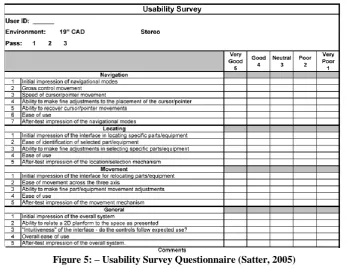
After completion of each pass of each Benchmark test in each environment, users provided their subjective views of their experience by completing the 22-question Usability Survey (see Appendix 4) rating the environment on a scale of 1 to 5 (very poor to very good). The questions were grouped into 4 areas (navigation, locating, movement, and general). Following is a presentation of user overall impressions ratings of the interfaces for performing Benchmark 2 tasks (find/repair) at the completion of the 3rd pass as a representation of user final evaluations of each interface. All other results are presented in figure 5.
VI. Benchmark 2 – pass 3 Overall Impressions ratings analysis:
As discussed above, each user was asked to rate his/her experience via the Usability Survey at the completion of each pass of each Benchmark test. Figure 2 (Benchmark 2 pass 3 Overall Impressions ratings /B2p3Ovr) presents the overall impressions ratings of the users at the completion of the 3rd pass of the Benchmark 2 scenario. As such, this represents each user’s final impression of the find/repair capabilities of each environment. For Benchmark 2 pass 3 overall impressions ratings, figure 2 shows that user’s preferred CAVETM over workstation.
B2P3 # Users Mean St. Dev. Low High P Value Normal? CV
Cave 30 187.5 42.7 111 260 >0.10 Yes 22%
W/S 30 272.6 59.3 173 408 <0.10 No 22%
F-Value P Value Value P Value
0.94 0.36 Yes -5.20 <0.001 No Cave
Cave vs W/S
Homogeneity of Variance Test for Differences Levene's Test Equal
Var?
Mann-Whitney Test
Figure 2: B2p3Ovr Overall Impressions Ratings
Table3: B2p3Ovr Overall Impressions Ratings
For Table 3, the K.S. test is used to test for normality of data. Since the P value is less than 0.1 for the CAVETM, the data are not normal and Levene’s test is used to test for equal variance. Since the P value is less than 0.1 the data have unequal variance. Furthermore, since the data are not normal, theMann Whitney test is used. With aMann Whitney test, P value greater than 0.1, which indicates that the mediansare equal for the CAVETM and workstation. Examination of these results shows that for the two environments, the differences are not statistically significant. The conclusion then is that at the 90% confidence level, there is significant evidence to support the null hypothesis (H0). This proves that neither of the two environments is statistically better than each other for Benchmark 2 pass 3 overall impressions subjective ratings.
B2-Pass to Pass Comparison Overall Impressions Ratings Analysis:
Table 4 shows the pass-to-pass improvements in user overall impression ratings for each of the environments. Note that with each successive exposure (pass-to-pass) the user’s overall impressions of the interfaces improved. Examination of the pass-to-pass analysis of improvements noted in Table 4 shows that for Benchmark 2, overall impressions subjective ratings, the ratings improved for both CAVETM and Workstation from pass-to-pass. Comparing CAVETM and Workstation, the ratings appear to have improved more for CAVETM with a higher percentage from pass-to-pass than Workstation. Hence, the CAVETM environment is barely preferred over Workstation for B2 Overall impressions subjective ratings.
Benchmark 2 - Pass 3 - Overall impressions Ratings
0 1 2 3 4 5
User # Rating
WkSta 4.05 4.50 4.20 4.05 4.00 4.25 4.45 4.25 4.35 4.35 4.45 4.15 3.95 4.15 4.15 4.10 4.25 4.15 4.30 4.50 4.25 4.25 4.40 4.10 4.30 4.20 4.35 4.45 4.60 4.75 4.28 Cave 4.00 4.00 4.00 4.00 4.00 4.00 4.00 4.00 4.00 4.95 4.85 4.85 4.85 4.95 4.95 4.85 4.85 4.95 4.95 4.95 4.90 4.90 4.80 4.85 4.00 4.00 4.00 4.00 4.05 4.00 4.45 U1 U2 U3 U4 U5 U6 U7 U8 U9 U10 U11 U12 U13 U14 U15 U16 U17 U18 U19 U20 U21 U22 U23 U24 U25 U26 U27 U28 U29 U30 Avg
B2OP3 # Users Mean St. Dev. Low High P Value Normal? CV
Cave 30 4.45 0.45 4 4.95 <0.10 No 10.00%
W/S 30 4.28 0.18 3.95 4.75 >0.10 Yes 4.00%
F-Value P Value Value P Value
176.5 <0.001 No -0.36 0.36 Yes N/A
Homogeneity of Variance Test for Differences Levene's Test Equal
Var?
Mann-WhitneyTest
Equal? Significant? Cave vs W/S
B2 Overall Ratings Pass to Pass Comparison
Diff % Diff % Diff %
for Workstation (pass 1 to pass 3) is calculated as (3.37-4.28)/3.37, where 3.37 and 4.28 represent the means of Benchmark 2 overall impressions ratings for pass 1 and pass 3 respectively.
Figure 5: – Usability Survey Questionnaire (Satter, 2005)
VII. Conclusions
For Benchmark 2 (Find/Repair) the statistics shows better results (lower timings and higher subjective ratings) for the CAVETM in both objective and subjective measures than the workstation, except for Benchmark 2 pass 3 Location ratings, General, and Overall ratings in which the subjective ratings do not suggest which of the two environments are better. My future work will focus competitive usability on Benchmarks 3 for spatial awareness under these same environments.
References
[1.] Number Cruncher Statistical System (NCSS software, 2004)
[2.] K. M. Satter, "Competitive Usability Studies of Virtual Environments for Shipbuilding." PhD Dissertation, Engineering Management, University of New Orleans, 2005.
[3.] Syed Adeel Ahmed, “Usability Studies with Virtual and Traditional Computer Aided Design Environments." PhD Dissertation, Engineering Management, University of New Orleans, 2006.
[4.] Kurt Satter and Alley Butler, ”Finding the Value of Immersive, Virtual Environments Using Competitive Usability Analysis”, Transactions of the ASME, Journal of Computing and Information Science in Engineering, June 2012, Vol, 12.