Web Ecology 6: 17–26.
Plant species characteristic of infertile environments reveal consistent correlations among traits such as low growth rate, high root-to-shoot ratio, high concentrations of sec-ondary metabolites, and low nutrient absorption rate which are a response to low availability of resources (Chapin 1980, Aerts and Chapin 2000). This
combina-tion of attributes represents a strategy to cope with high levels of stress and enables plants to successfully colonize infertile environments (Grime 1977, Westoby et al. 1992). The set of trait attributes is sufficiently consistent among different low-resource environments that it constitutes what could be termed a stress resistance syndrome (SRS,
Evolutionary changes in correlations among functional traits in
Ceanothus
in response to Mediterranean conditions
Francisco I. Pugnaire, F. Stuart Chapin III and Terry M. Hardig
Pugnaire, F. I., Chapin III, F. S. and Hardig, T. M. 2006. Evolutionary changes in correlations among functional traits in Ceanothus in response to Mediterranean condi-tions. – Web Ecol. 6: 17–26.
Ceanothus is a widely speciated genus with two sections that differ markedly in size, patterns of biomass allocation and reproductive strategies. On greenhouse-grown seed-lings we tested whether divergence occurred in single traits or in suites of traits, and whether taxonomic affinity or the ability to fix nitrogen (N) influenced the relation-ships among functional traits. Species of the subgenus Cerastes differed from species in the subgenus Ceanothus in the following characteristics: reproduction by seed rather than primarily resprouting, high rates of photosynthesis and high stomatal conduct-ance, thick leaves, low root allocation, and high leaf allocation. Correlations of traits across the entire genus showed positive correlations among traits that maximize photo-synthesis and tradeoffs between root allocation and carbon gain patterns frequently observed in other broad taxonomic comparisons. Trait correlations differed between the two subgenera (divergence in allocation-photosynthesis tradeoffs in Ceanothus and di-vergence of growth-related traits in Cerastes). Similarly, N-fixers, which were distributed broadly between the two subgenera, differed in trait correlations (primarily among traits related to photosynthesis) from non-fixers (primarily among traits related to growth and allocation). These results indicate that 1) divergence in genus Ceanothus was associated with changes in entire suite of traits, rather than independent changes in individual traits and 2) evolution occurring under different environmental or nutritional circum-stances alters the suites of traits exhibited by plants.
F. I. Pugnaire ([email protected]), Estación Experimental de Zonas Áridas, CSIC, Almería, Spain. – F. S. Chapin III, Inst. of Arctic Biology, Univ. of Alaska, Fairbanks, AK 99775,
USA. – T. M. Hardig,Dept of Biology, Univ. of Montevallo, Montevallo, AL 35115-6000,
Chapin et al. 1993). Environmental pressures have psumably selected for this specific profile of attributes in re-sponse to stressful environments.
The presence of a similar suite of trait attributes in dif-ferent species irrespective of evolutionary lineage supports the idea that the SRS evolved in a synchronous manner rather than by parallel selection for each individual trait. Evolutionary changes leading to stress tolerance in plants might occur through only a few mutations in genes with large pleiotropic effects rather than by accumulation of many small mutational events (Chapin et al. 1993).
However, this hypothesis has not been rigorously tested by statistical analysis of the relationships among traits in plant groups whose evolutionary relationships are known. Different species might have traits in common either because they are linked by a network of shared ancestry or because the traits are adaptations to common environ-ments (Lechowicz 1984, Herrera 1992). Therefore, when analyzing species traits to look for selective pressures or ec-ological trends, it is important to determine the phyloge-netic relationships among species and the extent to which changes in one set of characters is associated with evolu-tionary changes in another set (Huey and Bennet 1987).
Although there are consistent broad trends in suites of traits, the broad diversity of plant types indicates some flexibility in these associations among traits. What types of changes in trait associations occur through evolution, and how are these influenced by phylogenetic constraints, physical environment, and physiological specializations such as nitrogen (N) fixation? In this paper we report an experiment with ten species of the genus Ceanothus, whose phylogeny is relatively well documented (Hardig 1997, Hardig et al. 2000), in which we compared two subgenera, one of which evolved more recently perhaps in response to drier and seasonally cooler environments. We compared cor-relations among functional traits between these subgenera and between species whose nutritional status was greatly al-tered by the presence or absence of N fixation capability.
Ceanothus is a highly diversified genus that is
wide-spread in California. It has two well differentiated sections, the subgenera Ceanothus and Cerastes, both of which have species present in a wide range of environments, from coastal scrub to dry chaparral habitats to sub alpine eleva-tions in Sierra Nevada. Species differ widely in size, alloca-tion patterns and reproductive strategies, which are condi-tioned by disturbance regime. Adult individuals of Cerastes species are killed by fire, but produce a number of large seeds whose germination is triggered by fire. In contrast, most species in the subgenus Ceanothus resprout from the root crown when the aerial part is removed by fire or graz-ing and produce fewer, smaller seeds. Most species of the genus Ceanothus now present in California appeared after an Eocene climatic change (Mason 1942), when a drier, more seasonal climate favored the recurrence of fires. Phy-logenetic analyses using chloroplast DNA suggest that the two subgenera diverged 18–39 million years ago, whereas
species within each subgenus diverged more recently (Jeong et al. 1997). Subgenus Ceanothus species share a large number of traits with other Rhamnaceae species, particularly regarding leaf traits and rooting depth, and can be considered ancestral, while Cerastes species with smaller, thicker leaves and shallow root systems differ from other Rhamnaceae, are considered to have evolved later and are better suited to thrive under a Mediterranean climate (Ackerly 2004b).
We tested whether the two sections of the genus
Cean-othus diverged in functional traits; whether suites of traits
diverged as a group or individually; and finally, whether the ability to fix N affected the assemblage of traits. We expected that in response to new, drier conditions evolu-tion would enhance traits related to stress tolerance, such as small leaves, while the higher frequency of fires in med-iterranean-type climate would affect recruitment traits, enhancing the seeder habit.
Study species
Ten species of the genus Ceanothus were selected, includ-ing five species belonginclud-ing to the subgenus Ceanothus (C.
arboreus, C. integerrimus, C. sorediatus, C. spinosus and C. thyrsiflorus) and five to subgenus Cerastes (C. cuneatus, C. crassifolius, C. gloriosus, C. megacarpus and C. verrucosus).
They included six known N fixers (Becking 1977) and four non-fixers. Nine species were evergreen and one de-ciduous (C. integerrimus). Most species are well repre-sented in coastal ranges and canyon slopes, as well as in inland chaparral (MacMinn 1942, Munz and Keck 1978).
Ceanothus integerrimus, the deciduous species, is more
re-stricted to the mountain slopes, where it is often found in the understory of conifers, but it also occurs in chaparral (Conard et al 1985). Other species, such as C. thyrsiflorus are also found in the understory of conifers. The selected species differ in size, ranging from the prostrate C. gloriosus (0.3 m height) to C. arboreus (4–8 m) and in their response to fire. All Cerastes species are obligate seeders, while most species in subgenus Ceanothus resprout from the root crown following fire (MacMinn 1942). Among the species we studied, C. sorediatus, in this subgenus, does not resprout after fire in the central and southern coast ranges but has been reported to stump-sprout in the northern coast ranges (D. Schwilk pers. comm.). Species were considered as N fixers or non-fixers following Bond and Wheeler (1980).
Methods
dishes. Germination occurred between 14 and 21 d. Seed-lings of C. cuneatus and C. integerrimus were taken from the field, as seeds were unavailable. In both cases, young seedlings with cotyledons attached (6–7 cm tall) were col-lected from silty road slopes 30 to 40 km east of Sacramento, California and cleaned of soil particles. Seed-lings of all species were planted in 30 cm plastic conetainers in a vermiculite-perlite (1:1) medium and re-ceived half-strength Hoagland’s solution with a mixture of NO3 and NH4 as source of N (Hewitt 1966) once a week
and deionized water every two days. Seedlings were grown in a greenhouse in Berkeley, California at 26±3°C and natural irradiance and daylength. Two weeks after plant-ing, plants were inoculated with ground radical nodules of
C. cuneatus taken in the field and diluted in water. At the
time of planting in mid May, root and shoot dry weights of 5–10 seedlings of each species were recorded. One month later, another group of 5–10 plants per species was ran-domly chosen for harvest, and a final harvest was made after 26 weeks. Harvested plants were oven-dried at 65°C for at least 48 h before the dry mass of roots, stems, and leaves was recorded; before drying, total leaf area was meas-ured with a LI-COR 3000 area meter. One week before the final harvest, photosynthetic rate (A) was measured in attached leaves of 3–6 individuals using a LI-COR 6200 portable photosynthesis system with a 0.25 L chamber at ~380 ppm CO2, and 27°C. Ambient light was
supple-mented with 1000 W metal-halide lamps and photon flux density averaged 1275 µmol m–2 s–1. Ground leaf samples
were analyzed for N, C and 13C using a Europa Scientific
Roboprep-CN elemental analyzer and mass spectrometer.
δ13C was calculated following Ehleringer and Osmond
(1989). Maximum relative growth rate (RGRmax) was
cal-culated by linear regression of the natural log of plant mass at each harvest against time over a standard weight change (0.1–0.2 g) because RGR depends on size (Cook and Evans 1983), and its variance was estimated using Tukey’s jackknife procedure (Sokal and Rolhf 1981). Net assimila-tion rate (NAR) was calculated from RGRmax and leaf mass
ratio (Hunt 1982). Nitrogen use efficiency (NUE) was cal-culated as the amount of dry matter produced per unit of N, combining root and shoot mass and tissue N concen-tration. Specific leaf area (SLA) was calculated from total leaf area and mass, and N and C pool sizes in leaves (g m–2)
were calculated per unit leaf area. Photosynthetic N use efficiency (PNUE) was obtained by dividing photosyn-thetic rate by the N pool in the leaf. For comparative pur-poses only, water use efficiency (WUE) was obtained di-viding photosynthetic rate by within-chamber transpira-tion rate.
Statistical analysis
Differences between the two subgenera of Ceanothus were determined by ANOVA, using the GLM procedure and
Tukey’s multiple comparison test of SYSTAT 5.2.1. The mean value of each variable for each species was used in statistical analysis, after log transformation when needed to meet normality criteria. Principal component analysis (PCA) based on correlation matrices was first performed including mean values for all ten species, and axes were rotated using the EQUAMAX procedure of SYSTAT; PCA was later performed with Cerastes and subgenus
Ceanothus species separately.
Results
Subgenera differentiation
The major functional differences between the two sections of Ceanothus were related to photosynthesis (SLA, A, and gl) and allocation (R:S, leaf:stem) (Table 1). The high SLA (high area per unit mass) of subgenus Ceanothus species resulted in a low area-based photosynthetic rate (A) and therefore low leaf conductance to water vapor (gl)
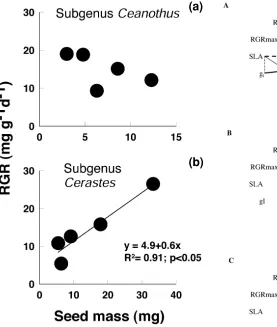
pared to Cerastes. These correlations among traits are com-monly seen in other species comparisons (Lambers and Poorter 1992, Reich et al. 1992, Poorter and Evans 1998, Niinemets 1999). Seeds of Cerastes species (all seeders) tended to be larger than those of crown-resprouting subgenus Ceanothus species. Seed mass correlated with adult plant height, so that species reported as trees (>4 m tall) had larger seeds than shrubs (14.4 vs 8.3 mg). At har-vest, Cerastes and subgenus Ceanothus species had similar plant mass (Table 1) because, as plants grow older, inter-specific differences in RGR override and compensate for differences in seed mass (Fig. 1; Westoby et al. 1992). Therefore, the correlation was stronger between seed mass and 12-d-old seedlings (p < 0.00012) than between seed mass and final plant size (p = 0.0007). Maximum relative growth rate (RGRmax) did not differ between the two
sec-tions of Ceanothus. RGRmax increased with increasing seed mass in Cerastes (the postfire seeders) but showed no rela-tionship to seed mass in subgenus Ceanothus (Fig. 1). A high allocation to roots and low allocation to leaves in subgenus Ceanothus species contributed to the low NAR (whole plant carbon gain per leaf area) in this section.
T
able 1. S
eed and seedling mass, r
oot-to-shoot ratio (R:S), leaf-to-stem ratio, maximum r
elativ
e gr
owth rate (R
GR), net assimilation rate (NAR), specific leaf ar
ea (SL
A), photosynthetic
rate (A), leaf conductance to water v
apor (g
l
), water use efficiency (
WUE), leaf nitr
ogen (N), photosynthetic N use efficiency (PNUE) and N use efficiency (N) of ten species belonging to
the Ceanothus and Ce rastes subgenera of C eanothus . E
cological groups ar
e indicated as spr
outers (S
p), seeders (S
e), N fix
ers (NF) and non fix
ers (nNF). S
ignificant differ
ences betw
een
subgenera means giv
en b
y * p< 0.05 and ** p< 0.01; ns not significant.
C. arbor eus C. integerrimus C. sor ediatus C. spinosus C. thyrsiflorus Av erage subgenus Ceanothus Ecological group Sp , nNF Sp , NF Sp/S e, NF Sp , nNF Sp , NF Sample siz e (N) 3 9 4 4 14
Seed mass (mg)
12.3 4.8 6.3 8.6 3.0 7.0 ± 1.6
Final plant mass (g)
0.97 ± 0.20 1.2 ± 0.1 0.7 ± 0.2 1.1 ± 0.1 1.3 ± 0.1 1.1 ± 0.1 R:S 1.4 ± 0.1 1.6 ± 0.2 1.3 ± 0.6 0.7 ± 0.2 1.1.1 ± 0.2 1.2 ± 0.2 Leaf:stem 3.2 ± 0.2 1.4 ± 1.1 1.1 ± 0.1 3.1 ± 0.2 2.3 ± 0.2 2.2 ± 0.4 R
GR (mg g
–1 d –1) 12.1 ± 0.4 18.8 ± 0.1 9.3 ± 0.7 15.1 ± 0.2 19.0 ± 0.1 14.9 ± 1.9
NAR (mg g
–1 d –1) 38.4 ± 1.3 85.2 ± 6.3 40.8 ± 9.1 34.0 ± 3.9 58.5 ± 5.9 51.4 ± 9.4 SL A (cm
2 g –1) 12.8 ± 1.3 6.2 ± 0.62 9.0 ± 0.9 10.0 ± 1.0 10.7 ± 0.9 9.8 ± 1.1 A ( µ mol m
2 s –1) 11.6 ± 2.2 18.1 ± 1.5 18.9 ± 5.7 9.8 ± 1.2 10.8 ± 0.9 13.8 ± 1.9 gl (mol m
2 s –1) 0.11 ± 0.02 0.09 ± 0.03 0.24 ± 0.11 0.09 ± 0.02 0.11 ± 0.01 0.13 ± 0.03
WUE (mmol mol
–1) 113 ± 9 244 ± 75 115 ± 28 124 ± 40 75 ± 40 134 ± 29
N (mg g
–1) 22.2 ± 1.1 29.1 ± 0.6 24.4 ± 1.7 18.0 ± 1.4 21.1 ± 0.8 23.0 ± 1.9
PNUE (mmol g
–1 s –1) 0.66 ± 0.09 0.40 ± 0.04 0.69 ± 0.21 0.56 ± 0.07 0.60 ± 0.17 0.58 ± 0.05
NUE (g g
–1) 45.3 ± 1.7 34.4 ± 1.6 41.5 ± 2.5 56.7 ± 2.5 48.3 ± 1.3 45.3 ± 3.7 pA verage C. cr assifolius C. cuneatus C. gloriosus C. megacarpus C. v err ucosus subgenus Ce rastes Ecological group Se, NF Se, NF Se, NF Se, nNF Se, nNF Sample siz e (N) 9 5 5 10 5
Seed mass (mg)
ns 14.5 ± 5.2 17.9 9.2 6.4 33.3 5.5
Final plant mass (g)
ns 1.0 ± 0.2 1.1 ± 0.1 0.9 ± 0.2 0.4 ± 0.0 1.8 ± 0.1 0.7 ± 0.1 R:S * 0.7 ± 0.1 0.6 ± 0.1 0.8 ± 0.1 0.6 ± 0.1 0.7 ± 0.1 1.0 ± 0.2 Leaf:stem * 3.1 ± 0.3 3.2 ± 0.2 2.5 ± 0.3 4.0 ± 0.5 2.8 ± 0.6 2.9 ± 0.6 R
GR (mg g
–1 d –1)n s 14.2 ± 3.5 15.8 ± 0.6 12.6 ± 0.1 5.4 ± 0.1 26.5 ± 0.1 10.8 ± 0.2
NAR (mg g
–1 d –1)n s 34.1 ± 8.6 33.1 ± 0.9 32.9 ± 2.2 10.7 ± 0.8 64.0 ± 2.2 29.7 ± 2.6 SL A (cm
2 g –1)* * 4. 9 ± 1.0 4.6 ± 0.4 4.5 ± 0.4 8.8 ± 0.8 3.9 ± 0.4 2.8 ± 0.2 A ( µ mol m
2 s –1)* * 23.7 ± 2.1 23.1 ± 1.3 24.3 ± 5.0 21.5 ± 1.1 18.4 ± 1.3 31.2 ± 1.0 gl (mol m
2 s –1)* * 0.31 ± 0.06 0.23 ± 0.01 0.33 ± 0.09 0.31 ± 0.03 0.17 ± 0.04 0.52 ± 0.16
WUE (mmol mol
–1)n s 100 ± 12 103 ± 15 76 ± 87 0 ± 5 139 ± 60 109 ± 43
N (mg g
–1)n s 22.9 ± 1.6 19.0 ± 0.6 26.0 ± 0.8 27.0 ± 1.4 19.5 ± 0.3 23.0 ± 0.3
PNUE (mmol g
–1 s –1)n s 0.51 ± 0.06 0.57 ± 0.04 0.44 ± 0.07 0.71 ± 0.09 0.37 ± 0.02 0.47 ± 0.04
NUE (g g
subgenus Ceanothus species thus involved allocation-pho-tosynthesis tradeoffs, whereas divergence within Cerastes involved growth-related traits.
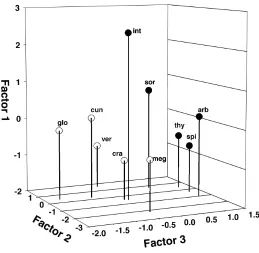
We then used principal component analysis (PCA) to identify the suites of traits that accounted for functional variation in the genus Ceanothus. The first two PCA axes with all examined Ceanothus species accounted for 61% of the variance (Table 2). The first axis, which explained 32% of the variance, was related to allocation patterns and showed the same allocation trade-off that emerged from the correlation analysis. Species with large seeds allocated more biomass to aboveground parts and leaves, had low NAR because of low N concentration but were more effi-cient at using N. The second axis explained 30% of the variance and was related to final plant size and its positive correlation with RGR. The two sections of Ceanothus sep-arated clearly in the basis of the PCA axes (Fig. 3), mainly because of differences allocation patterns (axis 1).
The first axis of a separate PCA performed on subgenus
Ceanothus species only (Table 3) loaded on allocation
pat-terns, N, and photosynthetic traits just as in the correlation analysis, explaining 52% of variance. Plants with high leaf
N were less efficient at using it in photosynthesis (r = –0.98; p = 0.02), though they had a high assimilation rate and a high NAR. A high allocation to roots meant a higher leaf N (r = 0.91; p = 0.03), thicker leaves, and lower leaf-to-stem ratio. In the PCA including Cerastes species only, the first axis explained 52% of variance and loaded on size pa-rameters, RGR, and use of N and water (Table 3) just as in the correlation analysis. Plants with large seeds produced large seedlings (r = 0.97; p = 0.02) that had high RGR (r = 0.79; p = 0.04), low leaf N and PNUE, and low WUE.
Thus the PCA analyses confirmed the general conclu-sions of the correlation analyses and identified the major suites of traits that differ between sections.
Fig. 1. Relationship between RGRmax and seed mass of subgenera Ceanothus (a) and Cerastes (b) species of Ceanothus.
(a)
(b)
Nitrogen-fixer species vs non-fixers
Seeds of non-N-fixing species tended to be larger than seeds of N-fixers, across all Ceanothus species (Table 4) and within sections, the differences being larger in Cerastes (19.4 mg in non-fixers vs 11.2 mg in N-fixers) than in subgenus Ceanothus (10.4 vs 4.7 mg). Most of the func-tional traits were similar in both groups, however, because of high inter-specific variability.
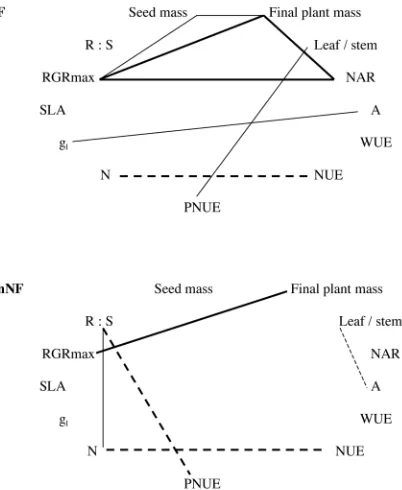
Covariance among traits differed depending on the N-fixing ability of Ceanothus species. N-N-fixing and non-N-fixing species shared 8 correlations among traits (Fig. 4). In addi-tion, N-fixer species had 9 pairs of traits that showed sig-nificant correlations (many of which related to photosyn-thesis), whereas 16 were significant in non-fixing species (many related to RGR and allocation). Thus N-fixing abil-ity altered the relationships among traits.
The distribution of N-fixing and non-fixing species in both sections suggests that this ability may have been gained or lost several times during the diversification of
Ceanothus.
Discussion
Divergence in physiology and allocation patterns in the genus Ceanothus was associated with changes in the entire suite of traits rather than with independent changes in in-dividual traits. At this broad taxonomic level, correlations among traits were similar to patterns described previously for entire floras or for functional types such as trees (Lambers and Poorter 1992, Reich et al. 1992, Poorter and Evans 1998, Niinemets 1999). However, at finer taxonomic levels, different relationships among traits emerged in response to different selective pressures (i.e.
Cerastes in drier habitats). For example, there was a
posi-tive relationship among seed mass, final plant size, and RGR in Cerastes but not in subgenus Ceanothus. Across growth forms and species, seed size and RGR are inversely Table 2. Correlation of functional plant characters of Ceanothus
species with PCA axes.
Axis 1 Axis 2
Seed mass 0.717 0.478
Final plant mass 0.276 0.940
Root/shoot –0.858 0.301
Leaves/stem 0.659 –0.451
RGR 0.281 0.925
NAR –0.811 0.333
SLA –0.378 –0.059
A 0.190 –0.456
Gl 0.467 –0.539
WUE –0.442 0.634
N –0.712 –0.302
PNUE –0.181 –0.604
NUE 0.688 0.343
% variance explained 31.6 29.6
related (Shipley and Peters 1990, Marañón and Grubb 1993, Fenner 2000) but in Cerastes they were positively correlated, perhaps because a large seed size provides re-serves to support early seedling growth in this group of species. Earlier studies did not measure RGR at a com-mon plant size and therefore may have confounded devel-opmental changes in RGR with species differences in RGR (Cook and Evans 1983). Differences in covariation among traits between the two sections suggest that 1) there is no single monolithic pattern of trait correlations that characterizes all species and 2) phylogenetic history did not constrain the evolution of new correlations among traits in Cerastes.
Consistent differences between sections (Jeong et al. 1997) support paleontological evidence that Cerastes evolved during the Eocene in response to the seasonally lower temperatures and aridity of the Mediterranean-type climate that followed the warm, moister climate of the late Tertiary (Mason 1942, Axelrod 1989). In contrast, species in subgenus Ceanothus are close to other Rhamnaceae spe-cies, in both functional traits and phylogenetic proximity (Hardig 1997, Hardig et al. 2000), suggesting that there was a single evolutionary trend within this subgenus, which could be explained by either natural selection or his-torical factors such as genetic drift or selection for traits unrelated to physiology.
Table 3. Correlation of functional plant characters of subgenera Ceanothus and Cerastes of genus Ceanothus with PCA axes, and percentage of explained variance.
Subgenus Ceanothus Subgenus Cerastes
Axis 1 Axis 2 Axis 3 Axis 1 Axis 2 Axis 3
Seed mass –0.563 –0.188 –0.788 –0.937 0.346 0.003
Final plant mass 0.379 0.897 0.068 –0.989 0.091 –0.115
Root/shoot 0.733 –0.339 –0.406 0.019 –0.914 –0.245
Leaves/stem –0.749 0.524 –0.405 0.542 0.673 0.432
RGR 0.418 0.871 0.197 –0.995 0.059 –0.075
NAR 0.924 0.336 0.021 –0.313 –0.679 0.165
SLA –0.881 0.014 –0.231 0.559 0.800 –0.029
A 0.757 –0.641 0.024 0.428 –0.874 0.196
Gl –0.015 –0.937 0.346 –0.471 –0.635 0.542
WUE 0.827 0.133 –0.373 –0.899 –0.151 0.228
N 0.933 –0.262 –0.220 0.828 0.060 –0.545
PNUE –0.711 –0.624 0.099 0.764 0.485 0.420
NUE –0.873 0.350 0.239 0.812 0.026 0.559
% variance explained 52.0 30.7 10.9 51.8 30.4 11.2
Table 4. Seed and final plant mass, root-to-shoot ratio (R:S), leaves-to-stem ratio, maximum relative growth rate (RGR), net assimilation rate (NAR), specific leaf area (SLA), photosynthetic rate (A), leaf conductance to water vapor (gl), water use efficiency
(WUE), leaf nitrogen concentration (N), N use efficiency (NUE), and photosynthetic N use efficiency (PNUE) of seedlings of N fixing and non-fixing species of Ceanothus grown from seeds under greenhouse conditions for 6 months. Statistical significance of differences (ANOVA) between fixers and non-fixers at p < 0.001, 0.01 and 0.05 given by ***, ** and *, respectively (ns = not significant). Values are mean ±1 SE; n = 6 for fixers and 4 for non-fixers.
Non fixers p N fixers
Seed mass (mg) 14.9±5.6 ns 7.9±2.4
Final plant mass (g) 13.1±0.9 * 10.0±0.6
R:S 1.0±0.1 ns 1.0±0.2
Leaves/stem 3.0±0.1 ns 2.4±0.5
RGR (mg g–1 d–1) 16.1±3.2 ns 13.5±2.4
NAR (mg g–1 d–1) 41.5±6.9 ns 43.5±12.2
SLA (cm2 g–1) 7.4±2.1 ns 7.3±1.0
A (µmol m–2 s–1) 17.8±4.3 ns 19.5±1.2
gl (mmol m–2 s–1) 0.2±0.1 ns 0.2±0.0
WUE (mmol mol–1) 121.3±6.0 ns 113.8±31.7
N (mg g–1) 20.7±1.0 ns 24.4±1.7
PNUE (mmol g–1 s–1) 0.5±0.1 ns 0.6±0.1
Cerastes diverged most from subgenus Ceanothus in
sclerophylly and in reproductive traits. Differentiation in seed size between the two sections of Ceanothus (Table 1) was associated with changes in other traits such as alloca-tion patterns that affect both physiology and adaptive strategies of species (Chapin et al. 1993). Cerastes species are seeders that do not resprout after fire, a trait most likely evolved in response to increasing fire frequency (Keeley and Keeley 1977). Because of their shorter lifespan and reproduction mainly by seeds, seeder species track climatic changes, both evolutionarily and spatially, more closely than do resprouter species and show a higher speciation rate (Wells 1969). This is particularly true for Cerastes spe-cies, because they hybridize easily (Nobs 1963). Finally, a greater reproductive allocation ensures a greater seedling recruitment, a trait that may offset the potential advantage of resprouter species after disturbance by fire (Thomas and Davis 1989).
Usually, the seeder habit is characterized by a low R:S ratio, as in Cerastes (Table 1; Keeley and Zedler 1978, En-right and Lamont 1989, Pate et al. 1990, Hansen et al. 1991), causing seeder species to experience more negative water potentials ( = greater water stress) than ecologically similar resprouter species (Barnes 1979, Davis and Moon-ey 1986, Thomas and Davis 1989, Ackerly 2004a). Never-theless, seedlings of Cerastes species survive summer drought better than seedlings of deep-rooted, subgenus
Ceanothus species (Barnes 1979, Keeley and Zedler 1978,
Miller and Poole 1979, Bowman and Roberts 1985, Davis 1989), and are more abundant than resprouters on south-facing slopes and dry places in California (Keeley and Keeley 1988, Meentemeyer and Moody 2002), pointing to an increased drought tolerance in Cerastes. This toler-ance could be based on anatomical modifications of xy-lem vessels (Carlquist and Hoeckman 1985) that tolerate greater water stress by preventing cavitation (Kolb and Davis 1994, Langan et al. 1997). In addition, physiologi-cal responses characteristic of warm, dry environments like heat shock protein expression and biochemical pho-toprotection of photosystems differed between both sec-tions and wereassociated with leaf physiological parame-ters and related aspectsof life history(Knight and Ackerly 2001).
Cerastes species also have high rates of functional
proc-esses (higher leaf allocation, A and gl, thicker leaves, and
lower WUE). These functional differences produce a new adaptive strategy in Cerastes that depends strongly in seed-ling recruitment and rapid growth in the favorable part of the growing season (when shallow roots would be more efficient) and resistance to high levels of stress at other times of the year.
The large initial seedling sizes of Cerastes species may have evolved to deal with drier climatic conditions and strong seasonality during establishment (Salisbury 1942, Keeley 1992, Lord et al. 1995). A large seed with large nu-trient stores reduces the dependence of seedling growth on external supply of both water and nutrients (Lee and Fen-ner 1989, Jurado and Westoby 1992) and improves seed-ling survival under a variety of hazards (Leishman et al. 2000). In addition, Cerastes seeds germinated earlier than resprouters seeds (13 vs 18.2 d after sown), a trait of short-lived species (Auld and Myerscough 1986) which could be related to their shorter generation time. Chaparral post-fire seeders may represent a novel group combining early successional traits with traits proper of stress-tolerant spe-cies (Ackerly 2004a).
Loss or gain of N fixation ability appeared to be a major evolutionary event in both sections, because it altered the relationships among functional traits. Trait correlations in N-fixers were related more to photosynthesis and those in non-fixers more to allocation (Fig. 4). This suggests that the latter developed new links among traits. That N-fixing species appear in both sections suggests that N-fixing abil-ity has been lost and gained several times through the his-tory of the genus Ceanothus. Alternatively, it may be an ancestral trait inherited by early species in both sections of
Ceanothus that has been kept or lost depending on
micro-habitat conditions. For example, N fixation may be an old (Tertiary) character associated with wetter conditions, that tended to disappear in drier environments because N fixa-tion is sensitive to water shortage (Irigoyen et al. 1992, Pratt et al. 1997) and causes low water use efficiency (Schulze et al. 1991).
We conclude that, although the linkages among traits in the genus Ceanothus as a whole were similar to patterns observed in other broad taxonomic comparisons, specia-tion within the two subgenera led to distinct physiological, genetic or developmental linkages. The gain or loss of N-fixing ability also influenced linkages among physiological or functional traits. Evolution in response to variation in both physical environment (e.g. drought and fire) and nu-tritional physiology (N fixation) appears to have shaped the suites of traits currently observed in these species and their ecological function. The evolution of Cerastes from earlier species of Ceanothus may have led to the acquisition of traits that improved seedling survival in seasonally drier environments. In contrast to subgenus Ceanothus species, evolution in Cerastes tended to increase seed size, which ensured seedling development before the onset of summer drought. We hypothesize that loss of N fixation capability would allow a faster growth during the seedling stage, which would be favored in arid environments.
Acknowledgements – We thank Rancho Santa Ana Botanic Gar-den for providing seeds, Don Herman for help with the N and C analyses, and Joe Craine, Sarah Hobbie, Heather Reynolds and D. Schwilk for comments on earlier drafts of this manuscript. This paper was partially funded by the Spanish MEC (grant REN2004-00090/CLI). A Junta de Andalucía travel grant is gratefully acknowledged.
References
Ackerly, D. D. 2004a. Functional strategies of chaparral shrubs in relation to seasonal water deficit and disturbance. – Ecol. Monogr. 74: 25–44.
Ackerly, D. D. 2004b. Adaptation, niche conservatism, and con-vergence: comparative studies of leaf evolution in the Cali-fornia chaparral. – Am. Nat. 163: 654–671.
Aerts, R. and Chapin, F. S. 2000. The mineral nutrition of wild plants revisited: a re-evaluation of processes and patterns. – Adv. Ecol. Res. 30: 1–67.
Auld, T. D. and Myerscough, P. J. 1986. Population dynamics of shrub Acacia suaveolens (Sm.) Willd.: seed production and predispersal seed predation. – Aust. J. Ecol. 11: 219–234. Axelrod, D. I. 1989. Age and origin of chaparral. – In: Keeley, S.
C. (ed.), The California chaparral. Paradigms reexamined. Natural History Museum of Los Angeles County, pp. 7–19. Barnes, F. J. 1979. Water relations of four species of Ceanothus. – M.Sc. Dissertation, San Jose State Univ., San Jose, CA, USA. Becking, J. H. 1977. Dinitrogen fixation by plant associations excluding legumes. – In: Hardy, R. W. F. and Gibson, A. H. (eds), A treatise on dinitrogen fixation. Wiley, pp. 185–275. Bond, G. and Wheeler, C. T. 1980. Non-legume nodule systems. – In: Bergersen, F. J. (ed.), Methods for evaluating biological nitrogen fixation. Wiley, pp. 185–211.
Bowman, W. D. and Roberts, S. W. 1985. Seasonal and diurnal water relations adjustments in three evergreen chaparral shrubs. – Ecology 66: 738–742.
Carlquist, S. and Hoeckman, D. A. 1985. Ecological wood anat-omy of the woody southern California flora. – Int. Assoc. Wood Anat. Bull., new ser. 6: 319–347.
Chapin III, F. S. 1980. The mineral nutrition of wild plants. – Annu. Rev. Ecol. Syst. 11: 233–260.
Chapin III, F. S., Autumn, K. and Pugnaire, F. 1993. Evolution of suites of traits in response to environmental stress. – Am. Nat. 142S: 578–592.
Conard, S. G. et al. 1985. The role of the genus Ceanothus in western forest ecosystems. – USDA Forest Service, Pacific Northwest Forest and Range Experiment Station, USDA Forest Service, Portland, OR, General Technical Rep. PNW-182.
Cook, M. G. and Evans, L. T. 1983. Some physiological aspects of the domestication and improvement of rice (Oriza spp). – Field Crops Res. 6: 219–238.
Davis, S. D. 1989. Patterns in mixed chaparral stands. Differen-tial water status and seedling survival during summer drought. – In: Keeley, S. C. (ed.), The California chaparral. Paradigms reexamined. Natural History Museum of Los An-geles County, pp. 97–105.
Davis, S. D. and Mooney, H. A. 1986. Tissue water relations of four co-occuring chaparral shrubs. – Oecologia 70: 527– 535.
Ehleringer, J. R. and Osmond, C. B. 1989. Stable isotopes. – In: Pierce, R. W. et al. (eds), Plant physiological ecology. Chap-man and Hall, pp. 281–300.
Enright, N. J. and Lamont, B. B. 1989. Seed banks, fire season, safe sites and seedling recruitment in five co-occurring Bank-sia species. – J. Ecol. 77: 1111–1122.
Fenner, M. 2000. Seeds: the ecology of regeneration in plant communities, 2nd ed. – CAB International, Wallingford, UK.
Grime, J. P. 1977. Evidence for the existence of three primary strategies in plants and its relevance to ecological and evolu-tionary theory. – Am. Nat. 111: 1169–1194.
Hansen, A., Pate, J. S. and Hansen, A. P. 1991. Growth and re-productive performance of a seeder and a resprouter species of Bossiaea as a function of plant age after fire. – Ann. Bot. 67: 497–509.
Hardig, T. M. 1997. Systematics of a North American shrub ge-nus: an investigation of character evolution and speciation in Ceanothus L. (Rhamnaceae). – Ph.D. thesis, Washington State Univ,. USA.
Hardig, T. M., Soltis, P. S. and Soltis, D. E. 2000. Diversification of the North American shrub genus Ceanothus (Rhamnace-ae): conflicting phylogenies from nuclear ribosomal DNA and chloroplast DNA. – Am. J. Bot. 87: 108–123. Herrera, C. M. 1992. Historical effects and sorting processes as
explanations for contemporary ecological patterns: character syndromes in Mediterranean woody plants. – Am. Nat. 140: 421–446.
Hewitt, E. J. 1966. Sand and water culture methods used in the study of plant nutrition. – Technical Communication No. 22, Commonwealth Agricultural Bureau, Farnham Royal, England.
Huey, R. B. and Bennet A. F. 1987. Phylogenetic studies of coad-aptation: preferred temperatures versus optimal performance temperatures of lizards. – Evolution 41: 1098–1115. Hunt, R. 1982. Plant growth curves. The functional approach to
plant growth analysis. – E. Arnold, London.
Jeong, S. C., Liston, A. and Myrold, D. D. 1997. Molecular phy-logeny of the genus Ceanothus (Rhamnaceae) using rbcL and ndhF sequences. – Theor. Appl. Gen. 94: 852–857. Jurado, E. and Westoby, M. 1992. Seedling growth in relation to
seed size among species of arid Australia. – J. Ecol. 80: 407– 416.
Keeley, J. E. 1992. Recruitment of seedlings and vegetative sprouts in unburned chaparral. – Ecology 73: 1194–1208. Keeley, J. E. and Keeley, S. C. 1977. Energy allocation patterns of
sprouting and non-sprouting species of Arctostaphylos in the California chaparral. – Am. Midl. Nat. 98: 1–10.
Keeley, J. E. and Zedler, P. H. 1978. Reproduction of chaparral shrubs after fire: a comparison of sprouting and seeding strat-egies. – Am. Midl. Nat. 99: 142–161.
Keeley, J. E. and Keeley, S. C. 1988. Chaparral. – In: Barbour, M. G. and Billings, W. D. (eds), North American terrestrial veg-etation. Cambridge Univ. Press, pp. 165–207.
Knight, C. A. and Ackerly, D. D. 2001. Correlated evolution of chloroplast heat shock protein expression in closely related plant species. – Am. J. Bot. 88: 411–418.
Kolb, K. J. and Davis, S. D. 1994. Drought tolerance and xylem embolism in co-occurring species of coastal sage and chapar-ral. – Ecology 75: 648–659.
Lambers, H. and Poorter, H. 1992. Inherent variation in relative growth rate between higher plants: a search for physiological causes an ecological consequences. – Adv. Ecol. Res. 23: 187–261.
Langan, S. J., Ewers, F. W. and Davis, S. D. 1997. Xylem disfunc-tion caused by water stress and freezing in two species of co-occurring chaparral shrubs. – Plant Cell Environ. 20: 425– 437.
Lechowicz, M. J. 1984. Why do temperate deciduous trees leaf out at different times? Adaptation and ecology of forest com-munities. – Am. Nat. 124: 821–842.
Lee, W. G. and Fenner, M. 1989. Mineral nutrient allocation in seeds and shoots of 12 Chionochloa species in relation to soil fertility. – J. Ecol. 77: 704–716.
Leishman, M. et al. 2000. The evolutionary ecology of seed size. – In: Fenner, M. (ed.), Seeds: the ecology of regeneration in plant communities, 2nd ed. CAB International, Walling-ford, UK.
Lord, J., Westoby, M. and Leishman, M. 1995. Seed size and phylogeny in six temperate floras: constraints, niche conserv-atism, and adaptation. – Am. Nat. 146: 349–364. MacMinn, H. L. 1942. A systematic study of the genus
Cean-othus. – In: Van Resselaer, M. (ed.), Ceanothus, part II. Santa Barbara Botanic Garden, Santa Barbara, CA, pp. 131–279. Marañón, T. and Grubb, P. J. 1993. Physiological basis and
eco-logical significance of the seed size and relative growth rate relationship in Mediterranean annuals. – Funct. Ecol. 7: 591–599.
Mason, H. L. 1942. Distributional history and fossil record of Ceanothus. – In: Van Resselaer, M. (ed.), Ceanothus, part II. Santa Barbara Botanic Garden, Santa Barbara, CA, pp. 281– 303.
Meentemeyer, R. K. and Moody, A. 2002. Distribution of plant life history types in California chaparral: the role of topo-graphically-determinated drought severity. – J. Veg. Sci. 13: 67–78.
Miller, P. C. and Poole, D. K. 1979. Patterns of water use in shrubs in southern California. – For. Sci. 25: 84–98. Munz, P. and Keck, D. D. 1978. A California flora and
supple-ment. – Univ. of California Press.
Niinemets, U. 1999. Components of leaf dry mass per area – thickness and density – alter leaf photosynthetic capacity in reverse directions in woody plants. – New Phytol. 144: 35– 47.
Nobs, M. A. 1963. Experimental studies on species relationships in Ceanothus. – Carnegie Inst. of Washington Publ. 623. Pate, J. S. et al. 1990. Juvenile growth and storage characteristics
of seeder and resprouter species of mediterranean-type eco-systems of SW Australia. – Ann. Bot. 65: 585–601. Poorter, H. and Evans, J. R. 1998. Photosynthetic nitrogen-use
efficiency of species that differ inherently in specific leaf area. – Oecologia 116: 26–37.
Pratt, S. D. et al. 1997. Influence of soil moisture on the nodula-tion of post fire seedlings of Ceanothus growing in the Santa Monica Mountains of southern California. – Physiol. Plant. 99: 673–679.
Quick, C. R. and Quick, A. S. 1961. Germination of Ceanothus seeds. – Madroño 16: 23–30.
Reich, P. B., Walter, M. B. and Ellsworth, D. S. 1992. Leaf life-span in relation to leaf, plant, and stand characteristics among diverse ecosystems. – Ecol. Monogr. 62: 365–392. Salisbury, E. J. 1942. The reproductive capacity of plants. – Bell,
London.
Schulze, E.-D. et al. 1991. Estimates of nitrogen-fixation by trees on an aridity gradient in Namibia. – Oecologia 88: 451– 455.
Shipley, B. and Peters, R. H. 1990. The allometry of seed weight and seedling relative growth rate. – Funct. Ecol. 4: 523– 529.
Sokal, R. R. and Rohlf, F. J. 1981. Biometry, 2nd ed. – Freeman. Thomas, C. M. and Davis, S. D. 1989. Recovery patterns of three chaparral shrub species after wildfire. – Oecologia 80: 309–320.
Wells, P. V. 1969. The relation between mode of reproduction and extent of speciation in woody genera of the California chaparral. – Evolution 23: 264–267.