Published online November 20, 2013 (http://www.sciencepublishinggroup.com/j/acm) doi: 10.11648/j.acm.20130206.15
Comments on the Adomian Decomposition Methods
applied to the KdV equation
Mahmoud AKDI, Moulay Brahim SEDRA
Université Ibn Tofail, Faculté des Sciences, Département de Physique, LHESIR, Kénitra, Morocco
Email address:
[email protected](M. AKDI), [email protected] (M. B. SEDRA)
To cite this article:
Mahmoud AKDI, Moulay Brahim SEDRA. Comments on the Adomian Decomposition Methods Applied to the KdV Equation. Applied and Computational Mathematics. Vol. 2, No. 6, 2013, pp. 137-142. doi: 10.11648/j.acm.20130206.15
Abstract:
Based on previous works, especially [1] and [2], we try in the present contribution to study some new aspects of
the numerical solution of the KdV equation through the standard Adomian Decomposition Method.
The use of the multistage
Adomian Decomposition Method, applied to this equation, will be presented and discussed.
Keywords:
KdV Equation - Standard and Multistage Adomian Decomposition Methods
1. The Adomian Decomposition Method
(ADM)
Consider the KdV equation:
( )
3 3
6
0, ( , 0)
u
u
u
u
u x
f x
t
x
x
∂
+
∂
+
∂
=
=
∂
∂
∂
which can be rewritten as follows:
( )
u
u
( ) ( )
x
f
x
N
Ru
t
u
=
−
−
=
∂
∂
0
,
,
6
where
R
= ∂ ∂
3/
x
3represents the linear operator of the
KdV equation and
N u
( )
= ∂
u u
/
∂
x
is the non-linear
function. According to the ADM, the solution is expressed
by:
( )
,
( )
,
,
0∑
∞ ==
nn
x
t
u
t
x
u
and the non-linear part:
( )
,
0∑
∞ ==
n nA
u
N
with:
0 0!
1
= ∞ =
=
∑
λλ
λ
i i i n nn
N
u
d
d
n
A
,
By integrating with respect to time and using the initial
conditions we have:
( )
0
( , )
( )
6.
.
t
u x t
=
f x
−
∫
Lu
+
N u
ds
So,
( )
0 0
0
( , )
( )
,
6.
.
t
n n
n n
u x t
f x
L
u
x s
A
ds
∞ ∞ = =
=
−
+
∑
∑
∫
For the KdV equation, the Adomian polynomials can be
expressed as follows:
∑
= −∂
∂
=
n i i n i nx
u
u
A
0This allows us to deduce
u
n( )
x t
,
,
namely
( )
( )
( )
[
]
0 1 0,
,
,
,
0
t
n n n
u
x t
f x
u
+x t
Ru
A ds
n
=
= −
+
≥
∫
( )
=
2
sech
2
1
0
,
2x
x
u
We proceed in the following to compute
A
n( )
x t
,
and
( )
,
n
u
x t
for
n
∈
[ ]
0, 2
and try to determine the
approximate solution
U
ɶ
n( )
x t
,
using the following
formula:
( )
( )
0
0 0
0
( , )
,
( )
,
6.
.
n
n i
i
t n n
i i
i i
U x t
U x t
f x
L
u x s
A ds
=
= =
=
=
−
+
∑
∑
∑
∫
ɶ
2. Study of the Discrepancy of the ADM
Applied to the KdV Equation
2.1. Calculation of Discrepancy
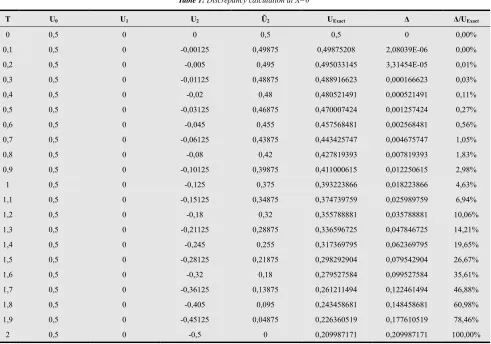
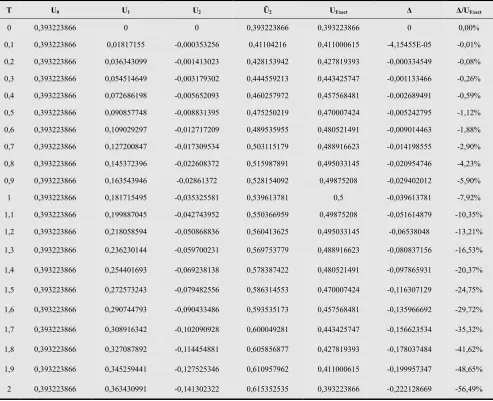
We present in this section some calculations by making
comparison between the values of approximated function
and the exact solution through space and time evolution. We
also evaluate the percentage of the discrepancy over the
exact solution.
Table 1: Discrepancy calculation at X=0
T U0 U1 U2 Ũ2 UExact ∆ ∆/UExact
0 0,5 0 0 0,5 0,5 0 0,00%
0,1 0,5 0 -0,00125 0,49875 0,49875208 2,08039E-06 0,00%
0,2 0,5 0 -0,005 0,495 0,495033145 3,31454E-05 0,01%
0,3 0,5 0 -0,01125 0,48875 0,488916623 0,000166623 0,03%
0,4 0,5 0 -0,02 0,48 0,480521491 0,000521491 0,11%
0,5 0,5 0 -0,03125 0,46875 0,470007424 0,001257424 0,27%
0,6 0,5 0 -0,045 0,455 0,457568481 0,002568481 0,56%
0,7 0,5 0 -0,06125 0,43875 0,443425747 0,004675747 1,05%
0,8 0,5 0 -0,08 0,42 0,427819393 0,007819393 1,83%
0,9 0,5 0 -0,10125 0,39875 0,411000615 0,012250615 2,98%
1 0,5 0 -0,125 0,375 0,393223866 0,018223866 4,63%
1,1 0,5 0 -0,15125 0,34875 0,374739759 0,025989759 6,94%
1,2 0,5 0 -0,18 0,32 0,355788881 0,035788881 10,06%
1,3 0,5 0 -0,21125 0,28875 0,336596725 0,047846725 14,21%
1,4 0,5 0 -0,245 0,255 0,317369795 0,062369795 19,65%
1,5 0,5 0 -0,28125 0,21875 0,298292904 0,079542904 26,67%
1,6 0,5 0 -0,32 0,18 0,279527584 0,099527584 35,61%
1,7 0,5 0 -0,36125 0,13875 0,261211494 0,122461494 46,88%
1,8 0,5 0 -0,405 0,095 0,243458681 0,148458681 60,98%
1,9 0,5 0 -0,45125 0,04875 0,226360519 0,177610519 78,46%
2 0,5 0 -0,5 0 0,209987171 0,209987171 100,00%
Table 2: Discrepancy calculation at X=0,5
T U0 U1 U2 Ũ2 UExact ∆ ∆/UExact
0 0,470007424 0 0 0,470007424 0,470007424 0 0,00%
0,1 0,470007424 0,011511359 -0,000963568 0,480555216 0,480521491 -3,37243E-05 -0,01%
0,2 0,470007424 0,023022718 -0,00385427 0,489175872 0,488916623 -0,000259249 -0,05% 0,3 0,470007424 0,034534077 -0,008672108 0,495869393 0,495033145 -0,000836248 -0,17%
0,4 0,470007424 0,046045436 -0,015417081 0,500635779 0,49875208 -0,001883699 -0,38% 0,5 0,470007424 0,057556795 -0,024089189 0,50347503 0,5 -0,00347503 -0,70%
T U0 U1 U2 Ũ2 UExact ∆ ∆/UExact
0,7 0,470007424 0,080579513 -0,047214811 0,503372127 0,495033145 -0,008338981 -1,68%
0,8 0,470007424 0,092090872 -0,061668324 0,500429972 0,488916623 -0,011513349 -2,35% 0,9 0,470007424 0,103602231 -0,078048973 0,495560683 0,480521491 -0,015039191 -3,13%
1 0,470007424 0,11511359 -0,096356756 0,488764258 0,470007424 -0,018756833 -3,99% 1,1 0,470007424 0,126624949 -0,116591675 0,480040698 0,457568481 -0,022472217 -4,91%
1,2 0,470007424 0,138136308 -0,138753729 0,469390003 0,443425747 -0,025964256 -5,86% 1,3 0,470007424 0,149647667 -0,162842918 0,456812173 0,427819393 -0,02899278 -6,78%
1,4 0,470007424 0,161159026 -0,188859242 0,442307208 0,411000615 -0,031306593 -7,62% 1,5 0,470007424 0,172670385 -0,216802702 0,425875107 0,393223866 -0,032651241 -8,30%
1,6 0,470007424 0,184181744 -0,246673296 0,407515872 0,374739759 -0,032776113 -8,75% 1,7 0,470007424 0,195693102 -0,278471026 0,387229501 0,355788881 -0,03144062 -8,84%
1,8 0,470007424 0,207204461 -0,31219589 0,365015995 0,336596725 -0,028419271 -8,44% 1,9 0,470007424 0,21871582 -0,34784789 0,340875355 0,317369795 -0,02350556 -7,41%
2 0,470007424 0,230227179 -0,385427025 0,314807579 0,298292904 -0,016514675 -5,54%
Table 3: Discrepancy calculation at X=1
T U0 U1 U2 Ũ2 UExact ∆ ∆/UExact
0 0,393223866 0 0 0,393223866 0,393223866 0 0,00%
0,1 0,393223866 0,01817155 -0,000353256 0,41104216 0,411000615 -4,15455E-05 -0,01%
0,2 0,393223866 0,036343099 -0,001413023 0,428153942 0,427819393 -0,000334549 -0,08%
0,3 0,393223866 0,054514649 -0,003179302 0,444559213 0,443425747 -0,001133466 -0,26%
0,4 0,393223866 0,072686198 -0,005652093 0,460257972 0,457568481 -0,002689491 -0,59%
0,5 0,393223866 0,090857748 -0,008831395 0,475250219 0,470007424 -0,005242795 -1,12%
0,6 0,393223866 0,109029297 -0,012717209 0,489535955 0,480521491 -0,009014463 -1,88%
0,7 0,393223866 0,127200847 -0,017309534 0,503115179 0,488916623 -0,014198555 -2,90%
0,8 0,393223866 0,145372396 -0,022608372 0,515987891 0,495033145 -0,020954746 -4,23%
0,9 0,393223866 0,163543946 -0,02861372 0,528154092 0,49875208 -0,029402012 -5,90%
1 0,393223866 0,181715495 -0,035325581 0,539613781 0,5 -0,039613781 -7,92%
1,1 0,393223866 0,199887045 -0,042743952 0,550366959 0,49875208 -0,051614879 -10,35%
1,2 0,393223866 0,218058594 -0,050868836 0,560413625 0,495033145 -0,06538048 -13,21%
1,3 0,393223866 0,236230144 -0,059700231 0,569753779 0,488916623 -0,080837156 -16,53%
1,4 0,393223866 0,254401693 -0,069238138 0,578387422 0,480521491 -0,097865931 -20,37%
1,5 0,393223866 0,272573243 -0,079482556 0,586314553 0,470007424 -0,116307129 -24,75%
1,6 0,393223866 0,290744793 -0,090433486 0,593535173 0,457568481 -0,135966692 -29,72%
1,7 0,393223866 0,308916342 -0,102090928 0,600049281 0,443425747 -0,156623534 -35,32%
1,8 0,393223866 0,327087892 -0,114454881 0,605856877 0,427819393 -0,178037484 -41,62%
1,9 0,393223866 0,345259441 -0,127525346 0,610957962 0,411000615 -0,199957347 -48,65%
2 0,393223866 0,363430991 -0,141302322 0,615352535 0,393223866 -0,222128669 -56,49%
As we can easily observe, the convergence is limited
relatively to the time parameter, and it’s shown that it
diverge consistently beyond the value of τ
0[1] defining the
2.2. Determination of the Contribution of Each Element of
the Adomian Polynomial
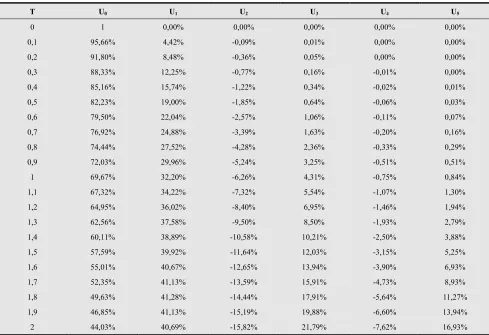
In order to obtain a behavior of the evolving manner of the
elements of the Adomian polynomial, we elaborate the
calculation for
x
=
1
, to precise the percentage of each one
separately, as exposed in the following table:
Table 4: The evolving of Ui
T U0 U1 U2 U3 U4 U5
0 1 0,00% 0,00% 0,00% 0,00% 0,00%
0,1 95,66% 4,42% -0,09% 0,01% 0,00% 0,00%
0,2 91,80% 8,48% -0,36% 0,05% 0,00% 0,00%
0,3 88,33% 12,25% -0,77% 0,16% -0,01% 0,00%
0,4 85,16% 15,74% -1,22% 0,34% -0,02% 0,01%
0,5 82,23% 19,00% -1,85% 0,64% -0,06% 0,03%
0,6 79,50% 22,04% -2,57% 1,06% -0,11% 0,07%
0,7 76,92% 24,88% -3,39% 1,63% -0,20% 0,16%
0,8 74,44% 27,52% -4,28% 2,36% -0,33% 0,29%
0,9 72,03% 29,96% -5,24% 3,25% -0,51% 0,51%
1 69,67% 32,20% -6,26% 4,31% -0,75% 0,84%
1,1 67,32% 34,22% -7,32% 5,54% -1,07% 1,30%
1,2 64,95% 36,02% -8,40% 6,95% -1,46% 1,94%
1,3 62,56% 37,58% -9,50% 8,50% -1,93% 2,79%
1,4 60,11% 38,89% -10,58% 10,21% -2,50% 3,88%
1,5 57,59% 39,92% -11,64% 12,03% -3,15% 5,25%
1,6 55,01% 40,67% -12,65% 13,94% -3,90% 6,93%
1,7 52,35% 41,13% -13,59% 15,91% -4,73% 8,93%
1,8 49,63% 41,28% -14,44% 17,91% -5,64% 11,27%
1,9 46,85% 41,13% -15,19% 19,88% -6,60% 13,94%
2 44,03% 40,69% -15,82% 21,79% -7,62% 16,93%
2.3. Interpretation of the Results
As described in the previous table, the contribution of the
first elements of
U
i, is more important at the beginning,
while we progress in the time calculation, and it gradually
decreases in favor of the other
U
ielements. The
U
iare
evolving in positive and negative values and progressively
their sum
Ũ
diverges from the exact solution.
So, the divergence cannot be attributed to special
categories of
U
i, which we can avoid by implementing a
filter, but it is a mass fact. From where the interest to develop
other technique, that allow us to overcome the limitations of
the standard ADM.
3. Multistage Adomian Decomposition
Method (MS-ADM) for KdV
Equation
3.1. Principe of the Method
To simplify, we present the MS-ADM by the following
diagram:
=
2 sech . 2 1 )
(x 2 x
f
n U~
( )i nxt U~ ,
) (
Based on this principle, we can write
( )
( )
0
2
,
t 0,1f x
U
x t
=
=
ɶ
Hence, after calculation we found:
( )
(
)
(
)
2
4
1,79186.
0,819005
2,21. .
1
x x
x
x
e
e
f x
e
e
+
+
=
+
Using the previous backgrounds, we have to recalculate
the approximated function
*( )
2
,
U
ɶ
x t
based on the new
expression of the initial condition
f
( )
x
, for:
t
=
t
2.
As made before for the standard Adomian decomposition
method and also taking into account the new formulation,
we have to precise the following expressions:
*
* * 0
0 0
U
A
U
x
∂
=
∂
;
* * *
1 0 0
0
t
U
= −
∫
RU
+
A
ds
;
* *
* * 1 * 0
1 0 1
U
U
A
U
U
x
x
∂
∂
=
+
∂
∂
;
* * *
2 1 1
0
t
U
= −
∫
RU
+
A
ds
.
3.2. Discrepancy Study
After calculation for
t
2=
0,15
, and in comparison with
the standard Adomian decomposition method, we present
the following results in the table below:
Table5: Discrepancies calculation
Values of X
0 0,25 0,5 0,75 1
Exact Solution 0,4971980 0,4987521 0,4849948 0,4575685 0,4195456
ADM 0,4971875 0,4988099 0,4851064 0,4577083 0,4196864
∆/ADM 0,0000105 -0,0000578 -0,0001116 -0,0001399 -0,0001407
MS-ADM 0,4881485 0,4734446 0,4525302 0,4256124 0,3918466
∆/MS-ADM 0,0090495 0,0253075 0,0324646 0,0319561 0,0276990
For establishing a better evaluation of these results, we
will elaborate a graphical representation of these functions:
•
f
1: the exact solution;
•
f
2: approximate solution using the standard
Adomian decomposition method;
•
f
3: approximate solution using the Multistage
Adomian decomposition method.
Graph 1: Comparative graphical representations
And for further richest visualization, we plot also these
function:
/
/
ADM Exact ADM MS ADM Exact MS ADM
F
U
U
F
U
U
∆
∆ − −
=
−
=
−
ɶ
ɶ
Where:
•
F
∆/ADM: is represented by the green color ;
•
F
∆/MS ADM−: is represented by the red color.
3.3. Discussion
Based on the previous numerical results and plotting
graphical representations, we can deduce the following
results:
1
Asymptotically, the both approximated functions
converge to the exact solution for this time value;
2
The discrepancy graphic for
F
∆/MS ADM−, show that
this function evolve between +0,032 and -0,002 and
have single null value at
x
=
2,88
and after that
conserve a negative value;
3
The discrepancy graphic for
F
∆/ADM, show that this
function have two null values for
x
=
0,037
and
2,33
x
=
and minimum for
x
=
0,881
, which it
means that this function conserve after his second zero,
a positive value.
Therefore, the both approximated functions are reaching
the exact solution, but not by the same manner. The positive
evolution for the function
F
∆/ADM, lead for the next
estimation processes of calculation of the Adomian
decomposition method, to the amplification of the
approximation error, contributing to it divergence.
Contrariwise, the Multistage Adomian decomposition
method have a more important positive discrepancy at the
beginning (in comparison with the Adomian decomposition
method), but it becomes negative for the rest of the spatial
parameter, while remaining near of 0.
4. Conclusion
Through this work, we were able to evolve with precision
the nature and the progression of the discrepancy between
the exact solution of KdV equation and the approximated
one using the standard Adomian decomposition method.
We have also, applied the Multistage Adomian
decomposition method to the resolution of the KdV equation,
which it allows us to elaborate a non-divergent method with
an acceptable accuracy level. Hence, the amplification of the
approximation error, as it occurs for the standard Adomian
decomposition method, is avoided.
Acknowledgements
The authors would like to express their thanks to Pr. Saad
CHOUKRI (EMI) for useful conversations.
References
[1] M.Akdi, M. B. Sedra, "Numerical KDV equation by the Adomian decomposition method", American Journal of Modern Physics. (2013)
[2] M. Akdi, "Study of solitary waves: results of resolution by numerical methods of the Korteweg-de Vries equation and simulation of the fluid flow", Ph. D. Thesis. (2013)
[3] M. Inc, On numerical solution of partial differential equation by the decomposition method, Kragujevac J Math. (2004) [4] García-Olivares, A., "Analytic solution of partial differential
equations with Adomian's
decomposition", Kybernetes (Bingley, U.K.: Emerald) 32: 354-368. (2003)
[5] García-Olivares, A., "Analytical solution of nonlinear partial differential equations of physics", Kybernetes (Bingley, U.K.: Emerald) 32: 548-560. (2003)
[6] Liao, S.J., "Homotopy Analysis Method in Nonlinear Differential Equation", Berlin & Beijing: Springer & Higher Education Press. (2012)
[7] G. Adomian, "Solving Frontier Problems of Physics: The Decomposition Method", Kluwer, Dordrecht. (1994) [8] K. Abbaoui and Y. Cherruault, Convergence of adomian’s
method applied to differential equations, Comp Math Appl. (1994)
[9] K. Abbaoui and Y. Cherruault, Convergence of Adomian’s method applied to nonlinear equations, Math Computer Model. (1994)
[10] N. Himoun, K. Abbaoui, and Y. Cherruault, New results of convergence of Adomian’s method,Kybernetes. (1999) [11] J. Biazar, E. Babolian, A. Nouri, R. Islam, "An alternate
algorithm for computing Adomian decomposition method in special cases", Appl. Math. Comput. 138, 1–7. (2003) [12] J. Biazar, M. Tango, E. Babolian, R. Islam, "Solution of the
kinetic modeling of lactic acid fermentation using Adomian decomposition method", Appl. Math. Comput. 139, 249–258. (2003)
[13] Kolebaje O. T., Ojo O. L., Akinyemi P., Adenodi R. A., "On the application of the multistage laplace adomian decomposition method with pade approximation to the rabinovich-fabrikant system", Advances in Applied Science Research. (2013)