A study of problems and prospects of Urban Co-operative Banks in India
1 Priyanka, 2 Prof Archna Singh 1 Research Scholar, 2 Professor
1, 2 Department of Applied Economics, University of Lucknow, India,
1. INTRODUCTION:
1.1 History of UCBs in India
The origin of Co-operative movement dated back during eighteenth century. They were founded for the welfare of common people engaged in different trading activities to get ride off by the exploitation of money lenders. The Co-operative movements were successful in UK and Germany, which were soon spread to other countries also. The first mutual aid co-operative society was founded in erstwhile princely state of Baroda in 1889, named Anyonya Sahakari Mandal, under the guidance of Bithal Laxman. After understanding the growing importance of Co-operative societies, Cooperative Societies Act was enacted in 1904. Co-operative Societies were based on the principles of mutual help, democratic involvement and voluntary association. Till date there is no formal definition of UCBs exists rather they are known as Primary Urban co-operative Bank. In order to make UCBs reach to every corner of society, it has provided legal status under Banking Regulation Act, 1949 and registered under Banking Laws (Co-operative Societies) Act, 1956. UCBs are the financial institutions, which are at the same time are the owner as well as customer of their bank. The diameter of work of UCBs was increased by RBI in 1996, by allowing them to provide banking facilities to agricultural sectors also. Today The UCBs covers a large area of Indian society, hence became lifeline of Indian Economy.
1.2 Current Status of UCBs in India:
By the end of March 2017, there were 1562 UCBs in country. On recommendation of Marathe Committee (1992), active licensing policy for UCBs adopted by RBI to tap area-specific deposits mobilization and credit absorption potential. As a result, between 1993-2004 a number of UCBs opened. But due to poor financial health of these UCBs, 2005 onward RBI started merging UCBs of poor financial condition. Hence afterward, 128 mergers of UCBs made till March 2017. The total number of Schedule banks was 541. The deposits and advances up to end March 2017 were 443768.52 cr. and Rs 261224.36 cr. There is an increase in assets of UCBs as compared to preceded year to 12.8% as compared to 10%. The loan and advances pertaining to asset side decline to 6.2% as compared to 9.6% in 2016-17. On liability side, deposits and reserve shows a slow growth rate. The NPA of UCBs also increased 2.7% from 2.2% in 2016-17. There is an increase in total income of UCBs to 9.8% from8.7% whereas there is decrease in total expenditure of UCBs to 8.6% to 9.8% in year 2016-17.
After liberalization policy of 1991, there raised multiple problems for Co-operative banks. It increased the competition of Co-operative Banks with other commercial and foreign banks. The banking sector was fast changing industry as per population growth and innovation of Information technology sector. With the policy of Liberalization, the financial system of India has come to play a much important role in allocation of resources rather than in past and its area of field become more complex with the passage of time. They are the potential source of making an economy efficient.
Net profit of UCBs in FY 17 rose to Rs 3900 cr than Rs 3700 cr previous year, whereas gross NPAs consistently increased at a higher rate than the assets. The gross NPA was at 6.6% in 2017 against 6.2% in 2015. As per RBI guidelines some important improvements are required to make UCBs performance more effective.
Making UCBs under strict regulation of both Banking and Co-operative Act. Improvement in pattern of resource allocation of UCBs.
Effective deployment of available resources to UCBs
Abstract: At ground level with simple objectives Urban Co-operative banks are playing Multi Agency banking system in the country. The Urban Co-operative banks are the source of recognizing the middle and lower income people from the huge population of country. The importance of UCBs is also identified by Reserve Bank of India. According to RBI, UCBs are the important source of credit available to small and weaker sections of society. But on the other hand, these banks suffer from huge losses due to malfunctioning as well as absence of supportive policies.
Effective management and supervision in UCBs. Making effective the role of UCBs in financial system.
Steps to improve the performance of UCBs:
Strengthening regulatory and supervisory framework. Maintaining standard CARA fixed by RBI.
Making more strict norms for licensing for new entrants in this sector. Providing effective training facility to all staff members of UCBs. If required RBI can undergo for amendments in functioning of UCBs. Corporate governance should also be made important function of UCBs.
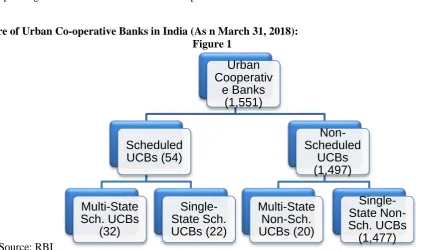
2. Structure of Urban Co-operative Banks in India (As n March 31, 2018): Figure 1
Source: RBI
The above Figure shows that as on 31 March 2018, there are 1551 UCBs are currently operative successfully among them 54 are scheduled UCBs and remaining are non-scheduled
3. Development of UCBs in India:
Due to weak financial performance of UCBs, RBI merged many weak performing UCBs as per guidelines. Hence number of UCBs reduced to 1562 in 2016-17 as compared to 1770 in 2007-08. However there was an increase in deposits from Rs 3922.66 billion to Rs 4437.68 billion in 2016-17 from previous year as well as an increases in advances from Rs 2612.24 billion to Rs 2449.05 billion from pervious year. In 2010, Malegam Committee recommended for granting new licenses to start UCBs as committee suggested the importance of UCBs in local communities with population below 5 lakhs and suggested to pen state and district co-operatives in unbanked locations. The committee also recommended giving importance to pre-existing well-managed co-operative credit that fulfills the norms.
Table-1
Deposits and Advances of UCBs
As on March 31 No. of UCBs Deposits (Crore) Advances (Crore)
2007-08 1770 1384.96 889.81
2008-09 1721 1587.33 979.82
2009-10 1674 1828.28 1103.03
2010-11 1645 2099.49 1351.04
2011-12 1618 2415.82 1679.44
2012-13 1606 2856.12 1781.44
2013-14 1589 3106.54 1932.15
2014-15 1579 3600.92 2124.11
2015-16 1574 3922.66 2449.05
2016-17 1562 4437.68 2612.24
Urban
Cooperativ
e Banks
(1,551)
Scheduled
UCBs (54)
Multi-State
Sch. UCBs
(32)
Single-State Sch.
UCBs (22)
Non-Scheduled
UCBs
(1,497)
Single-State
Non-Sch. UCBs
(1,477)
Multi-State
From above table it is analyzed that, there is continuous decrease in number of UCBs. As per recommendation of many committees, RBI merged many weak performing UCBs to stronger one. But on the side, there is a continuous increase in deposits and loan and advances, which shows improvement in performance of UCBs as well as increasing trust of customers n UCBs.
Table-2
Advances of UCBs to Priority Sector and Weaker Section from 2014-2018:
Item Priority Sector Advances
Amount Percentage to Total Advances
1. Agriculture [(i) + (ii)] 287.43 2.96
(i) Agriculture (Direct finance) 117.97 1.22
(ii) Agriculture (Indirect finance)
169.4 1.75
2. Micro and Small Enterprises [(i) + (ii)]
2654.54 27.35
(i) Micro and Small Enterprises (Direct Finance)
2137.90 22.03
(ii) Micro and Small Enterprises (Indirect Finance)
516.64 5.32
3. Micro Credit 322.67 3.32
4. State sponsored organizations for SC / ST
5.17 0.05
5. Education loans 82.65 0.85
6. Housing loans 1003.93 10.34
7. Others 1078.32 11.11
8. Total (1 to 7) 4852.33 75.19
Source: RBI Annual Report
From the above table it is determined that, as per RBI guidelines, UCBs started providing to agricultural field also. The percentage of advances provided through direct finance is more as compare to indirect finance in agriculture, i.e. 2.96% than 1.22%. Similarly the direct finance to MSE sector is much more than indirect finance, i.e. 22.03% than to 5.32%. But the contribution of state toward SC/ST organization is very minimal i.e. 0.05%. The educational and housing loans are still less than MSE in case of priority sector i.e., 11.19% as compare to 27.35%. Hence UCBs now a
day’s share maximum portion of their deposits in loan and advances.
Table-3
Profitability indicator of all UCBs
Year Return on Assets Return on Equity Net Interest Margin
2011-12 0.79 9.71 2.87
2012-13 0.81 9.58 2.99
2013-14 0.84 9.91 2.95
2014-15 0.79 9.26 2.99
2015-16 0.76 9.42 2.97
2016-17 0.77 9.09 2.79
Source: Annual Report RBI
Fig.2 Barometer for public confidence in UCBs – Market Share
Any banking business basically relies on public trust, because they the main source of resource of any bank in the form of deposits. In UCBs deposits grow only when the members of public have confidence in the bank. From the 2001-02 to 2016-17, there is continues decline in market share, i.e. 6.3% to 3.7%. This reflects the strict norms for UCBs, not permitting UCBs, for healthy and well managed performance. Continuous decline in number of UCBs lead to their inability to garner their share in the growing economy. The confidence may generate by,
The bank should run smooth, and therefore declare safe for depositors. There should be capability of banks to resolve any crisis if arises. If any failure arises, it will not disrupt any depositors.
Table-4
Market share of Urban Co-operative Bank in Banking Sector, on March 2016
Bank Type Branches Share in total deposits
(%)
Share in total loan & advances (%) Urban Co-operative
Banks
1562 3.9 3.3
Rural Co-operative Banks
412 4.5 4.7
Regional Rural Banks 91 3.2 2.8
Commercial Schedule Banks
83 97.8 99.4
Source: Annual Report
From the above table, it is concluded that the market share of UCBs are better than RRBs. Its market share of deposit is more than RRBs and nearby RCBs, but huge gap from commercial banks. Similar status of UCBs is found in case of Market share of loan and advances f UCBs.
4. ISSUES AND CHALLENGES:
Capital: The UCBs are still under Basel I norms. The CRAR computed under these norms may not adequately reflect resilience and ability to absorb shocks. Reserve Bank appreciates the constraints of the UCBs in raising capital and, therefore, has allowed the UCBs to continue under Basel I norms although this also restrains the UCBs from entering into new businesses and expanding their presence vis-à-vis the commercial banks.
Competition: UCBs suffer from a tough competition from commercial as well as private banks at ground level. The lack of transparency, duality of Control, information technology, unfulfilled RBI norms etc, still UCBs lag behind in efficient performance. Hence, the market share of UCBs keeps on decreasing from 2001.
0 1 2 3 4 5 6 7
Market Share of UCBs-percent
Information Technology: Modern banking cannot be carried out without IT, be it for banks’ own housekeeping and
MIS or for customer interface. IT reduces the cost of operations and brings tremendous efficiencies but at the same time, it also considerably increases the operational risk and consequently underlines the need for managing them. Digital banking comes with risks associated with cyber security concerns. Banks therefore, need to have robust IT systems and subject them to regular IS audits.
Duality of Control: Both state co-operative and RBI handle the administration as well as financial performance of UCBs, which directly and indirect effecting the health of UCBs. Due to which, the people doubted the future of UCBs.
5. SUGGESTIONS:
UCBs must install modernized information technology system, to enhance its day to day performance without error and delay.
UCBs must train its staff and improve its working mechanism in order to retain and attract more customers and build the trust.
Licensing policy of UCBs should be made more transparent and simple.
In the name of priority sectors, the UCBs should also focus toward agricultural field also as compare to MSE. In order to reduce the burden of NPAs, UCBs have to make strict regulation of recovery.
UCBs must appoint professional and experience people having good knowledge of banking sector, in order to face any risk.
UCBs should maintain the minimum standard fixed RBI, in order continue the trust of their customers.
6. CONCLUSION:
Improvement should be done in management and administration system of UCBs. Hiring professional and director to UCBs make the performance of UCBs effective and bias less. Since in coming future UCBs have more competition with commercial and private banking industries, hence UCBs must follow Corporate Governance, information system and strict regulatory system. With the increasing competition and challenges, the scope of risk will also increase hence UCBs must maintain its Owned funds as well as Working Capital regularly.
REFERENCES:
1. Annual Report of Reserve Bank f India from 2011-12 to 2016-17. 2. High Powered Committee Report submitted in 2015.
3. Bhaskaran R and Praful Josh P (2000), “Non Performing Assets (NPAs) in Co-operative.
4. Dutta Uttam and Basak Amit , “Appraisal of financial performance of Urban co- operative banks- a case
study.”, 2008
5. Dr. M. Mohsim Khan Impact of globalization on Indian Banking Industry. Journal-Banking Finance-2004. 6. Dr P. Rajendra- Development in Co-operative Banking in New Millennium, 2001, p-141.
7. Urban Co-operative Bank-An Appraisal Anmol Publication Pvt. Ltd, New Delhi, First Edition, 1996. 8. Dr. C Rangarajan (1997)- Importance of Co-operative Banking under the changed scenario, Ex-Governor,