
Available Online at www.ijpret.com 314
INTERNATIONAL JOURNAL OF PURE AND
APPLIED RESEARCH IN ENGINEERING AND
TECHNOLOGY
A PATH FOR HORIZING YOUR INNOVATIVE WORKA COMPARATIVE EXPERIMENTAL STUDY OF COMPRESSION TEST AND
REBOUND HAMMER TEST ON CONCRETE
ANKUSH M. PACHGHARE, SHANU A. SHAH
Department of Civil Engineering D.R.G.I.T. & R. Amravati
Accepted Date: 15/03/2016; Published Date: 01/05/2016
\
Abstract: In this paper we have done the comparative experimental study of strength of concrete by using
compression test on concrete as destructive testing method and rebound hammer test as non-destructive
testing method. For that we have casted 6 cubes each of M20, M25, M30, M35 and M40 grade by doing mix
design as per IS 10262:2009. For doing mix design all the materials are tested for their physical properties as
per IS code provision and casting of cube is carried out as per IS 1199:1959. Three cubes are tested for 7 days
strength by Non-destructive and Destructive testing and the remaining three cubes are tested for 28 day
strength for the same. Compression test give 100% strength of concrete as per mix design. Though the Schmidt
rebound hammer provides a concrete strength up to accuracy of ±15 to ±20 percent but from experimental
work we get percentage accuracy of 10.08% for 7 days and 10.50% for 28 days. Schmidt rebound hammer is an
inexpensive, simple and quick method to assess the concrete strength of structure.
Keyword– Concrete, Design mix, Compression test, NDT
Corresponding Author: MR. ANKUSH M. PACHGHARE
Access Online On:
www.ijpret.com
How to Cite This Article:
Available Online at www.ijpret.com 315 INTRODUCTION
The strength of concrete is its most important property (especially when needed for structural purposes) alongside its durability [5]. Therefore, it is very important to ascertain the compressive strength of concrete before subjecting it to its anticipated loads. Compressive strength of the hardened concrete can be determined using the destructive and non-destructive testing (NDT) methods. The destructive testing (DT) method is carried out by crushing the cast specimen to failure while the non destructive is carried out without destroying the concrete specimen. The main disadvantage of the destructive testing methods is the length of time it takes for the results to be ready, the equipment and the power required.
The rebound (Schmidt) hammer is one of the most popular non destructive testing (NDT) methods used to test the strength of concrete. This is due to its relatively low cost and simplicity in use. Although the non destructive testing (NDT) results are much quicker compared to the destructive methods, they are more of an approximation than exact compressive strength values. In as much as the rebound hammer results are quicker, and do not destroy the surface of concrete tested, there is no established relationship between the compressive strength obtained using NDT and DT. The aim of this research is to compare concrete compressive strengths measured using destructive method and those measured using the non destructive method.
II) MATERIALS AND METHODS
Raw materials such as cement, sand, coarse aggregates and admixture were collected from the nearby sources. Portland pozzolona cement [8] of ACC brand is used for the experiment. Sand [4] was collected from Kanhan river. Course aggregate [4] used throughout the experiment was procured from local quarry site in Rajura village, Amravati. The admixture [12] (superplasticizer) used was supplied by BASF brand.
Sr. No. Materials Source
1 Cement Portland Pozzolona Cement of ACC brand
2 Fine Aggregate Kanhan River
3 Coarse Aggeregates Masod Quarry
Available Online at www.ijpret.com 316
5 Admixture Superplasticizer of BASF
Table 1 Material used and their sources
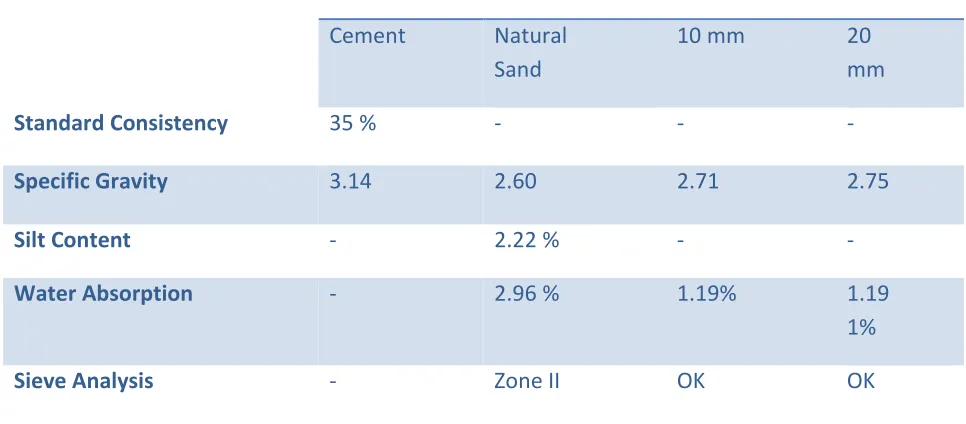
Physical tests were conducted as per specification. Following tests were conducted on the raw materials
1. Standard consistency of cement [11].
2. Specific gravity of sand and course aggregate [10].
3. Silt content in sand.
4. Water absorption [10].
5. Sieve analysis [4] [9].
Tests Materials
Cement Natural
Sand
10 mm 20
mm
Standard Consistency 35 % - - -
Specific Gravity 3.14 2.60 2.71 2.75
Silt Content - 2.22 % - -
Water Absorption - 2.96 % 1.19% 1.19
1%
Sieve Analysis - Zone II OK OK
Table 2 Test results obtained from physical test
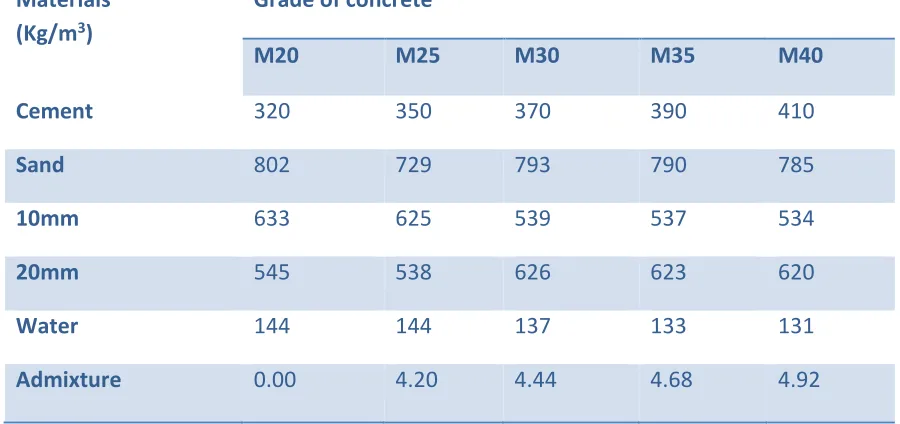
Concrete of grade 20 N/mm2, 25 N/mm2, 30 N/mm2, 35 N/mm2 and 40 N/mm2 were used for
Available Online at www.ijpret.com 317 Table 3 Quantity of each material required for 1cu.m.
Batching of concrete constituents was carried out by weighing using the manual weighing machine [2]. Mixing of the constituents was done by using mechanical mixer until a uniform mix
was obtained. Batch size of 0.30 m3 was prepared for 6 specimens. Concrete cubes [5] [6] [7] of
size 15cm x 15cm x 15cm were casted from the freshly prepared concrete. The procedure was carried out in accordance with IS 1199 specification [7]. The specimen were de-moulded after 24 hours and immersed into the curing tank filled with water and cured for 7 and 28days [1] [5] [6]. Six concrete specimens for each grade were casted. A total of thirty (30) cubes were casted for the study.
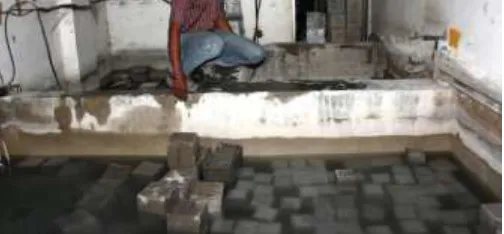
Figure 1 Concrete cube casting Materials
(Kg/m3)
Grade of concrete
M20 M25 M30 M35 M40
Cement 320 350 370 390 410
Sand 802 729 793 790 785
10mm 633 625 539 537 534
20mm 545 538 626 623 620
Water 144 144 137 133 131
Available Online at www.ijpret.com 318 Figure 2 Curing of concrete cubes for 7 days and 28 days
Testing of concrete cubes
For non destructive testing [14] choose the uniform face of cube and marked 9 points spaced at equal distance. Then placed that cube under CTM and apply a 100 KN load for firmly holding that cube. After that take nine rebound hammer readings at nine marked points for each cube.
Figure 3 NDT by using Schmidt rebound hammer
Figure 4 NDT by using Schmidt rebound hammer
Available Online at www.ijpret.com 319 Figure 5 Compression test by using compression testing machine
RESULT AND DISCUSSION
On the basis of individual test results on the specimens, a correlation was developed between the compressive strengths by compression testing machine and the corresponding rebound hammer carried out on the specimen.
Grade of concrete Strength of concrete in N/mm2 Difference in %
Destructive test Non-destructive Test
M20 23.62 16.75 35.05
M25 27.72 22.67 21.89
M30 32.36 36.17 -14.32
M35 33.89 31 9.60
M40 36.07 36.67 -1.79
Average difference 10.08 %
Table 4 Correlation between destructive and non-destructive test after 7 days[2]
Grade of concrete Strength of concrete in N/mm2 Difference in %
Destructive test Non-destructive Test
M20 28.50 26.67 -4.18
M25 37.50 33.0 13.64
M30 39.50 38.50 2.63
M35 36.00 26.60 21.86
M40 54.00 45.1 18.54
Average difference 10.50 %
Available Online at www.ijpret.com 320 CONCLUSIONS
Based on the current research work, the following conclusions can be drawn regarding the application of non destructive testing and destructive testing to assess the strength of existing concrete blocks with mix design. The select mix design is tested and examined a using Non Destructive Testing and Destructive Testing method which includes Rebound Hammer and Compression Testing Machine.
The conclusions made from above mentioned tests are as follows:
1) The Schmidt hammer provides an inexpensive, simple and quick method of obtaining an
indication of concrete strength, but accuracy of ±15 to ±20 percent is possible.
2) From our experimental work we get accuracy of 10.08% in 7 days and 10.50% in 28 days
3) The compression testing machine gives an accurate compressive strength of concrete by
applying uniform axial load on the concrete cube.
4) From the results obtained it was concluded that 100% strength of concrete was achieved as
per design except M35 grade due to some casting errors.
REFERENCE
1. Correlations between non-destructive and destructive tests of low strength concrete
published by Khodja Ali-Benyahia, Said Kenai and Mohamed Ghrici at World Congress on Housing October 26 – 29, 2010, Santander, Spain.
2. Correlation between Non-Destructive Testing (NDT) and Destructive Testing (DT) of
Compressive Strength of Concrete published by Duna Samson, Omoniyi, and Tope Moses at
International Journal of Engineering Science Invention ISSN (Online): 2319 – 6734, ISSN (Print): 2319 – 6726 www.ijesi.org Volume 3 Issue 9 ǁ September 2014 ǁ PP.12-17.
3. Concrete mix proportioning published by S.C. Maiti, Raj K. Agarwal and Rajeeb Kumar at ICJ,
December 2006 Fundamentals of concrete, Canadian Portland cement association.
4. IS 383:1970 Specifications for coarse and fine aggregate from natural source for concrete.
5. IS 456:2000 Code of practice for plain and reinforced concrete Aug 2005 (fourth revision).
6. IS 516:1959 Method of test for strength of concrete Oct 2008
7. IS1199:1959 Methods of sampling and analysis of concrete Oct 2008
8. IS 1489(Part 1):1991 Specification for Portland pozzolana cement: Jul 2009 Part 1 Fly ash
Available Online at www.ijpret.com 321
9. IS 2386(Part 1):1963 Methods of test for aggregates for concrete: Jan 2007 Part 1 Particle
size and shape.
10. IS 2386(Part 3):1963 Methods of test for aggregates for concrete: Jan 2007 Part 3 Specific
gravity, density, voids, absorption.
11. IS 4031(Part 4):1988 Methods of physical tests for hydraullic cement: Jul 2009 1 Part 4
Determination of consistency of standard cement paste (first revision)
12. IS 9103:1999 Specification for admixtures for concrete.
13. IS 10262:2009 Guidelines for concrete mix proportioning (First Revision)
14. IS 13311(Part 2):1992 Methods of non-destructive testing of concrete: Oct 2008 Part 2
![Table 5 Correlation between destructive and non-destructive test after 28 days [2]](https://thumb-us.123doks.com/thumbv2/123dok_us/8717929.1743008/6.612.180.434.82.209/table-correlation-destructive-non-destructive-test-days.webp)
