PC Algorithm for Nonparanormal Graphical Models
Naftali Harris [email protected]
Department of Statistics Stanford University Stanford, CA, USA 94305
Mathias Drton [email protected]
Department of Statistics University of Washington Seattle, WA, USA 98195
Editor: Chris Meek
Abstract
The PC algorithm uses conditional independence tests for model selection in graphical modeling with acyclic directed graphs. In Gaussian models, tests of conditional independence are typically based on Pearson correlations, and high-dimensional consistency results have been obtained for the PC algorithm in this setting. Analyzing the error propagation from marginal to partial correlations, we prove that high-dimensional consistency carries over to a broader class of Gaussian copula or
nonparanormal models when using rank-based measures of correlation. For graph sequences with
bounded degree, our consistency result is as strong as prior Gaussian results. In simulations, the ‘Rank PC’ algorithm works as well as the ‘Pearson PC’ algorithm for normal data and considerably better for non-normal data, all the while incurring a negligible increase of computation time. While our interest is in the PC algorithm, the presented analysis of error propagation could be applied to other algorithms that test the vanishing of low-order partial correlations.
Keywords: Gaussian copula, graphical model, model selection, multivariate normal distribution,
nonparanormal distribution
1. Introduction
Let G= (V,E) be an acyclic digraph with finite vertex set, and let X = (Xv)v∈V be a random vec-tor whose entries are in correspondence with the graph’s vertices. Then the graph G determines a statistical model for the joint distribution of X by imposing conditional independences that can be read off from G using the concept of d-separation. These independences are natural if the edges in E encode causal/functional relationships among the random variables Xv, and a distribution that satisfies them is said to be Markov with respect to G. Appendix B contains a brief review of these and other key notions that are relevant to this paper. More detailed introductions to statistical mod-eling with directed graphs can be found in Lauritzen (1996), Pearl (2009), Spirtes et al. (2000) or Drton et al. (2009, Chapter 3). As common in the field, we use the abbreviation DAG (for ‘directed acyclic graph’) when referring to acyclic digraphs.
PC algorithm can be found in Maathuis et al. (2010), Schmidberger et al. (2011), Le et al. (2013), and Verdugo et al. (2013).
Graph inference is complicated by the fact that two DAGs G= (V,E) and H = (V,F) with
the same vertex set V may be Markov equivalent, that is, they may possess the same d-separation relations and, consequently, induce the same statistical model. Hence, the goal becomes estimation of the Markov equivalence class of an acyclic digraph G. For representation of the equivalence class, prior work considers a particular partially directed graph C(G), for which it holds that C(G) =C(H) if and only if the two DAGs G and H are Markov equivalent; see Andersson et al. (1997) and
Chickering (2002). The graph C(G) may contain both directed and undirected edges, and it is
acyclic in the sense of its directed subgraph having no directed cycles. We will refer to C(G)as the
completed partially directed acyclic graph (CPDAG), but other terminology such as the essential graph is in use.
The PC algorithm uses conditional independence tests to infer a CPDAG from data (Spirtes et al., 2000). In its population version, the algorithm amounts to a clever scheme to reconstruct
the CPDAG C(G)from answers to queries about d-separation relations in the underlying DAG G.
Theorem 1 summarizes the properties of the PC algorithm that are relevant for the present paper. For a proof of the theorem as well as a compact description of the PC algorithm we refer the reader to Kalisch and B¨uhlmann (2007). Recall that the degree of a node is the number of edges it is incident to, and that the degree of a DAG G is the maximum degree of any node, which we denote by deg(G).
Theorem 1 Given only the ability to check d-separation relations in a DAG G, the PC algorithm
finds the CPDAG C(G) by checking whether pairs of distinct nodes are d-separated by sets S of cardinality|S| ≤deg(G).
Let XA denote the subvector (Xv)v∈A. The joint distribution of a random vector X = (Xv)v∈V is faithful to a DAG G if, for any triple of pairwise disjoint subsets A,B,S⊂V , we have that S
d-separates A and B in G if and only if XA and XB are conditionally independent given XS; it is customary to denote this conditional independence by XA⊥⊥XB|XS. Under faithfulness, statistical tests of conditional independence can be used to determine d-separation relations in a DAG and lead to a sample version of the PC algorithm that is applicable to data.
If X follows the multivariate normal distribution N(µ,Σ), with positive definite covariance ma-trixΣ, then
XA⊥⊥XB|XS ⇐⇒ Xu⊥⊥Xv|XS ∀u∈A,v∈B.
Moreover, the pairwise conditional independence of Xu and Xv given XS is equivalent to the
van-ishing of the partial correlation ρuv|S, that is, the correlation obtained from the bivariate normal conditional distribution of (Xu,Xv) given XS. The iterations of the PC algorithm make use of the recursion
ρuv|S=
ρuv|S\w−ρuw|S\wρvw|S\w
q
1−ρ2 uw|S\w
1−ρ2 vw|S\w
, (1)
for any w∈S, whereρuv|/0=ρuvis the correlation of u and v. Our later theoretical analysis will use
the fact that
ρuv|S=−
Ψ−1 uv
p
Ψ−1 uuΨ−vv1
whereΨ=Σ(u,v,S),(u,v,S)is the concerned principal submatrix ofΣ.
A natural estimate ofρuv|Sis the sample partial correlation obtained by replacingΣwith the em-pirical covariance matrix of available observations. Sample partial correlations derived from inde-pendent normal observations have favorable distributional properties (Anderson, 2003, Chapter 4), which form the basis for the work of Kalisch and B¨uhlmann (2007) who treat the PC algorithm in the Gaussian context with conditional independence tests based on sample partial correlations. The main results in Kalisch and B¨uhlmann (2007) show high-dimensional consistency of the PC algo-rithm, when the observations form a sample of independent normal random vectors that are faithful to a suitably sparse DAG.
The purpose of this paper is to show that the PC algorithm has high-dimensional consistency properties for a broader class of distributions, when standard Pearson-type empirical correlations are replaced by rank-based measures of correlations in tests of conditional independence. The broader class we consider includes continuous distributions with Gaussian copula. Phrased in the terminology of Liu et al. (2009), we consider nonparanormal distributions. Recall that a correlation matrix is a covariance matrix with all diagonal entries equal to one.
Definition 2 Let f = (fv)v∈V be a collection of strictly increasing functions fv:R→R, and let Σ∈RV×V be a positive definite correlation matrix. The nonparanormal distribution NPN(f,Σ)is the distribution of the random vector(fv(Zv))v∈V for(Zv)v∈V ∼N(0,Σ).
Taking the functions fv to be affine shows that all multivariate normal distributions are also nonparanormal. If X ∼NPN(f,Σ), then the univariate marginal distribution for a coordinate, say
Xv, may have any continuous cumulative distribution function F, as we may take fv=F−◦Φ, where Φ is the standard normal distribution function and F−(u) =inf{x : F(x)≥u}. Note that fv need not be continuous.
Definition 3 The nonparanormal graphical model NPN(G)associated with a DAG G is the set of all distributions NPN(f,Σ)that are Markov with respect to G.
Since the marginal transformations fv are deterministic, the dependence structure in a nonpara-normal distribution corresponds to that in the underlying latent multivariate nonpara-normal distribution. In other words, if X ∼NPN(f,Σ)and Z∼N(0,Σ), then it holds for any triple of pairwise disjoint sets
A,B,S⊂V that
XA⊥⊥XB|XS ⇐⇒ ZA⊥⊥ZB|ZS.
Hence, for two nodes u and v and a separating set S⊂V\ {u,v}, it holds that
Xu⊥⊥Xv|XS ⇐⇒ ρuv|S=0, (3)
withρuv|Scalculated fromΣas in (1) or (2). In light of this equivalence, we will occasionally speak
of a correlation matrixΣbeing Markov or faithful to a DAG, meaning that the requirement holds
for any distribution NPN(f,Σ).
our main result, an error bound for the output of the PC algorithm when correlations are used to determine nonparanormal conditional independence. In Corollary 9, we describe high-dimensional asymptotic scenarios and suitable conditions that lead to consistency of the PC algorithm. The proof of Theorem 8 is given in Section 3, which provides an analysis of error propagation from marginal to partial correlations. Our numerical work in Section 5 makes a strong case for the use of rank correlations in the PC algorithm. Some concluding remarks are given in Section 6.
2. Rank Correlations
Let(X,Y)be a pair of random variables, and let F and G be the cumulative distribution functions of X and Y , respectively. Spearman’sρfor the bivariate distribution of(X,Y)is defined as
ρS=Corr(F(X),G(Y)),
that is, it is the ordinary Pearson correlation between the quantiles F(X)and G(Y). Another classical measure of correlation is Kendall’sτ, defined as
τ=Corr sign X−X′
,sign Y−Y′
where (X′,Y′) is an independent copy of (X,Y), that is, (X′,Y′) and(X,Y) are independent and have the same distribution.
Suppose(X1,Y1), . . .(Xn,Yn)are independent pairs of random variables, each pair distributed as (X,Y). Let rank(Xi)be the rank of Xiamong X1, . . . ,Xn. In the nonparanormal setting, the marginal distributions are continuous so that ties occur with probability zero, making ranks well-defined. The natural estimator ofρSis the sample correlation among ranks, that is,
ˆ ρS=
1 n∑
n i=1
rank(Xi) n+1 −
1 2
rank(Yi) n+1 −
1 2 q 1 n∑ n i=1
rank(Xi) n+1 −
1 2
2q1
n∑ n i=1
rank(Yi) n+1 −
1 2
2
=1− 6
n(n2−1) n
∑
i=1rank(Xi)−rank(Yi)
2
,
which can be computed in O(n log n)time. Kendall’sτmay be estimated by
ˆ
τ= 2
n(n−1)1≤i
∑
<j≤nsign(Xi−Xj)sign(Yi−Yj).A clever algorithm using sorting and binary trees to compute ˆτ in time O(n log n) instead of the naive O(n2)time has been developed by Christensen (2005).
It turns out that simple trigonometric transformations of ˆρSand ˆτare excellent estimators of the population Pearson correlation for multivariate normal data. In particular, Liu et al. (2012a) show that if(X,Y)are bivariate normal with Corr(X,Y) =ρ, then
P
2 sin
π
6ρˆ S−ρ
>ε
≤ 2 exp
− 2
9π2nε 2 (4) and P sin π
2τˆ
−ρ >ε
≤ 2 exp
−π22nε 2
Clearly, ˆρSand ˆτdepend on the observations(X1,Y1), . . .(Xn,Yn)only through their ranks. Since ranks are preserved under strictly increasing functions, (4) and (5) still hold if(X,Y)∼NPN(f,Σ) with Pearson correlationρ=Σxyin the underlying latent bivariate normal distribution. Throughout
the rest of this paper, we will assume that we have some estimator ˆρofρwhich has the property
that, for nonparanormal data,
P(|ρˆ−ρ|>ε) < A exp −Bnε2 (6)
for fixed constants 0<A,B<∞. As just argued, the estimators considered in (4) and (5) both have this property.
When presented with multivariate observations from a distribution NPN(f,Σ), we apply the
estimator from (6) to every pair of coordinates to obtain an estimator ˆΣ of the correlation matrix parameter. Plugging ˆΣinto (1) or equivalently into (2) gives partial correlation estimators that we denote ˆρuv|S.
3. Error Propagation from Marginal to Partial Correlations
The PC algorithm leverages statistical decisions on conditional independence. An analysis of the algorithm in the context of nonparanormal distributions thus requires bounds on errors in partial correlations. The following Lemma 4 is our main tool. It provides a uniform bound on errors in partial correlations when a uniform bound on errors in marginal correlations is available. At
times we will write such uniform bounds in terms of the l∞vector norm of a matrix. For matrix
A= (ai j)∈Rq×qwe denote this norm by
kAk∞= max 1≤i,j≤q|ai j|.
Some proofs involve the spectral normkAk, that is, the square-root of the maximal eigenvalue of
ATA.
Lemma 4 (Errors in partial correlations) Suppose Σ∈Rq×q is a positive definite matrix with minimal eigenvalueλmin>0. If ˆΣ∈Rq×qsatisfies
kΣˆ−Σk∞< cλ2min (2+c)q+λmincq
with c>0, then all partial correlations are well-defined and their differences are bounded as
|ρuvˆ |\{u,v}−ρuv|\{u,v}| :=
Σ−1 uv
p
Σ−1 uuΣ−vv1
− Σˆ−
1 uv
p
ˆ Σ−1
uuΣˆ−vv1
<c, 1≤u<v≤q.
The proof of Lemma 4 follows by combining the conclusions of Lemmas 5, 6 and 7 from this section. The first of these, that is, Lemma 5, invokes classical results on error propagation in matrix inversion.
Lemma 5 (Matrix inversion) SupposeΣ∈Rq×qis a positive definite matrix with minimal eigen-valueλmin>0. If E∈Rq×qis a matrix of errors withkEk∞<ε<λmin/q, thenΣ+E is invertible
and
k(Σ+E)−1−Σ−1k∞≤ qε/λ
2 min 1−qε/λmin
Proof First, note that
kEk∞≤ kEk ≤qkEk∞; (7)
see entries (2,6) and (6,2) in the table on p. 314 in Horn and Johnson (1990). Using the
sub-multiplicativity of a matrix norm, the second inequality in (7), and our assumption onε, we find
that
kEΣ−1k ≤ kΣ−1k · kEk< qε
λmin
<1. (8)
As discussed in Horn and Johnson (1990, Section 5.8), this implies that I+EΣ−1 and thus also
Σ+E is invertible. Moreover, by the first inequality in (7) and inequality (5.8.2) in Horn and
Johnson (1990), we obtain that
k(Σ+E)−1−Σ−1k
∞≤ k(Σ+E)−1−Σ−1k ≤ kΣ−1k · kEΣ−1k 1− kEΣ−1k.
Since the function x7→ x/(1−x) is increasing for x<1, our claim follows from the fact that
kΣ−1k=1/λ
minand the inequalitykEΣ−1k<qε/λminfrom (8).
Lemma 6 (Diagonal of inverted correlation matrix) IfΣ∈Rq×qis a positive definite correlation matrix, then the diagonal entries ofΣ−1= (σi j)satisfyσii≥1.
Proof The claim is trivial for q=1. So assume q≥2. By symmetry, it suffices to consider the entryσqq, and we partition the matrix as
Σ=
A b
bT 1
with A∈R(q−1)×(q−1)and b∈Rq−1. By the Schur complement formula for the inverse of a parti-tioned matrix,
σqq= 1
1−bTA−1b;
compare Horn and Johnson (1990, Section 0.7.3). Since A is positive definite, so is A−1. Hence,
bTA−1b≥0. SinceΣ−1is positive definite,σqqcannot be negative, and so we deduce thatσqq≥1, with equality if and only if b=0.
The next lemma addresses the error propagation from the inverse of a correlation matrix to partial correlations.
Lemma 7 (Correlations) Let A= (ai j)and B= (bi j)be symmetric 2×2 matrices. If A is positive
definite with a11,a22≥1 andkA−Bk∞<δ<1, then
a12
√a
11a22−
b12
√ b11b22
Proof Without loss of generality, suppose a12≥0. SincekA−Bk∞<δ,
b12
√
b11b22−
a12
√a
11a22
<p a12+δ
(a11−δ) (a22−δ)
−√aa12
11a22
=p δ
(a11−δ) (a22−δ) +a12
1
p
(a11−δ) (a22−δ)
−√a1
11a22
!
.
Using that a11,a22≥1 to bound the first term and a212<a11a22to bound the second term, we obtain that
b12
√
b11b22−
a12
√a
11a22 < δ
1−δ+
√a
11a22
1
p
(a11−δ) (a22−δ)
−√a1
11a22
!
= δ
1−δ+
r
a11
a11−δ·
a22
a22−δ− 1
.
Since the function x7→x/(x−δ)is decreasing, we may use our assumption that a11,a22≥1 to get the bound
b12
√
b11b22−
a12
√a
11a22 < δ
1−δ+
r
1 1−δ·
1
1−δ−1
!
= 2δ 1−δ
A similar argument yields that
a12
√a
11a22−
b12
√ b11b22
< 2δ 1+δ,
from which our claim follows.
4. Rank PC Algorithm
Based on the equivalence (3), we may use the rank-based partial correlation estimates ˆρuv|S to test conditional independences. In other words, we conclude that
Xu⊥⊥Xv|XS ⇐⇒
ρˆuv|S
≤γ, (9)
where γ∈[0,1] is a fixed threshold. We will refer to the PC algorithm that uses the conditional independence tests from (9) as the ‘Rank PC’ (RPC) algorithm. We write ˆCγ(G)for the output of
the RPC algorithm with tuning parameterγ.
The RPC algorithm consist of two parts. The first part computes the correlation matrix ˆΣ= (ˆρuv) in time O(p2n log n), where p :=|V|. This computation takes O(log n) longer than its analogue under use of Pearson correlations. The second part of the algorithm is independent of the type of correlations involved. It determines partial correlations and performs graphical operations. For an accurate enough estimate of a correlation matrixΣthat is faithful to a DAG G, this second part takes
O(pdeg(G))time in the worst case, but it is often much faster; compare Kalisch and B¨uhlmann (2007).
for several different values ofγ, in which case the estimate ˆΣneeds to be calculated only once. As a result, Rank PC takes only marginally longer to compute than Pearson PC for high-dimensional data.
What follows is our main result about the correctness of RPC. For a correlation matrix Σ∈
RV×V, let
cmin(Σ):=min
|ρuv|S| : u,v∈V,S⊆V\ {u,v},ρuv|S6=0 (10)
be the minimal magnitude of any non-zero partial correlation, and letλmin(Σ)be the minimal eigen-value. Then for any integer q≥2, let
cmin(Σ,q):=min{cmin(ΣI,I) : I⊆V,|I| ≤q}, and (11) λmin(Σ,q):=min{λmin(ΣI,I) : I⊆V,|I| ≤q} (12) be the minimal magnitude of a non-zero partial correlation and, respectively, the minimal eigenvalue of any principal submatrix of order at most q.
Theorem 8 (Error bound for RPC-algorithm) Let X1, . . . ,Xn be a sample of independent
obser-vations drawn from a nonparanormal distribution NPN(f,Σ) that is faithful to a DAG G with p nodes. For q :=deg(G) +2, let c :=cmin(Σ,q) andλ:=λmin(Σ,q). If n>q, then there exists a
thresholdγ∈[0,1]for which
P Cˆγ(G)6=C(G)
≤ A2p2exp
−Bλ
4nc2 36q2
,
where 0<A,B<∞are the constants from (6).
We remark that while all subsets of size q appear in the definitions in (11) and (12), our proof of Theorem 8 only requires the corresponding minima over those principal submatrices that are actually inverted in the run of the PC-algorithm.
Proof (Theorem 8) We will show that our claimed probability bound for the event ˆCγ(G)6=C(G)
holds when the threshold in the RPC algorithm isγ=c/2. By Theorem 1, if all conditional
inde-pendence tests for conditioning sets of size|S| ≤deg(G)make correct decisions, then the output of the RPC algorithm ˆCγ(G)is equal to the CPDAG C(G). When γ=c/2, the conditional indepen-dence test accepts a hypothesis Xu⊥⊥Xv|XSif and only if|ρˆuv|S|<γ=c/2. Hence, the test makes a correct decision if|ρˆuv|S−ρuv|S|<c/2 because all non-zero partial correlations for|S| ≤deg(G) are bounded away from zero by c; recall (10) and (11). It remains to argue, using the error analy-sis from Lemma 4, that the event|ρˆuv|S−ρuv|S| ≥c/2 occurs with small enough probability when
|S| ≤deg(G).
Suppose our correlation matrix estimate ˆΣ= (ˆρuv)satisfieskΣˆ−Σk∞<εfor
ε= cλ
2
(4+c)q+λcq =
λ2c/2
(2+c/2)q+λqc/2 >0. (13)
Choose any two nodes u,v∈V and a set S⊆V\{u,v}with|S| ≤deg(G) =q−2. Let I={u,v}∪S.
Applying Lemma 4 to the I×I submatrix ofΣand ˆΣyields
Therefore,kΣˆ−Σk∞<εimplies that our tests decide all conditional independences correctly in the RPC algorithm.
Next, using (6) and a union bound, we find that
P Cˆγ(G)6=C(G)
≤P |Σuvˆ −Σuv| ≥ε for some u,v∈V
≤Ap(p−1)
2 exp −Bnε
2
.
Plugging in the definition ofεgives the claimed inequality
P Cˆγ(G)6=C(G)
≤A2p2exp − Bλ 4nc2 ((4+c)q+λcq)2
!
≤A2p2exp
−Bλ
4nc2 36q2
because c≤1 and λ≤1. The inequality c≤1 holds trivially because partial correlations are in
[−1,1]. The inequalityλ≤1 holds because a q×q correlation matrix has trace q, this trace is equal
to the sum of the q eigenvalues, andλis the minimal eigenvalue.
From the probability bound in Theorem 8, we may deduce high-dimensional consistency of RPC. For two positive sequences(sn)and(tn), we write sn=O(tn)if sn≤Mtn, and sn=Ω(tn)if
sn≥Mtnfor a constant 0<M<∞.
Corollary 9 (Consistency of RPC-algorithm) Let (Gn) be a sequence of DAGs. Let pn be the
number of nodes of Gn, and let qn=deg(Gn) +2. Suppose(Σn)is a sequence of pn×pncorrelation
matrices, with Σn faithful to Gn. Suppose further that there are constants 0≤a,b,d,f <1 that
govern the growth of the graphs as
log pn=O(na), qn=O(nb),
and minimal signal strengths and eigenvalues as
cmin(Σn,qn) =Ω(n−d), λmin(Σn,qn) =Ω(n−f).
If a+2b+2d+4 f <1, then there exists a sequence of thresholdsγnfor which
lim n→∞P
ˆ
Cγn(Gn) =C(Gn)
=1,
where ˆCγn(Gn)is the output of the RPC algorithm for a sample of independent observations X1, . . . ,Xn
from a nonparanormal distribution NPN(·,Σn).
Proof By Theorem 8, for large enough n, we can pick a thresholdγnsuch that
P(Cˆγn(Gn)6=C(Gn)≤A′exp
2na−B′n1−2b−2d−4 f
for constants 0<A′,B′<∞. The bound goes to zero if 1−2b−2d−4 f >a.
correlation estimates, their proof appeals to Fisher’s result that under Gaussianity, sample partial correlations follow the same type of distribution as sample correlations when the sample size is adjusted by subtracting the cardinality of the conditioning set (Anderson, 2003, Chapter 4). It is then natural to work with a bound on the partial correlations associated with small conditioning sets. More precisely, Kalisch and B¨uhlmann (2007) assume that there is a constant 0≤M<1 such that for any n, the partial correlationsρuv|Sof the matrixΣnsatisfy
|ρuv|S| ≤M ∀u,v∈V,S⊆V\ {u,v},|S| ≤qn. (14)
It is then no longer necessary to involve the minimal eigenvalues from (12). The work in Kalisch and B¨uhlmann (2007) is thus free of an analogue to our constant f . Stated for the case of polynomial growth of pn(with a=0), their result gives consistency when b+2d<1; our constant b corresponds to 1−b in Kalisch and B¨uhlmann (2007). The condition from Corollary 9, on the other hand,
requires 2b+2d<1 even if f =0. This is more restrictive as larger b allows for faster growth in the degree of the graphs and larger d allows for faster decay of the minimal signal strength.
In the important special case of bounded degree, however, our nonparanormal result is just as strong as the previously established Gaussian consistency guarantee. Staying with polynomial growth of pn, that is, a=0, suppose the sequence of graph degrees deg(Gn)is indeed bounded by a fixed constant, say q0−2. Then clearly, b=0. Moreover, the set of correlation matrices of size
q0satisfying (14) with qn=q0is compact. Since the smallest eigenvalue is a continuous function, the infimum of all eigenvalues of such matrices is achieved for some invertible matrix. Hence, the
smallest eigenvalue is bounded away from zero, and we conclude that f =0. Corollary 9 thus
implies consistency if 2d<1, or if d<1 2=
1−b
2 , precisely as in Kalisch and B¨uhlmann (2007). (No
generality is lost by assuming a=0; in either one of the compared results this constant is involved solely in a union bound over order p2events.)
5. Numerical Experiments
In this section we evaluate the finite-sample properties of the RPC algorithm in simulations and in
an application to gene expression data. In implementations of the PC algorithm in thepcalg
pack-age for R (Kalisch et al., 2012) and other software such asTetrad IV,1 the Gaussian conditional
independence tests use a fixed levelα∈[0,1]and decide that
Xu⊥⊥Xv|XS ⇐⇒
p
n− |S| −3
1 2log
1+ρuvˆ
|S 1−ρˆuv|S
≤
Φ−1(1−α/2). (15) If the observations are multivariate normal and ˆρuv|S are sample partial correlations then α is an asymptotic significance level for the test. The sample size adjustment from n to n− |S| −3 achieves a bias-correction (Anderson, 2003).
Suppose for a moment that in (15) the square root of n− |S| −3 was simply√n. Then, for
fixed n andα, the acceptance region in (15) could be translated into a corresponding fixed value
forγin (9). Hence, our Theorem 8 would apply directly when plugging rank correlations into the
mentioned software implementations of the PC algorithm. With the sample size adjustment from n to n−|S|−3, however, the value ofγdepends on|S|and further arguments are needed. We postpone these to Appendix A, where we show that the sample size adjustment has indeed no effect on the consistency result in Corollary 9.
5.1 Simulations
We compare RPC to two other versions of the PC-algorithm: (i) ‘Pearson-PC’, by which we mean the standard approach of using sample partial correlations to test Gaussian conditional
indepen-dences, and (ii) ‘Qn-PC’, which is based on a robust estimator of the covariance matrix and was
considered in Kalisch and B¨uhlmann (2008). All our computations are done with thepcalg
pack-age for R.
Following Kalisch and B¨uhlmann (2007), we simulate random DAGs and sample from proba-bility distributions faithful to them. Fix a sparsity parameter s∈[0,1]and enumerate the vertices as V ={1, . . . ,p}. Then we generate a DAG by including the edge u→v with probability s,
inde-pendently for each pair(u,v)with 1≤u<v≤p. In this scheme, each node has the same expected
degree(p−1)s.
Given a DAG G= (V,E), letΛ= (λuv)be a p×p matrix withλuv=0 if u→v6∈E. Furthermore,
letε= (ε1, . . . ,εp)be a vector of independent random variables. Then the random vector X solving the equation system
X=ΛX+ε (16)
is well-known to be Markov with respect to G. Here, we draw the edge coefficientsλuv, u→v∈E,
independently from a uniform distribution on the interval(0.1,1). For such a random choice, with probability one, the vector X solving (16) is faithful with respect to G. We consider three different types of data:
(i) multivariate normal observations, which we generate by takingεin (16) to have independent
standard normal entries;
(ii) observations with Gaussian copula obtained by transforming the marginals of the normal random vectors from (i) to an F1,1-distribution;
(iii) contaminated data, for which we generate the entries ofεin (16) as independent draws from
a 80-20 mixture between a standard normal and a standard Cauchy distribution.
The contaminated distributions in (iii) do not belong to the nonparanormal class.
For the simulations we sample from two graph distributions: A small graph on ten vertices with an expected vertex degree of three, and a larger graph on one hundred vertices with an expected vertex degree of six. For each n∈ {50,1000}and each of the three types of data listed above, we sample 201 random graphs from both the small and large graph distributions, and then sample n observations from the graph with the given data distribution.
For each resulting combination, we run each of the three considered versions of the PC algorithm on a grid ofα’s ranging from 10−100to 0.8. We consider the RPC algorithm in the version that uses Spearman correlations as in (4); the results for Kendall’sτwere similar. For each estimated skeleton, we compute the proportions of true and of false positives by comparing the estimated skeleton to the true skeleton. The skeleton of a graph G is the undirected graph with edges between nodes that are adjacent in G. Finally, we compute the area under the receiver operating characteristic curve (AUC) for each of the 201 repetitions. Mean areas with standard deviation in parenthesis are listed in Tables 1- 3.
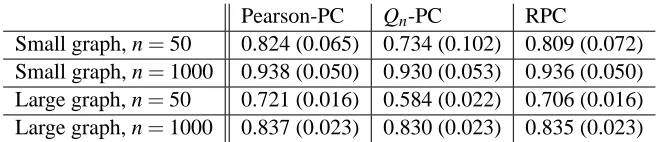
A clear message emerges from the tables. First, Table 1 shows that for normal data, RPC
per-forms only marginally worse than Pearson-PC. The Qn-PC algorithm does well on larger sample
Pearson-PC Qn-PC RPC
Small graph, n=50 0.824 (0.065) 0.734 (0.102) 0.809 (0.072)
Small graph, n=1000 0.938 (0.050) 0.930 (0.053) 0.936 (0.050)
Large graph, n=50 0.721 (0.016) 0.584 (0.022) 0.706 (0.016)
Large graph, n=1000 0.837 (0.023) 0.830 (0.023) 0.835 (0.023)
Table 1: Mean AUC for Normal data
Pearson-PC Qn-PC RPC
Small graph, n=50 0.668 (0.079) 0.506 (0.062) 0.813 (0.067)
Small graph, n=1000 0.774 (0.068) 0.566 (0.082) 0.930 (0.054)
Large graph, n=50 0.587 (0.012) 0.502 (0.004) 0.704 (0.016)
Large graph, n=1000 0.678 (0.021) 0.525 (0.011) 0.833 (0.024)
Table 2: Mean AUC for Nonparanormal data
in performance for RPC for the Gaussian copula data with F1,1 marginals. As expected, the
per-formance of RPC on nonparanormal data is the same as on normal data, while that of Pearson-PC
and Qn-PC deteriorate. Finally, Table 3 shows that RPC continues to do well in the presence of
contaminated data, the mean AUC for the other two algorithms is significantly lower. Curiously,
despite using a robust covariance matrix estimator, the Qn-PC performs substantially worse than
Pearson-PC on this data.
5.2 Gene Expression Data
While Kendall’sτand Spearman’s rank correlation give similar results for continuous observations
from a distribution with Gaussian copula, the two measures of correlation can give quite differ-ent results in applications. We illustrate this for data on gene expression in yeast from Brem and
Kruglyak (2005), where we focus on p=54 genes from the MAPK signaling pathway as was done
in Sun and Li (2012). The sample size is n=112.
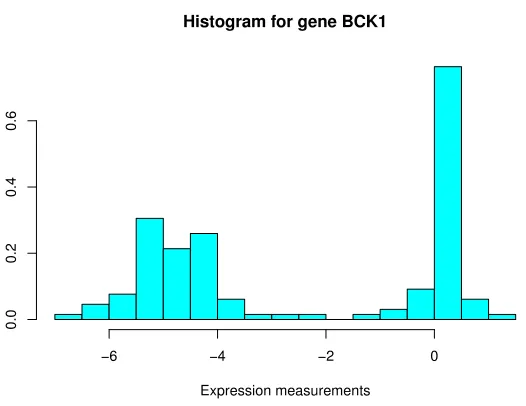
When plotting histograms of the expression measurements for each of the 54 genes, the majority of the plots do not show any obvious deviation from normality but, as one might suspect, there are several with signs of skewness as well as some outliers. Moreover, for five genes, the marginal distribution appears to be bimodal; see Figure 1 for an example. Multimodal marginals can arise under nonparanormal distributions, which thus have the potential to alleviate the effects of such
Pearson-PC Qn-PC RPC
Small graph, n=50 0.781 (0.075) 0.656 (0.102) 0.819 (0.073)
Small graph, n=1000 0.905 (0.078) 0.859 (0.110) 0.939 (0.053)
Large graph, n=50 0.646 (0.023) 0.518 (0.008) 0.690 (0.017)
Large graph, n=1000 0.738 (0.039) 0.616 (0.044) 0.832 (0.024)
✦✻ ✦ ✹ ✦✷ ✵
✁
✁
✂
✁
✄
✁
☎
❍✆✝ ✞✟ ✠✡ ☛ ☞✌✟ ✡✠❡✍ ❡✎✏✑✒
❊✓✔ ✕✖ ✗✗✘✙ ✚✛✖ ✜ ✗✢✕✖✛✖ ✚ ✣ ✗
Figure 1: A histogram suggesting a bimodal distribution for the expression values of gene BCK1.
obvious departures from multivariate normality. This said, a Gaussian copula remains of course a strong assumption about the joint distribution.
We ran the PC algorithm using Pearson correlations, Spearman correlations as well as Kendall’s τ. We considered a grid of values forαfrom 10−8to 0.5 and selectedαby optimizing the Bayesian information criterion (BIC) of Schwarz (1978). (Extensions in the spirit of Chen and Chen, 2008 and Foygel and Drton, 2010 could be attractive for this tuning problem but have yet to be adapted and studied for directed graphs.) The computations were done using routines from the aforementioned
R packagepcalgas well as the packageggm(Sadeghi and Marchetti, 2012). The former package
offers, in particular, routines to create DAGs from the PC output and the latter package contains a routine to fit a DAG model by maximum likelihood.
For the case of Pearson correlations, tuning with BIC gaveα=0.5 and a graph with 178 edges. Spearman correlations behaved similarly. No true optimum arose during the BIC tuning, which
again suggestedα=0.5 and led to a graph with 171 edges. For Kendall’s τ on the other hand,
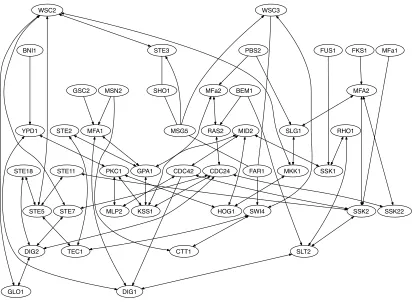
the BIC was minimal for α=0.1 and only values in the range[0.05,0.1] gave comparable BIC values. The graph inferred forα=0.1 has 74 edges. We display its largest connected component in Figure 2.
Figure 2 was produced using output from TETRAD IV and features directed, undirected and bidirected edges. While the former two arise in CPDAGs, the latter type of edge indicates incon-sistencies that the PC algorithm encountered. Briefly put, a bidirected edge arises when this edge appears in the skeleton inferred in the first stage of the PC algorithm but the edge orientation rules in the second stage of the algorithm yield arrowheads at both tails of the edge.
As mentioned in Sun and Li (2012), some prior biological knowledge about the pathway is available but not in a form that can be translated into a statistical model as considered here. Never-theless, in this example, the use of Kendall’sτseems preferable to that of Pearson and also Spearman correlations. Both the sparsity of the inferred graph as well as the more favorable behavior in the
MFa2
GPA1
RAS2
MFa1
SSK2 MFA1
DIG1
MFA2
SLG1
SSK22 STE2
TEC1
STE3 WSC2
SHO1
STE18
STE5
DIG2
CDC42 CDC24
MLP2 STE7 KSS1
BEM1
SLT2 BNI1
YPD1
STE11
MSG5
FAR1 WSC3
GLO1
FUS1
SSK1
SWI4
MKK1 MID2
HOG1
RHO1
PKC1
CTT1
PBS2
MSN2 GSC2
FKS1
Figure 2: Largest connected component in the output of the Kendall RPC algorithm applied to expression data for genes in the MAPK pathway in yeast.
6. Conclusion
The PC algorithm of Spirtes et al. (2000) addresses the problem of model selection in graphical mod-elling with directed graphs via a clever scheme of testing conditional independences. For multivari-ate normal observations, the algorithm is known to have high-dimensional consistency properties when conditional independence is tested using sample partial correlations (Kalisch and B¨uhlmann, 2007). We showed that the PC algorithm retains these consistency properties when observations fol-low a Gaussian copula model and rank-based measures of correlation are used to assess conditional independence. The assumptions needed in our analysis are no stronger than those in prior Gaus-sian work when the considered sequence of DAGs has bounded degree. When the degree grows our assumptions are slightly more restrictive as our proof requires control of the conditioning of principal submatrices of correlation matrices that are inverted to estimate partial correlations in the rank-based PC (RPC) algorithm.
com-pute than sample correlations, the simulations suggest that there are hardly any downsides associated with making RPC the standard version of the PC algorithm for continuous data.
Consistency results assume the data-generating distribution to be faithful to an underlying DAG. In fact, our results make the stronger assumption that non-zero partial correlations are sufficiently far from zero. As shown in Uhler et al. (2013), this can be a restrictive assumption, which provides an explanation for why consistency does not ‘kick-in’ quicker in simulation studies such as the one in Kalisch and B¨uhlmann (2007) and also ours.
Our analysis of the PC algorithm made use of two main arguments. First, for graphs with suit-ably bounded degree the population version of the PC algorithm only needs to check conditional independences with small conditioning sets. Second, the low-order partial correlations whose van-ishing corresponds to these conditional independence can be estimated accurately. Lemma 4, which provides the error propagation from marginal to partial correlations, could similarly be used to an-alyze other algorithms that test the vanishing of low-order partial correlations. One example is the FCI algorithm that infers a more complex graphical object to deal with situations in which some relevant variables remain unobserved (Spirtes et al., 2000; Colombo et al., 2012).
Recent work shows that Kendall’sτcan be used to obtain accurate estimates of the dispersion
parameters in a more general setting of elliptical (rather than nonparanormal) distributions. Our analysis would again carry over to this case as an analogue to (5) is available in this setting. How-ever, in the elliptical family zeros in the dispersion matrix do not correspond to independences and would have to be interpreted in terms of a latent normal random vector (Liu et al., 2012b).
Acknowledgments
We would like to thank three anonymous reviewers for carefully reading a draft manuscript and offering insightful suggestions which greatly improved our paper. Mathias Drton was supported by the NSF under Grant No. DMS-0746265 and by an Alfred P. Sloan Fellowship.
Appendix A. Sample Size Adjustment
We now show that the consistency result in Corollary 9 still holds when using the conditional inde-pendence tests from (15). In these tests, the sample size is adjusted from n to n− |S| −3.
Proof The test in (15) accepts a conditional independence hypothesis if and only if
|ρuvˆ |S| ≤ γ(n,|S|,z), (17)
where
γ(n,|S|,z) =exp z/
p
n− |S| −3−1
exp z/p
n− |S| −3
+1
and z=z(α) =2Φ−1(1−α/2). We need to find a sequence (αn) of values forα such that con-sistency holds under the scaling assumptions made in Corollary 9. We will do this by specifying a sequence(zn)for values for the (doubled) quantiles z.
We claim that the RPC algorithm using the tests from (17) is consistent when choosing the quantile sequence
zn=
√
n−3·log
1+cn/3 1−cn/3
where we use the abbreviation
cn:=cmin(Σn,qn).
We will show that as the sample size n tends to infinity, with probability tending to one, |ρuvˆ |S− ρuv|S|<cn/3 for every u,v∈V and|S| ≤qn. Furthermore, we will show that for the above choice of
znand all sufficiently large n, we have cn/3≤γ(n,|S|,zn)≤2cn/3 for each relevant set S with 0≤
|S| ≤qn. These facts imply that, with asymptotic probability one, every conditional independence test is correct, and the RPC algorithm succeeds.
First, we slightly adapt the proof of Theorem 8. Choosing the uniform error threshold for the correlation estimates as
ε= cλ
2
(6+c)q+λcq >0
in place of (13) yields that, with probability at least
1−A
2p 2exp
−Bλ
4nc2 64q2
, (19)
we have that|ρˆuv|S−ρuv|S|<c/3 for every u,v∈V and|S| ≤q. When substituting pn, qn, cnand λmin(Σn,qn) for p, q, c and λ, respectively, the scaling assumptions in Corollary 9 imply that the probability bound in (19) tends to one as n→∞, and we obtain the first part of our claim.
For the second part of our claim, note that our choice of znin (18) givesγ(n,0,zn) =cn/3. Since γ(n,|S|,z)is monotonically increasing in|S|, we need only show that for sufficiently large n,
γ(n,qn,zn)−γ(n,0,zn)≤cn/3.
For x≥0, the function
f(x) =exp(x)−1 exp(x) +1
is concave and, thus, for any qn≥0,
γ(n,qn,zn)−γ(n,0,zn) = f
z √
n−qn−3
−f
z √
n−3
≤ f′
z √
n−3
z √
n−qn−3−
z √
n−3
. (20)
The derivative of f is
f′(x) = 2 exp(x) (exp(x) +1)2. Evaluating the right hand side of (20), we obtain that
γ(n,qn,zn)−γ(n,0,zn)≤ 1 2
1−c
2 n 9 log
1+cn/3 1−cn/3
√ n−3
√
n−qn−3− 1
≤1
2log
1+cn/3 1−cn/3
√ n−3
√
n−qn−3− 1
Being derived from absolute values of partial correlations, the sequence cnis in[0,1]. Now, log[(1+
x)/(1−x)] is a convex function of x≥0 that is zero at x=0 and equal to log(2) for x=1/3. Therefore,
1 2log
1+cn/3 1−cn/3
≤ 1
2log(2)·cn, cn∈[0,1].
This shows that the bound in (21) is o(cn) because, by assumption, qn=o(√n). In particular, the bound in (21) is less than cn/3 for sufficiently large n, proving the claimed consistency result.
Appendix B. Background on Graphical Models
Let G= (V,E)be an acyclic digraph with finite vertex set. We write v→w∈E to indicate that(v,w) is an edge in E. As mentioned in the introduction, the conditional independences associated with the graph G may be determined using d-separation; compare, for example, page 48 in Lauritzen (1996). We briefly review the concept.
Since a DAG contains at most one edge between any two nodes, we may define a path from a node u to a node v to be a sequence of distinct nodes(v0,v1, . . . ,vn)such that v0=u, vn=v and for all 1≤k≤n, either vk−1→vk∈E or vk−1←vk∈E. Two distinct nodes u and v are then said to be d-separated by a set S⊂V\ {v,u}if every path from u to v contains three consecutive nodes (vk−1,vk,vk+1)for which one of the following is true:
(i) The three nodes form a chain vk−1→vk→vk+1, a chain vk−1←vk←vk+1, or a fork vk−1←
vk→vk+1, and the middle node vkis in S.
(ii) The three nodes form a collider vk−1→vk←vk+1, and neither vk nor any of its descendants is in S.
Suppose A,B,S are pairwise disjoint subsets of V . Then S d-separates A and B if S d-separates any
pair of nodes a and b with a∈A and b∈B.
Two DAGs G= (V,E)and H= (V,F)with the same vertex set V are Markov equivalent if they may possess the same d-separation relations, that is, two sets A and B are d-separated given a third
set C in the graph G if and only if the same holds in H. To give an example, the graphs u→v→w
and u←v←w are Markov equivalent, but u→v→w and u→v←w are not. As first shown in
Verma and Pearl (1991), two DAGs G and H are Markov equivalent if and only if they have the same skeleton and the same unshielded colliders. The skeleton of a digraph G is the undirected graph obtained by converting each directed edge into an undirected edge. An unshielded collider is a triple of nodes(u,v,w)that induces the subgraph u→v←w, that is, there is no edge between u
and w.
Let[G]be the Markov equivalence class of an acyclic digraph G= (V,E). Write E(H)for the edge set of a DAG H, and define the edge set
[E] = [ H∈[G]
E(H).
That is,(v,w)∈[E]if there exists a DAG H∈[G]with the edge v→w in its edge set. We interpret
C(G) = (V,[E])is known as the completed partially directed acyclic graph (CPDAG) for G or also as the essential graph. Two DAGs G and H satisfy C(G) =C(H)if and only if[G] = [H], making the CPDAG a useful graphical representation of a Markov equivalence class; see Andersson et al. (1997) and Chickering (2002).
References
Theodore. W. Anderson. An Introduction to Multivariate Statistical Analysis. Wiley Series in Probability and Statistics. Wiley-Interscience [John Wiley & Sons], Hoboken, NJ, third edition, 2003.
Steen A. Andersson, David Madigan, and Michael D. Perlman. A characterization of Markov equivalence classes for acyclic digraphs. Ann. Statist., 25(2):505–541, 1997.
Rachel B. Brem and Leonid Kruglyak. The landscape of genetic complexity across 5,700 gene expression traits in yeast. Proceedings of National Academy of Sciences, 102:1572–1577, 2005.
Jiahua Chen and Zehua Chen. Extended Bayesian information criterion for model selection with large model sp ace. Biometrika, 95:759–771, 2008.
David Maxwell Chickering. Learning equivalence classes of Bayesian-network structures. J. Mach.
Learn. Res., 2(3):445–498, 2002.
David Christensen. Fast algorithms for the calculation of Kendall’sτ. Comput. Statist., 20(1):51–62, 2005.
Diego Colombo, Marloes H. Maathuis, Markus Kalisch, and Thomas S. Richardson. Learning high-dimensional directed acyclic graphs with latent and selection variables. Ann. Statist., 40(1): 294–321, 2012.
Mathias Drton, Bernd Sturmfels, and Seth Sullivant. Lectures on Algebraic Statistics, volume 39 of
Oberwolfach Seminars. Birkh¨auser Verlag, Basel, 2009.
Rina Foygel and Mathias Drton. Extended Bayesian information criteria for Gaussian graphical models. Adv. Neural Inf. Process. Syst., 23:2020–2028, 2010.
Roger A. Horn and Charles R. Johnson. Matrix Analysis. Cambridge University Press, Cambridge, 1990. Corrected reprint of the 1985 original.
Markus Kalisch and Peter B¨uhlmann. Estimating high-dimensional directed acyclic graphs with the PC-algorithm. J. Mach. Learn. Res., 8:613–636, May 2007.
Markus Kalisch and Peter B¨uhlmann. Robustification of the PC-algorithm for directed acyclic graphs. J. Comput. Graph. Statist., 17(4):773–789, 2008.
Markus Kalisch, Martin M¨achler, Diego Colombo, Marloes H. Maathuis, and Peter B¨uhlmann. Causal inference using graphical models with the R package pcalg. Journal of Statistical
Steffen L. Lauritzen. Graphical Models, volume 17 of Oxford Statistical Science Series. The Clarendon Press Oxford University Press, New York, 1996.
Thuc Duy Le, Lin Liu, Anna Tsykin, Gregory J. Goodall, Bing Liu, Bing-Yu Sun, and Jiuyong Li. Inferring microRNA-mRNA causal regulatory relationships from expression data.
Bioinformat-ics, 29(6):765–771, 2013.
Han Liu, John Lafferty, and Larry Wasserman. The nonparanormal: semiparametric estimation of high dimensional undirected graphs. J. Mach. Learn. Res., 10:2295–2328, 2009.
Han Liu, Fang Han, Ming Yuan, John Lafferty, and Larry Wasserman. High-dimensional semipara-metric Gaussian copula graphical models. Ann. Statist., 40(4):2293–2326, 2012a.
Han Liu, Fang Han, and Cun-hui Zhang. Transelliptical graphical models. Adv. Neural Inf. Process.
Syst., 25:800–808, 2012b.
Marloes H. Maathuis, Diego Colombo, Markus Kalisch, and Peter B¨uhlmann. Predicting causal effects in large-scale systems from observational data. Nature Methods, 7(4):247–248, 2010.
Judea Pearl. Causality. Cambridge University Press, Cambridge, second edition, 2009. Models, reasoning, and inference.
Kayvan Sadeghi and Giovanni M. Marchetti. Graphical Markov models with mixed graphs in R.
The R Journal, 4(2):65–73, December 2012.
Markus Schmidberger, Sabine Lennert, and Ulrich Mansmann. Conceptual aspects of large meta-analyses with publicly available microarray data: A case study in oncology. Bioinformatics and
Biology Insights, 5:13–39, 2011.
Gideon Schwarz. Estimating the dimension of a model. Ann. Statist., 6(2):461–464, 1978.
Peter Spirtes, Clark Glymour, and Richard Scheines. Causation, Prediction, and Search. Adaptive Computation and Machine Learning. MIT Press, Cambridge, MA, second edition, 2000. With additional material by David Heckerman, Christopher Meek, Gregory F. Cooper and Thomas Richardson, A Bradford Book.
Hokeun Sun and Hongzhe Li. Robust Gaussian graphical modeling via l1penalization. Biometrics,
68:1197–1206, 2012.
Caroline Uhler, Garvesh Raskutti, Bin Yu, and Peter B¨uhlmann. Geometry of faithfulness assump-tion in causal inference. Ann. Statist., 41(2):436–463, 2013.
Ricardo A. Verdugo, Tanja Zeller, Maxime Rotival, Philipp S. Wild, Thomas M¨unzel, Karl J. Lackner, Henri Weidmann, Ewa Ninio, David-Alexandre Tr´egou¨et, Franc¸ois Cambien, Stefan Blankenberg, and Laurence Tiret. Graphical modeling of gene expression in monocytes sug-gests molecular mechanisms explaining increased atherosclerosis in smokers. PLoS ONE, 8(1): e50888, 2013.