Deshpande. World Journal of Pharmaceutical and Life Science
ANTIMICROBIAL POTENTIAL OF BOSWELLIA SERRATA ROXB. EX.
COLEBR.EXTRACTS AGAINST HUMAN PATHOGENS.
Dr. Aarti R. Deshpande*
Department of Microbiology, Shankarlal Khandelwal College, Akola (Maharashtra) (India).
Article Received on 20/11/2019 Article Revised on 10/12/2019 Article Accepted on 31/12/2019
INTRODUCTION
Rapidly increasing multidrug resistant strains of pathogenic microbes is of major concern considering the problems they create for treatment of common infectious diseases. Insensitivity of such strains to currently available antimicrobial drugs is a factor contributing to spread of the diseases and increasing the frequency of hospital acquired infections. This problem is posing a great threat to immuno-compromised and AIDS patients.[1] Indiscriminate, inappropriate and extensive use of antibiotics, a common practice in past few decades, has created this alarming and dreadful situation. This has resulted in augmented efforts world- wide for the discovery of novel antimicrobial agents. Combination therapy is considered one of the strategies for effective treatment and for restricting the growing antimicrobial resistance in microorganisms.[2]
Enormous knowledge of traditional medicine such as Ayurveda holds immence potential for modern drug development.[3,4] Many plant based antimicrobial compounds have been isolated and found effective
with other modern drugs to increase their potency or to remediate the problem of antimicrobial resistance.
Boswellia serrata Roxb. ex. Colebr, is a plant belonging to the family Buseraceae. In ayurvedic literature this plant is known by the Sanskrit name Sallaki and has been used since ages for treating arthritis. Its gum exudate is known as frankincense which has anti-inflammatory properties. According to Bhavaprakash (Ancient Ayurvedic literature) its bark is mentioned as “Jantughna” i. e. which kills the germs. It is useful in infectious diseases such as skin diseases, dysentery, diarrhea, boils, mouth sores and bronchitis.[6] Boswellic acids extracted from frankincense (Salai Guggul) are the pharmacological active compounds responsible for anti-inflammatory action,[7] Regulation of immune cytokine production has been considered important as mechanism responsible for anti-inflammatory action[8] along with infiltration of leucocytes.[9]
Extensive studies have been undertaken by researchers regarding the pharmacological properties of gum exudates of this plant[10] such as anti-arthritic,[11]
anti-World Journal of Pharmaceutical and Life Sciences
WJPLS www.wjpls.org
SJIF Impact Factor: 6.129
*Corresponding Author: Dr. Aarti R. Deshpande
Department of Microbiology, Shankarlal Khandelwal College, Akola (Maharashtra) (India).
ABSTRACT
In the context of the growing problem of multidrug resistant strains of microorganisms, discovery and introduction of novel alternative antimicrobial compounds is a major challenge. Medicinal plants that have been traditionally used for the treatment of diseases with microbial etiology, could offer potent antimicrobial drugs. Considering the medicinal importance of Boswellia serrata an attempt was made in present study to evaluate the antimicrobial potential of this plant against human pathogenic bacteria and fungi. The sequential extracts of leaves and bark of this plant were separately prepared in petroleum ether, acetone, 90% methanol and water. Antibacterial activity of these extracts were tested against standard cultures of Staphylococcus aureus, Bacillus cereus, Escherichia coli,
Proteus vulgaris, Pseudomonas aeruginosa, Klebsiella pneumoniae and Salmonella typhimurium using well plate
method. Significant antimicrobial activity was exhibited by acetone and methanol extracts. The relative minimum inhibitory concentrations of these extracts were determined for four bacteria and were found to be in the range of 3.12 mg/ml to 12.5 mg/ml for different bacteria. Antifungal activities of the organic extracts were tested against
Microsporum gypseum, Candida albicans, and Cryptococcus neoformas. Appreciable antifungal activity was
recorded for B. serrata leaves extract.
stoppered reagent bottles and shaking for 16 to 18 hrs. at room temperature. The bottles were allowed to stand for few hours and then the extract was filtered through triple layered ordinary filter paper. The solvents were concentrated by evaporating at room temperature. Aqueous extract was prepared separately by same procedure.
Screening for Antibacterial Activity
Bauer –Kirby disc diffusion method was used.[19] for which 6mm discs of Whatman paper number 42 were soaked with plant extracts, allowed to dry and placed on plates of sensitivity test medium (Hi media M-296) that was surface inoculated with test culture of required turbidity .The plates were kept in refrigerator for 30 minutes for pre-diffusion and then incubated at 37°C for 18 to 24 hours. Bacterial cultures used were Bacillus
cereus (NCIM 2322), Staphylococcus aureus (ATCC
6538), Escherichia coli (NCIM 2931), Proteus vulgaris (MTCC 742) Pseudomonas aeruginosa (NCIM 2200),
Salmonella typhimurium (NCIM 2501), Klebsiella
pneumoniae (MTCC 432).
Antibacterial Assays For Relative MIC
Agar well diffusion method.[20] was used in which the wells were made in sensitivity test agar seeded with test
against three fungal cultures on potato dextrose agar containing 0.5mg/ml chloramphenicol.[22] Inoculum was prepared by suspending two loopfuls of fresh culture in 5ml of sterile distilled water. The plates were seeded by swabbing so as to get uniform distribution of the culture on the surface of the agar. The disc impregnated with the extracts were placed on the surface of the agar. The plates were kept in refrigerator for 30 minutes for pre-diffusion and then incubated at 300c for 18 to 24 hours.
RESULTS AND DISCUSSION
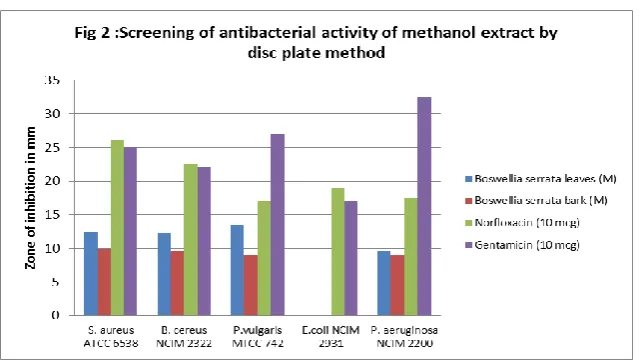
Crude and un-concentrated aqueous and petroleum ether extracts did not reveal any antibacterial activity by disc plate method. Hence more detailed studies were performed by employing quantitative comparison of the antibacterial action of the dried extracts (Sticky/ Powders) by well plate method against seven standard bacterial cultures using di methyl sulfoxide (DMSO) as solvent (Table- 1). All the extracts demonstrated greater
zones of inhibition against all the bacterial culture when tested at 0.1 g/ml concentration. Aqueous extracts of leaves (0.5g/ml concentration) displayed antibacterial action against most of the cultures except E.coli and K. pneumoniae. However the zones of inhibition were smaller as compared to the action and methanol extracts. None of the petroleum ether extracts of the leaves as well as bark showed antibacterial activity.
Table 1: Antibacterial activity of Boswellia serrata extracts by well plate method.
Bacteria
Zone of inhibition in mm
P. ether (0.1 gm/ml) Acetone (0.1 gm/ml) Methanol (0.1 gm/ml) Aqueous (0.5 gm/ml)
Leaves Bark Leaves Bark Leaves Bark Leaves Bark
S. aureus (ATCC 6538) 00 00 18 12 17.5 13 9 10
B. cereus (NCIM 2322) 00 00 16 14.5 15 12.5 9 10
P. vulgaris (MTCC 742) 00 00 18.6 15 15 15 10.5 11
P.aeruginosa (NCIM 2200) 00 00 18 16 17 18 10 8
E. coli (NCIM 2931) 00 00 8 (zs) 8 (zs) 8 (zs) 8 (zs) 00 00
S.typhimurium (NCIM 2501) 00 00 9 (zs) 8 8 (zs) 8.3 12 7.5
K. pneumoniae (MTCC 432) 00 00 13 13(zs) 17 12(zs) 00 8 (zs)
(zs = zone of suppression)
Patel had studied the antibacterial activity of the extracts of gum exudates of this plant against UTI pathogens P. aeruginosa, K. pneumonia, E. coli and P. vulgaris and have reported significant activity against all the test bacteria in two or more extracts including E. coli.[23] In his studies the acetone and petroleum ether extracts were found to be active against K. pneumonia. In present investigations, zone of inhibition was not detected against E. coli NCIM (2931) and K. pneumoniae MTCC (432) by acetone extracts and no antibacterial action was detected with petroleum ether extract. These differences in the two reports could be most likely due to different plant materials used in the studies. Similar differences were also noted with the reports of Shaikh Mannur et al., regarding aqueous extracts.[15] Their reports indicate
concentrated form of essential oils of the plant, appear to be far more enriched with the antibacterial compounds as compared to bark and leaves.
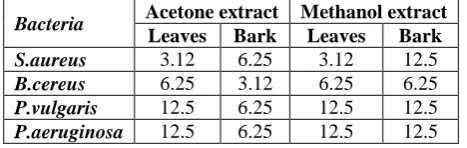
Relative MISCs of Boswellia serrata leaves and bark extracts were evaluated against four test bacteria to compare the degree of their antibacterial action (Table-2). MICs of methanol extract of leaves and bark and acetone extracts of leaves were lower for the two Gram positive test bacteria as compared to the Gram negative test bacteria. Higher MIC values were recorded for
Proteus vulgaris and Pseudomonas aeruginosa
Fig. 3: Antimicrobial assays of Boswellia serrata extract against Basillus cereus.
Table 2: Relative MICs of Boswellia serrata extracts (mg/ml).
Bacteria Acetone extract Methanol extract Leaves Bark Leaves Bark
S.aureus 3.12 6.25 3.12 12.5
B.cereus 6.25 3.12 6.25 6.25
P.vulgaris 12.5 6.25 12.5 12.5
P.aeruginosa 12.5 6.25 12.5 12.5
Acetone extract of Boswellia serrata leaves showed strongest inhibitory action against Microsporum gypseum (Table-3, Fig-4). Significant antifungal activity was also present in its methanol extract of leaves and acetone extract of bark against the same organism. Acetone and methanol extracts of leaves were also active against C. neoformans. However no antifungal activity against Candida albicans was detected in any of the extracts of this plant. Petroleum ether extract were inactive against all the three test fungi.
Leaves extract appeared to possess more antifungal potential against two of the three test fungi as compared to the bark extracts. Test culture of M. gypseum was more sensitive to these extracts than the test culture of
Cryptococcus neoformans. Test culture of Candida
albicans was insensitive to the inhibitoty action of the extracts. M. gypseum had more sensitivity also to standard antifungal drugs Amphotericin B, Clotramizole and Nystatin as compared to the other two test fungi (Table 3 and 4).
Table 3: Antifungal activity of Boswellia serrata extracts by disc plate method.
Fungi
Zone of inhibition in mm
P. ether (0.1 gm/ml) Acetone (0.1 gm/ml) Methanol (0.1 gm/ml) Leaves Bark Leaves Bark Leaves Bark
M.gypseum (MTCC 2829) 00 00 19 14 13.5 00
C.albicans (NCIM 3100) 00 00 00 00 00 00
C.neoformans (Clinical isolate) 08 00 10 00 13 10 (zs)
(zs = zone of supression)
Table 4: Sensitivity of test fungi to standard antifungal drugs.
Antifungal Drugs Zone of inhibition in mm
C. albicans NCIM 3100 C. neoformans (clinical isolate) M. gypseum MTCC 2829
Amphortecin B (100 U/disc) 13.75 16.5 24.0
Clotramizole (10 mcg/disc) 12.5 13.0 21.5
Fig. 4: Antifungal activity of Boswellia serrata extracts against Microsporum gypseum.
Saddhasivam et al., had reported antimycotic activity of essential oil of B. serrata against Trichophyton and Candida albicans and had found more sensitivity of the former than the latter.[24] Result of the present investigation also indicate the antimycotic potential of aceton and methanol extract of B. Serrata leaves and acetone extract of bark against M. gypseum, a dermatophyte. However these extracts were ineffective against the test strain of C. albicans. Mohammadi Rasoul et al. had reported inhibitory action of essential oil of the plant on C. albicans isolates.[25] Our findings suggested that the acetone and methanol extracts of B. serrata did not appear to possess the components inhibitory to Candida albicans. Present findings are in agreement with finding of Hassan et al., regarding the absence of antimycotic activity in methanol extract of the plant against C. albicans.[26]
CONCLUSIONS
Acetone, methanol and aqueous extracts of B. serrata have shown antibacterial and antifungal activities against one or more test cultures. The leaves extracts appeared to possess more antimicrobial potential than the bark extract. Growth of Microsporum gypseum MTCC 2829 was inhibited by the extracts. This supports the ancient knowledge of Ayurveda which states the use of this plant for skin diseases. Intensive future studies may lead to antimicrobial products for topical application and use of B.serrata derived antimicrobial compounds for treatment of infectious diseases.
REFERENCES
2. Warthington R. J. and Melander C. Combination approaches to combat Multi-drug Resistant bacteria. Trends Biotechnol., 2013; 31(3): 177-184.
3. Sukh Dev Ethnotherapeutics and modern drug developments, the potential of Ayurveda. Current Science, 1997; 73: 909-928.
4. Patwardhan, B., Vaidya, A.D.B. and Chorghade, M. Ayurveda and Natural products drug discovery. Current Science, 2004; 86(6): 789-799.
5. Cowan, M. Plant products as antimicrobial agents. Clinical Micro Rev., 1999; 12(4): 564-582.
6. Siddiqui, M. Z. Boswelliaserrata, a potential Antiinflammatory Agent. Indian J. Pharm Sci., 2011; 73(3): 255-261.
7. Iram Farah, Shah Alam Khan, Asif Husain Phytochemistry and potential therapeutic actions of Boswellic acids: A mini-review. Asian Pacific Journal of Tropical Biomedicine, 2017; 7(6): 513-523.
8. Chevier MR, Ryan AR, Lee DY, Zhongze M, Wu-Yan Z, Via SC Boswellia carterii extract inhibits TH1 cytokines and promotes TH2 cytokines in vitro. Clin Diag Lab Immunoo, 2005; 12: 575-580. 9. Sharma ML., Khajuria A., Kaul A., Singh S., Singh
GB, Atal CK Effect of Salai guggal ex-Boswellia serrata on cellar humoral innume responses and leucocyte migration. Agents Actions, 1988; 24: 161-164.
10. Ernst E. Frankincense: systematic review. BMJ, 2008; 337: 2813.
11. Kimmatkar N, et al., Efficacy and tolerability of
Boswellia serrata extract in treatment of
microbiology and applied sciences, 2014; 3(19): 1095-1101.
16. Raja, Alsaba F., Furqan Ali, Subhash C. Taneja Antistaphylococcal and biofilm inhibitory activities of acetyl-11-keto-b-boswellic acid from Boswellia
serrata. International Journal of Current
Microbiology and Applied Sciences, 2011; 3(19): 1095-1101.
17. Gaurea S. H., Bapat U. C. Study of Antibacterial activity of resins of BoswelliaserrataRoxb. Ex Colebr. Commiphora Mukul (Hooks Ex-stocks) Engl., Gardenia Resinifera Roth. And Shorea Robusta Gaertn. International Journal of Pharmacy and Pharmaceutical Science, 2016; 8: ISSBN0975-1491.
18. Venkatesh, H. N., Sudarshana T. N., Rayasandra U. A., Sreerangegowda T., Kiragandur M., Devihalli C. M. Antifungal and Antimycotoxigenic properties of chemically characterized essential oil of Boswellia serrata Roxb. Ex Colebr. Online published, Dec. 2017; 27: 1856-1868.
19. Agrawal K. C. Antibiotic sensitivity test by disc diffusion method standardization and interpretation. Indian Journal of Pathology and Bacteriology, 1974; 17: 149-159.
20. Perez, C., Pauli, M. and Bazerque, P. A antibiotic assay by the agar well diffusion methods. Acta Biologiae at Medicine Experimentalis, 1990; 15: 113-115.
21. Vahidi, H., Mohammad Kamalinejad, Nabi Sedaghati Antimicrobial properties of Croccus
sativus L. Iranian Journal of Pharmaceutical
Research, 2002; 1: 33-35.
22. Drouhet, E., Dupont, B., Improvisi, L., Viviani, M. A. and Tortorand, A. M. Invitro and in vivo evaluation of antifungal agents. Elsevier Science Publishers, Amsterdam, 1986; 31.
23. Patel N. Antibacterial activity of Boswellia serrata Roxb. Ex. Colebr. Ethanomedicinal plant against gram negative UTI pathogens, 2014.