Author name / JHMTR 00 (2013) 000–000 41
41 1. Introduction
The continual uses of fossil fuels to meet our ever-increasing energy demands have led to environmental pollution to air, water and land. Renewable energy sources are alternatives to the depleting fossil fuels and offer the improved security of our future energy supply [1]. Among them, solar energy is clean and free with no gas emissions. Combined Heating and Power (CHP) is an integrated system which provide more than one product.
Several studies have been conducted on thermodynamic and thermoeconomic analysis of CHP systems [2-10]. Tempesti et al.[3] proposed two different layouts for a CHP system with two sources: solar energy and geothermal. The result of energy and exergy analysis of these two systems has been compared and evaluated. The same authors [2], applied thermoeconomic analysis for the same systems and results showed that when there is a balance between ambient temperature and the solar radiation are in balance, the lowest cost is achievable for the CHP system. Ahmadi et al. [9] evaluated a CHP system from the viewpoint of thermodynamics and thermoeconomic and found the
optimum design of the system. Ahmadi et al. [10] proposed a CHP system for a paper mill and applied thermodynamic analysis and multiobjective optimization for it. In this study, thermodynamic and thermoeceonomic analysis of a CHP system driven by solar energy is carried out. Multi objective optimization of the system is conducted using GA in which, thermal efficiency, exergy efficiency, and total product cost rate are considered as objective functions.
2. Materials and Methods
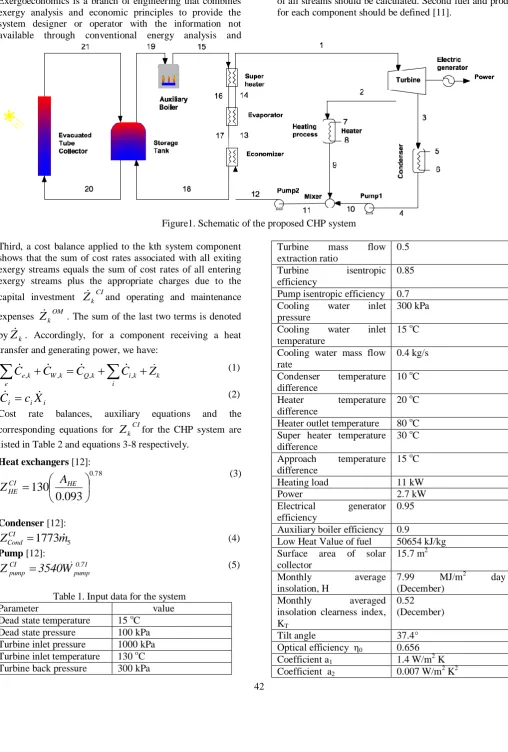
Figure 1 shows the schematic of proposed CHP system. The extracted flow of the turbine goes to the heater to supply the heat to the heating user. Turbine exhaust enters the condenser to reject the heat to the cooling water, and then these two streams (outlet of heater and condenser) are mixed in a mixer and pumped into economizer, evaporator and super heater to absorb heat from the heat source. Evacuated tube solar collectors are utilized to collect the solar radiation because of its low costs. A thermal storage system and an auxiliary boiler are used to provide continuous cooling, heating and power output when solar radiation is
Click here, type the title of your paper, Capitalize first letter of each words
First Author
a, Second Author
b,*a
First affiliation, Address, City and Postcode, Country
b
Second affiliation, Address, City and Postcode, Country
Journal of Solar Energy Research 22 (2017) 41-47
Journal of Solar Energy Research (JSER)
Journal homepage: jser.ir
A B S T R A C T
Click here and insert your abstract text. Click here and insert your abstract text. Click here and insert your abstract text. Click here and insert your abstract text. Click here and insert your abstract text. Click here and insert your abstract text. Click here and insert your abstract text. Click here and insert your abstract text. Click here and insert your abstract text. Click here and insert your abstract text. Click here and insert your abstract text. Click here and insert your abstract text. Click here and insert your abstract text. Click here and insert your abstract text. Click here and insert your abstract text. Click here and insert your abstract text. Click here and insert your abstract text. Click here and insert your abstract text. Click here and insert your abstract text. Click here and insert your abstract text. Click here and insert your abstract text Click here and insert your abstract text Click here and insert your abstract text Click here and insert your abstract text Click here and insert your abstract text Click here and insert your abstract text Click here and insert your abst
© 2013Published by University of Tehran Press. All rights reserved.
ARTICLE INFO Received:
Received in revised form: Accepted:
Available online:
Keywords:
Type 3-6 keywords here,
separated by semicolons ;
Multi Objective Exergy Based Optimization of a Solar Micro CHP System Based on
Organic Rankine Cycle
Heidarnejad
a,*,P., Hashemian
a,N., Noorpoor
a,A.R.
a
Graduate Faculty of Environment, University of Tehran, Tehran, Iran *E-Mail: [email protected]
Journal of Solar Energy Research (JSER)
Journal homepage: www.jser.ut.ac.ir
A B S T R A C T
A novel micro solar combined heating and power (CHP) cycle integrated with organic Rankine cycle (ORC) is proposed in this study. The thermal storage tank is installed to correct the mismatch between the supply of the solar energy and the demand of thermal source consumed by the CHP subsystem, thus the desired system could continuously and stably operate. The cycle is investigated and optimized from the viewpoint of thermodynamics and thermoeconomics. In base case design, the thermal efficiency, exergy efficiency and product cost rate are found to be 48.45%, 13.76% and 5688.1$/year. The thermal efficiency, exergy efficiency and product cost rate are selected as three objective functions and multi-objective optimization is carried out through Genetic Algorithm.
© 2017 Published by University of Tehran Press. All rights reserved.
ARTICLE INFO
Received: 2 May 2017 Received in revised form: 22 May 2017
Accepted: 1 June 2017
Keywords:
42 insufficient. Auxiliary boiler utilizes natural gas. In thermodynamic modeling, some inputs have been assumed as shown in Table 1.
2.1. Exergoenomic Analysis
Exergoeconomics is a branch of engineering that combines exergy analysis and economic principles to provide the system designer or operator with the information not available through conventional energy analysis and
economic evaluations, but crucial to the design and operation of a cost-effective system. We can consider exergoeconomics as exergy-aided cost minimization [11]. In SPECO method which is applied in this study, firstly exergy of all streams should be calculated. Second fuel and product for each component should be defined [11].
Figure1. Schematic of the proposed CHP system
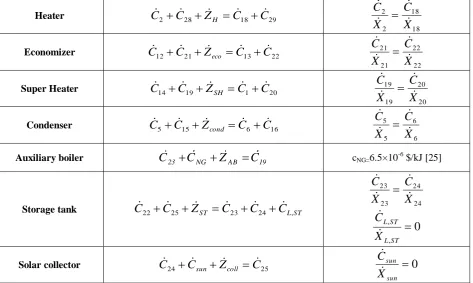
Third, a cost balance applied to the kth system component shows that the sum of cost rates associated with all exiting exergy streams equals the sum of cost rates of all entering exergy streams plus the appropriate charges due to the capital investment
Z
kCIand operating and maintenanceexpenses
Z
kOM. The sum of the last two terms is denoted byZ
k. Accordingly, for a component receiving a heat transfer and generating power, we have:, , , ,
e k W k Q k i k k
e i
C
C
C
C
Z
(1)i i
i
c
X
C
(2)Cost rate balances, auxiliary equations and the corresponding equations for
Z
kCIfor the CHP system are listed in Table 2 and equations 3-8 respectively.Heat exchangers [12]: 78 . 0
093
.
0
130
HECI HE
A
Z
(3)
Condenser [12]:
5
1773
CI Cond
Z
m
(4)Pump [12]:
CI 0.71
pump pump
Z
3540W
(5)Table 1. Input data for the system Parameter value Dead state temperature 15 oC
Dead state pressure 100 kPa Turbine inlet pressure 1000 kPa Turbine inlet temperature 130 oC Turbine back pressure 300 kPa
Turbine mass flow extraction ratio
0.5
Turbine isentropic efficiency
0.85
Pump isentropic efficiency 0.7 Cooling water inlet pressure
300 kPa
Cooling water inlet temperature
15 oC
Cooling water mass flow rate
0.4 kg/s
Condenser temperature difference
10 oC
Heater temperature difference
20 oC
Heater outlet temperature 80 oC Super heater temperature difference
30 oC
Approach temperature difference
15 oC
Heating load 11 kW
Power 2.7 kW
Electrical generator efficiency
0.95
Auxiliary boiler efficiency 0.9
Low Heat Value of fuel 50654 kJ/kg Surface area of solar
collector
15.7 m2
Monthly average
insolation, H
7.99 MJ/m2 day
(December)
Monthly averaged
insolation clearness index, KT
0.52 (December)
Tilt angle 37.4°
Optical efficiency η0 0.656
Coefficient a1 1.4 W/m2 K
43 Storage Tank [13]:
506 . 0
4042
STCI
ST
V
Z
(6)Turbine [14]:
210 10
10
log
1776
.
0
)
(
log
4398
.
1
6259
.
2
)
(
log
turb turb
CI turb
W
W
Z
(7)
Electric generator [15]: 0.95
60
CI
Elec Elec
Z
W
(8)Also, capital investments of the solar collector and auxiliary boiler in the reference year (2013) are 567 $/m2 and 28 $/kW [16]. It should be noted that capital investments of ejector, mixers, and valves can usually be neglected since their contribution to the system cost is rather small [17, 18]. Capital investment of a component is converted to the cost rate by multiplying it by 1/t, the Capital Recovery Factor (CRF) and maintenance factor (
). Here, t is the number of hours per year that the unit operates and the CRF is an economic parameter that depends on the interest rate (i) and the estimated component lifetime (N). The CRF is determined as Eq. (9) [19]:1
)
1
(
)
1
(
N N
i
i
i
CRF
(9)
In the mentioned components in Table 2, investment cost rate is calculated by Eq. (10) [12]:
t
CRF
Z
Z
k
kCI
/
(10)The parameters in Eqs. (9) and (10) are assumed to be: N=20 year, i=10%,
=1.06, t=7446h.All cost data used in an economic analysis must be brought to the reference year (in this study 2013) by the following relation and using an appropriate cost index [11]:
Cost at the reference year = original cost (cost index for reference year/ cost index for the year when the original cost was obtained)
In this study, Chemical Engineering Plant Cost Index (CEPCI) index [20] is applied for updating all costs to the year 2013.
3. Results and Discussion
The thermodynamic and thermoeconomic analyses and optimization of a solar domestic CHP cycle with 2.7 kW electric output and 11kW heating output are conducted. The daily radiation is taken as 2.21 kWh/m2[21]. Thermodynamic and thermoeconomic modeling of the system has been conducted based on simulation code in EES software [22]. The system thermal and exergy efficiency is determined to be 48.45% and 13.76%.
Effect of turbine inlet pressure
The effect of turbine inlet pressure on investment cost rate and product cost rate for fixed values of [T1=130°C,
P2=300kPa, T29=80°C] is shown in Figure 2. Figure 2
illustrates that investment cost rate decreases 1% as turbine inlet pressure varies, therefore, product cost rate decreases
3%. This means that if turbine works at higher pressures, it would be cost effective.
Effect of turbine inlet temperature
The influence of turbine inlet temperature on investment cost rate and product cost rate is illustrated in Figure 3 for fixed values of [P1=1000kPa, P2=300kPa, T29=80°C]. It is
Figure 2. Variation of product cost rate and investment cost rate versus turbine inlet pressure.
indicated that by increasing turbine inlet temperature, investment cost rate decreases slightly because of slight increment in exergy efficiency and as a result, product cost rate decreases only 5%.
Figure 3. Variation of product cost rate and investment cost rate versus turbine inlet temperature.
Effect of turbine back pressure
Figure 4 represents the effect of turbine back pressure on the investment cost rate and product cost rate for fixed values of [P1=1000kPa, T1=130°C, T29=80°C]. Figure 4 indicates that,
with a variation of about 200kPa in turbine back pressure, investment cost rate increases 3% and consequently product coat rate increases 6%.
Effect of heater outlet temperature
Figure 5 represents the effect of heater outlet temperature on investment cost rate and product cost rate [P1=1000kPa,
T1=130°C, P2=300kPa] Figure 5 illustrates that investment
44 Figure 4. Variation of product cost rate and investment
cost rate versus turbine back pressure.
2000 2200 2400 2600 2800 3000
5000 5200 5400 5600 5800 6000
50 60 70 80 90 100
In
ve
st
m
en
t c
os
t
rat
e,Ż
to
t
[$/
ye
ar
]
P
rod
u
ct
c
os
t r
at
e,Ċ
P
[$/
ye
ar
]
Heater outlet temperature, T29 [C]
Ċp,win Żtot,win
Figure 5. Variation of product cost rate and investment cost rate versus turbine back pressure.
4. Optimization
In this section, multi objective optimization is simultaneously carried out through optimizing thermal efficiency (
tot), exergy efficiency of (
tot) and CHPproduct cost rate (
C
p tot, ). Multi-objective optimizationproblems, generally, show a possibly uncountable set of solutions whose evaluated vectors represent the best possible trade-offs in the objective function space [23]. In this work, the genetic meta-heuristic algorithm (GA) through EES software is used for optimization of CHP plant. The selected decision variables in this work are turbine inlet temperature (
T
1), turbine inlet pressure (P
1), turbine backpressure (
P
2) and heater outlet temperature (T
28).One of the approaches to multi objective optimization problems is weighted cost functions. In this approach, we weight each function and add them together to obtain a single objective function which can be maximized or minimized using GA [24]. In fact, the different optimal solutions on the Pareto front can then be obtained by varying the weight coefficients [23, 24] and each optimal solution is selected using engineering experience and importance of each objective.For the CHP considered in this paper, the combined objective can be constructed by summing the three before mentioned objectives with some appropriate weights, as Eqs. (11) to (13):
Objective 1:
elec H
CCHP ,win
coll t NG NG
W
Q
A
G
m
LHV
(11)Objective 2:
elec H
CCHP ,win
sun NG
W
X
X
X
(12)Objective 3:
P,tot F ,tot tot
C
C
Z
(13)))
1
(
)
,
,
,
(
(
3 2
1
29 2 1 1
p tot
tot
w
w
C
w
T
P
T
P
F
MAX
(28)
1
,
,
0
w
1w
2w
3
(29)1
3 21
w
w
w
(30)Table 2. Cost rate balances and auxiliary equations for components
Components Cost rate balance Auxiliary
Equation
Turbine
turb
w
turb
C
C
C
Z
C
1
2
3
3 3
2 2
1 1
X
C
X
C
X
C
Mixer
C
17
C
18
Z
M
C
11 _Electric generator
C
wnet
Z
gen
C
welecEvaporator
C
13
C
20
Z
eva
C
14
C
2121 21
20 20
X
C
X
C
Pump1
C
10
C
wpump1
Z
pump1
C
17 _45 Heater
C
2
C
28
Z
H
C
18
C
2918 18
2 2
X
C
X
C
Economizer
C
12
C
21
Z
eco
C
13
C
2222 22
21 21
X
C
X
C
Super Heater
C
14
C
19
Z
SH
C
1
C
2020 20
19 19
X
C
X
C
Condenser
C
5
C
15
Z
cond
C
6
C
166 6
5 5
X
C
X
C
Auxiliary boiler
C
23
C
NG
Z
AB
C
19 cNG=6.5×10⁻⁶ $/kJ [25]Storage tank
C
22
C
25
Z
ST
C
23
C
24
C
L,ST 24 2423 23
X
C
X
C
0
, ,
ST L
ST L
X
C
Solar collector
C
24
C
sun
Z
coll
C
25
0
sun sun
X
C
2 1
,
w
w
andw
3 are weighting factors for energetic, exergetic and thermoeconomic objectives, respectively. Selecting different values of weighting factors enable thedecision maker to choose any set of optimal solutions.
Table 3 shows the decision variables and feasibility values for multi objective optimization.
Table 3. Decision variables and feasibility values Decision variables value
Turbine inlet pressure
850
(
)
1000
1
P
kPa
Turbine inlet temperature
115
(
)
145
1
T
C
Turbine back pressure
250
(
)
400
2
P
kPa
Heater outlet temperature
50
(
)
100
28
T
C
In this study, three of the coefficients are considered 1/3 and the results are indicated in Table 4.
Table 4. Base case and optimal case values of the decision variables and objective functions
Parameters Base case Optimal case Turbine inlet
pressure (kPa)
1000.00 974.30
Turbine inlet temperature (oC)
130.00 144.90
Turbine back pressure (kPa)
200.00 258.60
Heater outlet temperature (oC)
80.00 100
Thermal efficiency (%)
48.45 50.41
Exergy efficiency (%)
13.76 15.55
Product cost rate ($/year)
5688.1 5454.9
Table 4 shows that in the optimal case, thermal and exergy efficiencies improve 4% and 13% respectively while product cost rate decreases 4%.
5. Conclusion
The present work provides an application of well-known SPECO methodology of thermoeconomic analysis to evaluate a solar micro-CHP integrated with ORC.
By formulating exergy balance, cost balance and auxiliary equations for each component and solving them through EES software, thermal efficiency, exergy efficiency and product cost rate were calculated to be 48.45%, 13.76% and 5688.1$/year. Then the parametric analysis is done by assessing the effect of thermodynamic variables on the system investment cost rate and product cost rate. The results show that lower CHP product cost rate is obtained at higher turbine inlet pressure and temperature and heater outlet temperature but lower turbine back pressure. In the last section, multi objective optimizations are carried out through GA and results indicate that thermal efficiency, exergy efficiency, and product cost rate in optimum case improves 4%, 13% and 18%, respectively.
Nomenclature
A Surface area (m2)
c Cost per exergy unit ($/GJ) Ċ Cost rate ($/year)
i Interest rate (%)
m
Mass flow rate (kg/s)t System operating hours (hour)
V Volume
W
Power (kW)X
Exergy (kW)Z Investment cost ($)
46 Subscripts
AB Auxiliary Boiler Coll Solar collector Cond Condenser e Outlet Eco Economizer elec Electrical Eva Evaporator gen Electric generator
H Heater
HE Heat Exchanger
i Inlet
M Mixer
NG Natural Gas pump Pump
Q Heat
SH Super Heater ST Storage Tank turb Turbine
w Power
Super scripts
CI Capital Investment N Component lifetime (year) OM Operating and Maintenance Greek symbols
ε Exergy efficiency η Thermal efficiency
Maintenance factor AbbreviationCHP Combined Heating and Power
CEPCI Chemical Engineering Plant Cost Index CRF Capital Recovery Factor
EES Engineering Equation Solver ORC Organic Rankine Cycle SPECO Specific Exergy Costing
References
[1] G. Qiu, Y. Shao, J. Li, H. Liu, S.B. Riffat. Experimental investigation of a biomass-fired ORC-based micro-CHP for domestic applications. Fuel. 96 (2012) 374-82.
[2] D. Tempesti, D. Fiaschi. Thermo-economic assessment of a micro CHP system fuelled by geothermal and solar energy. Energy. 58 (2013) 45-51.
[3] D. Tempesti, G. Manfrida, D. Fiaschi. Thermodynamic analysis of two micro CHP systems operating with geothermal and solar energy. Applied Energy. 97 (2012) 609-17.
[4] H. Liu, Y. Shao, J. Li. A biomass-fired micro-scale CHP system with organic Rankine cycle (ORC)–Thermodynamic modeling studies. Biomass and Bioenergy. 35 (2011) 3985-94.
[5] A.M. Pantaleo, P. Ciliberti, S. Camporeale, N. Shah. Thermo-economic assessment of small scale biomass CHP: steam turbines vs ORC in different energy demand segments. (2015).
[6] R. Soltani, I. Dincer, M.A. Rosen. Thermodynamic analysis of a novel multigeneration energy system based on heat recovery from a biomass CHP cycle. Applied Thermal Engineering. 89 (2015) 90-100.
[7] D. Mikielewicz, J. Mikielewicz. A thermodynamic criterion for selection of working fluid for subcritical and
supercritical domestic micro CHP. Applied Thermal Engineering. 30 (2010) 2357-62.
[8] Á. Campos-Celador, E. Pérez-Iribarren, J.M. Sala, L.A. del Portillo-Valdés. Thermoeconomic analysis of a micro-CHP installation in a tertiary sector building through dynamic simulation. Energy. 45 (2012) 228-36.
[9] P. Ahmadi, I. Dincer. Exergoenvironmental analysis and optimization of a cogeneration plant system using Multimodal Genetic Algorithm (MGA). Energy. 35 (2010) 5161-72.
[10] P. Ahmadi, A. Almasi, M. Shahriyari, I. Dincer. Multi‐objective optimization of a combined heat and power (CHP) system for heating purpose in a paper mill using evolutionary algorithm. International Journal of Energy Research. 36 (2012) 46-63.
[11] A. Bejan, G. Tsatsaronis, M.J. Moran. Thermal design and optimization. John Wiley & Sons Inc., New York, 1996. [12] F. Mohammadkhani, N. Shokati, S.M.S. Mahmoudi, M. Yari, M.A. Rosen. Exergoeconomic assessment and parametric study of a Gas Turbine-Modular Helium Reactor combined with two Organic Rankine Cycles. Energy. 65 (2014) 533-43.
[13] S. Martínez-Lera, J. Ballester, J. Martínez-Lera. Analysis and sizing of thermal energy storage in combined heating, cooling and power plants for buildings. Applied Energy. 106 (2013) 127-42.
[14] R.S. El-Emam, I. Dincer. Exergy and exergoeconomic analyses and optimization of geothermal organic Rankine cycle. Applied Thermal Engineering. 59 (2013) 435-44. [15] L. Pierobon, T.-V. Nguyen, U. Larsen, F. Haglind, B. Elmegaard. Multi-objective optimization of organic Rankine cycles for waste heat recovery: Application in an offshore platform. Energy. 58 (2013) 538-49.
[16] http://www.apricus.com.au/downloads/. product specification sheet.
[17] L.G. Farshi, S. Mahmoudi, M. Rosen. Exergoeconomic comparison of double effect and combined ejector-double effect absorption refrigeration systems. Applied Energy. 103 (2013) 700-11.
[18] B.H. Gebreslassie, G. Guillén-Gosálbez, L. Jiménez, D. Boer. Design of environmentally conscious absorption cooling systems via multi-objective optimization and life cycle assessment. Applied Energy. 86 (2009) 1712-22. [19] L. Garousi Farshi, S. Mahmoudi, M. Rosen. Exergoeconomic comparison of double effect and combined ejector-double effect absorption refrigeration systems. Applied Energy. 103 (2013) 700-11.
[20] CEPCI. Chemical Engineering Plant Cost Index. Chem Eng. (2010) 76.
[21] J. Paul W. Stackhouse, Ph.D. NASA Surface meteorology and Solar Energy. 2013.
[22] S.A. Klein. engineering equation solver (EES). 2013. [23] H. Sayyaadi, A. Saffari, A. Mahmoodian. Various approaches in optimization of multi effects distillation desalination systems using a hybrid meta-heuristic optimization tool. Desalination. 254 (2010) 138-48.
[24] R.L. Haupt, S.E. Haupt. Practical genetic algorithms. John Wiley & Sons2004.