AUT J. Model. Simul., 49(1)(2017)3-12 DOI: 10.22060/miscj.2016.873
Output Consensus Control of Nonlinear Non-minimum Phase Multi-agent Systems
Using Output Redefinition Method
F. Shamsi, H. A. Talebi*, F. Abdollahi
Department of Electrical Engineering, Amirkabir University of Technology, Tehran, Iran
ABSTRACT: This paper concerns the problem of output consensus in nonlinear non-minimum phase systems. The main contribution of the paper is to guarantee achieving consensus in the presence of unstable zero dynamics. To achieve this goal, an output redefinition method is proposed. The new outputs of agents are functions of original outputs and internal states and defined such that the dynamics of agents are minimum phase. However, since the main objective is to achieve consensus on original outputs of agents, the consensus invariant set in the new coordinate of the agents dynamics should be defined such that if the new states of the agents converge to this invariant set, the output consensus in original system is achieved. On the other words, achieving consensus in minimum phase system with redefined output is equivalent to output consensus in original system. After defining the proper invariant set, a consensus protocol is designed to guarantee that the redefined outputs and the internal states to this set. Theoretical results are mathematically proved based on Lyapunov criterion. Numerical examples are employed to show the effectiveness of the proposed approach.
Review History:
Received: 3 June 2016 Revised: 19 November 2016 Accepted: 21 December 2016 Available Online: 25 December 2016
Keywords:
Consensus
multi-agent system
non-minimum phase dynamics zero dynamics
output redefinition
1- Introduction
Cooperative control of multi-agent systems has received lots of attentions in the past few years. Some examples of multi-agent systems applications are robotics [1,2], unmanned aerial vehicles [3], autonomous underwater vehicles [4], and space systems [5].
Control problems such as sensor fusion [6,7], formation control in multi-robot systems [8-13], rendezvous for unmanned vehicles [14], and synchronization [15-19] are some of the problems that have arisen in multi-agent systems research area. One of the challenging problems in this area of research is the consensus which means agreement of agents on a certain quantity of interest [20-23].
In the past few years consensus control of multi-agent systems has been studied over various classes of agents dynamics. For the first time, consensus control of agents with single-integrator models was studied in [20,21]. Since then, several methods for achieving consensus among agents with more complex models such as double-integrators [22-25], and general linear dynamics [26,27], have been proposed. In many real applications, the dynamics of agents are nonlinear, and linearization of agents dynamics will affect the performance and the region of convergence. Therefore, some studies have been devoted to the control of multi-agent systems with different types of nonlinear models.
The consensus problem over various classes of nonlinear dynamics have been investigated in the literature. For instance, consensus control of multi-agent systems with first-order nonlinear models were studied in [28-31]. The consensus problem in second-order nonlinear multi-agent systems were investigated in [32-37]. In [38], a control scheme for achieving consensus in a multi-agent system in
which the dynamics of the agents were nonlinear with relative degree two and stable internal dynamics was proposed. A technique for output synchronization has been studied in [39] for a group of agents with nonlinear dynamics by using the feedback linearization approach and based on the asymptotic stability assumption of the agents zero dynamics. Finally, in [40-42], consensus control of multi-agent systems with Lagrangian dynamics of agents were studied.
All of the above mentioned methods for solving consensus problems are generally based on dynamics inversion. In other words, they have considered nonlinear systems without internal dynamics or systems with stable internal dynamics. However, there are many systems which are non-minimum phase, i.e., poses unstable zero dynamics, (e.g. flexible manipulators, satellites with flexible panels, etc). In such systems, if the instability of internal dynamics is not considered in controller design, the internal states of the systems would grow unboundedly. Therefore, since the inverse dynamics of a non-minimum phase system is unstable, dynamics inversion based methods cannot be applied to multi-agent systems with non-minimum phase dynamics of agents. To the best of the authors’ knowledge, the problem of consensus control for a leaderless multi-agent systems with nonlinear non-minimum phase dynamics is still open to study.
Control of non-minimum phase systems is a challenging problem which has been studied in literature extensively [43-48]. In such systems, perfect reference tracking cannot be achieved due to the limitations which are caused by unstable zero dynamics. Recently, the performance limitations of non-minimum phase systems have been studied in [48], and new classifications for non-minimum phase systems based on value of minimum norm of the regulation error is proposed.
To deal with non-minimum phase systems problem, several methods are proposed such as output regulation [49,50], sliding mode [51]-[53], output redefinition [54,55] etc.
Output Redefinition is one of the most common methods that is presented to solve the tracking problem in non-minimum phase system [54]. The main ideas of this method are:
• define a new output such that the zero dynamics with respect to this redefined output are stable (e.g. the system with the modified output is minimum phase,
• define a modified desired trajectory such that if the new output tracks the new desired trajectory, the original output tracks the original desired trajectory, as well. In [55], a new method for output redefinition is proposed. In this method, the possible relative degrees for systems with new output is determined. Some conditions are considered to guarantee the minimum phase property of the system with redefined outputs.
In this paper, based on the idea of the output redefinition method, a consensus strategy is proposed to achieve output consensus in nonlinear non-minimum phase multi-agent systems. In this method, a structure for redefining a new output is presented such that the zero dynamics of the agents are exponentially stable with respect to this output. Since, there is no desired trajectory to be modified, based on this definition, a new consensus invariant set is proposed for the states of the agents to converge such that the output consensus for the original outputs of the agents is achieved, which is the main objective of control design.
The following notations are considered throughout the paper.
R is the set of real numbers. R+ denotes the set of positive real numbers 1 is a vector with all elements equal to 1, In denotes an nₓn identity matrix, stands for the Kronecker product, and ||.|| indicates the 2-norm. Moreover, lmin(M) and lmax(M) denote the minimum and maximum eigenvalues of the matrix
M, respectively.
The rest of the paper is organized as follows. Some preliminaries are presented in Section 2. In Sections 3 and 4, agents model definition and the main result for output consensus problem for nonlinear non-minimum phase multi-agent systems are investigated, respectively. A numerical example is presented in Section 5, and Section 6 concludes the paper.
2- Preliminaries
2- 1- GRAPH THERORY
The interconnection among agents is modelled using an undirected graph G described by a node (agent) set V={1,2,...,N} and an edge set e⊆vₓv which (i,j)∈e if there exists an edge between the ith and jth nodes. The neighbouring set of the node can be defined as Ni⊂V which j∈Ni if (i,j)∈e. In the graph, a path between two nodes is a sequence of edges connecting these two nodes. Moreover, a connected graph is a graph in which there exists a path between each two distinct nodes. The Laplacian matrix associated with the graph can be defined as L=[lij]NₓN where lij= lji=-1,i≠j if (i,j)∈e while lij=0 otherwise, and . It is known that for an undirected graph, the Laplacian matrix is symmetric. It can be said that for a connected graph, the Laplacian matrix is positive semi-definite with a simple zero eigenvalue.
2- 2- Non-Minimum Phase Systems
Let us consider the following -order nonlinear systems [45]:
in which where y∈R is the output, z∈R(n-r) denotes the internal states vector, and stands for the internal dynamics.
Definition 1: In (1), let u is selected such that y and all of its derivatives stay identically at zero. In this condition, the internal dynamics of the system are called its zero dynamics described as follows [45]:
Definition 2: If the zero dynamics of a nonlinear system are unstable, the nonlinear system is called non-minimum phase [45].
3- Problem Formulation
Consider a group of agents with identical nonlinear non-minimum phase dynamics as follows:
where yi, zi, and ui∈R are the output, internal state, and the input of the ith agent, respectively. Moreover, f and g
are continuous nonlinear functions. It is assumed that the dynamics of the agents are non-minimum phase. This means that the zero dynamics of agents defined by the following equation, is unstable.
The objective is to find ui such that the consensus among outputs of the agents, yi,i∈{1,2,...,N}, is achieved, i.e.
Therefore, the consensus invariant set can be defined by the following set:
It can be seen that if the outputs of the agents converge to M1 output consensus is obtained.
Before presenting the main results, the following assumptions are considered:
Assumption 1: Nonlinear functions f and g are Lipschitz with respect to their arguments:
where are Lipschitz constants for every and .
Assumption 2: There exists a nonlinear Lipschitz function
j(zi) (with Lipschitz constant h1) such that j(0)=0 and the nonlinear system
is exponentially stable. We assume that
It should be noted that since nonlinear functions g(.,.) and j(.) are Lipschitz, and considering (8), it can be concluded that g1 is also a Lipschitz function as follows:
It is also assumed that .
More details on defining new output can be found in [54] and [55].
⊗
1
=
= −∑N
ii ij i
l l
( )
( , )
( , ) ,
( , ),
=
+
=
µ
µ
µ
ry
a
z
b
z u
z w
z
(1)( 1)−
= … µ y y y r
( ,z) =
µ
z w
(0, ).
=
z w
z
(2)(3)
(4)
(5)
(6)
(7) (8)
(9)
( , )
,
( , ),
{1,2, , },
=
+
=
∈
i i i i
i i i
y
f y z
u
z
g y z i
N
(0, ).
=
i iz
g
z
lim(→∞ i − j) 0, ,= ∈{1,2, , }…
t y y i j N
1
=
{( , , ,
1 2…
N) |
1=
2= … =
N}
M
y y
y
y
y
y
1 2
3 4
( , ) ( , ) | | | | |, | ( , ) ( , ) | | | | |,
− ≤ − + −
− ≤ − + −
g g
g g
i i j j i j i j
i i j j i j i j
f y z f y z y y z z
g y z g y z y y z z
1, , ,2 3 4∈+∪{0}
g g g g
( , )y zi i ( , )y zj j ∈2
( ( ), )
=
i i iz
g
j
z z
1
(
i+
( ), )
i i= −
i+
( , ).
i ig y
j
z z
α
z
g y z
1 1 5 6
| ( , )g y zi i −g y z( , ) |j j ≤g |yi −yj |+g |zi−zj|.
6
>
Assumption 3: The states of the agents, i.e. both output and internal state, are available for transmission among the neighbouring agents.
Remark 1: It should be noted that by considering local Lipschitz conditions, our analysis will be the same as it for global Lipschitz conditions; however, in this condition, the results are valid locally.
4- Control Design
In this section, a control protocol based on the output redefinition is proposed. In this method, we first redefine a new output for agents (a new set of coordinates for describing the agents dynamics) such that the system with respect to this redefined output is minimum phase and then we define a new consensus invariant set such that if the modified outputs converge to the new invariant set, the original outputs would also converge to the original consensus invariant set, M1 , as well.
First, Let us define the modified outputs of the agents as follows: where j(zi) is a nonlinear Lipschitz function which satisfies Assumption 2. It can be easily seen that qualifies as a new set of coordinates for the dynamics of the agents. Then, in the new coordinates, the dynamics of the agents can be rewritten as:
We claim that the new system (11) with the redefined output yinew is minimum phase. To prove this, the stability of the zero dynamics of the new system should be investigated. The zero dynamics of the system (11) can be obtained as follows: Using Assumption 2, it can be concluded that the zero dynamics of the new system are exponentially stable. Therefore, the new system with the redefined output is minimum phase.
The main objective of this paper is to achieve consensus among the original outputs of the agents, yi,i=1,...,N , i.e. the original outputs of the agents converge to the consensus invariant set M1. Therefore, we should redefine the consensus invariant set in the new coordinates such that if the states of the new system converge to the redefined set, the original outputs converge to M1, as well. In this condition, it can be concluded that the proposed approach guarantees achieving output consensus in the multi-agent system with non-minimum phase dynamics of the agents.
Consider the following invariant set in the new coordinates:
Using the definition of M1 and yinew, it can be seen that M1=M2. Let us define M3 as follows:
It can be easily verified that M3⊂M2 and since M1≡M2, it can be concluded that M3⊂M1. Therefore, if the states of the new system (11) converge to M3, the original outputs of the agents will also converge to M1, and hence the output consensus will be achieved.
For simplicity, we consider the control signal as follows:
Considering (11) and (15), the model of the agents in the new coordinates can be obtained as
The control signal is designed as follows:
where k is a positive constant. The main results of this paper are summarized in Theorem 1.
Theorem 1: Consider a group of N agents with uniform and nonlinear non-minimum phase dynamics (3). Suppose that the communication graph among the agents is undirected and connected, and Assumptions 1, 2 and 3 hold. Then, the control signal proposed in (15) and (17) asymptotically solves the output consensus problem of the agents if the following condition hold:
where
Proof:
According to the definition of Laplacian matrix, we have
where lij is the (i,j)th element of the Laplacian matrix. The closed loop dynamics of the agents can be obtained by substituting (17) into (16) and considering (19) as follows:
Considering (8), the internal dynamics of the system (20) can be rewritten as
The consensus error for the redefined output and the error of internal state for the ith agent are defined as follows:
where
( ),
=
−
inew i i
y
y
j
z
(10)(11)
(12)
(13)
(14) (yinew, )zi
(
( ), )
( )
(
( ), )
,
(
( ), ).
+
∂
−
+
+
=
+
=
∂
inew inew i i
i
inew i i i
i
i inew i i
y
f y
z z
z g y
z z
u
z
z
g y
z z
j
j
j
j
( ( ), ).
=
i i iz
g
j
z
z
2 1 1 2 2
1 1
{(
, ,
, , ,
,
) |
( )
( )}
=
…
+
= … =
+
new new Nnew N
new Nnew N
M
y
z y
z
y
z
y
j
z
y
j
z
3 1 1 2 2
1 1
{(
, ,
, , ,
,
) |
,
}
=
…
= … =
= … =
new new Nnew N
new Nnew N
M
y
z y
z
y
z
y
y
z
z
( ) ( ( ), )
∂
= + +
∂ i
i inew i i i
i
z
u g y z z v
z
j
j
(15)(16) (17) (18) (19) (20) (21) (22) (23)
1
(
( ), )
,
(
( ), ).
=
+
+
=
+
inew inew i i i
i inew i i
y
f y
z z
v
z
g y
z z
j
j
(
),
∈=
∑
−
ii jnew inew
j
v
k
y
y
(
)
2 2 5 12
( ) 4(
6) ( )
2′
+
>
+
−
k
l
g
α g l
g
g
2′ = 1 1+ 2
g g h g
1 ( ) . ∈ = − = −
∑
∑
i Njnew inew ij jnew
j j
y y l y
1
(
( ), )
,
(
( ), ).
==
+
−
=
+
∑
Ninew inew i i ij jnew
j
i inew i i
y
f y
z z
k
l y
z
g y
z z
j
j
1
(
, ).
= −
+
i i inew iz
α
z
g y
z
,
,
=
−
=
−
i inew i ie
y
s
z
q
e
1 1
1
,
1
.
= =
=
∑
N jnew=
∑
N jj j
s
y
q
z
Considering this definitions, it can be concluded that if
and then the states of the system (11) converge to . Now, by using (20), (21), and (22) and considering , the error dynamics can be obtained as follows:
To study the asymptotic stability of (24), the following Lyapunov candidate function is used:
Now, taking the time derivative of V along the error trajectories of (24) yields in
Now, by adding f(s+j(q),q) and g1(s,q) to and subtracting them from the right-hand-side of (25), and after some manipulation, one can get
where s and q are defined in (23). Using the definition of ei and ei in (22), it can be verified that and . Therefore, it can be concluded that
Since two terms
and are independent of the summation variable i. Considering (26) and (27), one can obtain
Assumption 1 and the Lipschitz conditions (6) and (9) yield in
where is defined in Theorem 1. Therefore, by using (28) and (29), it can be concluded that:
Considering the definition of the Laplacian matrix, one can get
where L is the Laplacian matrix, and
In this condition, substituting (31) into (30) results in
It is assumed that the communication graph of the network is connected. Therefore, the Laplacian matrix L has exactly one zero eigenvalue and the other eigenvalues are positive real numbers denoted by l2≤...≤lN. Moreover, the right and left eigenvectors corresponding to the zero eigenvalue are and , respectively [46]. There exists a unitary matrix F such that , where the first column of F is . Now, consider the following definition:
Since the left eigenvector associated with the zero eigenvalue of the Laplacian matrix is , it can be verified that
Therefore, by defining , one can conclude that , where . By substituting into (32), one can obtain
lim 0
→∞ i=
t e
lim→∞ i =0, ∈{1,2, , }
t e i N
1 0
=
=
∑
N ij j l s1 1 1 1 1 ( ( ), )) 1 ( ( ), ) , 1 ( , ) ( , ). = = = = + − + − = − + −
∑
∑
∑
i inew i i
N N
jnew j j ij j
j j
N
i i inew i jnew j
j
e f y z z
f y z z k l e
N
g y z g y z
N
j
j
e
αe
(24) (25) (26) (27) 2 2 11
.
2
==
∑
N i+
ii
V
e
e
1 1 1 1 1 1 ( ( ( ), ) 1 ( ( ), ) ) 1 ( ( , ) ( , ))
(
)
= = = = = + − + − + − + −∑
∑
∑
∑
N i inew i ii
N N
jnew j j ij j
j j
N
i i inew i jnew j
j
V e f y z z
f y z z k l e
N
g y z g y z
N j j e αe 1 1 2
1 1 1
1
1 1 1
( ( ( ), ) ( ( ), )) 1 ( ( ( ), ) ( ( ), )) ( ( , ) ( , )) ( ( , ) 1 ( , )) .
(
)
= = = = = = + − + + + − + − + − + − −∑
∑
∑
∑ ∑
N i inew i i
i
N
i jnew j j
j
i i inew i i
N N N
jnew j i ij j
j i j
V e f y z z f s q q
e f s q q f y z z
N
g y z g s q g s q
g y z k e l e
N
j j
j j
αe e e
1 0
= =
∑
N i i e 1 0 = =∑
N i i e 1 1 1 1 1 1 ( ( ( ), ) 1( ( ), )) 0
1
( ( , ) ( , ) 0,
= = = = + − + = − =
∑
∑
∑
∑
N i i Njnew j j
j
N N
i jnew j
i j
e f s q q
f y z z
N
g s q g y z
N
j
j
e
1 1 ( ( ( ), ) ( ( ), )) =+ −
∑
N jnew + j jj
f s q q f y z z
N j j 1 1 1 1 ( ( , ) ( , ) =
−
∑
N jnew jj
g s q g y z N 1 2 1 1 1 1
( (
( ), )
(
( ), ))
( (
, )
( , ))
.
(
)
= = ==
+
−
+
−
+
−
−
∑
∑ ∑
N i inew i ii
i i inew i
N N
i ij j
i j
V
e f y
z z
f s
q q
g y
z
g s q
k
e
l e
j
j
αe
e
(28)(29) (30) (31) (32) (33) (34) (35) 1 2
1 1 5 6
| (
( ), )
(
( ), ) |
| |
| |,
| ( (
, )
( , )) |
| |
| |.
′+
−
+
≤
+
−
≤
+
inew i i
i i
inew i i i
f y
z z
f s
q q
e
g y
z
g s q
e
j
j
g
g e
g
g e
2′
g
2
1 2 5
1 2 6 1 1
| | (
) | || |
(
) | |
.
(
)
′ = = =≤
+
+
+
−
−
∑
∑ ∑
N i i ii
N N
i i ij j
i j
V
e
e
k
e
l e
g
g
g
e
g
α e
1 1
= =
−
∑ ∑
N i N ij j= −
i j
k
e
l e
ke e
[
1 2]
=
Ne e e
e
2
1 2 5
1 2 6
| | (
) | || |
(
) | |
.
(
)
′ =≤
+
+
+
−
−
∑
N i i ii
i
V
e
e
ke e
g
g
g
e
g
α e
1 1 N 1 1 N 1 1 N 1 1 N 2
diag{0, , , }
FF = L = l lN
[
1 2]
= F
,
Ne
w
w w
w
1
=
1
e
=
0
N
w
[
2]
= N
z
w
w
0
=
w z −1
∈N z
= FLF
2
1 2 5
1 2 | | ( ) | || | ( ) | | .
(
)
′ = ≤ + ++ − − FLF
∑
N i i i
i
V e e
ke e
g
g
g
e
By using the definition (33), (35) can be restated as follows:
Considering that L is a diagonal matrix containing the eigenvalues of the Laplacian matrix and by using (34), the following inequality can be concluded from (36):
where . Since G is a diagonal positive definite matrix, it can be concluded that
Now, substituting (38) into (37) results in
Since F is a unitary matrix, it can be verified that ||w||=||Fe||=||e||. Moreover, based on the definitions of w, one can say that ||z||=||w||, implying that ||z||2=||e||2, and therefore
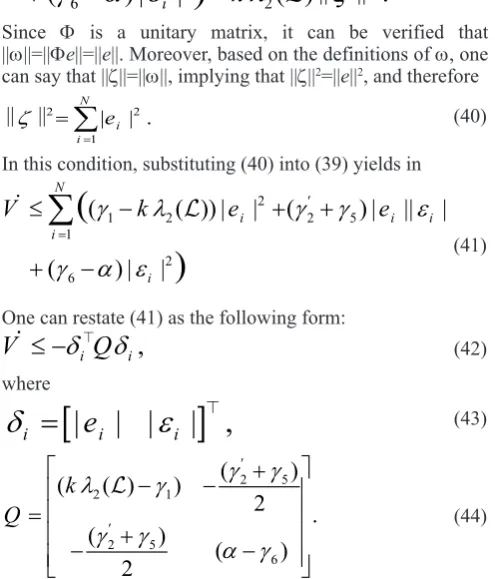
In this condition, substituting (40) into (39) yields in
One can restate (41) as the following form: where
Now, let us investigate the sign of . Considering (42), (43), and (44), it can be concluded that if we select control gain k
such that Q is positive definite, would be negative definite, and therefore the consensus errors of the redefined output and internal state converge to zero asymptotically. Hence, the states of redefined system (11) converge to M3. It can be verified that condition (18) guarantees that Q is a positive definite matrix. On the other hand, since M3⊂M2 and M1≡M2, one can conclude that the original outputs of the agents
converge to M1 and therefore, output consensus is achieved. This completes the proof.
5- Simulation
In this section, two examples are considered to show the effectiveness of the proposed approach.
Example 1: Consider a group of four agents described by the following nonlinear non-minimum phase dynamics:
It is assumed that the communication graph is as shown in Fig. 1. Therefore, the minimum eigenvalue of the Laplacian matrix is 2. Moreover, the Lipschitz constants can be calculated as
g1=2, g2=0.5, g3=1 and g4=1. To redefine the output, j(zi)=−2zi is selected. It can be verified that using yinew=yi+2zi, the redefined system is minimum phase. In this condition, to satisfy (18), the controller gain is set to k=5. Now, let us define the agent coupling error with respect to neighbouring agents as follows:
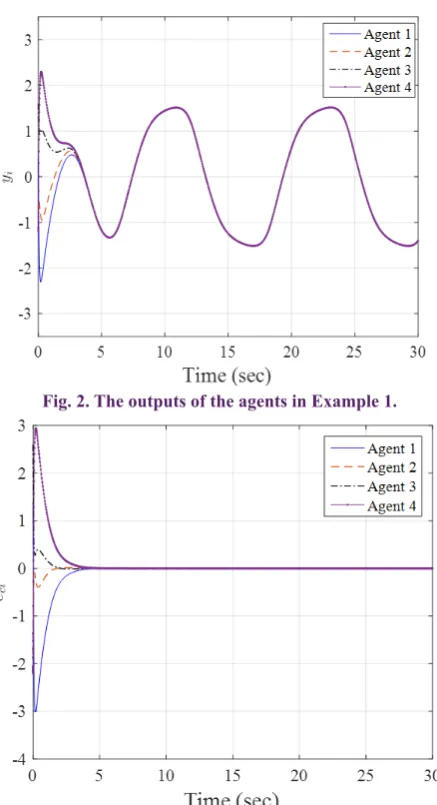
where ni denotes the number of the neighbours of ith agent. The original outputs and the coupling errors of the agents are depicted in Fig. 2 and Fig. 3, respectively and as shown in these figures, the outputs of the agents converge to a common value and also the coupling errors converge to zero, confirming that output consensus is achieved. The internal states of the agents are shown in Fig. 4. It can be seen that, the internal states of the agents are bounded. Furthermore, the control signal of each agent is depicted in Fig. 5, which are also bounded.
Example 2: In this example, we consider a network of four disturbed forced Van der Pol oscillators which have a wide range of applications in various areas such as physics, biological systems, social networks, engineering, etc. [47]. The dynamical model of each oscillator is
Based on Definition 2, the zero dynamics of the agents can be obtained as which are not asymptotically stable. Thus, they are non-minimum phase. The communication topology of the multi-agent is as the previous example. We consider j(zi)=−1.5zi for output redefinition. Based on the results of Theorem 1, the controller gain is set to k=2. It should be noted that the nonlinear terms in the dynamics of the agents are locally Lipschitz. Therefore, the results of Theorem 4.2 are valid locally. The main outputs of the agents
2
1 2 5
1 2 6
| | (
) | || |
(
) | |
.
(
)
′ =≤
+
+
+
−
−
L
∑
N i i ii
i
V
e
e
k
g
g
g
e
g
α e
w w
(36) (37) (38) (39) (40) (41) (42) (43) (44) 2
1 2 5
1 2 6
| | (
) | || |
(
) | |
.
(
)
′ =≤
+
+
+
−
−
G
∑
N i i ii
i
V
e
e
k
g
g
g
e
g
α e
z
z
2
diag{ , , }
G = l lN
2
2
( )
.
−
k
z
G ≤ −
z
k
l
‖ ‖
z
2
1 2 5
1 2 2 6 2
| | (
) | || |
(
) | |
( )
.
(
)
′ =≤
+
+
+
−
−
∑
N i i ii
i
V
e
e
k
g
g
g
e
g
α e
l
‖ ‖
z
2 2
1
| | .
=
=
∑
N ii e
z
‖ ‖
2
1 2 2 5
1 2 6
(
( )) | | (
) | || |
(
) | |
(
)
′ =≤
−
+
+
+
−
∑
N i i ii
i
V
g
k
l
e
g
g
e
e
g
α e
,
≤ −
i iV
δ
Q
δ
[
| | | | ,
]
=
i
e
i iδ
e
2 5 2 1 2 5 6
(
)
(
( )
)
2
.
(
)
(
)
2
′ ′
−
−
+
=
−
+
−
k
Q
g
g
l
g
g
g
α g
V
V
2sin( ) 0.5 ,
tanh( ) .
= + +
= +
i i i
i i
i
i
y z u
z z y
y
1
,
∈
=
−
∑
i
ci i j
j i
e
y
y
n
Fig. 1. The communication topology associated with the MAS network.
(
2)
( )
0.1
0.3 1
sin
,
.
= −
+
−
+
+
=
i i i i ii i
z
z y
t
u
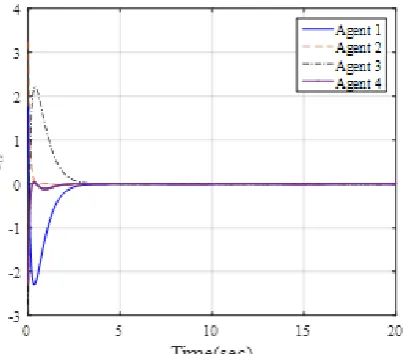
and the consensus coupling errors are depicted in Fig. 6 and Fig. 7, respectively. It can be seen that the outputs consensus is achieved, and as shown in Fig. 8, the internal states of the agents are bounded. Furthermore, the control signal of each agent is given in Fig. 9.
6- Conclusion
A new consensus strategy for a network of agents with nonlinear and non-minimum phase dynamics based on output redefinition was proposed in this paper. In this method, an output redefinition was done such that the new system is minimum phase with respect to the redefined output. Then,
Fig. 2. The outputs of the agents in Example 1. Fig. 5. The inputs of the agents in Example 1.
Fig. 5. The inputs of the agents in Example 1. Fig. 3. The coupling errors of the agents in Example 1.
we defined a new consensus invariant set such that if the states of the redefined system converge to this set, the original outputs converge to original consensus invariant set, as well. Therefore, the proposed strategy guaranteed achieving output consensus in the network of agents with nonlinear non-minimum phase dynamics.
References
[1] Das, A., Fierro, R., Kumar, V., Ostrowsky, J., Spletzer, J., and Taylor, C., ”,A Vision-Based Formation Control Framework”, IEEE Transactions on Automatic Control, vol. 18, no. 5, pp. 813–825, 2002.
[2] Rezaee, H., and Abdollahi, F., “A Decentralized Cooperative Control Scheme with Obstacle Avoidance for A Team of Mobile Robots”, IEEE Transactions on Industrial Electronics, vol. 61, no. 1, pp. 347–354, 2014.
[3] Kuriki, Y., and Namerikawa, T., “Consensus-Based Cooperative Formation Control with Collision Avoidance for A Multi-UAV System”, in Proceedings of the American Control Conference, USA, June 2014, pp. 2077–2082.
[4] Edwards, D., Bean, T., Odell, D., and Anderson, M., “A Leader-Follower Algorithm for Multiple AUV Formations”, in Proceedings of IEEE/OES Autonomous Underwater Vehicles, USA, June 2004, pp. 40–46.
[5] Wu, Y., Cao, X., Zheng, P., and Zeng, Z., “Variable Structure-Based Decentralized Relative Attitude-Coordinated Control for Satellite Formation”, IEEE Aerospace and Electronic System Magazine , vol. 27, no. 12, pp. 18–25, 2012.
[6] Olfati-saber, R., “Distributed Kalman Filtering for Sensor Networks”, in Proceedings of the IEEE Conference on Decision and Control, USA, December 2007, pp. 5492– 5498.
[7] Olfati-saber, R., “Distributed Kalman Filter with Embedded Consensus Filters”, in Proceedings of the European Control Conference and the 44th IEEE Conference on Decision and Control , Spain), December 2005, pp. 8179–8184.
[8] Tan, K., and Lewis, M., “High Precision Formation Control of Mobile Robots Using Virtual Structures”, Autonomous Robots, vol. 4, no. 4, pp. 387–403, 1997.
[9] Balch, T., and Arkin, R., “Behavior-Based Formation Control for Multi Robot Teams”, IEEE Transactions IEEE Transactions on Robotics and Automation, vol. 14, no. 6, pp. 926–939, 1998.
[10] Fax, J., and Murray, R., “Information Flow and Cooperative Control of Vehicle Formations”, IEEE Transactions on Automatic Control, vol. 49, no. 9, pp. 1465–1467, 2004.
[11] Shamsi, F., Abdollahi, F., and Nikravesh, S. K. Y., “Time Varying Formation Control Using Differential Game Approach”, in Proceedings of the 18th IFAC World Congress, Italy, August 2011, pp. 1114–1119.
[12] Liu, C., and Tian, Y., “Formation Control of Multi-Agent Systems with Heterogeneous Communication Delays”, International Journal of Systems Science, vol. 40, no. 6, pp. 627–636, 2009.
[13] Chen, Y. Y., and Tian, Y. P., “Formation Tracking and Attitude Synchronization Control of Under Actuated Ships Along Closed Orbits”, International Journal of Robust and Nonlinear Control, vol. 25, no. 16, pp. 2023– 2044, 2015.
[14] Lin, J., Morse, A., and Anderson, B., “The Multi-Agent Rendezvous Problem. Part 1: The Synchronous Case”, SIAM Journal on Control and Optimization, vol. 46, no. 6, pp. 2096–2119, 2007.
Fig. 7. The coupling errors of the agents in Example 2.
Fig. 8. The internal states of the agents in Example 2.
[15] Abdessameud, A., and Tayebi, A., “Attitude Synchronization of A Group of Spacecraft Without Velocity Measurement”, IEEE Transactions on Automatic Control, vol. 54, no. 11, pp. 2642–2648, 2009.
[16] Ren, W., “Distributed Cooperative Attitude Synchronization and Tracking for Multiple Rigid Bodies”, IEEE Transactions on Control Systems Technology, vol. 18, no. 2, pp. 383–392, 2010.
[17] Rezaee, H., and Abdollahi, F., “Synchronized Cross Coupled Sliding Mode Controllers for Cooperative UAVs with Communication Delays”, in Proceedings of the 51st IEEE Conference on Decision and Control, USA, August 2012, pp. 3116–3121.
[18] Rezaee, H., Abdollahi, F., and Talebi, H., “H1 Based Motion Synchronization in Formation Flight with Delayed Communications”, IEEE Transactions on Industrial Electronics, vol. 61, no. 11, pp. 6175–6182, 2014.
[19] Wang, L. and Wang, Q. G., “A General Approach for Synchronization of Nonlinear Networked Systems with Switching Topology”, International Journal of Systems Science, vol. 44, no. 12, pp. 2199–2210, 2013.
[20] Olfati-Saber, R., and Murray, R., “Consensus Problems in Networks of Agents With Switching Topology and Time-Delays”, IEEE Transactions on Automatic Control, vol. 49, no. 9, pp. 1520–1533, 2004.
[21] Olfati-Saber, R., Fax, J., and Murray, R., “Consensus and Cooperation in Networked Multi-agent Systems”, Proceeedings of the IEEE, vol. 95, no. 1, pp. 215–233, 2007.
[22] Ren, W. and Atkins, E., “Distributed Multi-Vehicle Coordinated Control via Local Information Exchange”, International Journal of Robust and Nonlinear Control, vol. 17, no. 10, pp. 1002–1033, 2007.
[23] Ren, W., “Consensus Strategies for Cooperative Control of Vehicle Formations”, IET Control Theory & Applications, vol. 1, no. 2, pp. 505–512, 2007.
[24] Zhou, B., Meng, C., and Hu, G., “Robust Consensus Tracking of Double Integrator Dynamics by Bounded Distributed Control”, International Journal of Robust and Nonlinear Control, 2015.
[25] Feng, Y., Xu, S., and Zhang, B., “Group Consensus Control for Double Integrator Dynamic Multi Agent Systems with Fixed Communication Topology”, International Journal of Robust and Nonlinear Control, vol. 24, no. 3, pp. 532–547, 2014.
[26] Seo, J. H., Shim, H., and Back, J., “Consensus of High-Order Linear Systems Using Dynamic Output Feedback Compensator: Low Gain Approach”, Automatica, vol. 45, no. 11, pp. 2659–2664, 2009.
[27] Yang, T. , Roy, S., Wan, Y., and Saberi, A., “Constructing Consensus Controllers for Networks with Identical General Linear Agents”, International Journal of Robust and Nonlinear Control, vol. 21, no. 11, pp. 1237–1256, 2011.
[28] Sun, J., and Gneg, Z., “Adaptive Consensus Tracking for Linear Multi Agent Systems with Heterogeneous Unknown Nonlinear Dynamics”, International Journal of Robust and Nonlinear Control, 2015.
[29] Zhong, W. S., Liu, G., and Rees, D., “Global Bounded Consensus of Multi-Agent Systems with Non-Identical Nodes and Communication Time-Delay Topology”, IEEE Transactions on Systems, Man, and Cybernetics–Part B: Cybernetic, vol. 44, no. 2, pp. 346–357, 2013.
[30] Yu, W., Chen, G., and Cao, M., “Consensus in Directed Networks of Agents with Nonlinear Dynamics”, IEEE Transactions on Automatic Control, vol. 56, no. 6, pp. 1436–1441, 2011.
[31] Zhao, Y., Li, Z., and Duan, Z., “Distributed Consensus Tracking of Multi Agent Systems with Nonlinear Dynamics Under A Reference Leader”, International Journal of Control, vol. 86, no. 10, pp. 1859–1869, 2013.
[32] Song, J. C. Q., and Yu, W., “Second-Order Leader-Following Consensus of Nonlinear Multi-Agent System via Pinning Control”, Systems and Control Letters, vol. 59, no. 9, pp. 553–562, 2010.
[33] Yu, W., Chen, G., Cao, M., and Kurths, J., “Second-Order Consensus for Multi Agent Systems with Directed Topologies and Nonlinear Dynamic”, IEEE Transactions on Systems, Man, and Cybernetics–Part B: Cybernetic, vol. 40, no. 3, pp. 881–891, 2010.
[34] Liu, K., Xie, G., Ren, W., and Wang, L., “Consensus for Multi-Agent Systems with Inherent Nonlinear Dynamics under Directed Topologies”, Systems and Control Letters, vol. 62, no. 2, pp. 152–162, 2013.
[35] Su, H., Chen, G., Wang, X., Lin, Z., “Adaptive Second-Order Consensus of Networked Mobile Agents with Nonlinear Dynamics”, Automatica, vol. 47, no. 2, pp. 368–375, 2011.
[36] Li, H., Liao, X., and Huang, T., “Second-Order Locally Dynamical Consensus of Multi-Agent Systems with Arbitrarily Fast Switching Directed Topologies”, IEEE Transactions on Systems, Man, and Cybernetics: Systems, vol. 43, no. 6, pp. 1343–1353, 2013.
[37] Wen, G., Peng, Z., Rahmani, A., and Yu, Y., “Distributed Leader Following Consensus for Second-Order Multi-agent Systems with Nonlinear Inherent Dynamics”, International Journal of Systems Science, vol. 45, no. 9, pp. 1892–1901, 2014.
[38] Munz, U., Papachristodoulou, A., and Allgower, F., “Robust Consensus Controller Design for Nonlinear Relative Degree Two Multi-Agent Systems with Communication Constraints”, IEEE Transactions on Automatic Control, vol. 56, no. 1, pp. 145–151, 2011.
[39] Bidram, A., Lewis, F. L., and Davoudi, A., “Synchronization of Nonlinear Heterogeneous Cooperative Systems Using Input Output Feedback Linearization”, Automatica, vol. 50, no. 10, pp. 2578-2585, 2014.
[40] Ren, W., “Distributed Leaderless Consensus Algorithms for Networked Euler Lagrange Systems”, International Journal of Control, vol. 82, no. 11, pp. 2137–2149, 2009.
[41] Liu, X., Du, C., Lu, P., and Yang, D., “Decentralised Consensus for Multiple Lagrangian Systems Based on Event-Triggered Strategy”, International Journal of Control, vol. 89, no. 6, pp. 1111–1124, 2016.
of Franklin Institute, vol. 351, no. 3, pp. 1700–1716, 2014.
[43] V. H. L. Cheng and C. A. Desoer, “Limitations on the Closed-loop Transfer Function due to Right-half Plane Transmission Zeros of the Plant”, IEEE Transactions on Automatic Control, vol. 25, no. 6, pp. 1218-1220, 1980.
[44] D. E. Miller and E. J. Davison, “On Necessary Assumptions in Continuous Time Model Reference Adaptive Control”, 28th IEEE Conference on Decision and Control, Tampa, FL, 1989.
[45] M. M. Seron, J. H. Braslavsky, P. V. Kokotovic and D. Q. Mayne, “Feedback Limitations in Nonlinear Systems: From Bode Integrals to Cheap Control”, IEEE Transactions on Automatic Control, vol. 44, no. 4, pp. 829–833, 1999.
[46] J. H. Braslavsky, R. H. Middleton and J. S. Freudenberg, “Cheap Control Performance of a Class of Non-right-invertible Nonlinear Systems”, IEEE Transactions on Automatic Control, vol. 47, no. 8, pp. 1314-1319, 2002.
[47] A. P. Aguiar, J. P. Hespanha, and P. V. Kokotović,
“Performance Limitations in Reference Tracking and Path Following for Nonlinear Systems”, Automatica, vol. 44, no. 3, pp. 598–610, 2008.
[48] H N. Foghahaayee, M. B. Menhaj, and H. A. Talebi, “Weakly and Strongly Non-Minimum Phase Systems: Properties and Limitations”, International Journal of Control, vol. 89, no. 2, pp. 306-321, 2016.
[49] J. S. A. Hepburn, and W. M. Wonham, “Error Feedback and Internal Models on Differentiable Manifolds”, IEEE Transaction on Automatic Control, vol. AC-29, pp. 397-403, 1984.
[50] A. Isidori, and C. I. Byrnes, “Output Regulation of Nonlinear Systems”, IEEE Transaction on Automatic Control, vol. 35, no. 2, pp. 131-140, 1990.
[51] V. Utkin, J. Guldner, and J. Shi, “Sliding Modes in Electromechanical Systems”, Taylor & Francis, 1999.
[52] I. A. Shkolnikov and Y. B. Shtessel, “Tracking in a Class of Non minimum-phase Systems with Nonlinear Internal Dynamics via Sliding Mode Control using Method of System Center”, Automatica, vol. 38, no. 5, pp. 837-842, 2002.
[53] X. G. Yan, C. Edwards, S. K. Spurgeon, “Output Feedback Sliding Mode Control for Non-minimum Phase Systems with Non-linear Disturbances”, International Journal of Control, vol. 77, no. 15, pp. 1353-1361, 2004.
[54] Gopalswamy S., and Hedrick, J. K., “Tracking Nonlinear Non-Minimum Phase Systems Using Sliding Control”, International Journal of Control, vol. 57, no. 5, pp. 1141– 1158, 1993.
[55] F. Jahangiri, H. A. Talebi, M. B. Menhaj, and C. Ebenbauer, “A New Approach for Minimum Phase Output Definition”, International Journal of Systems Science, 2016, doi: 10.1080/00207721.2016.1179815.
[56] Slotine, J. J. E, and Li, W., Applied Nonlinear Control. Englewood Cliffs: Prantice Hall, 1991.
[57] Ren, W., and Beard, R. W., Distributed Consensus in Multi-vehicle Cooperative Control, Communications and Control Engineering Series. London: Springer-Verlag, 2008.
Please cite this article using: