in the population sciences published by the Max Planck Institute for Demographic Research Konrad-Zuse Str. 1, D-18057 Rostock · GERMANY www.demographic-research.org
DEMOGRAPHIC RESEARCH
VOLUME 17, ARTICLE 28, PAGES 821-858
PUBLISHED 20 DECEMBER 2007
http://www.demographic-research.org/Volumes/Vol17/28/ DOI: 10.4054/DemRes.2007.17.28
Research Article
The interrelationship between fertility, family
maintenance, and Mexico-U.S. migration
David P. Lindstrom
Silvia Giorguli Saucedo
Special Collection 6: Interdependencies in the Life Course,
edited by Hill Kulu and Nadja Milewski.
© 2007 Lindstrom & Giorguli Saucedo
1 Introduction 822
2 Migration and fertility 823
3 Incorporating elements of the life-course perspective 826
4 Data and methods 828
4.1 Dependent variables 831
4.2 Independent variables 832
5 Results 835
5.1 Descriptive statistics 835
5.2 The impact of fertility on migration 837
5.3 Migration and the timing of birth 844
6 Discussion 849
7 Acknowledgement 852
The interrelationship between fertility, family maintenance,
and Mexico-U.S. migration
David P. Lindstrom1 Silvia Giorguli Saucedo2
Abstract
This study examines the interrelationship between migration and marital fertility, using a bi-national sample of retrospective life histories collected in Mexican origin communities and U.S. destination areas. We treat couples as the unit of analysis and use discrete-time hazard models to examine: (1) how the timing and parity of births influence the occurrence of migration (to the U.S. or return to Mexico) and the type of migration (solo or couple), and (2) how current migration status and cumulative migration experience influence the likelihood of a birth. Examining the effects of fertility on migration, and the effects of migration on the timing of births, we are able to address how couples integrate migration opportunities and fertility goals into family building strategies in a context where international circular migration is pervasive.
1 Population Studies and Training Center, Brown University Providence, RI, USA. Tel. 401-863-3765.
Fax 401-863-3351. E-mail: [email protected]
1. Introduction
Mexico-U.S. migration constitutes one of the largest migration systems in the world. In 2004 an estimated 10.6 million Mexican-born persons resided in the United States. The figure represents a 13-fold increase over the number of Mexicans in the United States recorded in the 1970 census (Passel 2005: 37). About 50% of the Mexican-born population residing in the United States does not have legal documentation (Passel 2005: 37). Mexico–U.S. migration is characterized by a significant counter-stream of migrants returning back to Mexico. Up until the mid-1990s, it is estimated that up to 55% of undocumented Mexican men who migrated to the United States returned to Mexico within one year (Reyes 2001: 1192). With the tightening of border controls in the late 1990s and the resulting increase in the costs of being smuggled into the United States, the percentage of annual undocumented Mexican migrants who returned to Mexico within 12 months dropped to around 25% (Massey 2006). Even with the tendency toward longer trips and settled migration, the number of return and circular migrants remains substantial.
2. Migration and fertility
A substantial body of accumulated research based on census and survey data links migration with fertility and family maintenance (Goldstein and Goldstein 1981, Stephen and Bean 1992, Brockerhoff and Yang 1994, White et al. 2005). Some studies have considered the impact of migration on fertility (Lee and Pol 1985, Jensen and Ahlburg 2004) and the impact of fertility on migration (White, Moreno, and Guo 1995, Yang 2000), as well as the presence of a non-causal association between the two, rooted in their shared association with other factors that influence both outcomes (Macisco, Weller and Bouvier 1969, Ribe and Schultz 1980, Schultz 1988). Most research that examines the relationship between migration and fertility treats migration as an independent variable and fertility as a dependent variable. In this causal ordering the two most common mechanisms linking migration and fertility are disruption and adaptation.
The disruption hypothesis considers the impact of spousal separation due to the solo migration of the husband or wife on the timing and spacing of births. A number of studies document lower annual probabilities of a birth among couples separated by migration at some point during a year (Chen et al. 1974, van de Walle 1975, Massey and Mullan 1984, Lindstrom and Giorguli Saucedo 2002). While spousal separation may in the immediate term delay a birth and disrupt the tempo of childbearing, the impact of separation on completed fertility depends on the expected number of births that would have occurred in the absence of migration, and the duration and frequency of migrant trips. In a sample of Mexican couples in which temporary migration to the United States was widespread, Lindstrom and Giorguli Saucedo (2002) found evidence of lower conception probabilities during years in which husbands departed for the United States, but they found no evidence of long-term separation effects on cumulative fertility. Couples were able to compensate for lost reproductive time by accelerating the timing of births during the years following periods of separation.
economic environments reduces for parents the value of high fertility, and increases the real and opportunity costs of each additional child. In addition to the change in economic environments, migrants are also exposed to urban norms and values concerning gender roles, family role relationships, and orientations to child rearing and child investment that provide an ideational basis for low fertility regimes (Lindstrom and Giorguli Saucedo 2002). Studies that examine the adaptation hypothesis typically use duration in the place of destination as a measure of exposure to the destination environment, and predict a negative relationship between fertility and migration experience (Ford 1990, Carter 2000).
Implicit in the adaptation hypothesis is the assumption that migration is long-term. The focus on long-term migration derives in part from the interest in anticipating the contribution of migrant fertility to the growth of destination populations that motivates much of the research on migration and fertility (Goldstein and Goldstein 1981, Stephen and Bean 1992). The focus on long-term migration is also consistent with economic theories that view migration as an investment in human capital and life-time income (Sjaastad 1962, Todaro 1969, Mincer 1978). Fertility adaptation is just one example of a variety of behavioral adaptations that migrants make in response to the opportunities and constraints present in destination environments, and it is part of a multifaceted effort to maximize the long-term returns on migration.
areas had lower fertility than their rural counterparts before migration, largely because they were more likely to have delayed marriage.
Another form of selectivity that is linked to migration is high aspirations for children. Couples may search out locations that offer the best educational opportunities for their children, and therefore view migration as an investment in their children’s future. In this case, as Jasso (2004) puts it, children are the engines of migration and migrants select themselves into particular migration streams based on pre-existing fertility preferences. Parental desires to invest in the quality rather than the quantity of children can drive migration to low fertility destinations where the educational and future labor-market opportunities for children are considered to be superior to those that are available at home. Rather than migration causing an adjustment in fertility behavior, fertility goals formulated at the outset of union formation drive subsequent migration decisions.
In a study of internal migration in Colombia, Ribe and Schultz (1980) and Schultz (1988) introduced the idea that fertility preferences influence migration choices. Rather than viewing the comparatively lower fertility of migrants (relative to non-migrants in the place of origin) as evidence of adaptation, Ribe and Schultz suggested that migrants selectively chose locations where the amenities and the costs of living were most consistent with their preferences of family size. Couples with preferences for large families chose to remain or move to places where the costs of living were comparatively low, and couples with preferences for fewer children of higher quality chose places that offered greater opportunities to invest in the quality of children. Ribe and Schultz’s elaboration of migrant selectivity allows preferences for large families as well as for small families to influence decisions about migration, and it offers an explanation for rural–rural migration in developing countries. Migration driven by family size goals suggests that high fertility or preferences for high fertility will have a negative relationship with couple migration to low-fertility destinations and a positive relationship with residence in rural or semi-urban locations.
childbearing and child-rearing occurred and the income needs of the household grew. As children aged and became economically active, a husband’s migration to the United States declined. The appeal of temporary migration over long-term settled migration as a way to meet current income needs is enhanced by the superior purchasing power of foreign earnings in low-income countries, the presence of legal barriers to settlement, language and cultural barriers to immigrant incorporation and assimilation, and the tendency of unskilled migrants to work in unstable seasonal jobs in destination labor markets. These factors provide powerful incentives for bi-national strategies of family formation and income generation.
3. Incorporating elements of the life-course perspective
The adaptation and selectivity hypotheses are generally invoked when migration is long-term or settled and couples move together, whereas the disruption and household survival hypotheses are most relevant to temporary migration that involves the repeated separation of couples. Both forms of migration are common in Mexico–U.S. migration streams, as well as different combinations and sequences of the two. Husbands who migrate alone to the United States as target earners may later be joined by their wife and eventually settle in the United States. Couples in the United States may decide to return to Mexico or to resort to a bi-national family maintenance strategy in which the husband works in the United States and the wife returns to Mexico for the purpose of childbearing and child-rearing. The possibility of bi-national household economic and reproductive strategies requires a dynamic modeling approach to migration and a fertility that can track changes in the configuration of husband’s and wife’s migration status that occur in response to family life-cycle transitions and changes in family size. In this section we bring into our discussion features of the life-course perspective and incorporate parity, the timing of births, and the location and migrant status of the husband and wife.
A life-course perspective offers additional insights into the interrelationship between fertility and migration by drawing attention to the crucial roles of context and timing in demographic processes. Three principles of the life-course perspective identified by Elder et al. (2004) that capture the dynamic and contingent nature of migration decision-making across the family life-cycle as it relates to fertility are: the principal of timing, the principal of linked lives, and the principal of time and place.3 The principal of timing suggests that ‘the developmental antecedents and consequences
of life transitions, events, and behavioral patterns vary according to their timing in a person’s life’ (Elder et al. 2004: 12). For married couples, the type of migration, whether solo or joint, is closely linked with the stage in the family life-cycle. Joint migration is most likely to occur before the onset of childbearing when the financial and psychic costs of migration are lowest and the time horizon over which the couples can realize the returns on migration is the longest. Once childbearing and child-rearing begin, studies show that the likelihood that a couple migrates declines, whereas the likelihood of men’s solo migration increases (Arizpe 1981, Torrealba 1989, Root and De Jong 1991, Tienda and Booth 1991, Cerruti and Massey 2001). An important derivative of the principal of timing is the presence of key turning points in the course when decisions are made that have lasting repercussions for subsequent life-course options and trajectories. The birth of a child is an example of key turning points in the life of couples, an event that is likely to have important repercussions on migration decisions.
The principal of linked lives encompasses the idea that ‘lives are lived interdependently’ (Elder et al. 2004: 13). At its most elementary level, the principal of linked lives conveys the importance of viewing married men and women’s migration as coordinated and interdependent. This principal is implicit in models of household decision-making that view individual migration behavior as part of a coordinated household strategy to allocate labor resources across different activities and places in order to achieve shared economic goals. The principal of linked lives is often lost in analytical approaches to migration that model men and women’s migration as distinct events experienced by independent actors.
The principal of time and place suggests that ‘the life-course of individuals is embedded and shaped by the historical times and places they experience over their lifetime’ (Elder et al. 2004: 12). The community context in Mexico, as in the United States, plays a fundamental role in the formation of family size ideals, in providing opportunities for family maintenance and socio-economic advancement, and in presenting opportunities for solo and family migration to the United States. Studies of fertility identify reproductive norms and practices in communities of origin as playing an important role in early socialization and in the formation of family size goals (Degraff, Bilsborrow and Guilkey 1997, Guilmoto and Rajan 2001, Kirby, Coyle, and Gould 2001). The emphasis on early socialization does not discount the influence of adult experiences, particularly in migrant destinations, on marital fertility, but rather it underscores the cultural clashes that rural–urban and international migrants experience as they circulate between origin and destination environments (Rundquist and Brown 1989).
migration, and to community based migration networks, which facilitate migration and channel it to particular destinations (Massey et al. 1993, 1994). We expect better economic opportunities at home to discourage out-migration and to encourage return migration from the United States. Consistent with other studies, we expect the prevalence of male and female U.S. migration in the community of origin to exert a strong pull on both men and women, but with the effects of prevalence being strongest for co-gender networks. To control for the importance of historic period, we define our community context variables as time-varying, and we use period controls in our multivariate models.
4. Data and methods
For our analysis, we use retrospective life-history data collected by the Mexican Migration Project in 88 Mexican communities and in selected U.S. destination areas. The communities are drawn from 14 of the 32 Mexican states, and incorporate traditional migrant sending regions as well as relatively new source areas of migration to the United States. The communities were purposively selected to represent a range of sizes, economic bases, and migration levels. They encompass villages and secondary towns, market towns, cities, and metropolitan areas. In most communities, the sample consists of 200 households selected through simple random sampling, although samples tended to be smaller in the less populated places. Sampling frames were constructed by conducting a census of all dwellings in the community or of specific working-class neighborhoods in the case of large urban areas. Interviews in Mexico were typically conducted in December and January, when the return of migrants to Mexico for the Christmas holidays is at a peak. The Mexican samples were supplemented with nonrandom samples of out-migrant households located in the United States. Interviewing in the United States was concentrated in the areas where migrants from each community tended to go, and typically was completed within one month. Snowball sampling methods were used to identify and locate settled migrants. In most cases, the U.S. samples consisted of between 10 and 20 households. Data for the 88 communities and U.S. samples were collected between 1987 and 2002, with three to six communities surveyed in most years (http://mmp.opr.princeton.edu).
our analysis to couples with the wife aged 59 or less at the time of survey. Our analytic sample includes 179,097 couple-years from 10,102 couples. The file includes both formal and consensual unions and is restricted to women and men who were in a union at the time of the survey.4 Currently divorced or widowed women are excluded from the analysis because the survey did not collect retrospective occupation and migration information on former spouses. The exclusion of currently divorced women from the analysis is unlikely to produce any bias in the analysis. In the 1990 Mexican census, only 4.5% of ever-married women aged 15 to 49 were currently divorced or separated (INEGI 1992) and the crude divorce rate in 1990 was 0.54 divorces per 1000 marriages, which was the 10th lowest rate of 82 countries for which data is available (United Nations 1996).
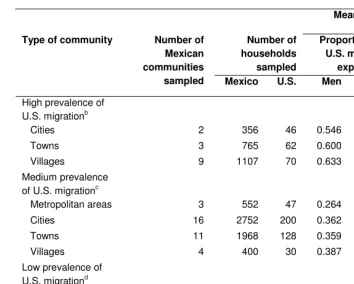
Table 1 presents selected characteristics of the communities surveyed by the Mexican Migration Project as of the year of the survey. The communities are grouped by the prevalence of U.S. migration and the type of community. The prevalence levels range from high (more than 50% of adult men in the community have some U.S. migration experience) to low (less than 25% of male adults have U.S. migration experience). Even though the prevalence of women’s U.S. migration is substantially lower than that of the men, in the high prevalence communities an average of one in four women have been to the United States. To measure fertility, the table presents the mean number of children ever born to women aged 15 to 29 at the municipal-level. The data is taken from the decennial Mexican population censuses of 1950 to 2000. We used linear interpolation to derive estimates of values for intercensal years. Fertility levels also vary across the study sites, but there is no apparent relationship between the mean number of children ever born and the prevalence of migration. As expected, the mean number of children ever born is lower in urban communities than it is in rural communities.
4 Approximately 4% of the married men in the analysis are in a second or higher union. The survey did not
Table 1: Characteristics of Mexican communities sampled
Mean community values
Number of households sampled
Proportion with U.S. migration experiencea
Type of community Number of
Mexican communities
sampled Mexico U.S. Men Women
Mean CEB aged 15–29e
High prevalence of U.S. migrationb
Cities 2 356 46 0.546 0.224 2.01
Towns 3 765 62 0.600 0.155 2.58
Villages 9 1107 70 0.633 0.161 2.59
Medium prevalence of U.S. migrationc
Metropolitan areas 3 552 47 0.264 0.113 1.98
Cities 16 2752 200 0.362 0.101 2.53
Towns 11 1968 128 0.359 0.071 2.63
Villages 4 400 30 0.387 0.150 2.65
Low prevalence of U.S. migrationd
Metropolitan areas 19 3479 102 0.127 0.055 1.97
Cities 5 901 51 0.180 0.062 2.37
Towns 6 767 27 0.155 0.073 2.64
Villages 10 1308 58 0.163 0.028 2.61
Total sample size 88 14,355 821
Source: Calculations based on COMMUN93, Mexican Migration Project.
a–Proportion of men and women aged 15 and above who were current household members at the time of survey and had ever
migrated to the U.S.
b–More than 50% of adult men from the community have U.S. migration experience. c
–25% to 50% of adult men from the community have U.S. migration experience.
d–Less than 25% of adult men from the community have U.S. migration experience.
4.1 Dependent variables
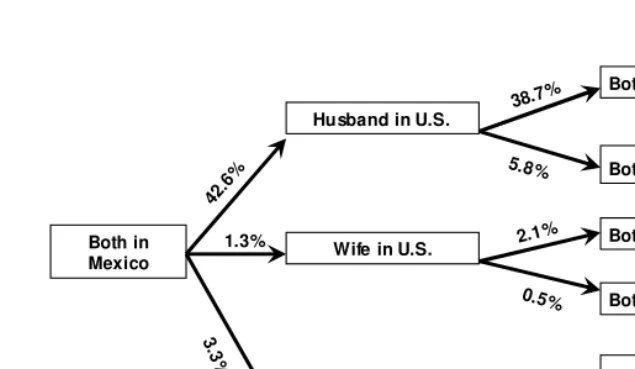
To examine the relationship between the timing of births and the timing and type of migration, we define four migration states based on the migration status of the husband and wife: (1) husband and wife together in Mexico, (2) husband in the United States and wife in Mexico, (3) husband in Mexico and wife in the United States, and (4) husband and wife in the United States together. Corresponding to each state is a set of possible transitions into each of the other states, which represent distinct types of migration. For example, in state (1) where the husband and wife are together in Mexico, three types of migration are possible: The husband migrates to the United States alone, the wife migrates to the United States alone, or both migrate together to the United States. Each type of migration represents a transition to one of the other three states. Using the four states and all possible transitions, we can measure the impact of the timing of births and cumulative births on the individual and the joint migration of husbands and wives. We can also identify whether there are key turning points in women’s reproductive careers that significantly affect the likelihood of a particular type of migration in subsequent years.
Figure 1 presents the distribution of migration events or transitions between the different couple-states for the 10,102 couples in our analytic sample. A total of 9733 transitions were made by the couples in the sample, which is close to an average of one migration event per couple. The vast majority of migration events correspond to the husband migrating alone to the United States (42.3%) and then returning to Mexico (38.6%). A total of 9% of migration events result in couples being together in the United States either through wives joining their husbands in the United States (5.9%) or couples migrating together to the United States (3.1%). Only 1.3% of transitions involve wives migrating alone from Mexico to the United States, and only 1.1% of transitions involve husbands migrating alone from the United States back to Mexico while their wife remains in the United States.
Figure 1: Distribution of migration events (transitions) across couple-states in the life histories of married Mexican couples; pooled samples
Wife in U.S. Husband in U.S.
Both in Mexico
Both in U.S.
Both in U.S.
Both in Mexico
Both in U.S.
42.6 %
1.3%
3.3 %
Both in Mexico
Husband in U.S.
Both in Mexico Wife in U.S. 5.8%
38.7%
0.5% 2.1%
2.7%
1.2%
1.8%
Source: Calculations based on Mexican Migration Project.
Note: Total number of couples=10,102, total number of migration events (transitions)=9733, percentages sum to 100.0 and are based on the number of all migration events.
4.2 Independent variables
Husband and wife background variables include education, husband’s occupation, dummy variables indicating if the husband or wife had premarital U.S. migration experience, continuous measures of husband and wife’s cumulative post-marital U.S. migration experience, and a dummy variable indicating if the husband had legal U.S. documents. The occupation, post-marital migration experience, and U.S. documents variables are time-varying and lagged by one year. Couple characteristics include agricultural land or business ownership (time-varying), an index of the husband’s marital power, the period and duration of the migration spell, and the spell duration squared. The husband power index is a composite measure constructed from a factor analysis of the differences in the husband and the wife’s age and years of schooling. Men who are older and have a higher education than their wife are assumed to exercise greater influence in couple decisions about fertility and migration (Jejeebhoy 1991, Balk 1997, Hogan, Berhanu and Hailemariam 1999).
Community characteristics include the type of community, the prevalence of male and female U.S. migration, an index of local economic opportunities, and the mean number of children ever born to women aged 15 to 29. All of the community variables are time-varying, with the exception of community type. The index of local economic opportunities is a composite measure constructed from eight municipal-level indicators of economic activity.5 We use the mean number of children ever born among women aged 15 to 29 in the municipality as a crude proxy measure of fertility preferences. The measures of economic opportunities and fertility at the community level are derived from census data. Communities of origin are one element of the context of early
5 We started with 11 municipal-level indicators of economic activity and population size gathered from
socialization that has an influence on the formation of family-size preferences. We expect couples in communities with higher fertility to have, on average, preferences for larger families than couples from communities with lower fertility, net of other factors.
For the analysis of births, we use a series of three dummy variables to define the number of months that the couple was separated due to U.S. migration in the prior year. We expect longer periods of separation in the prior year to be negatively associated with the likelihood of a birth in the current year. We use a single dummy variable to indicate if the couple was together in the United States during the prior year, and we include interactions between this variable and parity to determine whether or not the influence on fertility of being in the United States varies by parity. Lindstrom and Giorguli Saucedo (2002) found that the negative effect on fertility of being together in the United States increased with parity in response to the relatively higher costs of having children in the United States compared to Mexico. We also include the log cumulative number of months of U.S. migration experience that men and women have as a measure of exposure to U.S. norms and as an additional test of the adaptation hypothesis.
impact of temporary migrant selectivity, and to overestimate the negative impact of duration in the United States on fertility.6
Finally, we include in the birth model dummy variables indicating if the union is the husband’s second union, indicating the wife’s birth cohort, the wife’s age at the start of the birth interval, and the birth spell duration.
5. Results
5.1 Descriptive statistics
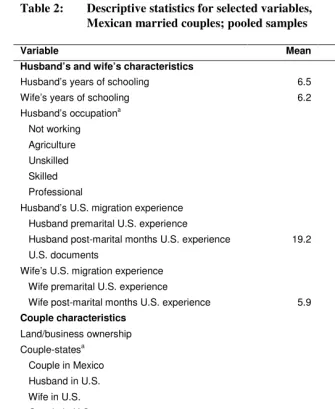
Table 2 presents descriptive statistics for selected socio-economic and demographic background variables. The mean levels of education in the sample are low by U.S. standards but they are close to national averages in Mexico, just over six years for both men and women.7 Consistent with the relatively low levels of education, close to one-third of the husbands’ life-years in the sample were spent working in agriculture, 27% were spent working in unskilled occupations, 30% in skilled occupations, and just 8% in professional occupations. One out of every five husbands first migrated to the United States prior to marriage and on average the husbands had slightly more than one and a half years of post-marital U.S. migration experience. In spite of the relatively widespread nature of U.S. migration in the sampled communities, only one in 20 males had legal U.S. residency or U.S. citizenship. Women’s U.S. migration experience is considerably less pervasive than that of the men – only 4% of the women in the sample had pre-marital U.S. migration experience. On average, women had approximately six months of post-marital U.S. migration experience.
6 See Hoem and Kreyenfeld 2006a, 2006b for a discussion of the pitfalls of using characteristics measured at
the time of the survey to model life-course transitions.
7 In 1990 the mean years of completed education among the adult population in Mexico was 6.6 years (INEGI
Table 2: Descriptive statistics for selected variables, Mexican married couples; pooled samples
Variable Mean Share in %
Husband’s and wife’s characteristics
Husband’s years of schooling 6.5
Wife’s years of schooling 6.2
Husband’s occupationa
Not working 1.7
Agriculture 32.4
Unskilled 27.4
Skilled 30.1
Professional 8.4
Husband’s U.S. migration experience
Husband premarital U.S. experience 20.4
Husband post-marital months U.S. experience 19.2
U.S. documents 5.6
Wife’s U.S. migration experience
Wife premarital U.S. experience 4.1
Wife post-marital months U.S. experience 5.9
Couple characteristics
Land/business ownership 24.9
Couple-statesa
Couple in Mexico 87.9
Husband in U.S. 8.6
Wife in U.S. 0.3
Couple in U.S. 3.2
Perioda
1950–1981 41.4
1982–1989 31.1
1990–2002 27.5
Number of couples 10,102
Number of couple-years 179,097
Source: Calculations based on LIFEFILE93, SPOUSE93, Mexican Migration Project.
a
One of the economic factors that keep couples in Mexico and pull them back from the United States is ownership of a business or agricultural land. One-quarter of the couples owned a business or more than 10 hectares of farm land in Mexico. Although U.S. migration is common in the sample, the vast majority (88%) of couple-years in our sample were spent together in Mexico compared to a mere 3% for the United States. Couples were separated by the solo migration of the husband to the United States during almost 9% of couple-years.
The retrospective couple-years cover five decades of Mexico–U.S. migration. Roughly 40% of couple-years occur during the years of high economic growth in Mexico from 1950 to 1981, this compares to 31% during the economic down-turn of the 1980s (1982–1989) and roughly 28% during the most recent decade of economic recovery and moderate economic growth (1990–2002).
5.2 The impact of fertility on migration
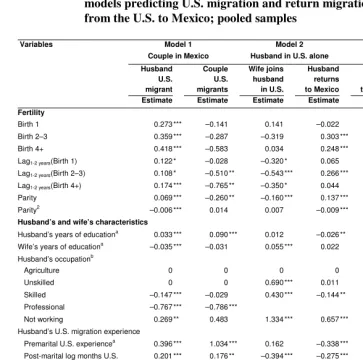
To model the impact of birth on migration or to model the transition from one couple state to another, we use multinomial discrete-time hazard regression models. For each of the four states (both in Mexico, husband in U.S., wife in U.S., and both in U.S.), there is a corresponding multinomial regression model. During the years in which couples are in a given state, they are exposed to the risk of solo or joint migration that places them in a different couple state. Because so few wives in the sample migrate from Mexico to the United States while their husband remains alone in Mexico, we do not estimate a model for the couple-state corresponding to the wife being alone in the United States. Couple-years in which the wife is alone in the United States constitute only 0.3% of the couple-years in our sample.
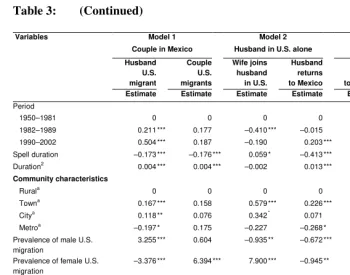
Table 3: Parameter estimates from multinomial discrete-time hazard models predicting U.S. migration and return migration from the U.S. to Mexico; pooled samples
Variables Model 1 Model 2 Model 3
Couple in Mexico Husband in U.S. alone Couple in U.S.
Husband U.S. migrant Couple U.S. migrants Wife joins husband in U.S. Husband returns to Mexico Couple returns to Mexico Wife returns to Mexico Estimate Estimate Estimate Estimate Estimate Estimate
Fertility
Birth 1 0.273 *** –0.141 0.141 –0.022 0.409 0.035 Birth 2–3 0.359 *** –0.287 –0.319 0.303 *** 0.650 * 0.220 Birth 4+ 0.418 *** –0.583 0.034 0.248 *** –0.056 –0.104
Lag1-2 years(Birth 1) 0.122 * –0.028 –0.320 * 0.065 0.253 0.025
Lag1-2 years(Birth 2–3) 0.108 * –0.510 ** –0.543 *** 0.266 *** 0.485 * –0.019
Lag1-2 years(Birth 4+) 0.174 *** –0.765 ** –0.350 * 0.044 –0.157 0.301
Parity 0.069 *** –0.260 ** –0.160 *** 0.137 *** 0.498 *** 0.206 ** Parity2 –0.006 *** 0.014 0.007 –0.009 *** –0.043 * –0.009
Husband’s and wife’s characteristics
Husband’s years of educationa 0.033 *** 0.090 *** 0.012 –0.026 ** –0.047 0.003 Wife’s years of educationa –0.035 *** –0.031 0.055 *** 0.022 0.033 0.040
Husband’s occupationb
Agriculture 0 0 0 0 0 0 Unskilled 0 0 0.690 *** 0.011 –1.244 *** –0.995 *** Skilled –0.147 *** –0.029 0.430 *** –0.144 ** –1.088 *** –0.929 *** Professional –0.767 *** –0.786 *** Not working 0.269 ** 0.483 1.334 *** 0.657 *** –0.082 –1.234 * Husband’s U.S. migration experience Premarital U.S. experiencea 0.396 *** 1.034 *** 0.162 –0.338 *** –0.717 *** –0.090
Post-marital log months U.S. experience
0.201 *** 0.176 ** –0.394 *** –0.275 *** –0.864 *** 0.003
U.S. documents 0.318 1.585 *** 0.202 * –0.849 *** –0.665 *** –0.041 Wife’s U.S. migration experience Premarital U.S. experiencea 0.025 0.794 *** –0.254 –0.278 ** –1.019 *** –0.571 ***
Post-marital log months U.S. experience
–0.103 *** 0.212 *** 0.166 *** –0.176 *** 0.121 –0.255 ***
Couple characteristics
Table 3: (Continued)
Variables Model 1 Model 2 Model 3
Couple in Mexico Husband in U.S. alone Couple in U.S.
Husband U.S. migrant Couple U.S. migrants Wife joins husband in U.S. Husband returns to Mexico Couple returns to Mexico Wife returns to Mexico Estimate Estimate Estimate Estimate Estimate Estimate
Period
1950–1981 0 0 0 0 0 0 1982–1989 0.211 *** 0.177 –0.410 *** –0.015 0.377 0.438 ** 1990–2002 0.504 *** 0.187 –0.190 0.203 *** 0.867 *** 0.461 ** Spell duration –0.173 *** –0.176 *** 0.059 * –0.413 *** –0.169 ** –0.267 *** Duration2 0.004 *** 0.004 *** –0.002 0.013 *** 0.005 0.007 ***
Community characteristics Rurala 0 0 0 0 0 0 Towna 0.167 *** 0.158 0.579 *** 0.226 *** –0.052 –0.059 Citya 0.118 ** 0.076 0.342 * 0.071 0.140 0.233
Metroa –0.197 * 0.175 –0.227 –0.268 * –0.886 ** 1.109 **
Prevalence of male U.S. migration
3.255 *** 0.604 –0.935 ** –0.672 *** 0.665 2.695 ***
Prevalence of female U.S. migration
–3.376 *** 6.394 *** 7.900 *** –0.945 ** –2.310 –0.294
Economic opportunity index –0.063 0.029 0.005 0.070 0.560 *** –0.198 Community fertility
MCEB(15–29)
–0.022 0.237 0.206 –0.215 * 0.884 ** 0.465
Constant –4.265 *** –6.656 *** –3.084 *** 0.919 *** –0.779 –3.170 *** Wald Chi-Square 5143 ***
2529 ***
681 *** Pseudo R2 0.140 0.200 0.170
Number of couple-years 157,478 15,370 5731
Source: Calculations based on LIFEFILE93, SPOUSE93, Mexican Migration Project. Significance: ‘*’=10%; ’**’=5%; ‘***’=1%.
a–Time-invariant variables, all other variables are time-varying.
b–The reference category for life-years in Mexico is Agriculture/Unskilled. For life-years in the U.S., the reference category is
Agriculture; Skilled/Professional is combined into one category.
Not shown in the table are model estimates for the wife being a U.S. migrant (Model 1) and the husband returning to Mexico (Model 3). The results for the two transitions are available from the authors upon request.
Because couples from the same community are likely to share unmeasured attributes that are also related to migration behavior, the assumption of independence of errors across observations is violated. Failure to adjust for correlated errors can result in underestimates of standard errors for the regression coefficients, making it easier to declare effects significant. The standard errors for the coefficients reported in Table 3 are adjusted for clustering at the community level.
We focus our attention on the couple fertility variables and the community fertility measure. The results for the husband’s solo migration to the United States are consistent with the household-survival hypothesis. The likelihood of husbands migrating is greatest in years during which a birth occurs and in the first two years following a birth, and it increases with birth order. The underlying parity-specific risk of migration (as measured by Parity and Parity2) also rises, but does so at a decreasing rate.
In contrast to the husband’s migration, the migration of wives to the United States becomes increasingly less likely as children are born. The turning point for wife’s migration appears to be the first birth. The underlying parity-specific risk of migration
(Parity and Parity2) decreases with each birth, although the actual occurrence of a birth
in a given year does not appear to be associated with a significantly lower risk of migration. However, the risk of women’s migration does drop significantly in the two years following a birth, and does increasingly so with each additional birth. This basic pattern applies to women migrating alone to join their husband in the United States and to women migrating in the same year with their husband.
Husbands who are alone in the United States are more likely to return to Mexico in a given year if a second- or higher-order birth occurs, or if it is the first or second year after a second or third birth. The parity-specific underlying risk of return (Parity and
Parity2) also increases with births. This result is contrary to the expectation that a
husband’s duration in the United States should increase with parity due to the greater income demands that come with more children. The low risk of a husband’s return and the high risk that a wife migrates to the United States to join her husband at parity 0 and in the year of a first birth suggest that the first birth is a significant turning point for U.S. migration. If couples are not together in the United States by the time of the first birth, they are very unlikely to be together in the United States thereafter. Husbands who are solo U.S. migrants after the first birth are likely to have entered into a pattern of temporary, repeat migration rather than long-term migration or settlement in the United States. Conceptions that lead to second and third births appear to increase the chances of men’s migration, but these same men are also more likely to return rapidly to Mexico in time for or soon after the occurrence of the birth.
occurrence and timing of births. The figure simulates a birth history in which the occurrence of births (indicated by birth 1–4) is followed by a two-year period of infancy (indicated by lag birth 1–4), and then another year without a birth (indicated by parity 1–3) before the next birth occurs. The graphs clearly show the divergence in the likelihood of men’s and women’s migration that occurs after the first birth. It also shows how the risks of men’s and women’s migration respond differently to the occurrence of a birth and the presence of infants in the household. The migration of the wife is most likely to occur in years during which there are no births or infants in the household, whereas the migration of the husband is most likely to take place during the years in which a birth occurs.
Figure 2: Husband’s, wife’s, and couple’s migration to the U.S., odds ratios for the effects of a birth, lagged birth, and parity
0.2 0.4 0.6 0.8 1 1.2 1.4 1.6 1.8 Parit y 0
Birth 1 Lag birth 1 Lag birth 1 Parit y 1
Birth 2 Lag birth 2 Lag birth 2 Parit y 2
Birth 3 Lag birth 3 Lag birth 3 Parit y 3
Birth 4 Lag birth 4 O d d s r a ti o
Husband migrates to U.S. Couple migrates to U.S. Wife joins husband in U.S.
The idea that the first birth constitutes a turning point for couple migration is further supported by the results from the model corresponding to the risk of return migration to Mexico for couples in the United States. After the occurrence of a first birth, the odds that a couple returns to Mexico together or that a wife returns alone while her husband remains in the United States increase significantly as indicated by the coefficients for Parity and Parity2. The likelihood that a couple returns to Mexico from the United States also increases significantly during the years in which a second or third birth occurs. The progressive rise in the odds of return migration in relationship to the occurrence of an additional birth ends after the third birth. Fourth- and higher-order births in the United States are still associated with a higher risk of return to Mexico compared to first births, but the parity-specific underlying risk of return rises at a substantially diminished rate (Parity and Parity2).
Figure 3 presents the graphs of the odds ratios for predicting husband’s and wife’s return migration from Mexico to the United States. The figure shows that the likelihood of a couple returning to Mexico rises significantly with the occurrence of a birth and in the two years immediately following a birth. In contrast, the likelihood of the return of the husband to Mexico from a solo trip to the United States and the likelihood of the wife’s solo return to Mexico when the couple are together in the United States show only moderate changes. In the case of a wife’s solo return to Mexico, only the linear parity term (Parity) was significant in Table 3. The decision to return to Mexico tends to be made early in the process of family building. If a couple has not returned to Mexico soon after a third child is born, the chance that they will return, at least in the near term, drops substantially.
Figure 3: Husband’s, wife’s, and couple’s return migration to Mexico: odds ratios for the effects of a birth, lagged birth, and parity
1 1.5 2 2.5 3 3.5 4 4.5 5 Parit y 0
Birth 1 Lag birth 1 Lag birth 1 Parit y 1
Birth 2 Lag birth 2 Lag birth 2 Parit y 2
Birth 3 Lag birth 3 Lag birth 3 Parit y 3
Birth 4 Lag birth 4 O d d s r a ti o
Husband returns to Mexico (wife in Mexico) Couple returns to Mexico
Wife returns to Mexico
Source: Calculations based on Mexican Migration Project.
5.3 Migration and the timing of birth
We now turn to the influence of migration on the timing of birth. In the prior analysis, we identified the first birth as a turning point in couple migration histories. In the analysis that follows, we examine whether or not a first birth in the United States represents a distinct fertility event from first births in Mexico and from subsequent births in the United States and Mexico. We also further explore the question of whether return migrants to Mexico are selected for higher than expected fertility, and long-term or settled migrants in the United States for lower than expected fertility. Our analysis updates work by Lindstrom and Giorguli (2002) on the impact of migration on fertility that used an earlier sample of 43 communities from the Mexican Migration Project. In their analysis, Lindstrom and Giorguli found that long-term and settled migration in the United States was associated with significantly lower fertility. They also found that a husband’s solo migration to the United States temporarily depressed fertility but that it had no long-term impact on completed fertility.
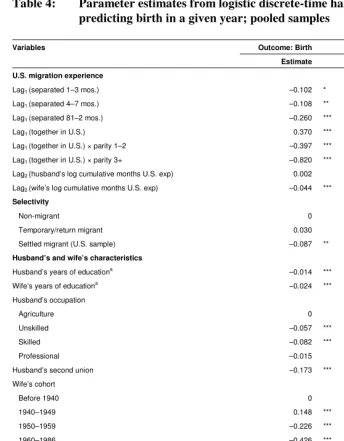
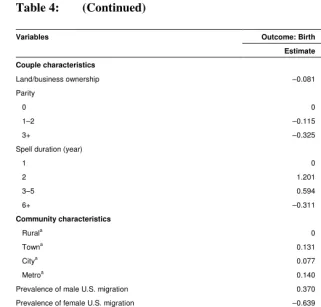
Table 4 presents the results of the logistic discrete-time hazard regression model predicting a birth. U.S. migration experience, whether it be in the form of a husband’s solo migration (the lag separation variables), a wife’s cumulative experience, or couples being together in the United States is associated with a lower annual risk of a birth. The one exception to this pattern is when couples were at parity 0 and in the United States. The risk of a first birth is 1.4 (e0.370) times greater when couples were in the United States in a prior year than when couples were in Mexico. After the first birth, the annual risk of a second- or higher-order birth to couples who were in the United States declines dramatically. Overall, the results for the separation variables, residence in the United States, and the wife’s cumulative migration experience are consistent with the predictions of the disruption and adaptation hypotheses.
Table 4: Parameter estimates from logistic discrete-time hazard model predicting birth in a given year; pooled samples
Variables Outcome: Birth
Estimate
U.S. migration experience
Lag1 (separated 1–3 mos.) –0.102 *
Lag1 (separated 4–7 mos.) –0.108 **
Lag1 (separated 81–2 mos.) –0.260 ***
Lag1 (together in U.S.) 0.370 ***
Lag1 (together in U.S.) × parity 1–2 –0.397 ***
Lag1 (together in U.S.) × parity 3+ –0.820 ***
Lag2 (husband’s log cumulative months U.S. exp) 0.002
Lag2 (wife’s log cumulative months U.S. exp) –0.044 ***
Selectivity
Non-migrant 0
Temporary/return migrant 0.030 Settled migrant (U.S. sample) –0.087 **
Husband’s and wife’s characteristics
Husband’s years of educationa –0.014 *** Wife’s years of educationa –0.024 ***
Husband’s occupation
Agriculture 0
Unskilled –0.057 ***
Skilled –0.082 ***
Professional –0.015
Husband’s second union –0.173 ***
Wife’s cohort
Before 1940 0
1940–1949 0.148 ***
1950–1959 –0.226 ***
1960–1986 –0.426 ***
Wife’s age (start of birth interval)a
15–19 0
20–24 0.034 *
25–29 –0.227 ***
30–34 –0.611 ***
35–39 –1.132 ***
40–44 –2.043 ***
Table 4: (Continued)
Variables Outcome: Birth
Estimate
Couple characteristics
Land/business ownership –0.081 ***
Parity
0 0
1–2 –0.115 ***
3+ –0.325 ***
Spell duration (year)
1 0
2 1.201 ***
3–5 0.594 ***
6+ –0.311 ***
Community characteristics
Rurala 0
Towna 0.131 ***
Citya 0.077 ***
Metroa 0.140 ***
Prevalence of male U.S. migration 0.370 *** Prevalence of female U.S. migration –0.639 *** Economic opportunity index –0.116 *** Community fertility MCEB(15–29) 0.132 ***
Constant –0.815 ***
Wald Chi-Square 16,570 ***
Pseudo R2 0.150
Number of couple-years 179,097
Source: Calculations based on LIFEFILE93, SPOUSE93, Mexican Migration Project. Significance: ‘*’=10%; ’**’=5%; ‘***’=1%.
a–Time-invariant variables, all other variables are time-varying.
Standard errors adjusted for clustering at the community level.
a birth. The negative association between economic opportunities and fertility is consistent with the conventional relationship between economic development and low fertility found in so many other contexts. Lindstrom and Giorguli (2002) found the same negative relationship between fertility and the prevalence of female migration in their earlier analysis. They attribute the relationship to the diffusion of low-fertility norms and behaviors back to the communities of origin by return and visiting migrant women. It should be emphasized again that for U.S. migrants the community-level variables refer to the community of origin in Mexico and not to the U.S. destination.
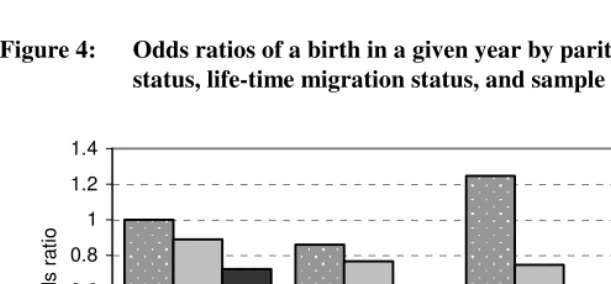
Figure 4 presents simulations of the odds ratios for predicting parity-specific births for four different migration status groups. The first two groups of bars in the figure correspond to the risk of birth for non-migrant couples in Mexico and for couple-years spent in Mexico by return migrant couples, respectively. Return migrants are couples who were interviewed in Mexico and for whom both the husband and wife have six years of cumulative U.S. migration experience. Six years corresponds closely to the mean duration of migration experience for men and women in the sample who have ever been to the United States (70 months for men and 73 months for women). The last two groups of bars in the figure correspond to couple-years spent in the United States by couples who eventually return to Mexico, and couple-years spent in the United States by couples who were interviewed in the United States as settled migrants. Men and women in these two groups also have six years of cumulative U.S. migration experience. The simulated odds ratios illustrate parity-specific differences in the likelihood of a birth by place and prior U.S. migration experience. The reference group for all of the odds ratios is birth 1 among non-migrant couples in Mexico.
The basic tempo of childbearing in Mexico among couples with some U.S. migration experience is slightly slower than that of non-migrant couples in Mexico, although this is not to say that return-migrant couples will not eventually go on to have the same number of children as non-migrant couples. In contrast, the risk of a first birth during years in which couples are in the United States is significantly higher than the risk of a first birth in Mexico and it is higher than the risk of higher-order births in the United States. Figure 4 also clearly shows the substantial decline in the likelihood of an additional birth in the United States that occurs at each parity after the first birth. Fourth- and higher-order births are particularly less likely to occur among couples in the United States compared to couples in Mexico.
than the estimated risk of a first birth in the United States will be higher because the portion of the interval that ends in a birth occurs in the United States. To explore this possible explanation further, we compared the mean age at marriage and the mean length of the first birth interval for non-migrant and migrant women. U.S. migrant women in the sample tend to marry on average 1.5 years later than do non-migrant women in Mexico (21.5 compared to 20.0 years); however, they tend to have a first birth at roughly the same time after marrying as non-migrant women. The mean length of the first birth interval for migrant women is 1.8 years compared to 1.5 years for non-migrant women. This result suggests that U.S. migration at the outset of marriage does not disrupt the timing of the first birth. Put another way, U.S. migrant couples do not appear to delay or postpone first birth. However, after the first birth, the tempo of childbearing among women in the United States increasingly diverges from the tempo of childbearing among women in Mexico.
Figure 4: Odds ratios of a birth in a given year by parity and current migration status, life-time migration status, and sample location
0 0.2 0.4 0.6 0.8 1 1.2 1.4
In Mexico, non-migrant
In Mexico, return migrant
In U.S., Mexico sample
In U.S., U.S. sample
O
d
d
s
r
a
ti
o
Birth 1 Birth 2-3 Birth 4+
6. Discussion
The interrelationship between migration and fertility is complex and multifaceted. Births are not only delayed or averted as a consequence of migration, but migration as well is initiated, postponed, or deterred as a consequence of births. The complexity of the interrelationship between migration and fertility stems from the fact that migration is used as a strategy for long-term economic mobility and as a way to satisfy current income needs.
We examined several different mechanisms by which fertility can influence migration. Prior studies have shown a strong relationship between stages in the family life-cycle and men’s and women’s migration from Mexico to the United States. We expand on this earlier work by looking more closely at the impact of the timing of parity-specific births and the presence of infants in the household on the risks of husband’s and wife’s migration. We find that births constitute an important catalyst for men’s migration and are turning points for women’s migration. Married women are most likely to migrate to the United States before or in the same year as the first birth. Once the first birth occurs, however, the likelihood of migration decreases progressively with each additional birth. In addition, at any given parity after the first birth, the wife’s migration is least likely to occur during the two years immediately following a birth.
With each additional birth, the childcare demands on women’s time increase as do the income demands on men’s time. Highly gendered family-role specialization in Mexico pulls young mothers into the home for childcare and pushes men into U.S. labor markets where the economic returns on men’s labor are greatest. This role specialization generates a divergence in the likelihood of men’s and women’s migration during the childbearing and early child-rearing years of the family life-cycle. Once a couple begins childbearing in Mexico, the options for U.S. migration narrow considerably.
return drops considerably and changes little with each additional birth. We suspect that schooling may be one of the reasons why the third birth constitutes a turning point for return migration. By the third birth, the first child is at or near school age. The entry of children into school marks a new phase of child-rearing and family settlement. The decision to begin educating children in the United States represents a higher level of integration with the host society than having a birth. Once children enter school in the United States, return migration to Mexico becomes increasingly less likely.
In this study we also examined how migration can influence fertility. Much of the literature on migration and fertility focuses on the disruptive and transformative influences of migration on fertility, and views migration as triggering adaptive responses that may not be entirely anticipated by the migrants themselves. The experience of moving from high- to low-fertility environments not only impacts fertility behavior in the immediate term through the costs and constraints of urban living, but also in the longer term as couples are challenged to consider their family-size goals and how they think about the financial and time demands of children. We found evidence of both short-term disruption effects and longer-term adaptation. Women are less likely to experience birth in a given year when their husband was away in the United States for more than three months during the prior year. This result is not surprising and is consistent with earlier findings by Massey and Mullan (1984) and Lindstrom and Giorguli (2002).
However, contrary to predictions of the disruption hypothesis, we find that women’s migration to the United States before the first birth does not appear to disrupt the timing of the first birth. In part, this finding is the result of splitting the first-birth interval across national borders, with the second part of the interval occurring in the United States. Another possible explanation for this result is that couples are anxious to have a birth in the United States with the expectation that the child’s right to U.S. citizenship will open a future route to legal immigration status for the parents. In addition, migrant women may decide not to postpone a first birth in order to finish childbearing at an earlier age and begin employment in the United States as soon as possible. Finally, evidence from other countries suggests that a higher risk of first birth among immigrant women is due to the fact that migration and family formation are often connected events (Andersson 2004, Andersson and Scott 2005, Milewski 2007). Whatever the motivation, the apparent absence of a delay in the first birth in the United States suggests that couples are able to accommodate themselves in their new destination rapidly. Well-established migration networks likely play a large role in facilitating this accommodation.
women who return to Mexico. However, husband’s cumulative migration experience does not appear to have an impact on fertility apart from the immediate effect of separation. Lindstrom and Giorguli (2002) found a similar result and suggested that men and women reacted differently to their experiences in the United States. Men are less receptive than women to low-fertility norms and values in the United States that challenge traditional, patriarchal gender roles and family relations.
Consistent with the gender-specific results for cumulative experience, we also found that women who lived in communities where women’s migration to the United States was widespread had lower than expected fertility, whereas a high prevalence of men’s migration was associated with higher than expected fertility. Women who migrate to the United States and adopt low-fertility practices dominant in the United States diffuse low-fertility values and behaviors back to their communities of origin through long-distance communication and return visits (also see Lindstrom and Muñoz-Franco 2005 for a similar result in Guatemala). However, a high prevalence of men’s U.S. migration is associated with a higher risk of men’s solo migration to the United States and a lower risk of wife’s migration.
We also found evidence of selectivity. Couples enter into migration with established preferences and family size goals that influence not only the decision to migrate, but also subsequent decisions about the type and timing of migration. We found strong evidence that couples who migrate to the United States and settle there are selected for lower fertility compared to non-migrant and return-migrant couples in Mexico. Controlling for background characteristics, couples from the U.S. sample are at a lower risk of birth in a given year than non-migrant couples in Mexico both before and after they migrate to the United States. However, a preference for large families, measured by average fertility in the community of origin, is associated with a significantly higher risk that couples in the United States return back to Mexico. This is the first study of which we are aware that has used fertility levels in the community of origin to proxy family-size preferences and that has identified a significant relationship between preferences for large families and return migration to Mexico. One of the implications of the findings of selectivity is that decisions about remaining in the United States or returning to Mexico are not entirely an outcome of the migration process but rather are also influenced by childrearing and family-size preferences established at the outset of migration.
between fertility and migration. The likelihood of husband’s and wife’s migration changes in a closely synchronized pattern in response to the occurrence and timing of births and to the location and migration of one another. Husband’s and wife’s characteristics also have an influential role in determining the likelihood of each other’s migration as well as their own.
7. Acknowledgement
References
Andersson, G. 2004. Childbearing after migration: fertility patterns of foreign-born women in Sweden, International Migration Review 38(2): 747–775.
Andersson, G., and K. Scott. 2005. Labour-market status and first-time parenthood: the experience of immigrant women in Sweden, 1981–97, Population Studies 59(1): 21–38.
Arizpe, L. 1981. Relay migration and the survival of the peasant household, in J. Balán (Ed.), Why People Move: Comparative Perspectives on the Dynamics of Internal
Migration. Paris: Unesco, pp. 187–210.
Balk, D. 1997. Defying gender norms in rural Bangladesh: a social demographic analysis, Population Studies 51(2): 153–172.
Brockerhoff, M., and X. Yang. 1994. Impact of migration on fertility in sub-Saharan Africa, Social Biology 41(1–2): 19–43.
Carter, M. 2000. Fertility of Mexican immigrant women in the U.S.: a closer look,
Social Science Quarterly 81(4): 1073–1086.
Cerrutti, M., and D. S. Massey. 2001. On the auspices of female migration from Mexico to the United States, Demography 38(2): 187–200.
Chen, L. C., C. Ahmed, M. Gesche, and W. H. Mosley. 1974. A prospective study of birth interval dynamics in rural Bangladesh, Population Studies 28(2): 277–297.
Degraff, D. S., R. E. Bilsborrow, and D. K. Guilkey. 1997. Community-level determinants of contraceptive use in the Philippines: a structural analysis,
Demography 34(3): 385–398.
Elder, G. H., Jr., M. K. Johnson, and R. Crosnoe. 2004. The emergence and development of life course theory, in J. T. Mortimer and M. J. Shanahan (Eds.),
Handbook of the Life Course. New York: Kluwer Academic/Plenum Publishers,
pp. 3–19.
Ford, K. 1990. Duration of residence in the United States and the fertility of U.S. immigrants, International Migration Review 24(1): 34–68.
Goldstein, S., and A. Goldstein. 1981. The impact of migration on fertility: an ‘own children’ analysis for Thailand, Population Studies 35(2): 265–284.
Hoem, J. M., and M. Kreyenfeld. 2006a. Anticipatory analysis and its alternatives in life-course research. Part 1: the role of education in the study of first childbearing, Demographic Research 15(16): 461–484. www.demographic-research.org/Volumes/Vol15/16/default.htm.
Hoem, J. M., and M. Kreyenfeld. 2006b. Anticipatory analysis and its alternatives in life-course research. Part 2: two interacting processes, Demographic Research
15(17): 485–498. www.demographic-research.org/Volumes/Vol15/17/default. htm.
Hogan, D., B. Berhanu, and A. Hailemariam. 1999. Household organization, women’s autonomy, and contraceptive behavior in Southern Ethiopia, Studies in Family
Planning 30(4): 302–314.
INEGI [Instituto Nacional de Estadística, Geografía e Informática]. 1992. Resumen
general del XI censo general de población y vivienda, 1990. Aguascalientes:
Instituto Nacional de Estadística, Geografía e Informática.
INEGI [Instituto Nacional de Estadística, Geografía e Informática]. 1997. Encuesta
nacional de dinámica demográfica, 1997. México: Instituto Nacional de
Estadística, Geografía e Informática.
INEGI [Instituto Nacional de Estadística, Geografía e Informática]. 2006. Indicadores seleccionados sobre nivel de escolaridad, promedio de escolaridad, aptitud para
leer y escribir y alfabetismo, 1960 a 2005. www.inegi.gob.mx.
Jasso, G. 2004. Migration, human development, and the life course, in J. T. Mortimer and M. J. Shanahan (Eds.), Handbook of the Life Course. New York: Kluwer Academic/Plenum Publisher, pp. 331–364.
Jejeebhoy, S. 1991. Women’s status and fertility: successive cross-sectional evidence from Tamil Nadu, India 1970–80, Studies in Family Planning 22(4): 217–230. Jensen, E. R., and D. A. Ahlburg. 2004. Why does migration decrease fertility?
Evidence from the Philippines, Population Studies 58(2): 219–231.
Kirby, D., K. Coyle, and J. B. Gould. 2001. Manifestations of poverty and birthrates among young teenagers in California zip code areas, Family Planning
Perspectives 33(2): 63–69.
Lee, B. S., and S. C. Farber. 1984. Fertility adaptation by rural-urban migrants in developing countries: the case of Korea, Population Studies 38: 141–155. Lee, B. S., and L. Pol. 1985. A comparison of fertility adaptation between Mexican
immigrants to the U.S. and internal migrants in Mexico, Contemporary